Showing posts with label bear bryant. Show all posts

Tuesday, September 27, 2022

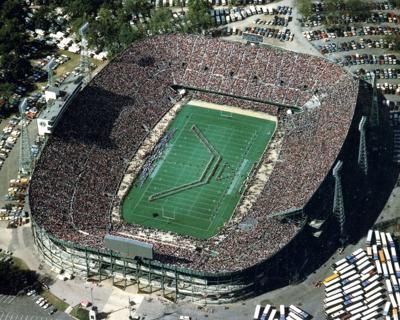
September 28, 1929: Bryant-Denny Stadium Opens

September 28, 1929: Denny Stadium opens on the campus of the University of Alabama. It is named for the man who got it built, George H. Denny, president of the University from 1912 to 1932. Having recently become both a regional and a national power under head coach Wallace Wade, 'Bama beat Mississippi College, 55-0.

Based in Clinton, Mississippi, Mississippi College now play in NCAA Division II, and should not be confused with the University of Mississippi (a.k.a. "Ole Miss"), Mississippi State, Southern Mississippi, or Mississippi Valley State, all of whom are in Division I.

Earlier in the year, a 115-foot-high bell tower was opened on the University's Quad, in memory of the University's victims of World War I. But it was named for the man who got it built as well: The Denny Chimes.

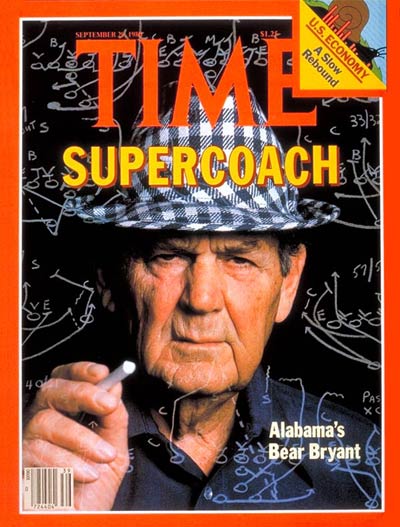
Wade left Alabama after the 1930 season, and was replaced by Frank Thomas. It was Thomas who would recruit two ends who would be among the greatest names in football: Don Hutson, who became professional football's 1st great receiver, leading the Green Bay Packers to 3 NFL Championships; and Paul Bryant, known as "Bear" because he allegedly wrestled one at age 12, who returned to 'Bama in 1958 after leading Texas A&M to a National Championship, and raised the Crimson Tide to new heights.

In 1975, the Alabama State legislature renamed the facility Bryant-Denny Stadium. It was a rare honor: Not only was Bryant still alive, but he was still coaching there. Wade would get a stadium named for him, at his next stop after Tuscaloosa: Duke University renamed Duke Stadium "Wallace Wade Stadium" in 1967.

'Bama had outgrown Denny Field, where they'd played since 1915. The new stadium opened with a capacity of 12,000. It was expanded to 24,000 in 1937, 31,000 in 1946, 43,000 in 1961, 60,000 in 1966, 70,000 in 1988, 83,000 in 1998, 92,000 in 2006, and 101.821 in 2010. Some tweaks, allowing for more accessible seating, reduced capacity slightly to 100,077 in 2020. The Bear had AstroTurf laid down in 1968, but real grass returned in 1991, and remains.

Before the stadium's opening, Alabama claimed National Championships for the 1925 and 1926 seasons. Since then, they've been awarded them for 1930 under Wade; 1934 and 1941 under Thomas; 1961, 1964, 1965, 1973, 1978 and 1979 under Bryant; 1992 under Gene Stallings; and 2009, 2011, 2012, 2015, 2017 and 2020 under Nick Saban. That's 16 while playing at Bryant-Denny Stadium, and 18 overall. No other school can match this.

In addition, they won 4 Southern Conference Championships, and the Southeastern Conference Championship 30 times since its founding in 1933: 1933, '34, '37, '45, '53, '61, '64, '65, '66, '71, '72, '73, '74, '75, '77, '78, '79, '81, '89, '92, '99, 2009, '12, '14, '15, '16, '18, '20 and '21. (UPDATE: They won again in 2023.)

Hard to believe, but Bryant only had 1 Heisman Trophy winner, and that was at Texas A&M: John David Crow in 1957. Alabama didn't get one until the 21st Century, but now, they've had 4: Running backs Mark Ingram II in 2009 and Derrick Henry in 2015, receiver DeVonta Smith in 2020 and quarterback Bryce Young in 2021.

Other 1929-onward 'Bama legends include Hutson, 1930s running back Dixie Howell, 1960s linebacker Lee Roy Jordan, 1970s running back Johnny Musso, 1970s guard John Hannah, 1970s tight end Ozzie Newsome, 1970s defensive tackle Marty Lyons, 1970s defensive end E.J. Junior, 1980s linebackers Derrick Thomas and Cornelius Bennett; and 2010s quarterbacks A.J. McCarron, Tua Tagovailoa and Jalen Hurts.

Auburn fans will argue that their Jordan-Hare Stadium is better. And Legion Field in Birmingham has hosted many historic games. But who's kidding who? Even more than the State Capitol in Montgomery, Bryant-Denny Stadium is the most famous structure in the State of Alabama.

*

September 28, 1929 was a Saturday. These other notable college football games were played that day:
* Army beat Boston University, 26-0 at Michie Stadium in West Point, New York.
* Navy beat Denison University, 47-0 at Thompson Stadium in Annapolis, Maryland.
* Fordham beat Westminster College of Pennsylvania, 43-0 at Fordham Field in The Bronx.
* New York University (NYU) beat Vermont, 47-0 at Ohio Field in The Bronx.
* Rutgers beat Providence, 17-0 at Neilson Field in New Brunswick, New Jersey. Princeton, New Jersey's other major football school at the time, opened their season the next week.
* The football teams at the University of Southern California and the University of California at Los Angeles play each other for the 1st time, at both teams' home field, the Los Angeles Memorial Coliseum. It is no contest, as USC beats UCLA 76-0.
There was 1 game played in the NFL: The Frankford Yellow Jackets beat the Dayton Triangles, 14-7 at Frankford Stadium in Northeast Philadelphia.
And the baseball regular season entered its final weekend. These games were played:
* The New York Yankees were swept in a doubleheader by the Washington Senators, 6-4 and 6-3 at Griffith Stadium in Washington. The Bronx Bombers were reeling in the wake of the death of their manager, Miller Huggins, 3 days earlier. Over the 2 games, Babe Ruth went 4-for-7 with a walk and 2 RBIs, and Lou Gehrig went 2-for-8 with 2 RBIs.
* The Brooklyn Dodgers -- or the Robins, as they were known while Wilbert Robinson was their manager from 1914 to 1931 -- swept a doubleheader from their arch-rivals, the New York Giants, 5-1 and 10-3 at the Polo Grounds, beating Fred Fitzsimmons and Carl Hubbell in the process. Over the 2 games, Bill Terry went 3-for-9, and Mel Ott went 1-for-7 with a walk.
* The Philadelphia Athletics beat the Boston Red Sox, 6-3 at Fenway Park in Boston. Jimmie Foxx had an unusual game: He went 0-for-1, but drew 3 walks, and stole home plate, a rare thing for a big slugger.
* The Philadelphia Phillies swept a doubleheader from the Boston Braves, 9-8 and 8-6 at Baker Bowl in Philadelphia.
* The Cleveland Indians beat the St. Louis Browns, 4-1 at League Park in Cleveland.
* The Detroit Tigers beat the Chicago White Sox, 11-10 at Navin Field in Detroit. (That ballpark was renamed Briggs Stadium in 1938, and Tiger Stadium in 1961.) This was a wild one. It was 3-0 Tigers after 1 inning, 8-3 White Sox going to the bottom of the 6th, and the Tigers tied it 8-8 in the bottom of the 9th. The White Sox scored 2 in the top of the 10th, but the Tigers scored 3 in the bottom of the 10th, with Charlie Gehringer singling George Uhle home with the winning run. Uhle was the winning pitcher, coming in to pitch the 10th, and future Hall-of-Famer Ted Lyons took the loss after pitching an inning and a third. Marty McManus hit a home run for the Bengals, and Clarence Hoffman hit one for the Pale Hose.
* The Cincinnati Reds beat the Chicago Cubs, 5-3 at Wrigley Field in Chicago. The Cubs won the Pennant, anyway, losing the World Series to the Athletics.
* And the Pittsburgh Pirates beat the St. Louis Cardinals, 8-5 at Sportsman's Park in St. Louis. Dick Bartell went 4-for-5 with 3 RBIs, Fred Brickell and Charlie Hargreaves each went 3-for-5 with an RBI, Earl Sheely went 3-for-4, Paul Waner went 1-for-5, and Lloyd Waner went 2-for-5 with an RBI. For the Cardinals, Ernie Orsatti went 3-for-4.

Monday, September 12, 2022

September 12, 1970: The Sam Cunningham Game

September 12, 1970: The University of Southern California, a.k.a. USC, takes the field at Legion Field in Birmingham, the secondary home field of the University of Alabama. They do so with the 1st all-black backfield in college football history, outside of historically black schools: Quarterback Jimmy Jones and running backs Clarence Davis and Sam Cunningham. The University of Alabama had been forced to racially integrate by President John F. Kennedy in 1963, but still hadn't fielded a single black football player. Of the schools then in the Southeastern Conference, Alabama's arch-rival Auburn, Florida, Kentucky, Mississippi State, Tennessee and Vanderbilt had; Georgia, Louisiana State (a.k.a. LSU) and Mississippi (a.k.a. Ole Miss) also had not. To be fair, there were previous attempts to integrate the 'Bama program. On April 1, 1967 -- perhaps head coach Paul "Bear" Bryant should have chosen a day other than April Fool's Day -- the 1st Spring practice session for the 1967 football season was held, and 5 black students were "walk-ons": Dock Rone, Arthur Dunning, Melvin Leverett, Andrew Pernell and Jerome Tucker.

Rone had approached Bryant first. The Bear warned him of the difficulties involved with making the squad, but told the guard from the State capital of Montgomery that he was welcome to try out, provided he passed the physical and was academically eligible. He said, “I admire your courage, young man.”

Rone was the 1st black man to wear an Alabama football uniform. The other 4 were not permitted, as they had not previously declared their desire, and thus had not yet been academically cleared, but they would be. Bryant told his players, "Treat 'em like everybody else."

On May 5, approximately 15,000 people showed up at Denny Stadium (renamed Bryant-Denny Stadium in 1975) to watch the annual A-Day intrasquad game. Rone, Tucker and Pernell were on the roster. Rone and Tucker played in the game.

But Rone dropped out, for reasons he has never discussed, and was subsequently drafted by the U.S. Army. Pernell walked on again in 1968, and played in the A-Day game. But he was dropped from the team due to a legal technicality.

Bryant had tried hard to recruit Frank Dowsing to be Alabama's 1st black player in 1969, but, a Mississippi native, he chose Mississippi State instead, becoming their 1st. So the Crimson Tide put an all-white team out against the USC Trojans.
Legion Field, circa 1970

Sam Cunningham ran for 135 yards and 2 touchdowns. USC beat 'Bama, 42-21. The game was televised nationally on ABC, so everyone who wanted to see a college football game that day, but wasn't actually going to a game, saw it. All-white 'Bama football had been exposed: No longer could such a team be counted on to resist the integrated North (or, in this case, the integrated West).The Bear knew he couldn't send an all-white team out anymore.

Jerry Claiborne, an assistant to Bryant at Texas A&M and Alabama, was head coach at Virginia Tech at the time, and later at Maryland and Kentucky. He said, "Sam Cunningham did more to integrate Alabama in 60 minutes than Martin Luther King Jr. did in 20 years." He wasn't just being a wise guy or a bigot: The man known as "Sam Bam" had integrated the minds of 'Bama football fans, although changing their hearts may have taken a little longer.

Ironically, in the next off-season, Bryant played golf with USC coach John McKay, who mentioned he had a commitment from a junior college transfer who was an Alabama native, defensive end John Mitchell. Bryant convinced Mitchell to switch, and he became 'Bama's 1st black varsity player. He even became one of Bear's assistant coaches, and has been on the Pittsburgh Steelers' staff since 1994.
John Mitchell

Bryant called his good friend, Darrell Royal, the head coach at the University of Texas, who had won the National Championship in 1963, and, running the wishbone offense, had done so again in 1969, and nearly again in 1970. He asked Royal to teach him the wishbone. Bryant tried everything he could to keep his teaching of it to his players a secret, right down to walking into the Los Angeles Memorial Coliseum, ranked Number 16 in the nation, for the rematch with then-Number 5 USC on September 10, 1971, with his newly-integrated team, and practicing in front of everyone before the game with the same old formation. Then, in his 1st offensive series, he sprung the 'bone on the Trojans. It worked: 'Bama won, 17-10.

Cunningham helped USC win the National Championship in 1972, on a team that also included running back Anthony Davis (no relation to Clarence), and future stars such as Los Angeles Rams quarterback Pat Haden and Pittsburgh Steelers receiver Lynn Swann. He spent the next 10 seasons with the New England Patriots, rushing for 5,453 yards and making the 1978 Pro Bowl. He was elected to the College Football Hall of Fame, and the Patriots elected him to their team Hall of Fame.

But if not for that game in Birmingham in 1970, he would now be known as the older brother of the great Philadelphia Eagles quarterback Randall Cunningham, who played his college ball at Nevada-Las Vegas (UNLV). Sam died on September 7, 2021, at age 71. Despite all their success in the 21st Century, he is still the Patriots' all-time leading rusher. The other members of that USC backfield? Jimmy Jones played in the Canadian Football League, and helped the Montreal Alouettes win their championship, the Grey Cup, in 1974. Although less regarded in college than Cunningham, Clarence Davis had a better pro career, helping the Oakland Raiders win Super Bowl XI in 1977.

In 1974, Bryant named 2 black players as co-captains: Sylvester Croom and Richard T. Davis. Croom was on the Alabama coaching staff from 1976 to 1986. In 2004, after 17 years of serving as an NFL assistant coach, including a trip to the Super Bowl with the San Diego Chargers, Mississippi State named him the 1st black head coach in the SEC. In 2007, he finished 8-5, led the Bulldogs to win the Liberty Bowl, and was named SEC Coach of the Year. In 2008, he finished 4-8, and was fired. He returned to the NFL.

Melvin Leverett became a successful real estate investor, and lived until 2010. Rone returned to the University, got his degree, and became a plant supervisor. Art Dunning served in the U.S. Air Force, earned a Ph.D., went into academic administration, and served as president of the historically black Albany State University in Georgia. Andrew Pernell and his wife founded a child care center. And Jerome Tucker went to law school, and became an Assistant District Attorney, and was elected to the Alabama House of Representatives and Chairman of the Alabama Democratic Party. As of September 12, 2022, Rone, Dunning, Pernell and Tucker are still alive. (UPDATE: Tucker died in 2023.)

*

September 12, 1970 was a Saturday. The University of Texas, the defending National Champions, opened the season at Number 1 in the polls, but didn't play their 1st game until the following Saturday. They almost won the title again, but lost the Cotton Bowl to Notre Dame. The Fighting Irish also didn't open until September 19. The same was true in New Jersey for Rutgers. Princeton opened a week after that.

A full slate of Major League Baseball games was played, and then some:

* The New York Yankees lost to the Washington Senators, 7-3 at Robert F. Kennedy Stadium in Washington. Ron Hansen hit a home run, and Horace Clarke got 3 hits. But it wasn't enough, as Mel Stottlemyre got shelled, allowing 5 runs and leaving with just 1 out in the 2nd inning.

* The New York Mets lost to the Montreal Expos, 5-3 at Shea Stadium. So the other New York team, at this time the defending World Champions, lost to the team that ended up replacing the Senators as the Washington Nationals.

* The Cincinnati Reds beat the Atlanta Braves, 6-5 at Atlanta Stadium (renamed Atlanta-Fulton County Stadium in 1974). For the Reds: Lee May had 3 hits including a home run and a triple, Johnny Bench went 1-for-4 with 2 RBIs, and Pete Rose went 0-for-5. For the Braves: Tony Gonzalez hit a home run, and Hank Aaron went 1-for-3 with a walk.

* The Boston Red Sox swept a doubleheader from the Cleveland Indians at Cleveland Municipal Stadium. The Sox won the opener 6-2, and the nightcap 8-2.

* A doubleheader was split at Tiger Stadium in Detroit. The Detroit Tigers won the 1st game 7-3, and the Baltimore Orioles won the 2nd game 13-3.

* The Chicago Cubs beat the Philadelphia Phillies, 10-2 at Wrigley Field in Chicago.

* The Pittsburgh Pirates beat the St. Louis Cardinals, 7-6 at Busch Memorial Stadium in St. Louis. This was a wild one, that went to the 10th inning. The Bucs scored 3 in the top half, including a home run by Al Oliver. The Cards scored 2 in the bottom half, and had men on 1st and 2nd with 2 out, and Dick Allen at the plate. Pirate manager Danny Murtaugh made Bruce Dal Canton his 3rd pitcher of the inning, and he got Allen to ground to short.

* The Chicago White Sox beat the Kansas City Royals, 10-5 at Kansas City Municipal Stadium.

* The Houston Astros beat the San Francisco Giants, 8-7 at the Astrodome in Houston. Willie Mays went 2-for-3 with a walk and an RBI, but it wasn't enough.

* The San Diego Padres beat the Los Angeles Dodgers, 4-1 at San Diego Stadium.

* The California Angels beat the Minnesota Twins, 6-2 at Anaheim Stadium.

* And a doubleheader was split at the Oakland-Alameda County Coliseum. The Oakland Athletics won the 1st game 4-3. Don Mincher hit 2 home runs. Reggie Jackson pinch-hit in the 8th inning, and struck out. The Milwaukee Brewers won the 2nd game 2-1. Reggie pinch-hit in the 8th again, and this time, he flied out.

Also, Arsenal beat Burnley, 2-1 at Turf Moor in Burnley, Lancashire.

Tuesday, February 8, 2022

February 8, 1936: The 1st NFL Draft

Jay Berwanger

February 8, 1936: The National Football League holds its 1st draft, at the Ritz-Carlton Hotel in Philadelphia.

The draft was instituted in an effort to end bidding wars among the league's teams by the arbitrary assignment of negotiating rights to amateur players. It was decided that the last-place team from the previous season would get the 1st selection, and the process would continue in reverse order of the standings. Under this structure, the 1st pick went to the Philadelphia Eagles, who had gone 2-9 in 1935.

This 1st draft had 9 rounds. The number of rounds was changed to 10 in 1937, 12 in 1938, 22 in 1939, 32 in 1943, 25 in 1949, 30 in 1950, 20 in 1960, 17 in the 1st combined NFL/AFL Draft of 1967, 12 in 1978, 8 in 1993, and has been 7 since 1994.

With the 1st pick, the Eagles made what must have looked at the time to be, as Charles Darwin would have put it, the natural selection: Jay Berwanger, a sensational back on both offense and defense, who had starred at the University of Chicago, and was, just a few weeks earlier, awarded the 1st-ever edition of what would become known as the Heisman Memorial Trophy.

But the Eagles also made the 1st-ever puzzling Draft Day move: Team owners Bert Bell (later to be the Commissioner of the NFL) and Lud Wray had heard that Berwanger was going to demand $1,000 per game (NFL contracts were per game back then, not per season), and they didn't think they could afford that, so they traded Berwanger's rights to the Chicago Bears, in exchange for tackle Art Buss. Buss played 2 seasons for the Eagles, having already played 2 for the Bears, and this is the most interesting thing about him.

But at least the Eagles got something for Berwanger's rights. The Bears got nothing. At first, Berwanger, a native of Dubuque, Iowa, chose not to sign for the Bears, or any team for that matter, because he wanted to maintain his amateur status, so that he could compete in the decathlon at the 1936 Olympics in Berlin. Certainly, a worthy goal, and one that Bears owner, general manager and head coach George Halas could respect. The Olympics would be in early August, and the Bears' 1st game wouldn't be until September 20. Halas could afford to bide his time.

But Berwanger didn't make the Olympic team, and the Gold Medal in the decathlon went to another American, Glenn Morris, who had also played football, at Colorado A&M University (which became Colorado State in 1957). So Berwanger went to Halas, and asked for $15,000 for the season -- which worked out to $1,250 a game, more than the Eagles thought he would demand.

Halas was known for his cheapness: One of his later star players, and the last head coach he would ever hire, Mike Ditka, loved him, but also said, "George Halas throws nickels around like manhole covers." Halas was willing to go as high as $13,500. Berwanger declined, and got a job with a Chicago-based rubber company, and also coached at the University of Chicago until it dropped its football program in 1940. He never played a down of professional football, and lived until 2002, having told an interviewer that he regretted not having accepted Halas' offer.

The Boston Redskins picked 2nd, and chose Riley Smith, a quarterback from the University of Alabama. Technically, this made him the 1st NFL Draft pick to play in the NFL: He played 3 seasons for the Redskins, including their last in Boston and their 1st 2 in Washington, which included their 1937 NFL Championship.

With the 3rd pick, the Pittsburgh Pirates drafted William Shakespeare. Yes, you read that right. The Pirates, named for the city's baseball team, would become the Steelers in 1940. And Notre Dame back Shakespeare, apparently a distant relative of the playwright, and nicknamed both "The Bard" and "The Merchant of Menace," also took a higher-paying job with a rubber company (albeit one based in Cincinnati, not the Chicago-based one that hired Berwanger), and was awarded a Bronze Star in World War II.

With the 6th pick, the Bears took West Virginia tackle Joe Stydahar. In the 9th round, the Bears took Colgate guard Dan Fortmann. Both men became mainstays of the team that won 4 NFL Championships in the 1940s, and were elected to the Pro Football Hall of Fame in Canton, Ohio. So it's hard to argue that the Bears would have been appreciably better if Berwanger had played a full career for them. Stydahar also coached the Los Angeles Rams to the 1951 NFL Championship.

In the 2nd round, the New York Giants took Alphonse "Tuffy" Leemans. He starred on their 1938 NFL Championship team. In the 8th round, the Redskins chose Notre Dame end Wayne Millner, who would be the leading receiver for the 1st great NFL quarterback, Sammy Baugh, helping them win NFL Championships in 1937 and 1942. Leemans and Miller would also go to Canton.

In the 3rd round, the Redskins chose New York University back Ed Smith, who made money on the side as a male model -- and was the model for the Heisman Trophy. He played for the Redskins in 1936 and the Green Bay Packers in 1937.

In the 4th round, the NFL version of the Brooklyn Dodgers chose Alabama end Paul "Bear" Bryant. He never played pro ball, but went on to become one of the greatest college coaches ever. In the 6th round, the Eagles chose back Al Barabas, one of the stars of Columbia's 1934 Rose Bowl upset over Stanford. But he never played in the pros.

The NFL Draft has become a televised spectacle. Sometimes, it seems as though there are fans who pay more attention to the Draft than to actual results.

*

February 8, 1936 was a Saturday. Football was out of season. So was baseball. The NFL hadn't been founded yet. There were 2 games played in the NHL. The Montreal Maroons beat the Montreal Canadiens, 7-2 at the Montreal Forum, in what was officially a home game for the Maroons. And the Toronto Maple Leafs beat the New York Americans, 3-0 at Maple Leaf Gardens in Toronto.

And in English soccer, North London team Arsenal traveled to Lancashire, and beat Blackburn Rovers, 1-0 at Ewood Park in Blackburn. Jack Crayston scored the goal.

Saturday, January 1, 2022

January 1, 1979: "You Better Pass"

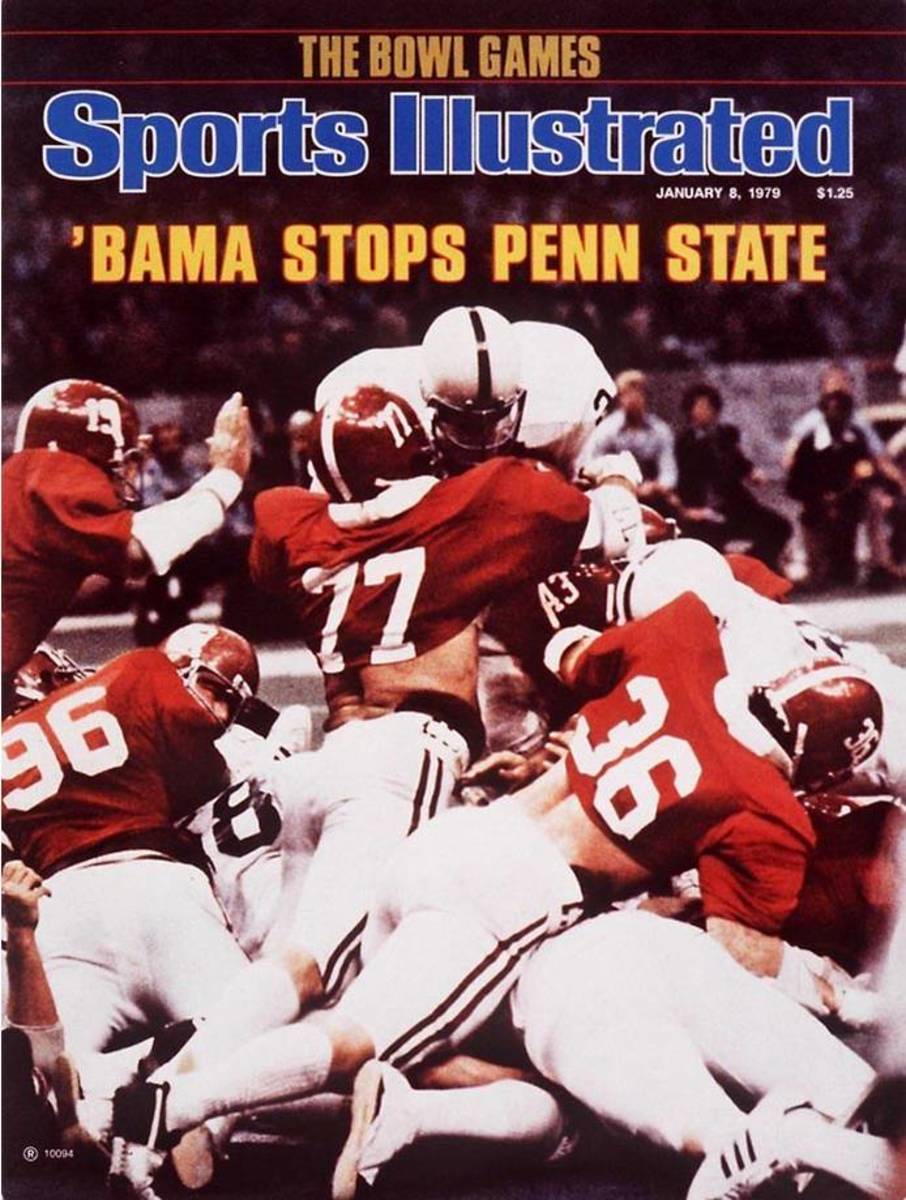
January 1, 1979: The Sugar Bowl is played at the Louisiana Superdome in New Orleans. It will decide the National Championship, as Number 1 Pennsylvania State University, then an independent, play Number 2 University of Alabama, Champions of the Southeastern Conference.

It is the 1st college football game I can remember watching on television. ABC showed a picture of Alabama coach Paul "Bear" Bryant. Then, they showed the Penn State coach, Joe Paterno. At the time, I had no idea that Bryant had once played end, both ways, for 'Bama, and that Paterno had played quarterback and defensive back for Brown University, an Ivy League school.
But, with ABC's college football anchor Keith Jackson describing Bryant and his achievements, and his craggy, weather-beaten image, I got the impression that his was what a football coach should look like. One look at Paterno, however, with his dark blue jacket, his jet-black hair, his sunglasses (even indoors at the Superdome), his big nose, his gritted teeth, and his hunched-over appearance, I thought even then, at the age of 9, that he looked like a rat. The rest of his life only increased that perception to me.
Alabama, as the SEC Champions in the Sugar Bowl, had the first choice of uniforms, and wore their "Crimson Tide" jerseys with their crimson red helmets with their uniform numbers on the side, and looked great coming onto the field. Penn State wore all white, including plain white helmets with a navy blue stripe down the middle, no logo at all. I didn't know yet that there was such a thing as high school football, but, in hindsight, Penn State looked like a high school team. They looked so plain. This was the Number 1 team in the country? I was sure Alabama were going to clobber them.
The Superdome

It didn't work out that way: The game was scoreless until late in the 1st half, when Jeff Rutledge threw a 30-yard touchdown pass to Bruce Bolton, putting the Tide up, 7-0. In the 3rd quarter, Penn State's defense stopped a 'Bama drive, and Alan McElroy missed a field goal to keep it a one-score game. This led to Chuck Fusina throwing a 17-yard touchdown pass to Scott Fitzkee to tie the game, 7-7.

Lou Ikner fielded a Penn State punt, and took it 62 yards, giving 'Bama a 1st-and-goal on the 8. After 2 stops on runs, Bryant and his offensive coordinator, Mal Moore, guessed that Paterno would now be expecting a pass. So the Bear called an option left, and Rutledge took it, and fooled the entire Nittany Lion defense, except for one defender. Seeing that defender take the bait, Rutledge pitched to Major Oglivie, and he scored the go-ahead touchdown. It was 14-7 Tide.

Early in the 4th quarter, on its own 22-yard line, Rutledge tried another pitch to Oglivie. This was a mistake, as Oglivie wasn't expecting it, and Penn State recovered a fumble. The Lions marched down the field, until they had 1st & goal on the 'Bama 8-yard line.

On 1st down, a run gained 2 yards. 2nd & goal on the 6: Fusina threw a pass to Fitzkee, who looked like he was going to score, until 'Bama cornerback Don McNeal came out of nowhere to knock Fitzkee out of bounds. 3rd & goal on the 1: Matt Suhey ran straight ahead, and tried a jump for the touchdown, but was hit by Curtis McGriff and Rich Wingo.

4th & goal. About 6 minutes left in the game. Fusina asked the referee how far the ball was from the goal line. Alabama defensive tackle Marty Lyons overheard, and said, "About a foot. You better pass." It was complete confidence in his teammates on this goal-line stand.

Paterno called a running play. Fusina gave the ball to Mike Guman. Barry Krauss hit him. So did Murray Legg. No gain. Penn State turned the ball over on downs. It remains the most famous goal-line stand in the history of college football, and it's hard to think of a more consequential one in the NFL.

Penn State held Alabama, and the punt snap was botched, resulting in Woody Umphrey shanking it. Penn State had the ball on the Alabama 30. Except the Nittany Lions were caught with 12 men on the field, and that gave Alabama an automatic 1st down. Paterno was not only losing the game, because he was being outcoached by Bryant, he was losing control.

The Tide were able to run the clock down, and the Lions had a little over a minute left when they got the ball back. They couldn't convert, and Alabama won, 14-7. The Crimson Tide were National Champions.

Bryant would lead Alabama to one more National Championship the next year, and become major college football's all-time winningest coach. He was once asked when he would retire, and he said, "Quit coaching? I'd croak in a week." He was too close to being right: He retired after the 1982 season, and died a month later.

Eventually, he was surpassed by Bobby Bowden of Florida State. Paterno, who had already had a few close calls for the National Championship, finally won one in 1982, and won another in 1986, and surpassed Bowden, and remains the winningest coach in the NCAA's Football Bowl Subdivision (formerly known as Division I-A). In 2011, dying of cancer, his regime collapsed in the most disgusting scandal in the history of college sports.

Chuck Fusina and Scott Fitzkee won 2 professional football championships -- not in the NFL, but in the USFL, with the 1984 Philadelphia Stars and the 1985 Baltimore Stars, under head coach Jim Mora. At that time, you could talk to Mora about Playoffs. But in the NFL, Fusina and Fitzkee were never more than backups.

Jeff Rutledge was also a career backup, "winning" 2 Super Bowl rings as the 3rd-string quarterback on the New York Giants. He became a quarterbacks coach, including with the Arizona Cardinals. Curtis McGriff was his teammate on the Giants, but was released before their 1st Super Bowl win.

Matt Suhey was the secondary running back on the Chicago Bears, behind Walter Payton, and helped them win Super Bowl XX. Mike Guman backed up Eric Dickerson on the Los Angeles Rams.

Marty Lyons became a star with the New York Jets' "New York Sack Exchange." Don McNeal starred with the Miami Dolphins, helping them reach 2 Super Bowls -- reaching 1 of them by beating Lyons' Jets in an AFC Championship Game. Rich Wingo played for the Green Bay Packers. Barry Krauss had a long NFL career, mostly with the Colts, and was with them when they moved from Baltimore to Indianapolis. Major Oglivie and Murray Legg never played pro ball, and found success in related businesses, Oglivie in concrete and Legg in construction.

*

January 1, 1979 was a Monday. The other traditional New Year's Day bowl games were as follows:

* Number 3 University of Southern California beat Number 5 Michigan, 17-10 in the Rose Bowl, in the stadium of the same name, in the Los Angeles suburb of Pasadena, California. USC running back Charles White, who would win the Heisman Trophy the next year, jumped over the Michigan line for the winning touchdown. The instant replay showed that he had fumbled the ball before crossing the plane of the goal line. No replay appeal in those days, and USC won.

* Number 4 Oklahoma beat Number 6 Nebraska, 31-24, in the Orange Bowl, in the stadium of the same name, in Miami. Nebraska had beaten arch-rival Oklahoma for the Big Eight Conference title, but then lost to Missouri the next week. So a rematch was set up in the Orange Bowl, and Oklahoma won it.

* And Number 10 Notre Dame beat Number 9 University of Houston, 35-34, in the Cotton Bowl, at the stadium of the same name in Dallas.

Baseball was out of season. The NFL was between its Conference Championships and Super Bowl XIII, which the Pittsburgh Steelers would win over the Dallas Cowboys, 35-31.

There was 1 game in the NHL: The Los Angeles Kings beat the Colorado Rockies, 5-3 at The Forum outside Los Angeles in Inglewood, California.

And there was 1 game in the World Hockey Association. A national side from Czechoslovakia was permitted to compete, and they played the Winnipeg Jets to a 3-3 tie at the Winnipeg Arena.

December 31, 1999 & January 1, 2000: The Millennium

December 31, 1999:  The Millennium arrives. The people of planet Earth survived. At a terrible cost. But we hadn't destroyed ourselves. ...