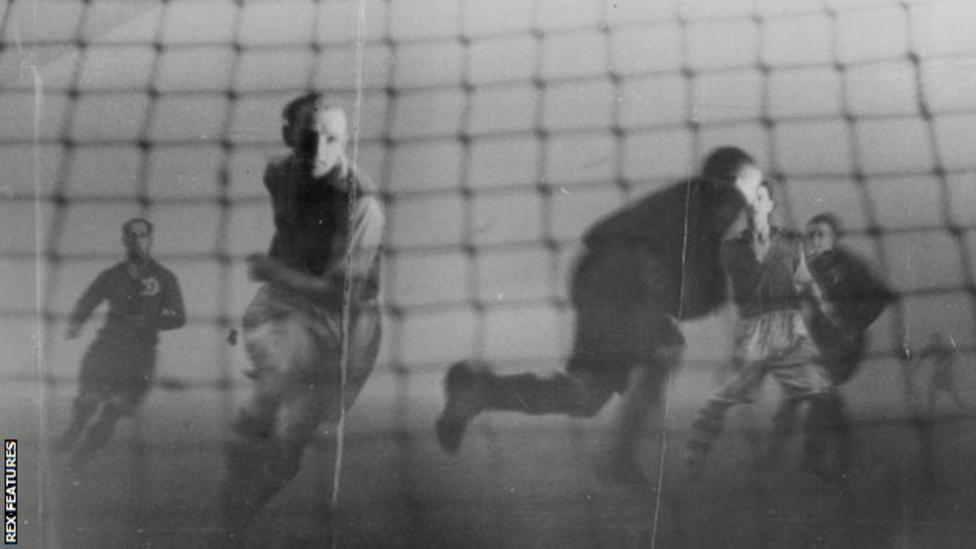
Yes, the fog was that thick.
November 21, 1945: The most-hyped game of the 1st visit of a Soviet soccer team to England, the sport's traditional birthplace, takes place. In hindsight, it can be called the event that kicked of the sports division of the Cold War.
In Communist countries, sports clubs, and the teams they fielded, were sponsored by state-owned industries. The countries' armies sponsored teams named "Central Club of the Army," or "CSKA" in Slavic languages. The national railroads sponsored teams named "Lokomotiv." The auto industry sponsored teams named "Torpedo." The teams most hated by the citizens, but with the most funding from the government and the most favorable decisions from government-appointed officials, were named "Dynamo."
Football Club Dynamo Moscow won the Soviet Top League in 1936, 1937, 1940 and 1945; and were regarded, along with Spartak Moscow, as the best team in the Soviet Union. So when World War II came to an end, Dynamo wanted to test themselves against what was seen as the best competition in the world: The British.
This was the age of radio. Television existed, but it hadn't yet done much to cover sports. Most of what people knew about sports was what they read in newspapers. So there was very little information on Dynamo for the British teams they would be facing, and their fans -- and vice versa: Dynamo knew very little about their opponents.
Interviewed for a 2001 documentary, Dynamo forward Konstantin Beskov said, "Until those games, we only knew that England was the motherland of football, that English football was the best in the world." One of Britain's national newspapers, The Evening Standard, wrote, "Don't expect much from Dynamo. They are only beginners, blue-collars, amateurs." They would regret that dismissive derision.
On Tuesday, November 13, Dynamo visited Chelsea Football Club, at Chelsea's West London stadium, Stamford Bridge. Officially, the crowd was 75,000 people. It was probably much more than that, given English "footie" fans' propensity to jam themselves into those vast "standing terraces." It's a wonder there weren't more disasters like Ibrox in 1971 and Hillsborough in 1989.
Chelsea, prior to the 1960s rarely even a good team, much less a challenge for Dynamo, took a 2-0 lead. Just before the half, Dynamo were awarded a penalty. Leonid Solovyov hit the post with his shot, and the Soviet side went into the locker room embarrassed. Whatever was said to them in the locker room, it worked: They came back to tie the game, 2-2, fell behind 3-2, and then tied it again near the end of the game, to end it 3-3.
Tommy Lawton, the former star of Liverpool team Everton FC who had recently been signed by Chelsea, said, "Dynamo were one of the fastest teams I have ever seen in my life. They flash the ball from man to man in bewildering fashion, often while standing still." Chelsea Captain John Harris said, "At least two of Lawton's kicks were of such a type that no goalkeeper would catch, but Khomich jumped like a tiger and caught them." The Soviet goalie was known as Tiger Khomich from then on.
On Saturday, November 17, Dynamo visited Cardiff City Football Club. England's Football Association, of which City were then 1 of 3 Welsh members, refused to rearrange their schedule to accommodate Dynamo, so City were the only team available, and they were in Division Three, equivalent to Class AA in modern baseball.
Wales, full of coal mines, steel mills and dockworkers, was openly sympathetic to socialism, and welcomed the Soviet team with open arms. But City were completely overwhelmed, as Dynamo beat them, 10-1.
The team with which Dynamo were most familiar, and the team they truly wanted to test themselves against, was Arsenal Football Club, winners of the Football League in 1931, '33, '34, '35 and '38. Dynamo badly wanted to play Arsenal at their North London home, the Arsenal Stadium, nicknamed Highbury for its neighborhood.
Having made trips to the Continent, including an annual home-and-home series on Armistice Day, November 11, with Racing Club de France in London and Paris, Arsenal were happy to make themselves available for this soccer "summit." But they could not do the same for Highbury: It had been commandeered by the British government at the outset of World War II, as an Air Raid Precaution Centre, and had not yet been returned to the club's control. Since 1939, Arsenal had been playing home games at White Hart Lane, the home of their arch-rivals, Tottenham Hotspur, a.k.a. Spurs, 4.7 miles to the north.
A dirty little secret had gotten out: Dynamo had "drafted" 4 star players from other Soviet teams, including Spartak Moscow and CSKA Moscow. So the FA made arrangements for teams to "loan" some players to Arsenal, including Stanley Matthews of Staffordshire team Stoke City, a winger known as "The Wizard of Dribble," and possibly England's best player at the time. Another loanee was Stan Mortensen of Lancashire team Blackpool. With massive hypocrisy, the Soviets complained.
(In 1953, Blackpool, having acquired Matthews, won the FA Cup Final, with Mortensen scoring the only hat trick in the history of the Final, but Matthews had put on such a show that it's still remembered as "The Matthews Final.")
The game was set for Wednesday, November 21, but, as so often happened in those days before environmental regulations were passed, leading to outsiders nicknaming London "The Smoke," a thick fog settled over White Hart Lane. Still, the place was sold out, 54,000 strong, and the FA didn't want to issue refunds, so the game went on. The Soviet officials insisted on a Soviet referee, Nikolay Latyshev, who had accompanied the team. The FA agreed.
Writer George Orwell, who had recently published Animal Farm (Nineteen Eighty-Four was yet to come), was in attendance, and called the match "War minus the shooting." The Soviet players, knowing Matthews was the best player on either side of the pitch, targeted him for rough treatment.
Both goalies, Khomich and Arsenal's Wyn Griffiths, took more physical assaults than shots with the ball. Griffiths sustained a concussion, and had to be replaced for the 2nd half. Harry Brown, goalkeeper for West London team Queens Park Rangers, was in attendance, and, since the Soviets had negotiated for the right to a substitution, something the FA wouldn't allow in League and cup ties until 1966, they allowed Brown to step in for Griffiths.
Dynamo scored first, but Ronnie Rooke equalized shortly thereafter. Shortly before the half, there were 3 goals within a span of 4 minutes: Mortensen put Arsenal up 2-1, then he took another Matthews feed to make it 3-1, and then Beskov put the ball past Griffiths to make it 3-2.
The 2nd half was a travesty. Solovyov scored to tie it up, but multiple witnesses claimed he was blatantly offside. Latyshev let the goal stand. A little later, Arsenal thought they should have been awarded a penalty, but Latyshev denied it. Shortly after that, he sent Arsenal midfielder George Drury off for throwing a punch. No one else claimed to see the punch.
Vsevolod Bobrov, who became one of the Soviet Union's first great hockey players as well, received a Solovyov pass while offside, and scored. The goal was allowed to stand. Rooke was nearly brought down by a rugby-style tackle by Dynamo Captain Mikhail Semichastniy, opening a cut on his forehead, but elbowed him out of the way, giving him a black eye, and driving a 25-yard shot that beat Khomich. But instead of rightly allowing the goal and sending Semichastniy off, Latyshev waved off the goal and called Rooke for a foul.
So instead of what it should have been, 4-2 to The Arsenal, with Arsenal having 11 players on the pitch and Dynamo having 10 at most, it was 4-3 to Dynamo, with Arsenal down to 10 and Dynamo fielding... no one was sure how many. Dynamo took advantage of the fog to put more players on, with some accounts saying it was now 15 against 10.
The match ended 4-3 to Dynamo. The Daily Mail wrote, "It was one of the most exciting games 54,000 people never saw." Unusually for the paper known in modern times as the Daily Fail, it was the truth.
The controversy threatened to cancel the 4th and final game on the tour. But the FA were making too much money to bow to the wishes of the fans, and the finale went on. On Wednesday, November 28, Dynamo were hosted by Rangers Football Club, Scotland's most successful team, at Ibrox Stadium in Glasgow. Despite Bobrov scoring what The Daily Telegraph called "as perfect a goal as has ever been scored at Ibrox," Rangers held on for a 2-2 draw.
Dynamo had finished the tour with 2 wins, 2 draws, and no losses. But all the goodwill they had generated in their games against Chelsea and Cardiff City was thrown away by their actions against Arsenal. The game with Rangers did them no good in the eyes of the British, or European, sporting public.
Dynamo would win the Soviet Top League again in 1949, 1954, 1955, 1957, 1959, 1963 and 1976. But they never won it again. Nor have they won its replacement, the Russian Premier League. They have long since been surpassed as Moscow's top team by Spartak and CSKA, and St. Petersburg team Zenit have also surpassed them among Russia's teams.
Nikolay Latyshev, the referee for the Arsenal-Dynamo match, went on to officiate at the 1962 World Cup Final, which featured a team from what was then a Communist nation, Czechoslovakia. But none of his calls in the game were considered controversial, and Brazil defeated the Czechs.
*
November 21, 1945 was a Wednesday. Actress Goldie Hawn was born on this day.
Baseball was out of season. Football was in midweek. The NBA hadn't been founded yet. Only 1 game was played in the NHL: The Boston Bruins beat the Montreal Canadiens, 3-0 at the Boston Garden.


