Showing posts with label al smith. Show all posts

Monday, November 21, 2022

November 21, 1934: The "Business Plot" Is Exposed

Smedley Butler

November 21, 1934: The New York Post and the Philadelphia Record break the story of what came to be known as "The Business Plot," a rich men's plan to launch a military coup and take over the American government.

The story is broken by Paul Comly French, a reporter who had once been the private secretary of Smedley Butler, a retired Major General (2 stars) in the U.S. Marine Corps.

Smedley Darlington Butler was born on July 30, 1881, in the Philadelphia suburb of West Chester, Chester County, Pennsylvania. His father, Thomas Stalker Butler, was a Republican Congressman. His maternal grandfather, Smedley Darlington, had previously held the same seat in Congress. Three earlier Darlingtons had served in Congress. Smedley's aunt, Isabel Darlington, was the 1st woman to practice law in Chester County.

He enlisted in the Marines, and served with distinction in the Spanish-American War, the Philippine Campaign and the Boxer Rebellion. His participation in the so-called "Banana Wars" in Central America caused him to look at war and its conduct differently.

He received his 1st Congressional Medal of Honor for his service in the American occupation of Veracruz, Mexico in 1914. He offered to return it, saying he had done nothing to earn it. He was ordered to keep it. He received a 2nd Medal of Honor for his role in repelling an ambush during the American occupation of Haiti in 1915.

He received his General's stars during World War I, and was appointed commanding officer of the Marine barracks at Quantico, Virginia, now the "home base" of the Corps (and of the FBI). In 1924, President Calvin Coolidge gave him leave from active duty so that he could become Director of Public Safety for Philadelphia.

He said, "Cleaning up Philadelphia was worse than any battle I was ever in." He brought crime down significantly, but his tactics were a bit heavy-handed. Still, there were many people who liked that, and they remembered it, thinking that Butler was their kind of man. He held the job for 2 years, returned to the Corps, and retired from the service in 1931.

He ran for the U.S. Senate in Pennsylvania in 1932, but, with the tide turning against Prohibition, which he supported, he lost the Republican Primary. He opposed the Bonus Army in a public statement that year, and there were many people who liked that.

That year, Governor Franklin D. Roosevelt of New York, a Democrat, was elected President of the United States. His "New Deal" lifted millions out of poverty, increasing taxes on rich people in order to do it. America's wealthiest men were furious, and some were not willing to wait until November 3, 1936, the next election, to do something about it.

In November 1934, Butler testified before a special committee of the U.S. House of Representatives. He told them that he was visited by Gerald P. MacGuire, a prominent Connecticut businessman. MacGuire had visited Germany and Italy, and saw how veterans' groups had aided the Fascist movements there, movements that had stopped Communist uprisings. He told Butler that he viewed FDR and his advisors, the so-called "Brain Trust," as Communists, and said they had to be stopped.

He told Butler that a group of businessmen had $50 million to spend, and a private army of 500,000 ex-soldiers, many of them members of the American Legion, ready to march on Washington, to remove Roosevelt from power, and establish a Fascist dictatorship. MacGuire told Butler that the group wanted him to be the dictator.

Butler said that he later met with Robert Sterling Clark, an heir to the Singer sewing machine fortune. Clark told him about some of the other men backing the plan:

Irénée du Pont, head of the DuPont Corporation, which had recently bought the Remington Arms company, which would produce the weapons and the ammunition for the coup.

* Thomas W. Lamont, running J.P. Morgan & Company on behalf of J.P. Morgan Jr., son of the company's founder, and an adviser to every President since Woodrow Wilson, including FDR, thus giving the group an "inside man." 

* Grayson Murphy, a director of Goodyear Tire, Anaconda Copper, and Bethlehem Steel, all companies capable of supplying the coup effort with necessary materiel.

* And the last 2 Democratic Party nominees for President before FDR: John W. Davis, a former Congressman from West Virginia and U.S. Ambassador to Britain, who was always more conservative than the mainstream of the Party; and Alfred E. Smith, who was also FDR's predecessor as Governor of New York, had lost very badly to Herbert Hoover in 1928, saw FDR beat Hoover even worse in 1932, and was intensely jealous of FDR's early success and popularity as President.

About all of this, Butler told French, whom he trusted due to his service. French did some digging, and found evidence that the plot was real, not just MacGuire and Clark blowing off steam at a President they hated. Armed with this knowledge, Butler met with MacGuire again, and said, "If you get 500,000 soldiers advocating anything smelling of Fascism, I am going to get 500,000 more, and lick the hell out of you, and we will have a real war right at home." And then he went to Congress, and spilled the beans.

French broke the story in the New York Post and the Philadelphia Record on November 21. On November 22, The New York Times wrote about it, calling it a "gigantic hoax." All the parties alleged to be involved publicly said there was no truth in the story, calling it a joke and a fantasy. Roosevelt's reaction to it is not known to have been recorded.

If the coup ever got beyond the talking stage, it was doomed without a leader -- or, more likely, a figurehead. It has been alleged that Hugh S. Johnson, a retired Army Brigadier General who had been running the National Recovery Administration for FDR, and had been named Man of the Year for 1933 by Time magazine, had also turned the plotters down.

In 1935, Butler published a book titled War Is a Racket, comparing what Dwight D. Eisenhower would later call "the military-industrial complex" to organized crime. He wrote, "I spent most of my time as a high class muscle man for Big Business... a gangster for capitalism" who "might have given Al Capone a few hints." That book, all by itself, showed that the big business boys were looking to the wrong man for their goal.
Plaque honoring Butler, Philadelphia City Hall:
"He enforced the law impartially,
he defended it courageously, he proved incorruptible."

MacGuire died of pneumonia shortly before Butler published his book. Grayson Murphy died in 1937, Smedley Butler in 1940, Hugh Johnson in 1942, Al Smith in 1944, Thomas Lamont in 1948, John W. Davis in 1955, Robert S. Clark in 1956, Paul French in 1960, and Irénée du Pont in 1963.

In 2018 and 2022, Thomas Lamont's great-grandson, Edward Miner Lamont Jr., a.k.a. Ned Lamont, was elected Governor of Connecticut -- as a liberal Democrat. He has conducted the office very differently from what his ancestor would have hoped.

*

November 21, 1934 was a Wednesday. This was also the day the Cole Porter musical Anything Goes, starring Ethel Merman, debuted on Broadway. I have a separate entry for that event.

This was also the day that the Yankees purchased the contract of Joe DiMaggio from the San Francisco Seals of the Pacific Coast League. I have a separate entry for that event.

Baseball was out of season. Football was in midweek. The NBA hadn't been founded yet. And while the NHL season began on November 8, there were no games scheduled for this day. So there were no scores.

Sunday, November 6, 2022

November 6, 1928: Herbert Hoover Is Elected President

November 6, 1928: Secretary of Commerce Herbert Hoover is elected President. The Republican Party's nominee gets a whopping 58 percent of the vote, and 444 Electoral Votes.

The Democratic Party had nominated Governor Alfred E. Smith of New York, the 1st Catholic ever nominated by a major party. He won just 40.8 percent, a figure exceeded by all but 2 Democratic nominees since (George McGovern in 1972 and Walter Mondale in 1984), and took just 8 States, worth 87 Electoral Votes: South Carolina, Georgia, Alabama, Mississippi, Louisiana and Arkansas in the South; and the 2 most Catholic States in the nation, Massachusetts and Rhode Island. In total votes, Hoover won, 21.5 million to 15.0 million.

After a career that had seen him get rich in mining, lead a massive hunger relief program for Europe during and after World War I, and serve as Secretary of Commerce under Presidents Warren G. Harding and Calvin Coolidge, Hoover had even broken through in what was then known as "the Solid South": He won Virginia, North Carolina, Kentucky, Tennessee, Florida, Oklahoma and Texas.

That's how much anti-Catholic bias there was: Southerners, who normally would never have voted for the nominee of the party of Abraham Lincoln, did so. After all, the Ku Klux Klan hated Catholics nearly as much as they hated black people.

It was a massive landslide: Even if Smith had won every State in which he got between 45.0 and 49.9 percent of the vote -- Texas, New York, Tennessee, Virginia, Utah, Connecticut and North Carolina -- he still would have lost the Electoral Vote, 349-189.
Alfred E. Smith

In his nationally-syndicated newspaper column, humorist Will Rogers wrote that Smith's supporters "are going to be shocked at how much of the country lives west of the Hudson River." He was right, as Smith was too New Yorky for the rest of the country, including most of New York State. The term "the Big Apple" had already come into use, and Smith called the State north of The Bronx "Apple-knockers."

In the end, thought, it was never even about Smith. Had Smith been a Protestant, from a small town rather than the biggest city, with a pleasant voice instead of a N'Yawk accent, in favor of keeping Prohibition rather than repealing it, and not connected (however loosely) to the corrupt Tammany Hall political machine that dominated New York State and especially New York City, he still would have lost, as Hoover rode the Republican prosperity of the Roaring Twenties.

Hoover's running mate was Senator Charles Curtis of Kansas, a member of the Kaw Nation. His inauguration as Vice President made him, to this day, the highest-ranking Native American in the history of American politics.

Despite the Hoover landslide, Franklin D. Roosevelt, former Assistant Secretary of the Navy, 1920 Democratic nominee for Vice President, and cousin of the late former President Theodore Roosevelt, is narrowly elected to succeed Smith as Governor. Someone asked Smith if FDR, one of his biggest backers, was going to be a rival that would prevent him from getting the Democratic nomination again in 1932. Smith, noting that Roosevelt had been dealing with the effects of polio since 1921, said, "No, he will be dead within a year."

Within a year of the 1928 election, the stock market had crashed, and, barring a major scandal, the Democratic nominee was going to win in 1932. Smith tried for that nomination. He lost it. To FDR. FDR became President. Smith became one of his fiercest critics. And, in the end, in spite of FDR's health difficulties, Smith died 6 months before he did.

Hoover, on the other hand, was pretty much forgiven by Republican regulars, and was invited to speak at every Republican Convention from 1936 to 1964. Only in the last of these did he decline, due to the illness that brought his life to an end at 90 years shortly before the general election. As for his enemies, he said, "I outlived the bastards."

He also outlived every one of his fellow members of both Warren Harding's Cabinet and Calvin Coolidge's, and even his own: His last surviving Cabinet member was Patrick J. Hurley, his Secretary of War, who died in 1963. Hurley remains the highest-ranking native of Oklahoma in American political history.

Hoover also outlived his Vice President: Charles Curtis died in 1936, 13 months before what would have been the 2nd Hoover-Curtis term would have ended. However, Curtis was 74, making him 12 years old than Hoover.

And yet, at the time of his death, Herbert Hoover was less famous than the Director of the FBI, J. Edgar Hoover, who was not related to him. Nor was he related to Irwin "Ike" Hoover, the White House Chief Usher from 1904 to 1933, who died in that post a few months after Herbert Hoover was succeeded by FDR.

In 1931, a bill was passed by Congress to build a dam on the Colorado River, forming the Nevada-Arizona State Line. It was named the Hoover Dam. In 1935, a year before it opened, President Franklin D. Roosevelt renamed it for the closest town, Boulder City, Nevada: Boulder Dam. In 1947, a Republican Congress renamed it Hoover Dam. As Hoover was U.S. Secretary of Commerce, the U.S. Department of Commerce Building in Washington is named for him. His Presidential Library opened adjacent to his birthplace in West Branch, Iowa, outside Iowa City, on August 10, 1962.
Statue, West Branch, Iowa

Hoover remains the only President born in Iowa, and the only one to live in Oregon. He was the 1st one to represent California.

Hoover was played by Larry Gates in Backstairs at the White House in 1979. On the campus of his alma mater, Stanford University, the Hoover Institution is a conservative economic think tank. Yes, they named an economic think tank after the Depression President.

*

November 6, 1928 was a Tuesday. This was also the day the news-flashing "Zipper" sign was introduced in Times Square. I have a separate entry for this event.

Baseball season was over. Football was in midweek. The NBA hadn't been founded yet. And the NHL season didn't start until November 15. So there were no scores on this historic day.

Friday, August 26, 2022

August 27, 1894: "The Sidewalks of New York" (East Side, West Side) Is Published

August 27, 1894: "Sidewalks of New York" is published, with lyrics by James W. Blake, and melody by Charles B. Lawlor. It becomes one of the most familiar songs about New York City.

The song is better known by its first line, "East Side, West Side":

East Side, West Side, all around the town
the tots sang "ring-around-rosie," "London Bridge is falling down."
Boys and girls together, me and Mamie O’Rourke
tripped the light fantastic on the sidewalks of New York

The song mentions a few neighborhood characters, but in the 4th and final verse, it's revealed as a lament for a lost youth. "Up in G" was an 1890s slang term meaning "doing well":

Things have changed since those times, some are up in "G."
Others they are wanderers, but they all feel just like me
They'd part with all they've got, could they once more walk
with their best girl and have a twirl on the sidewalks of New York.

Assemblyman, Governor and 1928 Democratic Presidential nominee Alfred E. Smith made "The Sidewalks of New York" his campaign theme song, usually singing just that verse, ignoring the other verses, including the sad 4th and final verse, and making it one of New York's great saloon singalongs. The song has also been rewritten for various causes, and for TV commercials, most notably for Hot Shoppes restaurants and Rheingold beer in he 1950s and '60s.

Lawlor died in 1925, Blake in 1935. Each man was 72 at the time of his death. "Sidewalks of New York" is the only song written by either man that is still widely remember.

It became the post parade (pre-race) song for the Belmont Stakes, the 3rd and final leg in thoroughbred horse racing's Triple Crown, as "My Old Kentucky Home" is for the Kentucky Derby and "Maryland, My Maryland" is for the Preakness Stakes.

In 1996, Belmont Park management, trying to appeal to a younger demographic, decided to alter tradition and changed the post parade song to "Theme from New York, New York" ("Start spreadin' the news... ")

There is speculation that a jinx has fallen over any horse attempting to win the Triple Crown of after having won the 1st 2 legs. Since 1996, 7 horses who won the Derby and the Preakness have failed to win the race since the song was changed, and 1 was scratched the morning of the race due to lameness.

It is said that the ghost of Mamie O'Rourke (a real person, a childhood friend of lyricist Blake) will never let another Triple Crown winner emerge unless and until "The Sidewalks of New York" is reinstated as the post parade song for The Belmont Stakes. However, this doesn't explain why 4 horses between 1979 to 1996 had already failed to win the Triple Crown after winning the 1st 2 legs. But after the wins of American Pharoah in 2015 and Justify in 2018, if such a curse existed, it's gone now.

*

August 27, 1894 was a Thursday. The only professional sports league in America at the time was baseball's National League, in which these 3 games were played:

* The Cincinnati Reds swept a doubleheader from the Philadelphia Phillies, 19-9 and 9-5. These games were played at the Philadelphia Base Ball Grounds. This was a temporary stadium built after the one of the same name burned down. It was replaced the next season, with the National League Park that would later be renamed Baker Bowl.

* And the Baltimore Orioles beat the Chicago Colts, 12-3 at Union Park in Baltimore. The Orioles were contracted out of the league after the 1899 season, while the Colts became the Cubs.

Sunday, July 17, 2022

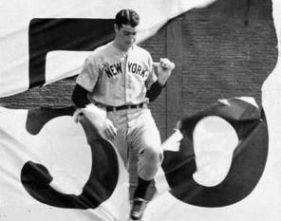
July 17, 1941: Joe DiMaggio's Hitting Streak Is Stopped

July 17, 1941: The New York Yankees play the Cleveland Indians in front of 67,468 fans at Cleveland Municipal Stadium. The Yankees' center fielder, Joe DiMaggio, comes into the game with a 56-game hitting streak. Before this, the longest streak ever was 44 games. Since this, the longest streak has also been 44 games. This record has never even been seriously approached.

What's more, with the streak, DiMaggio put the Yankees on his back, and carried them to glory. On Game 3 of the streak, on May 17, the Yankees were 7 1/2 games out of 1st place in the American League. Now, in Game 57, exactly 2 months later, they are in 1st place by 7 games, a 14 1/2-game swing.

Don't tell me Ted Williams was the most valuable player, capitalized or otherwise, in the AL that season. His .406 batting average didn't help his team come anywhere near a Pennant. The latest in the season that the Boston Red Sox were in 1st place was April 22. After June 25, they were never within 3 games of 1st place. From July 13 onward, they were never within 10. From August 9 onward, they were never within 14. On September 4, they bottomed out at 20 1/2 back. And when the regular season ended on September 28, they were 84-70, not a bad record, but and in 2nd place, not a bad finish -- but 17 games behind the Yankees.

Williams batted .406, with an on-base percentage of .553, a slugging percentage of .735, a 235 OPS+, and hit 37 home runs, all of which led both major leagues. He had 120 RBIs. In comparison, DiMaggio's "slash line" for the season was .357/.440/.643, his OPS+ was 185, and he hit 30 homers, but led both Leagues with 125 RBIs.

But the Yankees went 41-13, with a game tied when called due to darkness and another tied when called due to rain, over those 56 games, including winning streaks of 14 and 8. Of those 56, 4 went to extra innings, but DiMaggio got his 1st hit within the 1st 9 each time; and 4 were shortened due to rain, making it even more impressive that DiMaggio got at least 1 hit in each.

Shortly after the streak ended, the Yankees started a 10-game winning streak. They went on to clinch the Pennant on September 3. It remains the earlier 1st-place clinching in AL history, even in the Divisional Play era. 

But on this day, DiMaggio was stopped. In the top of the 1st inning, batting against pitcher Al Smith, Red Rolfe singled, and Tommy Henrich doubled, to give the Yankees a 1-0 lead. DiMaggio then came up, and hit a sharp grounder to 3rd base, where Ken Keltner made a great play to throw him out. In the 4th, DiMaggio drew a walk against Smith, but that didn't count as a hit.

In the bottom of the 4th, Gerald "Gee" Walker hit a home run off Yankee pitcher Lefty Gomez, to tie the game. The game remained tied until the top of the 7th. With Smith still pitching for Cleveland, DiMaggio came up, but was again robbed by a great play by Keltner. Right after this, Joe Gordon hit a home run, giving the Yankees a 2-1 lead.

Charlie Keller led off the top of the 8th with a triple. Rookie shortstop Phil Rizzuto grounded to 3rd, and Keltner held Keller, then, threw Rizzuto out. But Gomez, a notoriously bad hitter even for a pitcher, singled Keller home. It was 1 of only 58 RBIs in a 14-season career that would see Gomez go 189-102 and make the Baseball Hall of Fame.

This was followed by Johnny Sturm singling, and Rolfe doubling him home. Henrich walked, and with DiMaggio due up next, that was enough for Roger Peckinpaugh, the former Yankee and Washington Senator shortstop, who had also managed both of those teams, and was now managing the Indians: He replaced Smith with Jim Bagby Jr., whose father had pitched for the Indians' World Series winners of 1920.

Still needing a hit, DiMaggio hit a grounder to short. Boudreau got it, and threw to Ray Mack (no relation to Connie) at 2nd to eliminate Henrich. Mack threw to Oscar Grimes at 1st, to eliminate DiMaggio, who wouldn't have been credited with a hit even if he'd beaten it out, as it would have been officially called a fielder's choice.

The Yankees did not score in the 9th, and there was no chance of DiMaggio coming up again. Even if there had been a 10th inning, he would have been the 4th man up. The Indians did threaten, scoring 2 runs. Yankee manager Joe McCarthy took Gomez out, and replaced him with Johnny Murphy, who slammed the door.

Yankees 4, Indians 3. The win was secure. But all the talk was of how the streak was over. The Yankee Clipper, for once, was at anchor.

*

July 17, 1941 was a Thursday. It was the off-season for the NFL and the NHL, and the NBA hadn't been founded yet. But there were 5 other Major League Baseball games played that day:

* The New York Giants lost to the Cincinnati Reds, 5-4 at the Polo Grounds.

* The Chicago Cubs and the Philadelphia Phillies were tied 2-2 after 6 innings, when the game was called due to rain.

* The Detroit Tigers beat the Washington Senators, 7-1 at Briggs Stadium in Detroit. (It was renamed Tiger Stadium in 1961.)

* The Boston Red Sox beat the Chicago White Sox, 7-4 at Comiskey Park, in Chicago. Ted Williams did not play.

* The St. Louis Browns beat the Philadelphia Athletics, 4-3 at Sportsman's Park in St. Louis.

* And the Brooklyn Dodgers, the Boston Braves, the Pittsburgh Pirates and the St. Lois Cardinals were not scheduled. 

Saturday, July 9, 2022

July 9, 1924: The Democrats Need 103 Ballots

John W. Davis

July 9, 1924: The Democratic Party nominates a candidate for President -- on the 103rd ballot. That's right: One hundred and three ballots. To put that into proper perspective: Neither they nor the Republican Party have even needed a 2nd ballot since 1952.

In 1920, Senator Warren Harding of Ohio led a Republican landslide, and won the Presidency. In 1923, the Teapot Dome scandal broke out, and it looked like it might damage Harding as he ran for re-election. Shortly after it broke out, Harding died, and was replaced by his Vice President, Calvin Coolidge.

It soon became clear that Coolidge would run for a term of his own in 1924, and the Democrats were confident: Except for Theodore Roosevelt in 1904, no "accidental President" had gone on to be elected in his own right, and the Republicans were tarred with scandal.

But unlike Harding and a few members of his Cabinet, Coolidge was not involved in Teapot Dome, or in any other scandal. And, under Republican leadership, the economy had recovered from the post-World War I depression. The slogans for 1924 were "Coolidge Prosperity" and "Keep Cool and Keep Coolidge."

That's the uphill fight that the Democrats had as they gathered for their Convention at Madison Square Garden in New York. This was the 2nd building with the name, built in 1891. It would be replaced the following year by the building that would eventually be known as "the Old Garden." That one hosted many political events, but never the National Convention of either major party. It was replaced in 1968 by the current building bearing the name, which has hosted the Democratic Convention in 1976, 1980 and 1992; and the Republican Convention in 2004.
Madison Square Garden II

Unlike the Republican Party, which only required a majority of its Delegates to nominate candidates for President and Vice President, the Democratic Party needed a two-thirds supermajority. This enabled the Southern States, which made up about one-third of the Democratic Delegates, to effectively have a veto over any candidate they felt insufficiently conservative, or too favorable to civil rights.

As a result, even after the American Civil War, most Democratic nominees for President turned out to be not all that liberal. Grover Cleveland was nominated in 1884, 1888 and 1892, and would be considered conservative by post-New Deal standards. William Jennings Bryan was nominated in 1896, 1900 and 1908, and while he was liberal on many issues, his support for farmers and his silence on civil rights made him acceptable to the South.

Woodrow Wilson was nominated in 1912 and 1916, and while he was progressive on many issues and had been Governor of a Northern State, New Jersey, he was a Southern native, and turned out to be the most regressive President this nation has ever had on the issue of race. Even Donald Trump didn't end up going as far backward on that issue as Wilson.

But by 1924, the Democratic Party had changed. Its youth, its energy, and its ideas were coming from big cities, from the labor movement, and from Catholic voters and the candidates they were electing. One of these was the Governor of New York, Alfred Emanuel Smith. Going into the 1924 Convention, the 50-year-old Al Smith had the support of the Northeastern and Midwestern cities, both big ones like New York and Chicago and smaller ones like Scranton, Pennsylvania and Akron, Ohio.
Alfred E. Smith

He projected an image of joy and optimism. In giving the speech nominating him, a fellow New Yorker, Franklin D. Roosevelt, called him "The Happy Warrior of the Political Battlefield." A former State Senator, a former Assistant Secretary of the Navy, and the Party's 1920 nominee for Vice President, FDR had seemingly been taken out of the Party's line of succession due to contracting polio in 1921, and made his way to the podium on crutches on this occasion. (The term "Happy Warrior" would also be applied to a later Democratic nominee for President, Hubert Humphrey.)

But Smith was too progressive for the South's taste. He was connected with the Democratic machine in the State of New York, Tammany Hall, long considered one of the most corrupt political organizations in the country. He was in favor of repealing the 18th Amendment to the Constitution, making it once again legal to produce, transport, sell and buy alcoholic beverages in America. (Pro-Prohibition people, as most Southerners and most Republicans were at the time, were called "drys"; and pro-repeal people, as Smith and most Catholics were, were called "wets.")

Smith had worked with black leaders, and was favorable to civil rights. The Southern States' individual Democratic Parties -- and even the Republican Party in the Northern, but Southern-bordering, States of Indiana and Illinois -- were then dominated by the Ku Klux Klan.

Most people from the 1950s onward, hearing of the Klan, have tended to think of their hatred and persecution of black people. But in the 1920s, most of their actions seemed to be against Catholics, the argument being that they bowed to a "foreign dictator" -- which, by the definition of each word, the Pope was, and remains. The Klan were also terribly anti-Semitic, although Jews had yet to become a significant voting bloc in America.

At that point, the Klan had never been stronger: It had over 3 million members, and regularly had well-attended parades down Pennsylvania Avenue in Washington, D.C. So they could have prevented the North's candidate from being nominated.
Klan Rally, Washington, August 9, 1925

Their candidate was William Gibbs McAdoo. At 60, McAdoo was a Southerner, born in Georgia, raised in Tennessee. He had run the company that built what's now known as the PATH subway train system in New York City and New Jersey. He had married Wilson's daughter Eleanor, and had served as Wilson's Secretary of the Treasury. So, at the least, he was qualified.
William G. McAdoo

He was now based in California, so he seemed to have the support of both the South and the West. His name had been put in nomination at the 1920 Convention, where the nomination was won by Governor James M. Cox of Ohio, so he had a solid base of support. (Cox had been clobbered by Harding in the general election, and was not seriously considered for a 2nd nomination.)

He was now based in California, so he seemed to have the support of both the South and the West. His name had been put in nomination at the 1920 Convention, where the nomination was won by Governor James M. Cox of Ohio, so he had a solid base of support. Cox had been clobbered by Harding in the general election, and was not seriously considered for a 2nd nomination. So, if there were a "line of succession," this would seem to have moved McAdoo up to 1st in it.

The 1924 Convention's 1st ballot was held on June 30. McAdoo got 39.4 percent of the Delegates, Smith 22.0 percent. Most of the remaining ballots went to various "favorite son" candidates put up by the State delegations.

Ballot after ballot was taken on that first day, until it reached a 15th ballot: McAdoo 43.6, Smith 27.8, with some of the favorite sons having drifted away, and their supporters having chosen McAdoo or Smith. Big demonstrations were held during the 10th ballot, when Governor Jonathan M. Davis of Kansas dropped out, freeing his delegation to vote for McAdoo; and Governor George Silzer of New Jersey dropped out, freeing his delegation to vote for Smith.

The prevailing belief among the delegates was that the impasse could only be broken by the elimination of both McAdoo and Smith, and the selection of one of the other contenders. McAdoo told his supporters that he was willing to drop the 2/3rds rule, but, being Protestant and South-heavy, they preferred to keep their veto over Smith. At no point in the balloting did Smith receive more than a single vote from the South, and scarcely more than 20 votes from the States west of the Mississippi River.

After 20 ballots, the vote was McAdoo 39.5, Smith 28.0. Coming in 3rd, with 11.3 percent of the Delegates, was John William Davis. At 51, he was a conservative lawyer for Wall Street firms. In 1910 and 1912, he was elected to Congress from West Virginia. In 1913, Wilson appointed him Solicitor General of the United States. In 1918, Wilson appointed him U.S. Ambassador to Britain. Certainly, he was qualified for the Presidency, but he was hardly a star, capable of generating big national support on his reputation alone. But, to an increasing number of Delegates, he seemed like a reasonable compromise candidate.

Through the next 10 ballots, the percentages for McAdoo, Smith and Davis didn't change much. Daniel C. Roper, a South Carolina Delegate and formerly the nation's Commissioner of Internal Revenue, went to FDR, to ask him to talk Smith into dropping out and accepting the Vice Presidential nomination on McAdoo's ticket.

The New York delegation, controlled by Tammany, tried what might be called a "dirty trick": They tried to prolong the convention until the hotel bills were beyond the means of the Delegates who had traveled to New York, thus giving the advantage to the pro-Smith Northeastern delegates. The Smith backers also attempted to stampede the Delegates by packing the galleries with noisy rooters, the idea being to fool the other Delegates into thinking Smith had more support than he actually did. This had worked at a Convention before, and would again.

To counter these tactics, McAdoo and Bryan, the latter booed by the New York delegation when he tried to speak on McAdoo's behalf, both tried unsuccessfully to adjourn and then reconvene in another city. The Democrats hadn't done that since 1860, and the result that time was a Party split 3 ways, and Abraham Lincoln being elected with a majority of the Electoral Votes, but only 39 percent of the popular vote, a record low for any Presidential election winner.

By the 42nd ballot, Davis had faded to 6 percent, and McAdoo was gaining support, leading Smith 45.7 to 28.9 -- but still not a majority, let alone 2/3rds. McAdoo supporters introduced a motion to eliminate one candidate on each ballot until only five remained, but Smith Delegates, and those still supporting the hopeless candidacies of favorite sons, voted this down.

Smith countered by suggesting that all Delegates be released from their pledges. McAdoo agreed to this, on the condition that the 2/3rds rule be eliminated, and Smith was fine with that. But, as before, McAdoo's own supporters balked at that idea.

Senator David Walsh of Massachusetts, Smith's fellow urban Irish Catholic, said, "We must continue to do all that we can to nominate Smith. If it should develop that he cannot be nominated, then McAdoo cannot have it, either." A record 61st ballot was held, and the tide had turned back: McAdoo 42.6, Smith 30.5, Davis down to 5.4, and everybody else combined at 21.5. McAdoo still had the Solid South and what political columnist William Safire would one day name the Winning West.

A new name was placed in nomination: Samuel Moffett Ralston, Senator and former Governor of Indiana. Bryan's brother, Charles Bryan, at this point Governor of Nebraska, had written, "Ralston is the most promising of the compromise candidates." In 1922, Ralston had written an attack on parochial schools, gaining some support from the KKK. And McAdoo had previously voiced appreciation for him. Furthermore, like Davis, Ralston seemed to have few enemies: Previous compromise choices, in both parties, had gotten the nomination not because they were loved by many, but because they were hated by few.
Samuel Ralston

It seemed possible that McAdoo might drop out, throw his support to Ralston, and then enough supporters of Smith, Davis and the favorite sons might draw upon their memories of the 3 Bryan campaigns to make the difference and nominate Ralston. On the 52nd ballot, Ralston passed Davis for 3rd place.

But still, the deadlock was not broken. Ralston had taken votes away from McAdoo. On July 8, the 87th ballot showed Smith back in the lead: 32.8 percent, to McAdoo's 30.3, Ralston's 18.0 and Davis' 6.0. Thomas Taggart, Chairman of the Democratic Party of Indiana, later said, "We would have nominated Senator Ralston if he had not withdrawn his name at the last minute. It was a near certainty as anything in politics could be. We had pledges of enough delegates that would shift to Ralston on a certain ballot to have nominated him."

But Ralston, 66, was over 300 pounds, and both his wife and his son were ill. He was not willing to leave their sides to campaign for the Presidency. He sent the Convention a telegram, saying that he would not accept the nomination. As it turned out, he would be dead within a year and a half.

However brief, Ralston's candidacy broke McAdoo's. On July 9, a 100th ballot was taken. Smith led with 32.4, Davis had jumped to 2nd with 18.7, and McAdoo had fallen to 17.5. At this point, both Smith and McAdoo dropped out, although they still held some Delegates. Davis took the lead on the 101st ballot, with 28.7. Finally, on the 103rd ballot, Davis got 844 of the 1,098 Delegates, or 76.8 percent. He was nominated. Charles Bryan was, considerably more easily, nominated for Vice President.

In his acceptance speech, Davis made the perfunctory statement that he would enforce the Prohibition laws, but his conservatism prejudiced him in favor of personal liberty and home rule, and he was frequently denounced as a wet. After the Convention, he tried to satisfy both factions of his party, but his support came principally from the same city elements that had backed Cox in 1920.

By taking 103 ballots, and picking the qualified but colorless Davis, the Democrats ended up looking like a gang that couldn't shoot straight. They had all those chances to pick somebody good, and they picked somebody who wouldn't even be thought of as a Democrat within 10 years.

Occasions like this made Will Rogers, America's leading humorist, to say, "I don't belong to any organized political party. I'm a Democrat."

Complicating things was a 3rd-party candidacy, that of Senator Robert M. La Follette of Wisconsin, a former Republican who was the nominee of the Progressive Party. He picked up a lot of votes that would have gone to Smith had he been nominated. Of course, had Smith been nominated, the South might have nominated their own 3rd-party candidate, in an attempt to sabotage the liberal Democratic nominee. (They would later try that against Harry Truman in 1948, unsuccessfully; and Hubert Humphrey in 1968, successfully.)

The general election was held on November 4, and it was no contest. Popular vote: Coolidge 54, Davis 29, La Follette 16. Davis' 29 percent remains the lowest any Democratic nominee for President has ever gotten. States won, out of the 48 then in the Union: Coolidge 35, Davis 12, all in the South; La Follette 1, his home State of Wisconsin. Electoral Votes: Coolidge 382, Davis 136, La Follette 13.

Garland S. Tucker III, an investment manager, published a book about this election in 2010, titling it The High Tide of American Conservatism. His point was that both major party candidates campaigned for limited government, reduced taxes, and less regulation. By contrast, La Follette called for the gradual nationalization of the railroads and increased taxes on the wealthy. And so, the 2 conservative candidates got 84 percent of the popular vote, 47 out of 48 States, and 518 out of 531 Electoral Votes. Oddly, the cover of the book has a bigger photograph of Davis than it does of Coolidge.
Coolidge served out his 1 full term, and, in 1927, famously told the press, "I do not choose to run for President in 1928." Smith tried again, and became the 1st Catholic nominated for President by a major party. But he got clobbered by the Republican nominee, Herbert Hoover, because the country wasn't ready to step away from the Republicans' policies that had brought prosperity, or to elect a Catholic President, or to elect a President who wanted to repeal Prohibition. Despite the Republican landslide of that year, Roosevelt was narrowly elected Governor of New York.

In 1929, the stock market crashed. "Republican prosperity" was no more, and their Party was blamed for the Great Depression. In 1932, Smith tried again, but Roosevelt was nominated on the Democratic Convention's 3rd ballot. He annihilated Hoover in November.

Then he had the Democratic National Committee do away with the 2/3rds rule. As a result of this, only once since have the Democrats needed a 2nd ballot, or more, to nominate a candidate for President: 1952, in Chicago, needing 3 ballots to nominate Adlai Stevenson. The Republicans last needed to do so in 1948, in Philadelphia, needing 3 ballots to nominate Thomas E. Dewey.

Like Samuel Ralston, "Fighting Bob" La Follette and William Jennings Bryan died in 1925. Charles Bryan left the Governorship of Nebraska that year, but was elected to it again in 1930. Calvin Coolidge died in 1933, 2 months before his 2nd full term, had he won it, would have ended. Upon being told that the famously taciturn and nap-taking Coolidge had died, writer Dorothy Parker said, "How can you tell?"

Al Smith became terribly embittered at his 1928 loss and his eclipse by Franklin Roosevelt as the Democrats' leading light. He nominated FDR's 1936 opponent, Alf Landon, to no avail, and died in 1944. Charles Bryan died the next year. A few weeks later, so did FDR.

William G. McAdoo was elected a U.S. Senator for California in FDR's 1932 landslide, but lost renomination for the office in 1938, and died in 1941. Charles Dawes, elected Vice President on Coolidge's ticket in 1924, lived until 1951.

John W. Davis went back to the practice of law, and became increasingly conservative, and the Democratic Party, fully in line with FDR's New Deal, turned its back on him, as a former nominee both hopelessly unsuccessful and out of step with where the Party had gone. It has been alleged that he -- and Smith as well -- was a participant in the "Business Plot" that sought a military coup that would have removed FDR from power and installed a fascist President.

He argued many cases before the Supreme Court of the United States. He had previously done so as Solicitor General. Unfortunately, his 140th and last such case was for the side of public school segregation in Brown v. Board of Education in 1954, which he deservedly lost. He died the next year.

The last major participant of the 1924 election was Burton Wheeler: As a Senator from Montana, he briefly left the Democratic Party to be La Follette's running mate, and lived until 1975.

In 1927, the Ku Klux Klan held a rally in Queens, New York City. The police broke it up, and arrested a few members. One of them was a 22-year-old aspiring real estate executive named Fred Trump, later to be the father of Donald Trump.

In 2016, the Southern Poverty Law Center estimated that the KKK's membership was between 3,000 and 8,000. Despite the Presidency of Donald Trump, and the growth of other hate groups, there is no reason to believe that the KKK's numbers have significantly increased.

*

July 9, 1924 was a Wednesday. These baseball games were played that day:

* The New York Yankees lost to the Chicago White Sox, 8-6 at Yankee Stadium. Wally Pipp hit a home run. Babe Ruth only appeared as a pinch-hitter, although he singled home 2 runs, part of a 3-run bottom of the 9th, but the Yankees' comeback fell short when Bob Meusel hit a comebacker that Sarge Connelly, in relief of Hall-of-Famer Red Faber, turned into a game-ending double play. Faber outpitched Cliff Markle.

* The Boston Red Sox swept a doubleheader from the St. Louis Browns at Fenway Park in Boston, 5-4 and 5-0. George Sisler went 2-for-5 with 3 RBIs for the Browns in the opener, but 0-for-4 in the nightcap, with Oscar Fuhr pitching a 6-hit shutout.

* The Cleveland Indians swept a doubleheader from the Philadelphia Athletics at Shibe Park in Philadelphia, 3-1 and 6-3. Tribe manager-center fielder Tris Speaker went 4-for-8 with 2 walks.

* A doubleheader was split at Griffith Stadium in Washington. The Detroit Tigers won the 1st game, 5-2. The Washington Senators won the 2nd game, 4-2. Tigers manager-center fielder Ty Cobb went 2-for-6 with 2 walks. Senators pitcher Walter Johnson did not appear in either game.

* The Boston Braves beat the Pittsburgh Pirates, 6-3 at Forbes Field in Pittsburgh.

* The Cincinnati Reds beat the Philadelphia Phillies, 6-3 at Redland Field (later Crosley Field) in Cincinnati.

* The Brooklyn Dodgers -- or the Brooklyn Robins, as they were known during the managerial tenure of Wilbert Robinson, 1914 to 1931 -- and the Chicago Cubs were rained out at Cubs Park (later Wrigley Field) in Chicago. The game was made up as part of a doubleheader the next day. The Cubs swept, 9-5 and 10-3.

* And the New York Giants and the St. Louis Cardinals were rained out at Sportsman's Park in St. Louis. The game was made up as part of a doubleheader on August 21. The Giants swept, 8-4 and 12-1. Frankie Frisch went 6-for-9 with 4 RBIs. Rogers Hornsby went 7-for-7 with 2 solo home runs. In 1926, Hornsby would manage the Cardinals to win the World Series -- and then be traded for Frisch, who would manage them to win the World Series in 1934.

Sunday, May 1, 2022

May 1, 1931: The Empire State Building Opens

May 1, 1931: The Empire State Building opens in Manhattan, on 5th Avenue between 33rd and 34th Streets. It is the tallest building in the world.

The land had long been in the Astor family, which preceded the Rockefellers as New York's richest. In 1893, William Waldorf Astor opened the Waldorf Hotel on the site. In 1897, next-door, his cousin, John Jacob Astor IV, opened the Astoria Hotel. (John IV would die on the Titanic in 1912.)

In 1928, the Astor family, recognizing that the center of New York life had moved a bit uptown, decided to build a new hotel, and sold the property to Bethlehem Engineering Corporation. The old hotels were demolished the next year, and the new Waldorf-Astoria Hotel -- now "Waldorf Astoria New York" -- opened in 1931 at 301 Park Avenue, between 49th and 50th Streets, 7 blocks north of Grand Central Terminal (a tunnel would connect them for special guests, such as Presidents of the United States) and 2 blocks east of Rockefeller Center. At 625 feet, 47 stories, it was the tallest hotel in the world until 1963.

But it would be dwarfed by what would rise on its predecessor's site. Developer John Jakob Raskob (no relation to the John Jacob Astors) and Pierre S. du Pont (a cousin of Thomas Coleman du Pont, a major investor in the previous hotel) formed Empire State, Inc. The State of New York was officially known as the Empire State. The group wanted to build the tallest building in the world.

At the time, there was a mad scramble in the City. At the time, the tallest was the Woolworth Building, which opened in 1913 at 792 feet, 55 stories, at 233 Broadway in Lower Manhattan. A few blocks away, at 40 Wall Street, the Bank of Manhattan Trust was building what it hoped would be the tallest. But automaker Walter Chrysler was trying the same, at 405 Lexington Avenue at 42nd Street in Midtown, across from the Grand Central complex.

On May 1, 1930, the Bank of Manhattan Trust Building was finished: 927 feet high, 70 stories. But on May 27, Chrysler sprung a surprise: A spire, hidden within his Chrysler Building, emerged, and allowed his Building to become the world's 1st 1,000-foot skyscraper: 1,046 feet, 77 stories. 40 Wall had held the record for all of 26 days.

But Chrysler wouldn't hold the record for long, either. The original 1,050-foot plan for the Empire State Building was added onto, just in case Chrysler tried another dirty trick, like inserting a 6-foot rod up through the top of his spire. It wasn't just what the press called it, "The Race to the Sky": Essentially, it was a dick-measuring contest.

Excavation of the Waldorf-Astoria site began on January 22, 1930. Over 3,500 people worked on it, and 5 of them died. It was expected to cost $60 million to build, but it came in under budget: $40.9 million -- about $763 million in 2022 money.

Running the corporation for Raskob and the rest was Alfred E. Smith, former Governor of New York, and the Democratic Party's nominee for President in 1928. His days as a "great man" over, he needed something to do. He wasn't crazy about the job.

The Empire State Building opened on May 1, 1931. It was 1,250 feet high, with an outdoor observation deck at the 86th floor, and an indoor observation deck on the 102nd floor. At the opening ceremony, Smith was outshone by his former friend, and replacement as Governor, Franklin D. Roosevelt. Mayor Jimmy Walker also attended.

At one point, the official film of the event showed someone calling out, "Governor?" And FDR said, "Which one?" The only person not laughing at this was Smith. The feud between them would continue until Smith's death in 1944.

The top of the Art Deco masterpiece was intended as a mooring mast for airships, but it was never used as such, due to wind gusts providing a safety issue. And while the Great Depression hadn't yet started when construction did, by the time the building opened, things were pretty bad. They had difficulty renting space. It became known as the Empty State Building. (My grandmother, who was just short of turning 7 and living in Queens when it opened, told me this. A PBS documentary eventually confirmed the nickname.)

But in 1933, the film King Kong was released, helping to make the Building a legend. The movie's climax showed the big ape taking Ann Darrow, played by Fay Wray, in his hand, and climbing up the side of the Empire State Building. Spoiler alert for an 89-year-old movie: World War I-era biplanes try to shoot him down. He grabs one and throws it down into the street. Eventually, though, the fusillades of bullets gets to be too much for him, and he tumbles down.

The 1976 remake would see him atop the World Trade Center, while the 2005 version would be set in 1933 and put Kong atop the ESB, both computer-generated.

Still, the Depression put an end to The Race to the Sky. No one wanted to build the next Empty State Building. Towers would still go up in New York, including Rockefeller Center, with its centerpiece at 30 Rockefeller Plaza, formerly known as the RCA Building. It is this building, not the Empire State, whose construction included the famous photo Lunch Atop a Skyscraper by Charles C. Ebbets (no relation to Charles H. Ebbets, the former Brooklyn Dodgers owner who built the ballpark that bore his name). But no new record was even threatened.

By 1936, the Depression had eased enough that the building was turning a profit thanks to its observation decks. On July 28, 1945, a B-25 bomber got lost in fog, and crashed into the north side of the building, between the 79th and 80th floors. There were 14 people killed, but the Indiana limestone of the building held, and everything reopened 2 days later.

In 1951, with the building finally becoming profitable, Raskob sold it for $51 million. In 1953, a TV and radio antenna was completed, extending the building's height to 1,454 feet. On October 19, 1970, after 40 years, the Empire State Building lost its title as the tallest building in the world, as the construction of the World Trade Center surpassed it.

In 1964, floodlights were added on the 72nd floor, so that the building could be seen from the New York World's Fair. Since 1976, the floodlights have had specialized colors for special occasions: Red and green for the Christmas season, green for St. Patrick's Day, blue and white for when the Yankees win a World Series, blue and orange for the Mets in 1986, and so on. When no special occasion is on, the lights are simply white.

Each night, those lights were shut off at midnight, when the observation decks closed. I developed a trick: At 11:59 PM, I would stand outside the Port Authority Bus Terminal at 42nd Street and 8th Avenue, and tell a tourist that I could turn off the Empire State Building. I looked at my watch, waited as it creeped up to 11:59:59, pointed my finger at the building, and said, "Zap!" And the lights went out, right on time at 12:00:00. A less scrupulous person would have offered bets on it. I never did. The look on the tourist's face was worth it.

After September 11, 2001, I realized the trick would now be in bad taste. In 2010, the 601-foot Eleven Times Square went up on the opposite corner, blocking the view of the Empire State Building from 42nd and 8th, so the trick became impossible, anyway. Eventually, the Empire State began keeping the lights on until sunrise.

In 1980, the U.S. Postal Service gave the Empire State Building its own ZIP Code, 10118. The World Trade Center also got its own, 10048. So did the Chrysler Building, 10174.

In 1995, Donald Trump bought 40 Wall Street, and, naturally, renamed it the Trump Building. On September 11, 2001, the World Trade Center was destroyed, and Trump called in to a news organization, bragging that he now had the tallest building in New York. Like pretty much everything Trump says, it wasn't true: It was now the tallest building in Lower Manhattan, but the Empire State Building was still taller.

I visited the observation decks a few times when I was younger, when the price of admission was just $20. Today, it's $42 for the 86th Floor Observation Deck, and $75 for the Decks on both the 86th and the 102nd Floors.

As of May 1, 2021, the Empire State Building's 90th Anniversary, there are 14 completed buildings in New York City that are at least 1,000 feet high, as there is once again a building boom in Manhattan: 

1. One World Trade Center, 285 Fulton Street, opened 2014, 1,776 feet, 104 stories, tallest building in the Western Hemisphere, 6th-tallest in the world. The address "1 World Trade Center" used to belong to the North Tower of the old WTC. The South Tower was "2 World Trade Center."

2. Central Park Tower, 225 West 57th, Street, 2020, 1,550, 98, tallest residential building in the world.

3. Steinway Tower, 111 West 57th Street, 2021, 1,428, 84, known as "the world's most slender skyscraper."

4. One Vanderbilt, 1 Vanderbilt Avenue near Grand Central, 2020, 1,401, 59.

5. 432 Park Avenue (at 57th Street), 2015, 1,397, 85. Part of a section of 57th Street known as Billionaires' Row.

6. 30 Hudson Yards, 500 West 33rd Street, 2019, 1,270, 73. The Hudson Yards project might generate a lot of jobs and income for the City, but it's ruined the view of the City coming down the ramp heading into the Lincoln Tunnel. It even blocks the view of the...

7. Empire State Building, 350 5th Avenue, 1931, 1,250, 102.

8. Bank of America Tower, 1101 6th Avenue at 42nd Street, 2009, 1,200, 55. If you watched the TV show Younger, this building was used for exterior shots of the building that was home to Empirical Publishing.

9. 3 World Trade Center, 175 Greenwich Street, 2018, 1,079, 80. The address formerly belonged to the 1981-2001 Vista International Hotel/Marriott World Trade Center, adjacent to the Twin Towers.

10. 53W53, 53 West 53rd Street, 2019, 1,050, 77.

11. Chrysler Building, 405 Lexington Avenue at 42nd Street, 1930, 1,046, 77.

12. New York Times Building, 620 8th Avenue at 41st Street, 2007, 1,046, 52. Across from the Port Authority Bus Terminal.

13. One57, 157 West 57th Street, 2014, 1,004, 75.

14. 35 Hudson Yards, 532 West 33rd Street, 2019, 1,000 even, 72.

The World Trade Center officially opened in 1973, surpassing the Empire State Building. That was surpassed by the Sears Tower (now officially named the Willis Tower, but nobody calls it that) in Chicago in 1974. That lasted until 1998, when the Petronas Towers, another set of "Twin Towers," was built in Kuala Lumpur, Malaysia. They were surpassed in 2004 by Taipei 101, in Taipei, Taiwan.

And in 2007, Burj Khalifa opened in Dubai, United Arab Emirates. It is 2,717 feet high, with 154 stories. But, like the Empire State did, it is having trouble filling its space, as Dubai hasn't really recovered from the 2008-09 worldwide recession. Saudi Arabia is trying to build the Jeddah Tower, with the intention of making it at least 3,281 feet high -- the world's first building to be taller than one kilometer. But construction was halted in 2018, with the tower only 1/3rd finished, and it hasn't come any closer.

*

May 1, 1931 was a Friday. It was the off-season for the NFL and the NHL, and the NBA hadn't been founded yet. But a full slate of Major League Baseball games was played:

* The New York Yankees lost to the Philadelphia Athletics, 4-0 at Shibe Park in Philadelphia. George Earnshaw pitched a 3-hit shutout. Mule Haas and Mickey Cochrane hit home runs off George Pipgras. Babe Ruth did not play, and Lou Gehrig went 0-for-3.

* The New York Giants beat the Boston Braves, 5-0 at the Polo Grounds. Bill Walker pitched a 7-hit shutout, and was backed by home runs from Bill Terry, Johnny Vergez and Hughie Critz.

* The Brooklyn Robins beat the Philadelphia Phillies, 8-4 at Ebbets Field. This would be the last season as Brooklyn manager for Wilbert Robinson, for whom the team was named. The following year, they went back to the name they had in 1913, right before "Uncle Robbie" was hired: The Brooklyn Dodgers.

* The Boston Red Sox beat the Washington Senators, 10-4 at Fenway Park in Boston.

* The Pittsburgh Pirates beat the Cincinnati Reds, 5-4 at Forbes Field in Pittsburgh. Ben Sankey drew a bases-loaded walk off Ownie Carroll in the bottom of the 11th inning.

* The Detroit Tigers beat the Cleveland Indians, 4-2 at Navin Field in Detroit. That ballpark would be expanded and renamed Briggs Stadium in 1938, and renamed Tiger Stadium in 1961.

* The Chicago White Sox beat the St. Louis Browns, 8-2 at Comiskey Park in Chicago.

* And the St. Louis Cardinals beat the Chicago Cubs, 6-2 at Sportsman's Park in St. Louis. 

December 31, 1999 & January 1, 2000: The Millennium

December 31, 1999:  The Millennium arrives. The people of planet Earth survived. At a terrible cost. But we hadn't destroyed ourselves. ...