Showing posts with label montreal wanderers. Show all posts

Sunday, December 25, 2022

December 25, 1907: College Football In Cuba

December 25, 1907: For the 1st time, a game of American football is played in a foreign country -- Cuba.

The game was known as the Bacaradi Bowl, and was held at La Tropical Stadium in the capital of Havana. The University of Havana, founded in 1728, had invited Louisiana State University, who came into the game at 6-3. Perhaps UH showed LSU a little too much hospitality -- or, perhaps UH drank too much Bacardi. LSU won the game, 56-0.

La Tropical was torn down in 1929, and replaced with a new football/soccer stadium, Pedro Marrero Stadium, which is still in use.

*

December 25, 1907 was a Wednesday. Cabell Calloway III, later known as the jazz singer Cab Calloway, was born.

There was 1 other sporting event that day, and it was also a college football game. Washington State University beat Saint Louis University, 11-0 at Natatorium Park in Spokane, Washington. This was a minor-league baseball park built next-door to a public pool, or a "natatorium."

For those of you from the St. Louis area, this is "Wazzu," from Pullman, in the eastern part of the State of Washington, near Spokane and the Idaho State Line, in "the Palouse"; and it should not be confused with Washington University of St. Louis.

Why the Cougars and the Billikens were playing each other at all, let alone on Christmas, and in a cold-weather place instead of a warmer clime, is information that I don't have. Nevertheless, this was a reasonable substitute for the on-hiatus Rose Bowl, as Wazzu finished the season 7-1, while SLU finished 7-3.

There may have been hockey games that week, but I have no record of them. A few days later, the Montreal Wanderers defended the Stanley Cup at the Montreal Arena, in a two-games-total-goals series with the Ottawa Victorias, winning 9-3 on January 9, 1908, and 13-1 on January 13.  

Saturday, December 24, 2022

December 24, 1906: The 1st Radio Broadcast

Reginald Aubrey Fessenden

December 24, 1906: The first radio broadcast for entertainment and music to the general public was transmitted from Brant Rock, in Marshfield, Massachusetts, about 30 miles southeast of Boston.

This pioneering broadcast was achieved after years of development work by Reginald Aubrey Fessenden (1866-1932), who built a complete system of wireless transmission and reception using amplitude modulation (AM) of continuous electromagnetic waves. This technology was a revolutionary departure from transmission of dots and dashes widespread at the time.

Fessenden played "O Holy Night" on his violin, read the Gospel of Luke's account of the birth of Christ, and played George Friderich Handel's "Largo" from a phonograph.

*

December 24, 1906 was a Monday. Baseball was out of season. Football was played on Christmas Day at the time, but not on Christmas Eve. Basketball barely existed. Later in the week, the Stanley Cup was won. It was a two-games-total-goals series, at the Montreal Arena. The Montreal Wanderers, defending Champions, known as "The Little Men of Iron," beat the New Glasgow Cubs, a team from Nova Scotia, 10-3 on December 27; and again, 7-2, on December 29.

Monday, December 19, 2022

December 19, 1917: The NHL's 1st Games

Dave Ritchie

December 19, 1917: The 1st games in the National Hockey League are played. There are no other games: It's the off-season for Major League Baseball, and the NFL and the NBA haven't been founded yet.

The NHL had been founded on November 26. And, on this Wednesday night, it debuted. Calling it "National" was a stretch, since there were only 5 member teams, all in Eastern Canada, and one of those, the Quebec Bulldogs, had trouble fielding a team. Western Canada, and America's Pacific Northwest with the Seattle Metropolitans and the Portland Rosebuds, had the Pacific Coast Hockey Association. (It would take until the founding of the Boston Bruins in 1924 for an American-based team to join the NHL.)

The game of hockey was very different then. Forward passing was not allowed. There were no zones. Lineup changes could only be made with time-outs, so "changing on the fly" wasn't allowed. Minor penalties were 3 minutes instead of 2. And goaltenders had to serve their own penalties, forcing teams to let a less-protected player guard the goal.

At Dey's Arena, in Canada's national capital of Ottawa, the Montreal Canadiens beat the Ottawa Senators 7-4. Attendance was cited in the newspapers as about 6,000, even though the arena supposedly seated just 4,500.

"Phantom" Joe Malone scored 5 of the Canadiens' goals, on his way to scoring 44 in the League's 20-game season, a pace that even Wayne Gretzky never managed. (When the Quebec team finally got onto the ice for the 1919-20 season, Malone would join them, and set an NHL record that still stands with 7 goals in a game.)

In addition to Malone, the Canadiens -- who were founded in 1909, and had won the title in the now-defunct National Hockey Association in 1916 and 1917, and won the Stanley Cup in 1916 -- had goaltender Georges Vezina, and attacking players Edouard "Newsy" Lalonde, Didier "Cannonball" Pitre and Jack Laviolette.

The Senators, who had won the Cup in 1903, 1904, 1905, 1909 and 1911, had goalie Clint Benedict and attackers Eddie Gerard, Cy Denneny and Jack Darragh. Each of these men would later be elected to the Hockey Hall of Fame. Gerard was also their head coach, and just 27 years old. He would remain the youngest head coach in NHL history until 1979, surpassed by Gary Green of the Washington Capitals at 26.
Eddie Gerard

At the Westmount Arena, just outside the city limits of Montreal, the Montreal Wanderers outlasted the Toronto Arenas 10-9. Just 1 minute into the game, defenseman Dave Ritchie scored the NHL's 1st goal, and future Hall-of-Famer Harry Hyland scored 5. Reg Noble, also on the way into the Hall, scored 4 for Toronto.

The Wanderers had Art Ross playing out the string, and once had Lester Patrick as well. These men would later have their names on trophies, and in Patrick's case, a Division. Ross would later run the Bruins, and Patrick the New York Rangers. But in 1906, 1907, 1908 and 1910, they would lead the Wanderers, known as "the Little Men of Iron," to the Stanley Cup.

But after this opener, the Wanderers would never win another game. They lost their next 3 games. And then, on January 2, 1918, the Westmount Arena burned down. This left both Montreal teams homeless. The Canadiens moved into the smaller Jubilee Rink, in the city's East End. The Wanderers folded.

The Senators would win the Cup in 1920, 1921, 1923 and 1927, but the Great Depression would doom them in 1934. A new franchise with their name would begin play in 1992. The Quebec Bulldogs didn't last long, either, moving in 1920 to become the Hamilton Tigers, and folding in 1925.

In 1924, the Montreal Forum opened, pretty much across the street from where the Westmount Arena was (but within the city limits). The Canadiens have won 24 Stanley Cups, more than any other team -- but they haven't won it since 1993.

The Arenas still exist, too, changing their name to the Toronto St. Patricks in 1919 and the Toronto Maple Leafs in 1927. They would win the 1st NHL title, and the 1918 Stanley Cup, the 1st of 13 they would win -- but they haven't won it since 1967, or even appeared in the Finals since then.

Dave Ritchie, scorer of the 1st NHL goal, would go on to play for all 5 of the League's charter teams, including the Canadiens, as you can see by the photo at the top of this post. He played professional hockey from 1914 to 1926, and lived until 1973, age 81.

December 19, 1917 was a Wednesday.

Thursday, March 24, 2022

March 25, 1911: The Triangle Shirtwaist Factory Fire

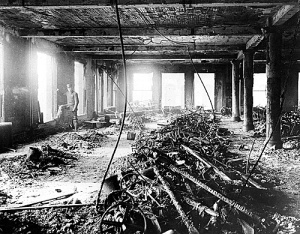
March 25, 1911: A fire strikes the Triangle Shirtwaist Factory in New York's Greenwich Village, killing 146 people, and sparking the modern labor rights movement.

Since the 1930s, "the Garment District" has been considered to be between 5th and 9th Avenues, from 34th to 42nd Streets. Before that, it was at the northern edge of Greenwich Village. This included the Triangle Waist Company -- the official name of the company -- on the 8th, 9th and 10th floors, the top 3, of the Asch Building, at 23 Washington Place (roughly, 5th Street), on the corner of University Place between 4th and 5th Avenue, a block east of Washington Square Park.

Owned by Max Blanck and Isaac Harris, Triangle produced women's blouses, then called "shirtwaists," hence it was widely known as "The Triangle Shirtwaist Factory." Blanck was the contractor who got the material into the factory, Harris the design expert. Harris married a cousin of Blanck's wife.

They went into business together in 1900, and opened the factory in 1902. It normally employed about 500 workers, almost all women and teenage girls, most of them immigrants from Italy and the Jewish sectors of Central and Eastern Europe. By 1908, they had made over $1 million, and were making 1,000 shirtwaists a day.

Harris lived in a townhouse on West 101st Street, when the Upper West Side was pretty much still being built, and had the cachet that the Upper East Side would later have. Blanck bought a mansion on Ocean Parkway in Brooklyn. Both were chauffered in automobiles, which most people didn't have yet.

There was a labor movement in America at the time, but it was weak. As a result, there were what came to be called "sweatshops," and Triangle had one of them. These women worked 9 hours a day, plus 7 more on Saturdays, 52 hours a week. They got between $7.00 and $12.00 for that week -- in today's money, $201 to $345. Multiply that by 4 weeks, and it's $804 to $1,380 a month. Not enough to rent an apartment anywhere in the New York Tri-State Area, especially in Manhattan. They had already gone on strike in 1909, and in early 1910 caved in to most of the women's demands, but still refused to let union organizers into the building.

And the women were working on a Saturday, March 25, 1911. Blanck was then 42 years old, Harris was 46, and most of the women working there were half their age or less, some as young as 14.

At 4:40 PM, 20 minutes before quitting time, a fire started on the 8th floor. As with the General Slocum fire on the East River 7 years earlier, the Fire Marshal concluded that it was probably an unextinguished cigarette or match that started it all. And with all the scraps of cloth, it was easy for the fire to spread.

There was no fire alarm inside the building. At 4:45, a passerby on Washington Place saw the smoke, and found a fire alarm. A bookkeeper on the 8th floor used a telephone to contact the 10th floor, but there was no connection to the 9th floor. Yetta Lubitz, a survivor, said that the 1st warning on the 9th floor was the fire itself.

There was a stairway to Greene Street, but the fire had already gotten to it. That's circumstance. The door to the stairway to Washington Place had been locked, to prevent early exits by the workers, for managers to check the women's purses for thefts, and to prevent union organizers from getting onto the factory floor. That's negligence.

The foreman and some employees escaped quickly. A few others got into the elevators and got down to the ground floor before the elevators were shut down. (Using an elevator to get out of a fire is dangerous, because smoke and flames can go up the shaft. In this case, it was the only available option.) There was one exterior fire escape, but it collapsed under the weight of would-be escapees, and 20 of them died.

The fire department, still using horse-drawn engines, got there quickly, but had trouble getting close to the building because of the dead bodies at the building's foot. And their ladders were only long enough to reach the 7th floor.
One hundred and forty-six deaths in a matter of minutes. To put that in perspective: According to the 1910 Census, New York City had a population of 4.7 million. According to the 2020 Census, it's 8.8 million. So it would be as if 270 people died today. That's about 1/10th as many as in the worst building fire in the City's history, on 9/11.

Blanck and Harris, themselves Jewish immigrants, got out early. They were indicted on manslaughter charges, but were acquitted, because the jury believed the prosecution had failed to prove that the owners knew the key doors were locked. In 1913, a civil suit found them liable of wrongful death, and were fined $75 per family of suing victim. Not much of a price to pay. 
Blanck (left) and Harris

Peter Liebhold, a historian with the Smithsonian Institution in Washington, has said, "What is rarely told, and makes the story far worse, is Triangle was considered a modern factory for its time. It was a leader in the industry, not a rogue operation." In other words, if this was the best that the industry could do, then how bad was the worst?

Triangle went out of business in 1918, not so much because of World War I, but because fashions had changed to the point that not enough women were still wearing "shirtwaists." Finally, in 1923, Blanck was convicted on grand larceny charges, and sentenced to 6 months to 3 years in State Prison. I can find no record of when Blanck and Harris died, but both did so well after 1911, unlike 146 of their employees.

The International Ladies' Garment Workers' Union organized a march on April 5, 11 days after the fire. It was attended by 80,000 people. The New York State legislature formed a Committee on Public Safety, which included an eyewitness to the fire, Frances Perkins.

From the 1850s to the 1960s, the Democratic Party in the State of New York, and especially in the City of New York, was run by a "political machine" called Tammany Hall, which got a lot of things done, often with corrupt means. In 1911, it was run by Charles F. Murphy, who saw a chance to strike at Republican leaders in both City Hall and the State capital of Albany.

The Assembly's Majority Leader was one of Murphy's guys, Alfred E. Smith. The State Senate's Majority Leader was Robert F. Wagner. They held hearings in Albany, inviting would-be social reformers to testify, and subpoenaing the negligent bosses. They got several labor and fire reforms passed into law.

Smith was elected Governor in 1918, and made Perkins one of his chief advisors. Wagner was elected to the U.S. Senate in 1926. When Smith was nominated for President in 1928, Franklin D. Roosevelt was nominated for Governor. Smith lost in a landslide, FDR won in a squeaker. In 1932, FDR was elected President, and named Perkins Secretary of Labor, the 1st woman in the Presidential Cabinet. Wagner wrote the bills that became the Social Security Act and the National Labor Relations Act, and FDR signed them into law. Wagner's son, Robert F. Wagner Jr., was elected Mayor of New York in 1953, 1957 and 1961.

Rose Freedman, the last survivor of the Triangle Shirtwaist Factory Fire, died on February 15, 2001, at the age of 107.

You might guess that the City ordered the demolition of the Asch Building as unsafe. Asch to ashes, dust to dust, as it were. But that guess would be wrong. In fact, it still stands today, and hosted a 100th Anniversary commemoration on March 25, 2011.
*

March 25, 1911, as I said, was a Saturday. Jack Ruby, assassin of Lee Harvey Oswald, the accused assassin of President John F. Kennedy, was born on this day.

Professional football was in its infancy, college football was the dominant form of the game, and both were in their off-season anyway. There was hardly any professional hockey, almost no hockey at all in the United States. There was no professional basketball at all. And baseball? Its season wouldn't start for another 3 weeks.

But there was a score on this historic day. It was a postseason exhibition. The team that had won the Stanley Cup on March 10, the original version of the Ottawa Senators, who had also won it in 1903, 1904, 1905 and 1909, invited the Montreal Wanderers, who had won the Cup in 1906, 1907, 1908 and 1910, on a postseason tour of the United States, to help grow the game here.

On March 20, they played at the St. Nicholas Rink in New York, also known as the St. Nicholas Arena, at 66th Street and Broadway, off Lincoln Square. It was demolished in the 1980s, to make way for the current ABC network studios. The Senators won, 7-2. The next day, also at St. Nicholas, the Wanderers won 8-5.
Then they headed north, to play at the Boston Arena, now the oldest active sports arena in North America, known as Matthews Arena and run by Northeastern University. On March 22, the Wanderers won 7-5. And on March 25, mere hours after the Triangle Fire, the Senators beat the Wanderers, 8-4. I wish I could find a record of the attendance at these matches, but I can't.

Also on that day, Woolwich Arsenal beat Bristol City, 3-0 at the Manor Ground in Plumstead, Southeast London.

Wednesday, March 16, 2022

March 17, 1906: Hockey's "Greatest Game Ever Played"

The 1906 Wanderers. Lester Patrick is in the center
of the top row of players.

March 17, 1906: A hockey game is played. It gets called the sport's "greatest game ever played." Maybe, by the standards of the time, it was. But it would be surpassed, many times over. Still, some game had to be the first "game of the century" in the sport.

And what's really weird by modern standards is, the team that got clobbered in it was declared the champions.

The Eastern Canada Amateur Hockey Association was wrapping up its 1st season, and there was a tie for 1st place, between the Montreal Wanderers and the Ottawa Hockey Club, both of whom finished 9-1. Although the Ottawa HC never deviated from that official name, by the time of their 1st Stanley Cup win in 1903, they were known as "The Silver Seven." By 1908, they were nicknamed the Senators, and it is by this name that they would become best known.

(Yes, "Silver Seven." At the time, there were 7 players on the ice, including a "rover," who switched between offense and defense. The National Hockey Association, the 1st pro league, founded in 1910, didn't use it, and most leagues stopped by the 1920s.)

The 9 most-used members of the Silver Seven were goaltender Billy Hague; defensemen Harvey Pulford (also their Captain) and Arthur Moore; rovers Frank McGee and Harry "Rat" Westwick; centers Tommy and Harry Smith; and wingers Alf Smith (also their head coach) and Billy Gilmour. Alf and Tommy Smith, Pulford, McGee, Westwick, Gilmour would be elected to the Hockey Hall of Fame. They had already won the Stanley Cup in 1903, 1904 and 1905.

The Wanderers, known as "the Little Men of Iron," are probably better-remembered today, if only because their Captain, rover Lester Patrick, would go on to coach and manage the New York Rangers. Their memory is also stronger due to a player they would acquire the following year, defenseman Art Ross, who would go on to coach and manage the Boston Bruins. Each man would eventually have an NHL Division and an NHL trophy named for him. And yet, for all they achieved as what the Hockey Hall of Fame calls "Builders," they were elected as "Players." This would also be true for Jack Adams, later the coach and general manager of the Detroit Red Wings.

Joining Patrick (and eventually Ross, and another 1907 Wanderer, William "Hod" Stuart) in the Hall of Fame, were forwards Frank "Pud" Glass, Ernie "Moose" Johnson and Ernie Russell. Oddly, Cecil Blachford, both their Captain and their head coach, has not been elected. Nor have their defensemen, Billy Strachan and Rod Kennedy; or their goaltender, Henri "Doc" Menard.

They finished in a tie for the title. Each team had handed the other their only loss. So the Stanley Cup would be decided by a tiebreaker series: Two games, one at each team's home rink, totals goals to decide it. Game 1 was a wipeout, as the Wanderers won, 9-1 at the Montreal Arena. Russell scored 4 goals, Glass 3, Johnson 2.

Game 2 was played at Dey's Arena in Ottawa, in front of 5,400 fans, believed to be a record for a hockey game at that point. Among the attendees was Albert Grey, the 4th Earl Grey, Governor-General of Canada (representative of the country's head of state, King Edward VII of Britain), and the man who would go on to donate the championship trophy for Canadian football, the Grey Cup. (His grandfather, Charles, the 2nd Earl, is the namesake of Earl Grey tea. Lord Stanley of Preston, who had donated the Stanley Cup in 1893, had also been Governor-General.)

All the Wanderers had to do to win the Stanley Cup was avoid losing this game by 8 or more goals. But that proved difficult, as the Silver Seven took advantage of the home ice and the home crowd. They also took advantage of a rule that allowed them to "bring in a ringer," Percy LeSueur, the goalie from the Smiths Falls Senators of Smiths Falls, Ontario, about 50 miles southwest of Ottawa. LeSueur would go on to the Hall of Fame.

Still, Johnson scored 12 minutes in, to give the Wanderers a 9-goal lead. But then, the Silver Seven exploded. Before the 1st half ended (they played 2 halves then, not 3 periods), McGee scored twice and Harry Smith once. In the 2nd half, Harry scored, Westwick scored, and Harry scored 3 more goals. The last of these came with 10 minutes to play, tying the series at 10-10 on aggregate, and bringing a 5-minute standing ovation.

But history would not remember the Wanderers for the greatest choke in hockey history. Patrick pulled their fat out of the fire, scoring with 90 seconds left, and then once more just before time expired. The Silver Seven had won the game, 9-3; but had lost the series, 12-10.

The next day's edition of the Toronto Globe called Game 2 the "greatest game of hockey ever played on Canadian ice, or any other." The Sporting News would later call it the "Greatest Hockey Game in History."

At some point during the game, Earl Grey's top hat had been knocked off. A fan found it, and, after the game, gave it to the Wanderers' Moose Johnson.

The Wanderers would lose the Cup to the Kenora Thistles in 1907, then regain it later that year, and win it again in 1908 and 1910. They would join the NHA in 1910 and the NHL in 1917, but the Montreal Arena burned down during their 1st season, and they went out of business.

The Silver Seven/Senators rebuilt, and won the Cup in 1909 and 1911. They would also be founding members of the NHA and the NHL, winning the Cup in 1920, 1921, 1923 and 1927. But the Great Depression did them in, and they moved in 1934, becoming the St. Louis Eagles, playing 1 season, and folding.

*

March 17, 1906 was a Saturday. Baseball was in Spring Training. Football was out of season. Professional basketball barely existed. In English soccer, Woolwich Arsenal, eventually to become the North London team I would support, beat East Midlands team Derby County, 1-0 at the Manor Ground in Plumstead, South-East London.

Saturday, February 26, 2022

February 26, 1908: The Hudson Tubes (PATH System) Open

February 26, 1908: The Hudson Tubes open, providing a subway link between New York City and the New Jersey cities of Hoboken, Jersey City, Harrison and Newark. 

Construction had begun in 1873, but it was a long process, with many accidents, including one in 1880 that killed 20 workers. In 1883, the project was abandoned.

The Hudson and Manhattan Railroad Company bought the rights to resume construction in 1902. It was run by William Gibbs McAdoo, who would later marry Eleanor Wilson, daughter of President Woodrow Wilson, and serve as his Secretary of the Treasury. They built a tunnel under 6th Avenue from 33rd Street in Midtown, just south of Herald Square, to 9th Street in Greenwich Village, then turned right under Christopher Street, then crossed the Hudson River.

From there, the tubes turned in 2 different directions. The northward tube went to Hoboken, and connected with the Erie-Lackawanna Railroad Terminal, now the Hoboken Terminal of New Jersey Transit. The southward tube opened in 1912, going to Jersey City, with stops at Newport-Pavonia, Grove Street, and Journal Square.

The H&M's plans to link the system to Grand Central Terminal in Manhattan, the Communipaw Terminal of the Central Railroad of New Jersey in Jersey City, and through Newark all the way to Montclair were abandoned. But in 1937, the line was extended to Harrison, and then across the Passaic River to Newark's Pennsylvania Station.

By 1962, the H&M was bankrupt, and was bought out by the Port Authority of New York and New Jersey. The Hudson Tubes were rebranded as the Port Authority Trans-Hudson, or PATH, system, although there are still a few tiled signs in the system mentioning "HUDSON TUBES" or "H&M."

In 1971, with the World Trade Center under construction, PATH extended the system to Exchange Place in Jersey City and to the World Trade Center. A plan to extend the Newark portion of the line to Newark International Airport and all the way to Plainfield was abandoned, paving the way for the creation of New Jersey Transit, which took over a Jersey Central line and turned it into the Raritan Valley Line, which included 2 stations in Plainfield, and going further into Somerset and Hunterdon Counties, terminating at High Bridge.

There have been 4 fatal incidents aboard the system:

  • On July 22, 1923, a collision near Manhattan Transfer killed one person and injured 15 others.
  • On April 26, 1942, a six-car H&M train derailed at Exchange Place. Five people were killed and 222 more were injured. A subsequent investigation found that the motorman was intoxicated.
  • On December 17, 1945, a seven-car H&M train collided with a steel barrier on the Dock Bridge west of Harrison, killing the motorman and injuring 67 passengers.
  • On July 23, 1963, a PATH train collided with a Pennsylvania Railroad engine east of Harrison, killing two passengers and injuring 28 more.

In 2017, the PATH system was used as a film substitute for the New York Subway for a scene in the film John Wick: Chapter 2.

The idea of extending the line to Newark Airport was renewed in the 2000s, and was approved in 2017, with construction set to begin in 2020, with service to be inaugurated in 2025. Then the COVID epidemic hit in March 2020, putting everything on hold. As of February 26, 2022, it's not clear when construction will begin.

UPDATE: The Port Authority announced in March 2023 that it was deferring funding for the Newark Airport extension to a future capital plan. In 2025, the Hoboken station was closed for a month, so that repairs left over from the 2012 Hurricane Sandy could be made all at once, instead of one weekend at a time over the course of an entire year.

*

February 26, 1908 was a Wednesday. Tex Avery, the animator who helped developed the cartoons of both Metro-Goldwyn-Mayer and Warner Brothers, was born on this day.

Baseball and football were out of season. Professional basketball barely existed. Even hockey was not fully professional. So there were no games on this historic day.

There were challenges for the Stanley Cup that Winter. On January 9 and 13, the Montreal Wanderers, "the Little Men of Iron," featuring later NHL team bosses Lester Patrick of New York and Art Ross of Boston, beat the Ottawa Victorias -- not to be confused with the Ottawa Hockey Club/Silver Seven/Senators. On March 10 and 12, they beat the Winnipeg Maple Leafs -- not to be confused with the later Toronto team of that name. And on March 14, they beat the Toronto Professional Hockey Club, keeping the Cup for another year. 

February 26, 1906: Upton Sinclair Publishes "The Jungle"

February 26, 1906: The Jungle by Upton Sinclair is published. It has a great effect on American life -- but not the one its author intended.

Upton Beall Sinclair Jr. was born on September 20, 1878 in Baltimore, but, due to his father's alcoholism and inability to hold a job, he grew up in many places. He turned out to be a child genius, and, just days before his 14th birthday, living in Queens, he entered City College of New York. He wrote for local magazines, and made enough money to not only pay his tuition -- CCNY did not yet offer free tuition for City residents -- but, by age 17, to pay his parents' rent.

He graduated from CCNY, but then dropped out of Columbia University School of Law to focus on writing. He published his 1st novel, King Midas, in 1901. By 1904, he had written 4 novels, 3 with a Socialist theme, and Manassas, a story of the American Civil War.

That year, for 7 weeks, he worked undercover in Chicago's meatpacking plants to see the working conditions. The result was The Jungle, which exposed those conditions, and the lives of the immigrants working there, many of whom continued to work while sick, because they couldn't afford not to. The novel was serialized in the Socialist newspaper Appeal to Reason the following year, and published in novel form the year after that.

What Sinclair wanted was to have America see that unregulated capitalism was destroying the lives of its workers, and call upon their government to do something about it. What he got was very different: Most people were appalled not by the working conditions and the living conditions on the South Side of Chicago and its slums, but by the process of the production of food.

It was like reading Moby Dick and moving toward electricity because whale oil is hard to obtain, instead of learning the lesson that when you seek revenge, you should dig two graves. Or reading On the Road, and instead of realizing that "kicks" are temporary, while art is forever, and beauty, friendship and love are what you should really seek, you go out and buy a car and drive out to California. Or reading All the President's Men, and instead of demanding that your government not do things like what the Nixon Administration did in Watergate, believing that all government is corrupt, and you need a "white knight" to fix it all, and turning to Ronald Reagan -- or Donald Trump.

The President then, Theodore Roosevelt, launched an investigation of the meatpacking industry. This led to the Pure Food and Drug Act, which revolutionized food safety. Sinclair wrote that this was not enough, and he considered it a way of buying the meat and meatpacking barons off.

Nevertheless, TR publicly said that a Republican crook is as bad as a Democratic crook. In a 1907 speech, he denounced "malefactors of great wealth," going on to say that there was a great contest between himself and them: "I regard this contest as one to determine who shall rule this free country: The people through their governmental agents, or a few ruthless and domineering men, whose wealth makes them peculiarly formidable, because they hide behind the breastworks of corporate organization."

Sinclair didn't give up, ripping one great industry after another with his books: Wall Street in The Moneychangers in 1908, King Coal in 1917, education with The Goslings: A Study of the American Schools in 1924, Oil! in 1927 (which would be adapted into the 2007 film There Will Be Blood), the American justice system in Boston the same year (in the wake of the execution of Nicola Sacco and Bartolomeo Vanzetti), and the auto industry in The Flivver King: A Story of Ford-America in 1937 (in the wake of Henry Ford's private armies firing on pro-union demonstrators).

One of the oil barons he detested was Harry Sinclair, who was also a sports mogul, running the Indianapolis-turned-Newark franchise of the Federal League, and breeding horses that, between them, won 3 Kentucky Derbies and 3 Belmont Stakes. He spent 6 months in prison for jury tampering during the Teapot Dome scandal. He and Upton Sinclair were not related.

Nor was either related to Sinclair Lewis, 7 years younger, who spent most of the 1920s publishing similar exposés of American life, and published anti-fascist literature in the 1930s. Sinclair Lewis admired Upton Sinclair, who nonetheless wrote to him and offered a criticism alternately glowing and stinging, but, in my opinion, accurate in both cases:

Everything of yours that I have read is about half and half… Wherever you are writing about the underworld, you are at your best, and when you come up to your own social level or higher, you are no good.

In 1934, with TR's cousin Franklin Roosevelt having become President and implemented the early part of his New Deal, Upton Sinclair left the Socialist Party and joined the Democratic Party, and ran for Governor of California. He called his movement EPIC: End Poverty In California. Although he had no experience in public office, he meant it, and people believed that he meant it.

No one believed it more than the Hollywood studio bosses, all of them conservative Calvin Coolidge-style, FDR-hating Republicans because they were very wealthy. They used the media, including the San Francisco-based empire of William Randolph Hearst (once a Democratic Congressman representing a district in New York City, but now one of the most conservative men in America), to make false propaganda claims, including the idea that a Governor Sinclair would turn California "Communist." They also pressured their employees to vote for the incumbent Republican Governor, Frank Merriam.

Merriam won with 48.9 percent of the vote, the Sinclair's 37.8, and Progressive Party nominee Raymond Haight's 13.0. In popular votes, Merriam won 1,138,000 to Sinclair's 879,000. Of California's 58 Counties, Sinclair won only 6, while Haight won 3.

Because of the 3-way vote, Sinclair didn't top 46 percent in any County, topping out at 45.6 in Contra Costa County, in the East Bay across from San Francisco. He got 42.0 percent in Los Angeles County, and 38.9 percent in San Francisco County (contiguous with the City of San Francisco), 37.7 percent in Alameda County (including Oakland and Berkeley), and 36.6 percent in San Diego -- but didn't win any of those big Counties. Haight's presence on the ballot didn't cost him the election; the Red-baiting media buy did.

In 1951, the year that Sinclair Lewis died, Upton Sinclair wrote, "The American People will take Socialism, but they won't take the label. I certainly proved it in the case of EPIC... I think we simply have to recognize the fact that our enemies have succeeded in spreading the Big Lie. There is no use attacking it by a front attack, it is much better to out-flank them."

He died in a nursing home in Bound Brook, Somerset County, New Jersey on November 25, 1968, a few weeks after his 90th birthday. Ironically, Bound Brook was then, and for many years thereafter, the home of the publishing house for the extreme right-wing John Birch Society. He is buried in Rock Creek Cemetery in Washington, D.C.

*

February 26, 1906 was a Monday. Baseball was about to start Spring Training. Football was in the off-season. Basketball and hockey were still all-amateur. There were no games on this historic day. However, the next 2 days saw a challenge for the Stanley Cup, then a "challenge trophy": You won the series, you got the Cup.

The Ottawa Hockey Club, a.k.a. the Silver Seven and forerunners of the original Ottawa Senators (who went out of business in 1934, during Upton Sinclair's campaign for Governor), defeated Queen's University of Kingston, Ontario, 16-7 on February 27, and 12-7 on February 8, to retain the Cup.

On March 6 and 8, they defeated Smiths Falls Hockey Club to keep the Cup again. Then they took on the Montreal Wanderers, a bunch of small but tough guys known as "The Little Men of Iron." Featuring future NHL team bosses Art Ross and Lester Patrick on defense, the Wanderers beat Ottawa 9-1 in Montreal on March 14. Ottawa won 9-3 in Ottawa on March 17. But since it was a two-games, total-goals series, Montreal beat Ottawa on aggregated, 12-10, and won the Cup. It was the 1st of 4 times in 5 years that they would win it.

Thursday, January 20, 2022

January 21, 1907: The Kenora Thistles Win the Stanley Cup

The 1907 Kenora Thistles. Notice that the Stanley Cup
is little more than a bowl at this point.

January 21, 1907: The Kenora Thistles win the Stanley Cup. If you've never heard of them, that's probably due to the distance of time. Maybe they would have stood out more if they still used the name their city used until 1904: Rat Portage.

The history of the name extends beyond the time of white settlers arriving in the region. The name Rat Portage had its origin in the Ojibwa name Waszush Onigum, which, roughly translated, means portage to the country of the muskrats. A shortened and somewhat corrupted version, Rat Portage, was adopted by the Hudson’s Bay Company in naming their post, then located on Old Fort Island on the Winnipeg River. When the post was moved to the mainland and a town grew up around it, the name Rat Portage was assumed by the community.

The town of Rat Portage was renamed in 1905 by using the first two letters of itself and the neighboring towns of Keewatin and Norman to form the City of Kenora. According to Canada's 2021 Census, it has a population of 14,967. It was roughly the same in 1907, so it was, and remains, the smallest municipality ever to win the Stanley Cup.

It is on the Lake of the Woods in southwestern Ontario, 1,160 miles northwest of Toronto. It's considerably closer to Winnipeg, Manitoba: 130 miles east. It's 135 miles northwest of the U.S. border crossing at International Falls, Minnesota; 250 miles northeast of Grand Forks, North Dakota; 300 miles northwest of Duluth; 330 miles northeast of Fargo; and 430 miles north of Minneapolis. In other words, it's one of those places that nobody discovers by accident: You have to want to go there.

The Rat Portage Thistles were founded in 1894, and changed their name to the Kenora Thistles with the city. The players chose "Thistles" because they were mostly of Scottish heritage. For distance reasons, they joined the Manitoba Hockey Association instead of the Ontario Hockey Association. They won league titles in 1901, 1903 and 1905. In 1903 and 1905, they challenged the Ottawa Hockey Club for the Stanley Cup, but lost both times.

They were MHA Champions again in 1906, but scheduling issues meant that they couldn't challenge the Montreal Wanderers, who had dethroned Ottawa, until January 1907. Taking advantage of the new professionalism of their league, the club hired Art Ross and Joe Hall from the Wheat City Hockey Club of Brandon, Manitoba. (Since 1936, that city has had a junior team called the Brandon Wheat Kings.)

So the Thistles took the ice with Eddie Giroux in goal, Art Ross and Silas "Si" Griffis on defense, former Ottawa star Harry "Rat" Westwick as "rover" (hockey was 7-a-side back then), and a forward line of Billy McGimsie centering team Captain Tommy Phillips on the left and Roque "Roxy" Beaudro on the right.

The Wanderers, nicknamed "the Little Men of Iron," and also mostly staffed by Scots, had William "Riley" Hern in goal, Rod Kennedy and William Hodgson "Hod" Stuart on defense, Captain Lester Patrick as rover, and Ernie Russell centering Ernie "Moose" Johnson on the left and Frank "Pud" Glass on the right. Jack Marshall was a spare player. Center Cecil Blachford was injured in their previous series against Ottawa.

It was a two-games-total-goals series, with both games played at the Montreal Arena. On January 17, 1907, the Thistles won, 4-2. On January 21, the Thistles won again, 8-6. So the Thistles swept, and won, 12 goals to 8.

On their return to Kenora later in January, the Thistles were warmly received: A reception at the Opera House saw each player given a commemorative cup by the city, among other gifts. The team's dire financial situation meant that an admission was charged for the celebratory banquet, unusual for similar events at the time.

There were signs of improved finances, though. The owners of the Victoria Rink, where the team played, stated their intention to build a 4,000 to 5,000-seat replacement rink. This would have made it the largest rink west of Toronto, and dwarfed the 1,000-seat Victoria Rink then in use. This was suggested as a solution to the team's financial issues, since they would earn a portion of each ticket sold.

Since the Cup was still a challenge trophy, the Thistles were challenged by Brandon Wheat City. In games played at the Winnipeg Auditorium, the Thistles won 8-6 on March 16, and 4-1 on March 18. The Wanderers challenged the Thistles right after this, and objected to the conditions at the Victoria Rink, so the games were again played at the Winnipeg Auditorium. The Wanderers won on March 23, 7-2. The Thistles won on March 25, 6-5, but this was not enough, as the Wanderers won on aggregate, 12 goals to 8.

Following the tradition that had already been established with the Cup's introduction in 1893, the Wanderers had their names engraved on the Cup. Unlike previous winners, who wrote on the side of the bowl, the Wanderers had the result and their players' names engraved inside it, on the bottom of the bowl. The inscription is still there today.
Beaudro, Geroux and McGimsie retired before the 1907-08 season. Tommy Phillips was signed by Ottawa. Unable to compete with rising professionalism, and unable to get the new arena they were told they would get from the city, the Thistles fell apart, and folded at the end of the season.

Ross, Hall, Griffis, McGimsie, Phillips, Hern, Stuart, Patrick, Russell, Johnson, Marshall and Blachford would all be elected to the Hockey Hall of Fame. Ross and Patrick were elected as players, but would become better known as coaches and executives, with the Boston Bruins and the New York Rangers, respectively. Phillips and Stuart were among the charter inductees into the Hockey Hall of Fame in 1945.

A new Kenora Thistles played in the Manitoba Junior Hockey League from 1926 to 1940. Another played from 1952 to 1959, winning an intermediate amateur title in 1953. The Kenora Muskies were founded in the MJHL in 1968, won a regular-season title before losing in the Playoffs in 1971, changed their name to the Kenora Thistles in 1975, and folded in 1982.

Yet another Kenora Thistles played in a league named Hockey Northwestern Ontario, founded in 2006, and won division titles in 2010, '11 and '12, before folding  in 2016. The current Thistles play in the Manitoba U-18 AAA Hockey League.

*

January 21, 1907 was a Monday. There were no other scores on this historic day: Baseball and football were out of season, and basketball was all-amateur.

Thursday, January 13, 2022

January 13, 1908: The Rhoads Opera House Fire

January 13, 1908: A fire breaks out at the Rhoads Opera House in Boyertown, Pennsylvania. A capacity crowd of 400 people was in attendance, and 171 of them died.

Boyertown is in coal-mining country, 17 miles east of Reading, 47 miles northwest of Center City Philadelphia, and 110 miles southwest of Midtown Manhattan. The Opera House -- really just an auditorium on the 2nd floor of what had been a factory building -- had been financed by local businessman Dr. Thomas Rhoads.

The play being performed that night was The Scottish Reformation by Harriet Earhart Monroe, who was heavily involved in the production. A slide (magic lantern) show and lecture were presented at intermission, to provide historical background for the play.

The fire started when a kerosene lamp being used for stage lighting was knocked over, starting a fire on the stage. In short order, the spreading fire ignited a mixture of lighting gas and oxygen from a malfunctioning stereopticon machine being used to present the magic lantern show. Audience members waited for the fire to be extinguished by theatre personnel, wasting the precious minutes they needed to escape safely.

Among the victims was Monroe's sister, Della Earhart Mayers, 51, who was involved in the production. Monroe lived until 1927, age 84.

No criminal charges were filed in connection with the fire, and $22,000 in relief funds were raised for the families of the victims. The Pennsylvania legislature passed new fire laws, and Governor Edward Stuart signed them into law on May 3, 1909.

*

January 13, 1908 was a Monday. There were no scores on this historic day. But the next day, the Montreal Wanderers would begin their defense of the Stanley Cup in a two-games-total-goals series against the Ottawa Victorias. Both games were played at the Montreal Arena, and "The Little Men of Iron" left no doubt: On January 9, the Wanderers won, 9-3. On January 13, the Wanderers won, 13-1.

Saturday, January 1, 2022

January 2, 1908: The Hod Stuart Benefit Game

January 2, 1908: A benefit game is played for the family of the late Hod Stuart. It is generally considered to be hockey's first all-star game.

William Hodgson Stuart was born on February 20, 1879 in Ottawa, Ontario, the capital of Canada. He played football for the Ottawa Rough Riders, but hockey was his best sport. After playing for teams in Ontario, he and his younger brother, Bruce Stuart, helped to introduce professional hockey to America, playing for the Pittsburgh Bankers, winning a league title in 1903.

Noted for his clean play, he was unhappy with the violence in American games, and, at the end of 1906, signed with the best team in Canada at the time, the Montreal Wanderers, "the Little Men of Iron." The Montreal Star quoted him from Pittsburgh: "I can get more money here, but I am coming to the Wanderers." He did, and, as the Cup was then a challenge trophy, he won his 1st with the Wanderers on December 27, 1906. They subsequently lost it to the Kenora Thistles, but, in a new challenge, beat the Thistles to reclaim it on March 25, 1907, at the Winnipeg Auditorium.

That was to be Hod Stuart's last game. On June 23, 1907, he was swimming with friends near Belleville, Ontario when he swam to a nearby lighthouse ,and climbed onto a platform. He then dived head first into the water, hitting his head on rock, gashing his head and breaking his neck. He was killed instantly.

When the Hockey Hall of Fame was established in 1945, Stuart was 1 of the 1st 9 players elected. His brother Stuart was elected in 1961.

Teammate Lester Patrick, who with his brother Frank (another pair of brothers in the Hall of Fame) would go on to grow the sport tremendously in Western Canada, and later became the 1st head coach and general manager of the NHL's New York Rangers, recalled:

I was walking uptown, crossing Dominion Square, when I met somebody. I’ve forgotten who he was, but he stopped me and said, "Did you hear the news?" I said, "What news?" He told me Hod Stuart was dead. I couldn’t believe it. Hod had been like an elder brother to me. We were more than friends. He had taught me a lot about hockey, and a lot about life. He had helped me to keep straight. I could hardly have been more deeply affected had a member of my own family been so suddenly taken. It broke me all up.

To raise money for Stuart’s widow and two children, the Eastern Canada Amateur Hockey Association (ECAHA) decided to hold an first All-Star game, a rarity for any sport at that point. It is sometimes credited as the first in any sport, ever, but this is not true: Baseball had one as far back as 1902, and had been holding benefit games (though not necessarily "all-star games") since at least 1873.

Nevertheless, the Westmount Arena, on the western edge of Montreal, agreed to host the game rent-free, so that all the gate receipts went to the Stuart family. On January 2, 1908, 3,800 fans attended. The Wanderers had future Hall-of-Famers Art Ross, Riley Hern, Ernie Russell and Ernie Johnson. (Ross was later the first head coach and general manager of the NHL's Boston Bruins, but, like Lester Patrick, good enough of a player to be elected as such despite his later, greater contributions in management)
Westmount Arena

They played a team whose players were selected by fans via mail, and included future Hall-of-Famers Percy LeSueur of the Ottawa Hockey Club (nicknamed the Silver Seven, and later renamed the Ottawa Senators), the aforementioned Frank Patrick of the Montreal Victorias, and Jack Marshall of the Montreal Shamrocks. Rod Kennedy of the Montreal Victorias was also on the All-Star team, and he and Marshall had both previously played for the Wanderers.

The Wanderers were used to playing together. According to the Montreal Gazette: "In the first half, it was all Wanderers. The Stars had not found their feet, suffering, just as might be expected, of a seven that had never played together before, from lack of familiarity with one another’s style of play."

The All-Stars battled back. According to the Ottawa Journal: "The second half seemed a little more exciting in the beginning. Patrick and Kennedy changed about in the position of point and cover-point and the All-Star men worked harder than in the first half." The All-Stars closed the gap, but the game ended 10-7 to the Wanderers. The Manitoba Morning Free Press wrote: "The game, although nominally a friendly one, bore all the marks of a cup contest, but was clean throughout, only two players being penalized."

The game raised $2,100 for the Stuart family. With inflation, that works out to about $53,000 in 2022 Canadian dollars. With the exchange rate, it's about $40,600 in American dollars.

Ten years later, to the day, January 2, 1918, a fire that began in, of all places, the ice-making plant caused the Westmount Arena to burn down. The National Hockey League was in its first season, and the Wanderers were members. Despite having won 4 Stanley Cups, they never played again.

*

January 2, 1908 was a Thursday. No other sporting events were held in North America. Therefore, this was the only score on this historic day.

December 31, 1999 & January 1, 2000: The Millennium

December 31, 1999:  The Millennium arrives. The people of planet Earth survived. At a terrible cost. But we hadn't destroyed ourselves. ...