Showing posts with label tex rickard. Show all posts

Monday, November 28, 2022

November 28, 1925: The "Old" Madison Square Garden Opens

November 28, 1925: Madison Square Garden, the 3rd building with the name, opens between 49th and 50th Streets, between 8th and 9th Avenues, in Midtown Manhattan, at the northern end of the Theater District. The front entrance is on 8th Avenue, topped by a marquee that will soon be world-famous.
Note: This was also the day that The Grand Ole Opry radio show premiered on Nashville radio station WSM. I have a separate entry for that event.

The 1st Garden was built at the northeast corner of 26th Street and Madison Avenue, catty-corner from Madison Square Park, in 1879. It had no roof. 

It was replaced in 1890 with a Moorish-style building, designed by the renowned architect Stanford White, that not only had a roof, but a tower with a roof garden where shows were hosted, and an apartment for White atop that.

Atop that was a statue of Diana, the Roman goddess of the hunt. This statue, sculpted of gilt copper by Augustus Saint-Gaudens, was nude, and the hoity-toity critics of the day hated it.

One of the nastiest reviews came from a Philadelphia newspaper. Ironically, when the 2nd Garden was demolished, the Diana statue was taken to the Philadelphia Museum of Art (you know, the one whose steps Rocky Balboa ran up), and is still there. A copy now stands in New York's equivalent, the Metropolitan Museum of Art.
For both versions, the bowstring has been lost.
Otherwise, they are intact.

White would take showgirls up to his rooftop apartment, for a pre-movies version of a "casting couch." One was Evelyn Nesbit, whom he then made a star. She left him for a man named Harry Thaw. 

On June 25, 1906, jealous over Evelyn still having feelings for "Stanny," Thaw went to the roof garden during a show, and shot White. Evelyn's star faded: Late in life, she said, "Stanny White died. My fate was worse: I lived."

The New York Life insurance company owned the mortgage on the 2nd Garden, and decided to tear it down to build their new headquarters. George "Tex" Rickard, the top boxing promoter of the era, decided to build his own arena, where he wouldn't have to worry about anybody else's whims. He was lucky that New York Life was willing to sell him the rights to the name "Madison Square Garden": It was already a valuable brand name, which is a big reason why the "new Garden" has never sold naming rights.

When his Garden proved successful, he decided to build 6 copies, all over America. It didn't work out that way: He built the Boston Madison Square Garden in 1928 -- soon, it became simply "The Boston Garden" -- but died early the next year. He had gone to Miami to escape the cold New York weather, and to make a deal on a prizefight featuring up-and-coming heavyweight Jack Sharkey (who would hold the title from mid-1932 to mid-1933), but came down with appendicitis. This was before antibiotics, and he was dead at age 59.

The 1st event at The Garden was a six-day bicycle race. It sounds ridiculous today, but this kind of competition was huge in the "Roaring Twenties," especially in Europe, where it's still popular 100 years later. Teams of 2 men take turns riding for 6 days straight, from 6:00 PM to 2:00 AM, and the winner is the team that completes the most laps.

The 1st prizefight was held on December 8, for the Light Heavyweight Championship of the World. Paul Berlenbach defended the title by winning a unanimous decision over Jack Delaney. The following July, Delaney took the title from Berlenbach in a rematch at Ebbets Field.

Also in 1926, James. A. Farley, Commissioner of the New York State Athletic Commission, got the Madison Square Garden Corporation to allow racially-mixed fights. It was also Farley's insistence that Heavyweight Champion Jack Dempsey fight Harry Wills, the black man who was then ranked the Number 1 contender, or else not fight in the State of New York at all, that led to Dempsey caving in to an audience that didn't want to see such a fight. That led to his epic fights with Gene Tunney being held in Philadelphia and Chicago. Farley went on to become Chairman of the Democratic Party of the State of New York, Chairman of the Democratic National Committee, and the U.S. Postmaster General.

The Garden became known as "The Mecca of Boxing." Heavyweight Joe Louis, light heavyweight Archie Moore, middleweight Sugar Ray Robinson, lightweight Henry Armstrong, and more became internationally-known superstars from their fights at The Garden.

It would also be known as "The Mecca of Basketball," with collegiate doubleheaders starting in 1934. It became a secondary home court for the City's college teams: New York University (NYU), City College of New York (CCNY), Long Island University (LIU), Columbia, Fordham and St. John's.

It also hosted the annual National Invitational Tournament (NIT), starting in 1938. And it hosted what would now be called the NCAA Final Four in 1943, 1944, 1945, 1946, 1947, 1948 and 1950, the last of these won by CCNY, which also won the NIT that year, the only time this "double" was ever achieved. 

The point-shaving scandal the next year crippled college basketball in New York City, and not only led to St. John's, not accused in the scandal, being the only major program that has survived on that level, but the NCAA ruling that teams could no longer compete in both their tournament and the NIT. The Final Four did not return to the New York Tri-State Area until 1996, when it was held at the Meadowlands.

That scandal coincided with the 1st trip to the NBA Finals for the New York Knicks, who debuted at The Garden in 1946. The scandal may have saved the Knicks, and thus may also have saved the NBA: Hoop fans needed something to turn to.

Rickard, who didn't always do things on the up-and-up, offered use of The Garden to Big Bill Dwyer, a bootlegger, who founded a hockey team, the New York Americans. The 1st NHL team in New York debuted on December 15, 1925, losing to the Montreal Canadiens 3-1.

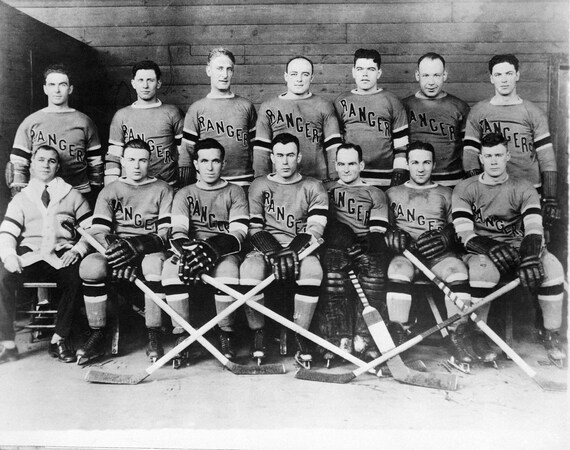
The "Amerks" did so well at the box office that Rickard, noting that New York had 3 Major League Baseball teams, decided that it could support 2 hockey teams. So he founded his own team, and when the media found out, they nicknamed the new team "Tex's Rangers." He decided to go with it, and the New York Rangers debuted at The Garden on November 16, 1926, beating the Montreal Maroons 1-0.

With Rickard's promotional skills, the Rangers proved even more successful than the Americans. World War II knocked the Amerks out, as the manpower drain caused by the American and Canadian military drafts forced them to suspend operations after the 1941-42 season, and they never returned.

But the Rangers, the Knicks, college basketball games, prizefights, circuses, musical performances, ice skating shows, rodeos, and an event that predated even the 1st Garden, the Westminster Kennel Club Dog Show, continued at The Garden through the 1930s, the '40s, and the '50s. Madison Square Garden was right up there with the Empire State Building and Grand Central Terminal as the most famous building in the City.

But poor sight lines, and the need for more space and more dates, proved the arena's undoing. In 1960, the Pennsylvania Railroad, desperate for money, sold the air rights above Pennsylvania Station, between 31st and 33rd Streets and 7th and 8th Avenues, to the Madison Square Garden Corporation. The plan was to build a new station on the site, and a new arena on top of that.

On the afternoon of February 11, 1968, the Rangers played their last game at "the Old Garden," a 3-3 tie with the Detroit Red Wings, which was followed by a final skate with several NHL legends, including the Wings' still-active Gordie Howe. That night, "the New Garden" opened with "The Night of the Century," a salute to the USO, the United Service Organizations, which since 1941 has worked with the armed forces to provide supplies and entertainment. The co-hosts were old film partners and golfing buddies Bob Hope and Bing Crosby.

The last event at the Old Garden was 2 days later, February 13, the Westminster Dog Show. Demolition soon began. The site became a parking lot while various parties haggled over what to build on the site. Finally, in 1989, the 778-foot office and residential tower Worldwide Plaza opened there. The Subway station at 50th Street includes a mural dedicated to the Old Garden.
Worldwide Plaza

*

November 28, 1925 was a Saturday. Baseball season was over. There was no NBA yet. It was the 1st season for the American Basketball League, but that could hardly be called "major league," and I can't find a list of games played there that day. For all I know, there might not have been any.

Three games were played in the NHL. The Pittsburgh Pirates beat the Montreal Canadiens, 1-0 at the Mount Royal Arena in Montreal. The Ottawa Senators beat the Montreal Maroons, 3-2 at the Ottawa Auditorium. And the Boston Bruins beat the Toronto St. Patricks, 3-2 at the Mutual Street Arena. (The St. Patricks became the Toronto Maple Leafs in 1927.)

There were also college football games played that day. Most of them did not involve teams currently in major conferences. But one was the Army-Navy Game, played at the Polo Grounds in Upper Manhattan. Army won, 10-3.

Montana beat Montana State, 28-7 at Montana State's Dornblaser Field in Missoula. Baylor and Rice tied, 7-7 at Rice Field in Houston. And 2 games were played in the Pacific Coast Conference, the league that would eventually evolve into the Pac-12. Washington beat Oregon, 15-14 at Husky Stadium in Seattle. And Washington State beat USC, 17-12 at the Los Angeles Memorial Coliseum.

There was 1 NFL game played on that Saturday. The Frankford Yellow Jackets beat the Green Bay Packers, 13-7 at Frankford Stadium in Northeast Philadelphia. The Jackets won the NFL Championship in 1926, but the Great Depression did them in, and they folded in 1931. The Pennsylvania law banning professional sports on Sunday wasn't repealed until 1933, making the founding and profitability of the Philadelphia Eagles and the Pittsburgh Steelers possible.

The Cleveland Bulldogs were then an NFL team. The Atlantic City Roses were not: They were a semipro team run by the Melrose Athletic Club of Atlantic City, New Jersey. But the Bulldogs played the Roses on this day, winning 12-0 at Bader Field, a minor-league ballpark next to the airport of the same name, where The Sandcastle, later the home of the minor-league Atlantic City Surf, was built.

And in English soccer, Arsenal beat North-East team Sunderland, 2-0 at the Arsenal Stadium, a.k.a. Highbury, in North London.

Thursday, November 17, 2022

November 17, 1928: The Boston Garden Opens

November 17, 1928: The Boston Madison Square Garden opens, on top of North Station, in Boston's North End. It was the 1st of 6 copies of Madison Square Garden in New York that boxing promoter and MSG owner George "Tex" Rickard had planned to build around the country. But Rickard died early in 1929, and this would be the only one that got built.

The 1st event was a boxing card, in which the main event was "Honey Boy" Dick Finnegan, a Boston native, defeating Andre Routis. Three days later, the NHL's Boston Bruins played their 1st game there, losing to the Montreal Canadiens, 1-0. Sylvio Mantha scored the arena's 1st goal, at the end of the 2nd period.
In 1934, the Madison Square Garden Corporation sold the building to the Boston Garden-Arena Corporation, which was bought out by Delaware North Corporation in 1975. From 1934 onward, it was "the Boston Garden," or, in the Boston accent, "the Gah-den."

The NBA was founded in 1946, and the Boston Celtics took up residence there. Both the Celtics and the Bruins remained in the Garden until 1995. From 1955 to 1995, the Beanpot Tournament was held, between 4 local college hockey teams: Boston College, Boston University, Northeastern University and Harvard. In 1978, a blizzard during the Tournament trapped fans inside the Garden. At least there were bathrooms and food, and the food was given out for free until plows could arrive to get the exits accessible.

The Bruins won the Stanley Cup in their 1st season there, 1929; and again in 1939, 1941, 1970 and 1972. The Celtics won the NBA Championship in 1957, 1959, 1960, 1961, 1962, 1963, 1964, 1965, 1966, 1968, 1969, 1974, 1976, 1981, 1984 and 1986.
In total, there were 19 NBA Finals and 16 Stanley Cup Finals played at the Boston Garden. In 1957 and 1958, both leagues' finals were held there.

There were lots of prizefights there, but never one for the Heavyweight Championship of the World. The rematch between Muhammad Ali and Sonny Liston was supposed to be there, on November 16, 1964. But 3 days before, Ali developed a hernia. Re-set for May 25, 1965, concerns over both Ali and Liston led City officials to drop sanction for the fight, and it was moved to Lewiston, Maine.

Since the Garden was designed by Rickard, the seating was set up primarily for boxing. It was not especially good for basketball or hockey. The NHL standard for rink size is 200 feet long by 85 feet wide, but that had not yet been put in place. The Garden's rink was only 191 by 83, and this smaller size gave rise to the rough-house style favored by the team that became known as "the Big Bad Bruins." And for all the advantages the Garden gave his Celtics, longtime coach and general manager Arnold "Red" Auerbach hated the place: "The seating's all cockeyed."

I only saw one event there, and had both horizontal and vertical obstruction: Under the upper-deck overhang and behind a pole. 

The Garden hosted political rallies, including hometown hero John F. Kennedy having his Election Eve rally there on November 7, 1960. Despite Boston being America's most Catholic city, the Garden hosted rallies not just by Bishop Fulton J. Sheen in 1953, but by evangelical Protestants Aimee Semple McPherson in 1931, Billy Graham in 1950, and Jimmy Swaggart in 1983.

And there were concerts. It was 1 of only 16 buildings to have hosted both The Beatles (on September 12, 1964) and Elvis Presley (on November 10, 1971). The most important concert there came on April 5, 1968. The day before, Dr. Martin Luther King Jr. was assassinated in Memphis. Many American cities broke out into riots. James Brown -- already one of America's biggest African-American singers, but a few months away from writing and recording "Say It Loud -- I'm Black and I'm Proud" -- was scheduled to perform at the Garden.

Kevin White, Mayor for just 3 months, was told he should cancel the concert, for fear that the mostly-black audience would riot. But he knew that a riot was more likely if the concert was canceled. He talked to Brown, and an idea was hatched: The concert would be broadcast live on public TV station WGBH-Channel 2, and anyone who didn't have a ticket was urged to stay home and watch it on TV. The concert went off without a hitch.

Other notable concerts included a "battle of the bands" between the orchestras of Rudy VallĂ©e and Benny Goodman in 1938; an Alan Freed Show in 1956, the arena's 1st rock concert; a 1972 show where Stevie Wonder opened for The Rolling Stones, and had to play for hours because the Stones had been detained in Rhode Island, and needed Mayor White's intervention to get them to Boston, arriving around midnight; several shows by New Englanders Aerosmith and The J. Geils Band; and, more than any other act, 24 times from 1973 to 1994, The Grateful Dead.

The Garden seated 14,890 for basketball, and 14,448 for hockey. There was no air-conditioning, leading to the famous scene of Los Angeles Lakers star Kareem Abdul-Jabbar needing oxygen on the bench during Game 5 of the 1984 NBA Finals. And there were power outages during the Stanley Cup Finals of 1988 and 1990.

A new arena was badly needed. Massachusetts, and especially Boston, politics being what they are, it took a while to secure funding. Finally, in 1993, construction began on the replacement, still on Causeway Street above North Station, but behind the Garden.

The last Celtic game was on May 5, 1995, Game 4 of the 1st Round of the NBA Playoffs, losing to the Orlando Magic, 95-92. The last Bruin game that counted was on May 14, 1995, Game 5 of the NHL Eastern Conference Quarterfinals, losing to the New Jersey Devils, 3-2. The last goal was scored by the Bruins' Adam Oates.

On September 26, 1995, a preseason exhibition marked the Garden's last event. The Bruins played the same team they played in the opener, 67 years earlier, the Montreal Canadiens. The Bruins won, 3-0, and Cam Neely scored the real last goal. Afterward, there was "One Final Skate" by Bruin legends, including Bobby Orr, Phil Esposito, 1940s legend Milt Schmidt, and current stars Neely, Oates and Ray Bourque.

The Celtics and Bruins moved into the new arena, originally named the FleetCenter, now named the TD Garden. It took until 1998 for the old Garden to be demolished, because, had they not, it would have been ruined anyway due to construction of the tunnel for the new John F. Fitzgerald Expressway and the demolition of the old one, an elevated highway that was such an eyesore, it was nicknamed "Boston's Other Green Monster."

The site of the old Garden is now a retail development named The Hub on Causeway.

UPDATE: Neither the Celtics nor the Bruins have a team Hall of Fame, but each has retired several uniform numbers. Here they are, through the 2025-26 season:

* The Celtics retired Number 1 for founding owner Walter Brown, and 2 for longtime head coach and general manager Arnold "Red" Auerbach. Ed Macauley, Number 22, is the only honoree from before their 1st NBA Championship in 1957. They also "retired a microphone" for broadcaster Johnny Most.

* From their 1957-69 dynasty: 6, Bill Russell; 14, Bob Cousy; 15, Tommy Heinsohn; 16, Tom "Satch" Sanders; 17, John Havlicek; 19, Don Nelson; 21, Bill Sharman; 23, Frank Ramsey; 24, Sam Jones; 25, K.C. Jones. In addition, because he wore 18 like Dave Cowens did, Jim Loscutoff was honored on the retired number banner with "LOSCY."

* From their NBA Champions of 1974 and 1976: Heinsohn as coach, Havlicek, Nelson; 10, Jo Jo White; and 18, Dave Cowens.

* From their NBA Champions of 1981, 1984 and 1986: K.C. Jones as head coach, and Heinsohn as broadcaster; 00, Robert Parish; 3, Dennis Johnson; 31 Cedric "Cornbread" Maxwell; 32, Kevin McHale; 33, Larry Bird. Reggie Lewis, Number 35, came after this period.

* From their NBA Champions of 2008: Heinsohn as broadcaster; 5, Kevin Garnett; and 34, Paul Pierce.

* From the Bruins' 1929 Stanley Cup winners: 2, Eddie Shore; 3, Lionel Hitchman; 5, Aubrey "Dit" Clapper.

* From their 1939 Cup winners: Shore, Clapper; 15, Milt Schmidt.

* From their 1941 Cup winners: Clapper and Schmidt.

* From their 1958 Cup Finalists: 22, Willie O'Ree, the 1st black player in the NHL.

* From their 1970 and 1972 Cup winners: 4, Bobby Orr; 7, Phil Esposito; 9, Johnny Bucyk.

* From their 1974, 1977 and 1978 Cup Finalists: 16, Rick Middleton; 24, Terry O'Reilly.

* From their 1988 and 1990 Cup Finalists: 8, Cam Neely; 77, Ray Bourque.

* And from their 2011 Cup winners: 33, Zdeno Chara.

*

November 17, 1928 was a Saturday. Rance Howard was born on that day. Although he was an actor of note, he is more famous for his descendants: He was the father of actor-directors Ron Howard and Clint Howard, and the grandfather of actresses Bryce Dallas Howard and Paige Howard.

There were 3 NHL games played that day. The Bruins were in one of them, but not at home, which would, for 3 more days, by the Boston Arena, now known as the Matthews Arena, home of Boston University.

The Bruins played the Ottawa Senators to a 2-2 tie at the Ottawa Auditorium. The Montreal Maroons beat the Chicago Black Hawks, 4-2 at the Montreal Forum. And the Toronto Maple Leafs beat the Montreal Canadiens, 4-2 at the Mutual Street Arena in Toronto.

The baseball season was over. And the NBA wouldn't be founded for another 18 years. But there were football games:

* In the NFL, the Providence Steam Roller beat the Philadelphia-based Frankford Yellow Jackets, 6-0 at the Cycledrome in Providence, Rhode Island.

* In college games, Georgia Tech beat the University of Alabama, 33-13 at Grant Field in Alabama. On New Year's Day, they clinched the National Championship by beating the University of California in the Rose Bowl, due in part to a wrong-way run by Cal's Roy Riegels.

* The University of Pittsburgh and the University of Nebraska played to a 0-0 at Memorial Stadium in Lincoln, Nebraska. Nebraska won the Big Six Conference title.

* The University of Illinois beat the University of Chicago, 40-0 at Stagg Field in Chicago. Illinois won the Big Ten Conference title.

* The University of Texas beat Texas Christian University, 6-0 at Clark Field in Fort Worth, Texas.

* The University of Southern California beat Washington State University, 27-13 at the Los Angeles Memorial Coliseum. USC won the Pacific Coast Conference title.

* Carnegie Tech, the school now known as Carnegie-Mellon University, beat Notre Dame, 27-7 at Cartier Field in South Bend, Indiana.

* Army beat Carleton College, of Northfield, Minnesota, 32-7 at Michie Stadium in West Point, New York.

* Navy beat Loyola University of Baltimore, 57-0 at Thompson Stadium in Annapolis, Maryland.

* In New York City, New York University beat the University of Missouri, 27-6 at Yankee Stadium.

* Fordham lost to the University of Detroit, 19-0 at the Polo Grounds.

* Manhattan College beat City College of New York, 14-10 at Lewisohn Stadium, CCNY's home field at 138th Street and Amsterdam Avenue in Harlem. (It was torn down in 1973.)

* Columbia lost to Penn, 34-7 at Franklin Field in Philadelphia.

* As for New Jersey's teams, Rutgers beat Lehigh, 7-3 at Taylor Stadium in Bethlehem, Pennsylvania.

* And Princeton beat Yale, 12-2 at Palmer Stadium.

Also, Arsenal lost to Bury F.C., 1-0 at Gigg Lane in Bury, outside Manchester. 

Wednesday, November 16, 2022

November 16, 1926: The New York Rangers Debut

November 16, 1926: The New York Rangers make their National Hockey League debut. They beat the Montreal Maroons, 1-0 at Madison Square Garden.

The first hockey team in New York was the New York Americans, who debuted in 1925, to fill the gap in the NHL left by the folding of the Ontario-based Hamilton Tigers. They were awful on the ice, but drew a lot of fans to the newly-built third Madison Square Garden, on 8th Avenue between 49th and 50th Streets. (The 1st 2 Gardens were built off the northeastern corner of Madison Square, on Madison Avenue between 26th and 27th Streets -- the 1st in 1879, the 2nd in 1890. The New York Life Building stands on the site now.)

The 3rd Garden, and the corporation that ran its business and events, was owned by George "Tex" Rickard, the nation's foremost boxing promoter. (One of his limited partners was wrestling promoter Jess McMahon, grandfather of WWE boss Vince McMahon.) Tex was so pleased by the profits from "the Amerks" that he applied to the NHL to have a second team at The Garden. Why not? New York had enough baseball fans for 3 teams, and enough football fans for 2 teams; so, surely it had enough hockey fans for 2 teams. He turned out to be wrong about that -- but in a way that benefited him.

The new team was quickly nicknamed "Tex's Rangers" by the media, and Tex went with it, outfitting them in the same colors as the Amerks: Red, white and blue. He hired Lester Patrick, one of the greatest defensemen of the previous era, as head coach and general manager.

Patrick had played for, among other teams, the now-defunct Montreal Wanderers. The Maroons had become the team of Montreal's English-speaking community, and the Canadiens that of its French speakers. There would be a similar divide in New York: The Amerks were the team for blue-collar fans, while the Rangers were billed as "the classiest team in hockey," with some fans coming to The Garden in tuxedos and gowns, as if they were attending the opera or a Broadway opening night. Tex even had the puck dropped at the same time Broadway curtains then went up: 8:45 PM.

The Maroons were defending Stanley Cup Champions, but that didn't faze the Rangers. They were 1 of 4 new teams in the NHL, made possible by the collapse of the Pacific Coast Hockey Association, which made such an expansion possible. The others were the Chicago Blackhawks, the Detroit Cougars (who became the Falcons in 1930 and the Red Wings in 1932), and the Pittsburgh Pirates (who became the Philadelphia Quakers in 1930 and folded due to the Great Depression in 1931).

Patrick had coached and managed in the PCHA. In fact, he and his brother Frank had not only built the Vancouver Millionaires and their British Columbia rivals the Victoria Cougars, they had financed the building of both teams' arenas, and the Cougars' rink was named the Patrick Arena. The Red Wings-to-be were named the Cougars because they were made up of most of the Victoria team, the last team from outside the NHL to win the Stanley Cup, in 1925.

So Lester knew to stock the Rangers with as many players with PCHA experience as he could. His 1st signing, and the Rangers' 1st Captain, was right wing Bill Cook from the Saskatoon Sheiks. He also signed Cook's brother and Saskatoon teammate, left wing Frederick "Bun" Cook. He signed center Frank Boucher from the Vancouver Maroons (formerly the Millionaires). And he signed goaltender Hal Winkler from the Calgary Tigers.

Defenseman Ivan Johnson, known as "Ching" because, in that politically-incorrect time, someone thought he looked Chinese, had starred for teams in Minneapolis. Patrick also signed goaltender Lorne Chabot.

So while the Ranger franchise was brand-new, it had plenty of on-ice experience. And with 1 minute and 23 seconds left in the 2nd period, it was, appropriately enough, Bill Cook who scored the 1st goal in team history. Winkler kept the Maroons at bay, and the Rangers were 1-0 victors. Winkler thus became the 1st goalie to have a shutout in his NHL debut.

But Winkler only played 8 games for the Rangers, before Patrick traded him to the Boston Bruins. It was Chabot who would go on to become the 1st great Ranger goalie, and also the 1st hockey player on the cover of Time magazine, which was founded in 1923.

But Chabot is best known for a game he had to leave early due to an injury. In 1928, at the close of the Rangers' 2nd season, they faced the Maroons in the Stanley Cup Finals. In Game 2, Chabot was struck in the eye by the puck -- no masks in those days -- and had to leave the game. The Rangers had no other goalie. So Patrick 44 years old, 12 years past his last game, and having played in goal only once, took on the post, stopped 18 of 19 shots, and the Rangers won in overtime. With the League allowing the emergency signing of Americans goalie Joe Miller, the Rangers won the Cup.

The Rangers also won the Cup in 1933 and 1940, and also reached the Finals in 1929, 1932 and 1937. Rickard lived to see the first Cup, but fell victim to appendicitis, and, in the days before antibiotics, died in 1929, just 58 years old. He had lived just long enough to see the first of what he planned on being 6 copies of The Garden built around the country. He called it the Boston Madison Square Garden -- which, of course, was soon shortened to just "the Boston Garden." (Maple Leaf Gardens in Toronto, aside from being one of the Original Six teams' arenas, had no connection to Rickard.)

The Rangers' success meant doom for the Americans: In spite of a stirring Playoff win over the Rangers in 1938, the manpower drain of World War II killed them in 1942. The Rangers didn't fare much better, going into a tailspin: A Finals berth in 1950 was an aberration until they got good again in the late 1960s, moving into the 4th and current Madison Square Garden, between 31st and 33rd Streets, and between 7th and 8th Avenue in 1968.

The Rangers reached the Finals in 1972, but that team got old fast, and by 1975, a bitterness had set in that rendered any idea of the Ranger team, or its fans being "classy" a relic. They became one of the dirtiest teams in hockey, reaching the Finals in 1979, but falling short again and again before winning the Cup again in 1994. Since then, they have reached the Finals only once more, in 2014.

UPDATE: Through the 2025-26 season, the Rangers do not have a team Hall of Fame, but they have a lot of players who were elected to the Hockey Hall of Fame. Many of those weren't Rangers for very long. These contributed to at least a Stanley Cup Finals appearance:

* From the 1928 Stanley Cup win: Head coach and general manager Lester Patrick, defenseman Ivan "Ching" Johnson, and the "A Line" of center Frank Boucher, right wing Bill Cook, and his brother, left wing Frederick "Bun" Cook. Although goaltender Lorne Chabot was named to The Hockey News' 1998 list of the 100 Greatest Hockey Players, he has never been elected to the Hall of Fame.

* From the 1933 Stanley Cup win: Patrick, Johnson, Boucher, both Cook brothers, defenseman Earl Seibert, and left wing Albert "Babe" Siebert. Earl and Babe were not related: Note the difference in the spelling of their surnames. Goaltender Andy Aitkenhead has not been elected to the Hockey Hall of Fame.

* From the 1940 Stanley Cup win: Lester Patrick, now only the general manager: Boucher, now the head coach; left wing Lynn Patrick, Lester's son; defensemen Art Coulter and Walter "Babe" Pratt, centers Neil Colville and Clint Smith, and right wing Bryan Hextall.

* From the 1950 Stanley Cup Finals: Boucher, now the GM; goaltender Chuck Rayner, defenseman Allan Stanley, and centers Edgar Laprade and Buddy O'Connor.

Defenseman Murray "Muzz" Patrick, another son of Lester, and Colville's brother, Matthew "Mac" Colville, also played on this Ranger team, but neither has been elected to the Hall of Fame. Nor has goaltender Davey Kerr. Bryan Hextall's sons Bryan Jr. and Denis, grandson Ron all played in the NHL. His granddaughter Leah became a hockey broadcaster. His great-grandson Brett played in the minor leagues, and now works in the Pittsburgh Penguins' front office, under his father, general manager Ron.

* From the 1950s and 1960s, the era in which television allowed Ranger fandom to grow by leaps and bounds, despite the team's struggles: Goaltender Lorne "Gump" Worsley, defensemen Harry Howell and Bill Gadsby, and right wing Andy Bathgate.

* From the 1972 Stanley Cup Finals: Executive William M. Jennings, head coach and general manager Emile Francis, goaltender Eddie Giacomin, defenseman Brad Park, center Jean Ratelle and right wing Rod Gilbert. Left wing Vic Hadfield, from this team, has not been elected to the Hall of Fame, but his Number 11 has been retired, as have the 1 of Giacomin, the 7 of Gilbert, and the 19 of Ratelle.

* From the 1979 Stanley Cup Finals: Jennings, head coach and GM Fred Shero, and center Phil Esposito; and broadcaster Sal Messina.

* From the 1994 Stanley Cup win: General manager Colin Campbell, center Mark Messier; right wing Glenn Anderson (who played only 35 games for the Rangers); defensemen Brian Leetch, Kevin Lowe and Sergei Zubov; and broadcasters Messina, Sam Rosen and John Davidson.

Head coach Mike Keenan has not been elected to the Hall of Fame. Nor have right wing Adam Graves or goaltender Mike Richter, yet the Rangers have retired Graves' Number 9 and Richter's Number 35. In 1996, the Rangers acquired center Wayne Gretzky, who played 3 seasons for them, and his Number 99 has been retired.

* From the 2014 Stanley Cup Finals: Rosen and goaltender Henrik Lundqvist, whose Number 30 has been retired.

Messina, Rosen and Davidson each received the Hall of Fame's award for broadcasters, the Foster Hewitt Memorial Award. Although both were longtime Ranger broadcasters before any of them, neither Win Elliott nor Marv Albert ever received the award. Albert did receive the Curt Gowdy Media Award from the Basketball Hall of Fame for his Knicks broadcasts, also from Madison Square Garden.

The Rangers have an unusual pattern of uniform number retirements. They are willing to honor two players to a number, but not always. Lester Patrick played just 2 games for the Rangers, but 1 was one of the most important games in team history, yet the Number 16 he wore has not been retired, not for him or for anyone else.

Ching Johnson won 2 Cups and wore 3, but it has been retired only for Harry Howell, who never played on a Cup Finalist in New York. Frank Boucher wore 7, and given that he was the best player on 2 Cup-winning teams and the head coach of another, he is arguably the greatest figure in team history behind Lester Patrick. But 7 has been retired only for Rod Gilbert, who is, to be fair, still the team's all-time leading scorer.

Lynn Patrick won a Cup, and is in the Hall of Fame. Andy Bathgate is in the Hall of Fame, but his only Cup came with the Toronto Maple Leafs. Adam Graves won a Cup, but is not yet in the Hall. All 3 men wore 9, but the number is retired for Bathgate and Graves, but not Patrick.

Vic Hadfield appeared in only 1 Cup Finals, and has not been elected to the Hall of Fame, yet got the honor of getting 11 retired along with Mark Messier, the most important Ranger since 1940.

*

November 16, 1926 was a Tuesday. There were 2 other NHL games that night. The Boston Bruins beat the Montreal Canadiens, 4-1 at the Boston Arena -- now the Matthews Arena, home to Boston University. And the Americans beat the Pittsburgh Pirates, 1-0 at the Duquesne Gardens.

Those were the only scores: Baseball was in the off-season, the NFL played on Sundays, and the NBA hadn't been founded yet.

The Rangers first won the Stanley Cup on April 14, 1928, beating the Montreal Maroons, 3 games to 1. Game 2, when Rangers head coach and general manager Lester Patrick, at age 44, became a victorious emergency goaltender, was played on April 7. There were no other games on that day: The NBA hadn't been founded yet, and the baseball season was about to start.

Tuesday, July 26, 2022

July 26, 1928: Gene Tunney's Last Fight, and His Million-Dollar Check

July 26, 1928: Yankee Stadium hosts its 1st fight for the Heavyweight Championship of the World. Champion Gene Tunney knocks Australian fighter Tom Heeney out in the 11th round.

George "Tex" Rickard, king of boxing promoters, and builder of the 1925-68 version of Madison Square Garden, had promised Tunney a percentage of the gate. It turned out to be $970,000. Tunney wanted a check for $1 million, so he gave Rickard a check for $30,000, to make up the difference, and got what he wanted. That million bucks, with inflation factored in, would be about $17.3 million today.

Tunney was a cultured man, but also a veteran of the U.S. Marine Corps, where he learned what he called "scientific boxing." He didn't even like to call himself a "boxer," instead preferring the term "pugilist." He once said, "Boxing is a chess game with gloves. You don't win by hitting hardest, but by hitting smartest. Every move must have a purpose, and every punch must set up the next."

Tunney then retired while still Champion. Unlike most fighters, he stayed retired. He was only 31 years old. His only professional loss was to Harry Greb, later Light Heavyweight Champion, in 1922 at the 2nd Madison Square Garden. He would beat Greb 3 times.

He died in 1978, living long enough to see his son, John, be elected to the U.S. Senate from California.

*

July 26, 1928 was a Thursday. These baseball games were played:

The New York Yankees and the Detroit Tigers played a doubleheader at Navin Field, the ballpark that became Briggs Stadium in 1938 and Tiger Stadium in 1961. In the opener, Waite Hoyt and Vic Sorrell were even for 11 innings, but in the top of the 12th, the Yankees pummeled Sorrell for 11 runs, and won, 12-1. Bob Meusel hit for the cycle. Those 11 runs in an extra inning would remain a record, tied by the 1969 Minnesota Twins, until the Texas Rangers scored 12 runs in a 15th inning in 1983.

The Tigers won the nightcap, 13-10. In other words, the Yankees scored 22 runs, but only came away with a split.

* The New York Giants lost to the Pittsburgh Pirates, 7-5 at the Polo Grounds. Burleigh Grimes went the distance for the win. Rookie Carl Hubbell didn't get out of the 2ndinning, but would straighten things out by the end of the season.

For the Bucs, Harold "Pie" Traynor went 2-for-5 with an RBI, Paul Waner went 3-for-5 with 2 RBIs, and Lloyd Waner went 1-for-5 with an RBI. For the Jints, Bill Terry went 1-for-4 with an RBI. So did Travis Jackson, whose hit was a home run. Lefty O'Doul went 1-for-4 with a walk and 2 RBIs, and Mel Ott went 2-for-4 with a walk and an RBI.

* The Brooklyn Robins, as the Dodgers were known when Wilbert Robinson was their manager from 1914 to 1931, lost to the St. Louis Cardinals, 6-1 at Ebbets Field. Grover Cleveland Alexander collected his 357th career win.Frankie Frisch went 2-for-5 with a home run and 2 RBIs.

* The Boston Braves beat the Chicago Cubs, 7-6 at Braves Field in Boston. Lance Richbourg singled Doc Farrell home with the winning run in the bottom of the 14th inning.

* The Cincinnati Reds beat the Philadelphia Phillies, 6-4 at Baker Bowl in Philadelphia. The Reds scored 4 runs in the top of the 9th, and the Phils could only come back with 1 in the bottom half.

* The Cleveland Indians swept the Boston Red Sox, 4-2 and 4-3 at League Park in Cleveland.

* The Philadelphia Athletics beat the Chicago White Sox, 5-1 at Comiskey Park in Chicago. Playing the last season of their respective legendary careers, Ty Cobb went 2-for-5, and Tris Speaker did not play. Jimmie Foxx went 2-for-5 with an RBI. Mickey Cochrane went 1-for-4 with a walk. Al Simmons went 2-for-4 with a walk and an RBI. Lefty Grove outpitched Tommy Thomas.

* And a doubleheader was split at Sportsman's Park in St. Louis. The St. Louis Browns won the 1st game, 7-5. The Washington Senators won the 2nd game, 6-4.

Sunday, July 3, 2022

July 4, 1910: Johnson vs. Jeffries

July 4, 1910: A fight is held for the Heavyweight Championship of the World. It would be years before sportswriter A.J. Liebling labeled boxing "the sweet science." There was nothing sweet about the proceedings here, and the fight itself would be the least ugly thing about them.

On December 26, 1908, at Sydney Stadium in Sydney, Australia, Jack Johnson, a 30-year-old black man from Texas, known as the Galveston Giant, knocked out Canadian fighter Tommy Burns to become the 1st black man to win the Heavyweight Championship of the World. (Johnson wasn't really a giant: He was 6 feet even, but a solid 200 pounds at his peak fighting condition.)

It was what we would now call a technical knockout: It was stopped after the 14th round, because Burns, considerably lighter and possibly ill with the flu, was totally outmatched.

Ironically, Burns might well be totally forgotten today had he won the fight. After all, who remembers who he beat for the title? (It was Marvin Hart.)

This "conquest of the white man," and his flamboyant lifestyle, made Johnson the most hated man in America. Even many black people hated him, for making them look bad. He didn't care: He was still going to be Jack Johnson.

So America's white establishment looked for a "Great White Hope" who could beat Johnson. Four times in 1909, a fighter was put up against Johnson:

* Philadelphia Jack O'Brien, the Light Heavyweight Champion, fought him in his hometown of Miami. I mean, Philadelphia. (Just wanted to see if you were paying attention.) It was a draw, but O'Brien didn't want a rematch.

* Tony Ross fought him in Pittsburgh, and Johnson beat him.

* Al Kaufman fought him in San Francisco, and Johnson beat him.

* Stanley Ketchel, the Middleweight Champion, a vicious fighter known as the Michigan Assassin, made a deal with Johnson, the same deal that O'Brien had made with him: They would fight to a draw, and thus split the proceeds from the film rights. It was a good plan. Except Ketchel got greedy, for the title and the money, and knocked Johnson down. All that did was make Johnson mad, and he not only knocked Ketchel out, he knocked out a bunch of his teeth. The film of the fight is clear enough to see Johnson brushing Ketchel's teeth out of his glove.

Now, the search for a Great White Hope became truly intense. Novelist Jack London, tapping into the racism of the time, had a nationally syndicated newspaper column, and used it to address Jim Jeffries, who had been Heavyweight Champion from 1899 to 1904, and retired undefeated to an alfalfa farm outside Los Angeles. London wrote, "Jeff, it's up to you."
Boxing promoter George "Tex" Rickard promised him $75,000 -- about $2.2 million in 2022 money -- regardless of the result. It took Rickard a while to find a location willing to host the fight, and Reno, Nevada set it up for the 4th of July, 1910. A ring was built in an open field, and a temporary stadium was built around it.

Johnson was willing to fight Jeffries. Having waited so long for his shot at the title, he knew he had no right to duck anybody. And he was sure he would win -- if the fight was on the level. So he told Rickard that the referee had to be someone that both fighters could trust.

Rickard wrote to the President of the United States, William Howard Taft. Before becoming the heaviest President ever, 355 pounds, Taft had been a catcher at Yale. And, on April 14 of that year, he had become the 1st President to throw out the ceremonial first ball on Opening Day of the baseball season. So he was a known sports fan. But he turned the opportunity down, partly because it would be poor form for the President to do such a thing, and partly due to practical reasons: It would have meant a 4-day train ride from Washington, and another 4 days back.

Dr. Sir Arthur Conan Doyle, creator of Sherlock Holmes, was in Reno, interested in seeing the fight. Rickard asked him to officiate. Before either fighter could consider whether he was trustworthy, Conan Doyle turned Rickard down as well. So Rickard decided that only one man could be trusted by both Jack Johnson and Jim Jeffries: Himself. He can be seen on the film, as the 3rd man in the ring, wearing a hat, a straw boater in the popular style of the time.
Jeffries had gotten fat in his retirement. He went on a crash diet and exercise program, and actually got back down to his usual fighting weight. But losing so much weight so soon weakened him. And it was the middle of the desert in western Nevada. Jeffries was used to California heat, but not this kind of heat, and the South Texas native Johnson was used to it. And Johnson was in peak physical condition.

So the fight was a mismatch. It was scheduled for a maximum of 45 rounds, which sounds brutal for the modern era, where the norm became 15, and eventually 12 by the 1980s. Jeffries hung on for 12 rounds, but in the 13th, Johnson did what (it was said -- the records may be wrong) no other fighter had ever done: He knocked Jeffries down. Jeffries got up. He shouldn't have, because Johnson knocked him out in the 15th.

Former Heavyweight Champions John L. Sullivan (reigned 1882-92) and Jim Corbett (1892-97) were in attendance. Both were asked to report on the fight for newspapers. Both men's reports were typically racist for the time. And yet, both men admitted that Johnson was the better fighter. Jeffries himself admitted that, on his best day, he never could have beaten Johnson -- and this was far from his best day.

Without the Internet, television, or even radio, it was the telegraph that spread word of the fight around the nation. Black people launched great celebrations. White people, humiliated and angry, accepting Jeffries' defeat as their own loss, launched attacks on black people, and there were riots in New York, Philadelphia, Johnson's adopted hometown of Chicago, and many other cities. At least 20 deaths are attributable to these riots.

On October 15, 1910, 3 months after the Johnson-Jeffries fight, Ketchel was shot and killed in Springfield, Missouri, by the husband of the woman he was seeing. He was only 24 years old.

In 1912, Johnson was arrested for violating the Mann Act, which forbade "transporting women across State lines for immoral purposes." The woman in question was Lucille Cameron. Contrary to what is often reported, Cameron was not already Johnson's wife, which would have made the charge impossible to prove in court -- not that an all-white jury would have cared. But she refused to cooperate, and soon married Johnson.

In 1913, Johnson was arrested on the Mann Act again. This time, in a Chicago courtroom presided over by Judge Kenesaw Mountain Landis, later to become the 1st Commissioner of Baseball and the perpetuator of the sport's "color line," Johnson was convicted by an all-white jury, and sentenced to a year and a day in prison.

He skipped bail, and escaped first to Canada, then to France. Having only defended his title once since the Jeffries fight, he could now only do so abroad. On December 19, 1913, in Paris, in the 1st-ever Heavyweight Championship fight between 2 black men, he may have recognized the significance, and held back a little, as he fought Battling Jim Johnson (no relation) to a rather lackluster draw. In 1914, he defeated Frank Moran in Paris. In early 1915, he knocked Jack Murray out in Buenos Aires, Argentina.

Finally, it all caught up with him. Jess Willard, a 6-foot-6 Kansan, became the latest "Great White Hope." On April 5, 1915, at Oriental Park, a horse racing track in Havana, Cuba, in a fight scheduled for 45 rounds, and held in heat even worse than in Reno 4 years earlier, perhaps he finally got tired of being Jack Johnson, and threw the fight. Or maybe, at 37, the oldest Heavyweight Champion ever (and he would remain so until Jersey Joe Walcott in 1951), he just wasn't in shape anymore. Willard knocked him out in the 26th round.

Jack and Lucille Johnson continued to live abroad. Finally, on July 20, 1920, Jack crossed the border from Mexico to America, and surrendered to federal agents. He was taken to the federal penitentiary at Leavenworth, Kansas (with some irony, in Willard's home State), and began serving his sentence. He was released early, on July 9, 1921.

Lucille was the 3rd of what turned out to be 4 wives for Jack Johnson. Only the 1st was black. On June 10, 1946, he was driving on U.S. Route 1 near Franklinton, North Carolina, when he crashed into a telegraph pole, and died. He was 68 years old.

His last wife, Irene Pineau, said of him, "I loved him because of his courage. He faced the world unafraid. There wasn't anybody or anything he feared."

Rickard's status as boxing's greatest promoter grew, until, when the 2nd Madison Square Garden was closed in 1925, he could afford to build the 3rd, what later became known as "the Old Garden." He planned to build 6 copies around the country, but only finished 1, which became known as the Boston Garden, before he died in 1929.

Jeffries went back to his farm, never fought again, and lived until 1953. Burns lasted until 1955. Willard successfully defended his title once, and was destroyed by Jack Dempsey in his 2nd defense. He died in 1968.

That same year, Howard Sackler's play The Great White Hope made its Broadway premiere. James Earl Jones became a star playing Jack Jefferson, a barely-disguised version of Johnson, right down to the shaved head. Jane Alexander played the character's white wife, both enjoying her husband's fame and struggling with its downside.

They reprised their roles in the 1970 film version, which seems to suggest that Johnson lost the title simply because his fight with the U.S. government had taken his fighting spirit away from him -- if not coming right out and saying he threw the Willard fight.

*

July 4, 1910 was a Monday. Gloria Stuart, an actress who peaked in the 1930s, was restored to prominence in the 1997 film Titanic, and lived to be 100, was born on this day.

Baseball was the only sport at the time that was both professional and with enough stature to be called "major league," and was the only one of what would become known as North America's "Big Four" sports in season, anyway. Being a major holiday, baseball teams tried to make as much money from gate receipts as they could, so many of them scheduled doubleheaders:

* The New York Highlanders, who would become the Yankees in 1913, split with the Philadelphia Athletics, at Shibe Park in Philadelphia. New York won the opener, 7-3. Ray Fisher outpitched Jimmy Dygert. The A's won the nightcap, 8-1. Jack Coombs outpitched Russ Ford (no relation to Whitey).

This being the so-called Dead Ball Era, a time when most ballparks had distant fences to left field and center field (though sometimes short ones to right field), it should surprise no one that, in 18 innings of play, no home runs were hit.

The Highlanders finished 2nd that season, but a distant 2nd, as Connie Mack's Athletics went on to beat the Chicago Cubs in the World Series. This began a string of 4 American League Pennants in 5 seasons.

* The New York Giants swept their arch-rivals, the Brooklyn Superbas, at the Polo Grounds. The Giants won the 1st game 6-5 in 13 innings. Nap Rucker went the distance for Brooklyn, while Christy Mathewson pitched the last 5 innings for John McGraw. The Giants won the 2nd game much more comfortably, 12-1.

Then named for a renowned circus troupe, Hanlon's Superbas, because they had once been managed by Ned Hanlon, the Brooklyn team would be renamed the next season, becoming the Dodgers.

* The Philadelphia Phillies swept the Boston Doves at the South End Grounds in Boston. The Phils won the 1st game, 4-3 in 10 innings; and the 2nd game, 6-5. The Boston team was then named for their owner, George Dovey. In 1912, they became the Braves.

* The Boston Red Sox swept the Washington Senators at Boundary Field in Washington. They won the 1st game, 3-2 in 14 innings; and the 2nd game, 6-3.

* A doubleheader was split at Forbes Field in Pittsburgh. The Pittsburgh Pirates won the 1st game, 5-2. The Chicago Cubs won the 2nd game, 7-2.

* A doubleheader was split at League Park in Cleveland. The Detroit Tigers won the 1st game, 3-1. The Cleveland Naps won the 2nd game, 5-3. Once manager and 2nd baseman Napoleon "Nap" Lajoie left the team in 1914, the Naps were renamed the Cleveland Indians.

* The Chicago White Sox swept the St. Louis Browns at Comiskey Park in Chicago. They won the 1st game, 5-3; and won the 2nd game, 7-4.

* And a doubleheader was split at Sportsman's Park in St. Louis. The St. Louis Cardinals won the 1st game, 8-3. The Cincinnati Reds won the 2nd game, 6-4.

Saturday, July 2, 2022

July 2, 1921: Boxing's 1st Million-Dollar Gate

Boyle's Thirty Acres, July 2, 1921.
The little square in the middle is the boxing ring.
Fire laws? We don't need no stinkin' fire laws.

July 2, 1921: For the 1st time, a professional prizefight takes in more than $1 million in gate receipts. The era of the "Million-Dollar Gate" is on.

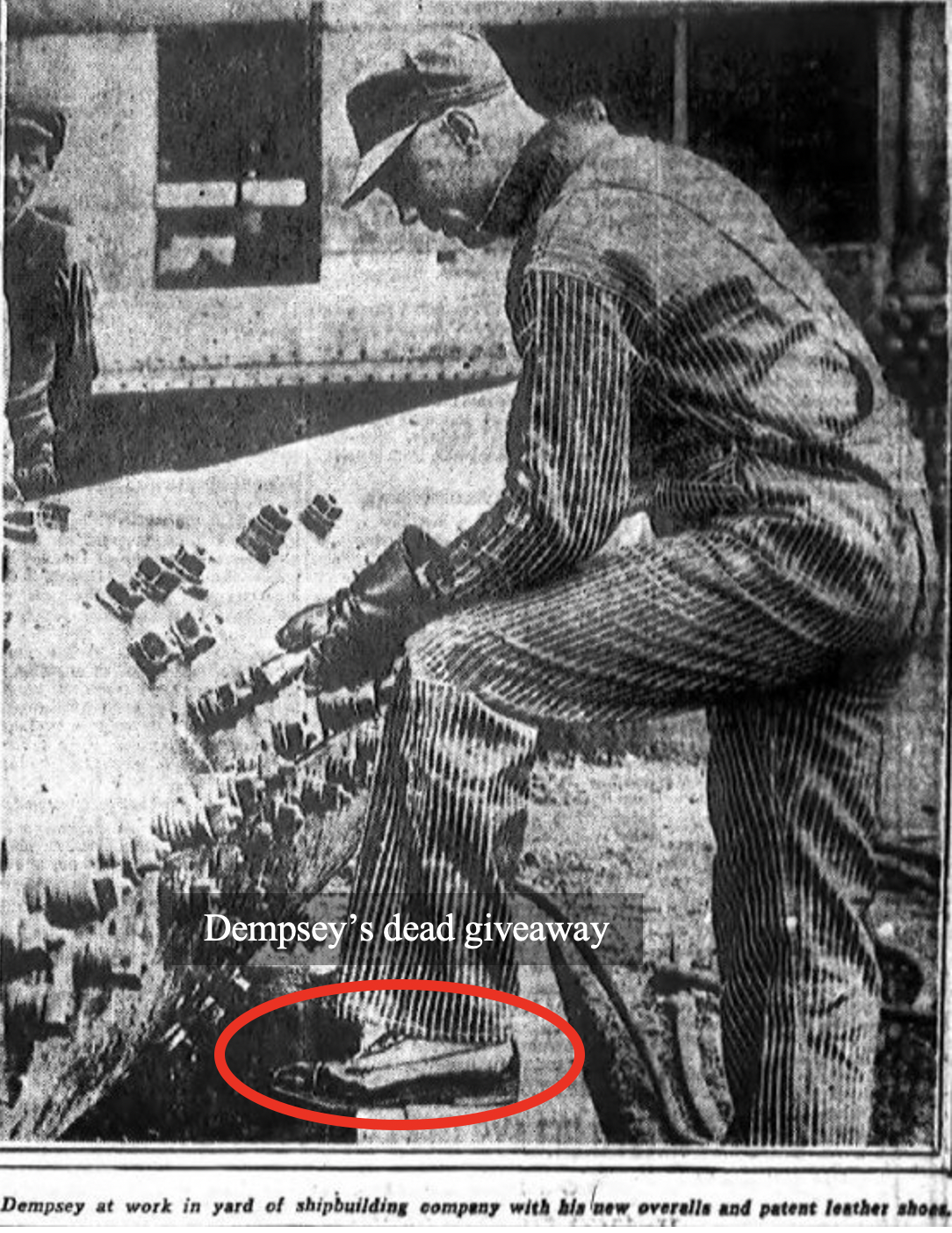
Jack Dempsey won the Heavyweight Championship in 1919, but he hadn't served in World War I. In 1920, a photo was produced showing Dempsey working in a shipyard, which should have ended the controversy right there. But someone noticed that he was wearing patent leather shoes in the photo, making some people think the photo was staged to take the curse off him.
Soon, evidence came to light that he had tried to enlist, but, despite being a very strong man for his size (he'd be classified as a cruiserweight today), the Army had classified him "4-F": "Registrant not acceptable for military service." This classification is nearly always applied to a person who fails either the physical or the psychological examination upon enlistment or reporting for the draft.
But some people still weren't satisfied. This became especially controversial in 1921, when he defended his title against the Light Heavyweight Champion, Georges Carpentier, a French pilot who had been awarded the Croix de Guerre and the MĂ©daille Militaire. The contrast between the much-decorated Carpentier and the "slacker" Dempsey was staggering.
Professional boxing would still be illegal in the State of New York, not just the City of New York, for 2 more years. So George "Tex" Rickard, boxing's leading promoter, decided to put the fight as close to Midtown Manhattan as possible. He found a plot of land owned by John F. Boyle, a mile south of Journal Square in Jersey City, New Jersey, only 6 miles from Midtown Manhattan. There, Rickard built what was intended as a temporary structure, wooden bleachers to seat 90,000 people, calling it "Boyle's Thirty Acres."

The fight was a sellout, and generated $1,789,238, about $29 million in 2022 money. It was no contest: Dempsey knocked Carpentier out in the 4th round. Much of the crowd booed, but Carpentier showed no hard feelings. He kept the Light Heavyweight Championship for another year, and lived until 1975.

It wasn't until Dempsey was "robbed" in the "Long Count" fight against Gene Tunney in 1927 that he became a near-universal hero. He lived until 1983.

The year 1927 would also see the end of Boyle's Thirty Acres, having hosted boxing champions such as Dempsey, Benny Leonard and Jim Braddock, a Hudson County resident who would win the Heavyweight Championship in 1935. The site is now mixed residential and industrial.

*

July 2, 1921 was a Saturday. Football, basketball and hockey were out of season. These baseball games were played, all doubleheaders:

* The New York Yankees swept the Philadelphia Athletics at the Polo Grounds, 6-4 and 14-4. Bob Shawkey won the opener, with 2 home runs by Frank "Home Run" Baker. Both were former A's. Carl Mays won the nightcap. Babe Ruth went 3-for-7 with 2 walks and 3 RBIs, but no home runs.

* The New York Giants swept the Brooklyn Robins (as the Dodgers were known from 1914 to 1931) at Ebbets Field, 8-1 and 7-4.

* The Washington Senators swept the Boston Red Sox at Fenway Park in Boston, 4-1 and 7-3.

* The Boston Braves swept the Philadelphia Phillies at Baker Bowl in Philadelphia, 6-4 and 3-2, the latter in 10 innings.

* There was a split at Forbes Field in Pittsburgh. The Pittsburgh Pirates won the 1st game, 5-2. The St. Louis Cardinals won the 2nd game, 6-3.

* The Cleveland Indians swept the Chicago White Sox at League Park in Cleveland, 6-4 and 11-10. Tris Speaker went 4-for-7 with 2 walks and 2 RBIs.

* There was a split at Cubs Park in Chicago (renamed Wrigley Field in 1926). The Cincinnati Reds won the 1st game, 4-2. The Chicago Cubs won the 2nd game, 6-2.

* And the Detroit Tigers swept the St. Louis Browns at Sportsman's Park in St. Louis, 4-1 and 7-6. Neither team's superstar, the Tigers' Ty Cobb or the Browns' George Sisler, played in either game.

December 31, 1999 & January 1, 2000: The Millennium

December 31, 1999:  The Millennium arrives. The people of planet Earth survived. At a terrible cost. But we hadn't destroyed ourselves. ...