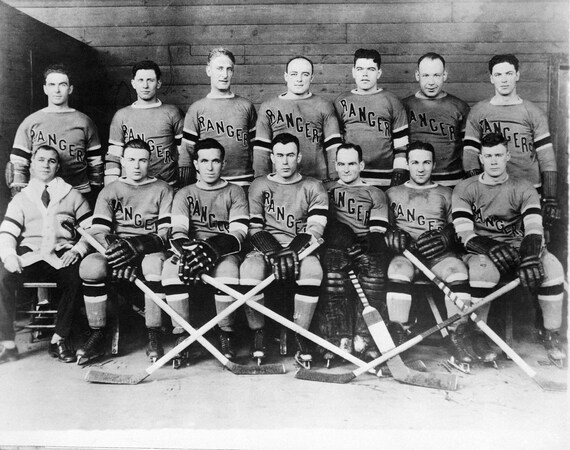
November 16, 1926: The New York Rangers make their National Hockey League debut. They beat the Montreal Maroons, 1-0 at Madison Square Garden.
The first hockey team in New York was the New York Americans, who debuted in 1925, to fill the gap in the NHL left by the folding of the Ontario-based Hamilton Tigers. They were awful on the ice, but drew a lot of fans to the newly-built third Madison Square Garden, on 8th Avenue between 49th and 50th Streets. (The 1st 2 Gardens were built off the northeastern corner of Madison Square, on Madison Avenue between 26th and 27th Streets -- the 1st in 1879, the 2nd in 1890. The New York Life Building stands on the site now.)
The 3rd Garden, and the corporation that ran its business and events, was owned by George "Tex" Rickard, the nation's foremost boxing promoter. (One of his limited partners was wrestling promoter Jess McMahon, grandfather of WWE boss Vince McMahon.) Tex was so pleased by the profits from "the Amerks" that he applied to the NHL to have a second team at The Garden. Why not? New York had enough baseball fans for 3 teams, and enough football fans for 2 teams; so, surely it had enough hockey fans for 2 teams. He turned out to be wrong about that -- but in a way that benefited him.
The new team was quickly nicknamed "Tex's Rangers" by the media, and Tex went with it, outfitting them in the same colors as the Amerks: Red, white and blue. He hired Lester Patrick, one of the greatest defensemen of the previous era, as head coach and general manager.
The 3rd Garden, and the corporation that ran its business and events, was owned by George "Tex" Rickard, the nation's foremost boxing promoter. (One of his limited partners was wrestling promoter Jess McMahon, grandfather of WWE boss Vince McMahon.) Tex was so pleased by the profits from "the Amerks" that he applied to the NHL to have a second team at The Garden. Why not? New York had enough baseball fans for 3 teams, and enough football fans for 2 teams; so, surely it had enough hockey fans for 2 teams. He turned out to be wrong about that -- but in a way that benefited him.
The new team was quickly nicknamed "Tex's Rangers" by the media, and Tex went with it, outfitting them in the same colors as the Amerks: Red, white and blue. He hired Lester Patrick, one of the greatest defensemen of the previous era, as head coach and general manager.
Patrick had played for, among other teams, the now-defunct Montreal Wanderers. The Maroons had become the team of Montreal's English-speaking community, and the Canadiens that of its French speakers. There would be a similar divide in New York: The Amerks were the team for blue-collar fans, while the Rangers were billed as "the classiest team in hockey," with some fans coming to The Garden in tuxedos and gowns, as if they were attending the opera or a Broadway opening night. Tex even had the puck dropped at the same time Broadway curtains then went up: 8:45 PM.
The Maroons were defending Stanley Cup Champions, but that didn't faze the Rangers. They were 1 of 4 new teams in the NHL, made possible by the collapse of the Pacific Coast Hockey Association, which made such an expansion possible. The others were the Chicago Blackhawks, the Detroit Cougars (who became the Falcons in 1930 and the Red Wings in 1932), and the Pittsburgh Pirates (who became the Philadelphia Quakers in 1930 and folded due to the Great Depression in 1931).
Patrick had coached and managed in the PCHA. In fact, he and his brother Frank had not only built the Vancouver Millionaires and their British Columbia rivals the Victoria Cougars, they had financed the building of both teams' arenas, and the Cougars' rink was named the Patrick Arena. The Red Wings-to-be were named the Cougars because they were made up of most of the Victoria team, the last team from outside the NHL to win the Stanley Cup, in 1925.
So Lester knew to stock the Rangers with as many players with PCHA experience as he could. His 1st signing, and the Rangers' 1st Captain, was right wing Bill Cook from the Saskatoon Sheiks. He also signed Cook's brother and Saskatoon teammate, left wing Frederick "Bun" Cook. He signed center Frank Boucher from the Vancouver Maroons (formerly the Millionaires). And he signed goaltender Hal Winkler from the Calgary Tigers.
Defenseman Ivan Johnson, known as "Ching" because, in that politically-incorrect time, someone thought he looked Chinese, had starred for teams in Minneapolis. Patrick also signed goaltender Lorne Chabot.
So while the Ranger franchise was brand-new, it had plenty of on-ice experience. And with 1 minute and 23 seconds left in the 2nd period, it was, appropriately enough, Bill Cook who scored the 1st goal in team history. Winkler kept the Maroons at bay, and the Rangers were 1-0 victors. Winkler thus became the 1st goalie to have a shutout in his NHL debut.
But Winkler only played 8 games for the Rangers, before Patrick traded him to the Boston Bruins. It was Chabot who would go on to become the 1st great Ranger goalie, and also the 1st hockey player on the cover of Time magazine, which was founded in 1923.
But Chabot is best known for a game he had to leave early due to an injury. In 1928, at the close of the Rangers' 2nd season, they faced the Maroons in the Stanley Cup Finals. In Game 2, Chabot was struck in the eye by the puck -- no masks in those days -- and had to leave the game. The Rangers had no other goalie. So Patrick 44 years old, 12 years past his last game, and having played in goal only once, took on the post, stopped 18 of 19 shots, and the Rangers won in overtime. With the League allowing the emergency signing of Americans goalie Joe Miller, the Rangers won the Cup.
The Rangers also won the Cup in 1933 and 1940, and also reached the Finals in 1929, 1932 and 1937. Rickard lived to see the first Cup, but fell victim to appendicitis, and, in the days before antibiotics, died in 1929, just 58 years old. He had lived just long enough to see the first of what he planned on being 6 copies of The Garden built around the country. He called it the Boston Madison Square Garden -- which, of course, was soon shortened to just "the Boston Garden." (Maple Leaf Gardens in Toronto, aside from being one of the Original Six teams' arenas, had no connection to Rickard.)
The Rangers' success meant doom for the Americans: In spite of a stirring Playoff win over the Rangers in 1938, the manpower drain of World War II killed them in 1942. The Rangers didn't fare much better, going into a tailspin: A Finals berth in 1950 was an aberration until they got good again in the late 1960s, moving into the 4th and current Madison Square Garden, between 31st and 33rd Streets, and between 7th and 8th Avenue in 1968.
The Rangers reached the Finals in 1972, but that team got old fast, and by 1975, a bitterness had set in that rendered any idea of the Ranger team, or its fans being "classy" a relic. They became one of the dirtiest teams in hockey, reaching the Finals in 1979, but falling short again and again before winning the Cup again in 1994. Since then, they have reached the Finals only once more, in 2014.
UPDATE: Through the 2025-26 season, the Rangers do not have a team Hall of Fame, but they have a lot of players who were elected to the Hockey Hall of Fame. Many of those weren't Rangers for very long. These contributed to at least a Stanley Cup Finals appearance:
* From the 1928 Stanley Cup win: Head coach and general manager Lester Patrick, defenseman Ivan "Ching" Johnson, and the "A Line" of center Frank Boucher, right wing Bill Cook, and his brother, left wing Frederick "Bun" Cook. Although goaltender Lorne Chabot was named to The Hockey News' 1998 list of the 100 Greatest Hockey Players, he has never been elected to the Hall of Fame.
* From the 1933 Stanley Cup win: Patrick, Johnson, Boucher, both Cook brothers, defenseman Earl Seibert, and left wing Albert "Babe" Siebert. Earl and Babe were not related: Note the difference in the spelling of their surnames. Goaltender Andy Aitkenhead has not been elected to the Hockey Hall of Fame.
* From the 1940 Stanley Cup win: Lester Patrick, now only the general manager: Boucher, now the head coach; left wing Lynn Patrick, Lester's son; defensemen Art Coulter and Walter "Babe" Pratt, centers Neil Colville and Clint Smith, and right wing Bryan Hextall.
* From the 1950 Stanley Cup Finals: Boucher, now the GM; goaltender Chuck Rayner, defenseman Allan Stanley, and centers Edgar Laprade and Buddy O'Connor.
Defenseman Murray "Muzz" Patrick, another son of Lester, and Colville's brother, Matthew "Mac" Colville, also played on this Ranger team, but neither has been elected to the Hall of Fame. Nor has goaltender Davey Kerr. Bryan Hextall's sons Bryan Jr. and Denis, grandson Ron all played in the NHL. His granddaughter Leah became a hockey broadcaster. His great-grandson Brett played in the minor leagues, and now works in the Pittsburgh Penguins' front office, under his father, general manager Ron.
* From the 1950s and 1960s, the era in which television allowed Ranger fandom to grow by leaps and bounds, despite the team's struggles: Goaltender Lorne "Gump" Worsley, defensemen Harry Howell and Bill Gadsby, and right wing Andy Bathgate.
* From the 1972 Stanley Cup Finals: Executive William M. Jennings, head coach and general manager Emile Francis, goaltender Eddie Giacomin, defenseman Brad Park, center Jean Ratelle and right wing Rod Gilbert. Left wing Vic Hadfield, from this team, has not been elected to the Hall of Fame, but his Number 11 has been retired, as have the 1 of Giacomin, the 7 of Gilbert, and the 19 of Ratelle.
* From the 1979 Stanley Cup Finals: Jennings, head coach and GM Fred Shero, and center Phil Esposito; and broadcaster Sal Messina.
* From the 1994 Stanley Cup win: General manager Colin Campbell, center Mark Messier; right wing Glenn Anderson (who played only 35 games for the Rangers); defensemen Brian Leetch, Kevin Lowe and Sergei Zubov; and broadcasters Messina, Sam Rosen and John Davidson.
Head coach Mike Keenan has not been elected to the Hall of Fame. Nor have right wing Adam Graves or goaltender Mike Richter, yet the Rangers have retired Graves' Number 9 and Richter's Number 35. In 1996, the Rangers acquired center Wayne Gretzky, who played 3 seasons for them, and his Number 99 has been retired.
* From the 2014 Stanley Cup Finals: Rosen and goaltender Henrik Lundqvist, whose Number 30 has been retired.
Messina, Rosen and Davidson each received the Hall of Fame's award for broadcasters, the Foster Hewitt Memorial Award. Although both were longtime Ranger broadcasters before any of them, neither Win Elliott nor Marv Albert ever received the award. Albert did receive the Curt Gowdy Media Award from the Basketball Hall of Fame for his Knicks broadcasts, also from Madison Square Garden.
The Rangers have an unusual pattern of uniform number retirements. They are willing to honor two players to a number, but not always. Lester Patrick played just 2 games for the Rangers, but 1 was one of the most important games in team history, yet the Number 16 he wore has not been retired, not for him or for anyone else.
Ching Johnson won 2 Cups and wore 3, but it has been retired only for Harry Howell, who never played on a Cup Finalist in New York. Frank Boucher wore 7, and given that he was the best player on 2 Cup-winning teams and the head coach of another, he is arguably the greatest figure in team history behind Lester Patrick. But 7 has been retired only for Rod Gilbert, who is, to be fair, still the team's all-time leading scorer.
Lynn Patrick won a Cup, and is in the Hall of Fame. Andy Bathgate is in the Hall of Fame, but his only Cup came with the Toronto Maple Leafs. Adam Graves won a Cup, but is not yet in the Hall. All 3 men wore 9, but the number is retired for Bathgate and Graves, but not Patrick.
Vic Hadfield appeared in only 1 Cup Finals, and has not been elected to the Hall of Fame, yet got the honor of getting 11 retired along with Mark Messier, the most important Ranger since 1940.
*
November 16, 1926 was a Tuesday. There were 2 other NHL games that night. The Boston Bruins beat the Montreal Canadiens, 4-1 at the Boston Arena -- now the Matthews Arena, home to Boston University. And the Americans beat the Pittsburgh Pirates, 1-0 at the Duquesne Gardens.
Those were the only scores: Baseball was in the off-season, the NFL played on Sundays, and the NBA hadn't been founded yet.
The Rangers first won the Stanley Cup on April 14, 1928, beating the Montreal Maroons, 3 games to 1. Game 2, when Rangers head coach and general manager Lester Patrick, at age 44, became a victorious emergency goaltender, was played on April 7. There were no other games on that day: The NBA hadn't been founded yet, and the baseball season was about to start.


No comments:
Post a Comment