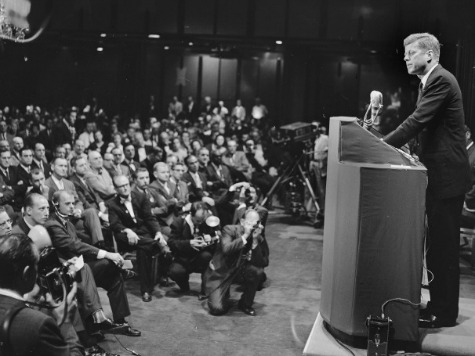
September 12, 1960: Senator John F. Kennedy of Massachusetts, the Democratic Party's nominee for President, speaks before the Greater Houston Ministerial Association.
The 1st 34 Presidents had all been Protestants. Only in 1928 had a major party even nominated a Roman Catholic for the office, as the Democratic Party nominated Governor Alfred E. Smith of New York. Given how well the economy was going, the Republican Party's nominee, Herbert Hoover, would have been elected regardless of Smith's religion. But some vile anti-Catholic bigotry was let loose in the land, and Smith lost in a massive landslide.
Few Catholics had even tried for the Presidency since. Kennedy got the nomination, but, again, people said ridiculous things like "If Kennedy is elected, the Pope will take over America." After all, the Pope was, effectively, a dictator for the Church.
Dr. Norman Vincent Peale, one of the country's leading Protestant clergymen, said, "Faced with the election of a Catholic, our culture is at stake." He later said, "It is inconceivable that a Roman Catholic President would not be under extreme pressure by the hierarchy of his Church to accede to its policies with respect to foreign interests." He suggested that the election of a Catholic might even end free speech in America.
Former President Harry S Truman got off an interesting zinger, objecting to Kennedy's father, former Ambassador Joseph P. Kennedy, trying to "buy" the election: He said, "It's not the Pope that bothers me, it's the Pop!"
JFK knew that he had to address this. He also knew that Texas was a key State in the election, which was why he'd selected that State's Senator Lyndon B. Johnson as his running mate. He accepted the Greater Houston Ministerial Association's invitation to speak before them, and sought to allay their fears, and those of Protestant America:
While the so-called religious issue is necessarily and properly the chief topic here tonight, I want to emphasize from the outset that we have far more critical issues to face in the 1960 election: The spread of Communist influence, until it now festers 90 miles off the coast of Florida; the humiliating treatment of our President and Vice President by those who no longer respect our power; the hungry children I saw in West Virginia, the old people who cannot pay their doctor bills, the families forced to give up their farms; an America with too many slums, with too few schools, and too late to the moon and outer space.
These are the real issues which should decide this campaign. And they are not religious issues, for war and hunger and ignorance and despair know no religious barriers.
But because I am a Catholic, and no Catholic has ever been elected President, the real issues in this campaign have been obscured, perhaps deliberately, in some quarters less responsible than this. So it is apparently necessary for me to state once again, not what kind of church I believe in, for that should be important only to me, but what kind of America I believe in.
I believe in an America where the separation of church and state is absolute; where no Catholic prelate would tell the President, should he be Catholic, how to act; and no Protestant minister would tell his parishoners for whom to vote; where no church or church school is granted any public funds or political preference; and where no man is denied public office merely because his religion differs from the President who might appoint him or the people who might elect him.
These are the real issues which should decide this campaign. And they are not religious issues, for war and hunger and ignorance and despair know no religious barriers.
But because I am a Catholic, and no Catholic has ever been elected President, the real issues in this campaign have been obscured, perhaps deliberately, in some quarters less responsible than this. So it is apparently necessary for me to state once again, not what kind of church I believe in, for that should be important only to me, but what kind of America I believe in.
I believe in an America where the separation of church and state is absolute; where no Catholic prelate would tell the President, should he be Catholic, how to act; and no Protestant minister would tell his parishoners for whom to vote; where no church or church school is granted any public funds or political preference; and where no man is denied public office merely because his religion differs from the President who might appoint him or the people who might elect him.
I believe in an America that is officially neither Catholic, Protestant nor Jewish; where no public official either requests or accepts instructions on public policy from the Pope, the National Council of Churches or any other ecclesiastical source; where no religious body seeks to impose its will, directly or indirectly, upon the general populace or the public acts of its officials; and where religious liberty is so indivisible that an act against one church is treated as an act against all.
For while this year it may be a Catholic against whom the finger of suspicion is pointed, in other years it has been, and may someday be again, a Jew, or a Quaker, or a Unitarian, or a Baptist. It was Virginia's harassment of Baptist preachers, for example, that helped lead to Jefferson's Statute of Religious Freedom. Today, I may be the victim. But, tomorrow it may be you; until the whole fabric of our harmonious society is ripped at a time of great national peril.
Finally, I believe in an America where religious intolerance will someday end, where all men and all churches are treated as equal, where every man has the same right to attend or not attend the church of his choice; where there is no Catholic vote, no anti-Catholic vote, no bloc voting of any kind; and where Catholics, Protestants and Jews, at both the lay and pastoral level, will refrain from those attitudes of disdain and division which have so often marred their works in the past, and promote instead the American ideal of brotherhood.
That is the kind of America in which I believe. And it represents the kind of Presidency in which I believe, a great office that must neither be humbled by making it the instrument of any one religious group nor tarnished by arbitrarily withholding its occupancy from the members of any one religious group. I believe in a President whose religious views are his own private affair, neither imposed by him upon the nation, or imposed by the nation upon him as a condition to holding that office.
I would not look with favor upon a President working to subvert the First Amendment's guarantees of religious liberty. Nor would our system of checks and balances permit him to do so. And neither do I look with favor upon those who would work to subvert Article VI of the Constitution by requiring a religious test, even by indirection, for it. If they disagree with that safeguard, they should be out openly working to repeal it.
For while this year it may be a Catholic against whom the finger of suspicion is pointed, in other years it has been, and may someday be again, a Jew, or a Quaker, or a Unitarian, or a Baptist. It was Virginia's harassment of Baptist preachers, for example, that helped lead to Jefferson's Statute of Religious Freedom. Today, I may be the victim. But, tomorrow it may be you; until the whole fabric of our harmonious society is ripped at a time of great national peril.
Finally, I believe in an America where religious intolerance will someday end, where all men and all churches are treated as equal, where every man has the same right to attend or not attend the church of his choice; where there is no Catholic vote, no anti-Catholic vote, no bloc voting of any kind; and where Catholics, Protestants and Jews, at both the lay and pastoral level, will refrain from those attitudes of disdain and division which have so often marred their works in the past, and promote instead the American ideal of brotherhood.
That is the kind of America in which I believe. And it represents the kind of Presidency in which I believe, a great office that must neither be humbled by making it the instrument of any one religious group nor tarnished by arbitrarily withholding its occupancy from the members of any one religious group. I believe in a President whose religious views are his own private affair, neither imposed by him upon the nation, or imposed by the nation upon him as a condition to holding that office.
I would not look with favor upon a President working to subvert the First Amendment's guarantees of religious liberty. Nor would our system of checks and balances permit him to do so. And neither do I look with favor upon those who would work to subvert Article VI of the Constitution by requiring a religious test, even by indirection, for it. If they disagree with that safeguard, they should be out openly working to repeal it.
He mentioned that, earlier in the day, he had visited the Alamo in San Antonio, site of a famous battle in 1836. He continued:
Side by side with Bowie and Crockett died McCafferty and Bailey and Carey. But no one knows whether they were Catholic or not. For there was no religious test at the Alamo.
The key words soon came:
Side by side with Bowie and Crockett died McCafferty and Bailey and Carey. But no one knows whether they were Catholic or not. For there was no religious test at the Alamo.
The key words soon came:
Contrary to common newspaper usage, I am not the Catholic candidate for President. I am the Democratic Party's candidate for President, who happens also to be a Catholic. I do not speak for my Church on public matters. And the Church does not speak for me.
Whatever issue may come before me as President -- on birth control, divorce, censorship, gambling or any other subject -- I will make my decision in accordance with these views, in accordance with what my conscience tells me to be the national interest, and without regard to outside religious pressures or dictates. And no power or threat of punishment could cause me to decide otherwise.
But if the time should ever come -- and I do not concede any conflict to be even remotely possible -- when my office would require me to either violate my conscience or violate the national interest, then I would resign the office. And I hope any conscientious public servant would do the same.
But I do not intend to apologize for these views to my critics of either Catholic or Protestant faith. Nor do I intend to disavow either my views or my Church in order to win this election.
If I should lose on the real issues, I shall return to my seat in the Senate, satisfied that I had tried my best, and was fairly judged. But if this election is decided on the basis that 40 million Americans lost their chance of being President on the day they were baptized, then it is the whole nation that will be the loser, in the eyes of Catholics and non-Catholics around the world, in the eyes of history, and in the eyes of our own people.
But if, on the other hand, I should win the election, then I shall devote every effort of mind and spirit to fulfilling the oath of the Presidency -- practically identical, I might add, to the oath I have taken for 14 years in the Congress. For without reservation, I can "solemnly swear that I will faithfully execute the office of President of the United States, and will to the best of my ability preserve, protect, and defend the Constitution of the United States," so help me God.
Whatever issue may come before me as President -- on birth control, divorce, censorship, gambling or any other subject -- I will make my decision in accordance with these views, in accordance with what my conscience tells me to be the national interest, and without regard to outside religious pressures or dictates. And no power or threat of punishment could cause me to decide otherwise.
But if the time should ever come -- and I do not concede any conflict to be even remotely possible -- when my office would require me to either violate my conscience or violate the national interest, then I would resign the office. And I hope any conscientious public servant would do the same.
But I do not intend to apologize for these views to my critics of either Catholic or Protestant faith. Nor do I intend to disavow either my views or my Church in order to win this election.
If I should lose on the real issues, I shall return to my seat in the Senate, satisfied that I had tried my best, and was fairly judged. But if this election is decided on the basis that 40 million Americans lost their chance of being President on the day they were baptized, then it is the whole nation that will be the loser, in the eyes of Catholics and non-Catholics around the world, in the eyes of history, and in the eyes of our own people.
But if, on the other hand, I should win the election, then I shall devote every effort of mind and spirit to fulfilling the oath of the Presidency -- practically identical, I might add, to the oath I have taken for 14 years in the Congress. For without reservation, I can "solemnly swear that I will faithfully execute the office of President of the United States, and will to the best of my ability preserve, protect, and defend the Constitution of the United States," so help me God.
Kennedy won Texas. He won the Electoral Vote, beating the Republican nominee, Vice President Richard Nixon, 303-219, with 15 votes going to a 3rd-party candidate, Senator Harry Byrd of Virginia. Kennedy barely won the popular vote, 49.72 percent to 49.55, a margin of 112,827.
Kennedy won the Catholic vote, 78 percent to 22. Nixon won the Protestant vote, 62-38. The difference may have been in the black vote, as Dr. Martin Luther King may have swayed their Protestants in enough States to make the difference.
Occasionally, politically-themed comedian Mark Russell, himself a Catholic, would tell his audience that JFK was elected, "thus paving the way for all the Catholic Presidents since." The audience laughed, because there hadn't been any other Catholic Presidents. The Republicans had never nominated any, and the Democrats had unsuccessfully nominated Michael Dukakis in 1988 and John Kerry in 2004. In 2020, Joe Biden finally became the 2nd Catholic to be elected. Russell did live to see it. (UPDATE: Russell died in 2023.)
*
September 12, 1960 was a Monday. There were only 2 scores on this historic day -- Monday Night Football was still 10 years away -- and they were in baseball. The Pittsburgh Pirates beat the San Francisco Giants, 6-1 at Forbes Field in Pittsburgh. Dick Stuart, he of the powerful bat and the "strange glove," hit a home run. Roberto Clemente went 2-for-4 with an RBI. Willie Mays went 0-for-4.
And the Milwaukee Braves beat the St. Louis Cardinals, 4-2 at the 1st ballpark named Busch Stadium, which had been the last ballpark named Sportsman's Park. Warren Spahn, his legend secure, outpitched Bob Gibson, whose legend was yet to come. Joe Adcock hit a home run. Hank Aaron went 0-for-4. So did Stan Musial.


