Showing posts with label estadio santiago bernabeu. Show all posts

Wednesday, December 14, 2022

December 14, 1947: Estadio Santiago Bernabéu Opens

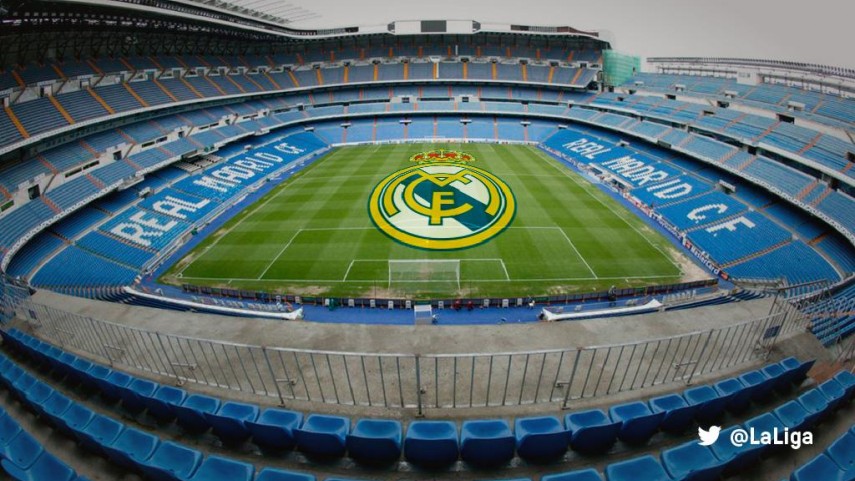
December 14, 1947: Real Madrid Club de Fútbol opens its new stadium, named Estadio Chamartín like the old one. In 1955, it was renamed after the man who got it built, team president Santiago Bernabéu.

Bernabéu the man is not to be celebrated: He was a dedicated follower of Fascist dictator Francisco Franco, which allowed him to fix results in favor of his team until his death in 1978, even after Franco died and Spain became free.
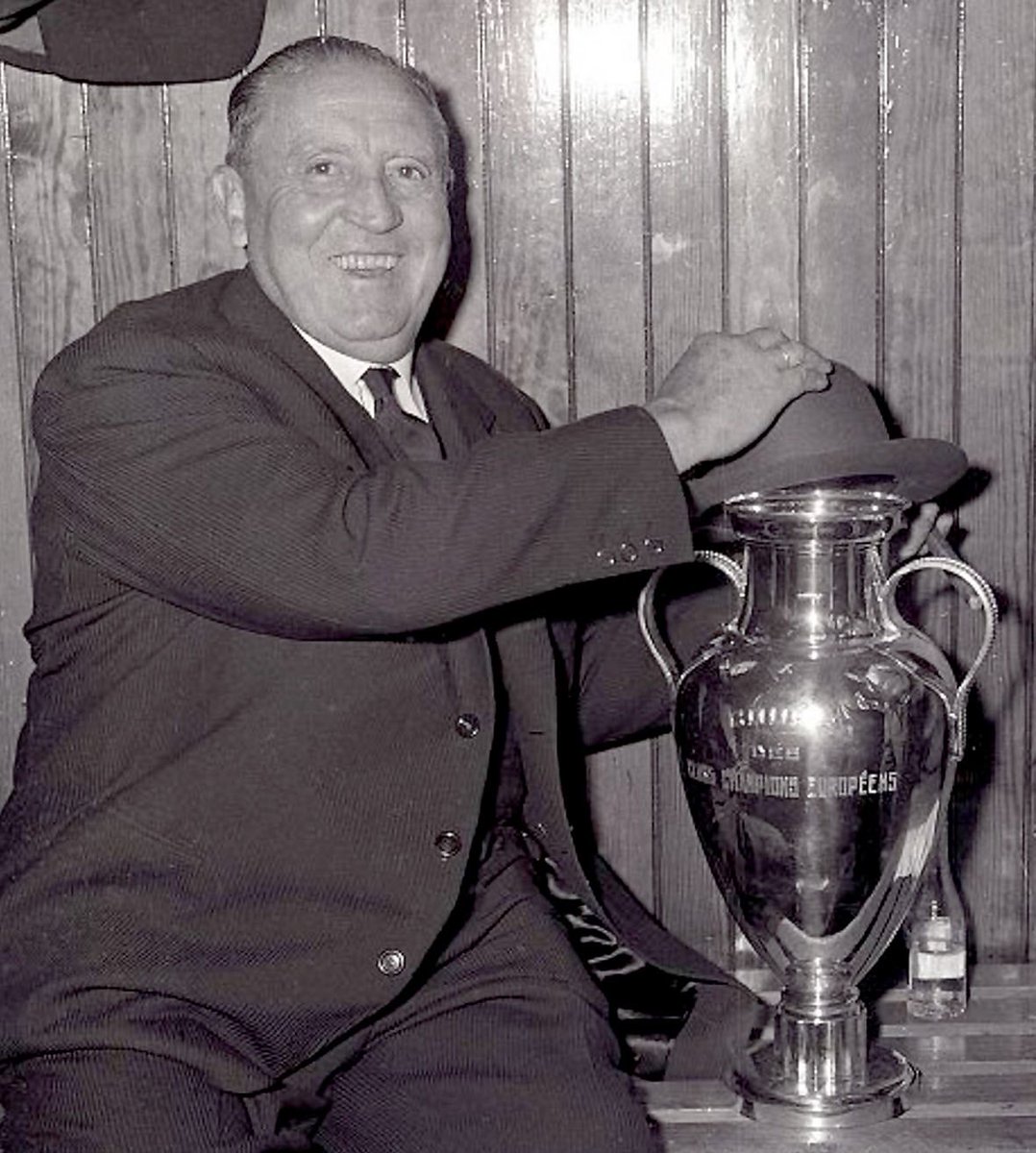
Santiago Bernabéu, with an early version of the European Cup

But the 84,744-seat stadium (it went as high as 129,690 before its conversion to all-seater) is one of the world's great sports palaces. It hosted the Finals of the 1964 European Nations Cup and the 1982 World Cup, making it the 1st to host the Final of both.
It's also hosted 4 Finals of the European Cup/UEFA Champions League, which Real Madrid have won a record 14 times:

* 1957: Real Madrid won it on home soil, beating Fiorentina of Florence, Italy, 2-0.

* 1969: AC Milan beat Ajax Amsterdam, 4-1.

* 1980: Nottingham Forest beat Hamburger SV, 1-0.

* 2010: Internazionale Milano of Milan, Italy, beat Bayern Munich, 2-0.

In 2018, CONMEBOL, the governing body for soccer in South America, moved the Final of its version of the Champions League, the Copa Libertadores, to the Bernabéu, because it was the biggest club soccer rivalry on the continent, and the Bernabéu would be, for them, a neutral site. River Plate beat their Buenos Aires, Argentina arch-rivals, Boca Juniors, 3-1.

In 2019, Real Madrid began a renovation of the stadium, expanding concourses and installing wider seats and a retractable roof.
(UPDATE: It reopened on December 23, 2023, with a seating capacity of 83,186. In 2025, the stadium was renamed simply "The Bernabéu." Apparently, old man Santiago was now considered too much of a symbol of Fascism to allow his name to remain on the stadium, but the Bernabéu name was too lucrative to remove it entirely.)

*

December 14, 1947 was a Sunday. Dilma Rousseff, who would later serve as President of the soccer-mad nation of Brazil, was born.

Baseball was out of season. There were 4 games played in the NFL:

* The New York Giants lost to the Los Angeles Rams, 34-10 at the Los Angeles Memorial Coliseum.

* The Philadelphia Eagles beat the Green Bay Packers, 28-14 at Shibe Park in Philadelphia.

* The Washington Redskins beat the Boston Yanks -- yes, Yankee fans and Red Sox fans, such a sports team actually existed -- 40-13 at Griffith Stadium in Washington.

* And the Chicago Cardinals beat the Chicago Bears, 30-21 at Wrigley Field in Chicago.

And the All-America Football Conference held its Championship Game. The Cleveland Browns beat the football version of the New York Yankees, 14-3 at Yankee Stadium.

No games were scheduled for the Basketball Association of America, the league that would become the NBA. But the NHL's entire "Original Six" were in action:

* The New York Rangers and the Detroit Red Wings played to a tie, 1-1 at the old Madison Square Garden.

* The Toronto Maple Leafs and the Boston Bruins played to a tie, 1-1 at the Boston Garden.

* And the Montreal Canadiens beat the Chicago Black Hawks, 4-3 at the Chicago Stadium.

Monday, July 11, 2022

July 11, 1982: The Wrong World Cup Final

July 11, 1982: The World Cup Final is held at the Estadio Santiago Bernabéu in Madrid, Spain. Going in, everyone seemed to want a Final between Brazil and France. Neither made it in.

This World Cup had a First Group Stage and a Second Group Stage, a format not used since. In their last game of the Second Group Stage, in Barcelona, Brazil were shocked by Italy, with Paolo Rossi of Juventus scoring 3 goals. He would title his subsequent book I Made Brazil Cry.

France reached the Semifinal in Seville, where they played West Germany. With the game tied 1-1 after 60 minutes, German goalkeeper Harald Schumacher collided with French player Patrick Battiston, who, as a result, suffered 2 broken teeth, several broken ribs, and a damaged vertebra. Incredibly both the referee and the linesman missed the challenge, and instead of awarding France an obvious penalty and sending Schumacher off to be replaced by another goalie, awarded Germany a goal kick. After seeing the challenge on TV later, the referee admitted that he should have given Schumacher a straight red card.

Regulation ended 1-1, and France jumped ahead 3-1 in extra time, before West Germany equalized, and then won the 1st penalty shootout in World Cup history. So both of the favorites were out, and the Final, in Madrid, was to be between 2 teams that hardly anybody outside either country wanted.

ABC, learning from its own mistakes as well as those of NBC and CBS, decided to buy the U.S. broadcast rights to the biggest sporting event in the world. They broadcast selected games on tape delay, and, for the 1st time in America, a World Cup Final was broadcast live. Games were also shown on ESPN (not yet owned by ABC) and the Spanish-language network SIN, which later became Univision.

The 1st half was uneventful. Italy were awarded a penalty, but Juventus' Antonio Cabrini missed it. Rossi scored in the 57th minute. Another Juventus player, Marco Tardelli, scored in the 69th. Alessandro Altobelli of Inter Milan put the game away in the 81st. Paul Breitner, the former Bayern Munich left back, now a central midfielder for Eintracht Braunschweig, scored a consolation goal in the 83rd, but that would be it: Italy won, 3-1. It was their 3rd World Cup, an achievement previously reached only by Brazil.

Suddenly, Italians all over America, who couldn't have cared less a month earlier, celebrated this victory. In my hometown of East Brunswick, New Jersey, the walls of Brothers Pizza were covered with photos and paintings of famous sites in Italy (the Colosseum in Rome, the Bridge of Sighs in Venice, the Leaning Tower of Pisa), and also with photos of Frank Sinatra and his friends, other Italian-American actors, and photos of various New York Yankees. Within days, probably received by mail from Europe -- it's not like American companies were lining up to produce them -- it had 2 big new posters: One of the Italy team, and one of Paolo Rossi.

At a time when the NFL was being considered "boring," and baseball was said to be "in decline," this could have been a moment for soccer to make a big move in America. But, despite its biggest star, Giorgio Chinaglia of the New York Cosmos, being Italian, but also English-speaking because his mother was from Wales and he'd lived there, the North American Soccer League did not act, mainly because its management was so inept. (At age 35, Chinaglia was not selected for the World Cup by Italy. He had played in the 1974 edition.) After 2 more seasons, the league folded, setting American soccer back 20 years.

UPDATE: An article for ESPN.com, published after the 2026 World Cup, ranking all 23 tournaments, rated this one 1st:

There just hasn't been a World Cup with more of everything than this one. The star power was off the charts -- Socrates, Zico and Falcao starring for Brazil; Diego Maradona marking his debut with two goals and a red card; Italy's Paolo Rossi dominating; Michel Platini leading France to the semifinals -- and a number of great teams captured the imagination. 

*

July 11, 1982 was a Sunday. These Major League Baseball games were played:

* The New York Yankees lost to the California Angels, 2-1 at Anaheim Stadium (now Angel Stadium of Anaheim). Shane Rawley of the Yankees and Steve Renko of the Angels both had good starts. But Brian Downing led off the bottom of the 8th with a home run off Goose Gossage, making a winning pitcher of Andy Hassler.

Yankee icon Reggie Jackson went 1-for-4 for the Halos, while Rod Carew did not play. Graig Nettles and Butch Wynegar each had 2 hits, but the rest of the Yankees combined for 1 hit and 3 walks.

* The New York Mets lost to the San Diego Padres, 6-2 at Shea Stadium. Tim Lollar was the winning pitcher, and helped his own cause with a home run. Mike Scott, not yet pitching his home games in the Astrodome, didn't get out of the 4th inning.

* The San Francisco Giants beat the Montreal Expos, 8-7 at the Olympic Stadium in Montreal. The Giants got 2 home runs from Milt May, including 1 in the top of the 10th inning to win the game, and 1 each from Joe Morgan, Reggie Smith and Champ Summers. Gary Carter hit 1 for the Expos.

* The Minnesota Twins beat the Boston Red Sox, 7-3 at Fenway Park in Boston. Carl Yastrzemski flew out as a pinch-hitter.

* The Philadelphia Phillies beat the Los Angeles Dodgers, 4-3 at Veterans Stadium in Philadelphia. Mike Schmidt went 0-for-2 with 2 walks. Pete Rose went 1-for-4.

* The Pittsburgh Pirates beat the Atlanta Braves, 3-1 at Atlanta-Fulton County Stadium. Willie Stargell, in his final season, struck out as a pinch-hitter.

* The Chicago White Sox beat the Toronto Blue Jays, 16-7 at Exhibition Stadium in Toronto. Harold Baines went 3-for-5 with 2 home runs and 5 RBIs.

* The Chicago Cubs beat the Cincinnati Reds, 9-2 at Wrigley Field in Chicago. Doug Bird was the winning pitcher. Bill Buckner hit a home run. Tom Seaver didn't get out of the 3rd inning. Johnny Bench did not play.

* The Milwaukee Brewers beat the Kansas City Royals, 8-5 at Milwaukee County Stadium. Manager Harvey Kuenn's Pennant-bound Brew Crew, nicknamed "Harvey's Wallbangers," got home runs from Gorman Thomas, Paul Molitor, Ted Simmons and Charlie Moore. Robin Yount went 2-for-4. George Brett went 0-for-4 with a walk.

* The Detroit Tigers beat the Texas Rangers, 3-2 at Arlington Stadium in the Dallas suburb of Arlington, Texas.

* The Houston Astros beat the St. Louis Cardinals, 4-2 at the Astrodome in Houston.

* The Baltimore Orioles beat the Oakland Athletics, 8-7 at the Oakland Coliseum. Eddie Murray went 2-for-4 with a home run, a walk, and 4 RBIs. Rookie of the Year-in-waiting Cal Ripken Jr. went 1-for-4 with a walk.

* And the Cleveland Indians beat the Seattle Mariners, 4-3 at the Kingdome in Seattle.

Tuesday, July 5, 2022

July 5, 1982: Paolo Rossi Makes Brazil Cry

July 5, 1982: Most soccer World Cups are best remembered for their Finals. The 1982 edition, in Spain, is not.

As they so often do, Italy went into the World Cup in controversy. The Totonero match-fixing scandal broke in 1980. Two of Italy's biggest teams, A.C. Milan and Rome team S.S. Lazio, were punished by relegation from Serie A to Serie B. Some others, including A.C. Perugia, were docked 5 points. Perugia star Paolo Rossi was punished more than any individual player, suspended for 3 seasons.

He always insisted he was innocent, but he missed his age 23 and 24 seasons. His suspension was lifted after the 2nd season. Turin-based Juventus F.C., known for their corruption (they were not charged in Totonero, but would be relegated and stripped of 2 titles in the 2006 Calciopoli scandal), didn't care that people still thought Rossi was guilty, and scooped him up for the 1981-82 season.

He helped them win the League in 1982, and he was once again selected for the national team. Despite there being no blue in Italy's national flag, their national team wears blue (this is also true for Japan), due to it being the color of their former ruling family, the House of Savoy, and are known as Gli Azzurri (The Blues).

Italy's sporting press is notorious for making bigger deals out of things than they should: For a big team like Juve, the Milan teams (A.C. Milan and Internazionale Milano F.C.) or the Rome teams (A.S. Roma and Lazio), a 3-game winless streak is a "crisis," and talk that the manager should be fired begins. So there was some fuss about Rossi being chosen for the World Cup.

The tournament was held in Spain, and 2 teams were the popular favorites, Brazil and France. Brazil, in particular, because, for the 1st time since their 1970 win, they seemed to have a team that was not only greatly talented, but stylish. Like most Brazil teams, they were led by men using single names, and the names still echo through the history of the game: Sócrates, Zico, Falcão, Éder. (Some of these names had been used for popular players before, and would again.) And one man who used 2 names, serving as a nickname: Roberto Dinamite.

Brazil had beaten Italy in the 1970 World Cup Final, and the contrast between the national teams' reputations couldn't have been more stark: While they had a high-scoring national team in 1970, Italy's best club teams had been notable for defense, with a style known as catenaccio, or "padlock."

Gianni Brera, the legendary writer for La Gazzetta dello Sport -- effectively, Italy's Grantland Rice -- had said that the perfect soccer game would end 0-0. Most Americans would find this boring, but Italian fans of the 1960s and '70s tended to agree with him.

Not surprisingly, Juventus were known for a strong defense, and had 6 players on Italy's team for the 1982 World Cup: Rossi, midfielder Marco Tardelli, goalkeeper Dino Zoff, and 3 defenders: Antonio Cabrini, Claudio Gentile and Gaetano Scirea.

Fiorentina, of Florence, had 5: Backup goalkeeper Giovanni Galli, defender Pietro Vierchowod, midfielder Giancarlo Antognoni, and forwards Daniele Massaro and Francesco Graziani. Inter Milan had 5: Backup goalkeeper Ivano Bordon, defender Giuseppe Bergomi, midfielders Giampiero Marini and Gabriele Oriali, and forward Alessandro Altobelli.

A.C. Milan had 2 players, both defenders: Franco Baresi and Fulvio Collovati. And 1 player each came from 4 other clubs: Forward Franco Selvaggi from Cagliari on Sardinia, midfielder Bruno Conti from A.S. Roma, midfielder Giuseppe Dossena from Turin team Torino, and midfielder Franco Causio from Udinese. The manager was Enzo Bearzot.

Italy excited no one in the First Group Stage, gaining 3 draws, all in the northwestern Spanish city of Vigo: 0-0 with Poland, 1-1 with Peru, and 1-1 with Cameroon. The Italian media ripped their own boys, singling Rossi out, with one writer calling him "a ghost aimlessly wandering over the field." But it was enough to finish 2nd to Poland in Group 1, and advance to the Second Group Stage.

They were put in Group C, with Brazil and Argentina. The latter were not only the defending champions, but had added a new star, Diego Maradona, and needed an emotional lift after getting clobbered by Britain in the Falklands War. Italy seemed like lambs being led to the slaughter. The term "Group of Death" was not yet in use in 1982, but, in 2007, with a quarter-century of hindsight, British newspaper The Guardian called this "the deadliest-ever Group of Death in World Cup history."

All the games in this Group were played at Estadi de Sarrià, home of RCD Espanyol in Barcelona. On June 29, Italy stunned Argentina -- a country which, despite having Spanish as its official language, has Italians as its largest ethnic group -- with 2nd-half goals by Tardelli and Cabrini within 10 minutes. Argentina pulled one back, but it wasn't enough, as Gentile and Scirea marked Maradona out of the action, and Italy were 2-1 winners.

On July 2, Brazil beat Argentina, their arch-rivals, 3-1 in a masterclass of what they called, in Portuguese, O Jogo Bonito: The Beautiful Game. Argentina were out, and the July 5 match between Brazil and Italy would decide one of the teams for the Semifinal.

Bearzot decided that keeping Zico from attacking was the answer. He sent Gentile to mark Zico, and it worked, but at a price: Gentile was called for a foul, and granted a yellow card. Due to accumulation of cards, he would be suspended for the Semifinal, should Italy qualify.

Rossi scored only 5 minutes in, with a header off a Cabrini cross. Sócrates answered in the 12th minute. In the 25th, Rossi stepped in front of Júnior, intercepted a pass from Cerezo, and scored a 2nd goal. It was 2-1 Italy at the half. Falcão tied it in the 68th. Had that 2-2 score held, Brazil would have advanced to the Semifinal on goal difference.

But in the 74th, Italy had a corner kick. Brazil did a poor job of clearing it. Rossi took the ball at the six-yard line, and drilled a shot to complete a hat trick. Antognoni seemed to score in the 86th, but it was disallowed for offside -- incorrectly, as an instant replay later showed. In stoppage time, Oscar nearly equalized for Brazil, but Zoff made an amazing save, clinching the 3-2 win for Italy.

Brazilian fans could be seen crying in the stands. Not since the Maracanazo of the 1950 Final, which they lost on home soil to Uruguay, had their team sustained such an impactful defeat. This one would also be named after the stadium where it was played: A tragédia do Sarrià. And Rossi, approached after the tournament to write a book, titled it Ho fatto piangere il Brasile: "I Made Brazil Cry."

It has been suggested that this loss was the end of O Jogo Bonito for Brazil: The attacking philosophy that had served them so well was scrapped for a defense-first approach. It paid off in 1994, when they won the World Cup -- beating Italy in the Final, on penalties after 120 minutes of goalless soccer. But the country practically revolted against this approach: Never was a team that won the World Cup less loved in its homeland. So they went back to the old approach, led by Ronaldo and Ronaldinho, reaching the Final in 1998 and winning it all in 2002.

But the 1982 tournament was not over. On July 8, at the Camp Nou, the already-storied home ground of FC Barcelona, Italy faced Poland in the Semifinal. Rossi was the star again, scoring in the 22nd and the 73rd minute, leading Italy to a 2-0 win. The Final would be on July 11, at the home of Real Madrid, Estadio Santiago Bernabéu. It would be against West Germany, which shocked France in what was widely seen as a dirty match.

In the World Cup, matches are usually refereed by a man from neither team's home continent, in the hopes of avoiding any bias. The referee for this match was Arnaldo Cézar Coelho -- from Brazil. Despite Rossi and his teammates having "made Brazil cry," in the end, he was not accused of showing any bias against Italy, and is generally considered one of the best referees in the sport's history.

The 1st half was scoreless. Italy were awarded a penalty, but Cabrini missed it. In the 57th minute, Rossi struck again, heading in a cross from Gentile. Tardelli scored in the 69th, and later said that he saw his life flashing before his eyes thereafter. Altobelli added a goal in the 81st. Paul Breitner scored for West Germany in the 83rd, but it was too little, too late. Italy won, 3-1.

Having previously won the World Cup in 1934 and 1938, this was their 3rd, tying Brazil for the most. Through 2018, the count is Brazil 5, Italy 4, Germany 4 (but only 1 since reunification with East Germany), France 2, Argentina 2, Uruguay 2, Spain 1, England 1.

Rossi was awarded the Golden Ball as the player of the tournament, and, in The Guardian, Peter Mason wrote that, for Italy, the World Cup "was a cathartic moment for the nation, which had been subject to significant social and political unrest for a number of years and, despite being regarded as one of the world's premier footballing nations, had not won a World Cup since 1938... With the victory came an incalculable lift to the nation’s spirits, and Rossi was at the centre of the celebrations."

Rossi became an icon wherever veins carried Italian blood. There was a pizzeria in my neighborhood, on the New York side of New Jersey. Before the tournament, one wall had pictures of Frank Sinatra and his Rat Pack pals, and other Italian actors like Sylvester Stallone, Robert De Niro and Al Pacino. Another wall was all New York Yankees, as this was right after the end of their 1976-81 dynasty.

The coverage of soccer in America was pathetic. If memory serves me correctly, I don't think a single game of that World Cup was shown on TV except the Final, on ABC Wide World of Sports. But Italy won it. The next day, the pizzeria had taken down all the Yankee pictures, and replaced it with pictures of the Italy team, especially Rossi. The guys running the place couldn't have named one player on the team before the Final, but they were front-runnering it. (As of 2022, it's still in business, but with very different decor.)

At his 25th birthday, Paolo Rossi was a genius with a cloud over his head. At his 26th, he was an all-time legend. He helped Juventus reach the Final of the European Cup (the tournament now known as the UEFA Champions League) in 1983, losing to German team Hamburger S.V.; and in 1985, beating Liverpool F.C. after a stadium disaster led to the deaths of 39 fans. The decision to play after it led to the Final being known as "the Cup of Blood."

Rossi moved on to A.C. Milan, and was selected for the 1986 World Cup, but had to drop out due to injury. He went into the real estate business, and became a commentator for Italy's top TV network, RAI. He died in 2020, due to smoking, at the age of 64.

*

July 5, 1982 was a Monday. These Major League Baseball games were played that day:

* The New York Yankees lost to the Seattle Mariners, 5-4 at the Kingdome in Seattle. Dave Winfield and John Mayberry hit home runs, but it wasn't enough.

* The New York Mets lost to the Los Angeles Dodgers, 4-1 at Shea Stadium.

* The San Diego Padres beat the Montreal Expos, 8-6 at the Olympic Stadium in Montreal. The Padres scored 6 runs in the 7th inning. Tony Gwynn made his major league debut for the Padres 2 weeks later.

* The San Francisco Giants beat the Philadelphia Phillies, 3-1 at Veterans Stadium in Philadelphia. Mike Schmidt went 1-for-5. Pete Rose went 1-for-3 with 2 walks.

* The Atlanta Braves beat the Chicago Cubs, 7-5 at Atlanta-Fulton County Stadium.

* The Houston Astros beat the Pittsburgh Pirates, 6-4 at Three Rivers Stadium in Pittsburgh. Willie Stargell, in his final season, appeared as a pinch-hitter, and did not reach base.

* The St. Louis Cardinals beat the Cincinnati Reds, 6-5 at Riverfront Stadium in Cincinnati. Ozzie Smith singled home the winning run in the top of the 10th inning.

* The Minnesota Twins beat the Detroit Tigers, 5-3 at Tiger Stadium in Detroit.

* The Milwaukee Brewers beat the Chicago White Sox, 10-4 at Comiskey Park in Chicago. Robin Yount went 2-for-3 with a home run and 2 RBIs. Paul Molitor went 1-for-5.

* A doubleheader was split at Royals Stadium (now Kauffman Stadium) in Kansas City. The Boston Red Sox won the opener, 4-3. Jim Rice drove in the winning run with a sacrifice fly in the top of the 11th inning. The Kansas City Royals won the nightcap, 4-3. Carl Yastrzemski appeared as a pinch-hitter in the opener, and did not reach base. But in the nightcap, he went 2-for-4 with a solo home run. Over the 2 games, George Brett went 1-for-10 with an RBI.

* The Texas Rangers beat the Toronto Blue Jays, 3-2 at Arlington Stadium in the Dallas suburb of Arlington, Texas.

* The Baltimore Orioles beat the California Angels, 8-5 at Anaheim Stadium (now Angel Stadium of Anaheim). Eddie Murray went 1-for-4 with a home run and 2 RBIs. Reggie Jackson went 2-for-4 with a solo home run. Cal Ripken and Rod Carew each went 0-for-4 with a walk.

* And the Oakland Athletics beat the Cleveland Indians, 2-0 at the Oakland Coliseum. Rickey Henderson went 1-for-3 with a walk. Tom Underwood (7 2/3rds innings) and Dave Beard combined on a 7-hit shutout.

Tuesday, June 21, 2022

June 21, 1964: Fascist Spain Beats the Soviet Union to Win Euro 64

Spain manager Pepe Villalonga with the trophy

June 21, 1964: The European Nations' Cup Final is held in Madrid, Spain, at the Santiago Bernabéu Stadium, named for the president of Real Madrid Club de Fútbol, whose home it was, and remains. The host nation defeat the Soviet Union, 2-1. The Soviets were the defending Champions, having won the tournament in 1960, beating Yugoslavia in the Final.

Spain were managed by José "Pepe" Villalonga, who had previously managed Real Madrid, leading them to the 1st 2 European Cups, in 1956 and 1957; and their local rivals, Atlético Madrid, leading them to the 1962 European Cup Winners' Cup. The Soviets were managed by Konstantin Beskov, who had both played for and managed Dynamo Moscow, and would later manage their arch-rivals, Spartak Moscow, to 2 Soviet Top League titles.

Spain wore dark blue, and the Soviets, as you might guess, wore red. This was fine for people in the stadium, not so much for people watching on television and in cinema newsreels. The way to tell them apart is that the Soviets had "CCCP" (Cyrillic alphabet for "SSSR," Russian for "USSR," Union of Soviet Socialist Republics) on their shirts, while Spain had only a small badge.

The game was 1-1 before some fans even reached their seats. Jesús María "Chus" Pereda, a midfielder formerly with Real Madrid, but now with their arch-rivals, FC Barcelona, scored in the 6th minute. But just 2 minutes later, the Soviets got a goal from Galimzyan Khusainov, a Tatar forward for Spartak Moscow.

The game remained 1-1, with the Soviets' Lev Yashin and Spain's José Ángel Iribar holding off all attackers. Iribar was a Basque who played for Athletic Bilbao, and was known as El Chopo, "The Poplar." Yashin, known for his dark hair, black kit, and dexterity as Chornyy Pauk, "The Black Spider," starred for Dynamo Moscow. In 1963, he was awarded the Ballon d'Or (Golden Ball) as world player of the year, and he remains the only goalkeeper ever to receive it. Spain also had a player named Luis Suárez, who starred for Italian club Inter Milan, and had no connection besides name to the later Barcelona and Liverpool star from Uruguay.

In the 84th minute, Real Zaragoza star Marcelino Martínez broke through and scored, to give Spain the victory, in front of 79,115 fans, most of them ecstatic over the home win.

In spite of Spain's Fascist dictatorship under Francisco Franco, and the Soviets' devotion to Communism, there was no controversy about this match. Franco didn't seem to care about sports at all. Soviet Premier Nikita Khrushchev cared enough to use Soviet athletic achievements as propaganda, but not to the extent that Adolf Hitler did when hosting the 1936 Olympics in Nazi Germany. So there were no political overtones in either the previews or the aftermath of the match. Nor was the match itself the subject of any complaints by the Soviets: Referee Arthur Holland, an Englishman, was not criticized for his officiating.

This would be Spain's last major tournament title until Euro 2008 -- which would be the first of 3 straight that they would win, followed by the 2010 World Cup and Euro 2012.

*

June 21, 1964 was a Sunday. This was also the day that members of the Ku Klux Klan murdered 3 men working to register black voters as part of "Mississippi Freedom Summer." I have a separate entry for that event.

As was often the case in that era, Sundays often featured baseball doubleheaders. These games were played:

* The Philadelphia Phillies swept a doubleheader from the New York Mets, 6-0 and 8-2 at Shea Stadium. In the opener, Jim Bunning pitched a perfect game for the Phillies, the 1st perfect game in the National League since 1880. It was Father's Day, and Bunning was already the father of 6 children. He would eventually have 9. It made him only the 2nd pitcher ever to pitch a no-hitter in each League: He had previously pitched one in the American League, for the Detroit Tigers in 1958. I have a separate entry for this event, too.
* The New York Yankees had one of their longest days, but a successful one, sweeping the Chicago White Sox, 2-0 and 2-1 at Comiskey Park in Chicago. In the opener, Jim Bouton pitched 3-hit shutout ball over 7 2/3rds innings, then Pete Mikkelsen went the rest of the way, completing a 4-hit shutout. Mickey Mantle and Elston Howard hit home runs.

The nightcap went 17 innings. With 1 out in the top of the 17th, Héctor López doubled of Don Mossi. White Sox manager Al López (no relation to Héctor) ordered that Howard be intentionally walked. But Mossi unintentionally walked Phil Linz to load the bases. Having no more available pinch-hitters, Yankee manager Yogi Berra sent pitcher Bill Stafford up to bat for himself. He hit a grounder to short, and future Met hero Al Weis bobbled it, allowing to Héctor to score. Stafford finished the South Siders off, getting the win. Al Downing had started, going 12 innings.

The games took a combined 26 innings to play, but, in time, just 6 hours and 42 minutes. To really show how times have changed, over those 26 innings, the Yankees used just 5 pitchers, although Mikkelsen pitched in both games. The Yankees ended up beating the White Sox for the Pennant by only 1 game, so this day may have decided the title.

* The Boston Red Sox beat the Baltimore Orioles, 9-6 at Memorial Stadium in Baltimore. Carl Yastrzemski went 3-for-4 with a walk and 2 RBIs. Brooks Robinson went 1-for-4 with a walk.

* The Chicago Cubs swept the Pittsburgh Pirates, 2-1 and 7-2 at Forbes Field in Pittsburgh. Ernie Banks went 1-for-8 with a walk and 2 RBIs, and Roberto Clemente went 0-for-8.

* A doubleheader was split at Crosley Field in Cincinnati. The Los Angeles Dodgers won the 1st game, 4-2. Sandy Koufax outpitched Bob Purkey. The Cincinnati Reds won the 2nd game, 2-1. Over the 2 games, Frank Robinson went 3-for-8. Pete Rose only appeared as a pinch-hitter in the 1st game, and did not reach base.

* The Houston Astros swept the Milwaukee Braves, 5-2 and 5-4 at Milwaukee County Stadium. Rusty Staub hit 2 home runs in the 1st game. Bob Bruce outpitched Warren Spahn. Ken Johnson won the 2nd game, and helped his own cause with a homer. Hank Aaron went 2-for-9 with 3 RBIs, but none was on a home run.

* The Detroit Tigers beat the Minnesota Twins, 4-2 at Metropolitan Stadium in the Minneapolis suburb of Bloomington, Minnesota. Al Kaline went 0-for-3, but drew a walk. Harmon Killebrew went 1-for-4.

* The San Francisco Giants beat the St. Louis Cardinals, 7-3 at Busch Stadium (formerly Sportsman's Park) in St. Louis. Willie Mays and Hal Lanier hit home runs for the Giants, while the newly-acquired Lou Brock did so for the Cardinals. Gaylord Perry pinch-hit for Giants starter Jack Sanford in the 6th, and had a sacrifice bunt. He then pitched the rest of the way for the save.

* The Washington Senators swept the Kansas City Athletics, 13-2 and 5-2 at Kansas City Municipal Stadium.

* And the Los Angeles Angels beat the Cleveland Indians, 4-1 at Dodger Stadium in Los Angeles, where the Angels groundshared with the Dodgers until their stadium in suburban Anaheim could open.

Saturday, May 28, 2022

May 28, 1980: The Library of Congress Opens the James Madison Memorial Building

May 28, 1980: The Library of Congress opens a new building, the James Madison Memorial Building. It is a complement to its main building, named the Thomas Jefferson Building; and its original annex, the John Adams Building.

NOTE: My cutoff date for this project is 1869, the year of the completion of the Transcontinental Railroad, the 1st openly professional baseball team, and the 1st American football game. I had managed to work in references to most pre-1869 Presidents. This was the only way I could think of to do it for Madison.

The Madison Building is to the south of the Jefferson Building, across Independence Avenue, and is also bounded by 1st, 2nd and C Streets SE. It is not only larger than the Jefferson and Adams Buildings, it is, at 2.1 million square feet, the 3rd-largest public building in the D.C. area, behind The Pentagon and the J. Edgar Hoover Building, the headquarters of the FBI.

A prominent lawyer in Virginia, and a protégé of Thomas Jefferson, Madison was a Delegate to the Congress of the Confederation, and then to the Constitutional Convention of 1787. He did most of the writing of the actual Constitution, and came up with many of the ideas in it, earning him the name "The Father of the Constitution." Writing The Federalist Papers with Alexander Hamilton, he was also a major force in getting the States to ratify the Constitution.

He was elected to the 1st Congress, serving Virginia from 1789 to 1797. When Jefferson was elected President in 1800, he appointed Madison as his Secretary of State. That made Madison the heir apparent, and he was elected the 4th President, in 1808 and 1812. He nearly lost the country in the War of 1812, but military victories turned the war around, and he was beloved when he left office in 1817. He died in 1836, the last surviving Signer of the Constitution.
Since he was Jefferson's Secretary of State, and Jefferson was widowed, Madison's wife, the former Dolley Payne Todd, served as White House hostess, through 4 full terms, a record unlikely ever to be broken (especially now that Presidents are limited to 2 terms, although "White House hostesses" are not). Dolley Madison is regarded as one of the greatest First Ladies ever, and not just because she was one of the first people to serve ice cream in America, doing so as Jefferson's hostess. (A brand of ice cream was named for her.) She lived until 1849, and was the earliest First Lady to be photographed.
There is a James Madison University in Harrisonburg, Virginia, about 50 miles west of his mansion, Montpelier, in Orange, itself only about 30 miles from Jefferson's Monticello and Ash Lawn-Highland, the home of another Jefferson protégé, Madison's own Secretary of State, Secretary of War, and the 5th President, James Monroe. There are James Madison High Schools in Brooklyn, the Virginia suburbs of Washington, Florida, Milwaukee, Dallas, San Antonio and San Diego. From 1963 to 1992, a submarine named the USS James Madison was in service.
Statue, in the Madison Memorial Building

U.S. Route 301 in Virginia is named the James Madison Parkway. Madison Avenue and Madison Square in Manhattan are named for him, as is the capital city of Wisconsin. Many towns and Counties are named for him. In New Jersey, there is a Madison Borough in Morris County, and there was a Madison Township, next-door to a Monroe Township, in Middlesex County. In 1975, to stop the confusion with the Morris County town, the one in Middlesex took the name of a locality in adjoining East Brunswick (my hometown), and renamed themselves Old Bridge.

In 1928 and 1934, the federal government issued gold certificates with Madison's portrait, with a face value of $5,000. It has not issued a bill with a value over $100 since.

Madison has been played by Burgess Meredith in Magnificent Doll (with Ginger Rogers as Dolley) in 1946, Ken Kercheval in The Adams Chronicles in 1976, Guy Paul in George Washington II: The Forging of a Nation in 1986, and Craig Wasson in A More Perfect Union in 1989.

The last surviving member of Madison's Cabinet was Richard Rush, who served as the United States Attorney General, and lived until 1859. He also turned out to be the last surviving member of James Monroe's Cabinet.
*

May 28, 1980 was a Wednesday. The European Cup Final was played at Estadio Santiago Bernabéu in Madrid, Spain. Nottingham Forest, of England's East Midlands, managed by Brian Clough, made it back-to-back titles, defeating German team Hamburger SV, 1-0. John Robertson scored the goal in the 20th minute. This makes them the only team in Europe to win the tournament now known as the UEFA Champions League more times than they've won their domestic league, 2-1.

And these Major League Baseball games were played:

* The New York Yankees lost to the Detroit Tigers, 6-3 at Yankee Stadium. Jack Morris outpitched Ron Guidry. Bobby Murcer hit a home run, and he and Bucky Dent each got 3 hits, but the rest of the Yankees combined only got 4, including an 0-for-4 with 2 strikeouts by Reggie Jackson. Dave Stegman hit a home run for the Tigers.

* The New York Mets beat the St. Louis Cardinals, 6-5 at Busch Memorial Stadium in St. Louis. The Mets scored 6 runs in the top of the 8th inning, on a double, 2 singles, and 5 walks.

* The Toronto Blue Jays beat the Boston Red Sox, 4-1 at Fenway Park in Boston. Carl Yastrzemski went 0-for-4.

* The Philadelphia Phillies beat the Pittsburgh Pirates, 6-3 at Veterans Stadium in Philadelphia. Mike Schmidt went 1-for-3 with a walk and 2 RBIs. Willie Stargell did not play.

* The Cleveland Indians beat the Baltimore Orioles, 10-6 at Memorial Stadium in Baltimore. Rick Waits outpitched Jim Palmer. Joe Charboneau, on his way to a Rookie of the Year season (before flaming out the next year), hit a home run. Eddie Murray went 2-for-5 with 2 RBIs.

* The Atlanta Braves beat the San Francisco Giants, 5-2 at Atlanta-Fulton County Stadium. Former Yankee Chris Chambliss singled Larvell Blanks home with the winning run in the bottom of the 12th inning.

* The Milwaukee Brewers beat the Seattle Mariners, 7-0 at Milwaukee County Stadium. Bill Travers pitched 6 innings of 1-hit ball, and Reggie Cleveland completed a 3-hit shutout. Robin Yount went 1-for-4 with 2 RBIs. Paul Molitor went 3-for-4 with a walk.

* The Minnesota Twins beat the Chicago White Sox, 6-4 at Metropolitan Stadium in the Minneapolis suburb of Bloomington, Minnesota.

* The Houston Astros beat the San Diego Padres, 1-0 at the Astrodome in Houston. Nolan Ryan pitched a 2-hit shutout. Who got the 2 hits? Oddly enough, one game from the opposing starter, Rick Wise, who once pitched a no-hitter and hit 2 home runs in the same game. The other came from the weak-hitting Ozzie Smith.

* The California Angels beat the Texas Rangers, 7-6 at Anaheim Stadium (later Angel Stadium of Anaheim). Rod Carew went 1-for-2 with 2 walks and 2 RBIs. The Angels scored 4 runs in the bottom of the 8th, and the Rangers almost came back in the 9th, but were held to 3 runs.

* And the Oakland Athletics beat the Kansas City Royals, 6-3 at the Oakland Coliseum. George Brett went 1-for-4 with 2 RBIs. Rookie Rickey Henderson went 0-for-4, but drew a walk, and was then caught stealing. The A's got 7 stolen bases from 6 different players (Dwayne Murphy had 2), but Henderson was not one of them.

* The Montreal Expos and the Chicago Cubs were tied 3-3 in the top of the 11th inning at Wrigley Field, when the game was called due to darkness. It was resumed on August 8. Each team scored a run in the 12th. The Cubs loaded the bases in the bottom of the 14th, and Cliff Johnson hit a grand slam to win it, 8-4.

* And the Cincinnati Reds and the Los Angeles Dodgers were not scheduled.

December 31, 1999 & January 1, 2000: The Millennium

December 31, 1999:  The Millennium arrives. The people of planet Earth survived. At a terrible cost. But we hadn't destroyed ourselves. ...