Showing posts with label new york americans. Show all posts

Wednesday, December 21, 2022

December 21, 1940: F. Scott Fitzgerald Dies

December 21, 1940: F. Scott Fitzgerald dies of a heart attack in Los Angeles, where he had gone to write for movies. He was 44 years old.

Francis Scott Key Fitzgerald had been born on September 24, 1896 in St. Paul, Minnesota. He became known as part of the "Lost Generation" writers, disillusioned by their experiences in World War I, and willing to critique American society where mainstream writers went out of their way to praise it.

Although he wrote many short stories, including The Curious Case of Benjamin Button in 1922, he only published 5 novels. This Side of Paradise was published in 1920, and was a runaway success. The Beautiful and the Damned came in 1922, and was considerably less successful. The Great Gatsby was published in 1925, and did well at the time, but not well enough that people then would have considered it an all-time classic.

Fitzgerald stuck to writing short stories for a while, then went back to novels with Tender Is the Night in 1934. It didn't sell well. He moved west, thinking writing screenplays would make him a lot of money. He was right. But he had begun working on another novel, The Last Tycoon. It was unfinished at the time of his death. Edmund Wilson, a writer and literary critic who was a close friend, finished it and published it.

As with many creative people, death was a great career move for Fitzgerald. He could no longer disappoint people with weak new product, and what little he left behind left people wondering what more he could have done. His books became popular among U.S. soldiers in World War II. By the 1950s, the nostalgia wave for the "Roaring Twenties" was underway, and Fitzgerald and his wife Zelda Sayre, the archetypal "flapper," became icons. The other 4 novels are afterthoughts: It is The Great Gatsby that everyone remembers.

He was played by Gregory Peck in Beloved Infidel in 1959, Richard Chamberlain in Last of the Belles (which focused on Zelda) in 1974, Jason Miller in F. Scott Fitzgerald in Hollywood in 1976, Timothy Hutton in Zelda in 1993, Malcolm Gets in Mrs. Parker and the Vicious Circle (about the Algonquin Round Table, of which he was a semi-member) in 1994, Jeremy Irons in Last Call in 2002, Tom Hiddleston in Midnight in Paris in 2011, David Hoflin in Z: The Beginning of Everything in 2016, and Guy Pearce in Genius in 2016.

*

December 21, 1940 was a Saturday. Rock singer Frank Zappa was born on this day. That he was born the day Scott Fitzgerald died must mean something.

Baseball was out of season. College football was between the regular season and the bowls. The NFL season was over. And there was no NBA yet.

But there were 2 games played in the NHL.  The New York Americans played the Toronto Maple Leafs to a tie, 2-2 at Maple Leaf Gardens in Toronto. And the Montreal Canadiens beat the Boston Bruins, 3-1 at the Boston Garden. 

Monday, December 19, 2022

December 20, 1926: The Hornsby-Frisch Trade

Rogers Hornsby

December 20, 1926: The New York Giants trade their 2nd baseman and Captain, Frankie Frisch, and Jimmy Ring to the St. Louis Cardinals for Rogers Hornsby.
Frisch had led the Giants to 4 straight National League Pennants from 1921 to 1924, including winning the 1921 and 1922 World Series. But on August 20, Giant manager John McGraw berated him in front of his teammates for missing a sign that cost the team a run in a game -- with retroactive irony, against the Cardinals. So he quit the team.
Frankie Frisch, the Fordham Flash
Giants management refused to step in and straighten things out between the manager and his best player. And since McGraw was also a part-owner of the Giants, and had the backing of main owner Charles Stoneham, he was not going to be the one to go. And Ring was a mediocre pitcher nearing the end of the line.
John McGraw
In exchange, the Giants got Hornsby, also a 2nd baseman, and the best hitter in the National League. From 1920 to 1925, Hornsby had won 6 straight NL batting titles, batting .370, .397, .401, .384, .424 (which remains the highest batting average since 1901, and the highest in the NL since 1887) and .403. In 1922 and 1925, he also led the NHL in home runs (with 42 and 39, respectively) and RBIs (152 and 143), becoming the 1st player to win the Triple Crown twice (an achievement since matched only by Ted Williams).
How good a hitter was he? Legend tells of the greatest umpire of that era, Bill Klem, calling a pitch that Hornsby took a ball; and, when the catcher objected, Klem told him, "Young man, when the pitcher throws a strike, Mr. Hornsby will show you." In other words, by hitting it.
Hornsby had also managed the Cardinals in 1925 and '26, and even owned some stock in them. Since he had to divest himself of that stock in order for the trade to go through, and majority owner Sam Breadon was offering less than Hornsby wanted, the trade was held up for a while. But it did go through.
At first, this blockbuster deal looked great for the Giants. The trade was great -- for the Cardinals. Hornsby's attitude was considerably worse than Frisch's, and McGraw had enough of him that 1st season, trading him afterward. The Giants didn't win another Pennant until 1933, after McGraw retired.
McGraw could be one ornery cuss, but Hornsby was nearly impossible to deal with. As would a later slugger, Dick Allen, he put up All-Star-worthy numbers 4 years in a row, for 4 different teams: He batted .317 with 11 home runs and 93 RBIs for the 1926 Cardinals; .361, 26 and 125 for the 1927 Giants; a League-leading .387, 21 and 94 for the 1928 Boston Braves; and .380, 39 and 149 for the 1929 Chicago Cubs.
He did help the Cubs win Pennants in 1929 and 1932, but was in decline by the latter year. The Cardinals took him back in 1933, but quickly traded him to their Sportsman's Park landlords, the woeful St. Louis Browns, and he served as a player-manager until 1937, when he retired as a player. He was elected to the Baseball Hall of Fame in 1942.
His .358 lifetime batting average ranks 2nd all-time behind Ty Cobb, and tops all National League hitters and all righthanded hitters. His 301 home runs included 298 in NL play, which topped all NL players at the time of his retirement in 1937. He fell short of 3,000 hits, though, at 2,930. 
Like later basketball star Bill Russell, he found it considerably harder to be a manager/head coach without himself as a contributing player. He was also a racist, and a compulsive gambler. Had the extent of his betting on horse racing been known at the time, he might have gotten banned from baseball.
But because he had lost so much money gambling, he had to stay employed in baseball, which wasn't easy. He was a player-manager for the Chattanooga Lookouts of the Southern Association in 1938, and the Baltimore Orioles of the International League in 1939. He went back to Texas, and got into the Texas League Playoffs managing the Oklahoma City Indians in 1940 and the Fort Worth Cats in 1942. Then the TL decided to suspend play for the duration of World War II.
He served as a Spring Training instructor for the Chicago White Sox and the Cleveland Indians. In 1949, he broadcast Cubs games on TV. In 1950, he went back to the Texas League, and led the Beaumont Roughnecks to the Pennant. In 1951, he won the Pacific Coast League Pennant with the Seattle Rainiers.
That got the majors' attention again. In 1952, Bill Veeck hired him to manage the Browns. It lasted 2 months, and when Veeck fired him, the Browns players gave him an engraved trophy to thank him. A few weeks later, the Cincinnati Reds hired him, but, frustrated, he resigned with 8 games left in the season. He coached for the Cubs.
In 1962, when no one else would hire him, his former Giant teammate Casey Stengel hired him as 3rd base coach for the expansion New York Mets. Rogers Hornsby coached that season, and was expecting to be brought back for the next season, when he died on January 5, 1963, in Chicago, of a heart attack. He was 66 years old.
Helped tremendously by a change of scenery, teammates and bosses, Frisch helped the Cardinals win Pennants in 1928, '30, '31 and, as player-manager of a team that became known as the Gashouse Gang, '34. So he was a member 8 Pennant winners, and 4 World Series winners.
He was elected to the Hall of Fame in 1947, and became a broadcaster, first for the Giants, then for CBS and its Game of the Week. He became known for moaning about walks: "Oh, those bases on balls!"
As a member of the Hall of Fame's Committee on Veterans, he was known for lobbying for the election of his former Giant and Cardinal teammates, which many later fans have suggested were undeserving. The term "The Frisch Five" was coined, although there is not consensus on who the 5 players are. From the Giants, they have included George "High Pockets" Kelly, Ross Youngs, Dave Bancroft, Travis Jackson and Freddie Lindstrom. From the Cardinals, they have included Jim Bottomley, Chick Hafey, Jesse Haines and Burleigh Grimes.
Frankie Frisch died on March 12, 1973, at the age of 75, at a hospital in Wilmington, Delaware, from injuries sustained in a car crash in nearby Elkton, Maryland.

In 1949, Ogden Nash, my grandmother's favorite poet, even though he was a Giant fan and she was a Brooklyn Dodger fan, wrote "Line-Up for Yesterday" for Sport magazine, an alphabetical list of star players. For the letter F, he wrote: 

F is for Fordham
And Frankie and Frisch;
I wish he were back
With the Giants, I wish.

And for H:

H is for Hornsby;
When pitching to Rog,
The pitcher would pitch,
Then the pitcher would dodge.

*
December 20, 1926 was a Monday. Baseball and football were out of season. The NBA hadn't yet been founded. One game was played in the NHL, and what would eventually be called "the old Madison Square Garden," but was then new: The New York Americans beat the Toronto Maple Leafs, 2-0.

Thursday, December 15, 2022

December 15, 1925: New York's 1st NHL Team

"Bullet" Joe Simpson

December 15, 1925: For the 1st time, a National Hockey League game is played in New York City. But the home team is not the New York Rangers. A few hours before the new, later "Old," Madison Square Garden held its 1st boxing card, it hosted a matinee of a brand-new hockey team, the New York Americans. In their 5th game, they lost to the Montreal Canadiens, 3-1.

The NHL began to expand into America the season before, with the Boston Bruins. This expansion continued in 1925-26, with the Americans and the Pittsburgh Pirates, who would also end up failing; then, in 1926-27, with the New York Rangers, the Detroit Red Wings and the Chicago Black Hawks.

The Americans' 1st game was on December 2, against the Pirates, at the Duquesne Gardens in Pittsburgh, and they won, 2-1, with Charlie Langlois scoring the winner, 3:10 into overtime.

The Americans were owned by Bill Dwyer, a bootlegger who was making money during Prohibition, and the hockey team became the toy he spent his money on. If that seems odd, let the record show that another major league sports team debuted in New York City that season: The football version of the New York Giants, and they were founded and owned by Tim Mara, who was a bookmaker at a time when that was legal in New York City.
Bill Dwyer

George "Tex" Rickard, builder and owner of the new version of Madison Square Garden -- eventually to be known as "The Old Garden" -- made so much money on the Americans' rent and concessions that he wanted his own team. The media called them "Tex's Rangers," and they immediately became more successful than the Americans. The Rangers became known as the "classy" team, while the Amerks were the "blue-collar" or "working man's" team.

When Prohibition ended in 1933, Dwyer's hockey ownership was doomed. The League took over ownership of the franchise in 1936, and let its head coach, one of their former players, run it: Norman "Red" Dutton. It didn't change the image of either team: The Rangers were seen as the team of classy people, the Americans the team of the working class, struggling through the Great Depression.

The Americans made the Playoffs for the 1st time in 1929, but lost -- to the Rangers. They didn't make it again until 1936, beating Chicago before losing to the Toronto Maple Leafs in the Semifinals, coming within 5 wins of the Stanley Cup. In 1938, the Americans beat the Rangers in the Quarterfinals, with Lorne Carr scoring in overtime to win the deciding Game 3, before losing to Chicago in the Semifinals, again coming within 5 games of the Cup. They made the Playoffs again in 1939, losing to Toronto; and in 1940, losing to Detroit.

As New York teams would later tend to do, the Americans became a haven for great players looking for one last payday, including Boston Bruins legend Eddie Shore. But they had some Hockey Hall-of-Famers that they could call their own: Center Billy Burch; left wing David "Sweeney" Schriner; defensemen Bullet Joe Simpson and the aforementioned Red Dutton;, and, at 5-foot-3 the shortest player in NHL history, and thus nicknamed "Shrimp," but the winner of the Hart Memorial Trophy as league Most Valuable Player in 1929, and the Vezina Trophy as best goaltender in 1931, Roy Worters.
Roy "Shrimp" Worters

By the 1939-40 season, Canadian players were going off to fight for the British Empire in World War II. The Americans missed the Playoffs in 1941. In 1941-42, still bogged down by lingering debt from the Dwyer era, Dutton had to sell off his best players for cash.
Red Dutton

At his wit's end, Dutton changed the team's name to the Brooklyn Americans. He intended to move the team to Brooklyn, but there was no arena in that borough suitable enough even for temporary use. As result, they continued to play their home games at The Garden, while practicing in Brooklyn. They barely survived the season, finishing dead last for the second year in a row with a record of 16–29–3.

St. Patrick's Day, March 17, 1942, was no lucky day for the New York Americans. New York City's original National Hockey League team loses to the Boston Bruins, 8-3 at the Boston Garden. Since the Amerks did not qualify for the Playoffs, this was their last game of the season. Two days earlier, they had played their last home game, at the old Madison Square Garden, and won, beating the Maple Leafs, 6-3. Murph Chamberlain scored a hat trick.

The Amerks suspended operations for The War's duration. In 1945, a group emerged willing to build a new arena in Brooklyn, and Dutton was ready to resume operations. But in 1946, the year Bill Dwyer died, the NHL reneged on previous promises to reinstate the Amerks, and canceled the franchise.

Legend has it that Dutton blamed the Rangers for canceling the Americans' franchise, and placed a curse on them, saying they would never win the Stanley Cup again for as long as he lived. They had won it in 1928, 1933 and 1940. Dutton died in 1987, and the Rangers had not won the Cup again. But the New York Islanders, founded as an expansion team in 1972, had won 4 straight Cups, from 1980 to 1983.

The Rangers finally won the Cup again in 1994. The New Jersey Devils, founded when the Colorado Rockies moved to the Meadowlands in 1982, won the Cup in 1995, 2000 and 2003. Since the Americans were cut off in 1942, the won-loss records of the New York Tri-State Area's teams in the Stanley Cup Finals -- keeping in mind that it was only the Rangers from 1942 to 1972 -- are 1-4 for the Rangers, 4-1 for the Islanders, and 3-2 for the Devils.

The Americans' records and trademarks are still owned by the NHL. The Islanders have never worn "throwback uniforms" in their style. I don't know if they've ever even asked for permission to wear them.

*

December 15, 1925 was a Tuesday. This was also the day that Louis Mbarick Fall, the former Light Heavyweight Champion boxer known as Battling Siki, was murdered a few blocks downtown from Madison Square Garden. I have a separate entry for that event. And Hockey Hall of Fame executive Sam Pollock was born.

Baseball was out of season. The NBA hadn't been founded yet. The NFL season ended 3 days earlier, with the Chicago Cardinals claiming the title amid controversy.

There was 1 other game in the NHL: The Ottawa Senators beat the Boston Bruins, 2-1 at the Boston Arena, now named the Matthews Arena.

Monday, November 28, 2022

November 28, 1925: The "Old" Madison Square Garden Opens

November 28, 1925: Madison Square Garden, the 3rd building with the name, opens between 49th and 50th Streets, between 8th and 9th Avenues, in Midtown Manhattan, at the northern end of the Theater District. The front entrance is on 8th Avenue, topped by a marquee that will soon be world-famous.
Note: This was also the day that The Grand Ole Opry radio show premiered on Nashville radio station WSM. I have a separate entry for that event.

The 1st Garden was built at the northeast corner of 26th Street and Madison Avenue, catty-corner from Madison Square Park, in 1879. It had no roof. 

It was replaced in 1890 with a Moorish-style building, designed by the renowned architect Stanford White, that not only had a roof, but a tower with a roof garden where shows were hosted, and an apartment for White atop that.

Atop that was a statue of Diana, the Roman goddess of the hunt. This statue, sculpted of gilt copper by Augustus Saint-Gaudens, was nude, and the hoity-toity critics of the day hated it.

One of the nastiest reviews came from a Philadelphia newspaper. Ironically, when the 2nd Garden was demolished, the Diana statue was taken to the Philadelphia Museum of Art (you know, the one whose steps Rocky Balboa ran up), and is still there. A copy now stands in New York's equivalent, the Metropolitan Museum of Art.
For both versions, the bowstring has been lost.
Otherwise, they are intact.

White would take showgirls up to his rooftop apartment, for a pre-movies version of a "casting couch." One was Evelyn Nesbit, whom he then made a star. She left him for a man named Harry Thaw. 

On June 25, 1906, jealous over Evelyn still having feelings for "Stanny," Thaw went to the roof garden during a show, and shot White. Evelyn's star faded: Late in life, she said, "Stanny White died. My fate was worse: I lived."

The New York Life insurance company owned the mortgage on the 2nd Garden, and decided to tear it down to build their new headquarters. George "Tex" Rickard, the top boxing promoter of the era, decided to build his own arena, where he wouldn't have to worry about anybody else's whims. He was lucky that New York Life was willing to sell him the rights to the name "Madison Square Garden": It was already a valuable brand name, which is a big reason why the "new Garden" has never sold naming rights.

When his Garden proved successful, he decided to build 6 copies, all over America. It didn't work out that way: He built the Boston Madison Square Garden in 1928 -- soon, it became simply "The Boston Garden" -- but died early the next year. He had gone to Miami to escape the cold New York weather, and to make a deal on a prizefight featuring up-and-coming heavyweight Jack Sharkey (who would hold the title from mid-1932 to mid-1933), but came down with appendicitis. This was before antibiotics, and he was dead at age 59.

The 1st event at The Garden was a six-day bicycle race. It sounds ridiculous today, but this kind of competition was huge in the "Roaring Twenties," especially in Europe, where it's still popular 100 years later. Teams of 2 men take turns riding for 6 days straight, from 6:00 PM to 2:00 AM, and the winner is the team that completes the most laps.

The 1st prizefight was held on December 8, for the Light Heavyweight Championship of the World. Paul Berlenbach defended the title by winning a unanimous decision over Jack Delaney. The following July, Delaney took the title from Berlenbach in a rematch at Ebbets Field.

Also in 1926, James. A. Farley, Commissioner of the New York State Athletic Commission, got the Madison Square Garden Corporation to allow racially-mixed fights. It was also Farley's insistence that Heavyweight Champion Jack Dempsey fight Harry Wills, the black man who was then ranked the Number 1 contender, or else not fight in the State of New York at all, that led to Dempsey caving in to an audience that didn't want to see such a fight. That led to his epic fights with Gene Tunney being held in Philadelphia and Chicago. Farley went on to become Chairman of the Democratic Party of the State of New York, Chairman of the Democratic National Committee, and the U.S. Postmaster General.

The Garden became known as "The Mecca of Boxing." Heavyweight Joe Louis, light heavyweight Archie Moore, middleweight Sugar Ray Robinson, lightweight Henry Armstrong, and more became internationally-known superstars from their fights at The Garden.

It would also be known as "The Mecca of Basketball," with collegiate doubleheaders starting in 1934. It became a secondary home court for the City's college teams: New York University (NYU), City College of New York (CCNY), Long Island University (LIU), Columbia, Fordham and St. John's.

It also hosted the annual National Invitational Tournament (NIT), starting in 1938. And it hosted what would now be called the NCAA Final Four in 1943, 1944, 1945, 1946, 1947, 1948 and 1950, the last of these won by CCNY, which also won the NIT that year, the only time this "double" was ever achieved. 

The point-shaving scandal the next year crippled college basketball in New York City, and not only led to St. John's, not accused in the scandal, being the only major program that has survived on that level, but the NCAA ruling that teams could no longer compete in both their tournament and the NIT. The Final Four did not return to the New York Tri-State Area until 1996, when it was held at the Meadowlands.

That scandal coincided with the 1st trip to the NBA Finals for the New York Knicks, who debuted at The Garden in 1946. The scandal may have saved the Knicks, and thus may also have saved the NBA: Hoop fans needed something to turn to.

Rickard, who didn't always do things on the up-and-up, offered use of The Garden to Big Bill Dwyer, a bootlegger, who founded a hockey team, the New York Americans. The 1st NHL team in New York debuted on December 15, 1925, losing to the Montreal Canadiens 3-1.

The "Amerks" did so well at the box office that Rickard, noting that New York had 3 Major League Baseball teams, decided that it could support 2 hockey teams. So he founded his own team, and when the media found out, they nicknamed the new team "Tex's Rangers." He decided to go with it, and the New York Rangers debuted at The Garden on November 16, 1926, beating the Montreal Maroons 1-0.

With Rickard's promotional skills, the Rangers proved even more successful than the Americans. World War II knocked the Amerks out, as the manpower drain caused by the American and Canadian military drafts forced them to suspend operations after the 1941-42 season, and they never returned.

But the Rangers, the Knicks, college basketball games, prizefights, circuses, musical performances, ice skating shows, rodeos, and an event that predated even the 1st Garden, the Westminster Kennel Club Dog Show, continued at The Garden through the 1930s, the '40s, and the '50s. Madison Square Garden was right up there with the Empire State Building and Grand Central Terminal as the most famous building in the City.

But poor sight lines, and the need for more space and more dates, proved the arena's undoing. In 1960, the Pennsylvania Railroad, desperate for money, sold the air rights above Pennsylvania Station, between 31st and 33rd Streets and 7th and 8th Avenues, to the Madison Square Garden Corporation. The plan was to build a new station on the site, and a new arena on top of that.

On the afternoon of February 11, 1968, the Rangers played their last game at "the Old Garden," a 3-3 tie with the Detroit Red Wings, which was followed by a final skate with several NHL legends, including the Wings' still-active Gordie Howe. That night, "the New Garden" opened with "The Night of the Century," a salute to the USO, the United Service Organizations, which since 1941 has worked with the armed forces to provide supplies and entertainment. The co-hosts were old film partners and golfing buddies Bob Hope and Bing Crosby.

The last event at the Old Garden was 2 days later, February 13, the Westminster Dog Show. Demolition soon began. The site became a parking lot while various parties haggled over what to build on the site. Finally, in 1989, the 778-foot office and residential tower Worldwide Plaza opened there. The Subway station at 50th Street includes a mural dedicated to the Old Garden.
Worldwide Plaza

*

November 28, 1925 was a Saturday. Baseball season was over. There was no NBA yet. It was the 1st season for the American Basketball League, but that could hardly be called "major league," and I can't find a list of games played there that day. For all I know, there might not have been any.

Three games were played in the NHL. The Pittsburgh Pirates beat the Montreal Canadiens, 1-0 at the Mount Royal Arena in Montreal. The Ottawa Senators beat the Montreal Maroons, 3-2 at the Ottawa Auditorium. And the Boston Bruins beat the Toronto St. Patricks, 3-2 at the Mutual Street Arena. (The St. Patricks became the Toronto Maple Leafs in 1927.)

There were also college football games played that day. Most of them did not involve teams currently in major conferences. But one was the Army-Navy Game, played at the Polo Grounds in Upper Manhattan. Army won, 10-3.

Montana beat Montana State, 28-7 at Montana State's Dornblaser Field in Missoula. Baylor and Rice tied, 7-7 at Rice Field in Houston. And 2 games were played in the Pacific Coast Conference, the league that would eventually evolve into the Pac-12. Washington beat Oregon, 15-14 at Husky Stadium in Seattle. And Washington State beat USC, 17-12 at the Los Angeles Memorial Coliseum.

There was 1 NFL game played on that Saturday. The Frankford Yellow Jackets beat the Green Bay Packers, 13-7 at Frankford Stadium in Northeast Philadelphia. The Jackets won the NFL Championship in 1926, but the Great Depression did them in, and they folded in 1931. The Pennsylvania law banning professional sports on Sunday wasn't repealed until 1933, making the founding and profitability of the Philadelphia Eagles and the Pittsburgh Steelers possible.

The Cleveland Bulldogs were then an NFL team. The Atlantic City Roses were not: They were a semipro team run by the Melrose Athletic Club of Atlantic City, New Jersey. But the Bulldogs played the Roses on this day, winning 12-0 at Bader Field, a minor-league ballpark next to the airport of the same name, where The Sandcastle, later the home of the minor-league Atlantic City Surf, was built.

And in English soccer, Arsenal beat North-East team Sunderland, 2-0 at the Arsenal Stadium, a.k.a. Highbury, in North London.

Saturday, November 12, 2022

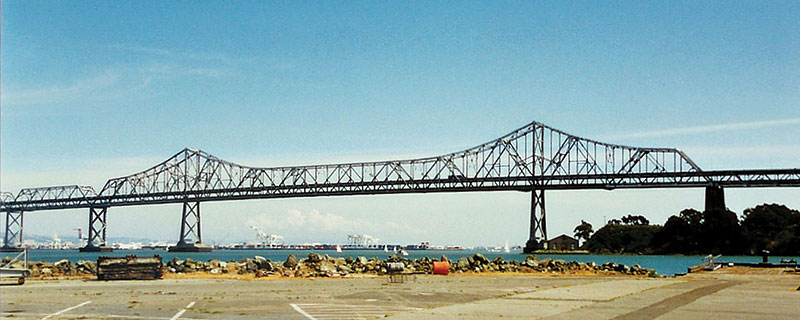
November 12, 1936: The Bay Bridge Opens

The western span

November 12, 1936: The San Francisco-Oakland Bay Bridge opens to automobile, bus and commuter rail traffic.

It often gets short shrift in comparison to the more famous Golden Gate Bridge. But the Bay Bridge (for simplicity's sake, I'm going to call it that from here on out) not only came first, but is longer (4.4 miles to 1.7), and carries more cars every day (260,000 to 110,000).

There are 2 sections. The western section, a suspension bridge, connects downtown San Francisco to Yerba Buena Island. It has 2 decks, with westbound (SF) traffic on the upper level and eastbound (Oakland) traffic on the lower level. The eastern section connects Yerba Buena Island to Oakland, and marks the western end of the transcontinental Interstate 80.
The original eastern span

The original eastern section was a cantilever bridge, also double-decked. In 1989, the Loma Prieta Earthquake not only interrupted the World Series between the San Francisco Giants and the Oakland Athletics, but it caused a part of the eastern section's upper deck to collapse onto the lower deck. On the official World Series highlight film, Giants catcher Terry Kennedy can be seen telling his teammates, "The Bay Bridge collapsed!" as it turned out, it was not the entire bridge, just one section; but people did die as a result.

The immediate fix took a month. But it was decided to replace the eastern section with a more quake-safe structure. On September 2, 2013, the new eastern section opened, a suspension bridge that took both directions of traffic on one level, then the widest bridge in the world.
The Key System ended commuter rail service in 1958, and bus service when it went out of business in 1960. Thus, the bridge has been all-car (and truck, and bus) since then. The Bay Area Rapid Transit (BART) system began service between the cities in 1972, but uses an underwater tunnel, not the Bay Bridge.

*

November 12, 1936 was a Thursday. Baseball was out of season. Football was in midweek. The NBA hadn't yet been founded. Two games were played in the NHL. The New York Americans and the Chicago Black Hawks played to a 0-0 tie at the old Madison Square Garden. And the Montreal Canadiens beat the Montreal Maroons, 2-1 at the Montreal Forum. 

Monday, November 7, 2022

November 7, 1940: The Tacoma Narrows Bridge Collapses

November 7, 1940: The Tacoma Narrows Bridge collapses. Opening just 4 months earlier, on July 1, 1940, outside Tacoma, Washington, it was then the 3rd-longest suspension bridge in the world, behind only the Golden Gate Bridge in San Francisco and the George Washington Bridge in New York.

The wind gusts that came through the Narrows made the road wobble in midair, giving it the nickname "Galloping Gertie." On November 7, someone heard that it was particularly wobbly, and got a home movie camera, and took spectacular color footage of the event, as 40-mile-per-hour winds eventually caused the roadway to fall apart.

The remnants of the bridge were given to the federal government as scrap metal for the war effort. Due to the Japanese attack on Pearl Harbor, new bridges on or near the Pacific Coast were put on hold for the duration. For that reason, and due to insurance difficulties, construction on the replacement bridge didn't begin until 1948.

A new Tacoma Narrows Bridge opened on October 14, 1950, and became the new model for suspension bridges standing up to high winds. It was nicknamed "Sturdy Gertie," and is still in use. Due to increasing traffic as the Seattle-Tacoma area has developed, a parallel span was added in 2007. As far as I know, this one has no nickname. It carries eastbound traffic, while the 1950 span carries westbound traffic, via Washington State Route 16.

*

November 7, 1940 was a Thursday. Baseball was out of season. Football was in midweek. The NBA hadn't been founded yet. Only 1 game was played in the NHL: The New York Americans beat the Chicago Blackhawks, 1-0 at the Chicago Stadium. John Sorrell scored the only goal, for the Amerks at 6:01 of the 3rd period (meaning 13:59 left to play in regulation.) 

Tuesday, March 29, 2022

March 29, 1938: The Overseas Highway Opens

March 29, 1938: The Overseas Highway is opened to traffic, linking the Florida Keys to the Florida mainland. It runs 113 miles rom Key West to the mainland, 164 miles from downtown Miami.

The Florida East Coast Railway had made the City of Miami possible in 1896, and linking the Keys to the mainland by road or rail had been planned since 1917. Construction began in 1922, and continued past the end of the Florida Land Boom in 1926.

On January 25, 1928, the Highway opened from Key West to Key Largo, but there was still a ferry from Key Largo to the mainland, and that ferry took 4 hours. The Highway and the Ferry were bannered as extensions of U.S. Route 1.

In 1935, work began on a bridge to connect the Highway to the mainland. Then came the Labor Day Hurricane, which wrecked much of their work, not to mention many of the buildings in the Keys. Finally, the full Highway was opened for traffic on March 29, 1938.

In 1939, President Franklin D. Roosevelt visited Key West, the southernmost point in the continental U.S., helping to spark tourism to the area. His successor, Harry Truman, occasionally stayed at a house there that became known as the Little White House or the Summer White House. Writer Ernest Hemingway also owned a house there, known for an extended family of six-toed cats. And on April 23, 1982, in an event for which I have a separate entry, a dispute between the City of Key West and the U.S. Navy led to the City seceding from the Union, forming the Conch Republic, and declaring war on the United States, surrendering one minute later.

*

March 29, 1938 was a Tuesday. Baseball was in Spring Training. Football was out of season. And the NBA hadn't been founded yet.

Two games were played in the Stanley Cup Finals. The Toronto Maple Leafs beat the Boston Bruins, 3-2 at the Boston Garden, to complete a 3-game sweep and clinch a Finals berth. Gordie Drillon scored at 10:04 of overtime. And the New York Americans beat the Chicago Black Hawks, 3-1 at Madison Square Garden. But the Hawks would win the series, and then beat the Leafs for the Cup.

Thursday, March 17, 2022

March 17, 1942: The End of the New York Americans

Red Dutton

March 17, 1942: St. Patrick's Day is no lucky day for the New York Americans. New York City's original National Hockey League team loses to the Boston Bruins, 8-3 at the Boston Garden. Since the Amerks did not qualify for the Playoffs, this is their last game of the season.

The struggling franchise chose to suspend operations for the duration of World War II. But the NHL did not let them reconvene for the 1945-46 season. So this turned out to be the last game the Americans ever played. Harry Watson, later a 5-time Stanley Cup winner with the Toronto Maple Leafs, but at this point a rookie a few days away from his 19th birthday, scored the last goal.

Two days earlier, they had played their last home game, at the old Madison Square Garden, and won, beating the Maple Leafs, 6-3. Murph Chamberlain scored a hat trick.

The Amerks had begun in 1925, as the NHL began to expand into America, first the season before with the Boston Bruins, then with the Americans and the Pittsburgh Pirates, who would also end up failing; then, in 1926, with the New York Rangers, the Detroit Red Wings and the Chicago Black Hawks. George "Tex" Rickard, builder and owner of the new version of Madison Square Garden -- eventually to be known as "The Old Garden" -- made so much money on the Americans' rent and concessions that he wanted his own team. The media called them "Tex's Rangers," and they immediately became more successful than the Americans.

The Americans were owned by Bill Dwyer, a bootlegger who was making money during Prohibition, and the hockey team became the toy he spent his money on. When Prohibition ended in 1933, his hockey ownership was doomed. The League took over ownership of the franchise in 1936, and let its head coach, one of their former players, run it: Norman "Red" Dutton. It didn't change the image of either team: The Rangers were seen as the team of classy people, the Americans the team of the working class, struggling through the Great Depression.

The Americans made the Playoffs for the 1st time in 1929, but lost -- to the Rangers. They didn't make it again until 1936, beating Chicago before losing to the Toronto Maple Leafs in the Semifinals, coming within 5 wins of the Stanley Cup. In 1938, the Americans beat the Rangers in the Quarterfinals, before losing to Chicago in the Semifinals, again coming within 5 games of the Cup. They made the Playoffs again in 1939, losing to Toronto; and in 1940, losing to Detroit.

But World War II was on, and Canadian players were going off to fight for the British Empire. The Americans missed the Playoffs in 1941. In 1941-42, still bogged down by lingering debt from the Dwyer era, Dutton had to sell off his best players for cash.

At his wit's end, Dutton changed the team's name to the Brooklyn Americans. He intended to move the team to Brooklyn, but there was no arena in that borough suitable enough even for temporary use. As result, they continued to play their home games at The Garden, while practicing in Brooklyn. They barely survived the season, finishing dead last for the second year in a row with a record of 16–29–3.

The Amerks suspended operations for The War's duration. In 1945, a group emerged willing to build a new arena in Brooklyn, and Dutton was ready to resume operations. But in 1946, the NHL reneged on previous promises to reinstate the Amerks and canceled the franchise.

Legend has it that Dutton blamed the Rangers for canceling the Americans' franchise, and placed a curse on them, saying they would never win the Stanley Cup again for as long as he lived. They had won it in 1928, 1933 and 1940. Dutton died in 1987, and the Rangers had not won the Cup again. But the New York Islanders, founded as an expansion team in 1972, had won 4 straight Cups, from 1980 to 1983.

The Rangers finally won the Cup again in 1994. The New Jersey Devils, founded when the Colorado Rockies moved to the Meadowlands in 1982, won the Cup in 1995, 2000 and 2003. Since the Americans were cut off in 1942, the won-loss records of the New York Tri-State Area's teams in the Stanley Cup Finals -- keeping in mind that it was only the Rangers from 1942 to 1972 -- are 1-4 for the Rangers, 4-1 for the Islanders, and 3-2 for the Devils.

The Americans' records and trademarks are still owned by the NHL. The Islanders have never worn "throwback uniforms" in their style. I don't know if they've ever even asked.

*

March 17, 1942 was a Tuesday. This was the only NHL game scheduled for the day. The NBA hadn't been founded yet. Baseball was in Spring Training. And football was out of season. So this was the only score on this historic day.

Sunday, March 13, 2022

March 13, 1940: The Winter War Ends

March 13, 1940: The Moscow Peace Treaty is signed, ending a war between the Soviet Union and neighboring Finland, a sub-conflict of World War II that had been known as the Winter War.

From the 13th Century until the Finnish War of 1808-09, Finland was a part of the Kingdom of Sweden. From that war until 1917, the Grand Duchy of Finland had been part of the Russian Empire. After the Russian Revolution, on December 6, 1917, Finland declared its independence.

When World War II started on September 1, 1939, Finland knew it faced an attack from the Soviet Union, especially since Leningrad (the once and future St. Petersburg) was only 20 miles from the Soviet-Finnish border. Indeed, when Vladimir Lenin returned to Russia to launch his Bolshevik Revolution, it was by train at St. Petersburg's Finland Station.

The Soviets made several demands, mostly the cessation of some border territories. The Finns refused, and, on November 30, 1939, the Soviets invaded.

But just as the cold and the snow would prove to be the Soviets' ally once Nazi Germany attacked them in 1941, it was Finland's ally on this occasion, as temperatures dropped to less than 40 degrees below zero (the point at which the Fahrenheit and Celsius scales meet).

The Finns were able to use cold to their advantage, but also heat. They filled jars with alcohol, put wicks in them, lit the wicks, and threw them at the Soviets. In Britain, this was already known as a "petrol bomb." In Finland, they named it after Soviet Foreign Minister Vyacheslav Molotov, the man who had presented the Soviets' demands to them: The Molotov Cocktail.

The war turned into a stalemate, and the Soviets took heavy losses: Over 160,000 dead, another 140,000 wounded, and over 60,000 removed from action due to frostbite. Finland, outnumbered 2-1 in total manpower, lost 26,000 dead and 43,000 wounded.

Simo Häyhä, often referred to by his nickname, "The White Death," for his white uniform that blended in with the snow, is believed to have killed more than 500 enemy soldiers during the conflict, the highest number of sniper kills in any major war. On March 6, 1940, the tables were turned, and a Soviet sniper hit him in the face. He recovered, but remained disfigured for the rest of his life -- until 2002, at the age of 96.
A peace treaty was signed. The Soviets got some of what they wanted: Finland ceded 9 percent of its territory, and the war was over. The Finns got the main things they wanted: Peace and the retention of their independence.

The Finns were hailed all over the world for their resistance. Chancellor Adolf Hitler of Nazi Germany took note of the Red Army's poor performance, and would launch his attack on the Soviet Union in June 1941. But he couldn't get either Moscow or Leningrad before the Winter set in, and this would be the beginning of his end.

Hostilities resumed in June 1941 with the Continuation War, when Finland allied itself with Germany in an attempt to regain the territory lost to the Soviets barely a year earlier. Finnish troops occupied Eastern Karelia from 1941 to 1944, and assisted the German army in the Siege of Leningrad. The massive Soviet Vyborg-Petrozavodsk offensive in the Summer of 1944 led to a breakthrough until the Finns finally repulsed it at Tali-Ihantala. This partial Soviet success led to a stalemate and later an armistice. This was followed by the Lapland War of 1944-45, when Finland fought retreating German forces in northern Finland. In other words, the Finns were with the Nazis before they were against them.

As a result of the three wars, Finland lost 12 percent of its land area; 20 percent of its industrial capacity; its second-largest city, Viipuri, which the Soviets renamed Vyborg, a name it still has today; and the ice-free port of Liinakhamari. The Finns lost around 97,000 soldiers, and were forced to pay war reparations initially set at $300 million in 1938 prices, later adjusted to $226.5 million.

However, the country avoided occupation by Soviet forces, and managed to retain its independence. Along with Great Britain, Finland emerged from the war as one of the only European countries to have taken part in hostilities that was never occupied and managed to preserve its democracy throughout. In 2022, Finland remains a democracy, home to about 5.6 million people. And, alone among the four mainland Scandinavian countries, it is the only one without a monarchy. (I say, "mainland," because Iceland, unlike Norway, Sweden and Denmark, does not have a monarch.)

UPDATE: In 2025, the YouTube comedy series Epic Rap Battles of History paired Simo Häyhä, played by "Epic" Lloyd Ahlquist, with Manfred von Richtofen, the German pilot of World War I known as the Red Baron, played by "Nice" Peter Shukoff. Lloyd cleverly rhymed the brand of rifle the White Death used, Mosin-Nagant, with "frozen savant."

*

March 13, 1940 was a Wednesday. Soul singer Candi Staton was born on this day.

Baseball was in Spring Training. Football was out of season. The NBA had not yet been founded. There were 3 games played in the NHL:

* The New York Rangers beat their tenants at the old Madison Square Garden, 4-2. It was considered a Ranger home game. Neil Colville scored twice for the Broadway Blueshirts, while former Toronto superstar Charlie Conacher scored twice for the Amerks. Exactly on month later, on April 13, the Rangers would win the Stanley Cup.

* The Detroit Red Wings beat the Montreal Canadiens, 5-2 at the Olympia Stadium in Detroit.

* The Chicago Black Hawks beat the Toronto Maple Leafs, 2-1 at the Chicago Stadium.

* And the Boston Bruins were not scheduled.

Tuesday, March 1, 2022

March 1, 1932: Charles Lindbergh Jr. Is Kidnapped

March 1, 1932: Charles Augustus Lindbergh III -- usually listed as "Charles Lindbergh Jr." -- is kidnapped from his home in East Amwell, Hunterdon County, New Jersey. (The location is usually listed as Hopewell, which is in Mercer County, because Hopewell was their mailing address.) His parents were Charles Lindbergh, the pilot who in 1927 became the 1st person to fly between the North American and European continents, and Anne Morrow Lindbergh, a poet.

The child was 20 months old. A ladder was found beneath the window of his bedroom. A ransom of $75,000 -- about $1.47 million in 2021 money -- was paid. It didn't matter: On May 12, a truck driver found the body in Hopewell (the actual town, about 4 miles south of the Lindbergh home).
Nobody had to ask the New York Daily News, "What baby?"
Journalist H.L. Mencken called it "the greatest story since Creation."

A skull fracture was determined to be the cause of death, and it was speculated that the kidnapper may have dropped the boy while trying to get out the window or back down the ladder.

*

March 1, 1932 was a Tuesday. It was the off-season for baseball and football, and the NBA hadn't been founded yet. But there were 3 NHL games played on the day, none of them involving the New York Rangers:

* The New York Americans lost to the Toronto Maple Leafs, 3-1 at Maple Leaf Gardens in Toronto.

* The Boston Bruins beat the Montreal Canadiens, 7-6 at the Boston Garden.

* And the Montreal Maroons beat the Chicago Black Hawks, 1-0 at the Montreal Forum.

*

America, still adoring Lindbergh nearly 5 years after his great feat, went into shock and mourning. The media coverage, in this golden age of newspapers and the early days of radio, was as intense as the technology would allow. But with few leads, the story began to fade.

Until September 18, 1934. A bank teller noticed a $10 gold certificate with an identification showing that it was part of the ransom delivery. The bill was traced, and Bruno Richard Hauptmann, a 34-year-old German-born carpenter living in The Bronx, was arrested. 

On February 13, 1935, after a trial that was accompanied by a media circus that got it labeled "The Trial of the Century," Hauptmann was convicted of the kidnapping and murder of the boy. I would have done a "Scores On This Historic Day" post for that day. But it was the off-season for baseball and football, the NBA hadn't been founded yet, and when I looked up the NHL games played on the day, I discovered that there weren't any. So I couldn't do it.

Hauptmann was executed in the electric chair at the State Prison in Trenton on April 3, 1936. He maintained his innocence until the end. His widow, Anna, lived until 1994, still insisting that he was innocent. Many books have been written on the case, some reaching the conclusion that the guilty verdict was correct, some reaching the opposite conclusion.

Trying to escape what newspaper editor H.L. Mencken called "the biggest story since the Resurrection," the Lindberghs left America, and moved to Europe. While there Charles became enamored of Nazi Germany, especially their air force, the Luftwaffe, and accepted a medal from the Nazi government.

He returned to America, and warned against getting involved in World War II, declaring that it was the British and Jews around the world -- both with good reason to oppose the Nazis -- who wanted America in the war. Millions of Americans who once loved him now abandoned him, and he got the obscurity he had until 1927, and had craved since. He died in 1974. 

Friday, February 4, 2022

February 4, 1943: The Death of Frank Calder

February 4, 1943: Frank Calder, the 1st President of the National Hockey League, dies of a heart attack in Montreal. He was 65 years old.

Frank Sellick Calder was born on November 17, 1877 in Bristol, in England's West Country. As a young man, he flipped a coin to decide whether to move to Canada or America. Canada won. Given his love for rugby, he might have ended up an executive in American football.

He became a sportswriter in Montreal, and was a key figure in the development of Canadian soccer. At the start of the 1914-15 season, the National Hockey Association named him its treasurer -- not because he had ever been affiliated with their sport, but because he had connections in sports in general, and in journalism.

In 1917, the NHA owners got tired of dealing with Eddie Livingstone, owner of the Toronto Blueshirts, who had won the Stanley Cup in 1914. But they couldn't get rid of him. First one president of the NHA, Emmett Quinn, resigned; then, his successor, Frank Robinson. That left Calder as acting president. He arranged meetings between the NHA's other team owners, and they decided to form a new league. Essentially, they all dropped out of the NHA and formed the NHL, leaving Livingstone with control of a league with one team in it.

The NHL was officially founded on November 26, 1917, and Calder was elected its 1st President. He managed the League through the crisis of the Spanish Flu epidemic that forced the cancellation of the last game of the 1919 Stanley Cup Finals, and fined the striking Hamilton Tigers in 1925, leading to their refusal to play for the Cup, despite having finished 1st in the NHL's regular season, and then to the cancellation of their franchise.

Calder oversaw the expansion of the NHL into America, in 1924 with the Boston Bruins (and also with Canada's Montreal Maroons); in 1925 with the New York Americans (allowing the owners of their rights to basically take over the Tigers) and the Pittsburgh Pirates; and, in 1926, following the collapse of the Western Hockey League, with the New York Rangers, the Detroit Red Wings and the Chicago Black Hawks.

(The Chicago team always wrote their name as two words, "Black Hawks," until 1986. Their original NHL charter document was found, and it had the name written as one word, "Blackhawks." They informed the NHL office, and the team has been "the Chicago Blackhawks" ever since.)

But he also led the NHL through the Great Depression, which would kill off some teams: The Pirates became the Philadelphia Quakers in 1930, but lasted only 1 season and then folded in 1931; the Ottawa Senators became the St. Louis Eagles in 1934, but lasted only 1 season and then folded in 1935; and the Maroons folded in 1938, despite having won the Stanley Cup only 3 seasons before. In 1942, the manpower drain of World War II forced the Americans to suspend operations. Calder promised team management that they would be able to start again after the war.

Except he wouldn't be able to keep that promise. On January 25, 1943, at a meeting of the NHL's Board of Governors in Toronto, he had a heart attack. He later had another in the hospital. On February 3, he felt well enough to travel, and returned to his hometown of Montreal. But he felt bad again, checked into Montreal General Hospital, and suffered another heart attack the next day, killing him.

In 1933, Calder began naming an NHL Rookie of the Year. In 1937, he began buying a trophy for the annual winner. After his death, it was renamed the Calder Memorial Trophy. The American Hockey League renamed its championship trophy the Calder Cup. In 1947, Calder was inducted into the Hockey Hall of Fame, in the "Builders" category.

*

February 4, 1943 was a Thursday. There were 2 games played in the NHL. The New York Rangers and the Chicago Black Hawks played to a tie, 1-1 at the old Madison Square Garden. And the Detroit Red Wings beat the Toronto Maple Leafs, 3-2 at Maple Leaf Gardens in Toronto. The Montreal Canadiens and the Boston Bruins were not scheduled.

Baseball and football are out of season. The NBA hadn't been founded yet.

This was also the day that the novel The Human Comedy, by William Saroyan, was published. I have a separate entry for that event.  

Sunday, January 16, 2022

January 16, 1938: Benny Goodman at Carnegie Hall

January 16, 1938: A concert is held at Carnegie Hall, the famous classical music palace in Midtown Manhattan, New York City. But it's not classical that holds court: For the 1st time in the building's history, it's jazz.

There's an old joke: A young man walks up to an older man on the streets of New York, and asks, "How do you get to Carnegie Hall?" And the older man says, "Practice, my boy, practice!"

In fact, in spite of the building's prestige, no amount of talent is necessary to perform at Carnegie Hall: As with pretty much any concert venue in the world, all you have to do is pay the rental fee and choose an open date to play.

The performers on this evening were the Benny Goodman Orchestra. Goodman, then 27 years old, was a Jewish clarinetist from Chicago, and his band had been successful for about 3 years already, to the point where he was able to take the bold step of racially integrating it.

Goodman led his Orchestra through some of the biggest names in jazz, playing songs by Count Basie (who sat in on piano to play his best-known song, "One O'Clock Jump"), Duke Ellington ("Blue Reverie"), Fats Waller ("Honeysuckle Rose"), Johnny Green ("Body and Soul") and Edgar Sampson ("Stompin' at the Savoy").

They also played popular standards written down the block on the stretch of Broadway, just Uptown from the Theater District, known as "Tin Pan Alley": George and Ira Gershwin ("The Man I Love" and "I Got Rhythm"), Irving Berlin ("Blue Skies,"), and Richard Rodgers and Lorenz Hart ("Blue Moon").

They also played "Life Goes to a Party," which Goodman had written with his trumpeter, Harry James; and their best-known number, written by Louis Prima: "Sing Sing Sing (with a Swing)."

The concert proved so successful that, twice, right before Christmas that year, and again the next year, Goodman returned to Carnegie Hall as the headliner for a concert titled "From Spirituals to Swing," bringing on Basie, Big Joe Turner, Big Bill Broonzy, Sonny Terry, and other luminaries of black music.

A live album, The Famous Carnegie Hall Jazz Concert, would be released by Columbia Records in 1950, and it became the 1st jazz record to sell over 1 million copies. Goodman lived until 1986.

*

January 16, 1938 was a Sunday. It was the off-season for Major League Baseball and the NFL, and the NBA hadn't been founded yet. But there were 4 games played in the National Hockey League that night, a few blocks away at what would later be called "the old Madison Square Garden." Not only were both New York teams in action that night, they played each other:

* The New York Rangers beat the New York Americans, 4-0. Despite this result, the Amerks would go on to knock the Rangers out of the Playoffs.

* The Boston Bruins beat the Montreal Canadiens, 1-0 at the Boston Garden.

* The Montreal Maroons and the Detroit Red wings played to a tie, 1-1 at the Olympia Stadium in Detroit.

* And the Toronto Maple Leafs beat the Chicago Black Hawks, 7-2 at the Chicago Stadium. Despite this shellacking, the Hawks would go on to beat the Leafs in the Stanley Cup Finals. 

December 31, 1999 & January 1, 2000: The Millennium

December 31, 1999:  The Millennium arrives. The people of planet Earth survived. At a terrible cost. But we hadn't destroyed ourselves. ...