Showing posts with label washington state. Show all posts

Thursday, November 24, 2022

November 24, 1971: The D.B. Cooper Hijacking

November 24, 1971: The legend of D.B. Cooper begins. He had some things in common with Jack the Ripper: He was a mysterious figure; he committed a shocking crime, although, in his case, he didn't kill anybody; he was never caught; and he may not even have come up with the name by which he became known on his own.

It was the day before Thanksgiving, traditionally the busiest travel day of the year. At Portland International Airport in Oregon, a flight counter attendant for Northwest Orient Airlines reported that a man identifying himself as "Dan Cooper" walked up and used cash to buy a one-way ticket on Flight 305 to Seattle, a flight intended as being only 30 minutes. "Mr. Cooper" boarded the plane, which was a Boeing 727-100, took his seat, and ordered a bourbon and soda.

The flight attendant, Florence Schaffner, backed up the counter attendant's description of Cooper: Wearing a business suit with a black tie and a white shirt, appearing to be in his mid-40s, and looking like the composite sketch above.

The plane took off at 2:50 PM Pacific Standard Time (5:50 Eastern), on time. Shortly thereafter, Cooper handed a note to Schaffner. Flight attendants -- they were usually still called "stewardesses" at this point, or "stews" for short -- often got handed notes, usually from men who were lonely from their travels. This one dropped it in her purse without reading it. Cooper spoke up: "Miss, you'd better look at that note. I have a bomb."

She read it. It asked her to sit next to him. She asked to see the bomb. He opened his briefcase, and convinced her that what was inside really was a bomb. The he gave her his demands: $200,000 (about $1.44 million in today's money), 4 parachutes, and a fuel truck standing by in Seattle, to refuel the plane after it landed.

Schaffner went to the cockpit, and told the pilots. When she got back, Cooper was wearing sunglasses. The flight's captain, William A. Scott, contacted Seattle-Tacoma International Airport (a.k.a. "Sea-Tac"). The authorities there contacted local and federal authorities. The other 35 passengers were told only that their arrival would be delayed because of "a minor mechanical difficulty."

Donald Nyrop, president of the airline, was reached. He ordered that the ransom be paid, and that all employees should cooperate completely with Cooper. The plane circled Puget Sound for 2 hours, to give the police and the FBI time to get the money and the parachutes.

Flight attendant Tina Mucklow recalled that Cooper appeared familiar with the local terrain; at one point he remarked, "Looks like Tacoma down there," as the aircraft flew above it. He also correctly mentioned that McChord Air Force Base was only a 20-minute drive (at that time) from Sea-Tac. He didn't match the profile of men engaged in air piracy at the time: Enraged, hardened criminals or "Take this plane to Cuba!" political dissidents.

"He wasn't nervous," she told investigators. "He seemed rather nice. He was never cruel or nasty. He was thoughtful and calm all the time." He even ordered a refill of his drink, paid his tab, and offered to request meals for the flight crew during the stop in Seattle. He was very much the stereotype not of the "air pirate," but that of the "gentleman bandit."

His motive? It wasn't clear. Mucklow asked Cooper if he had a grudge with Northwest Airlines. He said, "I don't have a grudge against your airline, Miss. I just have a grudge."

The FBI got 10,000 $20 bills from the Federal Reserve Bank of San Francisco, thus making the serial numbers easier to track.

At 5:39 PM, the plane landed at Sea-Tac. A backpack with the money and the parachutes was delivered to Mucklow. Cooper then released the passengers, Schaffner, and another flight attendant, Alice Hancock -- but not Mucklow. He then told the cockpit crew to take off again, toward Mexico City.

At 7:40, the plane took off again. The only people on board were Cooper, Scott, Mucklow, first officer William Rataczak, and flight engineer Harold E. Anderson. Two F-106 fighter jets from McChord and a Lockheed T-33 training jet followed. At 8:00 PM, having been shown how while on the ground, Cooper opened the plane's rear staircase. At 8:13, there was a sudden, unexpected change in altitude. It has been presumed that this was when he jumped. At 10:15, the plane landed at Reno, Nevada, and it was determined that Cooper was no longer on board.

The FBI found fingerprints and Cooper's tie, but the prints were not in their system, and the tie gave them no hints as to his identity. They looked for men in the region with a criminal record, and an Oregon man named D.B. Cooper stood out. The Portland police quickly ruled him out as a suspect, but the wire service picked up the story, and "D.B. Cooper" has been the name attached to the hijacker ever since.

As far as can be determined, "Dan Cooper" was never seen again. An extensive search was made of Washington State and Oregon. It enabled the FBI to solve one crime: A skeleton was found, but of a teenage girl, determined to be one murdered weeks earlier. In 1980, Brian Ingram, a boy on a camping trip, found some weather-damaged bills with serial numbers matching the ransom money, $5,880 worth. This was near the Columbia River, which separates Washington from Oregon.

This has led to the leading theory: Cooper died in his attempt to escape, either through being unable to open his parachute in time, or landing too hard anyway, on impact with either the ground or a tree, or drowned in the river, possibly before he could get the heavy parachute off of himself.

In 1986, the FBI gave a cash award worth half the money to Ingram, by then in high school; and half to Northwest Orient Airlines' insurer. Like Cooper himself, none of the other money has ever been found.

As with Jack the Ripper, multiple guesses as to the perpetrator's identity have been made. As with the Ripper, most are easily dismissible. One of the more fascinating ones was that Cooper was John List, who had murdered his family in a religious-fanatic rage in Westfield, New Jersey just 15 days before the hijacking, and hadn't been seen since. He did bear a facial resemblance to the sketch, and, at 46, was age-consistent. List was captured in 1989, and confessed to slaying his family, but denied any connection to the Cooper case, and maintained that denial until his death in prison in 2008. The FBI have dropped him from their list of Cooper suspects.

Also as with the Ripper, the fact that the Cooper case was unsolved has led to an unending public fascination with it. In 1975, James M. Cain, author of the crime novels turned film noirs The Postman Always Rings Twice, Mildred Pierce and Double Indemnity, published the novel Rainbow's End, an imagination of what happened to Cooper after he jumped.

In 1980, J.D. Reed published a novel titled Free Fall. The following year, it was made into a film, The Pursuit of D.B. Cooper, starring Treat Williams. The story takes a lot of liberties, including the fact that Cooper jumped in daylight, when he actually jumped at night.

In 1991, Scott Adams published an issue of his Dilbert comic strip suggesting that Cooper died due to sabotage: "He learned that you should never get your parachutes from the same people you're robbing."

The TV series In Search of... (in 1979) and Unsolved Mysteries (1988) examined the Cooper case. TV shows suggesting in-universe solutions to the case have included NewsRadio in 1998, Prison Break in 2006, Numbers in 2009, Leverage in 2012, and Loki in 2021 (The Marvel Cinematic Universe makes the suggestion that Loki, played by Tom Hiddleston, was Cooper).

And the series Twin Peaks, set in Washington State, has a lead character, an FBI Agent, named Dale Bartholomew Cooper. (The name is only a tribute: Agent Cooper was too young to have been the hijacker -- his portrayer, Kyle MacLachlan, was 12 at the time -- but he could have been his son, and thus became an FBI agent as an act of rebellion.)

*

November 24, 1971 was a Wednesday. Baseball was out of season, and football was in midweek. There were 5 games each in the NBA and the ABA:

* The New York Knicks beat the Baltimore Bullets, 111-94 at the Baltimore Civic Center. (It still stands, known as the CFG Bank Arena.)

* The Boston Celtics beat the Buffalo Braves, 108-100 at the Boston Garden.

* The Cincinnati Royals beat the Portland Trail Blazers, 114-112 at the Cincinnati Gardens.

* The Milwaukee Bucks beat the Atlanta Hawks, 141-107 at the Milwaukee Arena. In 1974, it was renamed the Milwaukee Exposition, Convention Center and Arena, or "The MECCA." Since 2014, it has been named the UW-Panther Arena. I don't know what Kareem Abdul-Jabbar, who had recently changed his name from Lew Alcindor in accordance with his conversion to Islam, thinks of that name now, or thought then, but he scored 33 points in this game.

* The Houston Rockets beat the Philadelphia 76ers, 109-108 at the Hofheinz Pavilion in Houston.

* The New York Nets lost to the Indiana Pacers, 112-101 at the Indiana State Fairgrounds Coliseum in Indianapolis. (It still stands, named the Corteva Coliseum.)

* The Utah Stars beat the Virginia Squires, 120-113 at the Scope in Norfolk, Virginia. Despite losing the game, Charlie Scott of the Squires led all pro basketball scorers on the night, with 42 points.

* The Carolina Cougars beat the Dallas Chaparrals, 120-106 at the Greensboro Coliseum.

* The Miami Floridians beat the Denver Rockets, 133-129 at the Miami Beach Convention Center. (The Rockets became the Denver Nuggets in 1974.)

* And the Memphis Pros beat the Pittsburgh Condors, 126-110 at the Mid-South Coliseum in Memphis.

There were 6 games played in the NHL:

* The New York Rangers beat the St. Louis Blues, 8-3 at the new Madison Square Garden. Bobby Rousseau, Walt Tkaczuk and Brad Park -- a defenseman, mind you -- each scored 2 goals for the Broadway Blueshirts. Vic Hadfield and Jim Neilson also scored.

* The Boston Bruins beat the Philadelphia Flyers, 2-1 at The Spectrum in Philadelphia.

* The Toronto Maple Leafs beat the Pittsburgh Penguins, 2-1 at the Civic Arena in Pittsburgh.

* The Montreal Canadiens and the Chicago Black Hawks played to a tie, 3-3 at the Chicago Stadium.

* The Los Angeles Kings beat the Buffalo Sabres, 5-3 at The Forum in Inglewood, California, outside Los Angeles.

* The California Golden Seals beat the Detroit Red Wings, 6-1 at the Oakland Coliseum Arena.

* And the Minnesota North Stars and the Vancouver Canucks were not scheduled.

Friday, November 11, 2022

November 11, 1919: The Centralia Massacre

November 11, 1919: An incident breaks out between U.S. Army veterans and labor union members in Centralia, Washington, about halfway between Seattle and Portland. It becomes known as the Centralia Tragedy, or the Centralia Massacre.

Note: There was an earlier event known as the Centralia Massacre, in Centralia, Missouri, about halfway between St. Louis and Kansas City, on September 27, 1864, a terrorist attack led by Confederate soldiers including Jesse James.

The American Legion was a brand-new organization, having been founded by U.S. Army officers still in Paris on March 15, 1919. They patterned themselves after the advocacy group for veterans of the American Civil War, the Grand Army of the Republic.

On November 11, the 1st Anniversary of the Armistice that ended World War I, they held a parade in Centralia. But the Pacific Northwest had also been a successful venue for the Industrial Workers of the World, a leftist labor union nicknamed the "Wobblies."

As the Legion tended to be conservative (in spite of their former commander-in-chief, President Woodrow Wilson, being a Democrat, and liberal on most issues except race), this sometimes brought the two groups into conflict. This included Warren Grimm, commander of the Legion's Centralia post and a former All-American football player at the University of Washington; and Elmer Smith, a lawyer for the IWW, and a pacifist who was known for antiwar activities.

The Legionnaires marched through Centralia, with loaded rifles, and fears of a repeat of the 1916 massacre in Everett, Washington, gripped the Wobblies. Grimm was at the head of the march, and he was shot in the head by Eugene Barnett. Whether the Legionnaires had charged the gathered Wobblies first has been disputed. Shooting and fighting broke out. When it ended, 4 Legionnaires, a Wobbly and a Deputy Sheriff were dead.

Smith was arrested, but, once it was determined that he did not participate, he was released. He lived until 1932. Wesley Everest was misidentified as Grimm's killer, arrested, and lynched before the night was up. Barnett was imprisoned, but released in 1931 before evidence was later found that he was the man who fired the shot that killed Grimm. He lived until 1973.

*

November 11, 1919 was a Wednesday. Baseball was out of season. Football was in midweek. Professional basketball barely existed. And the NHL season didn't start for over a month. So there were no scores on this historic day.

Thursday, November 10, 2022

November 11, 1889: Washington Is Admitted As the 42nd State

November 11, 1889: Washington is admitted to the Union as the 42nd State. It is the only State named after a President, George Washington. It is also the only State with a green State Flag, and the only State with a State Flag with the face of a real person on it, rather than a representation of some principle or other.

Other States have been named after people, but not Presidents:

* Delaware: Thomas West, 3rd Baron De La Warr, a colonial administrator.
* Pennsylvania: William Penn, its founder.
* Georgia: King George II of England.
* Maryland: St. Mary, mother of Jesus.
* South Carolina and North Carolina: King Charles I of England.
* Virginia: Queen Elizabeth II of England, "the Virgin Queen."
* New York: James, Duke of York, brother of King Charles II of England. James succeeded his brother, becoming King James II.
* Louisiana: King Louis IX of France, a.k.a. St. Louis, "the Crusader King." The City of St. Louis, Missouri was also named for him.

Washington was in the Northwest. It had been acquired as part of the Oregon Treaty of 1846. It has become known for its rainy climate; but, when the weather is good, it is known for its outdoor activities: Bicycling, camping in its forests, climbing Mount Rainier, riding the ferry from Seattle (including to Victoria, the Provincial capital of British Columbia, Canada), skiing in the Winter.

Its largest city, Seattle, is particularly known for the U.S. Navy base in nearby Bremerton; the accompanying aviation industry, as the birthplace of aircraft manufacturer Boeing; the computer industry, as the birthplace of Microsoft; and the coffee industry, as the birthplace of Starbucks. The State Capitol is Olympia.

Politically, Washington tends to vote Democratic. However, as with neighboring Oregon, and fellow Pacific Coast State California, the further inland you get, the more conservative people get. This is particularly true of "The Palouse": Eastern Washington (including Spokane), Eastern Oregon, and Northern Idaho, the State's Panhandle. The highest-ranking politician produced by the State has been Thomas S. Foley, who was Speaker of the U.S. House of Representatives from 1989 to 1995.

That political divide is evident in the 2 major colleges with sports programs: The University of Washington, in Seattle, is generally thought of as liberal; while Washington State University, in Pullman, 288 miles to the east, is considered conservative. The annual Thanksgiving weekdn football game between "U-Dub" vs. "Wazzu" is known as the Apple Cup, named for the State's best-known agricultural product.

Seattle was home to the 1st American team to win the Stanley Cup, the 1917 Seattle Metropolitans. But after their league failed in 1926, the city, and therefore the State, didn't return to the major leagues until 1967, when the NBA expanded to include the Seattle SuperSonics. 

After decades with the Pacific Coast League, with teams called the Siwashes, the Turks, the Giants, the Purple Sox, the Indians, the Rainiers and the Angels, baseball tried the Seattle Pilots in 1969, but they were bankrupt and failed after 1 season. When the Kingdome opened in 1976, the NFL expanded to the Seahawks, and MLB expanded to the Mariners.

The Sonics won the 1979 NBA title, but were moved in 2008. There were new stadiums for the Mariners in 1999 and the Seahawks in 2002. The Seahawks won Super Bowl XLVIII in 2014. The Sounds won the MLS Cup in 2016 and 2019.

The Seattle Sounders played in the North American Soccer League from 1974 to 1983, and MLS expanded to include a new Sounders team in 2009. In 2021, the NHL expanded to include the Seattle Kraken, and the movement to bring in an expansion or moved team to become the new Sonics remains strong.

*

November 11, 1889 was a Friday. Baseball was out of season. Basketball was 2 years away from being invented. Hockey barely existed. There was 1 college football game on this day: Lehigh University beat Penn State, 106-0 at the Athletic Association's Grounds in South Bethlehem, Pennsylvania. Lehigh coach Jake Robeson mercifully offered to stop the game with 5 minutes left on the clock, and it remains the worst loss in Penn State football history.

This was a long time ago: Teams would sometimes play 2 games in less than 1 week, and Penn State had played Lehigh's nearby arch-rival, Lafayette, just 2 days before, and lost that, 26-0. They did play 2 other games that season, and win both, also against Pennsylvania teams, Swarthmore and Bucknell. Penn State was not yet the power that it would become, and, because of the diversion of the schools' footballing prowess, Penn State have not played Lehigh since 1942, and Lehigh haven't beaten them since 1936.

Monday, November 7, 2022

November 7, 1940: The Tacoma Narrows Bridge Collapses

November 7, 1940: The Tacoma Narrows Bridge collapses. Opening just 4 months earlier, on July 1, 1940, outside Tacoma, Washington, it was then the 3rd-longest suspension bridge in the world, behind only the Golden Gate Bridge in San Francisco and the George Washington Bridge in New York.

The wind gusts that came through the Narrows made the road wobble in midair, giving it the nickname "Galloping Gertie." On November 7, someone heard that it was particularly wobbly, and got a home movie camera, and took spectacular color footage of the event, as 40-mile-per-hour winds eventually caused the roadway to fall apart.

The remnants of the bridge were given to the federal government as scrap metal for the war effort. Due to the Japanese attack on Pearl Harbor, new bridges on or near the Pacific Coast were put on hold for the duration. For that reason, and due to insurance difficulties, construction on the replacement bridge didn't begin until 1948.

A new Tacoma Narrows Bridge opened on October 14, 1950, and became the new model for suspension bridges standing up to high winds. It was nicknamed "Sturdy Gertie," and is still in use. Due to increasing traffic as the Seattle-Tacoma area has developed, a parallel span was added in 2007. As far as I know, this one has no nickname. It carries eastbound traffic, while the 1950 span carries westbound traffic, via Washington State Route 16.

*

November 7, 1940 was a Thursday. Baseball was out of season. Football was in midweek. The NBA hadn't been founded yet. Only 1 game was played in the NHL: The New York Americans beat the Chicago Blackhawks, 1-0 at the Chicago Stadium. John Sorrell scored the only goal, for the Amerks at 6:01 of the 3rd period (meaning 13:59 left to play in regulation.) 

Monday, October 24, 2022

October 24, 2002: The Beltway Snipers Are Arrested

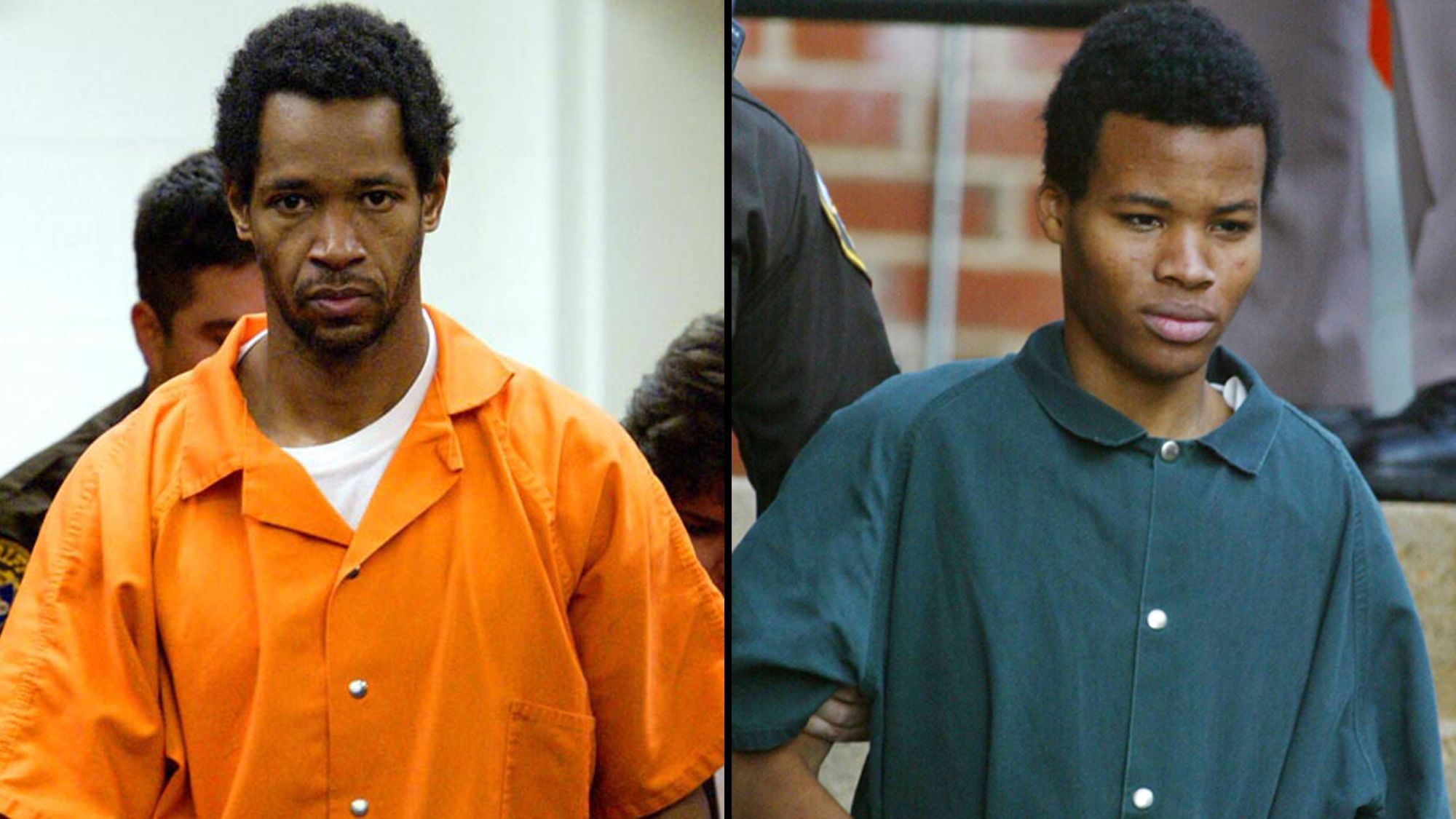
John Allen Muhammad (left) and Lee Malvo

October 24, 2002: The "Beltway Snipers," who killed 7 people in the Washington, D.C. area, are arrested.

John Allen Muhammad was 41 years old, and a native of Baton Rouge, Louisiana. He joined the Nation of Islam, dropping his birth name of John Allen Williams. In 1999, he kidnapped his children and took them to the Caribbean island nation of Antigua, apparently engaging in credit card and immigration document fraud.

It was during this time that he became close with Lee Boyd Malvo, who was living on Antigua with his mother. Then 17 and a native of Jamaica, he fell into a Svengali relationship with Muhammad, being converted to Islam and moved to Bellingham, Washington. There, he shoplifted a Bushmaster XM-15, an AR-15 style semi-automatic rifle.

At first, Muhammad was making Malvo shoot people connected with his ex-wife, Mildred Williams. On February 16, 2002, 21-year-old Keenya Nicole Cook was shot and killed by Malvo at the front door of her aunt's home in Tacoma, Washington. The aunt, Isa Nichols, had been good friends with John Allen Muhammad's ex-wife Mildred and had encouraged her to seek a divorce. This was the 1st of 9 shootings that the FBI later classified as "preliminary attacks": 3 in Maryland, 2 in Louisiana, and 1 each in Washington State, Arizona, Atlanta and Alabama.

Then came the series of shootings that became known as the Beltway Sniper attacks. A hole was cut at the rear of a blue 1990 Chevrolet Caprice driven by Muhammad and Malvo, as a firing port to be used during their attacks. This allowed them to remain hidden and escape the scene following their attacks.

On October 2, a shot was fired in Aspen Hill, Maryland, but it didn't hit anybody, and it was originally presumed to be random, before it was later compared to the other shootings. Just an hour later, in a supermarket parking lot in Wheaton, Maryland, James Martin was shot and killed.

The next morning, all within a span of 2 hours and 17 minutes, 4 people were killed in the Maryland suburbs of Washington, all in open areas where they were easy targets: A man at a car dealership in Rockville; a man at a gas station in Aspen Hill; a woman at in a shopping center parking lot in Norbeck; and a woman at a gas station in Kensington. That night, a man was killed outside a Target in the Shepherd Park neighborhood of Washington, D.C.

The next day, October 4, the pair of killers crossed the Potomac River into Virginia, and shot a woman in a mall parking lot in Spotsylvania. She survived. There were no shootings for 2 days, but on October 7, a 13-year-old boy was shot outside his school in Bowie, Maryland. He survived. On October 9, a man was shot and killed at a gas station in Manassas, Virginia. On October 11, a man was shot and killed at a gas station in Spotsylvania.

Charles Moose, Chief of the Montgomery County Department of Police, headed the investigation. Since more than one State was involved, he worked closely with the FBI even before one of their employees became a victim. On October 14, with the killers probably not realizing they were now messing with the wrong people, they shot a woman who was an FBI intelligence analyst in a shopping center parking lot in Falls Church, Virginia.

Just as a belief that the serial killer known as the Son of Sam was killing women with long blonde hair in New York in 1977, and women started tying their hair up or dying it, gas stations responded to these shootings by putting tarps up to conceal their customers, and some people crouched over while pumping their own gas.

It would take 5 more days before the shootings resumed. On October 19, a man was killed in a restaurant parking lot in Ashland, Virginia. At 90 miles, this was the furthest yet from downtown Washington. On October 22, a man was shot on his house steps in Aspen Hill.

Just after midnight on October 24, 2002, refrigerator mechanic Whitney Donahue called 911 at a rest stop off Interstate 70 near Myersville, Maryland. He said he saw a dark blue 1990 Chevrolet Caprice with New Jersey license plates, which matched the description that law enforcement had said they were looking for. At 3:19 AM, Muhammad and Malvo were found sleeping in their car, and were arrested on federal weapons charges.

The stolen Bushmaster rifle was found, and ballistics tests later conclusively linked it to 11 of the 14 shootings, including one in which no one was hurt. The Caprice was later discovered to have formerly been used as an undercover police car in Bordentown, New Jersey.

In total, Muhammad and Malvo were responsible for 27 people being shot, 17 of them fatally. There were 12 attacks in Maryland, 5 in Virginia, 2 in Louisiana, and 1 each in the District of Columbia, Washington State, Arizona, Georgia and Alabama.


In 2003, both defendants were convicted. Muhammad was sentenced to death, and was executed by lethal injection at Greensville Correctional Center in Virginia on November 10, 2009. As Malvo was legally a juvenile at the time of the shootings, he received 6 life sentences in Maryland and 3 in Virginia.

Charles Moose died in 2021. As of October 24, 2022, Mildred Muhammad, John Allen's ex-wife, is a motivational speaker and counselor, counseling people affected by crime, including the victims and the families of the perpetrators. Lee Malvo is serving multiple life sentences at Keen Mountain Correctional Center in Virginia. He is unlikely ever to be released alive. 

*

October 24, 2002 was a Thursday. This was also the day that Gary Lineker, former star soccer player for Leciester City Football Club, led a consortium to buy the team and save it from bankruptcy. the I have a separate entry for that event.

Game 5 of the World Series was played. The San Francisco Giants beat the team then known as the Anaheim Angels, 16-4. Jeff Kent hit 2 home runs. The most well-known moment in this game occurred in the bottom of the 7th inning, when Giants 1st baseman J.T. Snow scored off a Kenny Lofton triple. Three-year-old batboy Darren Baker, son of Giants manager Dusty Baker, ran to home plate to collect Lofton's bat before the play was completed, and was quickly lifted by the jacket by Snow with one hand as he crossed the plate, with David Bell close on his heels. Had Snow not acted quickly, Darren could have been seriously injured in a play at home plate.

The Giants were now 1 win away from winning the World Series for the 1st time in 1954, when they were still in New York. They would have to wait. Darren Baker was later drafted by the Washington Nationals as a 2nd baseman.

(UPDATE: In 2024, he played 9 games for the Nationals. These were his only major league games through the 2025 season.)

The NFL was in midweek. Two games were played in college football. Number 12 North Carolina State beat Clemson, 38-6 at Memorial Stadium in Clemson, South Carolina. And Colorado State beat Brigham Young University, 37-10 at Hughes Stadium in Fort Collins, Colorado.

The NBA season started 5 days later. There were 9 games in the NHL:

* The New York Islanders beat the Florida Panthers, 5-3 at the Nassau Coliseum.

* The Boston Bruins and the Ottawa Senators played to a tie, 2-2 at the FleetCenter (now the TD Garden) in Boston.

* The Philadelphia Flyers beat the Montreal Canadiens, 6-2 at the First Union Center (now the Xfinity Mobile Arena) in Philadelphia.

* The San Jose Sharks beat the Nashville Predators, 2-1 at the Gaylord Entertainment Center (now the Bridgestone Arena) in Nashville.

* The Minnesota Wild beat the Chicago Blackhawks, 3-2 at the United Center in Chicago.

* The Colorado Avalanche beat the Phoenix Coyotes, 3-2 at the American West Arena (now the Mortgage Matchup Center) in Phoenix.

* The Dallas Stars and the Calgary Flames played to a tie, 3-3 at the Saddledome in Calgary.

* The St. Louis Blues beat the Edmonton Oilers, 2-1 at the Skyreach Center (as the Northlands Coliseum was then known) in Edmonton.

* And the Vancouver Canucks and the Mighty Ducks of Anaheim played to a tie, 2-2 at General Motors Place (now the Rogers Arena) in Vancouver.) 

Tuesday, March 8, 2022

March 9, 1926: America’s 1st Female Big-City Mayor

March 9, 1926: Doc Brown is Mayor of Seattle. Seriously. No, Back to the Future fans, this isn't as a result of time travel, and messing with the space-time continuum: This really happened, to a real person. He was elected in 1922, and was re-elected in 1924.

But on this day, he is defeated for re-election. The winner becomes the 1st female Mayor of a major American city.

Bertha Ethel Knight was born on October 19, 1868 in Ware, in the Berkshire Mountains of Western Massachusetts, and grew up in Worcester, Massachusetts. She attended Indiana University, and returned to Worcester to teach at her Alma Mater, Classical High School. In 1894, she married Henry Landes, a geologist she met at IU. He got a teaching post at the University of Washington, and they moved to Seattle, where they raised 3 children.

Bertha Knight Landes was a Republican, and by the time her children were grown, she had become President of the Washington State chapter of the League of Women Voters. In 1922, she and the aptly-named Kathryn Miracle were elected the 1st 2 women on the Seattle City Council. Edwin J. Brown, a Democrat and a dentist, known as "Doc," was elected Mayor.

In 1924, Brown left town to serve as a Delegate to the Democratic National Convention on New York. He chose Landes to serve as acting Mayor, and the Council approved it. Big mistake, from his perspective: She fired the corrupt chief of police, and cracked down on speakeasies. (Prohibition was on.) When Brown got back, he reinstated the Chief. So Landes ran against Brown in 1926, and beat him by 6,000 votes, a landslide given Seattle's size at the time.

"I suppose some of the politicians believe I should merely stay at home and darn my husband's socks," she said in an interview. "That is a laudable occupation, no one will deny, but it certainly does not take all of a woman's time."

She built the Civic Auditorium (now named Marion Oliver McCaw Hall, in honor of a donor), brought Seattle City Light under city control, and reduced the influence of organized crime, which, given the city's status as a port city, was running rampant. Opponents derided her as "Bluenose Bertha" and, inevitably, "Big Bertha.: Her anti-Prohibition, or "dry," stance proved unpopular, and she she was defeated for re-election by a newcomer in 1928.

She continued to advocate for women in public service, and lived until November 29, 1943. Brown lived until 1941. Henry Landes had died in 1936. None of the Landes children entered politics.

Here's a list of America's "major league" cities, and when they had their 1st female Mayor -- if any:

* 1926, Seattle, Bertha Landes.

* 1948, Portland, Oregon, Dorothy McCullough Lee.

* 1974, San Jose, Janet Gray Hayes. Although San Jose had not yet had a major league team in any sport, this was the 1st time a woman had been elected Mayor of an American city with at least 500,000 people.

* 1975, Cincinnati, Bobbie Sterne.

* 1975, San Antonio, Lila Cockrell.

* 1975, Phoenix, Margaret Hance. This was the 1st time a woman had been elected Mayor of an American city with at least 700,000 people.

* 1976, Dallas, Adlene Harrison, after Wes Wise resigned to make an unsuccessful fun for Congress. Dallas first elected a female Mayor in 1986, with Annette Strauss.

* 1976, St. Petersburg, Florida, Corinne Freeman.

* 1978, San Francisco, Dianne Feinstein, after the assassination of George Moscone. She won in her own right in 1979.

* 1979, Chicago, Jane Byrne. This was the 1st time a woman had been elected Mayor of an American city with at least 800,000 people, or 1 million, or 2 million, or 3 million.

* 1981, Houston, Kathy Whitmire.

* 1982, Columbus, Kathleen McMillan.

* 1983, Sacramento, Anne Rudin.

* 1985, San Diego, Maureen O'Connor.

* 1986, Tampa, Sandra Freedman, after Bob Martinez resigned to run for Governor. She won in her own right later that year.

* 1987, Charlotte, Sue Myrick.

* 1988, Pittsburgh, Sophie Masloff, after the death of Richard Caliguiri. She won in her own right in 1989.

* 1990, Washington, Sharon Pratt Dixon.

* 1991, Salt Lake City, Deedee Corradini.

* 1991, Las Vegas, Jan Jones.

* 1992, Orlando, Glenda Hood.

* 1993, Minneapolis, Sharon Sayles Belton. She was also the city's 1st black Mayor.

* 1998, Kansas City, Kay Barnes.

* 2001, Atlanta, Shirley Franklin.

* 2001, Cleveland, Jane Campbell.

* 2006, Baltimore, Sheila Dixon, after Martin O'Malley was elected Governor. She won in her own right in 2007.

* 2010, Oakland, Jean Quan.

* 2015, Nashville, Megan Barry.

* 2017, New Orleans, LaToya Cantrell.

* 2017, St. Louis, Lyda Krewson.

* 2021, Boston, Kim Janey, after Marty Walsh was appointed U.S. Secretary of Labor. She was also the city's 1st black Mayor. She subsequently lost a Primary to Michelle Wu, who became the city's 1st Asian Mayor and its 1st elected female Mayor.

* 2022, Los Angeles, Karen Bass. This made L.A. the largest American city to have had a female Mayor.

* 2023, Philadelphia, Cherrelle Parker.

So far, none: New York, Newark, Anaheim, Buffalo, Denver, Detroit, Indianapolis, Jacksonville, Memphis, Miami, Milwaukee.

UPDATE: In 2022, Ashleigh Aitken was elected the 1st female Mayor of Anaheim. In 2023, Donna Deegan was elected the 1st female Mayor of Jacksonville. In 2025, Mary Sheffield was elected the 1st female Mayor of Detroit, and Eileen Higgin was elected the 1st female Mayor of Miami.

*

March 9, 1926 was a Tuesday. Baseball was in Spring Training. Football was out of season, Professional basketball barely existed. There were 2 games in the NHL. The New York Americans beat the Boston Bruins, 1-0 at the Boston Arena (now the Matthews Arena). And the Pittsburgh Pirates (who did not survive the Great Depression) beat the Montreal Canadiens, 4-3 at the Mount Royal Arena in Montreal.

Tuesday, March 1, 2022

March 1, 1910: The Wellington Avalanche & Train Wreck

March 1, 1910: The Wellington Avalanche occurs, the deadliest avalanche in American history, marked by the total death count of 96.

Wellington is in the Cascade Mountains, in the central part of the State of Washington, about 85 miles east of Seattle. For 9 days at the end of February 1910, the Wellington area experienced a severe blizzard. Up to a foot of snow fell every hour. On the worst day, 11 feet fell.

Two Great Northern Railroad trains, a passenger train and a mail train, both bound from Spokane to Seattle, were trapped in the depot. Snow plows were present at Wellington, and others were sent to help, but they could not penetrate the snow accumulations and repeated avalanches along the stretch of tracks between Scenic and Leavenworth.

Late on February 28, the snow stopped, and was replaced by rain and a warm wind. Just after 1:00 AM on March 1, as a result of a lightning strike, a slab of snow broke loose from the side of Windy Mountain during a thunderstorm. A 10-foot high mass of snow, half a mile long and a quarter of a mile wide, fell toward the town. A forest fire had recently ravaged the slopes above the town, leaving very little to impede the avalanche.

The avalanche missed the Bailets Hotel, which also housed the town's general store and post office, but hit the railroad depot. Most of the passengers and crew were asleep aboard their trains. The impact threw the trains 150 feet downhill and into the Tye River valley. A total of 96 people were killed, including 35 passengers, 58 Great Northern employees on the trains, and 3 railroad employees in the depot. However, 23 people survived, pulled from the wreckage by railroad employees who immediately rushed from the hotel and other buildings where they had been staying. The work was then abandoned because of the adverse weather conditions, and it was not until 21 weeks later, in late July, that the last of the bodies were retrieved.

This was not the only avalanche in the Pacific Northwest that winter. Three days later, 63 railroad workers were killed in the Rogers Pass Avalanche, 433 miles to the northwest in British Columbia, Canada.

*

March 1, 1910 was a Tuesday. Actor David Niven was born. This was also the day the film In Old California was released. I have a separate entry for that event.

There were no scores on this historic day. Baseball was in Spring Training. Football was in midweek. Professional basketball barely existed. The National Hockey Association was wrapping up its 1st season, but no games were played on this day. The Montreal Wanderers won the Stanley Cup. In mid-March, the Wanderers went to New York, and played 3 games at the St. Nicholas Arena, beating the previous (and next) year's Cup winners, the Ottawa Senators, twice, before losing a 3rd game, against the Renfrew Creamery Queens.

December 31, 1999 & January 1, 2000: The Millennium

December 31, 1999:  The Millennium arrives. The people of planet Earth survived. At a terrible cost. But we hadn't destroyed ourselves. ...