Showing posts with label atlanta-fulton county stadium. Show all posts

Sunday, October 30, 2022

October 30, 1978: "Turkeys Away" on "WKRP in Cincinnati"

Left to right: Gordon Jump, Frank Bonner, Gary Sandy

October 30, 1978: WKRP in Cincinnati airs the episode "Turkeys Away." Why they aired a Thanksgiving-themed episode on the night before Halloween, I don't know.

The situation comedy, which had debuted on CBS on September 16, was created by Hugh Wilson (who also wrote the opening theme song, sung by Steve Carlisle, and directed the Police Academy movies), and was based upon his experiences working in advertising sales at an Atlanta Top 40 station, with the Gary Sandy character of Andy Travis based on himself. (This was before the country singer Randy Travis became famous.)

Andy has been hired to revitalize a struggling AM radio station, by its general manager, Arthur Carlson (played by Gordon Jump), known to the station's smarmy advertising director, Herb Tarlek (Frank Bonner), as "Big Guy." As program director, Andy changed the station's format from what had been known as "beautiful music" (or, to its detractors, "elevator music") to rock and roll -- to the great dismay of the station's actual owner, Carlson's fabulously wealthy and incredibly stodgy mother Lillian, a.k.a. "Mama Carlson" (Sylvia Sidney in the pilot, Carol Bruce thereafter).

She really messed Arthur up: Her domineering way of raising him left him indecisive, and, while reasonably intelligent, and certainly good-natured, was as unsuited to running a big-city radio station in the rock and roll era as M*A*S*H's Henry Blake, a good doctor, had been to running an Army hospital during a war. This was emphasized in the show's 2nd season, when, in an episode built around a real life concert tragedy in Cincinnati, he mentioned that he'd never been to a rock concert before, and, then, in the aftermath, not yet knowing about the tragedy, told his employees he was amazed at the energy of it.

The fact that he always wore three-piece suits and had a wood-paneled office deepened this impression of hopeless squareness. So he heavily depended on Andy, Herb, and the station's receptionist, the surprisingly smart blonde bombshell Jennifer Marlowe (Loni Anderson), whom Herb constantly hits on, to no avail.

The news director is Les Nessman (Richard Sanders). He was the kind of man that made Mark Twain say, 100 years earlier, "When the end of the world comes, I want to be in Cincinnati, because it's always 20 years behind the times." Les is not a good journalist, but he has perfect diction (which matters for radio), he dresses neatly (which doesn't), and he is enthusiastic about delivering the farm reports (which matters for the Midwest). There are no offices, except for Arthur's. But, in the bullpen where everyone has their desks, Les has put masking tape around his desk, to simulate an office, and insists that visitors knock on an imaginary door before he says, "Come in."

If Arthur is a square, then Les is so square, he's a cube. Les is Mama Carlson's kind of guy. The disc jockeys are not. Les and Herb refer to themselves and Mr. Carlson as "the suits," and to Andy and the rest as "the dungarees." One of "the dungarees" was Bailey Quarters (Jan Smithers), originally in charge of billing, but, with a journalism degree, she becomes an on-air reporter, and turns out to be better than Les. Les is smart enough to know it, behind the times enough to hate it, but enough of a gentleman to treat her well.

While some of the other deejays are mentioned, two are featured on the show. John Caravella (Howard Hesseman) is the morning host, a rocker using the stage name Dr. Johnny Fever. Along with Anderson's Jennifer, he became the show's breakout character. Gordon Sims (Tim Reid) is the smooth-talking, soulful evening DJ, using the name Venus Flytrap. Despite being at the opposite end of the day as Johnny, they are often seen together. Despite their racial and stylistic differences, they are close friends, and sometimes broadcast together.

Not seen often are Arthur's wife Carmen (Allyn Ann McLerie), their son Arthur Jr. (Sparky Marcus), and Herb's wife Lucille (Edie McClurg) and their children Herb III (N.P. Schoch) and Bunny (Stacy Heather Tolkin).

The show didn't start off with good ratings, but, as with policemen and ABC's Barney Miller, real-life radio business people spread the word that WKRP was the 1st TV show that told about what their business was really like.

"Turkeys Away," the 7th episode, is the episode that really got people to watch. Mr. Carlson wants to be more involved in promoting the station. So he and Herb come up with what they think is a great idea for Thanksgiving Day. They have Les do a live report from a local shopping center, not knowing what he's going to be reporting on. They have set things up with the shopping center's manager, and a helicopter hovers overhead. Arthur and Herb are inside, and they begin dropping turkeys out.

Not frozen turkeys, for free, which would get those who got to them to be grateful to the station and listen to them. Live turkeys. Spoiler alert: Wild turkeys can fly, but domesticated, farm-produced turkeys, bred for human consumption and loaded with fat, can't. (Even if they had dropped wrapped-up frozen turkeys out, they would have bruised upon landing, and probably wouldn't have been edible.)

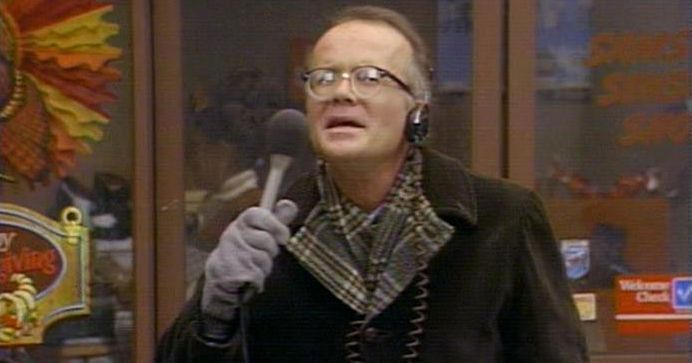
And so, the live turkeys went splat on the asphalt of the parking lot. Except for those who got sucked into the copter's rotor, spreading feathers and giblets everywhere. Shocked at all this, Les uses Herbert Morrison's line from the Hindenburg disaster broadcast of 41 years earlier, which he would have been old enough to remember: "Oh, the humanity!"
Richard Sanders as Les Nessman

Back at the station, "the dungarees" are listening, and there's little they can say, and nothing they can do. When Arthur and Herb return, covered in feathers -- a 1970s sitcom didn't dare show them with blood and guts on them -- there's little they can say, either. Finally, the Big Guy says, "As God is my witness, I thought turkeys could fly!"

The show lasted for 5 years, and is still fondly remembered. A sequel series, The New WKRP in Cincinnati, ran in syndication from 1991 to 1993. It featured some of the original characters, while the others were each brought back as guest stars at least once.

Cincinnati did have, and still has, a radio and a TV station with the call letters WKRC. CBS owns it now, but didn't when WKRP was running. (WKRC's AM frequency is 550.) In 2008, an unrelated independent TV station in Cincinnati, WBQC-LD, took advantage of local nostalgia for the sitcom, promoting its conversion to digital broadcasting by rebranding as "WKRP-TV in Cincinnati."

After WKRP was canceled, Gordon Jump went against type, and played a child molester on a "very special" two-part episode of Diff'rent Strokes, replaced Jesse White as the "lonely" repairman in commercials for Maytag dishwashers, and returned to star on The New WKRP. He died in 2003.

Frank Bonner played, of all things, a priest, teaching at a Catholic high school on New York's Long Island, on the sitcom Just the Ten of Us. He was part of the main cast of The New WKRP, and then turned to directing. He died in 2021. Howard Hesseman went on to star as a high school history teacher in Brooklyn in the ABC sitcom Head of the Class, and died in 2022.

As of October 30, 2022, Gary Sandy, Loni Anderson, Richard Sanders, Tim Reid and Jan Smithers are still alive. Sandy has mostly done stage work since. Anderson paired up with former Wonder Woman star Lynda Carter for the series Partners in Crime, and was part of the main casts of the sitcoms Easy Street and Nurses.

Sanders was part of the main cast of The New WKRP, and has been a "character actor" since. Reid starred on Sister, Sister and, with his wife Daphne Maxwell, Frank's Place; and played recurring characters on Simon & Simon and That '70s Show. Smithers has not acted since 1987, although she attended a reunion of the surviving WKRP actors in 2014.

UPDATE: Loni Anderson died in 2025.

*

October 30, 1978 was a Monday. Actor Matthew Morrison, famed for his starring role on Glee, was born.

Baseball season had ended 13 days earlier, when the New York Yankees beat the Los Angeles Dodgers to win the World Series. On ABC Monday Night Football, the Atlanta Falcons, with a defense known as "The Gritz Blitz," beat the Los Angeles Rams, 15-7 at Atlanta-Fulton County Stadium.

The NBA, NHL and World Hockey Association seasons were underway, but, since they were all then struggling for attention, and didn't want to compete for TV ratings with Monday Night Football, no games were scheduled by any of them.

Friday, October 28, 2022

October 28, 1995: The South Rises In the World Series

October 28, 1995: The Atlanta Braves win Game 6 of the World Series, beating the Cleveland Indians, 1-0‚ on a combined 1-hitter by Tom Glavine and Mark Wohlers.

David Justice's 6th-inning home run accounts for the game's only run. Having noticed that Cleveland's Jacobs Field (renamed Progressive Field in 2007) seemed a lot louder in Games 3, 4 and 5 than Atlanta-Fulton County Stadium had in Games 1 and 2, Justice called on the Braves' fans to be louder for Game 6. They were, especially when he hit his homer.
Catcher Tony Peña's leadoff single in the 6th was Cleveland's only hit. The Indians, who won 100 games in the strike-shortened 144-game season, and won their 1st American League Pennant in 41 years, led the majors in homers and runs scored. But in this Series, they batted just .179‚ the lowest average for a 6-games series since 1911.

This was the 1st time that two of the "Big Four" sports' titles were held by Southern teams. The Houston Rockets had won the NBA title in June.
It was Ted Turner's 20th season owning the Braves. By trusting John Schuerholz as general manager, and trusting Schuerholz's trust in Bobby Cox as field manager, he finally got his title.

In winning‚ the Braves become the 1st team to win World Championships representing 3 different cities: Boston in 1914‚ Milwaukee in 1957‚ and Atlanta in 1995. It was their 30th season in Atlanta, and despite having had such talents as Hank Aaron, Phil Niekro and Dale Murphy, they mostly struggled through their 1st 25 years, winning Division titles in 1969 and 1982.

They won the National League Pennant in 1991 and 1992, but lost the World Series both times. They lost the NL Championship Series in 1993, and the 1994 season was cut short by a strike. In 1995, they won it all, led by their pitching "Big Three": Glavine went 16-7, Greg Maddux went 19-2, and John Smoltz went 16-7. Justice, Fred McGriff, Chipper Jones, Ryan Klesko and Javy López led the attack. And so, the Braves became the 1st team from a former Confederate State to win a World Series.

How key for the Braves was Justice? The following season, the Braves won the Pennant again, but he was injured for the World Series, and they lost it to the New York Yankees. Foolishly, the Braves let him go, to the Indians, and he helped them win the Pennant in 1997. He later helped the Yankees win the AL Pennant in 2000 (winning the World Series) and 2001 (losing it). Although he fell short of career stats for the Baseball Hall of Fame -- 1,571 hits, 305 of them home rums -- he was one of the top clutch performers of his era.

UPDATE: Justice hit his homer off Jim Poole. Although a native of Rochester, New York, Poole had pitched in Atlanta, for Georgia Tech. He died of ALS, a.k.a. Lou Gehrig's Disease, in 2023, only 57 years old.

*

October 28, 1995 was a Saturday. This was also the day of the worst subway disaster in human history. I have a separate entry for that event.

In college football, Number 1 Florida State were idle. They would lose their next game, away to the University of Virginia, and fall from the top spot.

These were among the games played that day:

* Number 2 Nebraska beat Number 7 Colorado, 44-21 at Folsom Field in Boulder, Colorado. Nebraska went on to win the last Big Eight Conference title, before the Big 8 took on half the Southwest Conference and became the Big Twelve. Colorado accepted a bid from the Cotton Bowl.

* Number 3 Florida beat Georgia, 52-17 at Sanford Stadium in Athens, Georgia. They were played a home-and-home series on campus, because the old Gator Bowl, the neutral-site game where the game was usually played, had been torn down to make way for the new Jacksonville Municipal Stadium (now EverBank Stadium. Florida went on to win the Southeastern Conference title. They turned down the accompanying automatic bid to the Sugar Bowl, to set up a Number 1 vs. Number 2 battle for an undisputed National Championship in the Fiesta Bowl. Nebraska beat them for that title.

* Number 4 Ohio State beat Number 25 Iowa, 56-25 at Ohio Stadium in Columbus.

* Number 5 Tennessee beat South Carolina, 56-21 at Neyland Stadium in Knoxville, Tennessee.

* Rivalry: Number 6 Kansas were upset by Number 14 Kansas State, 41-7 at KSU Stadium (now Bill Snyder Family Football Stadium) in Manhattan, Kansas.

* Rivalry: Number 8 Northwestern beat Illinois, 17-14 at Memorial Stadium in Champaign, Illinois. Northwestern won the Big Ten Conference title for the 1st time since 1936, and went to the Rose Bowl for the 1st time since the 1948 season.

* Rivalry: Number 9 Michigan won the Little Brown Jug by beating Minnesota, 52-17 at Michigan Stadium in Ann Arbor.

* Number 10 Oregon were upset by Arizona State, 35-24 at Autzen Stadium in Eugene, Oregon. Oregon accepted a bid from the Cotton Bowl, where they lost to Colorado.

* Number 11 Auburn were upset by Arkansas, 30-28 at Razorback Stadium in Fayetteville, Arkansas.

* Number 12 Notre Dame beat Boston College, 20-10 at Notre Dame Stadium in South Bend, Indiana. Notre Dame accepted a bid to the the Orange Bowl, where they played Florida State, which won the Atlantic Coast Conference title. Florida State won.

* Number 13 Southern California (USC) and Number 17 Washington played to a tie, 21-21 at Husky Stadium in Seattle. USC went on to win the Pacific-Ten Conference title, and beat Northwestern in the Rose Bowl.

* Number 14 University of Texas had the week off. They went on to win the last Southwest Conference title, and turned down the accompanying automatic bid to the Cotton Bowl to play in the more prestigious Sugar Bowl.

The deals had already been made: At the conclusion of the 1995-96 schoolyear, Texas, Texas A&M, Texas Tech and Baylor left the SWC, and joined the Big Eight, making it the Big Twelve Conference. The remaining SWC teams, joined other leagues: The 2 Dallas-area schools, Southern Methodist University (SMU) of Dallas and Texas Christian University (TCU) of Fort Worth; and the 2 Houston schools, Rice University and the University of Houston.

* Number 16 Penn State beat Indiana, 45-21 at Beaver Stadium in State College, Pennsylvania.

* Virginia Tech, as yet unranked, beat West Virginia, 27-0 at Mountaineer Field (now Milan Puskar Stadium) in Morgantown, West Virginia. Tech went on to win the Big East Conference title, and advanced to the Sugar Bowl, where they beat Texas.

* Rivalry: The University of Nevada beat the University of Nevada-Las Vegas (UNLV), 55-32 at Mackay Stadium in Reno, Nevada.

* Among the service academies, Army beat Colgate, 56-14 at Michie Stadium in West Point, New York; Air Force beat Fresno State, 31-20 at Bulldog Stadium (now Valley Children's Stadium) in Fresno, California; and Navy had the week off.

* And in New Jersey, Rutgers beat the University of Pittsburgh, 42-14 at the new Rutgers Stadium (now SHI Stadium) in Piscataway.

The NBA season started 6 days later. There were 9 games played in the NHL:

* The New York Islanders and the Philadelphia Flyers played to a tie, 5-5 at the Nassau Coliseum.

* The New Jersey Devils lost to the Pittsburgh Penguins, 5-3 at the Brendan Byrne Arena at the Meadowlands.

* In an "Original Six" matchup, the Montreal Canadiens beat the Chicago Blackhawks, 5-3 at the Montreal Forum.

* In an all-New England matchup, the Boston Bruins beat the Hartford Whalers, 3-0 at the FleetCenter (now the TD Garden) in Boston.

* The Washington Capitals beat the Tampa Bay Lightning, 4-2 at the ThunderDome (now Tropicana Field) in St. Petersburg, Florida.

* The Florida Panthers beat the Ottawa Senators, 4-1 at the Ottawa Civic Centre (now the TD Place Arena).

* The Toronto Maple Leafs and the Los Angeles Kings played to a tie, 2-2 at Maple Leaf Gardens in Toronto.

* The Dallas Stars beat the San Jose Sharks, 4-3 at the San Jose Arena (now the SAP Center).

* And the Winnipeg Jets beat the Vancouver Canucks, 4-1 at General Motors Place (now the Rogers Arena) in Vancouver.

Sunday, October 23, 2022

October 23, 1996: The Jim Leyritz Game II

October 23, 1996: Game 4 of the World Series, at Atlanta-Fulton County Stadium. The Atlanta Braves rock New York Yankees starter Kenny Rogers, and lead 6-0. The Yankees close to within 6-3, but in the top of the 8th, they are 4 outs away from being down 3 games to 1 in the Series, their great season coming to a very disappointing close.

But they get 2 runners on, and backup catcher Jim Leyritz comes to bat against Braves closer Mark Wohlers. After throwing 98- and 99-mile-per-hour fastballs that Leyritz can only foul off, Wohlers hangs an 86-mile-per-hour slider. Leyritz, a postseason hero for the Yankees a year earlier with his 15th-inning walkoff homer in the Division Series against Seattle, knocks it over the left-field fence to tie the game.

The Yankees load the bases in the 10th, and Hall of Fame 3rd baseman Wade Boggs, whom Torre had benched in favor of Charlie Hayes due to his usual magnificent hitting having failed him, is sent up to pinch-hit. Boggs draws one of the most important walks in baseball history, and it's 7-6 Yanks. An error makes the final score 8-6 Yanks.

Not since the 1929 Cubs, going from 8-0 up to 10-8 down in the 7th inning of Game 4, had a team blown a 6-run lead in a Series game. The Yankees were in serious trouble, but now the Series is tied, and anything can happen. In this 1996 season, lots of "anythings" have already happened for the Yankees.

The next night, Game 5 was, regardless of result, the last event at Fulton County Stadium, as the Braves were moving into the next-door Turner Field the next season. The Yankees won, 1-0. Two nights later, they won Game 6 at Yankee Stadium, 3-2, completing their remarkable comeback, and winning their 23rd World Series.

The Yankees traded Leyritz in 1997. He helped the San Diego Padres reach the World Series in 1998 -- against the Yankees. In 1999, the Yankees reacquired him, and he helped them with another World Series, hitting what turned out to be the last home run of the 20th Century in Game 4. This led NBC's Bob Costas to say, "You could send this guy to a resort in the spring and summer, as long as he comes back for October." His career ended in 2000 with the Los Angeles Dodgers.

Leyritz has had his ups and downs since. In 2006, he admitted that he'd used amphetamines while playing -- legal at the time, and not nearly as performance-enhancing as steroids. (So if you want to invalidate the Yankees' 1996 and 1999 World Championships because of this, you shouldn't.) In 2007, he killed another driver in a drunken crash. He ended up serving 10 days in jail and a year's probation. In 2009, he was charged with domestic violence for hitting his wife, although she later dropped the charges (but also dropped him through divorce -- they had 4 children).

In 2011, he was a coach for the Newark Bears of the Atlantic League. In 2012, he worked for the Yankee front office. He lives in the Orange County suburbs of Los Angeles, with his new wife, Michelle, his 3 kids and her 2. He co-hosts a radio show in Los Angeles for SB Nation Radio.

*

October 23, 1996 was a Wednesday. Football was in midweek. The NBA season started 9 days later. There were 4 games in the NHL:

* The New York Rangers lost to the Washington Capitals, 3-2 at Madison Square Garden.

* The Florida Panthers beat the Ottawa Senators, 5-2 at the Miami Arena.

* The Detroit Red Wings beat the Dallas Stars, 4-1 at the Joe Louis Arena in Detroit.

* And the Colorado Avalanche beat the Vancouver Canucks, 4-1 at General Motors Place (now the Rogers Arena) in Vancouver.

Friday, October 14, 2022

October 14, 1992: The Francisco Cabrera Game

October 14, 1992: For the 1st time ever, a team from outside the United States of America wins a Major League Baseball Pennant. The Toronto Blue Jays win the ALCS in 5 games with a 9-2 victory over the Oakland Athletics. Joe Carter and Candy Maldonado both homer, while Juan Guzman gets the win.

The NL Pennant is also won today, in Game 7. With the Atlanta Braves down 2-0 to Doug Drabek of the Pittsburgh Pirates entering the 9th‚ the decisive blow comes with 2 outs‚ as seldom-used 3rd-string catcher Francisco Cabrera drives in the tying and winning runs with a pinch-hit single.

The scene of ex-Pirate Sid Bream, often ridiculed as the slowest man in baseball, somehow reaching home plate before the tag of Pirate catcher Mike LaValliere, is one of the signature plays in the Braves' postseason years of 1991 to 2005. John Smoltz‚ who works 6 strong innings without a decision‚ is named the series MVP.
In 2010, the MLB Network listed this game at 4th on their list of MLB's 20 Greatest Games -- limited in scope, due to the availability of surviving videotape, to 1975 onward.

It took 21 years, until 2013, for the Pirates to even have another winning season, let alone make the postseason. An entire generation of Western Pennsylvanians was born and reached adulthood without ever having had a real Pennant race in their lifetime.

UPDATE: The Pirates have a team Hall of Fame. From their 1990, '91 and '92 National League Eastern Division Champions, they have inducted manager Jim Leyland, left fielder Barry Bonds, and former pitcher turned broadcaster Steve Blass.

*

October 14, 1992 was a Wednesday. Football was in midweek. The NBA season didn't start until November 6. There were 3 games played in the NHL:

* The New York Rangers beat the New Jersey Devils, to my dismay, 6-1 at Madison Square Garden.

* The Hartford Whalers beat the Ottawa Senators, 4-1 at the Hartford Civic Center (now the PeoplesBank Arena).

* And the Winnipeg Jets beat the Edmonton Oilers, 7-3 at the Winnipeg Arena.

Saturday, September 17, 2022

September 17, 1976: Bill Lucas Becomes the 1st Black GM In MLB

September 17, 1976: The Atlanta Braves promote Bill Lucas to the office of general manager. This makes him the 1st black man to hold that position in Major League Baseball. This came 2 years after Frank Robinson was appointed the 1st black manager, 14 years after Buck O'Neil became the 1st black coach, and 29 years after Jackie Robinson became the 1st black player since 1884.

William DeVaughn Lucas was born on January 25, 1936 in Jacksonville, graduated from the historically black Florida A&M University, and signed with the Milwaukee Braves in 1957 -- partly because his sister, Barbara, was married to Braves star Hank Aaron. (They later split up, and Aaron remarried.) An infielder, he never reached the major leagues, although he did miss 2 years as an officer in the U.S. Army. He joined the Braves' front office in 1965, as they were preparing their move to Atlanta for the next season.

In 1972, he was named director of their farm system, a common position from which teams have promoted men to the GM position. Atlanta was the hometown of Dr. Martin Luther King Jr., former Mayor William Hartsfield had billed it as "the City Too Busy to Hate," Maynard Jackson had been elected as its 1st black Mayor in 1973, and Aaron had broken the career home run record at Atlanta Stadium in 1974. (It was renamed Atlanta-Fulton County Stadium the following year.)

Lucas was in the process of building the team that would become the centerpiece of team owner Ted Turner's national "SuperStation TBS" over the next few years, including Dale Murphy, Bob Horner, Brett Butler and Steve Bedrosian.

But Lucas would not live to see his work come to fruition. On May 1, 1979, shortly after congratulating Braves ace Phil Niekro on his 200th career win (by phone, as Lucas was in Atlanta and the game was in Pittsburgh), he suffered a cerebral hemorrhage. He died 4 days later, only 43 years old.

Murphy said, "Bill's dream was for this organization to become a success. It is our sacred honor to be chosen to fulfill his dream." Maybe it would have been fulfilled had he lived. But it didn't happen: They won the National League Western Division title in 1982, and almost won another in 1983, but that's as close as they got. The Braves did not win a Pennant between 1958, when they were still in Milwaukee, and 1991, when a new GM, John Schuerholz, put together the team that dominated the NL in the 1990s.

For his contributions to their organization, the Braves named Lucas to their team Hall of Fame.

*

September 17, 1976 was a Friday. These games were played in Major League Baseball that day:

* The aforementioned Atlanta Braves split a doubleheader with the Los Angeles Dodgers at Atlanta Stadium. The Braves won the opener, 1-0. The winning run scored in the bottom of the 12th inning, when Ellie Rodriguez committed a passed ball on a pitch from Charlie Hough, after Don Sutton had pitched 11 shutout innings. The Dodgers won the nightcap, 11-7.

* The Baltimore Orioles and the Cleveland Indians were rained out at Cleveland Municipal Stadium. The game was made up as part of a doubleheader the next day. The Indians won the 1st game, 5-1. The Orioles won the 2nd game, 3-2.

I mentioned Frank Robinson earlier. At this point, he was managing the Indians, but not yet retired as a player. Best remembered as an Oriole, he did not put himself into the 1st game against his former team. He did put former Oriole John "Boog" Powell in, and he hit a home run off Jim Palmer. Frank did put himself in the 2nd game, and pinch-hit an RBI single. It was his 2,808th career game, his 2,943rd hit, and his 1,812th RBI. In each case, it turned out to be his last, as he did not put himself into any more games, and retired as a player after the season. He hit 586 home runs.
Brooks Robinson did not play in the 1st game, but went 1-for-4 in the 2nd game. Reggie Jackson, in his only season with the Orioles, went 3-for-3 with a walk in the 1st game, but 0-for-4 in the 2nd game.

* The New York Yankees beat the Milwaukee Brewers, 5-3 at Milwaukee County Stadium. Graig Nettles hit a home run to win the game in the top of the 11th inning. Ed Figueroa went 10 innings, and Dick Tidrow pitched the 11th to get the win. In one of his last major league games, Hank Aaron went 0-for-5.

* The New York Mets lost to the Pittsburgh Pirates, 4-1 at Shea Stadium. George "Doc" Medich outpitched Jon Matlack. Willie Stargell went 1-for-4. 

* The Montreal Expos beat the St. Louis Cardinals, 9-5 at Jarry Park in Montreal. Lou Brock went 1-for-2 with 2 walks and an RBI.

* The San Francisco Giants beat the Cincinnati Reds, 4-2 at Riverfront Stadium in Cincinnati. Pete Rose went 1-for-4 with a walk. Johnny Bench only appeared as a defensive replacement, at 1st base.

* The Boston Red Sox beat the Detroit Tigers, 8-3 at Tiger Stadium in Detroit. Carl Yastrzemski went 1-for-2 with an RBI, before being replaced by Fred Lynn as a pinch-runner.

* The Chicago Cubs beat the Philadelphia Phillies, 4-3 at Wrigley Field in Chicago. Jerry Morales singled home the winning run in the bottom of the 12th inning. Mike Schimdt went 0-for-5.

* The Kansas City Royals beat the Chicago White Sox, 3-2 at Royals Stadium (now Kauffman Stadium) in Kansas City. George Brett went 1-for-3 with 3 RBIs.

* The Minnesota Twins beat the California Angels, 11-2 at Anaheim Stadium (now Angel Stadium of Anaheim). Rod Carew went 1-for-4 with a walk.

* The Texas Rangers beat the Oakland Athletics, 4-3 at the Oakland Coliseum.

* And the Houston Astros and the San Diego Padres were not scheduled.

Friday, August 5, 2022

August 5, 1985: The "Dodger Dogs to Fenway Franks" Tour Is Completed

August 5, 1985: Bob Wood sees a baseball game. It's not a particularly noteworthy game. But it does complete a journey: He had set out to visit all 26 Major League Baseball stadiums then in use in one Summer, and had now done it.

Born in 1959 in Kalamazoo, Michigan, he started out as a Detroit Tigers fan. But a visit to Boston in 1975 converted him to the Boston Red Sox, and, while still retaining an affinity for the team that won him the World Series when he was 9 years old, he became one of the Fenway Faithful.

He went to Michigan State University, saw them win the Big Ten Conference title in football in 1978, and became a teacher. By 1985, he was teaching history at a junior high school in Seattle, and going to Mariners games at the Kingdome.

In 1977, he and a friend, Bob Matyas, drove from the MSU campus in East Lansing to Comiskey Park in Chicago, to watch the Red Sox play the White Sox. Sitting near them were two men who had gone to all 26 ballparks. Wood decided that, one day, he would do the same thing. Finally, in 1985, at the age of 26, he made out a schedule, and set out to do it.

He even wrote to all 26 teams, telling him of his plan, and asking for free tickets. After all, while it was Summer, and school was out, and he had the time, he still had a teacher's salary, and was going to be spending a lot of money on lodging and gas for his car. Some teams turned him down, though some sent him letters wishing him well on his trip. But he got free tickets from 12 out of 26: Both New York teams, both Los Angeles area teams, both Pennsylvania teams, both Texas teams, the White Sox, the San Francisco Giants, the Kansas City Royals, and the Milwaukee Brewers.

He also decided to grade every ballpark, like a teacher, judging them on certain categories: Layout and Upkeep, Ball Field, Seating, Scoreboard, Food (further breaking that down into accessibility, selection, cost and taste), Ballpark Employees, Facilities, and Atmosphere. Ballparks with artificial turf and, worse, domes suffered for "Atmosphere."

Having started with his adopted hometown of Seattle, he stopped a hotel in Williams, California, and awoke the next morning to find his hatchback's window shattered and his car robbed. The local police recovered his suitcases intact, but his valuable binoculars were too good for the thief to pass up. He got his window fixed, and moved on.

Later on, the threat of a players' strike suggested that he would fall one park short: The strike was to begin on August 6, the day he was supposed to make Atlanta his 26th and final park. And while the strike was settled after 3 days, he had no way of knowing that at the time: For all he knew, that would be the end of the season, as would eventually happen with the Strike of '94.

The day before the Strike of '85 was to start, Cincinnati was supposed to be Number 25. But he found an open date on his schedule, while he was going through the Midwest, and snuck Cincinnati in there, and move Atlanta up to August 5. He was going to make it -- if only there were no rainouts. As it turned out, there were none, and he made it. Here's how it turned out, with the results of the games, and a sampling of his assessments:

1. June 16, Kingdome, Seattle: "Buy a ticket, step inside, then leave. The place is depressing." Mariners 2, Royals 1.
2. June 19, Candlestick Park, San Francisco: "Nobody seems really intent on presenting baseball as it should be... Just the fact that the sky, whatever shade of gray it happens to be turning at the time, is not covered by a dome and the place has real grass, even if it is weird-looking, makes 'The Stick' bearable. And then just barely." Giants 5, Reds 2. Reds player-manager Pete Rose did not put himself into the game.

3. June 21, Oakland-Alameda County Coliseum: "If you like MTV and baseball, you'll love the way they go together in the Coliseum." (This was before "Mount Davis" was built in 1995-96.) A's 9, Indians 1. Don Sutton started for the A's, and collected his 286th career win. He would go on to win 324.

4. June 23, Dodger Stadium, Los Angeles: "I the custom that Arthur's Knights of the Round Table maintained, true to their principles even amid all the glory showered upon them, Dodger Stadium remains virtuous. In all its elegance it remains in touch with those simple qualities so necessary to the game." (Virtuous? It only exists because of Walter O'Malley's greed!) Dodgers 6, Astros 2.
5. June 24, Anaheim Stadium (now named Angel Stadium of Anaheim): "All the doubts I had rolling into Dodger Stadium -- the glitter, that Hollywood hollowness, that baseball just wouldn't be baseball -- hit home in Anaheim." Indians 2, Angels 1. Bert Blyleven was the winning pitcher.

6. June 26 and 27, Jack Murphy Stadium, San Diego: "Southern California's summer high finds a good friend in San Diego. A mixture of hot sun, fans that finally get up off their butts and cheer, and a scoreboard of such magnitude that it dwarfs all else inside make a game in Jack Murphy California's most energetic."

Padres 10, Dodgers 4; Padres 5, Dodgers 4. This was the 1st time on the trip that he saw 2 games in 1 park. The crowd jumped from 36,113 to a then-sellout of 47,482 for his 2nd game, because Fernando Valenzuela was starting for the Dodgers, and the facility originally known as San Diego Stadium and later as Qualcomm Stadium was only 19 miles from the Mexican border. (Its replacement, Petco Park, is 15 miles from the border.) But the Padres won. In 1996, Fernando started and won the 1st regular-season MLB game in Mexico, pitching for the Padres against the Mets.

7. July 2 and 3, Arlington Stadium, outside Dallas: "Something in the heart, a special sincerity, fights the head and makes the Rangers' home a happy one." Angels 7, Rangers 2; Angels 3, Rangers 2. This 2nd game was his 1st extra-inning game on the trip, going 11 innings.

Wood had been set to watch games in Houston on July 3 and 4, but was so taken with the Rangers' hospitality, they talked him into sticking around for a 2nd game there. After all, while the old Arlington Stadium was a frying pan, he knew that he wouldn't get cheated out of a game in Houston: It was impossible to get a rainout at the Astrodome. (With one exception, a 1976 game when the city was flooded.)

8. July 4, Astrodome, Houston: "To the baseball world Houston's tomb provides a new low in charisma, a bottom-of-the-ballpark barrel." It just didn't seem right to him to spend the 4th of July indoors. Expos 9, Astros 3, in 12 innings.

9. July 6, Royals Stadium (now named Kauffman Stadium), Kansas City: "A totally professional atmosphere makes Royals Stadium one of the majors' best... A first-class sight brings on that first-class air. Together they create a first-class feeling." Orioles 8, Royals 3.
Royals Stadium as it appeared in 1985

10. July 7, Busch Memorial Stadium, St. Louis: "A fiery excitement flows through Busch. It can be found in many places. Loud and red, enthusiastic fans have fun under the push of the big city." Cardinals 7, Dodgers 1. This turned out to be a preview of the National League Championship Series, which the Cardinals also won, before losing the World Series to the cross-State Royals in controversial fashion.

11. July 9 and 10, Wrigley Field, Chicago: "As thick as they ivy that hugs its red brick walls, the very essence of baseball hangs in the atmosphere of Wrigley. Not only the ballpark itself, with its vine-covered walls and hand-operated scoreboard, but the folks that grace the place are why Chicago's North Side park is the purest in baseball." Cubs 7, Padres 3; Cubs 4, Padres 3.

After this one, he took a little decompression break, which included the All-Star Break, and visited his family in Kalamazoo, their house being a convenient home base for his Midwestern trips, not to mention free.

12. July 16, Hubert H. Humphrey Metrodome, Minneapolis: "Maybe the next time Minneapolis decides to put something up in their lovely city they won't mind adding in a few options, paying a few more dollars, and buying something other than the stripped-down economy model."

This was the All-Star Game: National League 6, American League 1. Jack Morris, a St. Paul native then with the Tigers, started and lost for the AL. But he would pitch a 10-inning shutout for the Twins in Game 7 of the 1991 World Series, the greatest moment in the Metrodome's history.

When Wood wrote Big Ten Country, and had to visit the Metrodome again to see a University of Minnesota home game, he doubled down: "Now, don't get me wrong. It's not that I don't like Minneapolis. How can you not like Minneapolis?... No, Minneapolis is lovely. It's the Metrodome that sucks!" He got his wish: UM moved back on-campus with Huntington Bank Stadium in 2009, the Twins built Target Field in 2010, and the Vikings played the 2014 and '15 seasons at UM's stadium while the Metrodome was demolished and U.S. Bank Stadium was built on the site. All 3 were vast improvements.

13. July 18, Milwaukee County Stadium: "Beer, bratwurst, and baseball -- what a combination!... From the players' rousing introduction to the organist's clap-alongs, a ball game at County Stadium is a treat for all the senses." Mariners 5, Brewers 2.

14. July 19, Comiskey Park, Chicago: "Like an enchanted castle, Comiskey infects those who pass through. It makes them a little crazier, a little looser, a little more fun-loving. It touches its visitors with a light heart and offers the kind of magic that only 75 years of good hard living can create."

White Sox 1, Indians 0. The only run came on a home run by one of Wood's former Boston heroes, Carlton Fisk. Tom Seaver outpitched Bert Blyleven, for his 298th career win. Both pitchers went the distance, despite Seaver being 40 years old, and Blyleven 36. Between them, they would win 598 games, and strike out 7,341 batters.

15. July 20, Riverfront Stadium, Cincinnati: "Talk about a transition. Comiskey bubbled with excitement. A full-housed Riverfront was almost soundless... Instead of a let-it-all-hang-out kind of spirit, we found a place that only a librarian could appreciate.... Their attitude, while commendable at the public library, was weird for a baseball game." Phillies 10, Reds 6. Despite being at home, Rose did not put himself into this game, either.

16. July 21, Tiger Stadium, Detroit: "At its heart, the park's a classic beauty. Entering through its gates, you make a special pact with baseball. The graceful spirit of Tiger Stadium makes up for all the frustrations along the way." Rangers 7, Tigers 5.

17. July 23, Canadian National Exhibition Stadium, Toronto: "Somehow, someway, baseball in Exhibition Stadium survives. On a silly-looking football field, surrounded by cold aluminum benches, the Blue Jays keep on winning. Blue Jay fans keep on coming. And the sea gulls keep on munching. All three should be awarded baseball's congressional medal of bravery -- players and fans for an iron will in taking on such an ugly place, and the gulls for having iron stomachs." Blue Jays 4, Mariners 2.

18. July 24, Olympic Stadium, Montreal: "Shaped like a spaceship, overhung by a death-ray concrete eye, surrounded inside by that silly-looking sprint-lined warning track, and filled with plastic seats and silent fans, in a strictly baseball sense... it's a disaster. Other factors are at work, though... I relished the idea that major league baseball was fortunate enough to enjoy the flavor of Montreal... as only it could be, both in French and English." Expos 3, Braves 1.

19. July 26 and 27, Fenway Park, Boston: "Boston's charming ballpark is surviving, and it does so without sacrificing integrity. Despite a little cosmetic primping, the very heart of the game, the people, and the park itself remain caught in time. Fenway today is baseball as it was in years past, and as pure as it will ever be again in the future." (This was, of course, before not just the various renovations that brought Fenway into the 21st Century, but before the cheating scandals that brought the Red Sox World Series glory at last, but also shame and scandal.)
Fenway Park as it appeared in 1985

His adopted "home team" and his adopted favorite team played each other, and each won a game: Red Sox 6, Mariners 2; Mariners 10, Red Sox 3.

20. July 28, Veterans Stadium, Philadelphia: "Despite an ugly ball field, housed by an ugly stadium, surrounded by an ugly parking lot, the game goes." Phillies 7, Braves 3.

21. July 29 and 30, Memorial Stadium, Baltimore: "Baseball in Baltimore is fun. A solid tradition, enjoyed by nice people, both sitting and serving, the game gets the sincerity it deserves." Blue Jays 4, Orioles 3; Orioles 4, Blue Jays 3. Both games went 10 innings.

22. July 31, William A. Shea Municipal Stadium, New York: "What the Queens park fails to do, and what Yankee Stadium, in a nastier section of town, does so well, is leave New York's ill feelings on the outside streets. Shea's not immune to the problems of the world, it's immersed in them." Mets 5, Expos 2.

23. August 2, Yankee Stadium, New York: This was the ultimate challenge -- not just for a Red Sox fan, but for any baseball fan: Yankee Stadium in The Bronx, during the bad old days of the Ed Koch Eighties in New York. Wood wrote: "Comiskey's neighborhood is nasty. Tiger Stadium has plenty of dangerous places nearby. And Oakland is a dive. The Bronx, though, is worse. It's slime... Yankee Stadium is a beauty, an oasis thriving in the ugliness of city slums, as well planned as any the burbs have... Yankee Stadium has it all: Sky, green grass, and good hard-core fans. Had it no history, I'd still have had a grand time. But the place adds something intangible, a spark that can't be bought by any ballpark. That great Yankee tradition hangs in the air."
I remember the game he saw. I had a nasty headache when it began, and, watching it on WNBC-Channel 4 -- a rare non-Saturday broadcast for the Peacock network -- it didn't get any better. In the bottom of the 7th inning, with the game tied 3-3, Rickey Henderson singled, but Bobby Meacham, not sure if the ball would be caught or not, got caught coming off 2nd base, and he ran for 3rd too late. Both he and Dale Berra, who had been on 1st, ran through the stop sign of 3rd base coach Gene Michael, allowing both of them to be tagged out by Chicago White Sox catcher Carlton Fisk, making for the strangest double play I've ever seen.

It cost the Yankees the game: Despite 2 home runs by Don Mattingly and another by Dave Winfield, the White Sox won, 6-5 in 11 innings. The winning run was scored by Ozzie Guillén, the ChiSox' shortstop and future manager, a genius/maniac every bit as much as the Yankee manager in this game, Billy Martin (on his 4th go-round). Attendance: 27,118.

24. August 3, Three Rivers Stadium, Pittsburgh: "Just another three-level plastic clone, this one with a lousy team and hardly any fans around to watch 'em lose, the spirit inside Three Rivers challenges the Kingdome as baseball's biggest bore." Expos 6, Pirates 5.

25. August 4, Cleveland Municipal Stadium: "Baseball anywhere can be beautiful, even in a clumsy-looking, empty warehouse on the shores of Lake Erie." Orioles 5, Indians 4.

On this day, pitching for the White Sox against the Yankees at Yankee Stadium, Tom Seaver collected his 300th win. Across the country, playing for the Angels against his former team, the Twins, Rod Carew collected his 3,000th hit.

26. August 5, Atlanta-Fulton County Stadium, completing the journey: Noting that it was one of the 1960s multipurpose jobs, Wood was surprised to see real green grass and real red dirt. "After the dirt, though, the place deteriorates and its charm evaporates, drowned out in a circus of garbage and smoke. Well-planned walkways fill up with crap; well-ordered rest room ooze with wastepaper. Chain-smoking employees plod about like the junk isn't even there. Meanwhile, circus music fills the air. Clanging away, turned to only God knows what fake instrument, the organist's preludes seemed more in tune to high-wire trapeze acts than a baseball game. And the fans, the just quietly sat around like they didn't know the difference."
And the home team, the Atlanta Braves? They lost to the Los Angeles Dodgers, 6-1. Ken Landreaux hit a home run for the Dodgers. Jerry Reuss, who'd pitched a no-hitter for the Dodgers in 1980, outpitched Len Barker, who'd pitched a perfect game for Cleveland the following year. Barker was relieved by Rick Camp, who, a month earlier, had stepped to the plate in the bottom of the 18th inning, with a lifetime batting average of .060, because he was the last player on the roster, and hit a game-tying home run against the Mets, before losing in the 19th.

It was over. He'd done it: 26 ballparks, 31 games, 11,636 miles in 51 days. In the end, he ranked Dodger Stadium and Royals Stadium tied for 1st, and the Astrodome and Exhibition Stadium tied for last. After Royals Stadium, which no longer has the plastic stuff, the Olympic Stadium, 15th, was the highest-ranking artificial turf stadium; Candlestick Park, 24th, the lowest-ranking one with real grass. Yankee Stadium was 13th, Shea Stadium 19th. His beloved Fenway, 6th; his original home park, Tiger Stadium, 12th.

Aside from the All-Star Game in Minneapolis, with a sellout crowd of 54,960, the largest crowd on his trip was in San Diego: 47,482. The smallest was in San Francisco: 8,490. Even Cleveland had more, with their game being on a Sunday.

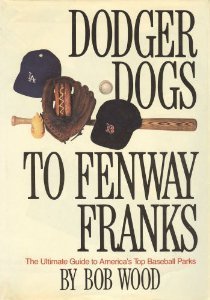
Wood completed his tour 3 days later, just ahead of the strike that began the next day, lasting 3 days. In 1988, he published his account of the trip, "Dodger Dogs to Fenway Franks." That year, the Michigan State University graduate went to all the Big Ten schools' football games, and, 2 years later, published "Big Ten Country." Now 66, he is retired from teaching.
Bob Wood, attending a Washington Nationals game
at Nationals Park in Washington, in 2008.
Neither the team nor the stadium existed during his 1985 trip.

Since his trip, the Colorado Rockies, the Miami Marlins, the Arizona Diamondbacks and the Tampa Bay Rays have been added; and the Montreal Expos have moved, becoming the Washington Nationals. Of the 26 ballparks he went to, only 6 are still in use: Fenway, Wrigley, Royals/Kauffman Stadium, the Oakland Coliseum, and both Los Angeles-area stadiums. The Astrodome is still standing, but no one is using it. (UPDATE: The Athletics moved out of Oakland after the 2024 season, though the Coliseum still stands.)

And the various multipurpose stadiums of built in the 1960s and '70s have been replaced by "retro" ballparks designed to look like the ones built early in the 20th Century, and even the ones built with retractable roofs and end up looking like airplane hangars have old-timey touches like hand-operated scoreboards. Artificial turf has fallen out of fashion. And instead of being built on the outskirts of cities, or in the suburbs, downtown, making for non-car accessibility, has been the way to go, for all the major sports. Since Camden Yards opened in Baltimore in 1992, both comfort and atmosphere have been in.

Wood's book was not a best-seller, but it sold enough copies to inspire several fans to make their own journeys to all 26 ballparks -- after 1993, to all 28; and then, after 1998, all 30 -- and, in some cases, all in one season. A few rich and foolhardy souls who don't mind getting on a lot of planes have attempted 30 parks in 30 days. In the 2005, '06 and '07 seasons, the YES Network took 4 lucky fans (different ones each season) to see all 162 Yankee games, home and away, for a series titled Ultimate Road Trip.

I, myself, took Wood's book with me on my visits to Baltimore, Boston, Montreal, Toronto, Cleveland, Detroit, Chicago and Milwaukee, to use as a reference, despite it already being out of date. (In the cases of Toronto and Cleveland, the stadiums in question had already been replaced.)

Since there are 92 "clubs," in 4 Divisions, in England's Football League, some fans there have managed to "Do the 92." Despite the large number, it's not as hard as it sounds, because of the traveling: England is a considerably smaller country, and so, instead of 3,092 miles from Fenway Park in Boston to Oracle Park, current home of the San Francisco Giants, the longest roadtrip in English football is from Newcastle United's St. James' Park to Plymouth Argyle's Home Park, and that's only 408 miles. And England has better public transportation, whereas some U.S. sports venues have poor public transit links. And, since the schedule (or "fixture list," as they'd say over there) makes it impossible, nobody tries to do it all in one season.

*

August 5, 1985 was a Monday. Ivory Coast soccer player Salomon Kalou, known in England for his performance with West London team Chelsea FC, was born.

In addition to the game Wood saw in Atlanta, these games were played on that "Strike Eve":

* The New York Yankees beat the Chicago White Sox, 7-3 at Yankee Stadium. This was not the first time, nor the last, that the Yankees lost a game I went to and then won the next day. Ron Guidry outpitched Floyd Bannister. Rickey Henderson and Don Mattingly hit home runs. Dave Winfield went 1-for-4. Carlton Fisk hit another home run against the Yankees.

* The New York Mets beat the Chicago Cubs, 7-2 at Wrigley Field in Chicago. Ed Lynch was the winning pitcher. Darryl Strawberry went 4-for-4 with 3 home runs and 5 RBIs. Danny Heep and Rafael Santana each added 3 hits for the Mets.

* The Montreal Expos beat the Pittsburgh Pirates, 5-2 at Three Rivers Stadium in Pittsburgh.

* The Cincinnati Reds beat the San Diego Padres, 8-7 at Riverfront Stadium in Cincinnati. This time, Pete Rose put himself in the game, and went 1-for-4. He would officially break Ty Cobb's career hits record 37 days later. Dave Parker went 4-for-5 with a home run and 3 RBIs. Tony Gwynn went 2-for-4 with a walk and an RBI.

* The Philadelphia Phillies beat the St. Louis Cardinals, 9-1 at Busch Memorial Stadium in St. Louis. Ozzie Virgil Jr. hit 2 home runs. Mike Schmidt went 2-for-4 with an RBI.

* The Detroit Tigers beat the Kansas City Royals, 8-4 at Royals Stadium (now Kauffman Stadium) in Kansas City. George Brett went 2-for-3 with a walk. Steve Balboni hit 2 home runs.

* The Houston Astros beat the San Francisco Giants, 7-5 at the Astrodome in Houston.

* The California Angels beat the Seattle Mariners, 3-1 at Anaheim Stadium (now Angel Stadium of Anaheim). Having gotten his 3,000th hit the day before, Rod Carew did not get another, going 0-for-3 with a walk. Reggie Jackson went 1-for-3 with a walk.

* The Oakland Athletics beat the Minnesota Twins, 5-1 at the Oakland Coliseum.

* And the Baltimore Orioles, the Boston Red Sox, the Cleveland Indians, the Milwaukee Brewers, the Texas Rangers and the Toronto Blue Jays were not scheduled.

Monday, August 1, 2022

August 1, 1972: Nate Colbert's 5-Homer Day

August 1, 1972: The San Diego Padres sweep a doubleheader from the Atlanta Braves at Atlanta Stadium. (It was renamed Atlanta-Fulton County Stadium in 1975.) They win the opener, 9-0. Clay Kirby pitches a 7-hit shutout. They win the nightcap, 11-7. Over the 2 games, the Braves' Hank Aaron went 1-for-7.

But the real story is Padres 1st baseman Nate Colbert. In the 1st game, he went 4-for-5 with 2 home runs and 5 RBIs. In the 2nd game, he went 3-for-4 with 3 home runs and 8 RBIs. Total: 7 of 9 (for the Braves, resistance was futile), 5 home runs and 13 RBIs. Some players would call that a month. Aaron Judge might call it a week. On this day, Colbert could have called it an honest a day's work.

In the 1st game, the Padres also got a home run from Cito Gaston, who would later manage the Toronto Blue Jays to back-to-back World Series wins. In the 2nd game, the Braves got a home run from Darrell Evans.

Here's the kicker: Five home runs in a doubleheader had been done only once before, and Colbert was there to see it: On May 2, 1954, Colbert, then an 8-year-old boy, was at Sportsman's Park in St. Louis as Stan Musial did it. Musial had 11 RBIs that day, so Colbert topped it by 2.

Colbert would not, however, join Musial in the Baseball Hall of Fame. By 1974, a back injury had cost him his hitting stroke, and he played his last major league game in 1976, only 30, finishing with 173 career home runs. He became an ordained minister, working with at-risk youth, and has been elected to the Padres' team Hall of Fame. He is still alive at age 76. (UPDATE: He died on January 5, 2023.)

*

August 1, 1972 was a Tuesday. These other games were played in Major League Baseball that day:

* The New York Yankees beat the Boston Red Sox, 10-4 at Fenway Park in Boston. Bobby Murcer went 3-for-5 with a home run and 4 RBIs, while Johnny Callison went 3-for-5 with 2 RBIs, in support of Mel Stottlemyre. Carl Yastrzemski went 0-for-4.

* A doubleheader was split at Shea Stadium -- and it had enough innings for 3 games. In the opener, The New York Mets beat the Philadelphia Phillies, 3-2. Cleon Jones singled Tommie Agee home with the winning run in the 18th inning. Jones had homered earlier in the game. Ray Sadecki was the winning pitcher.

The Phillies won the nightcap, 4-1. Steve Carlton was the Phils' starter, meaning, "It's Win Day." He outpitched Jerry Koosman. Jones had 4 hits over the 27 innings. Willie Mays struck out as a pinch-hitter in the 1st game, and went 1-for-4 in the 2nd.

* The Montreal Expos beat the Chicago Cubs, 3-2 at Jarry Park in Montreal. Tim Foli hit a sacrifice fly to drive in the winning run in the 10th.

* The Cleveland Indians beat the Baltimore Orioles, 2-0 at Cleveland Municipal Stadium. Gaylord Perry pitched a 2-hit shutout. Brooks Robinson went 0-for-2.

* The Milwaukee Brewers were leading the Detroit Tigers, 9-0 at Tiger Stadium in Detroit, when the game was called due to rain at the 7th inning stretch. Harmon Killebrew went 1-for-4. Rod Carew did not play. Al Kaline did not play.

* The St. Louis Cardinals beat the Pittsburgh Pirates, 7-4 at Busch Memorial Stadium in St. Louis. Lou Brock went 1-for-5 with a stolen bases, and Joe Torre went 1-for-4 with an RBI. Willie Stargell went 1-for-3 with a walk, and Roberto Clemente did not play.

* The Minnesota Twins beat the Texas Rangers, 3-0 at Arlington Stadium in the Dallas suburb of Arlington, Texas. Dick Woodson pitched a 3-hit shutout.

* The Cincinnati Reds beat the Houston Astros, 3-1 at the Astrodome in Houston. Joe Morgan hit a 2-run home run. Pete Rose went 1-for-2 with 2 walks. Johnny Bench went 1-for-4 with an RBI.

* The San Francisco Giants beat the Los Angeles Dodgers, 4-3 at Dodger Stadium in Los Angeles. Frank Robinson, in his only season with the Dodgers, went 1-for-4 in this game.

* And the Oakland Athletics beat the Kansas City Royals, 4-0 at the Oakland Coliseum. Reggie Jackson went 2-for-3 with a home run, a walk and 2 RBIs.

December 31, 1999 & January 1, 2000: The Millennium

December 31, 1999:  The Millennium arrives. The people of planet Earth survived. At a terrible cost. But we hadn't destroyed ourselves. ...