Showing posts with label charles evans hughes. Show all posts

Monday, November 7, 2022

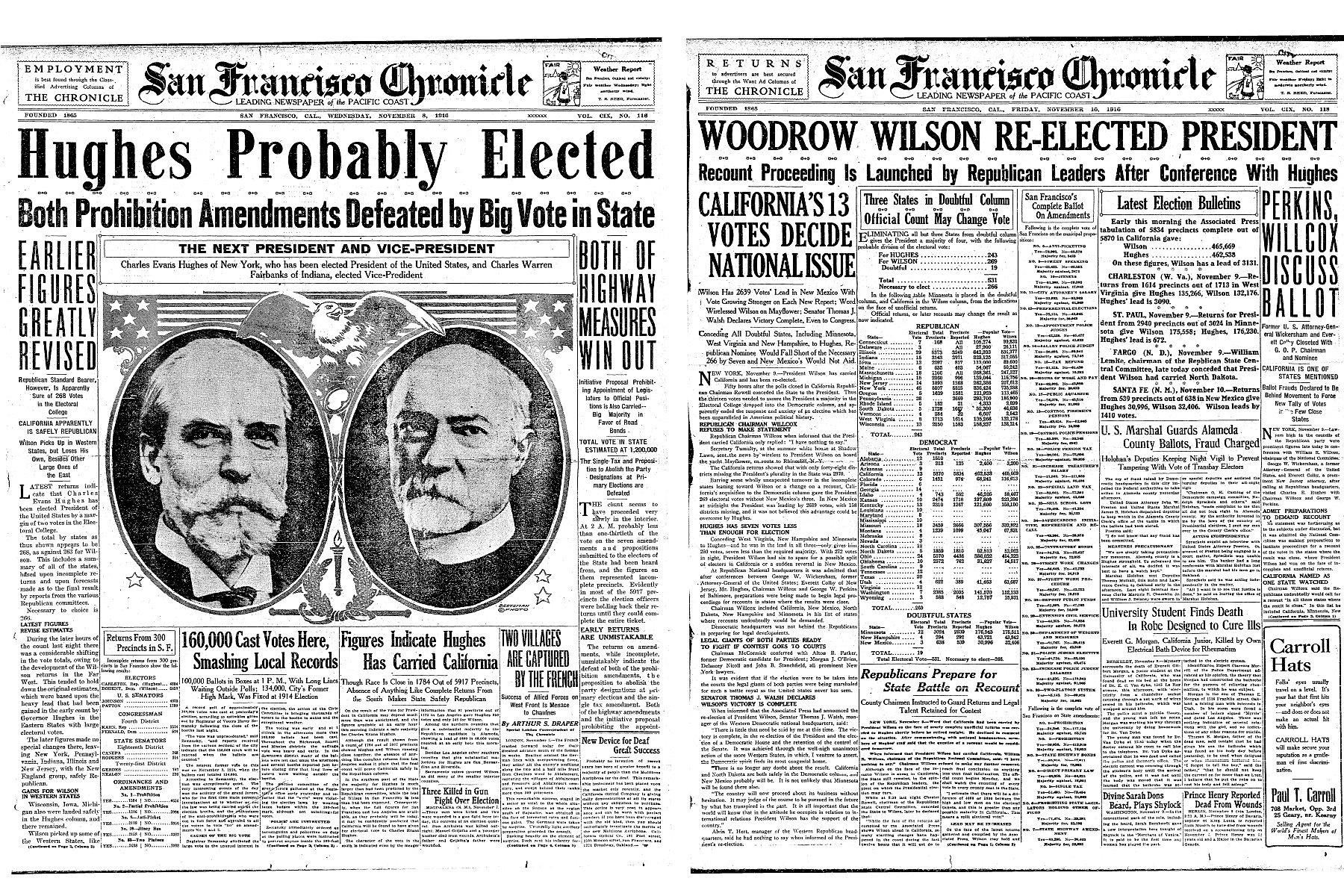
November 7, 1916: President Woodrow Wilson Is Re-Elected -- Barely

November 7, 1916: America elects a President. The Democratic nominee is the incumbent, President Woodrow Wilson, campaigning against American entry into World War I. His slogan was, "He kept us out of war."

The Republican nominee is Charles Evans Hughes, who had been Governor of New York and a Justice of the Supreme Court, who believes America should enter the war. It should be noted that each man's party is roughly evenly divided on the subject, for various reasons.

When the night is over, Hughes appears to be the winner. But, as with President Samuel J. Tilden, there's a reason most of you have never heard of President Charles E. Hughes: He, too, went to bed as the President-elect, and woke up as not that.

The problem turns out to be the communication systems of the time, with the results in rural areas not getting to the State capitals quickly, and thus not being sent on to the national capital quickly. For example, New Hampshire: Wilson ended up winning it by 56 votes. Not 56,000, not 5,600, but fifty-six. That's the smallest margin ever recorded in a State in a Presidential vote.

The key State is California, then having 13 Electoral Votes (about 1/4 of what it has now). At first, Hughes is winning it, and he goes to bed believing he has won it. Wilson, too, had gone to bed, thinking he had lost the State, and thus the country.
The San Francisco Chronicle, needing 2 tries to get it right

The story, perhaps apocryphal, tells of a reporter learning early the next morning that Wilson has taken the lead in California, and thus won the election, and calling Hughes' home. Hughes' son, or his butler, or someone else (depending on who's telling the story), tells the reporter, "The President-elect is asleep." The reporter says, "When he wakes up, tell him he's not the President-elect anymore."

With 266 Electoral Votes then needed for victory, Wilson wins, 277-254. If Hughes had won California, he would have won, 267-264. Wilson won 49.2 percent of the national popular vote, Hughes 46.1 percent. For both of his terms, Wilson would be a plurality President -- which had already happened to Grover Cleveland, and would later happen to Bill Clinton.

By the time he is Inaugurated again on March 5, 1917 (the usual date until 1933, March 4, was a Sunday that year), it is clear that Wilson will have to take America into the war. The war will make him beloved around the world. The peace process will make him despised at home.

A stroke in October 1919 paralyzed him, and when he left office in March 1921, he was, physically and emotionally, a broken man. He died in 1924. Hughes was appointed Secretary of State by Wilson's successor, Warren Harding, in 1921, and Chief Justice of the Supreme Court by Herbert Hoover in 1930. He served until retiring in 1941, and lived until 1948.

In the same election, Jeannette Rankin becomes the 1st woman elected to Congress. At the time, her home State of Montana was 1 of 10 States which then had full voting rights for women – all of them West of the Missouri River.
A pacificst, Rankin voted against America's entry into World War I, and was defeated for re-election in 1918. She bided her time, rebuilt her reputation, and was elected again in 1940. And voted against America's entry into World War II, and was defeated for re-election in 1942. She lived on until 1973.

*

November 7, 1916, like all modern American election days, was a Tuesday. Baseball was out of season. Football was in midweek. Professional basketball barely existed. And the professional hockey season was still a few months away. So there were no scores on this historic day.

Friday, October 7, 2022

October 7, 1935: The U.S. Supreme Court Building Opens

October 7, 1935: It is the 1st Monday in October, the beginning of the annual session of the Supreme Court of the United States. They had just moved into a new building.

Following the ratification of the Constitution of the United States in 1788, the United States government was based in New York City, where the Supreme Court met in the Merchants Exchange Building. When the capital was moved to Philadelphia, the Court moved with it, and began meeting in Independence Hall, before settling in Old City Hall at 5th and Chestnut Streets from 1791 until 1800.

At that point, the federal government moved to Washington, D.C, the Court had no permanent meeting location until 1810. When the architect Benjamin Latrobe had the second U.S. Senate chamber built directly on top of the first U.S. Senate chamber, the Supreme Court took up residence in what is now referred to as the Old Supreme Court Chamber from 1810 through 1860. It remained in the Capitol until 1935, with the exception of a period from 1812 to 1819, during which the Court was absent from Washington because of the British invasion and the damage done to the Capitol during the War of 1812.

The proposal for a separate building for the Supreme Court was suggested in 1912 by President William Howard Taft, who became Chief Justice in 1921. In 1929, Taft successfully argued for the creation of the new building, but died the next year. Physical construction began in 1932, and was officially completed in 1935. The building was designed by architect Cass Gilbert, a friend of Taft. The building serves as an unofficial "Taft Memorial."

At the time, there were 3 factions on the Court:

* The Four Horsemen were ultraconservative: Willis Van Devanter, appointed by William Howard Taft, a Republican; James McReynolds, appointed by Woodrow Wilson, a Democrat but a Southern one; and George Sutherland and Pierce Butler, both appointed by Warren Harding, a Republican.

* The Three Musketeers were liberal: Louis Brandeis, the 1st Jewish Justice on the Court, appointed by Wilson and considerably more liberal than McReynolds; Harlan Stone, appointed by Calvin Coolidge, a Republican; and Benjamin Cardozo, appointed by Herbert Hoover, a Republican. But both Stone and Cardozo tended to vote FDR's way.

* The swing votes were Charles Evans Hughes, once an Associate Justice appointed by Taft, a predecessor of FDR's as Governor of New York, the 1916 Republican nominee for President, very nearly beating Wilson, and appointed Chief Justice by Hoover, to replace Taft, who had been appointed by Harding; and Owen Roberts, another Hoover appointee.
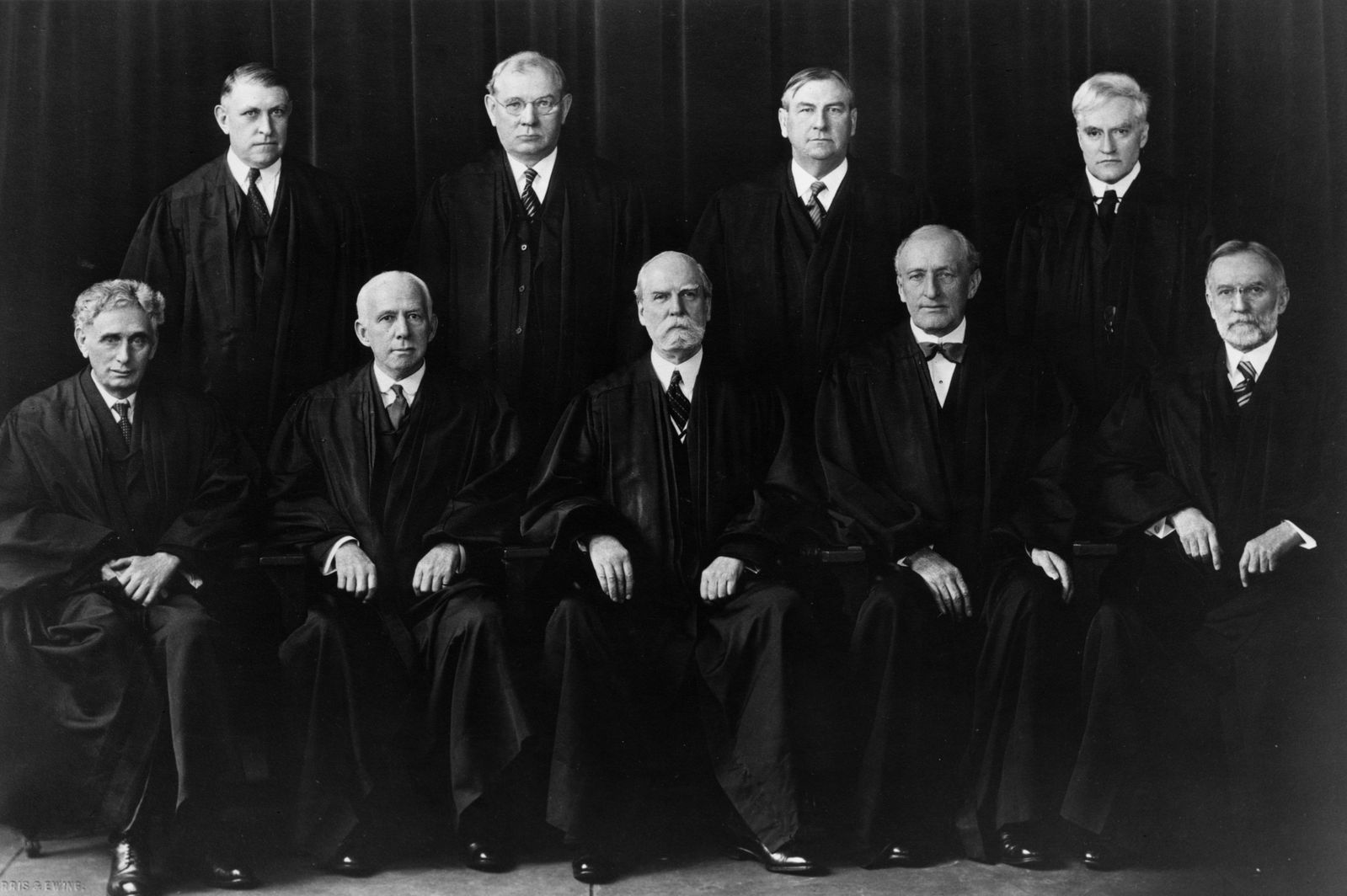
The Supreme Court, 1935. Top row, left to right:
Pierce Butler, Harlan Stone, Owen Roberts, Benjamin Cardozo.
Bottom row, left to right: Louis Brandeis, James McReynolds,
Chief Justice Charles Evans Hughes, Willis Van Devanter, George Sutherland.


The Supreme Court, 1935. Top row, left to right:
Pierce Butler, Harlan Stone, Owen Roberts, Benjamin Cardozo.
Bottom row, left to right: Louis Brandeis, James McReynolds,
Chief Justice Charles Evans Hughes, Willis Van Devanter, George Sutherland.

In this new Supreme Court building, the nation's highest cases have been decided: Civil liberties, civil rights, the rights of the accused, voting rights, privacy rights. The Court took a liberal turn in 1953 with Earl Warren becoming Chef Justice, and a conservative one in 1986 with William Rehnquist occupying the Chief's chair.

Major decisions in the 21st Century have hurt civil liberties, and the 6-3 conservative majority of the early 2020s, with 5 Justices appointed by Presidents who lost the popular vote but won the Electoral Vote, has led some liberals to cast doubt on its legitimacy, calling it "The Extreme Court."

*

October 7, 1935 was, as I said, a Monday. The Detroit Tigers beat the Chicago Cubs to win Game 6 and clinch the World Series, 4-3 at Navin Field in Detroit. (The ballpark would be renamed Briggs Stadium in 1938, and Tiger Stadium in 1961.) But the World Series clincher was the only score on this historic day. The NBA hadn't been founded yet, the NHL season's start was a few days away, and the NFL did not play. There would be no Monday Night Football for another 35 years.

Monday, August 1, 2022

August 2, 1923: Warren Harding Dies

August 2, 1923: Warren Gamaliel Harding, the 29th President of the United States, dies in office, halfway through the 3rd year of his term. He was 57 years old.

The former newspaper editor was a U.S. Senator from Ohio when he was elected President in a landslide in 1920. He was handsome, charming, and promised "a return to normalcy" after the turbulent Progressive Era, World War I, and its difficult aftermath. Actually, he never used the words "return to normalcy" in any speech. What he said was:

America's present need is not heroics, but healing; not nostrums, but normalcy; not revolution, but restoration; not agitation, but adjustment; not surgery, but serenity; not the dramatic, but the dispassionate; not experiment, but equipoise; not submergence in internationality, but sustainment in triumphant nationality.

Things had considerably calmed down in America during his time in office, and he was still popular in the Summer of 1923. He even posed for a photo with the biggest star in baseball, the Yankees' Babe Ruth.
Legend has it that Ruth, whose many alliterative nicknames could have included the Imperator of Informality, once asked the President of the United States, "Hot as hell, ain't it, Prez?" It's not clear whether the President in question was Harding, who might have appreciated it, or his successor, Calvin Coolidge, who certainly would not have.

So he was still popular in the Summer of 1923, when the Teapot Dome scandal broke out. Unlike such later scandals as Richard Nixon's Watergate, Ronald Reagan's Iran-Contra, Bill Clinton's relationship with Monica Lewinsky, and the many scandals of George W. Bush and Donald Trump, this one was, and remains, a bit complicated.

Teapot Dome was an oil reserve outside Casper, Wyoming, one of three set aside for the use of the U.S. Navy in the event of a national emergency. In May 1921, Harding signed an executive order transferring control of the reserves from the Department of the Navy to the Department of the Interior. Secretary of the Navy Edwin Denby agreed to this, and Secretary of the Interior Albert Fall now had control.

In July 1921, California-based oilman Edward Doheny offered Fall a bribe of $100,000 -- about $1,633,000 in today's money -- for permission to drill at Teapot Dome. The weird part is, after Harding was gone, Fall was convicted of accepting this bribe in 1929 -- the 1st Cabinet member ever to go to prison for actions in office -- but Doheny was acquitted of offering it in 1930.
Teapot Rock, above Teapot Dome

The scandal had begun to break, and Harding's bid for re-election was less than a year and a half away. He called his Secretary of Commerce into his office. He asked the Secretary, if he were President, and knew of a scandal in his Administration, what would he do? The Secretary said he would come completely clean. The Secretary's name was Herbert Hoover, and he would eventually become President. He didn't have a scandal like Teapot Dome in his Administration. He should have been no more unlucky than that.

Harding did not come clean. Instead, he ran away. No, he didn't resign. He went on what he called a "Voyage of Understanding," a train trip all over the continent. He became the 1st sitting President to visit Canada, and then the 1st to visit Alaska, which would still be a Territory until gaining Statehood in 1959.

On his way back south, he visited Seattle, and gave a speech at the University of Washington on July 27. That night, he called his doctor, Charles E. Sawyer, complaining of abdominal pain. Sawyer diagnosed an "acute gastrointestinal attack," and that's what the press was told. Somehow, it got out that Harding had eaten some tainted crabmeat in Alaska.

On July 29, Harding arrived in San Francisco, and checked into the Palace Hotel, and had a relapse. It wouldn't be publicly revealed until after his death, but, like his immediate predecessor, Woodrow Wilson, Harding was already a sick man when he became President, with a few years of heart problems, which were flaring up again. His wife, Florence, known as "The Duchess," was with him, and she wasn't very healthy, either, with a chronic kidney condition.
At 7:30 PM Pacific Time, in their room at the Palace, Florence was reading a flattering article about him, published by The Saturday Evening Post: "A Calm Review of a Calm Man." She paused, and he said, "That's good. Go on, read some more." She did, for a few seconds, until she noticed him twisting and gasping for air. She called the doctors, but it was too late: He was dead.

It was 10:30 PM in the East. Now, the Secret Service had to find the Vice President, Calvin Coolidge, former Governor of Massachusetts, and swear him in as the new President. That turned out to be an adventure, worthy of a separate entry, and I have one for it.

Mrs. Harding did not permit an autopsy for her husband. A rumor got around that she had poisoned him -- possibly to protect him from the rising scandal; or possibly out of revenge for something the public didn't know at the time, his voracious womanizing, including an affair that resulted in the only child he would ever have.

That wouldn't be known for a few years. At first, the country was deeply saddened by the death of a popular President. But before the Harding Tomb could be completed in 1929, it had all come out, and he became regarded as one of the worst Presidents the country had ever had: As scandalous as Richard Nixon, as dumb as George W. Bush, and as horny as Bill Clinton.

Whatever Mrs. Harding knew, she took to the grave, on November 21, 1924, less than a year and a half after her husband, and just after he would have had to face the voters again. Would he have been re-elected, given the booming economy, even with Teapot Dome and the subsequent scandal in the U.S. Department of Justice, which sent his Attorney General and former campaign manager, Harry Daugherty, to prison? Maybe, because the Democrats were badly divided.

But since Coolidge wasn't involved in the scandals at all, he cruised to an easy victory, as the nation decided to follow the Republican slogan, "Keep Cool and Keep Coolidge."

Under the Presidential Succession Act of 1886, from Harding's death on August 2, 1923 until the next Presidential term began on March 4, 1925, the man next in line for the Presidency was the Secretary of State, Charles Evans Hughes.
Hughes had been Governor of New York, an Associate Justice of the Supreme Court, and the 1916 Republican nominee for President. After serving as Secretary of State, he would be appointed Chief Justice of the Supreme Court. Had he had to take the office, he might have been a better President than Coolidge. Certainly, he would have been better than Harding or Herbert Hoover.
By the time the Harding Tomb in Marion was ready in 1927,
his reputation was in tatters.

Hoover ended up being the last surviving member of Harding's Cabinet, and also of Coolidge's, living until 1964.

The Warren G. Harding Presidential Center opened adjacent to the Harding Home in Marion, Ohio on May 12, 2021. There have been 2 ships named the USS Harding, but neither was named for Warren Gamaliel. In New Jersey, Harding Township in Morris County is named for him, and U.S. Route 40 in South Jersey is named the Harding Highway. High schools have been named for Harding in his hometown of Marion, and also in the Ohio city of Warren; in Bridgeport, Connecticut; in St. Paul, Minnesota; and in Oklahoma City.
Statue of Harding and his dog Laddie Boy,
"Presidential City," Rapid City, South Dakota

Harding remains the most recent President born in, or representing, Ohio. He has been played by Harry Dean Stanton in the 1975 film The Curse of the Hope Diamond, George Kennedy in the 1979 NBC miniseries Backstairs at the White House, and Malachy Cleary on a 2010 episode of Boardwalk Empire.

*

August 2, 1923 was a Thursday. Shimon Peres, twice Prime Minister of Israel, was born on this day. So was boxer Ike Williams, Lightweight Champion of the World from 1945 to 1951.

It was the off-season for the NFL and the NHL, and the NBA hadn't been founded yet. But Major League Baseball games were played on August 2. Out of respect to Harding, all games scheduled for the next day, August 3, were postponed. They would be again on August 10, the day of Harding's Washington funeral. Here are the August 2 results:

* The New York Yankees beat the Cleveland Indians, 4-2 at the then-new original Yankee Stadium. Hall-of-Famer Waite Hoyt outpitched James Edwards. The aforementioned Babe Ruth went 1-for-3. No home runs were hit in the game, but Yankee 3rd baseman Joe Dugan got 3 hits, and Hoyt helped his own cause with 2 hits.

* The New York Giants beat the Pittsburgh Pirates, 3-2 at Forbes Field in Pittsburgh. The Giants had beaten the Yankees in the last 2 World Series, the 1st 2 the Yankees had ever played in. They were on collision course again, and this time, the Yankees would win the Series.

* The Detroit Tigers beat the Philadelphia Athletics, 6-5 at Shibe Park in Philadelphia. It would be renamed Connie Mack Stadium in 1953.

* The Washington Senators swept a doubleheader from the St. Louis Browns at Griffith Stadium in Washington. The Senators won the 1st game 5-0, as Monroe Mitchell pitched a 6-hit shutout. They won the 2nd game 2-1, with George Mogridge going the distance.

* The Cincinnati Reds beat the Philadelphia Phillies, 2-0 at Redland Field in Cincinnati. It would be renamed Crosley Field in 1933.

* The Chicago White Sox beat the Boston Red Sox, 9-5 at Fenway Park in Boston.

* It would also be Chicago beating Boston in the National League: The Chicago Cubs beat the Boston Braves, 5-1 at Cubs Park. It would be renamed Wrigley Field in 1926.

* And a game between the Brooklyn Robins and the St. Louis Cardinals at Sportsman's Park in St. Louis was rained out, and postponed until September 24. The Robins -- as the Dodgers were known while Wilbert Robinson was their manager from 1914 to 1931 -- beat the Cardinals 8-2. 

Thursday, June 9, 2022

June 10, 1916: A Supreme Court Justice Resigns -- to Run for President

June 10, 1916: The Republican National Convention meets at the Chicago Coliseum. For President, it nominates Charles Evans Hughes, a Justice of the U.S. Supreme Court, and a former Governor of New York. For Vice President, it nominates Charles W. Fairbanks, who had already held the office under Theodore Roosevelt.
Charles W. Fairbanks

Hughes resigned from the Court the same day, and remains the last person to resign from the Supreme Court to seek elective office, the last sitting Justice nominated for President, and the last major party Presidential nominee with a beard. Only Thomas E. Dewey, the mustachioed Republican nominee of 1944 and 1948, has since been nominated with any facial hair. And William Howard Taft remains the last President with a mustache, and Benjamin Harrison the last one with a beard.
Chicago Coliseum

Roosevelt had been a supporter of Hughes as Governor, but had become disillusioned with him, and with the conservative wing of the Republican Party, with whom he had famously split at the 1912 Convention.

This time, despite calling him "The Bearded Lady," TR brought his progressive wing of the party in to support Hughes. because, both politically and personally, he despised the Democratic incumbent, President Woodrow Wilson -- perhaps more than any President has ever hated any other President. (Wilson wasn't exactly fond of TR, either.)

Born in 1862 in Glens Falls, New York, closer to Montreal than to Midtown Manhattan, he graduated from Brown University, and Columbia University School of Law. After a private law practice in New York City, in 1905 he led successful New York State investigations into public utilities and the life insurance industry.

He was elected Governor of New York in 1906, as a TR-style progressive Republican, and implemented several reforms. In 1910, President William Howard Taft appointed Hughes as an Associate Justice of the Supreme Court. Hughes often joined Associate Justice Oliver Wendell Holmes Jr. in voting to uphold state and federal regulations.

The 1916 Presidential election was terribly close, and came down to 1 State, California. On Election Night, November 7, both Hughes and Wilson went to bed thinking that Hughes had won. But Hughes did not publicly claim victory, and Wilson did not offer his concession, either in a message to Hughes or in a statement to the press.

The story, perhaps apocryphal, tells of a reporter learning early the next morning that Wilson had taken the lead in California, and thus won the election, and calling Hughes' home. Hughes' son, or his butler, or someone else (depending on who's telling the story), tells the reporter, "The President-elect is asleep." The reporter says, "When he wakes up, tell him he's not the President-elect anymore."

Hughes went back to private practice, becoming one of the most respected lawyers in America, as befitting a former Supreme Court Justice. (He was only 54 when he left the Court, and Justices tend to be older than that when first appointed.) He did not run again in 1920, and when Warren Harding won, he appointed Hughes to be Secretary of State.

In that office, he negotiated the Washington Naval Treaty, in which the governments of the U.S., the British Empire, France, Italy and Japan agreed to cut back on naval construction, to avoid an arms race that could lead to a second World War. Of course, it didn't work out that way, but that was hardly the fault of any American, including Harding or Hughes.

Hughes returned to private practice in 1925, having served the term of Harding, with Calvin Coolidge having served that last year and a half of it after Harding's death. In 1930, a dying Taft retired as Chief Justice, and President Herbert Hoover appointed Hughes to be the Chief Justice.

He held the office until retiring in 1941, and, while he didn't get to be President himself, he did get to swear one in, Franklin Delano Roosevelt -- 3 times. FDR, like TR and Hughes, had been a Governor of New York. Hughes and Associate Justice Owen Roberts each turned out to be a "swing vote" on the Court, between the liberal "Three Musketeers" (Louis Brandeis, Benjamin Cardozo and Harlan Stone) and the conservative "Four Horsemen" (James McReynolds, George Sutherland, Willis Van Devanter and Pierce Butler).

He died in 1948, at the age of 86. He is widely considered by historians to be one of the best Secretaries of State, and one of the best Chief Justices. Some historians have called him one of the best losing Presidential candidates, or one of the losing candidates who would have been a better President than the winning candidate.

Federal Judge Learned Hand, sometimes called the best judge who didn't get to serve on the Supreme Court, said, "Hughes was the greatest lawyer he had ever known, except that his son was even greater." Charles Evans Hughes Jr. was briefly the Solicitor General of the United States, but had to resign the office when his father was appointed Chief Justice, to avoid a conflict of interest. One of his sons, Charles Evans Hughes III, became a prominent architect; and another, Henry Stuart Hughes, taught history and psychology at several universities, including Harvard.

From 1916 to 2022, the resignation of a Justice of the Supreme Court of the United States, for reasons other than retirement due to advancing age and/or ill health, has been limited to 3 examples. James F. Byrnes resigned in 1942, because FDR appointed him to the wartime office of Director of the Office of Economic Stabilization. Arthur J. Goldberg resigned in 1965, because President Lyndon B. Johnson appointed him to be U.S. Ambassador to the United Nations. And Abe Fortas resigned in 1969, over an insider-trading scandal, one whose scope and amount now seems tame in comparison to later political scandals.

Rarer still has been consideration of a Supreme Court Justice for a national ticket. In 1944, FDR considered William O. Douglas for Vice President, but he declined, and FDR chose Senator Harry Truman of Missouri instead. In 1945, FDR died, and Truman became President.

In 1948, Truman considered Douglas, and even tried to talk him into accepting the Presidential nomination. Douglas declined both, and Truman ran with Senator Alben Barkley of Kentucky. In 1952, Truman was definitely not running again, and again tried to talk Douglas into running for President. Once again, he refused.

In 1948, Governor Earl Warren of California ran for President, and was nominated for Vice President by the Republicans. But it was only in 1953 that he was later appointed Chief Justice. No Justice since has been seriously considered for President or Vice President.

UPDATE: In 2024, the Republicans nominated Senator JD Vance (no periods on his initials) for Vice President, on Donald Trump's ticket. He then had a beard. The ticket emerged victorious. As of June 10, 2026, Vance still had the beard. But, still, no President has had a mustache since Taft, no major-party nominee for President has had a mustache since Dewey; and none of either has had a beard since Benjamin Harrison.

*

June 10, 1916 was a Saturday. These baseball games were played:

* The New York Giants beat the Chicago Cubs, 1-0 at the Polo Grounds. Larry Doyle, who once announced, "It's great to be young and a Giant, was about to turn 30, and he went 2-for-4, and drove in the game's only run with a single in the bottom of the 7th inning.

* The Brooklyn Robins, as the Dodgers were known during the managing of Wilbert Robinson from 1914 to 1931, lost to the St. Louis Cardinals, 3-2 at Ebbets Field. Owen Wilson doubled 2 runs home in the top of the 14th inning, and while George Cutshaw doubled in the bottom of the 14th, the Robins only got 1 run out of it, and ran out of outs. Zack Wheat went 3-for-5 with a walk for Brooklyn. Rogers Hornsby, in his 1st full season, and playing 3rd base instead of his usual 2nd, went 1-for-5 with a walk for St. Louis.

* The Cleveland Indians beat the Philadelphia Athletics, 10-1 at League Park in Cleveland. Stan Coveleski went the distance for the win. Tris Speaker went 5-for-5 with 2 RBIs. Napoleon "Nap" Lajoie, running out the string, went 1-for-4 with the only A's RBI.

* The Chicago White Sox beat the Washington Senators, 2-1 at Comiskey Park in Chicago. Shoeless Joe Jackson went 2-for-4, and Eddie Collins went 1-for-4.

* The Boston Red Sox beat the St. Louis Browns, 4-2 at Sportsman's Park in St. Louis. Hal Janvrin tied it with an RBI single in the top of the 9th inning, and Everett Scott singled home 2 runs in the top of the 10th. Babe Ruth, still mainly a pitcher at this point, was sent up as a pinch-hitter, but when the Browns made a pitching change, Ruth was withdrawn for another pinch-hitter.

* The New York Yankees and the Detroit Tigers were rained out at Navin Field (later Briggs Stadium and Tiger Stadium) in Detroit. The game was made up on June 14. The Tigers won, 6-2. Ty Cobb went 1-for-2 with 2 walks and a stolen base. Bobby Veach went 4-for-4 with 3 RBIs.

* The Pittsburgh Pirates and the Philadelphia Phillies were rained out at Baker Bowl in Philadelphia. The game was made up as part of a doubleheader on July 26. The Phils won the opener, 7-1. Grover Cleveland Alexander outpitched Babe Adams. The Bucs won the nightcap, 5-2. Max Carey, better known as one of the best baserunners of the era, hit a home run. Over the 2 games, Honus Wagner went 1-for-7 with a walk.

* And the Cincinnati Reds and the Boston Braves were rained out at Redland Field (later Crosley Field) in Cincinnati. The game was made up as part of a doubleheader on August 3. The Reds won the 1st game, 3-1. The Braves won the 2nd game, 5-3.

Friday, May 27, 2022

May 27, 1935: "Black Monday" vs. the New Deal

The Supreme Court, 1935. Top row, left to right:
Pierce Butler, Harlan Stone, Owen Roberts, Benjamin Cardozo.
Bottom row, left to right: Louis Brandeis, James McReynolds,
Chief Justice Charles Evans Hughes, Willis Van Devanter, George Sutherland.

May 27, 1935: A bad day for President Franklin D. Roosevelt and his New Deal, at the Supreme Court of the United States. Among FDR's advisors, the "Brain Trust," it becomes known as "Black Monday."

In Humphrey's Executor v. United States, FDR, a Democrat, had fired William Humphrey, a Republican, from the Federal Trade Commission. Humphrey sued to get his job back, and to get back pay. He died before the case could be heard, so his wife, as the executor of his estate, kept the suit going. The Court ruled in favor of Mrs. Humphrey.

FDR was not used to losing. He had never lost an election in his own right: State Senator from Dutchess County in 1910 and 1912, Governor of New York in 1928 and 1930, President in 1932. He had been on the losing side of the 1920 Presidential election, but as the Democratic nominee for Vice President, with Governor James M. Cox of Ohio as the top of the ticket and the official loser. He'd even gained seats for the Democrats in the 1934 Congressional election. So, this hurt a little. If that had been the end of it, it probably would've been a footnote in the story of his Administration.

Then, the Court announced its ruling in Louisville Joint Stock Land Bank v. Radford. The Frazier-Lemke Farm Bankruptcy Act of 1934 was designed to give aid to debt-ridden farmers. But the Court ruled that it violated the "Takings Clause" of the 5th Amendment to the Constitution of the United States: While the States could not impair contract obligations, the federal government could, but it could not take property in such a manner without compensating the creditor. Two losses for FDR in one day. Unpleasant, but not really a big deal.

But the last decision the Court read that day was a very big deal. In A.L.A. Schechter Poultry Corporation v. United States, the Court struck down the National Industrial Recovery Act of 1933, a key piece of New Deal legislation, in its entirety.

The details of what became known as "the Sick Chicken Case" involved the Schechter brothers violating laws governing the sale of poultry in the State of New York, both State and federal, including the NIRA.

(Ironically, the symbol of the NIRA -- or just the NRA, at that point better-known than the National Rifle Association -- was a bird, a blue eagle. This inspired the naming of a professional football team that started play in 1933, which later switched its main color from blue to green: The Philadelphia Eagles. And until becoming contenders during World War II, they seemed to play more like sick chickens than soaring eagles.)

In a unanimous 9-0 vote, the Court ruled that the NIRA was in violation of both the Due Process Clause of the 5th Amendment, and also of the Commerce Clause of the Constitution (Article I, Section 8, Clause 3.)

If the 1st 2 cases rolled off FDR like water off a duck's back, this last one stung. Four days later, he held a press conference, saying Schechter had "relegated the nation to a horse-and-buggy-definition of interstate commerce.

At the time, there were 3 factions on the Court:

* The Four Horsemen were ultraconservative: Willis Van Devanter, appointed by William Howard Taft, a Republican; James McReynolds, appointed by Woodrow Wilson, a Democrat but a Southern one; and George Sutherland and Pierce Butler, both appointed by Warren Harding, a Republican.

* The Three Musketeers were liberal: Louis Brandeis, the 1st Jewish Justice on the Court, appointed by Wilson and considerably more liberal than McReynolds; Harlan Stone, appointed by Calvin Coolidge, a Republican; and Benjamin Cardozo, appointed by Herbert Hoover, a Republican. But both Stone and Cardozo tended to vote FDR's way. Not in Schechter, though.

* The swing votes were Charles Evans Hughes, once an Associate Justice appointed by Taft, a predecessor of FDR's as Governor of New York, the 1916 Republican nominee for President, very nearly beating Wilson, and appointed Chief Justice by Hoover, to replace Taft, who had been appointed by Harding; and Owen Roberts, another Hoover appointee.

FDR knew that the Four Horsemen were a threat to his legislation, and that the two swing votes were both Republicans. But he didn't expect a unanimous vote against the NIRA.

After being re-elected in 1936, FDR proposed what became known as "the Court-packing plan," allowing the President to appoint a Justice to the Supreme Court without there being a vacancy, one such Justice for every member of the Court that was at least 70 years old. In the Spring of 1937, that would have meant six, for a total of 15.

(Incidentally, the Constitution has never said, anywhere its text, either the original or the Amendments, how many Justices should be on the Supreme Court; only that the Court should exist, and what it should do. The number has been fixed at 9 since the Civil War, mainly because there were 9 "circuits" in the federal court system, although it was not traditional to have 1 Justice from each of the 9 circuits. Since 1981, there have been 11 circuits.)

But even the Democrats in Congress wouldn't go along with FDR on this one. It was too much of an overreach, and it seemed like a power grab, upsetting the separation of powers between the branches of the federal government. The plan was never even voted on by Congress.

FDR didn't get what he wanted, but he got the next-best thing: The plan struck fear into the Justices, and led them to look at his New Deal legislation more closely. On March 29, 1937, Justice Roberts (no relation to current Chief Justice John Roberts) voted with Hughes and the Three Musketeers in West Coast Hotel Company v. Parrish, upholding minimum wage laws.

He had been expected to vote the other way, which would have made the vote 5-4 against, striking all such laws down. It became known as "The Switch In Time That Saved Nine," and was a sign that the Court -- or, at least, that Roberts -- had gotten FDR's message.

Despite the many successes, some of them political landmarks, of his 1st term, FDR hadn't gotten a chance to replace any of the Justices. Starting with his 2nd term, his chances began to come:

1. On June 2, 1937, Van Devanter retired, and was replaced by Senator Hugo Black of Alabama. Despite having once been a member of the Ku Klux Klan, the inaptly-named Black became one of the Court's leading voices for the forward movement of civil rights.

2. On January 17, 1938, Sutherland retired, and was replaced by Stanley Reed, FDR's Solicitor General, the person who argues before the Supreme Court on behalf of the federal government -- in other words, FDR had appointed the man who lost the Black Monday cases to the Court.

3. On July 9, 1938, Cardozo died, and was replaced by Felix Frankfurter, one of the founders of the American Civil Liberties Union, and a longtime professor at Harvard Law School, FDR's alma mater.

4. On February 13, 1939, Brandeis retired, and was replaced by the Chairman of the Securities and Exchange Commission, William O. Douglas, who served longer on the Court than anyone yet has: 36 years.

5. On November 16, 1939, Butler died, and was replaced by Frank Murphy, who had been FDR's Attorney General, and, before that, Governor of Michigan and Mayor of Detroit.

6. On January 31, 1941, 11 days after FDR was sworn in for a 3rd term, McReynolds retired, and was replaced by Senator James F. Byrnes of South Carolina. In 1942, with World War II on, FDR decided Byrnes was more valuable in a different role, and replaced him with federal Judge Wiley Rutledge.

7. On June 30, 1941, Hughes retired, and FDR promoted Stone to Chief Justice.

8. To replace Stone as Associate Justice, FDR appointed Robert H. Jackson, who had replaced Murphy as U.S. Attorney General, and had replaced Reed as U.S. Solicitor General, and before that had been an Assistant Attorney General in the Tax and Antitrust Divisions.

FDR appointed 9 Justices -- but only replaced 8 of those he inherited. With some appropriateness, the only Justice he didn't replace was Roberts, who retired from the Court on July 31, 1945, 3 months after FDR died. President Harry Truman replaced him with Harold Burton, a Senator from Ohio and former Mayor of Cleveland, and a Republican, as a bipartisan gesture in the closing days of World War II.

*

May 27, 1935 was, as stated, a Monday. Up until 1970, Memorial Day was observed on May 30. Since 1971, it's been on the last Monday in May. So this Monday was not a Memorial Day. But it was the birthdate of future Miss America and actress Lee Meriwether.

Football, basketball and hockey were out of season. These games were played in what would later be called Major League Baseball:

* The New York Yankees beat the Detroit Tigers, 3-1 at Yankee Stadium. Johnny Allen outpitched Lynwood Thomas "Schoolboy" Rowe. This was the year after Babe Ruth left, and the year before Joe DiMaggio arrived, but Lou Gehrig went 1-for-4 in this game. For the Tigers, Hank Greenberg went 0-for-4. The Tigers went on to win the World Series, anyway.

* The St. Louis Browns beat the Boston Red Sox, 5-3 at Fenway Park in Boston.

* The Philadelphia Athletics beat the Chicago White Sox, 6-1 at Shibe Park in Philadelphia. (It was renamed Connie Mack Stadium in 1953.)

* The Washington Senators beat the Cleveland Indians, 6-5 at Griffith Stadium in Washington.

* The Philadelphia Phillies beat the Pittsburgh Pirates, 4-2 at Forbes Field in Pittsburgh.

* The Cincinnati Reds beat the Boston Braves, 9-5 at Crosley Field in Cincinnati. In one of his last major league appearances, Babe Ruth led off the top of the 9th inning with a walk. But the Cliché Alert didn't kick in: The Braves couldn't capitalize on that and mount a rally.

* The New York Giants and the St. Louis Cardinals, the last 2 World Series winners, were supposed to play at Sportsman's Park in St. Louis, but got rained out. It was made up as part of a doubleheader on July 23. The Cards won the opener, 6-1. Paul "Daffy" Dean beat Roy Parmelee, thanks to 2 home runs from Joe Medwick. The Jints won the nightcap, 8-2. Al Smith won it over Bill Walker. Bill Terry and Mel Ott both went 0-for-4 in the 1st game, but made up for it in the 2nd: Terry 2-for-4 with an RBI, Ott 3-for-5 with 2 RBIs.

* And the Brooklyn Dodgers and the Chicago Cubs were supposed to play at Wrigley Field in Chicago, but got rained out. This one was also made up as part of a doubleheader on July 23. The Cubs won both games, 8-0 and 6-4. Roy Henshaw pitched a 6-hit shutout in the opener.

Friday, March 4, 2022

March 4, 1933: The New Deal Begins

March 4, 1933: A new President is inaugurated, and it begins a new era in American history.

A few of our transfers of power have been fraught with worry:

* March 4, 1797: The 1st transfer of power, from George Washington to John Adams. It turned out not to be anything to worry about, but that was far from certain at the time, since no one, not even the brilliant and highly talented Adams, had Washington's gravitas.

* March 4, 1801: The 1st transfer of power from one party to another, from Adams, a member of the Federalist Party, to Thomas Jefferson, founder and leader of the Democratic-Republican Party, whose members called themselves "Republicans," but would eventually evolve into the Democratic Party. 

Once closely linked in the fight for independence, now estranged and bitter enemies, Adams had appointed what became known as "midnight judges" at the end of his Administration, with the intent of holding Jefferson back from perceived extreme measures. But Jefferson's 2 terms in office turned out to be comparatively peaceful. The friendship would later be restored.

* March 4, 1861: With the threat of civil war becoming very real, James Buchanan handed the Presidency over to Abraham Lincoln. Threats against Lincoln's life had already been made, and he practically had to sneak into Washington. He tried a conciliatory Inaugural Address. It didn't work.

* March 5, 1877: The disputed election that put Rutherford B. Hayes in as the next President, despite Samuel J. Tilden having received the most popular votes and, it appeared at first, the necessary Electoral votes, infuriated people to the point where another civil war seemed possible: The cry from the Democrats was "Tilden or blood!" And it wasn't officially settled until March 2. To complicate matters further, the usual Inauguration Day, March 4, fell on a Sunday: The official ceremony at the Capitol was set for the following day.

To simplify things, the outgoing President Ulysses S. Grant, suggested that Hayes take the Oath of Office in the White House on March 3, taking effect at noon on March 4, so that he would already be the President on March 5, so that the Inaugural ceremonies would essentially be going through the motions for public display. There was no violence.

* January 20, 1981: The 20th Amendment to the Constitution, ratified in 1933, had moved Inauguration Day up, largely because of the events of 1932-33. President Jimmy Carter, a Democrat, and President-elect Ronald Reagan, a Republican who had overwhelmingly defeated him in a bitter election, were not friendly with each other. But that wasn't the problem.

The problem was that Carter was finally close to getting 52 hostages released by Iran, but the Iranian government decided to keep them in custody until after noon, U.S. Eastern Time, to deny Carter a full victory. Their plane ended up clearing Iranian airspace at 12:35 PM Eastern. While Carter went to meet them at the U.S. Air Force base in Weisbaden, West Germany, it was Reagan who welcomed them to the White House, making it look like he was taking credit for it. He did nothing to make their release happen.

* January 20, 1993: Despite a bitter campaign, President George H.W. Bush, Republican, and President-elect Bill Clinton, Democratic, had made peace with each other in the transition. But there was a situation involving Iraq on the last day of Bush's term. Bush suggested that his national security team remain in charge for a few hours more, and Clinton agreed. Bush signed an Executive Order extending their terms by 4 hours. The situation was settled, and Clinton's team began their terms.

* January 20, 2001: Bush's son, George W. Bush, had emerged victorious over Clinton's Vice President, Al Gore, under dubious circumstances. There were protestors at the Capitol for the Inauguration, but there was no violence.

* January 20, 2017: Again under dubious circumstances, a Republican who did not win the popular vote took the office. This time, it was Donald Trump, the most underqualified incoming President ever, and the most psychologically unfit. Violence was feared. There was none.

* January 20, 2021: Joe Biden had beaten Trump, but after the attack on the Capitol while the Electoral Votes were being certified on January 6, people were afraid that another attack would be launched. This time, there was enough of a deterrent force on hand that the would-be second-time insurrectors did the smart thing, and stayed away.

If anything, the events of March 4, 1933 were fraught with even more worry than 2021 -- or even 1861.

*

For it was the depth of the Great Depression. Within 8 months of taking office as President on March 4, 1929, Herbert Hoover saw the stock market crash on his watch. He wasn't responsible for it. And it would be unfair to say he did nothing about it. A fairer statement would be that he didn't do enough things, and that he didn't take the things he did do, which did help a little, far enough.

So, in the 1932 election, he lost in a massive landslide to the Governor of New York, a Democrat, Franklin Delano Roosevelt. The interregnum between the election on November 8 and the Inauguration on March 4 was interminable, as a bitter Hoover, like Trump with Biden 88 years later, shared nothing with FDR and his team. Essentially, Hoover sabotaged his own best chance at leaving office on a high note.

As a result, things got worse. Banks were failing all over the country. People were terrified. The American economy was on the brink of complete collapse, more so than it had been during the "panics" of 1791, 1819, 1837, 1857, 1869, 1873, 1893 and 1907, even more so than during the Crash of 1929. And, as it turned out, more than during the Crash of 1987, the economic free-fall of 2008, and the drop during Spring 2020's coronavirus crisis.

Inauguration Day fell on a Saturday, and this may have been for the best, as the banks would have been closed anyway.

Roosevelt was sworn in by the Chief Justice of the Supreme Court, Charles Evans Hughes, and made the most important Inaugural Address in the history of the office. It wasn't just the conditions that were the problem, it was the fear of the problem that he wanted to address, the fear that was making things worse. On that subject, it is fair to say that Hoover did nothing. Roosevelt addressed this right off the bat:

President Hoover, Mr. Chief Justice, my friends: I am certain that my fellow Americans expect that, on my induction into the Presidency, I will address them with a candor and a decision which the present situation of our Nation impels.

This is preeminently the time to speak the truth, the whole truth, frankly and boldly. Nor need we shrink from honestly facing conditions in our country today. This great Nation will endure as it has endured, will revive and will prosper.

So, first of all, let me assert my firm belief that the only thing we have to fear is fear itself: Nameless, unreasoning, unjustified terror which paralyzes needed efforts to convert retreat into advance. 

Despite a light rain falling on Washington for most of the day, the Inaugural crowd may have been the biggest in history to that point, and a great cheer went up.

Roosevelt promised "action, and action now!" He acted on it. Over the weekend, he set in motion the policies that embodied what he called, during the campaign, "a new deal for the American people." His New Deal measures included keeping the banks closed for a week, so they could straighten out their own situations. When they reopened on March 12, they were secure, and the nation's recovery began.

It would be long and slow, but FDR's New Deal measures helped millions of people get by. Had he only served 2 terms, and someone else had led the nation through World War II, FDR would still be remembered as one of the nation's greatest and most important Presidents. His leadership during World War II would put him up there with Washington and Lincoln as 1 of the 3 greatest.

Franklin Delano Roosevelt was inaugurated as President of the United States just 33 days after Adolf Hitler was appointed Chancellor of Germany, and the Nazi regime began. No one knew it at the time, but FDR and Hitler were on a collision course. A little more than 12 years later, both would be dead -- but one of them would be victorious. And for most of those 12 years, it wasn't clear which one that would be.

There have been, essentially, 4 eras of American history:

* The Colonial era, beginning with the arrival of Christopher Columbus in 1492 (note that I'm not saying that he "discovered America"), and lasting until the Declaration of Independence in 1776.

* The Revolutionary era, from the Declaration until the end of the Civil War in 1865.

* The next era, whatever name you want to give it, lasting from the end of the Civil War until the start of the New Deal in 1933.

* And the era that began with the New Deal. If you want to say that, sometime since 1933, that 4th era ended and a 5th era has begun, I don't know what your line of demarcation would be. Neither the resignation of Richard Nixon in 1974, nor the Inauguration of Reagan in 1981, nor that of Clinton in 1993, nor the 9/11 attacks of 2001, nor the arrival of Trump in 2017, nor the leaving of Trump in 2021 carries the same amount of historical weight, nor is likely to.

*

March 4, 1933 was a Saturday. Roosevelt's appointee as Secretary of Labor, Frances Perkins, took office that same day, making her the 1st female member of any President's Cabinet. I have a separate entry for that distinction.

Baseball teams were starting Spring Training, the NFL was out of season, and the NBA hadn't been founded yet. There was only the NHL to provide games and scores. Even then, there were slim pickings:

* Only one American-based team was scheduled to play: The New York Americans lost to the Montreal Canadiens, 2-0 at the Montreal Forum.

* And, in a game broadcast on the Canadian Broadcasting Corporation's most popular radio show, which would become, and remains, the CBC's most popular television show, Hockey Night In Canada, the Toronto Maple Leafs beat the Montreal Maroons, 4-2 at Maple Leaf Gardens in Toronto.

* The Detroit Red Wings and the Ottawa Senators had last played on March 2, against each other at the Ottawa Auditorium, with the Wings winning 3-2. They would play each other again on March 5, at the Olympia Stadium in Detroit, with the Wings winning 2-0.

* The Chicago Black Hawks had also last played on March 2, beating the Americans 3-2 at Chicago Stadium. They would next play on March 5, also at the Stadium, losing to the Maple Leafs 2-1.

* The Boston Bruins had last played on February 28, against the Senators at the Boston Garden. It ended in a 0-0 tie.

* The New York Rangers hadn't played since February 26, a 4-1 win over the Hawks in Chicago. Their next game would also be the Bruins' next game, on March 5, at what was then called the new, but would eventually be called the old, Madison Square Garden, and the Bruins won 2-1.

Also, Arsenal beat Liverpool, 1-0 at Highbury in North London.

Thursday, January 20, 2022

January 20, 1937: FDR Sees One-Third of a Nation Ill-Housed, Ill-Clad, Ill-Nourished

January 20, 1937: For the 1st time, following the 20th Amendment moving it from March 4, the Inauguration of the President of the United States takes place on January 20.

In spite of a steady rain, more people come to see Franklin Delano Roosevelt be sworn in for a 2nd term, by Chief Justice Charles Evans Hughes, than came for his 1st Inauguration. Of course, thanks to his New Deal programs, the economy was considerably better, and more people had the means to come.

FDR had cut unemployment in half, from 31 percent when he took office on March 4, 1933 to 14 percent. But this still wasn't enough. Perhaps spurred on by First Lady Eleanor Roosevelt, and her tours of the poorer sections of America -- she had coined the saying, "We are all better off when we are all better off" -- FDR said, using the long-established "I see" construction of political speeches:

I see a great nation, upon a great continent, blessed with a great wealth of natural resources. Its hundred and thirty million people are at peace among themselves. They are making their country a good neighbor among the nations.

I see a United States which can demonstrate that, under democratic methods of government, national wealth can be translated into a spreading volume of human comforts hitherto unknown, and the lowest standard of living can be raised far above the level of mere subsistence.

But here is the challenge to our democracy: In this nation, I see tens of millions of its citizens, a substantial part of its whole population, who, at this very moment, are denied the greater part of what the very lowest standards of today call the necessities of life.

I see millions of families trying to live on incomes so meager that the pall of family disaster hangs over them day by day.

I see millions whose daily lives, in city and on farm, continue under conditions labeled indecent by a so-called polite society half a century ago.

I see millions denied education, recreation, and the opportunity to better their lot, and the lot of their children.

I see millions lacking the means to buy the products of farm and factory, and, by their poverty, denying work and productiveness to many other millions.

I see one-third of a nation ill-housed, ill-clad, ill-nourished.

It is not in despair that I paint you that picture. I paint it for you in hope, because the Nation, seeing and understanding the injustice in it, proposes to paint it out.

We are determined to make every American citizen the subject of his country's interest and concern. And we will never regard any faithful law-abiding group within our borders as superfluous.

The test of our progress is not whether we add more to the abundance of those who have much; it is whether we provide enough for those who have too little.

If I know aught of the spirit and purpose of our Nation, we will not listen to Comfort, Opportunism, and Timidity. We will carry on.

Challenging the greedy and supporting the needy was what FDR did best. He not only said it, but he'd spent the last few years -- including while he was Governor of New York -- trying to do something about it.

Senator Harry Truman of Missouri, later to be his Vice President and his successor, later said that FDR may have understated the case: It probably wasn't 1/3rd of the nation's people, 33.3 percent, that didn't have proper housing, clothing and food, it was more like 2/5ths, 40 percent -- and, in rural American, 1/2, 50 percent.

But FDR was also a canny politician. He knew that this speech would be considered radical then -- and, following the Presidencies of Ronald Reagan and George W. Bush, and into the era of Donald Trump, it sounds radical now. But if he cited the figures that Truman suggested, it would sound like he was blaming his opponents. And that's not what he wanted to do: He wanted to challenge his opponents to join him in working to solve the problem.

More was done in his 2nd term. But it took America entering World War II, reducing the job market, to truly bring unemployment to heel.

Lyndon B. Johnson had been sworn into his 1st term in Congress, from a district in the "Hill Country" of South Texas, 17 days earlier. He considered FDR his political role model. In 1964, starting his 1st full year as President after the assassination of John F. Kennedy, LBJ declared "War On Poverty." As FDR did before him, he had significant, if only partial, success.

*

January 20, 1937 was a Wednesday. Baseball and football were out of season. The NBA hadn't been founded yet. And no games were scheduled for the NHL. Therefore, there were no scores on this historic day.

December 31, 1999 & January 1, 2000: The Millennium

December 31, 1999:  The Millennium arrives. The people of planet Earth survived. At a terrible cost. But we hadn't destroyed ourselves. ...