
October 7, 1935: It is the 1st Monday in October, the beginning of the annual session of the Supreme Court of the United States. They had just moved into a new building.
Following the ratification of the Constitution of the United States in 1788, the United States government was based in New York City, where the Supreme Court met in the Merchants Exchange Building. When the capital was moved to Philadelphia, the Court moved with it, and began meeting in Independence Hall, before settling in Old City Hall at 5th and Chestnut Streets from 1791 until 1800.
At that point, the federal government moved to Washington, D.C, the Court had no permanent meeting location until 1810. When the architect Benjamin Latrobe had the second U.S. Senate chamber built directly on top of the first U.S. Senate chamber, the Supreme Court took up residence in what is now referred to as the Old Supreme Court Chamber from 1810 through 1860. It remained in the Capitol until 1935, with the exception of a period from 1812 to 1819, during which the Court was absent from Washington because of the British invasion and the damage done to the Capitol during the War of 1812.
The proposal for a separate building for the Supreme Court was suggested in 1912 by President William Howard Taft, who became Chief Justice in 1921. In 1929, Taft successfully argued for the creation of the new building, but died the next year. Physical construction began in 1932, and was officially completed in 1935. The building was designed by architect Cass Gilbert, a friend of Taft. The building serves as an unofficial "Taft Memorial."
At the time, there were 3 factions on the Court:
* The Four Horsemen were ultraconservative: Willis Van Devanter, appointed by William Howard Taft, a Republican; James McReynolds, appointed by Woodrow Wilson, a Democrat but a Southern one; and George Sutherland and Pierce Butler, both appointed by Warren Harding, a Republican.
* The Three Musketeers were liberal: Louis Brandeis, the 1st Jewish Justice on the Court, appointed by Wilson and considerably more liberal than McReynolds; Harlan Stone, appointed by Calvin Coolidge, a Republican; and Benjamin Cardozo, appointed by Herbert Hoover, a Republican. But both Stone and Cardozo tended to vote FDR's way.
* The swing votes were Charles Evans Hughes, once an Associate Justice appointed by Taft, a predecessor of FDR's as Governor of New York, the 1916 Republican nominee for President, very nearly beating Wilson, and appointed Chief Justice by Hoover, to replace Taft, who had been appointed by Harding; and Owen Roberts, another Hoover appointee.
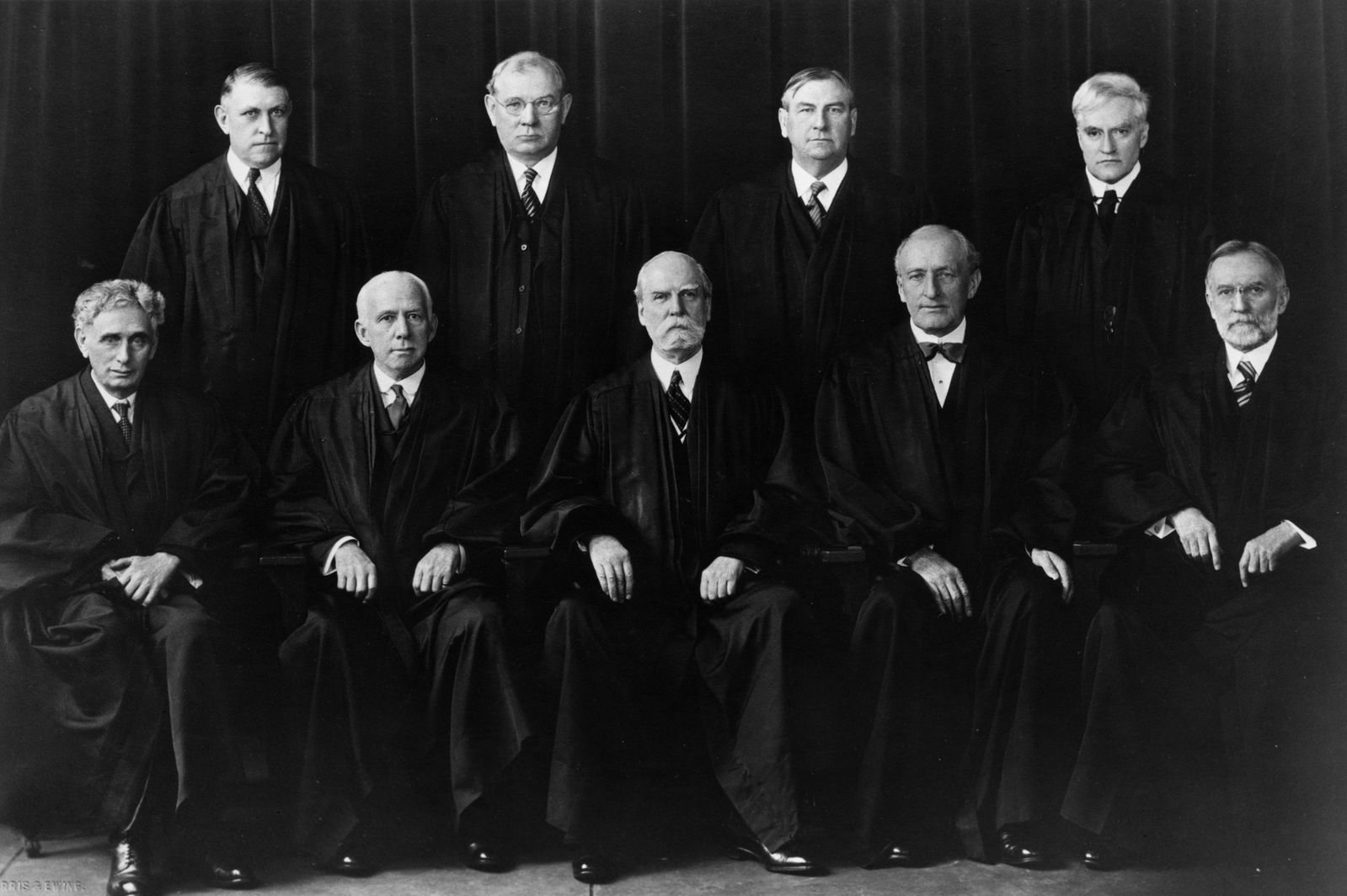
The Supreme Court, 1935. Top row, left to right:
Pierce Butler, Harlan Stone, Owen Roberts, Benjamin Cardozo.
Bottom row, left to right: Louis Brandeis, James McReynolds,
Chief Justice Charles Evans Hughes, Willis Van Devanter, George Sutherland.
The Supreme Court, 1935. Top row, left to right:
Pierce Butler, Harlan Stone, Owen Roberts, Benjamin Cardozo.
Bottom row, left to right: Louis Brandeis, James McReynolds,
Chief Justice Charles Evans Hughes, Willis Van Devanter, George Sutherland.
In this new Supreme Court building, the nation's highest cases have been decided: Civil liberties, civil rights, the rights of the accused, voting rights, privacy rights. The Court took a liberal turn in 1953 with Earl Warren becoming Chef Justice, and a conservative one in 1986 with William Rehnquist occupying the Chief's chair.
Major decisions in the 21st Century have hurt civil liberties, and the 6-3 conservative majority of the early 2020s, with 5 Justices appointed by Presidents who lost the popular vote but won the Electoral Vote, has led some liberals to cast doubt on its legitimacy, calling it "The Extreme Court."
*
October 7, 1935 was, as I said, a Monday. The Detroit Tigers beat the Chicago Cubs to win Game 6 and clinch the World Series, 4-3 at Navin Field in Detroit. (The ballpark would be renamed Briggs Stadium in 1938, and Tiger Stadium in 1961.) But the World Series clincher was the only score on this historic day. The NBA hadn't been founded yet, the NHL season's start was a few days away, and the NFL did not play. There would be no Monday Night Football for another 35 years.


No comments:
Post a Comment