Showing posts with label cooperstown. Show all posts

Sunday, June 12, 2022

June 12, 1939: The Baseball Hall of Fame Opens

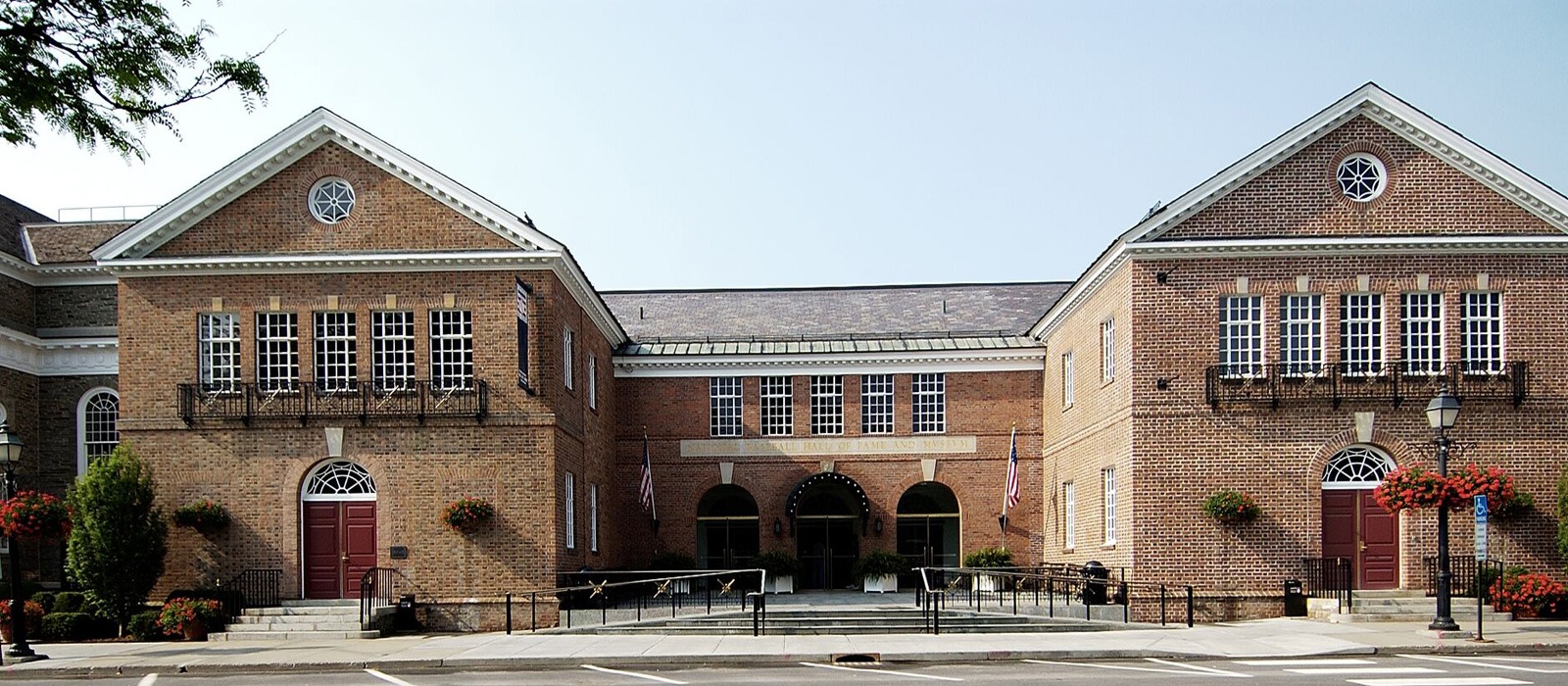
June 12, 1939: The National Baseball Hall of Fame and Museum opens, at 25 Main Street in Cooperstown, Otsego County, in Central New York. It was the official 100th Anniversary of baseball being invented in that town by Abner Doubleday.

Of course, just as most people already knew the world was round long before Christopher Columbus was born, most people already knew that Doubleday, a hero of the American Civil War, who did come from Cooperstown, didn't have a damn thing to do with baseball. The real reason the Hall, and its accompanying museum, were established there is that the Clark family, the unofficial powers-that-be (and still do) in Cooperstown, wanted a tourist attraction during, and that would outlast, the Great Depression. Mission accomplished.

The opening ceremony is presided over by the Commissioner of Baseball, Kenesaw Mountain Landis. It is broadcast nationwide on NBC radio.

In each of the past 4 years, there had been elections for the Hall of Fame. These were the inductees thus far:

* 1936: Ty Cobb, Babe Ruth, Honus Wagner, Christy Mathewson and Walter Johnson. "The First Five," or "The First Class," whose plaques are located in an X pattern, with leading vote-getting Cobb's in the middle, at the center of the back wall of the Hall's Gallery.
Top left: Christy Mathewson. Top right: Honus Wagner.
Center: Ty Cobb.
Bottom left: Babe Ruth. Bottom right: Walter Johnson.

* 1937: Players George Wright, Cy Young, Nap Lajoie and Tris Speaker; managers Connie Mack and John McGraw; and the 1st President of each major league, the National League's Morgan Bulkeley and the American League's Ban Johnson.

* 1938: One player, Grover Cleveland Alexander; and pioneers Alexander Cartwright and Henry Chadwick.

* 1939: Players Candy Cummings, Al Spalding, Cap Anson, Buck Ewing, Charles "Old Hoss" Radbourn, Willie Keeler, Eddie Collins and George Sisler; and executive Charles Comiskey. (Due to the unusual circumstances of his retirement, Lou Gehrig would be elected later in the year, after the Hall's opening.)

So there were 5 inaugural electees, and 25 inaugural inductees. Of these, 11 were still alive: Mack was 76 years old, Young 72, Wagner 65, Lajoie 64, Alexander and Collins 52, Johnson and Speaker 51, Sisler 46, and Ruth 44.

And of those 11 men, 10 posed for a commemorative photograph. Legend has it that Cobb arrived late, in order to spite someone, probably Landis. He was late, arriving a few minutes after the photo was taken, but it was due to circumstances beyond his control: He lived in California, and, transportation links being what they were at the time, he just plain didn't make it.
Top row, left to right: Honus Wagner, Grover Cleveland Alexander,
Tris Speaker, Nap Lajoie, George Sisler and Walter Johnson.
Bottom row, left to right: Eddie Collins, Babe Ruth, Connie Mack and Cy Young.
No, I don't know why the Babe has no tie and has his
collar sticking out over his lapels, like he's in the 1970s.

Sisler is probably the least well-remembered player of these 10, partly because he fell just short of 3,000 hits for his career; and partly because he played most of his career for a team that no longer exists in that form: The St. Louis Browns became the Baltimore Orioles in 1954.

Uniform numbers have only been worn since 1929, so most of the original 25 honorees are not honored with the retirement of their uniform number, because the number, let alone the honor, wasn't available. Wagner wore one as a coach, and was so honored; Johnson wore one as a manager, and Speaker and Collins wore them as coaches, but were not so honored.

Cobb, Johnson, Mack and Sisler are honored with statues at the current ballparks in their cities. Ruth is honored with one at the ballpark in his hometown. Young is honored with one at the site of one of his home ballparks. And Mathewson is honored with the renaming of his school's football stadium for him. (In college, he excelled at that sport as well.) Comiskey was once, but is no longer, honored with the naming of the ballpark he built for him.

In 1949, Ogden Nash, my grandmother's favorite poet, wrote "Line-Up for Yesterday" for Sport magazine, an alphabetical list of star players. For the letter Z, instead of citing a single player, since none with a last name starting with Z has been elected to the Hall of Fame, he wrote:

Z is for Zenith
The summit of fame.
These men are up there.
These men are the game.

For the letter I, he cheated a little:

I is for Me,
Not a hard-hitting man,
But an outstanding all-time
Incurable fan.

*

June 12, 1939 was a Monday. There were no scores on that historic day: MLB got the day off so the ceremony could be the focus, it was the off-season for the NFL and the NHL, and the NBA hadn't been founded yet.

Saturday, April 2, 2022

April 2, 1908: The Doubleday Legend

Abner Doubleday

April 2, 1908: The Mills Commission, convened to determine the origins of the sport of baseball, releases its finding. They get it very wrong.

Albert Goodwill Spalding, former star pitcher of the Boston Red Stockings (the team that became the Atlanta Braves), and owner of the Chicago White Stockings (the team that became the Cubs), demanded a definitive origin story for the sport, to stop people like the English-born journalist Henry Chadwick from claiming that baseball evolved from the English games of cricket and rounders.

The members:

* Abraham G. Mills (1844-1929), owner of the Washington Olympics, a team at the dawn of the professional era; and the President of the National League in the 1883 and 1884 seasons.

* Morgan G. Bulkeley (1837-1922), Mayor of Hartford, 1880-88; Governor of Connecticut, 1889-93; U.S. Senator, 1905-11; pertinent to baseball, owner of the Hartford Blues, a team at the dawn of the professional era; and the 1st President of the National League, serving only in the 1st season, 1876.

* Arthur P. Gorman (1839-1906), Maryland House of Delegates, 1869-75, including Speaker, 1872-74; State Senator, 1875-81; U.S. Senator, 1881-99 and 1903-06; described in 1952 by The Baltimore Sun as "the most powerful political figure the State has ever known"; pertinent to baseball, a founding member of the Washington Nationals, a team at the dawn of the professional era, and the first team to be known as the Washington Senators -- and, thus, all later teams with the name -- was named in his honor.

* Nicholas E. Young (1840-1916), another early figure in Washington baseball, later a respected umpire, the 1st secretary and the 1st treasurer of the NL, president of the NL from 1885 to 1902. He oversaw the merger with the American Association after the 1891 season, but his recalcitrance in the face of the founding of the American League led to his downfall.

* Alfred J. Reach (1840-1928), one of the best players in baseball as the amateur era gave way to professionalism. A right fielder for the Brooklyn Eckfords and the original Philadelphia Athletics, he led the Athletics to the 1st Pennant of the National Association in 1871. In 1883, he founded the team now known as the Philadelphia Phillies, and owned them until 1903. He founded a sporting goods company that competed with that of Al Spalding, before selling out to him in 1889. In return, when the AL was founded, Spalding put the Reach name on the AL's game balls, and his own on the NL's balls. This held until 1976; since then, all have borne the Spalding name.

* George Wright (1847-1937), the shortstop on the 1st openly professional baseball team, the 1869 and 1870 Cincinnati Red Stockings. That team sort-of evolved into the Boston Red Stockings, and Wright (along with Spalding, pitching) was their best player, leading them to the NA Pennant in 1872, 1873, 1874 and 1875; and the NL Pennant in 1877 and 1878. In 1879, he was the player-manager of the NL Pennant-winning Providence Grays.

* James E. Sullivan (1862-1914), President of the Amateur Athletic Union, which would later name its annual award for America's best amateur athlete for him.

For nearly 3 years, the Mills Commission got nowhere. Finally, in late 1907, they found the story they needed, and they released it on April 2, 1908: Baseball was invented on June 12, 1839 in Cooperstown, New York, laid out in a cow pasture owned by the Phinney family, related to the Coopers by marriage, by Abner Doubleday.

This claim was given to the Commission by a 71-year-old mining engineer from Denver named Abner Graves (yes, also named Abner), who said that he witnessed Doubleday playing the then-popular game of "town ball," being played by students of 2 local schools on what came to be known as "Farmer Phinney's Lot," and watched Doubleday make the changes necessary to create a better version, and watched him give it the name "base ball."

Graves backed his story up by sending the Commission a diagram that, he said, Doubleday gave him. In 1934, someone visiting the Graves family in Cooperstown found a tattered ball, which was put on display in the Village Hall and later in the Hall of Fame itself (where it is still on display), and called "The Doubleday Ball," alleged to be the ball in the first game. The First Baseball.

Abner Doubleday was a real person. And if you were going to make something up, he was a great choice. He was a graduate of the U.S. Military Academy at West Point, New York -- 146 miles southeast of Cooperstown. He served in the Mexican-American War. He was second-in-command at Fort Sumter, South Carolina, when it was attacked on April 12, 1861, and he ordered the 1st Union shot in retaliation. Thus, he was there for the beginning of an epic story that would later chronicled by documentarian Ken Burns... The Civil War.

He was one of the heroes of the Battle of Gettysburg on July 3, 1863. He rose to the rank of Major General -- 2 stars. His multi-volume journal has been a godsend for people studying American military life in the mid-19th Century, including the Civil War and the Indian Wars. He commanded an all-black regiment, with no racist incidents. He was a financial backer of Thomas Edison's inventions. He even founded San Francisco's famous cable car company.

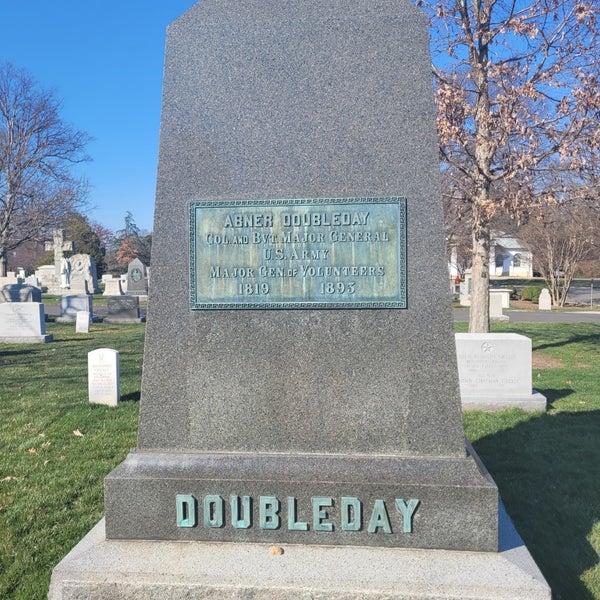
On multiple levels, Abner Doubleday was a genuine American hero. He was, as the saying goes, a Renaissance Man. And he was a New Jerseyan the last few years of his life, living in Mendham, Morris County -- also the hometown of former Governor Chris Christie and Game of Thrones actor Peter Dinklage -- although he is rightly buried at Arlington National Cemetery, not far from an actual sports legend, Joe Louis.
Note that the plaque on his tombstone
does not mention baseball.

It was also helpful that Mills, Bulkeley, Gorman, Young, and -- this cannot be minimized -- Spalding, the de facto Commissioner at the time, had also been friends of Doubleday's. It was also helpful that Doubleday had died in 1893, and was, rather conveniently, no longer around to say, "Come on, guys. You know that story isn't true."

The truth? Mills knew Doubleday rather well, and admitted that he'd never heard him claim to be the inventor of baseball. Doubleday's extensive journals mention baseball only once: In his duty as a quartermaster, he had requisitioned balls and bats for his soldiers, as there was a lot of down time between battles and they needed a diversion, and baseball had grown tremendously popular in the 1850s. His obituary in The New York Times didn't mention baseball at all. Based on the evidence we have, we don't know if Abner Doubleday liked baseball -- or if he ever even actually saw a game. 

As for Abner Graves, he was old, and he was nuts. He apparently (accidentally?) burned down his own house, killing his wife. He spent a good chunk of his later years institutionalized. What's more, he would have been just 5 years old at what he claimed was the time of the game's invention. (I was 5 years old in 1975, when Carlton Fisk hit a certain home run, and I have absolutely no memory of having seen it then, not even on the news the next day.)

But here's the clincher, the part that makes the Doubleday story absolutely impossible: At the time, cadets at West Point were not permitted to leave the Academy grounds for any reason. If Doubleday had been in Cooperstown at any time in 1839, he would have been AWOL: Absent without leave. And there's no way he could have snuck off the grounds, gone almost 150 miles with no mode of transportation faster than a horse (there was no rail connection), gotten to Cooperstown, been involved with any sort of town event, gotten back, and snuck onto the grounds, without anybody noticing he was gone. It would have been days. He would have been expelled.

(A similar story had already been written for the invention of rugby. William Webb Ellis, the man credited with inventing it as, as we would say, a high school student at the Rugby School in the West Midlands of England, went on to become a well-known and highly respected man in his country, in his case a clergyman, and died without ever having made a claim to being the inventor of a sport, making him unable to deny the credit he later got.)

No, Doubleday did not invent baseball. Nor can it be called wholly the invention of Alexander Cartwright, who has been credited with writing the original rules for the game in New York in 1845 (and the evidence we have now suggests that other men wrote some of them). It is worth nothing that Cartwright, Spalding, Bulkeley and Wright were among the early inductees into the Baseball Hall of Fame. Doubleday has never been elected.

Baseball wasn't invented so much as it evolved, and to name any one person its creator is, however well-intentioned, misleading.

*

April 2, 1908 was a Thursday. Actor Buddy Ebsen was born. Baseball was in Spring Training at the time, so there were no scores on this historic day. The Stanley Cup had been decided for the year on March 14, when the Montreal Wanderers beat the Toronto Hockey Club.

Wednesday, February 2, 2022

February 2, 1936: The 1st Baseball Hall of Fame Election

Top left: Christy Mathewson. Top right: Honus Wagner.
Center: Ty Cobb.
Bottom left: Babe Ruth. Bottom right: Walter Johnson.

February 2, 1936: The Baseball Hall of Fame holds its 1st election for players.

Members of the Baseball Writers' Association of America (BBWAA) were given authority to select individuals from the 20th Century; while a special Veterans Committee, made up of individuals with greater familiarity with the 19th Century game, was polled to select deserving individuals from that era. The intent was for 15 honorees to be selected before the ceremony that would open the Hall's Museum in 1939: 10 from the 20th Century and 5 from the 19th; and that additional players from both eras would be selected in later years.

The Voters were given free rein to decide for themselves in which group a candidate belonged, with neither group knowing the outcome of the other election; some candidates had their vote split between the elections as a result: Cy Young, the pitcher with most wins in Major League history, finished 8th in the BBWAA vote, and 4th in the Veterans vote.

In addition, there was no prohibition on voting for active players, a number of whom received votes. Individuals who had been banned from baseball, such as "Shoeless" Joe Jackson and Hal Chase, were also not formally excluded, though few voters chose to include them on ballots.

In the BBWAA election, voters were instructed to cast votes for 10 candidates, the same number of desired selections. In the Veterans' election, voters were also instructed to vote for 10, although the desire for only 5 initial selections led to revisions in the way the votes were counted.  Any candidate receiving votes on at least 75 percent of the ballots in either election would be honored with induction to the Hall upon its opening in the sport's supposed centennial year of 1939.

A total of 226 ballots were cast, with 2,231 individual votes for 47 specific candidates, an average of 9.87 per ballot. 170 votes were required for election.
PlayerVotesPercent
Ty Cobb22298.2
Babe Ruth21595.1
Honus Wagner21595.1
Christy Mathewson20590.7
Walter Johnson18983.6
Nap Lajoie14664.6
Tris Speaker13358.8
Cy Young11149.1
Rogers Hornsby10546.4
Mickey Cochrane8035.3
George Sisler7734.0
Eddie Collins6026.5
Jimmy Collins5825.6
Grover Cleveland Alexander5524.3
Lou Gehrig5122.5
Roger Bresnahan4720.7
Willie Keeler4017.6
Rube Waddell3314.6
Jimmie Foxx219.2
Ed Walsh208.8
Ed Delahanty177.5
Pie Traynor167.1
Frankie Frisch146.1
Lefty Grove125.3
Hal Chase114.8
Ross Youngs104.4
Bill Terry93.9
Johnny Kling83.5
Lou Criger73.1
Mordecai Brown62.6
Johnny Evers62.6
Frank Chance52.2
John McGraw41.7
Ray Schalk41.7
Al Simmons41.7
Chief Bender20.8
Joe Jackson20.8
Edd Roush20.8
Frank Baker10.4
Bill Bradley10.4
Fred Clarke10.4
Sam Crawford10.4
Kid Elberfeld10.4
Connie Mack10.4
Rube Marquard10.4
Nap Rucker10.4
Dazzy Vance10.4
Charlie Gehringer00
Gabby Hartnett00
Billy Sullivan00
Note: All players whose names are in italics here have since been elected. Eddie Collins and Jimmy Collins were not related, but they were teammates, on the 1907 and 1908 Philadelphia Athletics, at the end of Jimmy's playing career and near the beginning of Eddie's.

Still active at the time of the vote: Hornsby, Cochrane, Gehrig, Foxx, Traynor, Frisch, Grove, Simmons, Gehringer and Hartnett. Ruth had played his last game only 8 months earlier.

The Hall would eventually ban from its balloting all players declared ineligible by Major League Baseball, so, as of February 2, 2022, Chase and Jackson have never been elected. Nor have, from this list, Kling, Criger, Bradley, Elberfeld and Rucker. None of those have many advocates at this point.

Cobb finished 1st in the voting. This made him, unofficially, not just in baseball, but the 1st member of any major sport's Hall of Fame. As time passed, however, despite neither man playing a game in the interim -- Ruth was the most recently-retired of the 5, having played his last game on May 30, 1935 -- Ruth came to surpass Cobb in fans' minds as the greatest player in the history of the sport.

Brief profiles:

* Tyrus Raymond Cobb, born on December 18, 1886 in Narrows, Georgia, and grew up in Royston, Georgia. Nicknamed "The Georgia Peach."

Center field, Detroit Tigers, 1905-26; Philadelphia Athletics, 1927-28. .366 lifetime batting average, still an all-time record. 4,189 hits, formerly a record, still 2nd all-time. 892 stolen bases, formerly a record. 168 OPS+. (His hit total had long been listed as 4,191, and thus his batting average at .367, but a later check of records showed that 1 game, and thus 2 of his hits, had mistakenly been counted twice.)
This photo is colorized, but real.

* George Herman Ruth Jr., born on February 6, 1895 in Baltimore, Maryland, and grew up there. Nicknamed "Babe" because his teammates, referring to the scout who signed him, called him "Jack Dunn's Baby." Also known as "The Great Bambino," "The Sultan of Swat," and a lot of similar hard-hitting royal nicknames.

Boston Red Sox, 1914-19; New York Yankees, 1920-34; Boston Braves, 1935. As a pitcher, most of it from 1914 to 1918: 94-46 record, 2.28 ERA, 122 ERA+, 1.159 WHIP, so he was on his way to a Hall of Fame level at that before his hitting meant that he had to be was switched to an everyday player. As an offensive player, mostly from 1918 onward: .342 batting average. 714 home runs, formerly a record. 2,214 RBIs, formerly a record. .474 on-base percentage, 2nd all-time. .690 slugging percentage, still a record. 206 OPS+, still a record. 
The Yankees did not put the interlocking N-Y logo
on their jerseys permanently until 1936,
so Ruth never wore such a jersey.

* John Peter Wagner, born February 24, 1874 in Carnegie, Pennsylvania, outside Pittsburgh. Being of German descent, he was called the German variation of John, "Hans," which became "Honus." Known for his speed as "The Flying Dutchman," keeping in mind that "Dutch" was a name given to people of German descent, as well as to people descended from the Netherlands.

Shortstop, Louisville Colonels, 1897-99; Pittsburgh Pirates, 1900-17. .328 batting average. 3,420 hits, the record until surpassed by Cobb. 723 stolen bases. Considered the best defensive player of his era. 151 OPS+.
* Christopher Mathewson, born August 12, 1880 in Factoryville, in the Lehigh Valley of Pennsylvania. Nicknamed "Christy," "Matty" and "Big Six," because he was 6 feet tall, at a time when that was considered big. Pitcher, New York Giants, 1900-16, concluding that last year with the Cincinnati Reds. 373-188, 2.13 ERA, 136 ERA+, 1.058 WHIP.
Colorized, but definitely a photo, not a painting.

* Walter Perry Johnson, born November 6, 1887 in Humboldt, Kansas, and grew up in Fullerton, California, outside Los Angeles. Nicknamed "The Big Train" early in his career, and "Old Barney" in his later years. Pitcher, Washington Senators, 1907-27. 417-279, 2.17 ERA, 147 ERA+ 1.061 WHIP.
These men became known as "The First Five," or "The First Class." Their plaques are located in an X pattern, with leading vote-getter Cobb's in the middle, at the center of the back wall of the Hall's Gallery.

Cobb was infamous for being difficult to get along with, including with Ruth, but the men eventually put aside their personal and, in terms of baseball playing, stylistic rivalry, and formed a friendship. Cobb had no problem getting along with the others, nor did any of them with each other.
Cobb visiting with Mathewson, 1911 World Series

In 1999, The Sporting News named its 100 Greatest Baseball Players. Ruth had last played 64 years earlier; Cobb, 71; Johnson, 72; Wagner, 82; Mathewson, 83. The number of people who could accurately remember watching them play was already pretty small. The rankings: Ruth came in 1st, Cobb 3rd, Johnson 4th, Mathewson 7th, Wagner 13th. (In between: Willie Mays was 2nd, Hank Aaron 5th, Lou Gehrig 6th, Ted Williams 8th, Hornsby 9th, Stan Musial 10th, Joe DiMaggio 11th, and Alexander 12th.)

In 2022, ESPN listed their Top 100. Ruth's last game was now further back that Mathewson's was in the earlier vote. Ruth came in 1st again, with David Schoenfeld writing for their article, "The baseball we watch today is Babe Ruth's game. Many players make an impact, a few become folk heroes, but nobody changed a sport like Ruth did when he joined the Yankees and transformed baseball into a game of power."

Cobb came in 4th, Johnson 9th, Wagner 12th, Mathewson 25th. (In between: Mays 2nd, Aaron 3rd, Williams 5th, Gehrig 6th, Mickey Mantle 7th, Barry Bonds a steroid-aided 8th, Musial 10th, Pedro Martinez a stupid 11th, Ken Griffey Jr. 13th, Greg Maddux 14th, Mike Trout a laughable 15th, DiMaggio 16th, Roger Clemens 17th, Mike Schmidt 18th, Frank Robinson 19th, Hornsby 20th, Young 21st, Tom Seaver 22nd, Rickey Henderson 23rd, and Randy Johnson -- no relation to Walter, although nearly as fast -- 24th.)

Lajoie, Speaker and Young were elected to the Hall of Fame in its 2nd election, in 1937; Alexander in 1938; Anson, Eddie Collins, Ewing, Keeler, Radbourn, Sisler and, in a special election due to his fatal illness, Gehrig, in 1939.

In addition, elected as managers were Connie Mack and John McGraw in 1937; elected as executives or "pioneers" were Morgan Bulkeley, Ban Johnson and George Wright in 1937; Alexander Cartwright and Henry Chadwick in 1938; and Charles Comiskey, Candy Cummings and Al Spalding in 1939.

So there were 25 inductees when the Hall had its opening ceremony in Cooperstown, New York, already known not to really be the sport's birthplace, on June 12, 1939. There were 11 still alive: Cobb, Ruth, Wagner, Johnson, Lajoie, Speaker, Young, Alexander, Eddie Collins, Sisler and Mack. Transportation links being what they were at the time, Cobb had difficulty getting there, and arrived just too late to appear in the photograph taken of the other 10.

Cobb did turn out to be the last survivor of the First Five, living until 1961. Mathewson had died in 1925, well before the vote; Johnson in 1946, and Ruth in 1948; both too young and from cancer; and Wagner in 1955. Sisler was the last of the Initial Inductees, living until 1973.

*

February 2, 1936 was a Sunday. Baseball and football were out of season. The NBA hadn't been founded yet. There were 2 games in the NHL. The New York Americans lost to the Boston Bruins, 2-1 at the Boston Garden. And the Chicago Black Hawks beat the Toronto Maple Leafs, 2-0 at the Chicago Stadium.

December 31, 1999 & January 1, 2000: The Millennium

December 31, 1999:  The Millennium arrives. The people of planet Earth survived. At a terrible cost. But we hadn't destroyed ourselves. ...