
Abner Doubleday
April 2, 1908: The Mills Commission, convened to determine the origins of the sport of baseball, releases its finding. They get it very wrong.
Albert Goodwill Spalding, former star pitcher of the Boston Red Stockings (the team that became the Atlanta Braves), and owner of the Chicago White Stockings (the team that became the Cubs), demanded a definitive origin story for the sport, to stop people like the English-born journalist Henry Chadwick from claiming that baseball evolved from the English games of cricket and rounders.
The members:
* Abraham G. Mills (1844-1929), owner of the Washington Olympics, a team at the dawn of the professional era; and the President of the National League in the 1883 and 1884 seasons.
* Morgan G. Bulkeley (1837-1922), Mayor of Hartford, 1880-88; Governor of Connecticut, 1889-93; U.S. Senator, 1905-11; pertinent to baseball, owner of the Hartford Blues, a team at the dawn of the professional era; and the 1st President of the National League, serving only in the 1st season, 1876.
* Arthur P. Gorman (1839-1906), Maryland House of Delegates, 1869-75, including Speaker, 1872-74; State Senator, 1875-81; U.S. Senator, 1881-99 and 1903-06; described in 1952 by The Baltimore Sun as "the most powerful political figure the State has ever known"; pertinent to baseball, a founding member of the Washington Nationals, a team at the dawn of the professional era, and the first team to be known as the Washington Senators -- and, thus, all later teams with the name -- was named in his honor.
* Nicholas E. Young (1840-1916), another early figure in Washington baseball, later a respected umpire, the 1st secretary and the 1st treasurer of the NL, president of the NL from 1885 to 1902. He oversaw the merger with the American Association after the 1891 season, but his recalcitrance in the face of the founding of the American League led to his downfall.
* Alfred J. Reach (1840-1928), one of the best players in baseball as the amateur era gave way to professionalism. A right fielder for the Brooklyn Eckfords and the original Philadelphia Athletics, he led the Athletics to the 1st Pennant of the National Association in 1871. In 1883, he founded the team now known as the Philadelphia Phillies, and owned them until 1903. He founded a sporting goods company that competed with that of Al Spalding, before selling out to him in 1889. In return, when the AL was founded, Spalding put the Reach name on the AL's game balls, and his own on the NL's balls. This held until 1976; since then, all have borne the Spalding name.
* George Wright (1847-1937), the shortstop on the 1st openly professional baseball team, the 1869 and 1870 Cincinnati Red Stockings. That team sort-of evolved into the Boston Red Stockings, and Wright (along with Spalding, pitching) was their best player, leading them to the NA Pennant in 1872, 1873, 1874 and 1875; and the NL Pennant in 1877 and 1878. In 1879, he was the player-manager of the NL Pennant-winning Providence Grays.
* James E. Sullivan (1862-1914), President of the Amateur Athletic Union, which would later name its annual award for America's best amateur athlete for him.
For nearly 3 years, the Mills Commission got nowhere. Finally, in late 1907, they found the story they needed, and they released it on April 2, 1908: Baseball was invented on June 12, 1839 in Cooperstown, New York, laid out in a cow pasture owned by the Phinney family, related to the Coopers by marriage, by Abner Doubleday.
This claim was given to the Commission by a 71-year-old mining engineer from Denver named Abner Graves (yes, also named Abner), who said that he witnessed Doubleday playing the then-popular game of "town ball," being played by students of 2 local schools on what came to be known as "Farmer Phinney's Lot," and watched Doubleday make the changes necessary to create a better version, and watched him give it the name "base ball."
Graves backed his story up by sending the Commission a diagram that, he said, Doubleday gave him. In 1934, someone visiting the Graves family in Cooperstown found a tattered ball, which was put on display in the Village Hall and later in the Hall of Fame itself (where it is still on display), and called "The Doubleday Ball," alleged to be the ball in the first game. The First Baseball.
Abner Doubleday was a real person. And if you were going to make something up, he was a great choice. He was a graduate of the U.S. Military Academy at West Point, New York -- 146 miles southeast of Cooperstown. He served in the Mexican-American War. He was second-in-command at Fort Sumter, South Carolina, when it was attacked on April 12, 1861, and he ordered the 1st Union shot in retaliation. Thus, he was there for the beginning of an epic story that would later chronicled by documentarian Ken Burns... The Civil War.
He was one of the heroes of the Battle of Gettysburg on July 3, 1863. He rose to the rank of Major General -- 2 stars. His multi-volume journal has been a godsend for people studying American military life in the mid-19th Century, including the Civil War and the Indian Wars. He commanded an all-black regiment, with no racist incidents. He was a financial backer of Thomas Edison's inventions. He even founded San Francisco's famous cable car company.
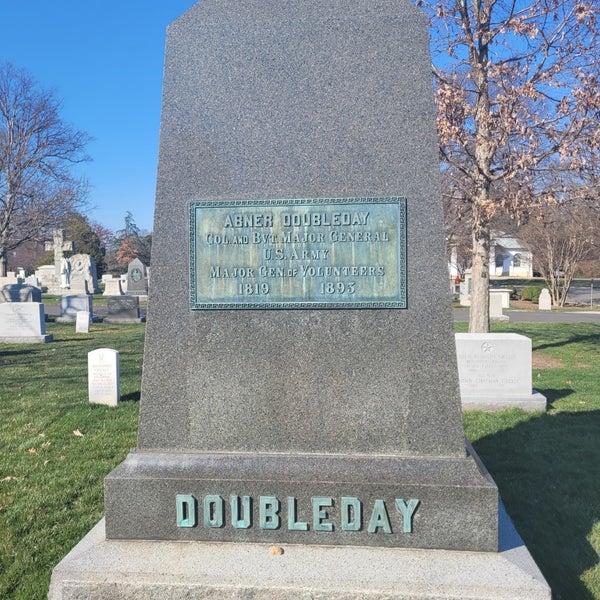
On multiple levels, Abner Doubleday was a genuine American hero. He was, as the saying goes, a Renaissance Man. And he was a New Jerseyan the last few years of his life, living in Mendham, Morris County -- also the hometown of former Governor Chris Christie and Game of Thrones actor Peter Dinklage -- although he is rightly buried at Arlington National Cemetery, not far from an actual sports legend, Joe Louis.
It was also helpful that Mills, Bulkeley, Gorman, Young, and -- this cannot be minimized -- Spalding, the de facto Commissioner at the time, had also been friends of Doubleday's. It was also helpful that Doubleday had died in 1893, and was, rather conveniently, no longer around to say, "Come on, guys. You know that story isn't true."
The truth? Mills knew Doubleday rather well, and admitted that he'd never heard him claim to be the inventor of baseball. Doubleday's extensive journals mention baseball only once: In his duty as a quartermaster, he had requisitioned balls and bats for his soldiers, as there was a lot of down time between battles and they needed a diversion, and baseball had grown tremendously popular in the 1850s. His obituary in The New York Times didn't mention baseball at all. Based on the evidence we have, we don't know if Abner Doubleday liked baseball -- or if he ever even actually saw a game.
On multiple levels, Abner Doubleday was a genuine American hero. He was, as the saying goes, a Renaissance Man. And he was a New Jerseyan the last few years of his life, living in Mendham, Morris County -- also the hometown of former Governor Chris Christie and Game of Thrones actor Peter Dinklage -- although he is rightly buried at Arlington National Cemetery, not far from an actual sports legend, Joe Louis.
Note that the plaque on his tombstone
does not mention baseball.
It was also helpful that Mills, Bulkeley, Gorman, Young, and -- this cannot be minimized -- Spalding, the de facto Commissioner at the time, had also been friends of Doubleday's. It was also helpful that Doubleday had died in 1893, and was, rather conveniently, no longer around to say, "Come on, guys. You know that story isn't true."
The truth? Mills knew Doubleday rather well, and admitted that he'd never heard him claim to be the inventor of baseball. Doubleday's extensive journals mention baseball only once: In his duty as a quartermaster, he had requisitioned balls and bats for his soldiers, as there was a lot of down time between battles and they needed a diversion, and baseball had grown tremendously popular in the 1850s. His obituary in The New York Times didn't mention baseball at all. Based on the evidence we have, we don't know if Abner Doubleday liked baseball -- or if he ever even actually saw a game.
As for Abner Graves, he was old, and he was nuts. He apparently (accidentally?) burned down his own house, killing his wife. He spent a good chunk of his later years institutionalized. What's more, he would have been just 5 years old at what he claimed was the time of the game's invention. (I was 5 years old in 1975, when Carlton Fisk hit a certain home run, and I have absolutely no memory of having seen it then, not even on the news the next day.)
But here's the clincher, the part that makes the Doubleday story absolutely impossible: At the time, cadets at West Point were not permitted to leave the Academy grounds for any reason. If Doubleday had been in Cooperstown at any time in 1839, he would have been AWOL: Absent without leave. And there's no way he could have snuck off the grounds, gone almost 150 miles with no mode of transportation faster than a horse (there was no rail connection), gotten to Cooperstown, been involved with any sort of town event, gotten back, and snuck onto the grounds, without anybody noticing he was gone. It would have been days. He would have been expelled.
But here's the clincher, the part that makes the Doubleday story absolutely impossible: At the time, cadets at West Point were not permitted to leave the Academy grounds for any reason. If Doubleday had been in Cooperstown at any time in 1839, he would have been AWOL: Absent without leave. And there's no way he could have snuck off the grounds, gone almost 150 miles with no mode of transportation faster than a horse (there was no rail connection), gotten to Cooperstown, been involved with any sort of town event, gotten back, and snuck onto the grounds, without anybody noticing he was gone. It would have been days. He would have been expelled.
(A similar story had already been written for the invention of rugby. William Webb Ellis, the man credited with inventing it as, as we would say, a high school student at the Rugby School in the West Midlands of England, went on to become a well-known and highly respected man in his country, in his case a clergyman, and died without ever having made a claim to being the inventor of a sport, making him unable to deny the credit he later got.)
No, Doubleday did not invent baseball. Nor can it be called wholly the invention of Alexander Cartwright, who has been credited with writing the original rules for the game in New York in 1845 (and the evidence we have now suggests that other men wrote some of them). It is worth nothing that Cartwright, Spalding, Bulkeley and Wright were among the early inductees into the Baseball Hall of Fame. Doubleday has never been elected.
Baseball wasn't invented so much as it evolved, and to name any one person its creator is, however well-intentioned, misleading.
*
April 2, 1908 was a Thursday. Actor Buddy Ebsen was born. Baseball was in Spring Training at the time, so there were no scores on this historic day. The Stanley Cup had been decided for the year on March 14, when the Montreal Wanderers beat the Toronto Hockey Club.


No comments:
Post a Comment