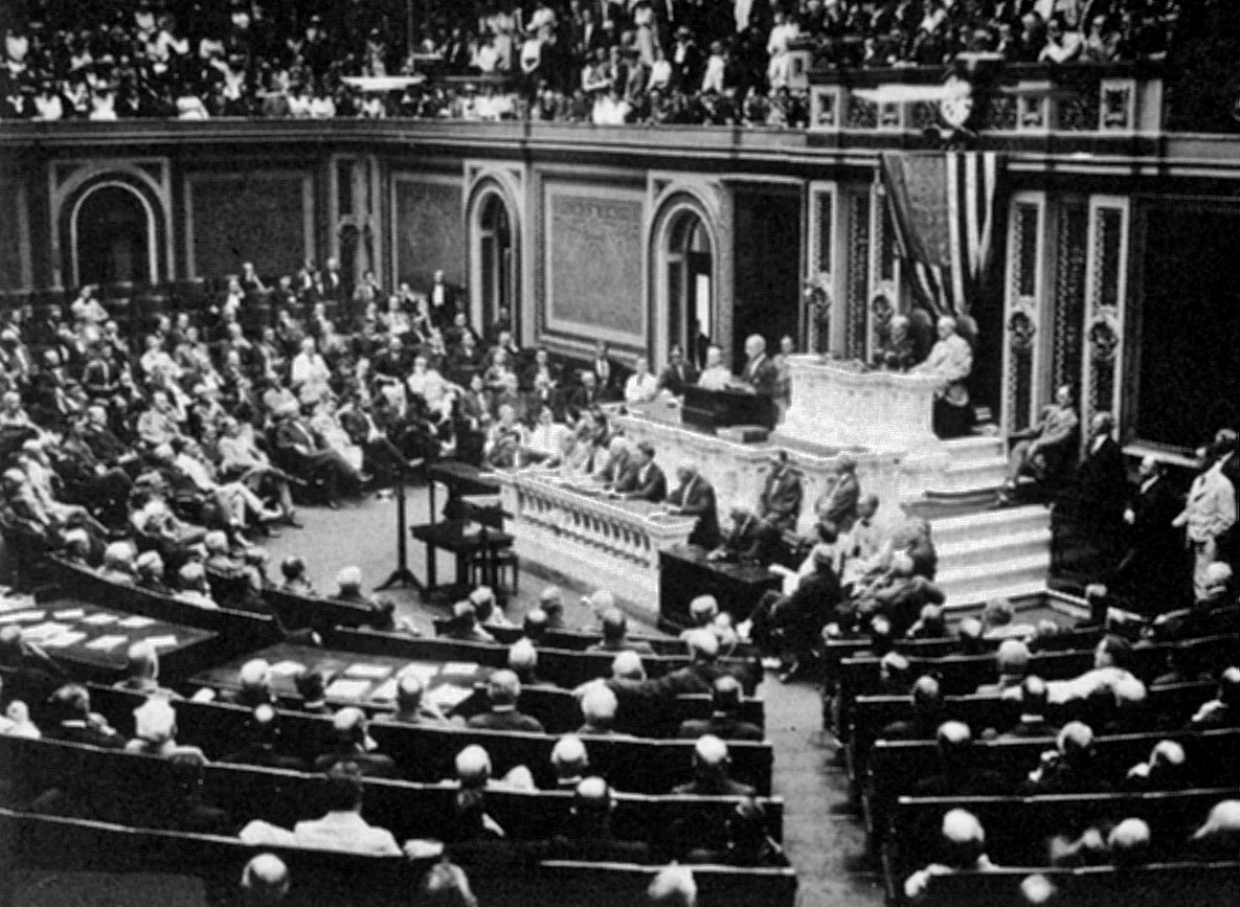
April 2, 1917: President Woodrow Wilson appears before a Joint Session of Congress, and asks for a Declaration of War against the German Empire.
He didn't want to go to war. But once the Great War, later known as the World War and World War I, began on August 1, 1914, the pressure to get America involved began. It intensified on May 7, 1915, when the Germans sank the British cruise liner Lusitania, which had hundreds of Americans on board.
But, having grown up in the South during the American Civil War and the immediate postwar era, and seen the devastation that resulted, Wilson knew just how bad a war could be. And the reports he was getting from Europe were confirming this. Britain, France, Russia, and even Germany, which seemed to be winning -- all the major players were suffering.
And so, in 1916, Wilson ran for re-election on the slogan, "He kept us out of war." He knew that the largest ethnic group in America was Germans, and they didn't want their homeland to go to war against their ancestral homeland. He also knew that a big chunk of the Democratic Party's voters was Irish-Americans, and they didn't want to go to war to help Britain, against whom Ireland had launched a rebellion in 1916 that would end with the creation of the Irish Free State in 1922.
But millions of Americans did want to go to war against a Germany portrayed by British propaganda as an ultimate evil -- enough that the election was very close. Wilson went to bed on Election Night thinking he had lost. It took 3 days for California's vote to be made official, making the difference. Wilson had his 2nd term, albeit for the 2nd time as a President with the majority in the Electoral Vote but only a plurality of the popular vote, and his mandate for peace.
In January 1917, the Germans initiated a new policy of unrestricted submarine warfare against ships in the seas around the British Isles. German leaders knew that the policy would likely provoke U.S. entrance into the war, but they hoped to defeat the Allied Powers before the U.S. could fully mobilize. In late February, the U.S. public learned of the Zimmerman Telegram, a secret diplomatic communication in which Germany sought to convince Mexico, already in conflict with America since 1914, to join it in a war against the United States.
After a series of attacks on American ships, Wilson held a Cabinet meeting on March 20. All Cabinet members agreed that the time had come for the United States to enter the war. The Cabinet members believed that Germany was engaged in a commercial war against the United States, and that the United States had to respond with a formal Declaration of War.
But the Constitution of the United States says that only the Congress can declare war, with or without the President asking for it. And so, on April 2, 1917, Wilson asked Congress for that Declaration, arguing that Germany was engaged in "nothing less than war against the government and people of the United States."
He requested a military draft to raise the Army, increased taxes to pay for military expenses, loans to Allied governments, and increased industrial and agricultural production. He stated:
The world must be made safe for democracy. We have no selfish ends to serve. We desire no conquest, no dominion... no material compensation for the sacrifices we shall freely make. We are but one of the champions of the rights of mankind. We shall be satisfied when those rights have been made as secure as the faith and freedom of the nations can make them...
It is a distressing and oppressive duty, gentlemen of the Congress, which I have performed in thus addressing you. There are, it may be, many months of fiery trial and sacrifice ahead of us. It is a fearful thing to lead this great peaceful people into war, into the most terrible and disastrous of all wars, civilization itself seeming to be in the balance. But the right is more precious than peace, and we shall fight for the things which we have always carried nearest our hearts—for democracy, for the right of those who submit to authority to have a voice in their own governments, for the rights and liberties of small nations, for a universal dominion of right by such a concert of free peoples as shall bring peace and safety to all nations and make the world itself at last free.
To such a task we can dedicate our lives and our fortunes, everything that we are and everything that we have, with the pride of those who know that the day has come when America is privileged to spend her blood and her might for the principles that gave her birth and happiness and the peace which she has treasured. God helping her, she can do no other.
The Senate voted on the Declaration of War on April 4. It passed, 82-6. Overnight, at 3:00 AM on April 6, the House of Representatives voted, and it passed, 373-50. One member voting against it was the 1st woman who had ever been elected to Congress, Jeannette Rankin of Montana. Like many of the others who voted against the Declaration, she lost her bid for re-election in 1918.
She worked her way back into politics, and in 1940, won her old seat back. On December 8, 1941, a day after the Japanese attack on Pearl Harbor, President Franklin D. Roosevelt asked for a Declaration of War. Only one member of the House voted against it: Jeannette Rankin. At least she was consistent. So were the voters of Montana: They turned her out in 1942.
Wilson's demand that the world be made safe for democracy was only half-sincere. While he had spoken of approving an Amendment to the Constitution to allow women the right to vote, which was ratified in 1920, before his 2nd term ran out, he had no intention of passing laws to back up the 15th Amendment, which gave all male adult citizens the right to vote regardless of race.
And, while attending the Paris Peace Conference after the war in 1919, he was approached by a young man asking for support for his country's independence from America's ally, France. Wilson had no intention of breaking up his allies' colonial empires. That young man's country was Vietnam. The name he would eventually become known by was Ho Chi Minh.
*
April 2, 1917 was a Monday. Baseball was in Spring Training. Football was out of season. Professional basketball barely existed. And the hockey season had ended 7 days earlier, when the Seattle Metropolitans beat the Montreal Canadiens, to become the 1st American team to win the Stanley Cup. So there were no scores on this historic day.


No comments:
Post a Comment