Showing posts with label azzurri. Show all posts

Saturday, October 15, 2022

October 15, 1967: The Tragedy of Gigi Meroni

October 15, 1967: Luigi "Gigi" Meroni darts into traffic on the Corso Re Umberto in Turin, Italy, and is hit by a car. The star winger for Torino F.C. was only 24 years old, and had just played in a 4-2 win over Genoa team Sampdoria.

Known as La Farfalla Granata (the Maroon Butterfly, for the color of Torino's shirts and for his fluttering around the field) and Il Beatnik del Gol (the Beatnik of Goals, for his bohemian lifestyle), Meroni was the matinee idol of Italian soccer. He became known for his stylish play, and had appeared for Italy in its ill-fated 1966 World Cup run that was tainted by a shocking loss to North Korea.

Torino, in the shadow of neighboring Juventus since the 1949 Superga Air Disaster killed most of their team, was on the rise again, and went on to win that season's Coppa Italia (and won it again 3 years later, and reached the Final the season before that). They won the Italian league, Serie A, in 1976, and finished 2nd in 1977, by which point Meroni would have been 34 and could still have been playing. They could have won more.
*

October 15, 1967 was a Sunday. There was 1 game played in the NBA: The St. Louis Hawks beat the San Francisco Warriors, 107-102 at the Cow Palace in the San Francisco suburb of Daly City, California. The Hawks were in their last season in St. Louis. In 1968, they moved to Atlanta.
There was 1 game in the new American Basketball Association. It was the debut game of the Denver Rockets, beating the Anaheim Amigos, 110-105 at the Denver Auditorium. They renamed themselves after Denver's 1st NBA team, becoming the Denver Nuggets in 1974, and join the NBA in 1976.
There were 4 games in the NHL:
* The New York Rangers lost to the Detroit Red Wings, 3-2 at the Olympia Stadium in Detroit.
* The Boston Bruins beat the Montreal Canadiens, 6-2 at the Boston Garden.
* The Toronto Maple Leafs beat the Chicago Black Hawks, 5-3 at the Chicago Stadium.
* And the Los Angeles Kings beat the Minnesota North Stars, 5-3 at the Long Beach Convention Center, outside Los Angeles. Their intended arena, The Forum in nearby Inglewood, wasn't ready, and didn't open until December 30.
In the NFL:
* The New York Giants beat the Pittsburgh Steelers, 27-24 at Pitt Stadium in Pittsburgh.
* The San Francisco 49ers beat the Philadelphia Eagles, 28-27 at Franklin Field in Philadelphia
* The Los Angeles Rams and the Baltimore Colts played to a tie, 24-24 at Memorial Stadium in Baltimore.
* The Washington Redskins and the Atlanta Falcons played to a tie, 20-20 at Atlanta Stadium (later Atlanta-Fulton County Stadium).
* The Cleveland Browns beat the football version of the St. Louis Cardinals, 20-16 at Cleveland Municipal Stadium.
* The Chicago Bears beat the Detroit Lions, 14-3 at Wrigley Field in Chicago.
* The Minnesota Vikings beat the Green Bay Packers, 10-7 at Milwaukee County Stadium.
* And the Dallas Cowboys beat the New Orleans Saints, 14-10 at the Cotton Bowl in Dallas.
And in the American Football League:
* The New York Jets and the Houston Oilers played to a tie, 28-28 at Shea Stadium.
* The Boston Patriots beat the Miami Dolphins, 41-10 at Alumni Stadium, on the campus of Boston College, just outside Boston in Chestnut Hill, Massachusetts. The Pats played home games at Fenway Park from 1963 to 1968, so this was their 1st home game of the season after 4 away games and a bye, and they still couldn't use Fenway for practice because the Boston Red Sox were in the World Series, so the game was moved to B.C.
* The Oakland Raiders beat the Buffalo Bills, 24-20 at War Memorial Stadium in Buffalo.
* The San Diego Chargers beat the Kansas City Chiefs, 45-31 at San Diego Stadium (later renamed Jack Murphy Stadium and Qualcomm Stadium).
* And the Denver Broncos had a bye week.

Tuesday, July 19, 2022

July 19, 1966: North Korea Shocks Italy at the World Cup

July 19, 1966: Aside from the 1950 win of the United States over England, this may be the greatest upset in the history of soccer's World Cup.

Italy has been one of the most successful countries in soccer. They have won the World Cup 4 times, reached the Final but lost twice, and reached the Semifinals twice. But the 1966 edition, in England, would not be one of those times.

North Korea, with a team made up entirely of soldiers in their army, made the World Cup for the 1st time. Their official name, when translated into English, is the Democratic People's Republic of Korea. Then as now, they were neither democratic nor a republic: They were, and are, an insanely repressive Communist nation, a pariah state -- except when it comes to sports. They always get invited to the Olympic Games, and, for this World Cup, they won the tournament to be the lone qualifier from Asia.

Italy, North Korea, the Soviet Union, and the South American nation of Chile were placed together in Group 4, with all games played at Ayresome Park in Middlesbrough, in the North-East of England. On July 12, the action opened with the Soviets beating their fellow Communists, North Korea, 3-0. On July 13, Italy beat Chile, 2-0. Neither of these results was a surprise.

But on July 15, North Korea managed a 1-1 draw with Chile. And, on July 16, the Soviets beat Italy, 1-0. So the July 19 match between Italy and North Korea turned out to be critical: The winner would qualify for the knockout stage, while the loser would be out -- unless Chile could manage an upset over the Soviets on July 20.

Italy had Fiorentina's Enrico Albertosi in goal, Inter Milan's Giacinto Facchetti leading the defense, and an attack led by Inter's Sandro Mazzola and A.C. Milan's Gianni Rivera. It didn't matter: In the 42nd minute, Pak Doo-ik, age 22, put the ball past Albertosi, and that goal held up: North Korea won, 1-0.

Only 17,829 fans could fit into Ayersome Park, most of them cheering the North Koreans for their pluck, despite the political differences between their nations. North Korea's 25 million people, hearing the broadcast on state radio, were ecstatic: For once, they were known for something other than Communism, starving their people, and starting a nasty 3-year war in 1950.

Italy's 50 million people went into shock, and their newspapers, always blowing sporting results out of proportion, went into overdrive with their recriminations. Some blamed Pierre Schwinte, the referee, from France, a nation often at odds with Italy, though the surviving film of the game does not suggest that he called the game inappropriately. Some blamed Edmondo Fabbri, the Italy manager.

The Soviets' 2-1 win over Chile the next day confirmed their position, and North Korea's, in the knockout stage. Italy were out. Fabbri was fired after the tournament, and later managed Torino, Bologna, Cagliari, Torino again, Ternana and Pistoiese, but never recovered from the disgrace of 1966, and died in 1995. Italy rebounded, and reached the Final in 1970, falling to the Brazil squad that might have been the greatest soccer team ever assembled.

North Korea advanced to the Quarterfinal, and nearly pulled off another upset, but Portugal came from behind to beat them. After that game, Pak never played the sport again, and became a gymnastic instructor.
In 2008, with China hosting the Olympic Games, they allowed the Olympic Torch Relay to pass through North Korea, and Pak was the 1st of his countrymen to carry the Torch. As of July 19, 2022, he is still alive.

*

July 19, 1966 was a Tuesday. There were 3 other games played in the World Cup that day. Mexico and Uruguay played to a 0-0 draw at Wembley Stadium in London. Argentina beat Switzerland, 2-0 at Hillsborough Stadium in Sheffield. And Portugal beat their former colony of Brazil, 3-1 at Goodison Park, home of Everton Football Club in Liverpool.

And these baseball games were played:

* The Baltimore Orioles beat the Detroit Tigers, 13-3 at Memorial Stadium in Baltimore. Eddie Watt was the winning pitcher, and helped his own cause with a home run. Frank Robinson went 3-for-4 with 2 home runs and 5 RBIs. Brooks Robinson went 3-for-5 with 2 RBIs. Al Kaline went 0-for-1 with a walk, before leaving the game with an injury.

* The Minnesota Twins swept a doubleheader from the Washington Senators, 5-4 and 4-0 at District of Columbia Stadium in Washington. (It was renamed Robert F. Kennedy Memorial Stadium in 1969.) Harmon Killebrew went 2-for-7 with an RBI. Jim Perry pitched a 2-hit shutout in the nightcap.

* The Chicago White Sox beat the Cleveland Indians, 5-4 at Cleveland Municipal Stadium.

* The Cincinnati Reds beat the Chicago Cubs, 3-2 at Wrigley Field in Chicago. The game went 18 innings, risking getting called due to darkness at the last ballpark without lights, before Don Pavelitch hit a home run off Fergie Jenkins, who was in his 4th inning of relief. Joe Nuxhall, once the youngest player in baseball, was the winning pitcher in his last season as a player. Robin Roberts, in his last season before retiring, pitched 11 innings for the Cubs, while Jim Maloney pitched 10 for the Reds. Ernie Banks went 2-for-3 with 2 walks and an RBI before being replaced by a pinch-runner. Pete Rose went 0-for-7, but reached base on a forceout and scored.

* The St. Louis Cardinals also needed extra innings to beat the Atlanta Braves, 10-9 at Busch Memorial Stadium. Charley Smith singled home Bobby Tolan in the bottom of the 12th. Lou Brock went 2-for-6 with an RBI. Hank Aaron went 1-for-5 with a walk and an RBI. Joe Torre went 2-for-6 with 2 home runs and 5 RBIs.

Smith had homered earlier in the game. Tracy Stallard was the Cards' starting pitcher. Stallard was the pitcher who gave up Roger Maris' 61st home run of the 1961 season. After this season, the Yankees traded Maris to the Cardinals, even-up, for Smith.

* The Houston Astros beat the Philadelphia Phillies, 8-2 at the Astrodome in Houston.

* The Boston Red Sox and the California Angels were rained out at Fenway Park in Boston. The game was made up as part of a doubleheader the next day. The Red Sox won the 1st game, 6-1. The Angels won the 2nd game, 1-0. Buck Rodgers singled John Wyatt home with the winning run in the top of the 10th inning. The Angels got 10 shutout innings, with Dean Chance allowing 1 hit over 8, Minnie Rojas pitching a perfect 9th, and Jack Sanford allowing 1 hit in the 10th. Over the 2 games, Carl Yastrzemski went 0-for-5, but had 4 walks and an RBI.

* The New York Yankees and the Kansas City Athletics were rained out at Yankee Stadium. The game was made up as part of a doubleheader on August 19. The Yankees won the opener, 7-5. The A's won the nightcap, 1-0. Lew Krausse Jr. pitched 6-hit shutout ball for 8 innings, but needed Joe Grzenda and Jack Aker to pitch the 9th. Roger Maris went 3-for-8 over the 2 games, but Mickey Mantle didn't play in either one.

* And the New York Mets, the Los Angeles Dodgers, the Pittsburgh Pirates and the San Francisco Giants were not scheduled.

Sunday, July 17, 2022

July 17, 1994: The World Cup Final On American Soil

The Rose Bowl, Pasadena, California, July 17, 1994.
Attendance: 94,194.

July 17, 1994: For the 1st time -- and, so far, for the only time -- the Final of soccer's World Cup is held on American soil. ABC broadcast it.

There were 9 venues. From East to West:

* Foxboro Stadium, built in 1971, in the Boston suburb of Foxboro, Massachusetts, home of the NFL's New England Patriots. It had been the home of the North American Soccer League's Boston Minutemen and New England Tea Men, and would become the home of Major League Soccer's New England Revolution.

* Giants Stadium, 1976, in the New York suburb of East Rutherford, New Jersey, home of the NFL's New York Giants and New York Jets. It had been the home of the NASL's New York Cosmos, and would become the home of MLS' New York/New Jersey MetroStars, who became the New York Red Bulls.

* Robert F. Kennedy Memorial Stadium, known as District of Columbia Stadium from 1961 to 1969, in Washington, D.C., home of the NFL's Washington Redskins (now the Washington Commanders). It had been the home of the NASL's Washington Darts and Washington Diplomats, and would become the home of MLS' D.C. United.

* The Citrus Bowl, 1936, now named Camping World Stadium, in Orlando, Florida, the only venue not then the regular home of a professional or college football team. It was home of college football's annual Florida Citrus Bowl. It would later become the home of MLS' Orlando City Soccer Club.

* The Silverdome, 1975, in the Detroit suburb of Pontiac, Michigan, home of the NFL's Detroit Lions. It had been the home of the NASL's Detroit Express. Alone among these 9 metropolitan areas, Detroit has never had an MLS team.

* Soldier Field, 1924, in Chicago, home of the NFL's Chicago Bears. It had been the home of the NASL's Chicago Sting, and would become the home of MLS' Chicago Fire.

* The Cotton Bowl, 1930, in Dallas, home of the annual Cotton Bowl game, and the former home of the NFL's Dallas Cowboys. It had been the home of the NASL's Dallas Tornados, and would become the home of MLS' Dallas Burn, who became F.C. Dallas.

* The Rose Bowl, 1922, in the Los Angeles suburb of Pasadena, California, home of the football team at the University of California at Los Angeles (UCLA) and the annual Rose Bowl game. It had been the home of the NASL's Los Angeles Wolves and Los Angeles Aztecs, and would become the home of MLS' Los Angeles Galaxy.

* And Stanford Stadium, 1921, in the San Francisco suburb of Palo Alto, California, home of the football team at Stanford University.

Thus, the Silverdome, Soldier Field, the Rose Bowl and Stanford Stadium became the only stadiums to host both a Super Bowl and a World Cup match -- and the Rose Bowl would become the only one to host both a Super Bowl and a World Cup Final.
 
This tournament remains the World Cup with the highest per-game attendance: 68,991. And what an array of talent, not dampened in the slightest by England, which still thinks of itself as the country in world "football," failing to qualify for the 1st time since 1978:

* From finalists Brazil: Romário, Ronaldo, Cafu, Bebeto, Dunga, Leonardo, and Claudio Taffarel.

* From finalists Italy: Franco Baresi, Paolo Maldini, Gianfranco Zola, Mauro Tassotti, Roberto Donadoni, Antonio Conte, and Roberto and Dino Baggio (not related).

* From semifinalists Sweden: Henrik Larsson and Tomas Brolin.

* From semifinalists Bulgaria: Hristo Stoichkov.

From quarterfinalists the Netherlands: Frank Rijkaard, Ronald Koeman, Dennis Bergkamp, Marc Overmars, Danny Blind, Edwin van der Sar, and the twins Frank and Ronald de Boer. (Marco van Basten had already had to retire due to injury.)

* From quarterfinalists Germany: Lothar Matthäus, Jürgen Klinsmann, Jürgen Kohler, Rudi Völler, Thomas Häßler, Andreas Brehme, Matthias Sammer and Oliver Kahn.

* From quarterfinalists Romania: Gheorghe Hagi and Gheorghe Popsecu.

* From quarterfinalists Spain: Pep Guardiola and Luis Enrique.

* From the Round of 16: From Argentina: Diego Maradona (who ended up getting suspended for drugs), Gabriel Batistuta and Claudio Caniggia. From Ireland: Roy Keane, Paul McGrath, Ray Houghton, John Aldridge, Steve Staunton, Ronnie Whelan, Tony Cascarino and Packie Bonner. From Nigeria: Jay-Jay Okocha.

* From teams that didn't make it to the knockout round: Roger Milla from Cameroon, and Carlos Valderrama and his hair from Colombia.

* And from our own team, which did make it past the Group Stage for the 1st time since 1930: Alexi Lalas, Eric Wynalda, Cobi Jones, Marcelo Balboa, Paul Caligiuri and Jersey Boys Tony Meola, John Harkes, Tab Ramos and Claudio Reyna.

True, we got knocked out by Brazil, on home soil, on the 4th of July no less, at the old Stanford Stadium in the San Francisco suburb of Palo Alto, California. And we wore horrid uniforms. But it was still a big boost for American soccer, just what the upcoming founding of Major League Soccer (MLS) needed going into 1996.
Yes, we actually wore these things.

Certainly, we got the pageantry right. Having America play on the 4th of July worked out well, despite the loss. And the New York market got lucky, as 2 of the country's, and particularly the Tri-State Area's, biggest ethnic groups ended up having their ancestral homelands playing each other at the Meadowlands: The Republic of Ireland and Italy.
Ireland vs. Italy, Giants Stadium, June 18, 1994.
Attendance: 75,338. Ireland pulled the upset, winning 1-0.

But, from the American perspective, the 2 worst things that could have happened did happen. Someone got killed. Not in the stadium, or in the streets; it wasn't a fight between hooligans. Not even in the country. After his own goal sent Colombia down to defeat against us, Andrés Escobar of Atlético Nacional went back home to Medellín, and was shot and killed. He was only 27 years old.

The other was that the Final ended scoreless. There were the 2 best teams in the world, Brazil and Italy, and, after a full 90 minutes, plus extra time making it 120 minutes, the final score was 0-0. Nil-nil. Nothing to nothing. Americans like scoring, and any American watching this Final, not knowing all that goes into a soccer game, would have found it boring as hell. It probably set American interest in the sport back several years.

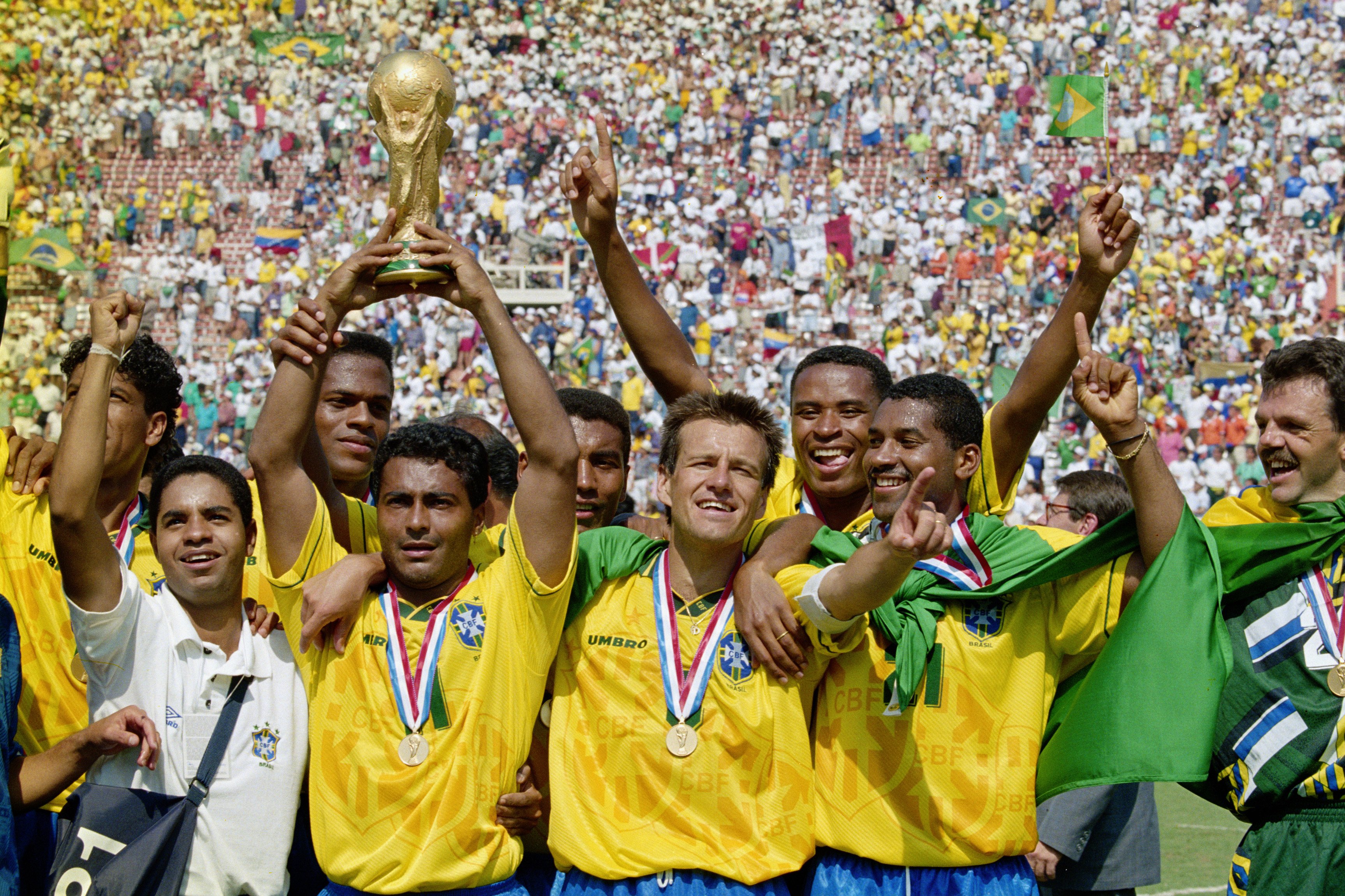
Roberto Baggio blasted a penalty kick over the crossbar, and Brazil won the penalty phase, 3-2. And Americans not already into soccer shrugged their shoulders, and either went back to watching baseball or began preparing for a new NFL season.
Romário (Number 11) lifts the Jules Rimet Trophy,
next to Dunga (8), the Captain

Foxboro Stadium was torn down in 2002, having been replaced by the next-door Gillette Stadium. Soldier Field was torn down in 2002, and replaced by a new stadium on the same site. Stanford Stadium was torn down in 2004, and replaced by a new stadium on the same site. Giants Stadium was torn down in 2010, having been replaced by the next-door MetLife Stadium. The Silverdome was torn down in 2017, after the Detroit Lions moved into Ford Field in 2002. RFK Stadium is scheduled to be torn down in 2023.

The 2026 World Cup was awarded jointly to all 3 North American nations: The United States, Canada (which has never hosted), and Mexico (which hosted in 1970 and 1986). Most of the host stadiums from 1994 are unlikely to host again in 2026, since they've been replaced.

If Los Angeles gets the Final again, it won't be played at the Rose Bowl, even though it is still in use and still in good shape. It will probably go to the new SoFi Stadium in Inglewood, because of its retractable roof. If New York gets the Final, it will be at MetLife Stadium, Giants Stadium's replacement.

UPDATE: In 2024, the 2026 World Cup Final was awarded to MetLife Stadium. SoFi Stadium got a Quarterfinal, while the Semifinals went to Mercedes-Benz Stadium in Atlanta and AT&T Stadium outside Dallas.

An article for ESPN.com, published after the 2026 World Cup, ranking all 23 tournaments, rated the 1994 edition 10th, citing "turmoil" and "tension"; but adding, "In terms of pure imagery, it will be difficult to ever top 1994." 

*

July 17, 1994 was a Sunday. It was the off-season for the NFL, the NBA and the NHL. But, in addition to the World Cup Final, there was a full slate of Major League Baseball games played that day. It was, however, well past the age of Sunday doubleheaders:

* The New York Yankees beat the Seattle Mariners, 14-4 at the Kingdome in Seattle. Jim Leyritz hit 2 home runs, and Danny Tartabull added another, to make a winning pitcher out of Scott Kamieniecki. Tino Martinez hit one of the M's, and would be a big part of them driving the Yankees crazy in the 1995 Playoffs. But the Yankees traded for him, and he became a part of their next Dynasty.

* The New York Mets lost to the San Diego Padres, 10-1 at Shea Stadium.

* The Philadelphia Phillies beat the Los Angeles Dodgers, 9-7 at Veterans Stadium in Philadelphia.

* The San Francisco Giants beat the Montreal Expos, 6-4 at the Olympic Stadium in Montreal.

* The Houston Astros beat the Pittsburgh Pirates, 9-0 at Three Rivers Stadium in Pittsburgh.

* The Atlanta Braves beat the Florida Marlins, 2-1 at Atlanta-Fulton County Stadium.

* The Cincinnati Reds beat the Chicago Cubs, 3-2 at Riverfront Stadium in Cincinnati. Reggie Sanders singled home the winning run in the bottom of the 10th inning.

* The Chicago White Sox beat the Cleveland Indians, 5-2 at the new Comiskey Park in Chicago. (It is now named Rate Field.)

* The Milwaukee Brewers beat the Minnesota Twins, 5-3 at the Metrodome in Minneapolis.

* The Kansas City Royals beat the Detroit Tigers, 4-1 at Kauffman Stadium in Kansas City.

* The Toronto Blue Jays beat the Texas Rangers, 3-1 at The Ballpark (now Choctaw Stadium) in the Dallas suburb of Arlington, Texas.

* The Colorado Rockies beat the St. Louis Cardinals, 10-6 at Mile High Stadium in Denver.

* The Baltimore Orioles beat the California Angels, 10-5 at Anaheim Stadium in the Los Angeles suburb of that name. (It is now named Angel Stadium of Anaheim.)

* And the Boston Red Sox beat the Oakland Athletics, 4-3 at the Oakland Coliseum. 

Saturday, July 9, 2022

July 9, 2006: Zinedine Zidane's "Coup de Boule"

July 9, 2006: The World Cup Final is held at the Olympiastadion in Berlin. ABC broadcasts it in America. France play Italy. Both teams tend to wear blue, thus France are Les Bleus, and Italy are gli Azzurri. On this occasion, Italy wore blue, while France wore white.
The Olympiastadion is 1 of 3 stadiums to have hosted an Olympic Games, a World Cup Final and a UEFA European Cup/Champions League Final. The others are the Olympiastadion in Munich and the old Wembley Stadium in London. In 2024, the Stade de France outside Paris will make it 4.

Italy were loaded with legends: Gianluigi Buffon, Fabio Cannavaro, Andrea Pirlo, Francesco Totti, Luca Toni. This was a team so good, Daniele De Rossi and Alessandro Del Piero did not start and had to come on as substitutes, Alessandro Nesta and Filippo Inzaghi remained on the bench, and Paolo Maldini, still starting for AC Milan at age 38, was not even selected.

But France were equally laden with starpower, many of them holdovers from their 1998 triumph: Fabien Barthez, Lilian Thuram, David Trezeguet, Patrick Vieira, Thierry Henry, and Captain Zinedine Zidane. Others had developed since that win: Claude Makélélé, Florent Malouda, Sylvain Wiltord, Lasanna Diarra, Éric Abidal, Franck Ribéry. 

The key was Zidane: The midfielder, who had starred for Girondins de Bordeaux in his homeland, Juventus in Turin, Italy, and Real Madrid in Spain, had put the team, indeed his entire country, on his back, and led them to victory in 1998.

The son of Kabyle immigrants from France's former colony of Algeria, he was a symbol of reconciliation, as both nations were still dealing with the nasty war that Algeria fought for its independence from 1954 to 1962 -- having ended only 36 years before.

Although light-skinned enough to appear white -- unlike several national side teammates, including Henry, Vieira, Thuram, Trezeguet, and his Real Madrid teammate Makélélé -- he had faced prejudicial gestures large and small, including the insinuation that he was not truly, or not wholly, French.

Yet he went into that 2006 Final once again having led the team to glory. It was to be his last game: At age 34, he had announced his retirement as a player. Win or lose, it would be all over when the final whistle blew for this game.

In the 7th minute, Malouda, then playing his club football for Olympique Lyonnais, was knocked down in the box by Marco Materazzi of Internazionale Milano. If Materazzi were a hockey player, he wouldn't be a "pest": A good player who frequently plays rough; he'd be a "goon": A player whose sole purpose is to play rough, because he can't do anything else.

Horacio Elizondo, the Argentine selected to referee the game (because he was from neither team's continent), correctly awarded a penalty, and Zidane converted it. France led, 1-0.

The lead did not last long. In the 19th minute, Pirlo, the AC Milan legend, sent a hellacious corner kick into the box, and Materazzi, of all people, headed it past Barthez, the famously bald goalkeeper who was back with Olympique de Marseille after starring for them, Toulouse, AS Monaco and Manchester United.

In the 2nd half, Luca Toni, then of Florence-based Fiorentina, hit the crossbar with a shot, and then correctly had a headed goal disallowed as having been offside. Malouda was tackled in the box by Juventus' Gianluca Zambrotta, but was incorrectly not awarded another penalty. Arsenal legend Henry was stopped by Juventus goalie Buffon. Malouda skied a shot over the bar. Pirlo just missed with a free kick.

In extra time, Ribéry, then with Marseille and later to star for Bayern Munich, just missed. Buffon just barely knocked a Zidane header away.

And then, in the 110th minute, Materazzi pulled on Zidane's jersey, they exchanged words, and Zidane head-butted Materazzi right in the chest. In French soccer, this is known as a coup de boule -- literally, "stroke of ball" or "blow of ball," but also meaning "play of head." (The more familiar phrase coup d'état means "blow of state," and refers to the overthrow of a government.)

Elizondo did not see the incident. The 4th official, Luis Medina Cantalejo -- so respected that he not only officiated at 3 games of that World Cup, but was one of the few Spanish referees to officiate at La Liga games between arch-rivals Real Madrid and Barcelona, a rivalry so intense that foreign referees are nearly always assigned to oversee it -- told Elizondo through his headset that it had happened.

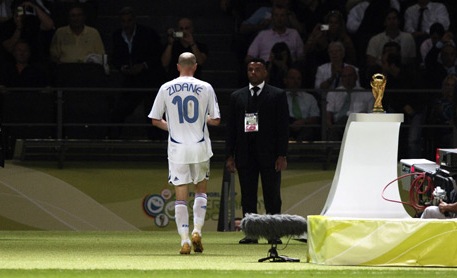
Elizondo properly showed Zidane a straight red card, making him the 4th player to be sent off in a World Cup Final, and the only player ever sent off in games of 2 separate World Cups. The scene of Zidane walking into the locker room, past the World Cup trophy but not even looking at it, is nearly as iconic as the coup de boule itself.
Extra time ended with the game still 1-1, so it went to penalties. Italy kicked first. Pirlo scored his penalty. Sylvain Wiltord, then with Lyon and previously the man whose goal past Barthez secured the League and Cup "Double" for Arsenal in 2002, made his. 1-1.

Materazzi was next for Italy, and made his penalty. Next for France was Trezeguet, facing his Juventus teammate Buffon. In extra time of the Euro 2000 Final, he had beaten Buffon with a shot. Under the rules then in place, it was a "golden goal": Automatic victory. This time, he was not a hero: He clanged his shot off the crossbar. 2-1 Italy.

De Rossi made his penalty. Abidal made his. Del Piero made his. Willy Sagnol made his for France. Finally, Fabio Grosso clinched the win for Italy: 5-3, with France's last shot not taken, seeing as how it would have been meaningless. Italia: Campioni del Mondo.
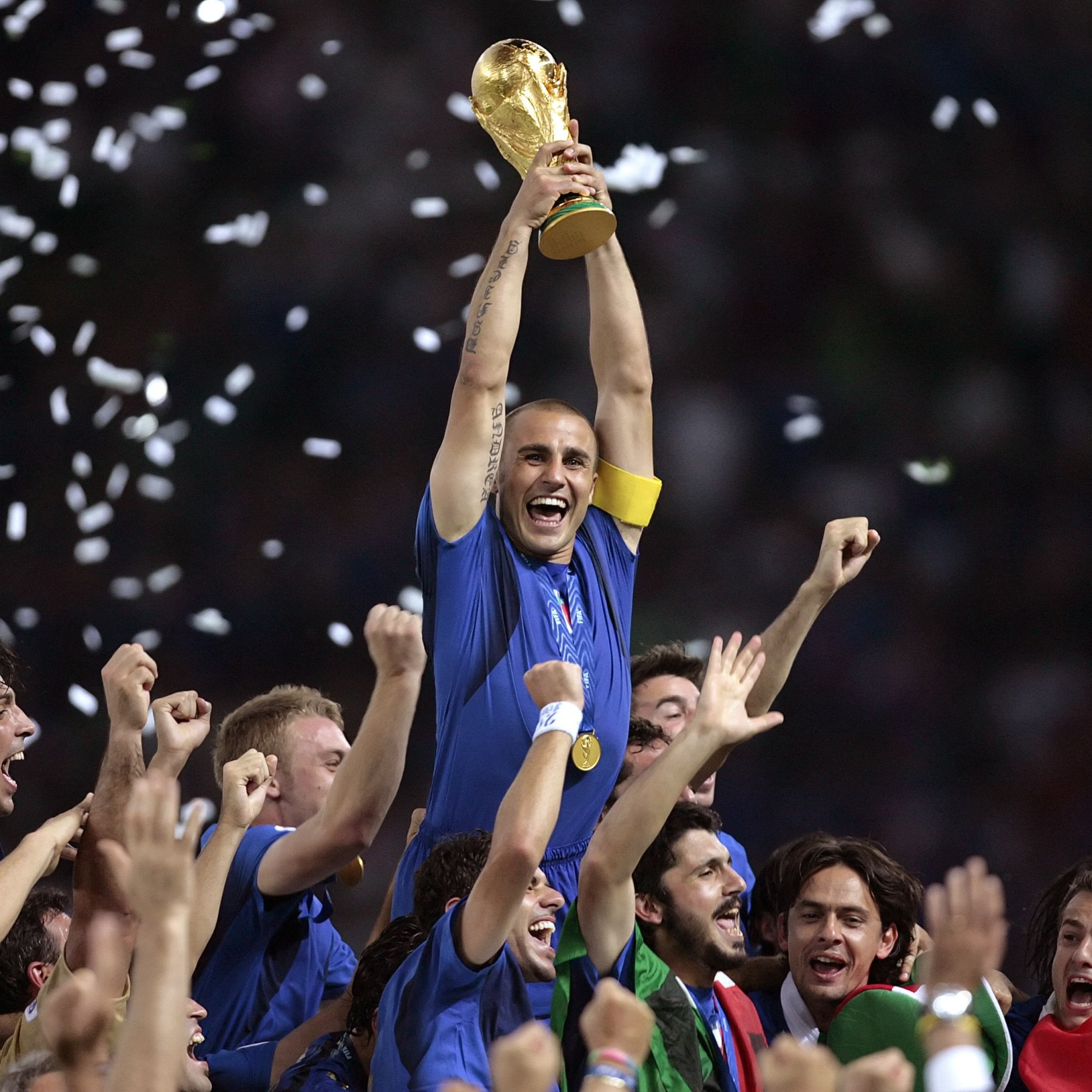
Fabio Cannavaro, as Captain, raising the Jules Rimet Trophy

Zidane, of course, was not available for the penalties.

Why did he do it? Three British newspapers -- The Times, The Sun, and the Daily Star, with varying degrees of reliability -- all hired lip-readers who were fluent in French and Italian to look at the tape, and to see what Materazzi had said to Zidane to provoke it. (Materazzi does not speak French, but Zidane played in Italy long enough to learn the language, and their exchange was entirely in Italian.)

The Times has a reputation for sterling journalism; The Sun and the Daily Star are considered lying right-wing propaganda rags. Yet the lip-readers hired by all 3 reported the exact same thing: They all said that Materazzi had called Zidane a "son of a terrorist whore."

It had been less than 5 years since the 9/11 attacks, and a year to the week after the 7/7 attacks on the London Underground (subway). Apparently, Materazzi was unaware that presuming that all Muslims are terrorists is not only bigoted, but stupid. To make matters worse, Zidane's mother was ill at the time.

Materazzi's version of events was a little different. He said he would never have insulted someone's mother, having lost his own when he was 15 years old. Without question, he had tugged on Zidane's shirt. The exchange of shirts is a postgame tradition that goes back decades, and Materazzi said that Zidane told him, "If you want my shirt, I will give it to you afterwards." Not an unreasonable request of a star of one of the finalists to one of the other finalist, and not an unreasonable response.

Materazzi said that his follow-up was, "I prefer the whore that is your sister." In other words, "Your sister puts out, and I'd like you to set me up with her." In other words, Materazzi admitted that he had gone too far.

But so had Zidane. There were about 10 minutes of play to go. Winning is the best revenge. A man as accomplished as Zidane -- 2 League titles in Italy and 1 in Spain, a Champions League win, a World Cup and a Euro title -- should have accepted this. Win the game, and you look like a champion, and the guy trying to provoke you looks like an idiot. Instead, the great Zizou looked like an easily provoked fool, and Materazzi an undeserved World Champion.

The play swept the world. Dozens of people posted their attempts at recreating it on the Internet. American TV shows parodied it. A song titled "Coup de Boule" hit Number 1 on the French music charts.

One moment can change not just a game, but a reputation, forever. Zidane stood to become the greatest hero in the history of French sport. Maybe he still is, anyway. But the first thing anyone thinks about when they hear his name is the coup de boule.

UPDATE: An article for ESPN.com, published after the 2026 World Cup, ranking all 23 tournaments, rated this one 3rd, citing "some old-school corruption," "a delightful semi-underdog run from the hosts," "stars doing star things," "another Final shootout," and, "Most of all, we got Zidane's head-butt."

*

July 9, 2006 was a Sunday.  It was the off-season for the NFL, the NBA and the NHL. But, as the last day before the All-Star Break, it featured a full slate of Major League Baseball games:

* The New York Yankees lost to the Tampa Bay Devil Rays, 6-5 at Tropicana Field in St. Petersburg. Jason Giambi hit a home run, but a bullpen collapse led by Ron Villone and the execrable Scott Proctor gave the game to the Deviled Eggs.

* The New York Mets beat the Florida Marlins, 7-6 at Shea Stadium. The Mets scored 4 runs in the 8th, including 3 on a home run by David Wright, to win it.

* The Philadelphia Phillies beat the Pittsburgh Pirates, 8-3 at Citizens Bank Park in Philadelphia.

* The San Diego Padres beat the Washington Nationals, 10-9 at Robert F. Kennedy Stadium in Washington.

* The Atlanta Braves beat the Cincinnati Reds, 8-3 at Turner Field (now Center Parc Stadium) in Atlanta.

* The Baltimore Orioles beat the Cleveland Indians, 5-4 at Progressive Field in Cleveland.

* The Chicago White Sox beat the Boston Red Sox, 6-5 in 19 innings, at U.S. Cellular Field in Chicago (now Rate Field). Tadahito Iguchi singled home the winning run.

* The Chicago Cubs beat the Milwaukee Brewers, 11-4 at Miller Park (now American Family Field) in Milwaukee.

* The Toronto Blue Jays beat the Kansas City Royals, 11-3 at Kauffman Stadium in Kansas City.

* The St. Louis Cardinals beat the Houston Astros, 7-5 at Minute Maid Park (now Daikin Park) in Houston. Aaron Miles' double won the game in the top of the 12th inning.

* The Texas Rangers beat the Minnesota Twins, 5-2 at Ameriquest Field (now Choctaw Stadium) in the Dallas suburb of Arlington, Texas.

* The Arizona Diamondbacks beat the Colorado Rockies, 8-5 at Coors Field in Denver.

* The Los Angeles Dodgers beat their arch-rivals, the San Francisco Giants, 3-1 at Dodger Stadium in Los Angeles.

* The Los Angeles Angels beat the Oakland Athletics, 4-2 at the Oakland Coliseum (then named the McAfee Coliseum).

* And the Seattle Mariners beat the Detroit Tigers, 3-2 at Safeco Field (now T-Mobile Park) in Seattle. 

Tuesday, July 5, 2022

July 5, 1982: Paolo Rossi Makes Brazil Cry

July 5, 1982: Most soccer World Cups are best remembered for their Finals. The 1982 edition, in Spain, is not.

As they so often do, Italy went into the World Cup in controversy. The Totonero match-fixing scandal broke in 1980. Two of Italy's biggest teams, A.C. Milan and Rome team S.S. Lazio, were punished by relegation from Serie A to Serie B. Some others, including A.C. Perugia, were docked 5 points. Perugia star Paolo Rossi was punished more than any individual player, suspended for 3 seasons.

He always insisted he was innocent, but he missed his age 23 and 24 seasons. His suspension was lifted after the 2nd season. Turin-based Juventus F.C., known for their corruption (they were not charged in Totonero, but would be relegated and stripped of 2 titles in the 2006 Calciopoli scandal), didn't care that people still thought Rossi was guilty, and scooped him up for the 1981-82 season.

He helped them win the League in 1982, and he was once again selected for the national team. Despite there being no blue in Italy's national flag, their national team wears blue (this is also true for Japan), due to it being the color of their former ruling family, the House of Savoy, and are known as Gli Azzurri (The Blues).

Italy's sporting press is notorious for making bigger deals out of things than they should: For a big team like Juve, the Milan teams (A.C. Milan and Internazionale Milano F.C.) or the Rome teams (A.S. Roma and Lazio), a 3-game winless streak is a "crisis," and talk that the manager should be fired begins. So there was some fuss about Rossi being chosen for the World Cup.

The tournament was held in Spain, and 2 teams were the popular favorites, Brazil and France. Brazil, in particular, because, for the 1st time since their 1970 win, they seemed to have a team that was not only greatly talented, but stylish. Like most Brazil teams, they were led by men using single names, and the names still echo through the history of the game: Sócrates, Zico, Falcão, Éder. (Some of these names had been used for popular players before, and would again.) And one man who used 2 names, serving as a nickname: Roberto Dinamite.

Brazil had beaten Italy in the 1970 World Cup Final, and the contrast between the national teams' reputations couldn't have been more stark: While they had a high-scoring national team in 1970, Italy's best club teams had been notable for defense, with a style known as catenaccio, or "padlock."

Gianni Brera, the legendary writer for La Gazzetta dello Sport -- effectively, Italy's Grantland Rice -- had said that the perfect soccer game would end 0-0. Most Americans would find this boring, but Italian fans of the 1960s and '70s tended to agree with him.

Not surprisingly, Juventus were known for a strong defense, and had 6 players on Italy's team for the 1982 World Cup: Rossi, midfielder Marco Tardelli, goalkeeper Dino Zoff, and 3 defenders: Antonio Cabrini, Claudio Gentile and Gaetano Scirea.

Fiorentina, of Florence, had 5: Backup goalkeeper Giovanni Galli, defender Pietro Vierchowod, midfielder Giancarlo Antognoni, and forwards Daniele Massaro and Francesco Graziani. Inter Milan had 5: Backup goalkeeper Ivano Bordon, defender Giuseppe Bergomi, midfielders Giampiero Marini and Gabriele Oriali, and forward Alessandro Altobelli.

A.C. Milan had 2 players, both defenders: Franco Baresi and Fulvio Collovati. And 1 player each came from 4 other clubs: Forward Franco Selvaggi from Cagliari on Sardinia, midfielder Bruno Conti from A.S. Roma, midfielder Giuseppe Dossena from Turin team Torino, and midfielder Franco Causio from Udinese. The manager was Enzo Bearzot.

Italy excited no one in the First Group Stage, gaining 3 draws, all in the northwestern Spanish city of Vigo: 0-0 with Poland, 1-1 with Peru, and 1-1 with Cameroon. The Italian media ripped their own boys, singling Rossi out, with one writer calling him "a ghost aimlessly wandering over the field." But it was enough to finish 2nd to Poland in Group 1, and advance to the Second Group Stage.

They were put in Group C, with Brazil and Argentina. The latter were not only the defending champions, but had added a new star, Diego Maradona, and needed an emotional lift after getting clobbered by Britain in the Falklands War. Italy seemed like lambs being led to the slaughter. The term "Group of Death" was not yet in use in 1982, but, in 2007, with a quarter-century of hindsight, British newspaper The Guardian called this "the deadliest-ever Group of Death in World Cup history."

All the games in this Group were played at Estadi de Sarrià, home of RCD Espanyol in Barcelona. On June 29, Italy stunned Argentina -- a country which, despite having Spanish as its official language, has Italians as its largest ethnic group -- with 2nd-half goals by Tardelli and Cabrini within 10 minutes. Argentina pulled one back, but it wasn't enough, as Gentile and Scirea marked Maradona out of the action, and Italy were 2-1 winners.

On July 2, Brazil beat Argentina, their arch-rivals, 3-1 in a masterclass of what they called, in Portuguese, O Jogo Bonito: The Beautiful Game. Argentina were out, and the July 5 match between Brazil and Italy would decide one of the teams for the Semifinal.

Bearzot decided that keeping Zico from attacking was the answer. He sent Gentile to mark Zico, and it worked, but at a price: Gentile was called for a foul, and granted a yellow card. Due to accumulation of cards, he would be suspended for the Semifinal, should Italy qualify.

Rossi scored only 5 minutes in, with a header off a Cabrini cross. Sócrates answered in the 12th minute. In the 25th, Rossi stepped in front of Júnior, intercepted a pass from Cerezo, and scored a 2nd goal. It was 2-1 Italy at the half. Falcão tied it in the 68th. Had that 2-2 score held, Brazil would have advanced to the Semifinal on goal difference.

But in the 74th, Italy had a corner kick. Brazil did a poor job of clearing it. Rossi took the ball at the six-yard line, and drilled a shot to complete a hat trick. Antognoni seemed to score in the 86th, but it was disallowed for offside -- incorrectly, as an instant replay later showed. In stoppage time, Oscar nearly equalized for Brazil, but Zoff made an amazing save, clinching the 3-2 win for Italy.

Brazilian fans could be seen crying in the stands. Not since the Maracanazo of the 1950 Final, which they lost on home soil to Uruguay, had their team sustained such an impactful defeat. This one would also be named after the stadium where it was played: A tragédia do Sarrià. And Rossi, approached after the tournament to write a book, titled it Ho fatto piangere il Brasile: "I Made Brazil Cry."

It has been suggested that this loss was the end of O Jogo Bonito for Brazil: The attacking philosophy that had served them so well was scrapped for a defense-first approach. It paid off in 1994, when they won the World Cup -- beating Italy in the Final, on penalties after 120 minutes of goalless soccer. But the country practically revolted against this approach: Never was a team that won the World Cup less loved in its homeland. So they went back to the old approach, led by Ronaldo and Ronaldinho, reaching the Final in 1998 and winning it all in 2002.

But the 1982 tournament was not over. On July 8, at the Camp Nou, the already-storied home ground of FC Barcelona, Italy faced Poland in the Semifinal. Rossi was the star again, scoring in the 22nd and the 73rd minute, leading Italy to a 2-0 win. The Final would be on July 11, at the home of Real Madrid, Estadio Santiago Bernabéu. It would be against West Germany, which shocked France in what was widely seen as a dirty match.

In the World Cup, matches are usually refereed by a man from neither team's home continent, in the hopes of avoiding any bias. The referee for this match was Arnaldo Cézar Coelho -- from Brazil. Despite Rossi and his teammates having "made Brazil cry," in the end, he was not accused of showing any bias against Italy, and is generally considered one of the best referees in the sport's history.

The 1st half was scoreless. Italy were awarded a penalty, but Cabrini missed it. In the 57th minute, Rossi struck again, heading in a cross from Gentile. Tardelli scored in the 69th, and later said that he saw his life flashing before his eyes thereafter. Altobelli added a goal in the 81st. Paul Breitner scored for West Germany in the 83rd, but it was too little, too late. Italy won, 3-1.

Having previously won the World Cup in 1934 and 1938, this was their 3rd, tying Brazil for the most. Through 2018, the count is Brazil 5, Italy 4, Germany 4 (but only 1 since reunification with East Germany), France 2, Argentina 2, Uruguay 2, Spain 1, England 1.

Rossi was awarded the Golden Ball as the player of the tournament, and, in The Guardian, Peter Mason wrote that, for Italy, the World Cup "was a cathartic moment for the nation, which had been subject to significant social and political unrest for a number of years and, despite being regarded as one of the world's premier footballing nations, had not won a World Cup since 1938... With the victory came an incalculable lift to the nation’s spirits, and Rossi was at the centre of the celebrations."

Rossi became an icon wherever veins carried Italian blood. There was a pizzeria in my neighborhood, on the New York side of New Jersey. Before the tournament, one wall had pictures of Frank Sinatra and his Rat Pack pals, and other Italian actors like Sylvester Stallone, Robert De Niro and Al Pacino. Another wall was all New York Yankees, as this was right after the end of their 1976-81 dynasty.

The coverage of soccer in America was pathetic. If memory serves me correctly, I don't think a single game of that World Cup was shown on TV except the Final, on ABC Wide World of Sports. But Italy won it. The next day, the pizzeria had taken down all the Yankee pictures, and replaced it with pictures of the Italy team, especially Rossi. The guys running the place couldn't have named one player on the team before the Final, but they were front-runnering it. (As of 2022, it's still in business, but with very different decor.)

At his 25th birthday, Paolo Rossi was a genius with a cloud over his head. At his 26th, he was an all-time legend. He helped Juventus reach the Final of the European Cup (the tournament now known as the UEFA Champions League) in 1983, losing to German team Hamburger S.V.; and in 1985, beating Liverpool F.C. after a stadium disaster led to the deaths of 39 fans. The decision to play after it led to the Final being known as "the Cup of Blood."

Rossi moved on to A.C. Milan, and was selected for the 1986 World Cup, but had to drop out due to injury. He went into the real estate business, and became a commentator for Italy's top TV network, RAI. He died in 2020, due to smoking, at the age of 64.

*

July 5, 1982 was a Monday. These Major League Baseball games were played that day:

* The New York Yankees lost to the Seattle Mariners, 5-4 at the Kingdome in Seattle. Dave Winfield and John Mayberry hit home runs, but it wasn't enough.

* The New York Mets lost to the Los Angeles Dodgers, 4-1 at Shea Stadium.

* The San Diego Padres beat the Montreal Expos, 8-6 at the Olympic Stadium in Montreal. The Padres scored 6 runs in the 7th inning. Tony Gwynn made his major league debut for the Padres 2 weeks later.

* The San Francisco Giants beat the Philadelphia Phillies, 3-1 at Veterans Stadium in Philadelphia. Mike Schmidt went 1-for-5. Pete Rose went 1-for-3 with 2 walks.

* The Atlanta Braves beat the Chicago Cubs, 7-5 at Atlanta-Fulton County Stadium.

* The Houston Astros beat the Pittsburgh Pirates, 6-4 at Three Rivers Stadium in Pittsburgh. Willie Stargell, in his final season, appeared as a pinch-hitter, and did not reach base.

* The St. Louis Cardinals beat the Cincinnati Reds, 6-5 at Riverfront Stadium in Cincinnati. Ozzie Smith singled home the winning run in the top of the 10th inning.

* The Minnesota Twins beat the Detroit Tigers, 5-3 at Tiger Stadium in Detroit.

* The Milwaukee Brewers beat the Chicago White Sox, 10-4 at Comiskey Park in Chicago. Robin Yount went 2-for-3 with a home run and 2 RBIs. Paul Molitor went 1-for-5.

* A doubleheader was split at Royals Stadium (now Kauffman Stadium) in Kansas City. The Boston Red Sox won the opener, 4-3. Jim Rice drove in the winning run with a sacrifice fly in the top of the 11th inning. The Kansas City Royals won the nightcap, 4-3. Carl Yastrzemski appeared as a pinch-hitter in the opener, and did not reach base. But in the nightcap, he went 2-for-4 with a solo home run. Over the 2 games, George Brett went 1-for-10 with an RBI.

* The Texas Rangers beat the Toronto Blue Jays, 3-2 at Arlington Stadium in the Dallas suburb of Arlington, Texas.

* The Baltimore Orioles beat the California Angels, 8-5 at Anaheim Stadium (now Angel Stadium of Anaheim). Eddie Murray went 1-for-4 with a home run and 2 RBIs. Reggie Jackson went 2-for-4 with a solo home run. Cal Ripken and Rod Carew each went 0-for-4 with a walk.

* And the Oakland Athletics beat the Cleveland Indians, 2-0 at the Oakland Coliseum. Rickey Henderson went 1-for-3 with a walk. Tom Underwood (7 2/3rds innings) and Dave Beard combined on a 7-hit shutout.

Tuesday, June 21, 2022

June 21, 1970: Brazil's Masterpiece

June 21, 1970: The World Cup Final is held before 107,412 fans at Estadio Azteca in Mexico City. It was the 1st World Cup televised in color around the world, and, as a recent article stated, the way it was broadcast and merchandised suggested that it was closer in style and form to the most recent World Cup, in Russia in 2018, than it was to the one it followed, in 1966 in England.

This was also the 1st World Cup that left the old, heavy, basketball-type ball behind, and used what became, largely because of this tournament, the most famous ball in the history of sports: The Adidas Telstar, with its black pentagons and white hexagons.
Let me get "the local angle" out of the way first. America -- or "the United States," if you prefer -- did not qualify for the 1970 World Cup. We did try, but, as was the case for every one between 1950 and 1990, we simply weren't good enough.
CONCACAF, the Confederation of North, Central American and Caribbean Association Football, put the U.S. in a Qualification Group Stage with Canada and Bermuda. On October 13, 1968, we lost 4-2 to Canada at Varsity Stadium in Toronto. On October 26, we beat Canada 1-0 at Atlanta (later Atlanta-Fulton County) Stadium. On November 2, we beat Bermuda 6-2 at Kansas City Municipal Stadium. And on November 11, we beat Bermuda 2-0 at their National Stadium in Hamilton.
So we advanced to the Semifinal, where we faced Haiti, a team we should have beaten, but didn't. On April 20, 1969, we lost 2-0 Stade Sylvio Cantor in Port-au-Prince. And on May 11, we lost 1-0 at San Diego (later Jack Murphy) Stadium, ending our bid. Haiti then lost the Final to El Salvador, who eliminated neighboring Honduras, a series of events that included a 2-day "Football War" between the countries.
So the 16 teams involved were:
* From CONCACAF: Mexico (as the host, they qualified automatically) and El Salvador.
* From CONMEBOL, the governing body for South America: Brazil, Peru and Uruguay.
* From UEFA, the governing body for Europe: England (as the defending champions, they qualified automatically), Belgium, Bulgaria, Czechoslovakia, Italy, Romania, the Soviet Union, Sweden and West Germany.
* From CAF, the governing body for Africa: Morocco.
* From AFC, the governing body for Asia: Israel.
* From OFC, the governing body for Oceania (centered on Australia): No teams qualified.
The Israelis were making their 1st appearance. It remains their only one. Eventually, the Muslim nations of the Middle East would refuse to allow their national teams play them, and would refuse to allow their club teams to play Israel's, resulting in FIFA, the governing body for world soccer (Fédération Internationale de Football Association), moving them into UEFA.
*

This was the 1st time the World Cup was held in a CONCACAF nation. The advantage to playing in Mexico was that the infrastructure was already in place, due to Mexico's solid Liga MX, and also to the country having hosted the Olympics in 1968. The disadvantages to playing in Mexico were the weather (much of the country is desert, so it was hot) and the elevation (the highest in World Cup history, even higher than the mountainous nations of Switzerland in 1954, Sweden in 1958 and Chile in 1962, thus the air was thinner, possibly dangerous when hot).
But the infrastructure already being in place meant that it wasn't an especially expensive World Cup to put on -- which helped in 1983, when Colombia, chosen as host for 1986, accepted that their internal strife was too much, and became the only nation ever to bow out as a World Cup host. As FIFA tended to alternate between Europe and Latin America, and Spain had hosted in 1982, they decided that the host had to be another Latin American nation. Mexico had done well as host in 1970, so they put it there again, and it worked pretty well again.
Brazil had hosted in 1950, but lost the Final to neighboring Uruguay, as devastating a loss as has ever been suffered in sports. In 1954, they won their Group, but were defeated in the Quarterfinal by a Hungary team known as "The Magnificent Magyars," which would also be stunned in a Final, by West Germany.
But in 1958, with 17-year-old Edson Arantes do Nascimento, a.k.a. Pelé, Brazil won their 1st World Cup, beating host nation Sweden in the Final. In 1962, in Chile, they won again, with a Final win over Czechoslovakia. Their 1966 experience was hard, with neighbors and arch-rivals Argentina literally kicking Pelé out of the tournament. England won the Final on home soil, over West Germany in extra time.
In the interim between 1966 and 1970, Brazil, as it occasionally does, fell to an autocratic government. What's more, the manager, João Saldanha, refused to pick Pelé for the 1970 team. He also refused to pick Dario José dos Santos, or simply "Dario." (Brazilian stars tend to be known by either just their first names, or nicknames as in Pelé's case.) Told that the military President, Emílio Garrastazu Médici, considered Dario one of his favorite players, and that Saldanha should pick him, Saldanha said, "Well, I also have some suggestions to give in the President's ministry choices."

Finally, his assistant manager quit, saying he was "impossible to work with." So Saldanha was fired. Mário Zagallo, who had played on the 1958 and '62 Cup winners, and had been managing Rio de Janeiro team Botafogo, was named to replace him. He named both Pelé and Dario to the team -- or, in Portuguese, O Seleção"the Selection."
Mário Zagallo

*

Venues for the World Cup were:

* Estadio Azteca in Mexico City, the 107,000-capacity (now 87,000-seat) home of Club América, the country's most successful team, and also of club sides Necaxa, Atlante, and soon Cruz Azul and the now-defunct Atlético Español.

* Estadio Jalisco in Guadalajara, then home to Guadalajara (a.k.a. Chivas, or Goats) and Jalisco; and, then as now, home to Atlas and Leones Negros (Black Lions).

* Estadio Cuauhtémoc in Puebla, home of Puebla F.C.

* Estadio Luis Dosal in Toluca, home of Deportivo Toluca. It is now named Estadio Nemesio Díez, and, like the home of Boca Juniors in Buenos Aires, Argentina, is nicknamed La Bombonera, or "The Chocolate Box."

* Estadio León, home of Club León. The stadium is nicknamed the Nou Camp, after the home of FC Barcelona in Spain.
Estadio Azteca

As I said, this was the 1st time the World Cup would be broadcast around the world in color, so no longer would teams be seen in shades of gray. Host Mexico would be in green. England, the Soviet Union, Belgium, Bulgaria, Morocco and Peru wore red. Brazil, Sweden and Romania wore yellow -- Brazil's shirt being nicknamed O Canarinho, "The Canary." Italy wore royal blue, the color of its former ruling House of Savoy. Uruguay and Israel wore sky blue. El Salvador and Czechoslovakia wore white for all of their matches. Peru wore white with a red sash. West Germany wore green once, and white for the rest of their matches.

Traditionally, the hosts play the 1st match, and Mexico opened against the Soviets on May 31, playing a 0-0 draw at the Azteca. Both advanced from Group 1. Italy and Uruguay advanced from Group 2, with Israel losing 2-0 to Uruguay, drawing 1-1 with Sweden, and bravely holding Italy to a 0-0 draw. West Germany and Peru advanced from Group 4.

The match everyone wanted to see was in Group 3, in Guadalajara on June 7. A cross at the corner from Jairzinho went right where he wanted it to, a spot soon met by the head of Pelé. As soon as he hit it, Pelé yelled, "Gol!"

This was a man who had already scored over 1,000 goals in all competitions -- and, contrary to what modern fans, citing Lionel Messi or Cristiano Ronaldo as the "GOAT" (Greatest Of All Time) would say, they were no more "all against farmers" than those current pretenders' goals have been -- so he usually knew what he was talking about.

Not this time. Gordon Banks, as much a reason as anyone why England won 4 years earlier, had been facing Jairzinho, expecting a shot to his left. He had just enough time to switch his dive to his right, stick out his right hand, and knock Pelé's shot over the crossbar.

Pelé, who did already speak English: "I thought that was a goal."
Banks: "You and me both."
Bobby Moore, England centreback and Captain: "You're getting old, Banksy. You used to hold on to them." (Banks was 32, Moore 29, Pelé also 29.)

It's been called the greatest save in the sport's history. But Brazil would not be denied. In the 59th minute, Jairzinho put one past Banks, and it was 1-0 Brazil, and would end that way. After the game, Moore, white, and a defender, swapped shirts with Pelé, black, and an attacker, each country's greatest sports legend joining for an act more important than anything that happened in the game.

*


In spite of the loss, England did advance to the knockout round, as did Brazil. The Quarterfinals, all played on June 14, were loaded with drama. Brazil had a little trouble with fellow South Americans Peru, but beat them 4-2. Uruguay and the Soviets went to extra time at the Azteca. Just when it looked like there might be a penalty shootout, Victor Espárrago scored in the 117th minute, allowing Uruguay, the 1930 and 1950 winners, to advance.

At Toluca, Italy eliminated the hosts. Mexico took an early 1-0 lead, but an own goal tied it up. In the span of 13 minutes in the 2nd half, Luigi "Gigi" Riva, whose spectacular strikes had given Sardinia-based Cagliari its only league title ever a few weeks earlier, scored 2 beauties. In between, Italy also got a goal from perhaps the greatest player they'd ever produced, A.C. Milan star Gianni Rivera.

At León came a rematch of the 1966 Final: England vs. West Germany. Banks came down with food poisoning, and, to this day, there are conspiracy theories that a German fan may have done it to him deliberately. (Shades of what would allegedly happen with Arsenal and Tottenham in 2006.) At gametime, manager Alf Ramsey, so dependent upon Banks 4 years earlier, dropped the Stoke City netminder for Chelsea's Peter Bonetti.

At first, things went well for England. Alan Mullery of Tottenham Hotspur scored in the 31st. In the 49th, Martin Peters of West Ham, who had scored in the '66 Final, tallied. Three-quarters of the way through the game, England were up 2-0, and looked like they were headed for a Semifinal date with Italy, who had won Euro 68.

But Franz Beckenbauer of Bayern Munich scored in the 68th minute. And then Uwe Seeler of Hamburg tied the game in the 82nd. The game went to extra time at 2-2, as had the '66 Final. This time, it was "Ze Germans" who found the 3rd goal, from Bayern striker Gerd Müller.

Looking at the tape of the game, I am firmly convinced that Banks would not have stopped any of the 3 German goals. It was England's vaunted defense that was to blame: Moore was the only '66 holdover, and newcomers Terry Cooper of 1969 Football League Champions Leeds United, and Brian Labone and Keith Newton of 1970 Champions Everton were not up to the task on this occasion.

Another conspiracy theory says that this defeat so depressed the people of England that it held down turnout in the United Kingdom's general election, allowing the Conservative Party to knock the Liberal Party out of power, resulting in Harold Wilson being replaced as Prime Minister by Edward Heath. This theory makes a bit more sense than the one about Banks being intentionally poisoned.

*

The Semifinals were played on June 17. It had been 20 years, minus a month, since Uruguay had humiliated Brazil in the World Cup Final at Estádio do Maracanã in Rio, an event known as Maracanaço, "The Agony of Maracanã." O Seleção wanted revenge.

And, for most of the 1st half in Guadalajara, it looked like they wouldn't get it. Uruguay took a 1-0 lead after just 19 minutes. But Clodoaldo scored near the end of the half. Jairzinho scored the winner in the 76th, and Rivelino added insurance in the 89th, giving Brazil a 3-1 win.

The other Semifinal, between Italy and West Germany at the Azteca, was a wild one, and has gone down in history as "The Game of the Century." It was a lot like the 1958 NFL Championship Game, a.k.a. "The Greatest Game Ever Played," in that it wasn't especially compelling most of the way, but became so, and went to overtime (or "extra time," as soccer calls it), and had a dramatic ending.

Roberto Boninsegna of Internazionale Milano put Italy on the board in the 8th minute. And 1-0 to the Azzurri (Blues) it remained. For whatever reason, Italy manager Ferruccio Valcareggi decided that he couldn’t make his country’s 2 best players, Gianni Rivera and Boninsegna's Inter teammate Sandro Mazzola, work together. So, for the 2nd half, he took Mazzola off, and put Rivera on.

Ironically, it was an A.C. Milan player, and a centreback to boot, Karl-Heinz Schnellinger, who got Germany the equalizer in the 90th and last minute of normal time. As German TV announcer Ernst Huberty said, "Schnellinger! Ausgerechnet Schnellinger!" (Schnellinger, of all people!)

After the restart, an Italian defensive error led to a goal by Müller in the 94th. But 4 minutes later, another defender leveled the game -- and, perhaps answering fate for fate, it was an ethnic German, Inter's Tarcisio Burgnich, a native of Udine near Italy's border with Austria and Slovenia (then part of Yugoslavia).

Riva scored in the 104th minute, and it looked like a 3-2 Italy win. Müller scored in the 110th, and, as English announcer Brian Moore might have said, it was up for grabs now. But just after the restart, Rivera came in and buried one past Bayern goalkeeper Sepp Maier. Italy's famed defense held on for the 4-3 win.

West Germany, having won the World Cup in 1954, would win Euro 72 and the 1974 World Cup. But, for now, it was Italy, winners in 1934 and 1938, against Brazil, winners in 1958 and 1962.

It was June 21, 1970. One nation, Brazil, was under a military dictatorship. The other, Italy, was constantly changing governments, as multi-party coalitions fell apart, with the current Prime Minister being Mariano Rumor. The host nation, Mexico, was effectively a one-party state, with Gustavo Díaz Ordaz as President.

In the last year and a half, New York City had seen 3 tremendous upsets give them "World" Championships: The Jets in Super Bowl III, the Mets in the 1969 World Series, and the Knicks in the 1970 NBA Finals. Joe Namath, Tom Seaver and Walt Frazier. Broadway Joe, Tom Terrific and Clyde.

In between, Richard Nixon had become President, man had landed on the Moon, the Woodstock music festival was held, and the Ohio National Guard had murdered 4 antiwar protestors at Kent State University outside Cleveland. The Beatles had broken up. And I had been born.

In America, ABC acquired the rights to broadcast the Final. But instead of airing it live, they waited several months and broadcast it on ABC Wide World of Sports on Christmas Day. The Spanish International Network, which later became Univision, recognized the unserved soccer audience, and provided much more extensive television coverage of the games. Local Spanish UHF stations, such as WXTV-Channel 41 in New York and KMEX-Channel 34 in Los Angeles, broadcast the tournament.

*

In the end, with 107,412 fans watching at the Azteca, it didn't matter that Valcareggi couldn't make Rivera and Mazzola work together. Because this was the climax of Brazil's show. It showed them to be the best national soccer team ever assembled, and Pelé, the best player ever. And if you think either Lionel Messi or Cristiano Ronaldo is better, you are a fool.

Pelé opened the scoring with a header in the 18th minute. Boninsegna tied it in the 37th, and the teams went into halftime at 1-1.

All through the 2nd half, Brazil passed the ball around in the way that led Pelé to call soccer O Jogo Bonito: "The Beautiful Game." Gérson picked the perfect time for his 1st-ever international goal, the 66th minute of the World Cup Final. Jairzinho put the game away 5 minutes later, becoming the 1st man ever to score in every round of a World Cup. Carlos Alberto, the Captain, put the cherry on the sundae in the 86th.

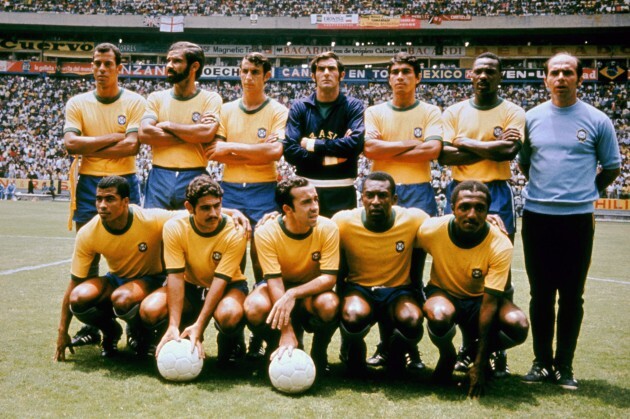
It ended Brazil 4, Italy 1. Brazil were the 1st 3-time winners of the World Cup. Zagallo became the 1st man ever to both play on and manage a World Cup winner.
Maybe it's the fact that it was the right time for the Baby Boomers, the largest generation ever, to see it. But the 1970 Brazil team embedded itself in the public consciousness as the greatest soccer team ever. Not just for results, but for quality. They were forerunner of the Netherlands' "Total Football" of the 1970s, the A.C. Milan mixture of Italian steel and Dutch free-flow in the late 1980s and early 1990s, and Arsène Wenger's Arsenal of the late 1990s and early 2000s.

Brazil won the World Cup again in 1994 and 2002, becoming the 1st 4-time and the 1st 5-time winner. (Italy would win in 1982 and 2006.) But, in spite of legends like Rivaldo, Ronaldo and Ronaldinho, it was never quite the same.

The late Spring and early Summer of 1970. There were wars with no end in sight. So many places in the world were a mess on their respective domestic fronts.

But 11 men from Brazil gave people all over the world something to marvel over. Then, and for the rest of their lives.

It wasn't just O Jogo Bonito, The Beautiful Game. It was Obra-Prima: A Masterpiece.

UPDATE: An article for ESPN.com, published after the 2026 World Cup, ranking all 23 tournaments, rated this one 5th.

*

June 21, 1970 was a Sunday. Football, basketball and hockey were out of season. These Major League Baseball games were played:

* The New York Yankees beat the Boston Red Sox, 14-11 at Fenway Park in Boston. Fritz Peterson started for the Yankees, and only lasted 2 innings. Gary Peters started for the Sox, and didn't get out of the 4th.

In spite of the length of this game, and the total number of hits, 38, there were no home runs. The Yankees scores 6 runs in the top of the 11th, with RBI singles by Jerry Kenney and relief pitcher Lindy McDaniel, an RBI double by Bobby Murcer, and a sacrifice fly by Danny Cater. The Sox came back with 2 in the bottom of the 11th, but McDaniel held them off for the win. For the Yankees, Cater and Thurman Munson each had 3 RBIs. So did Mike Andrews and Jerry Moses for the Sox. Carl Yastrzemski went 1-for-5.

* The Baltimore Orioles beat the Washington Senators, 4-2 at Memorial Stadium in Baltimore. Brooks Robinson went 1-for-4 with an RBI, but Frank Robinson did not play.

* The Atlanta Braves beat the Houston Astros, 6-4 at Atlanta Stadium. (It was renamed Atlanta-Fulton County Stadium in 1974.) Hank Aaron hit 2 home runs.

* The Montreal Expos beat the Pittsburgh Pirates, 3-2 at Forbes Field in Pittsburgh. Neither Roberto Clemente nor Willie Stargell got into the game.

* The Detroit Tigers swept a doubleheader with the Cleveland Indians at Cleveland Municipal Stadium. The Tigers won the opener, 7-2. Al Kaline was held out, to keep him fresh for the nightcap. The Tigers won that one, too, 9-8 in 12 innings.

The Indians led 6-1 after 2 innings, 8-5 after 6, and 8-7 after 7, and blew it. Tiger starter Mike Kilkenny didn't get out of the 1st inning, and Indian starter Rick Austin didn't get out of the 3rd. Tom Timmerman pitched 3 scoreless extra innings to become the winning pitcher.
Tiger shortstop Cesar Gutierrez tied a major league record by going 7-for-7: He singled to right in the 1st, singled to left in the 3rd, beat out a grounder to short in the 5th, doubled to left in the 7th, singled to right to drive in a run in the 8th, beat out another grounder to short in the 10th, and singled to center in the 12th. Gutierrez did not play in the 1st game.
 
None of his hits were home runs. But Jim Northrup hit 2, and Kaline and Mickey Stanley each hit 1 for the Tigers, Stanley's in the 12th making the difference. Tony Horton, Chuck Hinton and Ted Uhlaender each hit 1 for the Indians.

* A doubleheader was split at Crosley Field in Cincinnati. The Los Angeles Dodgers won the 1st game, and the Cincinnati Reds won the 2nd game. In each game, the final score was 9-3. Over the 2 games, Pete Rose went 4-for-9 with a home run and 2 RBIs, and Johnny Bench went 5-for-9 with 2 home runs and 4 RBIs.

* The St. Louis Cardinals swept a doubleheader from their arch-rivals, the Chicago Cubs, at Wrigley Field in Chicago, 3-0 and 3-2. Steve Carlton outpitched Ken Holtzman in the opener, and Bob Gibson outpitched Jim Colborn in the nightcap. Lou Brock went 2-for-8 with 2 walks and 3 stolen bases against his former team. Joe Torre went 3-for-7 with 2 walks and 2 RBIs. Ernie Banks went 1-for-3 in the 1st game, and got the 2nd game off.

* The Minnesota Twins beat the Kansas City Royals, 11-2 at Kansas City Municipal Stadium. Harmon Killebrew hit a home run, and Rod Carew went 2-for-4 with a a walk and an RBI.

* The San Francisco Giants beat the San Diego Padres, 7-2 at San Diego Stadium. (It was renamed Jack Murphy Stadium in 1980, and Qualcomm Stadium in 1997.) Willie Mays went 1-for-4. 

* The Oakland Athletics swept a doubleheader with the Chicago White Sox, 6-3 and 5-4 at the Oakland Coliseum. Reggie Jackson went 3-for-6 with an RBI, and Sal Bando hit 2 home runs in the 2nd game.

* The California Angels beat the Milwaukee Brewers, 6-5 at Anaheim Stadium. (It was renamed Edison International Field in 1997, and Angel Stadium of Anaheim in 2004.) Jay Johnstone doubled home the winning run in the bottom of the 10th inning.

* The New York Mets were supposed to play the Philadelphia Phillies at Shea Stadium, but it was rained out. It was made up as part of a doubleheader on September 9th. The Phillies won the 1st game, 3-2. The Mets won the 2nd game, 3-1.

Also on that day, Ball Four was published. It was pitcher Jim Bouton's diary of the 1969 season. Other players hated it because it showed them to be vain, immature and unfaithful to their wives. Team owners hated it because it showed just how badly they had been ripping the players off.

Bouton stood by his story for the rest of his life, and Ball Four remains the best-selling sports-themed book of all time – and maybe the funniest.

December 31, 1999 & January 1, 2000: The Millennium

December 31, 1999:  The Millennium arrives. The people of planet Earth survived. At a terrible cost. But we hadn't destroyed ourselves. ...