Showing posts with label three-finger brown. Show all posts

Friday, October 14, 2022

October 14, 1908: Any Team Can Have a Bad Century

October 14, 1908: The Chicago Cubs win the World Series. This had happened just 368 days earlier. It would not happen again for another 39,466 days.

The Cubs may have been the defending Champions, but they had a rough time getting back to the World Series. Led by the poetic infield of shortstop Joe Tinker, 2nd baseman Johnny Evers, and 1st baseman and manager Frank Chance, they battled the New York Giants and the Pittsburgh Pirates to the last day of the season -- and beyond.

Because of what became known as the Fred Merkle Game on September 23, the Cubs and Giants finished tied for 1st, and the Pirates were 1 game back. On October 8, the Merkle Game was replayed, the Cubs beat the Giants, 4-2, to win the National League Pennant.

Their opponents were the Detroit Tigers, they, too, had a 3-way race that took the American League Pennant to the final day. Led by Ty Cobb, the Tigers finished just half a game ahead of the Cleveland Naps (the pre-Indians and pre-Guardians were named for their manager and 2nd baseman, Napoleon Lajoie), and a game and a half ahead of the Chicago White Sox.

Game 1 of the World Series was played at Bennett Park in Detroit on October 10. The Cubs led 5-1 going to the bottom of the 7th, the Tigers took a 6-5 lead into the 9th, then the Cubs scored 5 in the 9th to win, 10-6. Mordecai "Three-Finger" Brown was the winning pitcher.

The Cubs won Game 2, 6-1. The Series shifted to Chicago for Game 3, and the Tigers won it, 8-3 at the West Side Grounds. Brown pitched a 4-hit shutout in Game 4, and the Cubs won, 3-0. Back in Detroit, the Cubs scored a run in the top of the 1st in Game 5, and that was all that Orval Overall, the winning pitcher in Game 2, would need. The Cubs got another run in the 5th, and the final score was 2-0.

The Cubs would win the Pennant again in 1910, 1918, 1929, 1932, 1935, 1938 and 1945 -- but lost all 7 World Series. They didn't make the postseason again until 1984, including late-season collapses in 1969 and 1977, with a whole lot of mediocrity in between. Their greatest broadcaster, Jack Brickhouse, was quoted as saying, "Any team can have a bad century."

It got worse. They had a shocking collapse in the 1984 NL Championship Series. They lost the NLCS in far less dramatic fashion in 1989. They had an inspiring run to the Playoffs in 1998, but got swept in the NL Division Series. In 2003, they won the NLDS, their 1st win in any postseason series since the 1908 World Series, but had their most shocking loss of all in the NLCS. In 2007 and 2008, for the 1st time in 100 years, they reached the postseason in back-to-back years, but lost in the NLDS both times.

In the 1989 film Back to the Future Part II, the Cubs were shown winning the 2015 World Series, against a team from Miami with an alligator logo, obviously in the American League. It was a joke, because the Cubs never won the World Series. They never even won the Pennant. It seemed like a wild guess about the future, played for laughs.

It became less funny in 1991, when Miami was awarded an expansion team, to begin play in 1993, and to originally be known as the Florida Marlins, for the National League, making Cubs vs. Miami in the World Series impossible. It became considerably less funny in 2003, when a Cub collapse gave the Marlins the Pennant. And it became less funny still in the actual 2015, when the Cubs did make it to the NLCS, but lost to the New York Mets, the same team that had victimized them in 1969, though there was some payback in 1984.

Somehow, in 2016, they bounced back, winning 103 games to take the NL Central Division, then beating the San Francisco Giants in the NLDS, and then beating the Los Angeles Dodgers in the NLCS, to win their 1st Pennant since 1945. Or, as songwriter Steve Goodman, a Cubs fan who died during their ill-fated run to the 1984 Playoffs, put it...

You know the law of averages says
anything will happen that can.
But the last time the Cubs won a National League Pennant
was the year we dropped the bomb on Japan.  

Finally, on November 2, 2016, in Game 7 of that year's World Series, the Cubs became World Champions again.

UPDATE: The Cubs have a team Hall of Fame. Inducted from their 1906-10 dynasty have been Tinker, Evers, Chance, outfielder Frank "Wildfire" Schulte, 3rd baseman Henry "Heinie" Zimmerman, and pitchers Brown, Overall and Ed Reulbach.

*

October 14, 1908 was a Wednesday. This was the only score on this historic day: Football was in midweek, professional basketball barely existed, and it was too early for a new hockey season to begin.

Tuesday, October 11, 2022

October 12, 1907: The Cubs Win In the Snow

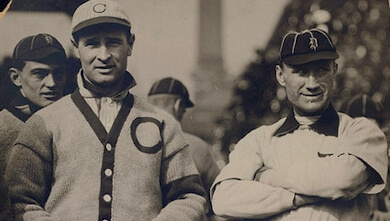
Opposing managers Frank Chance (left) and Hughie Jennings.
It hadn't started snowing yet, but a sweater was a good idea.

October 12, 1907: The Chicago Cubs win the World Series. Having lost it the year before to the crosstown White Sox, this is sweet redemption for them.

It wasn't quite revenge, as the opponents were the Detroit Tigers. But it was a dish served cold. There was no choice: Temperature-wise, this was the coldest World Series ever.

Game 1 was played at the West Side Grounds in Chicago, and no winner could be found: It went 12 innings before the umpires called it due to darkness. There was some retroactive appropriateness to this: The Cubs were the last team in the major leagues to put lights up at their home stadium, in 1988; while the Tigers were the last team in the American League to do so, in 1948.

This was the 1st World Series game for Tigers superstar Ty Cobb, 2 months shy of his 21st birthday. "Wild" Bill Donovan of the Tigers struck out 12 batters, matching the Series record set by Ed Walsh of the White Sox the year before. That record stood until 1929, when Howard Ehmke of the Philadelphia Athletics struck out 13 Cubs. The record was raised to 14, by Carl Erskine of the 1953 Brooklyn Dodgers; 15, by Sandy Koufax of the 1963 Los Angeles Dodgers; and the current mark of 17, by Bob Gibson of the 1968 St. Louis Cardinals.

Game 2 was also played in Chicago. For the 1st, and perhaps only, time in World Series history, the "hidden-ball trick" is successfully tried. In Game 2 at the West Side Grounds, Detroit Tigers 3rd baseman Bill Coughlin tags out Cub center fielder Jimmy Slagle, who is leading off the base.

It didn't help the Tigers much. Their 2nd baseman Herman "Germany" Schaefer was caught stealing, and Tiger manager Hughie Jennings, the star shortstop of the 1890s Baltimore Orioles dynasty, argued the call, becoming the 1st manager to be thrown out of a World Series game, by umpire Hank O'Day. The Cubs won, 3-1. Game 3 was also played in Chicago. With considerably less controversy, the Cubs won again, 5-1.

The Series shifted to Bennett Park in Detroit for Game 4. A triple by Cobb led to the Tigers' 1st run, but it turned out to be the only run, as the Cubs won, 6-1. And in a chilly Game 5, with snow falling, and the lowest attendance in World Series history, only 7,370 fans, Mordecai "Three-Finger" Brown pitched a 7-hit shutout to outpitch George Mullin, and the Cubs won, 2-0.

Frank Chance, the Cubs' manager and 1st baseman known as "The Peerless Leader," was only 30 years old. He remains the youngest manager ever to win the World Series.

There would not be snow at a World Series game again for 90 years, until Game 4 in 1997, in Cleveland. That Series had the greatest extremes of temperature: While the 3 games in Cleveland were cold, the 4 games in the Miami suburbs were hot.

*

October 12, 1907 was a Saturday. Among the notable college football games played that day were these:

* Army beat Trinity College of Connecticut, 12-0 on The Plain on the U.S. Military Academy grounds in West Point, New York.

* Navy and Vanderbilt played to a tie, 6-6 at Worden Field on the Naval Academy grounds in Annapolis, Maryland.

* The Carlisle Indian School beat Syracuse, 14-6 at Archbold Stadium in Syracuse, New York.

* Rutgers lost to Lehigh, 16-6 at Neilson Field in New Brunswick, New Jersey.

* Princeton beat Villanova, 45-5 at University Field in Princeton, New Jersey.

* The Western University of Pennsylvania beat their neighbors, Carnegie Tech, 6-0 at Exposition Park in Pittsburgh. In 1908, WUP became the University of Pittsburgh. In 1967, the Carnegie Institute of Technology merged with the Mellon Institute of Industrial Research, and became Carnegie-Mellon University.

* In what would later become a major rivalry, the University of Michigan beat Michigan State Agricultural College, 46-0 at Ferry Field in Ann Arbor. MSAC became Michigan Agricultural College in 1909, Michigan State College in 1925, and Michigan State University in 1955.

* In what was already a major rivalry, Texas and Texas A&M played to a tie, 0-0 at Gaston Park, the Texas League baseball park in Dallas.


And in English soccer, Woolwich Arsenal, the South-East London team that would later become Arsenal F.C., the North London team I support, went to Birmingham in the West Midlands, and beat Aston Villa, 1-0 at Villa Park.

Friday, October 7, 2022

October 8, 1908: The Merkle Playoff

Three-Finger Brown

October 8, 1908: In a make-up game necessitated by 19-year-old 1st baseman Fred Merkle's baserunning "boner" on September 23, the New York Giants met the Chicago Cubs at the Polo Grounds to decide the National League Pennant. Officially, Major League Baseball does not recognize this game as a "Playoff," but as a makeup of the September 23 game.

Both teams were 98-55, with the Pittsburgh Pirates, led by Honus Wagner, just 1 game behind them at 97-56. The Giants won 11 of their last 16, the Cubs 8 of their last 10, and the Pirates 9 of their last 10 before losing a makeup game against the Cubs on October 4, which eliminated them and kept the Cubs in position to win the Pennant, if they could win the makeup game against the Giants. It was the greatest Pennant race in National League history, and would remain its only real 3-team race until 1964.

And, judging from the newspaper accounts collected in G.H. Fleming's 1981 book The Unforgettable Season, we can only imagine that ESPN would have had wild coverage of the race, and that social media would have been absolutely poisonous.

Officially, the 1890-1911 version of the Polo Grounds was full to about 40,000 people. Unofficially, reports have suggested anywhere from 80,000 to 250,000 outside. This could very well have been the most people that ever showed up for a baseball game, regardless of whether they got in or not. Reports at the time told of people who died falling out of trees trying to watch, and of a man electrocuted while trying to watch from the elevated railway which then overlooked the ballpark.

Giant manager John McGraw, "the Little Napoleon," of course, started his best pitcher, the best pitcher in the game at that point, Christy Mathewson, who was 37-10. "Matty" had told McGraw, "I'm not fit to pitch today. I'm dog-tired." Although he had a full 4 days' worth of rest, he'd previously pitched 384 innings that season -- even in the Dead Ball Era, that was a lot -- and from September 12 to October 3, had pitched 10 games in 22 days, including 2 relief appearances.

Cub manager Frank Chance, "the Peerless Leader," started Jack Pfeister, who was only 12-10 on the season, but whose record against the McGrawmen earned him the nickname "Jack the Giant Killer." Jack would kill no Giants today: He began by hitting Fred Tenney with a pitch (in spite of all the passions running around the game, it was definitely not intentional), then walked Buck Herzog, picked Herzog off 1st base, gave up a double to Mike Donlin to score Tenney, and walked Cy Seymour.

Chance went against his name and took no more chances. He removed Pfeister, and brought in his best pitcher, the one man in the National League (along with Ed Walsh of the Chicago White Sox and Addie Joss of the Cleveland Naps in the American League) who could challenge Mathewson for the title of baseball's best pitcher: The man whose childhood farm accident had left him with a grip that gave him the best curveball in baseball at the time, Mordecai "Three-Finger" Brown. Brown got Art Devlin and Harry "Moose" McCormick out to end the threat.

It was still 1-0 New York in the bottom of the 3rd. Joe Tinker led off with a triple, and was singled home by Johnny Kling. Johnny Evers drew a walk. Frank "Wildfire" Schulte hit a double that scored Kling. Chance helped his own cause with a 2-run double. It was 4-1 Chicago, and the Polo Grounds crowd grew despondent.

Brown allowed a run in the bottom of the 7th, and the crowd picked up a little. But no more. The final score would be Cubs 4, Giants 2. The Cubs had their 3rd straight Pennant.

The game over, the Cubs, knowing that the crowd would be furious over having the Pennant "stolen" from them, made a mad dash for the clubhouse in center field. Most of them made it, but someone took a dagger and slashed Chance on the shoulder, and he had to be stitched up.

McGraw ordered pocket watches made, and given to all the Giant players, inscribed "THE REAL CHAMPIONS 1908." And for the rest of his life -- he lived until 1934, outliving Chance by 10 years -- he stood by Merkle, calling him the smartest player he'd ever managed, in spite of the "Bonehead" nickname that still stuck to him.

The Cubs went on to beat the Detroit Tigers, with young superstar Ty Cobb, in the World Series. They didn't win another Series for 108 years. The Giants would win 7 over that stretch, although they left New York for San Francisco after the 1957 season.

Merkle, as it turned out, outlived every Cub who played in the game, except for right fielder Jimmy Slagle, who outlived him by 2 months, both dying in 1956. The last survivor from either the September 23 game or the October 8 game was Giant shortstop Al Bridwell, who lasted until 1969.

As the last survivor, Bridwell was interviewed about it by Giant fan Lawrence S. Ritter for his 1966 book of baseball interviews The Glory of Their Times. He got the hit that would have scored the run in the September 23 game, had Merkle actually touched 2nd base, and, for all the grief it brought Merkle, told Ritter he wished he'd never gotten that hit.

October 8, 1908 was a Thursday. There was 1 other game in the major leagues that day. The Washington Senators beat the New York Highlanders, 7-5 at American League Park in Washington. Earle Gardner -- not to be confused with Earle Stanley Gardner, author of the Perry Mason novels -- went 4-for-5 for the Highlanders, to no avail. They finished 51-103, the most losses in franchise history to this day. In 1913, they would officially change their name to what many observers were already calling them: The New York Yankees.

December 31, 1999 & January 1, 2000: The Millennium

December 31, 1999:  The Millennium arrives. The people of planet Earth survived. At a terrible cost. But we hadn't destroyed ourselves. ...