Showing posts with label iowa state cyclones. Show all posts

Thursday, October 6, 2022

October 6, 1923: A Big Day In College Football

Jack Trice

October 6, 1923: It's a big day in college football. The University of Minnesota hosts Iowa State University at Northrop Field in Minneapolis. Iowa State's lone black player, Jack Trice, gets hurt on the 2nd play of the game, breaking his collarbone. He insists he is all right, and stays in the game. But in the 3rd quarter, he tries to tackle a runner, falls, and 3 Minnesota players trample him. He is taken to a hospital, but doctors don't think his life is in danger, and he is released as fit to travel back to Iowa State's campus in Ames. But he has suffered internal bleeding, and dies 2 days later at age 21.

Trice was from the Cleveland area, and in 1979, 56 years after the fact, that city's major paper, The Plain Dealer, investigated his death. A surviving Iowa State teammate, Johnny Behm, said, "One person told me that nothing out of the ordinary happened. But another who saw it said it was murder."

In 1997, Iowa State's home field was named Jack Trice Stadium. It is the only stadium in the NCAA's Football Bowl Subdivision (FBS, formerly known as Division I-A) named for a black person. A statue of him stands outside.
Also on this day, 2 of the classic stadiums of the Big Ten Conference open. Memorial Stadium opens on the campus of the University of Illinois in Champaign. The Fighting Illini beat Nebraska 24-7, and, led by sophomore running back Harold "Red" Grange, go on to win the National Championship.

The stadium's dedication game wouldn't come until the next season, October 18, 1924, when Grange would put on a legendary show in a win over Michigan. The Chicago Bears played their home games at Memorial Stadium in 2002, while the original Soldier Field was torn down and the new one built in its place.
Also on this day, College Field opens on the campus of Michigan State College in East Lansing, but not with a game. The school would be renamed Michigan State University on its Centennial in 1955; the stadium, Macklin Field in 1935, Macklin Stadium in 1948, and Spartan Stadium in 1957. John Macklin was their football coach from 1911 to 1915.

It opened with 14,000 seats. By the time Clarence "Biggie" Munn was coaching the school's 1st great team in the early 1950s, it seated 51,000. When Hugh "Duffy" Daugherty coached its great team of the mid-1960s, it had peaked at 76,000. Today, it seats 75,005. It switched to artificial turf in 1969, and has kept it.
Also on this day, the Los Angeles Memorial Coliseum, which had opened on the preceding May 1, hosts a football game for the 1st time. The University of Southern California hosts Pomona College, and wins, 23-7.

The USC Trojans have used the Coliseum as their home field ever since. Their nearby rivals, the University of California at Los Angeles, played home games there from 1933 to 1981. The UCLA Bruins now play home games at the Rose Bowl in Pasadena, which, due to the Trojans' success, has often seemed like a secondary home field to them.
The Coliseum has also been the leading professional football venue in Southern California. In the NFL, the Los Angeles Rams played there from 1946 to 1979, and again from 2016 to 2019; the Los Angeles Raiders from 1982 to 1994; Super Bowl I in 1967 and Super Bowl VII in 1973; and the postseason Pro Bowl from 1951 to 1972, and again in 1979.

Other pro football teams using the Coliseum: The Los Angeles Dons of the All-America Football Conference from 1946 to 1949, the Los Angeles Chargers of the American Football League in 1960, the Los Angeles Express of the United States Football League from 1983 to 1985, and the Los Angeles Xtreme of the XFL in 2001.

It has hosted the U.S. national soccer team 20 times, starting in 1965; and Mexico's team 61 times. In 1967, the only season of play for the United Soccer Association, it hosted the Los Angeles Wolves, who won that league's title. It also hosted the city's entry in another league starting that season, the Los Angeles Toros of the National Professional Soccer League. After that year, the two leagues merged to form the North American Soccer League, whose Los Angeles Aztecs used the Coliseum as their home field in the 1977 and 1981 seasons.

The Los Angeles Dodgers used the Coliseum as their 1st home field after leaving Brooklyn, while waiting for Dodger Stadium to be built, from 1958 to 1961. Their home games in the 1959 World Series against the Chicago White Sox attracted over 92,000 fans, the highest-attended competitive games in Major League Baseball history. An all-time record crowd for baseball, 115,300, attended a preseason game between the Dodgers and the Boston Red Sox on March 29, 1958, honoring the Dodgers' 50h Anniversary in Los Angeles.

And, of course, the Coliseum was the main venue for the 1932 and 1984 Summer Olympic Games, and will be again in 2028. 

*

October 6, 1923 was a Saturday. These other noteworthy college football games were played:

* Army beat Florida, 20-0 on The Plain in West Point, New York.

* Navy beat Dickinson College, 13-7 at Worden Field in Annapolis, Maryland.

* Maryland beat Pennsylvania, 3-0 at Franklin Field in Philadelphia.

* Notre Dame beat Lombard, 14-0 at Cartier Field in South Bend, Indiana.

* The University of Washington beat Willamette, 54-0 at Husky Stadium in Seattle. They would play Navy in the Rose Bowl, and it would end in a 14-14 tie.

* And in New Jersey, Princeton beat Johns Hopkins, 16-7 at Palmer Stadium in Princeton; and Rutgers beat Villanova, 44-0 at Neilson Field in New Brunswick.

In a regular-season baseball game, Ernie Padgett of the Boston Braves, in only his 2nd major-league appearance, pulled off an unassisted triple play in a doubleheader sweep of the Philadelphia Phillies, at Braves Field in Boston. It is the 1st such play in National League history. The Braves won the opener, 5-4 in 14 innings; and won the nightcap, 4-1 in a game called after 5 innings due to darkness.

Born in Philadelphia in 1899, the infielder would only last 5 seasons in the majors, and died in 1957 in East Orange, Essex County, New Jersey.

* The Brooklyn Robins -- as the Dodgers were known during the managerial tenure of Wilbert Robinson, 1914 to 1931 -- beat their arch-rivals, the New York Giants, 4-3 at Ebbets Field. Jack Fournier's grounder into a fielder's choice got Gene Bailey home with the winning run in the bottom of the 10th inning.

* The New York Yankees beat the Philadelphia Athletics, 3-1 at Yankee Stadium. Babe Ruth went 3-for-4 with an RBI, but no home run.

* The Chicago White Sox swept a doubleheader from the Cleveland Indians, 6-3 and 7-6 at League Park in Cleveland.

* The Pittsburgh Pirates beat the Cincinnati Reds, 7-1 at Redland Field (later Crosley Field) in Cincinnati.

* The Detroit Tigers beat the St. Louis Browns, 12-3 at Navin Field (later Briggs Stadium and Tiger Stadium) in Detroit. Ty Cobb, by this point the player-manager of the Tigers, went 1-for-3 with 2 walks and 2 RBIs. George Sisler did not play for the Browns.

* And the St. Louis Cardinals beat the Chicago Cubs, 5-2 at Sportsman's Park in St. Louis.

Monday, March 28, 2022

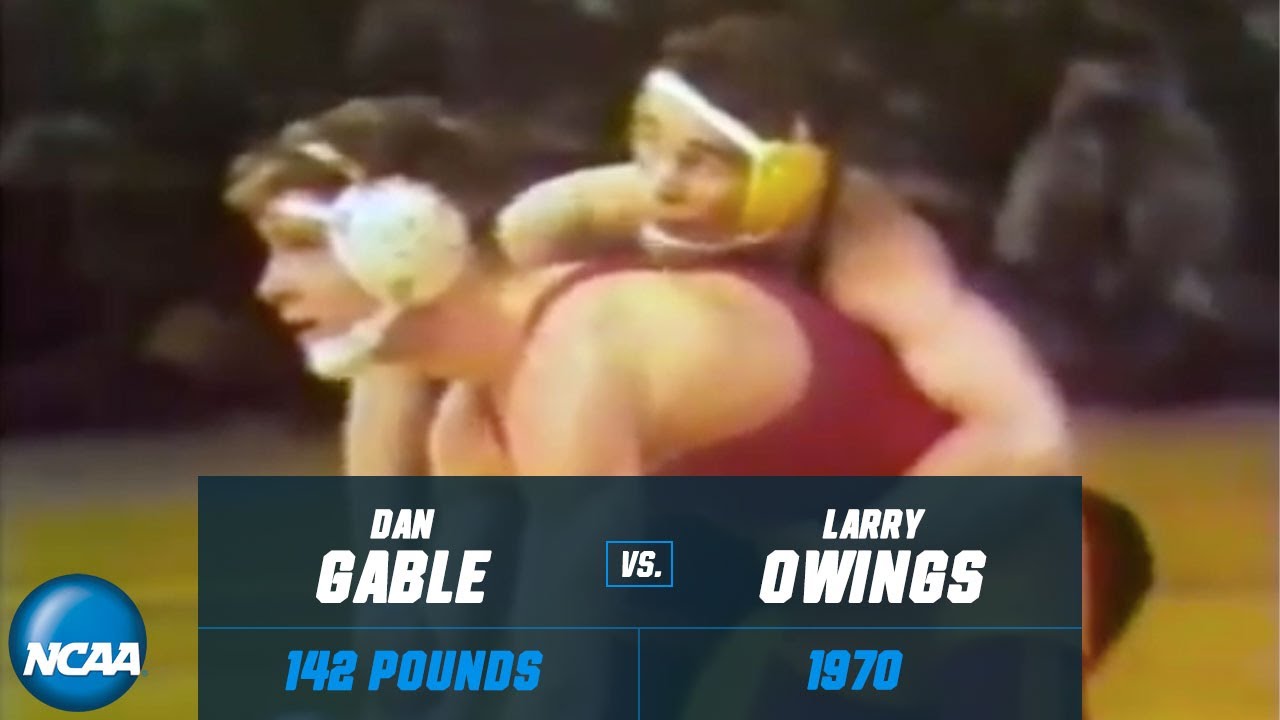
March 28, 1970: Dan Gable Falls to 181-1

March 28, 1970: The NCAA Wrestling Championships are held, at McGaw Hall (now known as Welsh-Ryan Arena), on the campus of Northwestern University in Evanston, Illinois, just north of Chicago.

The team title is won by Iowa State University. They had previously won in 1950, 1965 and 1969. On an individual basis, however, the tournament is known not for any of its winners, but for a defeated finalist: Dan Gable.

He is the greatest wrestler who ever lived, and the greatest wrestling coach who ever lived, and you can take all your WWE stars and stick them where the Sun don't shine.

At Waterloo West High School in Waterloo, Iowa, his career record as a wrestler was 64-0, winning 3 State Championships. He was also a State Champion swimmer, their quarterback, and a baseball player. At Iowa State University, he went 117-1, winning 2 National Championships, losing only in the NCAA Final in his senior year. In other words, he won 225 amateur wrestling matches before he was finally beaten.

(Gable could have won 3 National Championships, but, until 1972, the NCAA didn't allow freshmen to compete on varsity teams in any sport, with a few exceptions, such as during wartime or following a team tragedy, as happened later in 1970 with the football teams at Wichita State and Marshall universities.)

That loss was in the 142-pound weight class, which would be Welterweight in boxing. The bout was close: 13-11. The wrestler who defeated him was Larry Owings of the University of Washington, who was named the tournament's outstanding wrestler.

He kept competing as an amateur, winning Gold Medals in 1971, at the Pan American Games in Cali, Colombia; and at the World Championships in Sofia, Bulgaria, behind the Iron Curtain. That got the attention of the Soviet Union athletic machine: Rightly proud of their wrestling achievements, and looking to the 1972 Olympic Games in Munich, West Germany, they vowed to "scour the Eastern Bloc to find a wrestler who could take down Dan Gable."

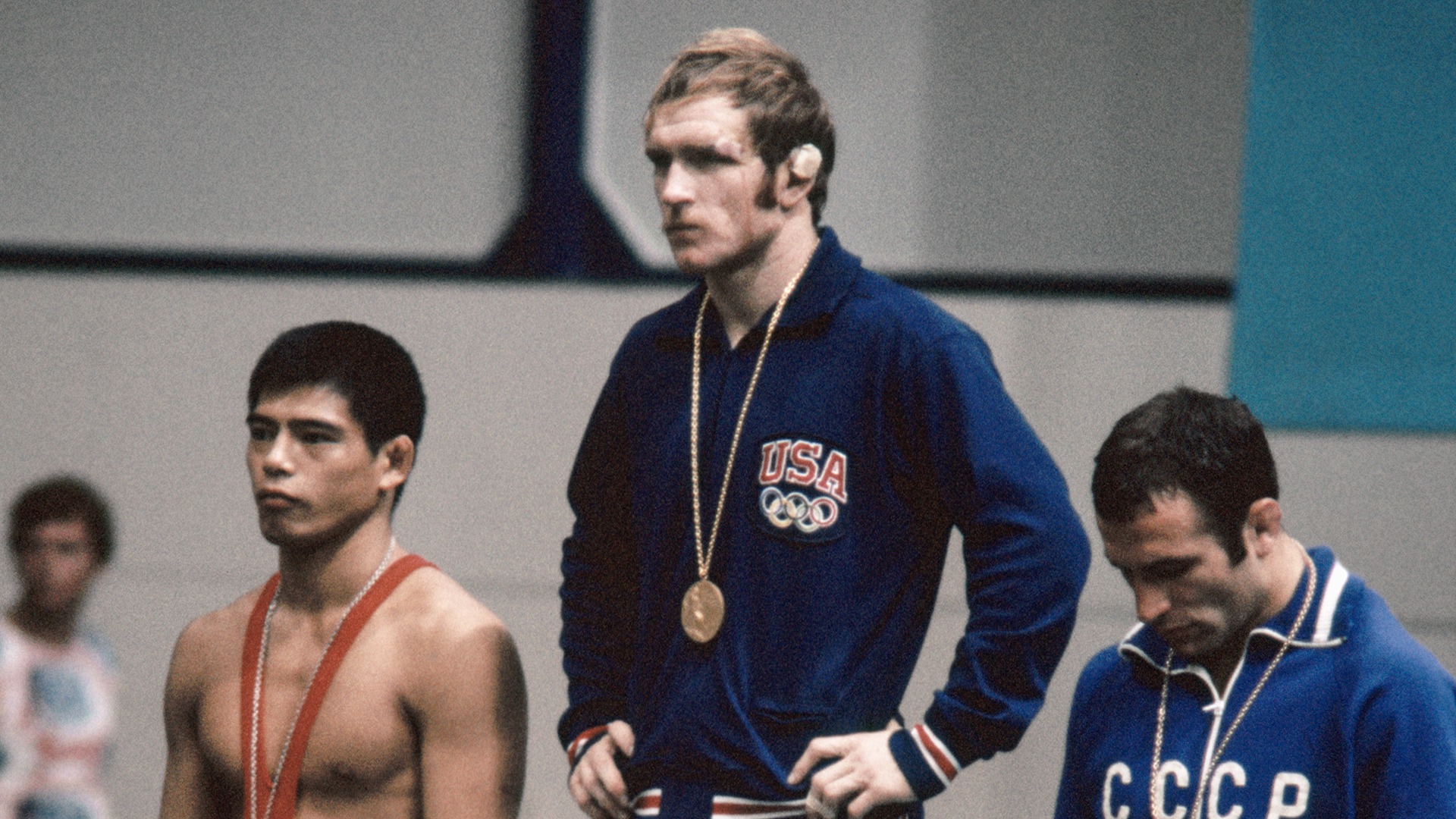
They were unsuccessful: Despite an injured knee and stitches in his head after an injury in his 1st match, he won the Gold Medal in the 150-pound weight class, without surrendering a single point in any match, an absolutely dominating performance.

He defeated Safer Sali of Yugoslavia (the part that is now the Republic of North Macedonia), Klaus Rost of West Germany, Stefanos Ioannidis of Greece, Kikuo Wada of Japan, and Włodzimierz Cieślak of Poland. In the Final, with 3 wrestlers, each competing against the other 2, Gable beat Wada again, and both beat the Soviet contender, Ruslan Ashuraliyev. So Gable beat 3 wrestlers from Warsaw Pact nations.
Despite having been an Iowa State graduate, he went to their arch-rivals, the University of Iowa, in 1976. He coached them to 9 straight National Championships from 1978 to 1986, finally being dethroned in 1987 by... Iowa State.

He coached until 1997, with a dual meet record of 355-21-5, 16 team National Championships, 152 All-Americans, 45 individual National Champions, and 4 Olympic Gold Medalists. He also coached the U.S. Olympic team in 1980 (boycotted), 1984 and 2000. He also, literally, wrote the book on coaching the sport: Coaching Wrestling Successfully, published in 1999. Of course, he is in the National Wrestling Hall of Fame. He should be: He is both the Babe Ruth and the Casey Stengel of his sport.

And what, you might ask, happened to Larry Owings? The native of Canby, Oregon was unable to follow up his great achievement, losing in the NCAA Tournament Final in 1971 and 1972, and was not selected to the U.S. Olympic Team for Munich. He became a high school wrestling coach and a building contractor in Oregon and Washington State. He has particularly been an advocate for women's wrestling, and has also been elected to the National Wrestling Hall of Fame. As of March 28, 2022, both Gable and Owings are still alive.
Larry Owings (left) and Dan Gable, 2018

The NCAA first conducted a National Championship Tournament for wrestling in 1928, and Iowa State were the 1st hosts. They did not win: Oklahoma A&M did. Changing their name to Oklahoma State in 1958, they have won by far the most titles, 34, although none since 2006. Iowa have won 24, Penn State 10, Iowa State 8, Oklahoma 7, Minnesota 3; and 1 each by Indiana, Cornell, Northern Iowa, Michigan State, Arizona State and Ohio State.

(UPDATE: Penn State won in 2023 and 2024, raising their total to 12.)

*

March 28, 1970 was a Saturday. Actor Vince Vaughn was born. This was also the day that Major League Baseball held a preseason exhibition game to raise money for Dr. Martin Luther King's Southern Christian Leadership Conference. I have a separate entry for that event.

Baseball was otherwise in Spring Training. Football was out of season. One game was played in the NBA. Appropriately, it was in Dr. King's hometown: The Atlanta Hawks beat the Chicago Bulls, 124-104 at the Alexander Memorial Coliseum (now the McCamish Pavilion), on the Georgia Tech campus in Atlanta. Three games were played in the American Basketball Association:

* The New York Nets lost to the New Orleans Buccaneers, 100-92 at the New Orleans Municipal Auditorium. After this season, the Bucs would become the Memphis Pros, then the Memphis Tams, then the Memphis Sounds, and fold in 1975. The Nets would enter the NBA in 1976, moving to New Jersey in 1977 and Brooklyn in 2012. 

* The Kentucky Colonels beat the Carolina Cougars, 101-98 at the Greensboro Coliseum in Greensboro, North Carolina. The Cougars became the Spirits of St. Louis in 1974. The Spirits and the Colonels both survived to the end of the ABA in 1976, but neither team was admitted to the NBA.

* And the Dallas Chaparrals beat the Denver Rockets, 150-126 at the Moody Coliseum in Dallas. Both of these teams still exist, though not under those names: The Chaparrals became the San Antonio Spurs in 1973; and the Rockets, anticipating entering the NBA, which already had the Houston Rockets, took on the name of the 1st NBA team from their city, the Denver Nuggets. Both teams entered the NBA in 1976, along with the Nets and the Indiana Pacers.

There were 5 games in the NHL:

* The New York Rangers and the Montreal Canadiens played to a tie, 1-1 at the Montreal Forum.

* The Boston Bruins and the Detroit Red Wings played to a tie, 5-5 at the Boston Garden.

* The Pittsburgh Penguins beat the Philadelphia Flyers, 2-1 at The Spectrum in Philadelphia.

* The Chicago Black Hawks and the Toronto Maple Leafs played to a tie, 1-1 at Maple Leaf Gardens in Toronto.

* The Los Angeles Kings beat the Minnesota North Stars, 4-2 at The Forum outside Los Angeles in Inglewood, California.

* And the St. Louis Blues and the California Golden Seals were not scheduled.

And in English soccer, Arsenal played Birmingham-area team Wolverhampton Wanderers to a draw, 2-2 at the Arsenal Stadium, a.k.a. Highbury, in North London.

Wednesday, January 12, 2022

January 12, 1907: The Big Eight Conference Is Founded

January 12, 1907: The Missouri Valley Intercollegiate Athletic Association is founded in Kansas City, Missouri. It eventually became known as the Big Eight Conference, or the Big 8.

The 5 original members were the University of Kansas, the University of Missouri, the University of Nebraska, Washington University of St. Louis, and the University of Iowa. Iowa only competed in the MVIAA for football and track, remaining in the league that would become the Big Ten Conference, and left the MVIAA entirely in 1911, leading to a split between Iowa and Iowa State that lasts to this day, and one between Iowa and neighboring Nebraska that lasted until 2011.

Iowa State University and Drake University of Des Moines, Iowa joined in 1908. Kansas State University joined in 1913. Grinnell College of Grinnell, Iowa was admitted in 1919, the University of Oklahoma in 1920, and Oklahoma State University (known as Oklahoma A&M until 1958) in 1925.

In 1928, Iowa State, Kansas, Kansas State, Missouri, Nebraska and Oklahoma left to form a new league. The remainders -- Drake, Grinnell, Oklahoma A&M and Washington University formed the Missouri Valley Conference. The 6 schools that left took on the MVIAA name, but began to informally call themselves the Big Six Conference. Both leagues traced their founding to the original MVIAA of 1907.

The University of Colorado was added in 1928, making the MVIAA a Big Seven. In 1957, Oklahoma State left the MVC and joined the MVIAA, making it the Big Eight. In 1964, the Big Eight name was made official.

From 1954 to 1995, the Orange Bowl in Miami usually invited the Big 8 football champion to participate. Of those 42 appearances: Oklahoma and Nebraska, the league's biggest football rivals, each made 15. In 1978, Nebraska beat Oklahoma in the regular season, then lost their last regular-season game, setting up a rematch in the Orange Bowl, which Oklahoma won.

Colorado appeared 5 times, Missouri 2, Kansas 1. Iowa State, Kansas State and Oklahoma State never made it. No Big 8 school appeared in the Orange Bowls of 1965, 1967, 1974 and 1975.

Kansas and Missouri, and to a lesser extent Kansas and Kansas State, would be heated rivals in basketball first, football second. Oklahoma and Oklahoma State would be college wrestling's greatest rivalry, but their "Bedlam" rivalry in football became heavily favored in OU's favor, and OU considers both Nebraska and Texas to be bigger rivals than OSU.

Iowa State also developed a great wrestling program, though not as great as Iowa, their Big 10 rivals. Kansas became, far and away, the league's greatest basketball program, and, to a lesser extent, in soccer; Oklahoma, its best in track & field; Oklahoma State, its best in baseball.

In the 1995-96 schoolyear, 4 schools from the Southwest Conference applied for, and received, membership to the Big 8: The University of Texas, Texas A&M, Texas Tech, and Baylor University of Waco, Texas. The 4 remaining SWC schools -- Texas Christian, Southern Methodist, Houston and its crosstown rival Rice -- joined other leagues.

Thus did 2 of the great college sports leagues, the Big 8 and the SWC, come to an end, but a better league, the Big Twelve Conference, was formed. The 4 Texas schools and the 2 Oklahoma schools formed the South Division, the other teams the North Division.

But that league did not hold: Nebraska went to the Big Ten, Colorado went to the Pac-10, and Texas, Texas A&M and Oklahoma all left for the Southeastern Conference. The Big 12 resembled the old Big 8, but little remains of that Great Plains collegiate sports tradition.

*

January 12, 1907 was a Saturday. Baseball and football were out of season. Professional basketball barely existed. There were no hockey games on this day, but, a few days later, the Kenora Thistles would beat the Montreal Wanderers for the Stanley Cup.

English soccer played the 1st Round Proper of its Football Association (FA) Cup. Teams winning that day were Aston Villa, Bolton Wanderers, Bradford City, Brentford, Bristol City, Burslem Port Vale, Bury, Crystal Palace (beating eventual League Champions Newcastle United in a big upset), Everton, Liverpool, Middlesbrough, Millwall, Norwich City, Notts County, Oldham Athletic, Sheffield Wednesday, Southampton Sunderland and West Ham United.

Playing to draws, and requiring a replay: Woolwich Arsenal, 1-1 away to Grimsby Town at Blundell Park, winning the replay 3-0; Accrington Stanley over Crewe Alexandra; Barnsley over Nottingham Forest; Blackburn Rovers over Manchester City; Bristol Rovers over Queens Park Rangers, Derby County needing a 2nd replay to defeat Chesterfield; Fulham over Stockport County, Lincoln City over Chelsea; Luton Town over Gainsborough Trinity; New Brompton needing a 2nd replay to defeat Burton United; Portsmouth over Manchester United, Tottenham Hotspur needing a 2nd replay to defeat Hull City; and West Bromwich Albion over Stoke City.

Sheffield Wednesday would go on to win the Final over Everton.

December 31, 1999 & January 1, 2000: The Millennium

December 31, 1999:  The Millennium arrives. The people of planet Earth survived. At a terrible cost. But we hadn't destroyed ourselves. ...