Showing posts with label netherlands. Show all posts

Tuesday, December 27, 2022

December 27, 1949: Indonesia Is Recognized as Independent

December 27, 1949: The Kingdom of the Netherlands recognizes the independence of its colony, formerly the Dutch East Indies. For over 4 years, it had been operating as the independent Republic of Indonesia.

On August 17, 1945, in the wake of the Japanese surrender in World War II, the Dutch East Indies, devastated by the War, declared their independence as the Republic of Indonesia, under nationalist leader Sukarno (his entire name was just the one word) as President. It would take another 4 years of armed struggle before the Netherlands gives up and accepts their independence.

Today, the island nation is a democracy with, after the 1998 fall of dictator Suharto, who had overthrown Sukarno in 1970, an elected President. It is home to 255 million people, more than any except China, India and America. Most of them are ethnic Asians and Muslims, and it is the most populous majority-Muslim nation. Its flag, red on top and white on bottom, is identical to that of Monaco, and the reverse of that of Poland.
Since 1950, the nation's capital has been Jakarta, home to 10.7 million people, and a metropolitan area of over 35 million, on Java, the most populous island in the world, with 157 million, or about 61 percent of Indonesia's population.
But in 2019, President Joko Widodo officially announced that, due to climate change resulting in the slow sinking of the part of Java on which Jakarta stands, the national capital would be moved to East Kalimantan, on the island of Borneo. Most of that island belongs to Indonesia, but portions of it belong to Malaysia, and the Sultanate of Brunei is also on the island.
UPDATE: Due to construction delays, including due to COVID, the new capital city, named Nusantara, about 800 miles to the northeast, and already being promoted as "A global city for all," is set to open on August 17, 2028.

*

December 27, 1949 was a Tuesday. Baseball was out of season. Football season was over, except for a few bowl games. No games were scheduled for the NHL. There were 3 games in the NBA:

* The New York Knicks lost to the Boston Celtics, 97-78 at the Boston Arena (now the Matthews Arena).

* The Rochester Royals beat the Washington Capitols, 96-72 at the Edgerton Park Arena in Rochester, New York.

* And the Indianapolis Olympians beat their fellow Indianans, the Anderson Packers, 89-82 at the Butler Fieldhouse (now the Hinkle Fieldhouse) in Indianapolis.

Saturday, September 17, 2022

September 17, 1944: Operation Market Garden

September 17, 1944: The Allies launch Operation Market Garden, an attempt to liberate the Netherlands. It turned out to be the Nazis' last win... and the Allies handed it to them through bungling.

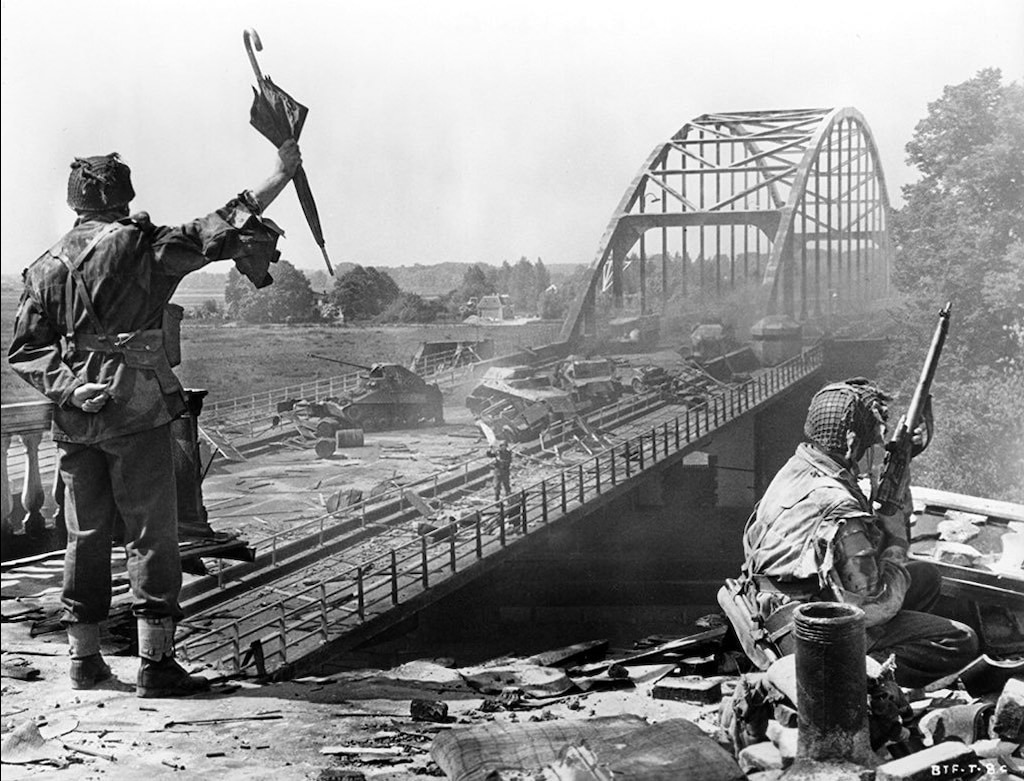
Its objective was to create a 64-mile salient into German territory, with a bridgehead over the Nderrijn (Lower Rhine) River, creating an Allied invasion route into northern Germany. This was to be achieved by two sub-operations: Seizing 9 bridges with combined U.S. and British airborne forces (the part of the operation codenamed "Market"), followed by British land forces swiftly following over the bridges ("Garden"). British General Bernard Montgomery was the architect of Operation Market Garden.

The airborne soldiers, numbering more than 41,000, were dropped in sites where they could capture key bridges and hold the terrain until the land forces arrived. This included the U.S. Army's famed 101st Airborne Division, which further included the 1st Demolition Section of the Regimental Headquarters Company of the 506th Parachute Infantry Regiment. They became known as "The Filthy Thirteen," and inspired the 1965 novel and the 1967 film The Dirty Dozen.

The land forces consisted of 10 armored and motorized brigades with a similar number of soldiers. The land forces advanced from the south along a single road surrounded by flood plains on both sides. The plan anticipated that they would cover the 64 miles from their start to the bridge across the Rhine in 48 hours. About 100,000 German soldiers were in the vicinity to oppose the allied offensive.

The operation succeeded in capturing the Dutch cities of Eindhoven and Nijmegen, and a few V-2 rocket launching sites. It failed in its most important objective: Securing the bridge over the Rhine at Arnhem. The Germans slowed and then halted the armored brigades advancing from the south before they reached the Rhine. The First Airborne Division was unable to secure the bridge, and was withdrawn from the north side of the Rhine after suffering 8,000 dead, missing, and captured out of a complement of 12,000 men.

Market Garden has been called "a testament to the failure of intelligence." Despite all the Allies' planning and logistics, they never had agents with actual eyes on the ground, and signal intelligence missed the Panzer division that was there for resupply and retrofit.

For this reason, the argument that Montgomery stopped U.S. General George Patton from coming in and winning the battle, waylaying the fuel and supplies he was using in France following the liberation of Paris, and made the European Theater of the war last months longer than it should have, is wrong: Patton's troops would have run into the same German tanks, and faced the same resistance.

In the aftermath of the battle, the Germans punished the people of the Netherlands by cutting off food shipments to the country, and 20,000 died of starvation. Arnhem was finally captured by the allies in April 1945, near the end of the war.

The story was told in the 1974 book A Bridge Too Far by Cornelius Ryan, made into a film in 1977.

*

September 17, 1944 was a Sunday. The NFL season kicked off, but with just 1 game: The Green Bay Packers beat the Brooklyn Tigers, 14-7 at the Dairy Bowl in the Milwaukee suburb of West Allis, Wisconsin. The Dairy Bowl was a football stadium built in the infield of a speedway, now known as the Milwaukee Mile, at the Wisconsin State Fair Park.

Formerly the football version of the Brooklyn Dodgers from 1930 to 1943, the Tigers folded after the season.

Since it was a Sunday, especially with wartime travel restrictions in effect, most baseball teams played doubleheaders that day:

* The New York Yankees were swept by the Philadelphia Athletics, 5-4 and 2-1 at Yankee Stadium.

* The New York Giants were swept by the Philadelphia Phillies, 7-0 and 5-4 at Shibe Park in Philadelphia. Bill Lee (no relation to the later pitching "Spaceman" of the same name) pitched a 2-hit shutout in the opener.

* The Brooklyn Dodgers split with the Boston Braves at Braves Field in Boston. The Braves won the 1st game, 3-0. Jim Tobin pitched a 4-hit shutout. The Dodgers won the 2nd game, 3-2.

* In a single game, the Washington Senators beat the Boston Red Sox, 7-6 at Griffith Stadium in Washington.

* There was a split at Forbes Field in Pittsburgh. The Pittsburgh Pirates won the 1st game, 7-1. The Cincinnati Reds won the 2nd game, 2-1. Frank McCormick doubled home Woody Williams with the winning run in the top of the 10th inning.

* The Detroit Tigers swept the Cleveland Indians, 7-2 and 3-0 at Cleveland Municipal Stadium. Rufus Gentry pitched a 2-hit shutout in the 2nd game.

* The Chicago Cubs swept their arch-rivals, the St. Louis Cardinals, at Wrigley Field in Chicago. Both games ended 2-1.

* And there was a split at Sportsman's Park in St. Louis. The St. Louis Browns won the 1st game, 5-1. The Chicago White Sox won the 2nd game, 8-2.

Sunday, September 11, 2022

September 11, 1945: The Kolff Kidney Machine

September 11, 1945: Dr. Willem Kolff performs a dialysis of a kidney patient, marking the 1st successful use of what would later be called an "artificial kidney" or a "kidney machine."

Willem Johan Kolff was born on February 14, 1911 at Leiden, The Netherlands. His father was a physician, and he decided at an early age to follow the footsteps of his father. He began his medical studies at the University of Leiden in 1930. From 1934 to 1936, he worked as an assistant in the pathological anatomy department of the university.

After completing M.D. in 1938, Kolff continued studies at the University of Groningen. It was during this time that Kolff became interested in the possibility of artificially simulating the function of kidney, to remove toxins from the blood of patients with uremia, or kidney failure. Professor Polak Daniels, chief of the medical department at Groningen, became his mentor and supported him.

He began his research in dialysis at Gottingen after watching a young man die from kidney failure. He became interested in and studied deeply on blood transfusion as well. When Germany attacked the Netherlands in 1940, Kolff founded the first blood bank on the continent of Europe.

He theorized that a machine could be made to work as a kidney substitute, and could be used to filter out acid and waste materials from the blood. The machine could be used for such time till the kidney tissue could regenerate and function again.

But all resources were restricted during World War II. His creative mind laid hands on laundry tubs, wooden drums, cellophane tubing, a semipermeable sausage casing, and an electric motor. With these, he made a crude apparatus. With that, he drew the patient's blood, cleansed it of impurities, and pumped it back into the patient.

The first several patients lived only a few days. The breakthrough came a month after the war ended. In August 1945, Kolff was asked to treat Maria Schafstad, a 65-year-old female prisoner. She was in a coma due to renal failure. Maria was branded as a Nazi collaborator, and Kolff was advised to deny treatment and allow her to die. But Kolff, true to the principles of medical ethics, believed that, as a doctor, it was not his job to determine who should live or die. He started treating her as a patient and not a criminal. After many hours of treatment, she slowly opened her eyes. She lived for 6 more years, and died for reasons not related to kidney issues.

After the war, he shipped free dialysis machines to researchers in England, Canada and the United States. He immigrated to the United States in 1950, where he worked at the Cleveland Clinic Foundation. Later, at the University of Utah, Dr. Kolff mentored Dr. Robert Jarvik, and, together, they created the Jarvik-7 artificial heart. Over the years, Dr. Kolff mentored many other pioneers in the artificial organ field.

In 1967, Kolff moved to the University of Utah. Despite the opposition of many physicians, he wanted to give the patient more comfort and allow them to perform their dialysis at home, without a doctor's supervision. In 1975, he introduced the Wearable Artificial Kidney, an 8-pound chest pack with an 18-pound auxiliary tank.

On December 2, 1982, the Jarvik-7 artificial heart was successfully implanted into Barney Clark, a 61-year-old dentist. When Cark died after 4 months, due to other issues, the Jarvik-7 was still functioning.

Like polio vaccine creator Jonas Salk, Kolff never patented his inventions, and donated everything to the world. He officially retired in 1997, but continued his research and creative work till his death on February 11, 2009.

*

September 11, 1945 was a Tuesday. These baseball games were played:

* The New York Giants lost to the St. Louis Cardinals, 6-5 at Sportsman's Park in St. Louis. The Jints led 5-1 at the 7th inning stretch, but the Cards scored 2 in the 7th, 1 in the 8th and 2 in the 9th, the winning run coming on Whitey Kurowski singling home Marty Marion. Mel Ott, at age 36 the Giants' right fielder and manager, with 510 home runs in his career to make him the National League's all-time leader, went 0-for-5. He only played 43 more games, and hit 1 more home run.

* The Brooklyn Dodgers split a doubleheader with the Cincinnati Reds at Crosley Field in Cincinnati. The Reds won the opener, 5-4. Despite Augie Galan going 4-for-5, and Dixie Walker 1-for-4 with a walk and 3 RBIs, the Dodgers lost it in the 10th inning when Al Libke singled home Kermit Wahl. Walker went 3-for-5 in the nightcap.

* The Pittsburgh Pirates swept a doubleheader from the Philadelphia Phillies, 5-4 and 5-1 at Forbes Field in Pittsburgh. They won the 1st game in the 10th inning, when Bob Elliott singled Johnny Barrett home.

* The Chicago Cubs beat the Boston Braves, 5-4 at Wrigley Field in Chicago.

* The Detroit Tigers beat the Boston Red Sox, 5-0 at Fenway Park in Boston. Dizzy Trout pitched a 2-hit shutout.

* The Chicago White Sox beat the Washington Senators, 2-1 at Griffith Stadium in Washington.

* The Philadelphia Athletics were supposed to play the St. Louis Browns at Shibe Park in Philadelphia. But wartime travel restrictions were still in effect, so the teams agreed to move this day's game to the day before, and play a doubleheader. The Browns won the 1st game, 3-2. The A's won the 2nd game, 5-3.

* And the New York Yankees and the Cleveland Indians were simply not scheduled.

Friday, September 2, 2022

September 2, 1945: The Battleship Missouri Surrender

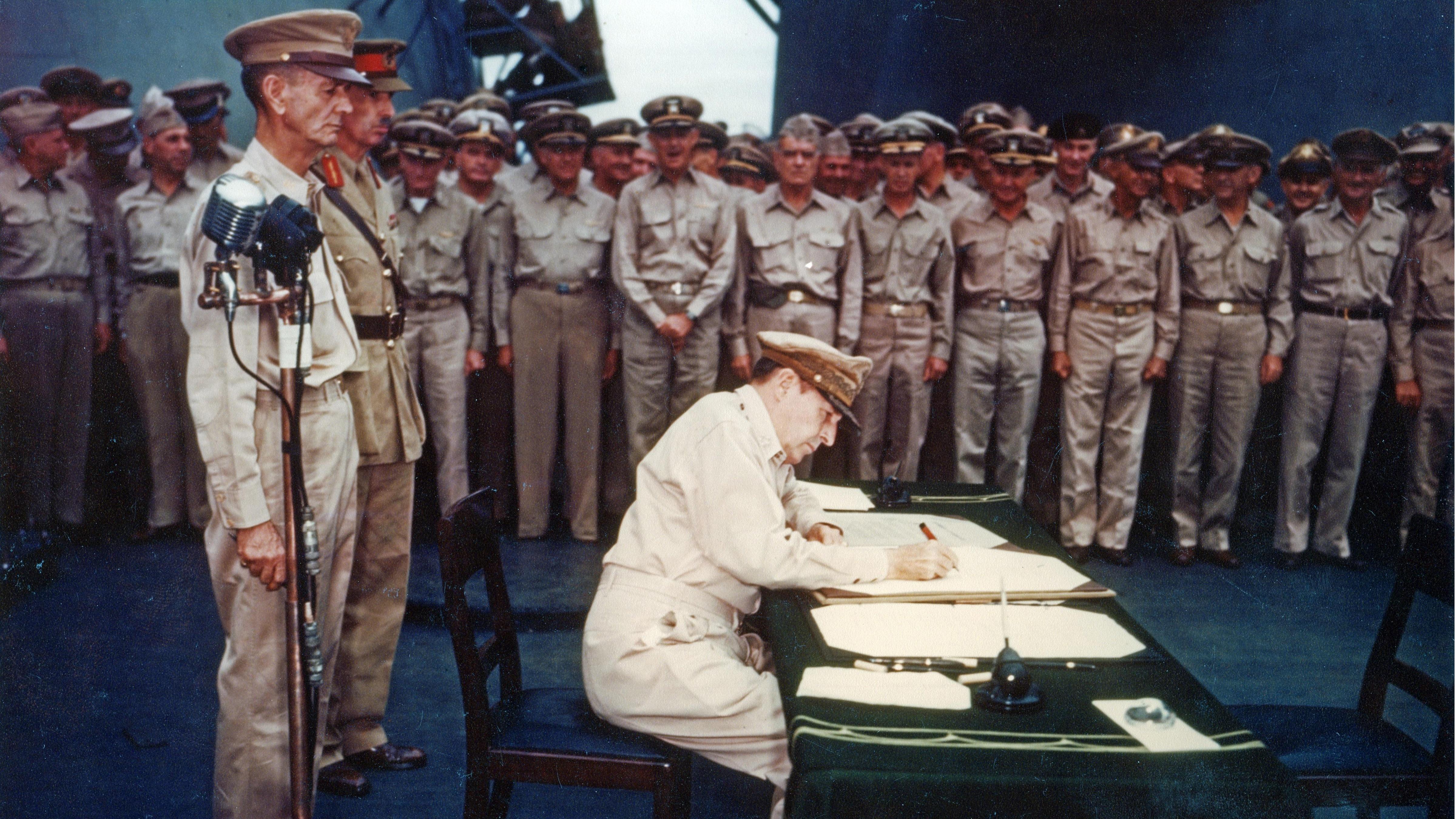
MacArthur signing, for the U.S. acknowledgement of the surrender

September 2, 1945: Foreign Minister Mamoru Shigemitsu, acting for the Empire of Japan, signs the Instrument of Surrender to end World War II, on the deck of the American battleship USS Missouri, anchored in Tokyo Bay. Shigemetsu later served as Deputy Prime Minister, and died in 1957.

The signing took place at 9:04 AM on September 2, Japan Standard Time -- 8:04 PM on September 1, U.S. Eastern. Representing the Allied Powers:

* The United States of America: General of the Army Douglas MacArthur, Fleet Admiral Chester Nimitz, and Admiral John S. McCain Sr., grandfather of the longtime Senator and Presidential candidate.

* The British Empire: British Admiral of the Fleet Sir Bruce Fraser, Canadian Colonel Lawrence Moore Cosgrave, Australian General Sir Thomas Blamey, and New Zealand Air Vice Marshall Sir Leonard Isitt.

* France: Général d'armée Philippe Leclerc.

* The Netherlands: Vice Admiral Conrad Helfrich.

* The Republic of China: General Xu Yongchang.

* The Union of Soviet Socialist Republics: Lieutenant General Kuzma Derevyanko.

Admiral Fraser was the last survivor of these men, living until 1981.

Among the sailors serving aboard the Missouri at the time, and thus a witness to the ceremony, was Bernard Schwartz, an aspiring actor from The Bronx, who was inspired to enlist in the Navy by Cary Grant and Tyrone Power, who had both appeared in films about submarine service. He took his stage name from the 1936 film Antony Adverse, and a name that had been in his mother's family: Kurtz. He anglicized the name to "Tony Curtis."

World War II was over, and the Allies had won. Now, the victorious nations had work to do, to set their own people free. The British Empire would get there first, mostly getting it done by 1960. France took a bit longer, due to a nasty war in Algeria. America took until the Voting Rights Act of 1965. The Soviet Union, and the countries formed when it broke apart? Some of those countries have never been free, to this day.
USS Missouri

The Missouri, built at the Brooklyn Navy Yard, was the last ship built by the U.S. Navy to be classified as a "battleship" and still be in active service. The "Mighty Mo" also served in the Korean War, the Vietnam War, and the Persian Gulf War, and was decommissioned in 1992. It is now a museum ship -- appropriately, docked at Pearl Harbor in Honolulu, Hawaii.

*

September 2, 1945 was a Sunday. Due to that fact, and the wartime travel restrictions that were still in place, not only was a full slate of baseball games played that day, but nearly every team was in a doubleheader:

* The New York Yankees split a doubleheader with the Washington Senators at Griffith Stadium in Washington. The Yankees won the opener, 4-2. Joe Page, later to be known as the best reliever in the game, started, and went 8 innings for the win. The Yankees scored all 4 runs in the 6th inning, including 3 on a bases-loaded triple by Nick Etten.

The Senators won the nightcap, 3-0. Roger Wolff almost pitched a 5-hit shutout, but he walked 2 batters in the bottom of the 9th, and Senators manager Ossie Bluege brought Mickey Haefner in to get the last out.

* The New York National League arch-rivals split a doubleheader at the Polo Grounds. The Brooklyn Dodgers won the 1st game, 7-4. The New York Giants won the 2nd game, 6-2. Dixie Walker singled home the winning run of the 1st game in the top of the 11th inning, and Tommy Brown singled home 2 more.

* A doubleheader was split at Braves Field in Boston. The Boston Braves won the 1st game, 6-3. The Philadelphia Phillies won the 2nd game, 5-4.

* The Philadelphia Athletics swept a doubleheader from the Boston Red Sox, 1-0 and 7-2 at Shibe Park in Philadelphia. Bobo Newsom pitched a 5-hit shutout in the 1st game. He would finish 8-20 with a 3.29 ERA for a team that finished 52-98.

* The Pittsburgh Pirates swept a doubleheader from the Cincinnati Reds, 4-2 and 7-3 at Crosley Field in Cincinnati.

* In a single game, the Cleveland Indians beat the Detroit Tigers, 3-2 at Briggs Stadium (later Tiger Stadium) in Detroit. Having already been discharged by the U.S. Army, Hank Greenberg went 1-for-3 with a walk and an RBI. At the end of the month, his grand slam on the last day of the regular season would win the Pennant for the Tigers.

* A doubleheader was split at Comiskey Park in Chicago. The Chicago White Sox won the 1st game, 6-0. Eddie Lopat, later to star with the Yankees, pitched a 5-hit shutout. The St. Louis Browns won the 2nd game, 3-2.

* And the NL's Midwestern arch-rivals split a doubleheader at Sportsman's Park in St. Louis. The Chicago Cubs won the 1st game, 4-1. Frank Secory hit a bases-loaded double in the top of the 10th inning.

The St. Louis Cardinals won the 2nd game, 4-0. Charles "Red" Barrett allowed only 1 hit, a single by Lennie Merullo in the 3rd inning. It was his 20th win of the season, and he finished 23-12. But his only full season with the Cards would be the one season between 1942 and 1946 in which they didn't win the Pennant. He did win one with the 1948 Boston Braves.

Tuesday, August 9, 2022

August 9, 1942: The Execution of Edith Stein

August 9, 1942: The Nazis execute Edith Stein, a Jewish woman who had become a Catholic nun, is executed at the Auschwitz concentration camp in Poland. She was 50 years old.

A native of what was then Breslau, Germany -- now Wrocław, Poland -- she read about Teresa of Ávila, the Spanish nun who founded the Carmelite order, converted, and joined the order, taking the name Teresa Benedicta of the Cross. In 1934, living in the Carmelite monastery in Echt, the Netherlands, she published Finite and Eternal Being – An Ascent to the Meaning of Being. This book proposed a phenomenological doctrine of being (Seinslehre), which knows itself to be Christian, i.e. as taking Christian Revelation to contribute towards the view of the world in which it looks for and finds the meaning of being in being's unfolding.  

When the Nazis took over the Netherlands in 1940, she began to believe that, because she was born a Jew, she would be arrested and taken to a concentration camp. On July 20, 1942, the Dutch Bishops' Conference had a public statement read in all churches across the nation on 20 July 1942, condemning the Nazis' racism. Six days later, the arrest of all Jewish converts in the Netherlands was ordered. Teresa Benedicta and her sister Rosa -- a biological sister, not a fellow nun with the title of "Sister" -- was arrested by the SS on August 2, and they were executed a week later.

She was officially declared a martyr of the Catholic Church, and is 1 of the 6 "Patron Saints of Europe." The others all long precede the modern era: Benedict of Nursia, in the 6th Century AD; Cyril and Methodius, Byzantines who ministered to the Slavic peoples of the 9th Century; Bridget of Sweden and Catherine of Siena, in the 14th Century.

*

August 9, 1942 was a Sunday. Comedian, actor and TV director David Steinberg was born on this day. This was also the day the Nazis played a soccer game against Dynamo Kyiv that became known as "The Death Match." I have a separate entry for that event.

These baseball games were played:

* The New York Giants swept a doubleheader from the Philadelphia Phillies at Shibe Park in Philadelphia, 3-2 and 2-0. Mel Ott went 1-for-8 with an RBI over the 2 games, and won the 1st game with a suicide squeeze bunt, belying his status as the National League's all-time home run leader (until surpassed by Willie Mays in 1966). Bill McGee pitched a 5-hit shutout in the 2nd game.

* The St. Louis Cardinals swept the Pittsburgh Pirates, 4-3 and 2-1 at Forbes Field in Pittsburgh. Rookie Stan Musial went 4-for-6 with 2 RBIs. The 2nd game was shortened to 8 innings, because of Pennsylvania's curfew for Sunday sports (long since repealed). 

* A doubleheader was split at Crosley Field in Cincinnati. The Chicago Cubs beat the Cincinnati Reds in the opener, 10-8 -- in 18 innings. Stan Hack went 5-for-5 with and an RBI for the Cubs in this game, Phil Cavarretta went 2-for-5 with 2 RBIs, and both of them drew 4 walks. For the Reds, Eddie Joost went 4-for-9 with 4 RBIs, and Bert Haas went 5-for-9 (but no RBIs). The Cubs led 4-0 going to the bottom of the 9th, and blew it. Both teams scored 2 runs in the 12th inning. Dom Dallessandro doubled home the winning run for the Cubs in the top of the 18th. The nightcap was shortened to 5 innings by a Sunday curfew. At that point, the Reds led, 2-1.

* The Chicago White Sox swept a doubleheader from the Cleveland Indians at Comiskey Park in Chicago, 11-1 and 3-2.

* The Detroit Tigers swept a doubleheader from the St. Louis Browns at Sportsman's Park in St. Louis, 9-3 and 3-1.

* The New York Yankees were supposed to play the Philadelphia Athletics at Yankee Stadium, but got rained out. It was made up as part of a doubleheader the next day. The A's won the 1st game, 4-1. The Yankees won the 2nd game, 3-2. Joe DiMaggio went 1-for-4 in each game.

* The Boston Red Sox were supposed to play the Washington Senators at Griffith Stadium in Washington, but got rained out. It was made up on September 8, and the Senators won, 15-11. Jake Early had 5 RBIs for the Senators, Jimmy Pofahl 4, and Bobby Estallela 3. Ted Williams went 1-for-4 with an RBI.

* The Brooklyn Dodgers were supposed to play the Boston Braves at Braves Field, but got rained out. The game was rescheduled for September 24, and the Dodgers won, 5-3. 

Tuesday, August 2, 2022

August 2, 1948: The Flying Housewife

August 2, 1948: Fanny Blankers-Koen wins her 4th Gold Medal of the 1948 Olympics, at the original Wembley Stadium in London.

At the time, she was 30 years old, married, with 2 children. Today, such a performance in the Olympic Games by a woman who met that description would not be considered a big deal. At the time, it was staggering.

Francina Elsje Koen was born on April 26, 1918 in Lage Vuursche, Utrecht, the Netherlands. The Netherlands has 12 Provinces, including North Holland, which includes Amsterdam; and South Holland, which includes Rotterdam and The Hague. But only those 2 Provinces are properly called "Holland." Telling someone living in Eindhoven they live in "Holland" would be like telling someone in Glasgow they live in "England." Don't do it.

"Fanny" excelled in several sports, including swimming. However, in her youth, the Netherlands had several successful female swimmers, so she turned to a sport they were not as strong in, one her father had competed in: Track and field. At age 17, she set a national record in the 800 meters. But races longer than 400 meters had been removed from the Olympics for women, as it was decided that women couldn't handle running for longer than that. This would later be proven to be ridiculous, and longer races were reintroduced.

Fanny was coached by Jan Blankers, who had competed in the Olympics on home soil in Amsterdam in 1928. Despite his being 15 years older, they would eventually marry. (In some European countries, a woman's married name comes first in the hyphenated form. This would also be true of another Olympian, the great Austrian skier Annemarie Moser-Pröll.) Jan encouraged Fanny to try for the 1936 Olympics in Berlin. At age 18, She finished 5th in both the high jump and as a member of the Dutch 4x100-meter relay team. The highlight of her Olympic experience was getting Jesse Owens' autograph.

She set some world records, and was considered a favorite to win a Gold Medal at the 1940 Olympics in Helsinki, Finland. But World War II led to the cancellation of those Games, and those of 1944, set for Axis nation Japan.

Fanny and Jan married on August 29, 1940, 3 months after the Nazi takeover. Their son, Jan Jr., was born in 1942. The European sports media presumed that, between having become a mother and not knowing when the war would end, Fanny's sports career was over. It wasn't: From 1942 to 1944, she set 6 world records. She had daughter Fanneke in 1945, and the war ended. This didn't end her career, either: She won 2 Gold Medals at the 1946 European Championships.

Two months before the 1948 Olympics, she broke her own world record in the 80-mter hurdles. Despite this, the sports journalists of the time ignored recent performance, and said that, at 30, she was too old to win. She didn't listen. She won the 100 meters, making her the 1st Dutch athlete, male or female, to win an Olympic Gold Medal in track and field. She won a photo finish for the 80-meter hurdles.

She got homesick, and broke down in tears, and refused to run in the 200 meters. Jan consoled her, and talked her into running, and won it. And she anchored the Dutch women's team in the 4x100-meters, taking them from 3rd place when she took the baton to 1st.

There were 9 women's track and field events at the 1948 Olympics, and she won 4 of them. The media called her "The Flying Dutchmam" (as opposed to "Dutchman") and "The Flying Housewife." Queen Juliana made her a knight of the Order of Orange Nassau, the country's highest honor. The City of Amsterdam gave her a new bicycle, "so she need not run so much."

She won 3 more Gold Medals at the 1949 European Championships, and in 1952, she finally made it to an Olympics held in Helsinki. But time caught up with her, and she won no medals. In 1955, she won her last victory, the Dutch national title in the shot put.

In retirement, Fanny served as team Captain of the Dutch track and field team from the 1958 European Championships through the 1968 Olympics. Jan died in 1977. Since 1981, the annual Fanny Blankers-Koen games have been held in Hengelo, in the Province of Overijssel.
In 1999, the IAAF, the world governing body for track and field, declared her the Female Athlete of the Century. She attended the awards ceremony in Moscow. However, by then, she was already deaf and in the early stages of Alzheimer's disease. She died on January 25, 2004. She was 85 years old.

One more note: The old Wembley Stadium is 1 of 3 stadiums to have hosted an Olympic Games, a World Cup Final and a UEFA European Cup/Champions League Final. The others are the Olympiastadions in Berlin and Munich. In 2024, the Stade de France outside Paris will make it 4.

*

August 2, 1948 was a Monday. There were 4 baseball games were played:

* The New York Giants lost to the St. Louis Cardinals, 21-5 at the Polo Grounds. Stan Musial, having the best season of his career, went 2-for-6 with a home run, a walk and an RBI. And he wasn't even close to being the star of this game. Del Wilber went 3-for-6 with 5 RBIs. Whitey Kurowski went 2-for-4 with home run, a walk and 4 RBIs. Enos Slaughter went 3-for-5 with 2 walks and 3 RBIs. Marty Marion went 2-for-5 with a home run, a walk and 3 RBIs. And Erv Dusak went 2-for-7 with a home run and 2 RBIs.

* The Brooklyn Dodgers weren't as badly beaten as their arch-rivals, but it counted the same in the standings: They lost to the Chicago Cubs, 4-2 at Ebbets Field. Jackie Robinson went 1-for-5. In the top of the 10th inning, Eddie Waitkus doubled home the go-ahead run, and future Dodger Andy Pafko drove in another with a sacrifice fly.

* The Cincinnati Reds beat the Boston Braves, 3-1 at Braves Field in Boston. Johnny Vander Meer, 10 years after pitching the 1st of his back-to-back no-hitters against the Braves, outpitched Vern Bickford.

* And in the only American League game of the day, the St. Louis Browns beat the Washington Senators, 7-5 at Sportsman's Park in St. Louis.

Monday, July 11, 2022

July 11, 2010: The Battle of Soccer City

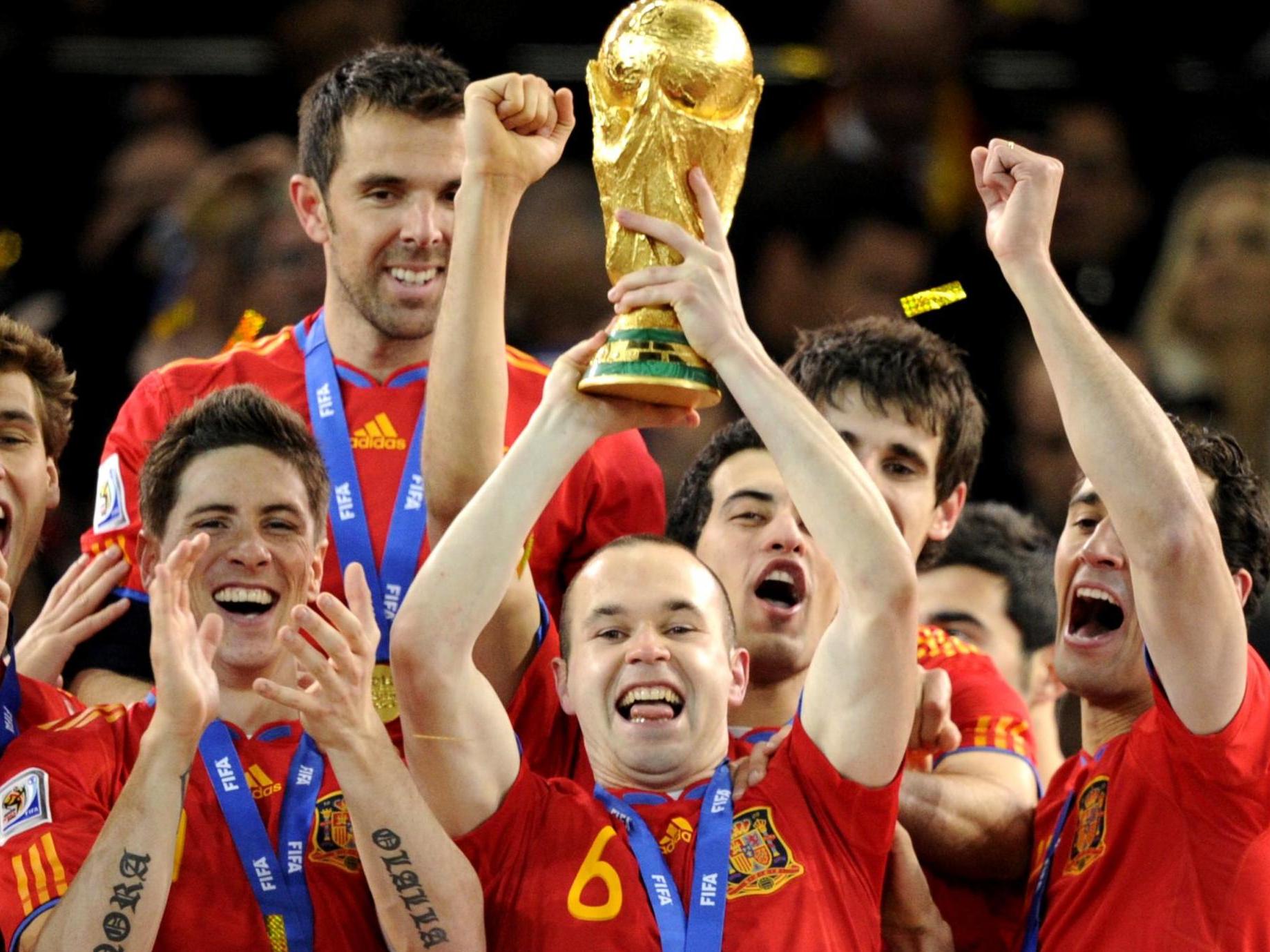
Andrés Iniesta with the World Cup

July 11, 2010: The World Cup Final is held at Soccer City in Johannesburg, South Africa. For sponsorship reasons, it is known as First National Bank Stadium, or FNB Stadium. But since the World Cup prohibits corporate names on stadiums, it was referred to as "Soccer City." It was built in 1989, on the edge of the Soweto township, a key location in black South Africans' struggle for equality. It is also the home of one of the country's top soccer teams, Kaizer Chiefs.

ABC broadcast it in America, including the constant annoyance of the fans with their native musical instrument, the vuvuzela. Given the countries competing in the game, it should have been a beautiful Final for the world championship of what Pelé called "The Beautiful Game": Spain vs. the Netherlands.

It wasn't. It was the ugliest Final in World Cup history, even more so than the tainted Final of 1978 in which Argentina, on Fascist-controlled home soil, beat the Netherlands.

The Spain side was managed by former Real Madrid boss Vicente del Bosque, and was dominated by 2 of the most-cheating teams in soccer, brought together for a common purpose: Real Madrid and FC Barcelona. From Real Madrid came goalkeeper Iker Casillas (Captain of club and country), defenders Sergio Ramos (maybe the dirtiest player in the sport at the time), Raúl Albiol and Álvaro Arbeloa; and midfielder Xabi Alonso.

From "Barça" came defenders Carles Puyol (their Captain), a dirty tackler, and Gerard Piqué, a notorious diver; midfielders Andrés Iniesta, Xavi Hernández (known by just his first name) and Sergio Busquets (another diver); forward Pedro Rodríguez (also known by his first name); and backup goalkeeper Victor Valdés.

From Valencia CF came forward David Villa; midfielders Juan Mata (yet another diver) and David Silva; and defender Carlos Marchena. From Villareal CF came defender Joan Capdevila. From Sevilla FC came midfielder Jesús Navas. From Athletic Bilbao came forward Fernando Llorente and midfielder Javi Martínez. And 3 players came from England's Premier League. From Liverpool FC were forward Fernando Torres and goalkeeper Pepe Reina. And from North London team Arsenal FC was former Barcelona midfielder Cesc Fàbregas.

And the Dutch? This was not your father's Oraanje. No Total Football, no brilliant passing, no stylish goalscoring. They were more like a sledgehammer. They were managed by Bert van Marwijk, who once managed Rotterdam side Feyenoord. As usual, the Dutch team was dominated by players who had come from the Netherlands' "Big Three" Feyenoord, Amsterdam team Ajax, and Eindhoven team PSV. But, as the Dutch top league, the Eredivisie, doesn't pay as well as the leagues of neighboring countries like England, Spain, France and Germany, not all of them had stayed with those teams:

From Ajax: Goalkeeper Maarten Stekelenburg; defenders Gregory van der Wiel, John Heitinga (then with Liverpool team Everton FC); midfielders Demy de Zeeuw, Nigel de Jong (then with Manchester City), Wesley Sneijder (who had played with Real Madrid, but was then with Internazionale Milano) and Rafael van der Vaart (then, ironically, with Real Madrid); and forward Ryan Babel (then with Liverpool).

From Feyenoord: Defender Giovanni van Bronckhorst (Captain); and forwards Dirk Kuyt (then with Liverpool) and Robin van Persie (then with Arsenal).

From PSV: Defender André Ooijer; midfielders Ibrahim Afellay, Mark van Bommel (who had played for Barcelona, but was then with Bayern Munich); and forwards Arjen Robben (who had played with Real Madrid, but was then with Bayern) and Klaas-Jan Huntelaar (who had also played for Ajax and Real Madrid, but was then with AC Milan).

From AZ Alkmaar: Defender Joris Mathijsen (then with Hamburger SV); midfielder Stijn Schaars.

From Enschede side FC Twente: Backup goalkeeper Sander Boschker; defender Edson Braafheid (then with Glasgow, Scotland team Celtic); and forward Eljero Elia (then with Hamburger).

From RKC Waalwijk: Defender Khalid Boulahrouz (then with VfB Stuttgart).

From FC Utretcht: Backup goalkeeper Michael Vorm, who led to the soccer-themed pun: "Vorm is temporary, class is permanent."

The Netherlands slogged through their Group, winning all 3 games, but not particularly distinguishing themselves in any of them, beating Denmark 2-0, Japan 1-0, and Cameroon 2-1. Spain opened their run by getting upset 1-0 by Switzerland, but rebounded to beat former colonies Honduras 2-0 and Chile 2-1.

In the Round of 16, the Netherlands beat Slovakia, 2-1 in Durban; while Spain beat neighboring Portugal, 1-0 in Cape Town. In the Quarterfinals, 2 goals by Sneijder turned an early 1-0 Brazil lead into a 2-1 Dutch win in Port Elizabeth; while Spain left it late, with Villa scoring in the 83rd minute, to beat Paraguay, 1-0 in Johannesburg. In the Semifinals, the Netherlands hung on to beat Uruguay, 3-2 in Cape Town; while Spain got a goal from Captain Puyol in the 73rd to beat Germany, 1-0 in Durban.

The referee for the Final was Howard Webb, the English former police officer infamous for his bald head and his apparent favoritism for Manchester United. To be assigned as the top official for a World Cup Final should be the greatest honor any sports official can ever receive, but Webb did not live up to the distinction. To say that he lost control of the match would suggest that he even tried to exert any control. The 14 yellow cards he gave out -- 9 to the Netherlands, 5 to Spain -- were more than double the previous record.
Howard Webb

Spain had the 1st serious chance of the game just 5 minutes in, when Stekelenburg made a diving save of a Ramos header. Shortly thereafter, the Dutch had their 1st chance, but Casillas saved from Kuyt. Heitinga deflected a Ramos shot over the crossbar in the 11th. Casillas stopped a screamer of a free kick from Sneijder.

In the 28th minute, with Webb having already given each side 2 yellow cards, de Jong kicked Alonso in the chest. For this, Webb should have shown him a straight red card and sent him off, but he only gave de Jong a yellow. As if the match wasn't rough enough, Casillas did Spain no favors by colliding with Puyol and injuring him in the 33rd. Puyol was able to carry on. Just before halftime, Casillas saved a shot by Robben, and it remained 0-0.

In the 50th minute, Spain did what Barcelona usually do when they think they should be awarded a penalty, and surrounded the ref in an attempt to intimidate him. Webb, used to such behavior from Premier League teams Man United and Chelsea, refused to give in. Two minutes later, Casillas saved a van Persie shot.

Heitinga was booked for a foul on Villa in the 56th. In the 62nd, Robben had a one-on-one with Casillas, but shot too low, and Casillas deflected it. In the 70th, Villa had an equally good chance, and an equally bad shot, deflected by Stekelenburg. Ramos had a great chance in the 77th, but fired over the crossbar. Casillas made a brilliant stop on Robben in the 83rd. Regulation play ended with the game still scoreless.

On to extra time. In the 92nd, Xavi went down a little too easy after a collision with Heitinga, and, again, the Spaniards demanded a penalty. Again, they didn't get it. Apparently, their reputation preceded them. Fàbregas had come on as a substitute for Alonso, and had a shot in the 95th, saved by Stekelenburg. In the 101st, Navas fired a shot that had the stadium roaring, thinking it was a goal, but it only hit the side netting. In the 104th, Fàbregas just missed, slightly wide of the goalpost. Still 0-0 as the match headed into the 2nd half of extra time.

In the 109th, Xavi was brought down by Heitinga. This earned him a 2nd yellow, equivalent to a red. Neither of his yellow card offenses was especially bad, but there were 2 of them, and, given the rules, he, rather than the much rougher de Jong -- or any of the Spanish players -- was off, and the Dutch were down to 10 men.

In the 115th minute, Webb made a call that may have changed the outcome of the game. He rightly awarded the Netherlands a free kick, which Sneijder took, and Casillas tipped it behind the goal. That should have resulted in a corner for the Netherlands. Instead, Webb awarded Spain a goal kick.

Torres took the kick, took the ball up the pitch, and passed it to Fàbregas, who passed it to Iniesta, who scored. His goal in the 116th minute remains the latest ever scored in a World Cup Final. The Dutch complained to Webb about his decisions, both the awarding of the goal kick and his failure to call a foul on Elia. Mathijsen slammed the ball on the grass in anger, and Webb booked him instead. But Spain held on for the 1-0 win.

Two days later, on July 13, Spain held its World Cup celebration in the capital of Madrid. Barcelona players pull an FC Barcelona shirt over the head of Fàbregas, calling him "The future of Barcelona, the future of Spain," as if he were only on loan to Arsenal, and that he had to be sent back to his boyhood club.

He did not immediately remove the shirt and tell his national team mates to respect his contract. A year later, he proved that he didn't respect his contract, either: He went on strike and faked an injury. Soon, he was sold back to Barcelona.

Had I been the manager of Arsenal, I would have sold Fàbregas to Real Madrid, Barcelona’s arch-rivals, the next day. For one pound. It would have sent multiple messages. To Fàbregas: You are a traitor, and are being punished for it. To Barcelona: Do not mess with The Arsenal. To the Arsenal players: No one is irreplaceable. And to the Arsenal fans: I know you love him, and that I didn't get any money for him, but there are things more important than money. Alas, the manager of Arsenal was Arsène Wenger, and he had too much class to do this.

Howard Webb retired from refereeing in 2014. In 2022, he was named the head of the Professional Game Match Officials Limited (PGMOL) is the body responsible for refereeing games in English soccer. He replaced Mike Riley, who had also been known for calls favoring Manchester United, both as a referee himself and in upholding the calls and cards of the referees he governed.

An article for ESPN.com, published after the 2026 World Cup, ranking all 23 tournaments, rated this one 17th, citing the rough play, the cheating, and those damn vuvuzelas.

*

July 11, 2010 was a Sunday. These Major League Baseball games were played:

* The New York Yankees beat the Seattle Mariners, 8-2 at Safeco Field (now T-Mobile Park) in Seattle. CC Sabathia was the winning pitcher. Marcus Thames hit a home run. Mark Teixeira went 4-for-5 with an RBI. Derek Jeter went 1-for-5 with 2 RBIs. Alex Rodriguez went 0-for-5.

* The New York Mets beat the Atlanta Braves, 3-0 at Citi Field. Johan Santana allowed 5 hits over 7 innings, and Bobby Parnell and Francisco Rodríguez completed the 5-hit shutout.

* The Philadelphia Phillies beat the Cincinnati Reds, 1-0 at Citizens Bank Park in Philadelphia. Cole Hamels allowed 6 hits over 7 2/3rds innings, and José Contreras, J.C. Romero and Brad Lidge finished the 6-hit shutout. The only run came in the 3rd inning, when Jimmy Rollins singled Carlos Ruiz home.

* The San Francisco Giants beat the Washington Nationals, 6-2 at Nationals Park in Washington.

* The Boston Red Sox beat the Toronto Blue Jays, 3-2 at the Rogers Centre in Toronto. David Ortiz * and Darnell McDonald hit home runs.

* The Tampa Bay Rays beat the Cleveland Indians, 6-5 at Tropicana Field in St. Petersburg, Florida. Jason Bartlett singled Carl Crawford home with the winning run in the bottom of the 10th inning.

* The Minnesota Twins beat the Detroit Tigers, 6-3 at Comerica Park in Detroit.

* The Chicago White Sox beat the Kansas City Royals, 15-5 at U.S. Cellular Field (now Rate Field) in Chicago.

* The Milwaukee Brewers beat the Pittsburgh Pirates, 6-5 at Miller Park (now American Family Field) in Milwaukee.

* The Baltimore Orioles beat the Texas Rangers, 4-1 at Rangers Ballpark (now Choctaw Stadium) in the Dallas suburb of Arlington, Texas.

* The St. Louis Cardinals beat the Houston Astros, 4-2 at Minute Maid Park (now Daikin Park) in Houston.

* The San Diego Padres beat the Colorado Rockies, 9-7 at Coors Field in Denver.

* The Florida Marlins beat the Arizona Diamondbacks, 2-0 at Chase Field in Phoenix. How many Marlin pitchers does it take to pitch an 8-hit shutout? This time, 6: Alex Sanabia allowed 5 hits over 3 1/3rd innings, Burke Badenhop none in 2/3rds of an inning and credited as the winning pitcher, Brian Sanches none over 2, José Veras none in 1, Clay Hensley 2 in 1, and Juan Carlos Oviedo 1 in 1.

* The Los Angeles Dodgers beat the Chicago Cubs, 7-0 at Dodger Stadium in Los Angeles. Vicente Padilla allowed 2 hits over 8 innings, and Hung-Chih Kuo completed the 4-hit shutout.

* And the Oakland Athletics beat the Los Angeles Angels, 5-2 at the Oakland Coliseum.

Thursday, July 7, 2022

July 7, 2019: Queen Megan Rapinoe's Coronation

July 7, 2019: The U.S. women's national soccer team wins the Women's World Cup, beating the Netherlands in the Final, 2-0 at Parc Olympique Lyonnais in Décines-Charpieu, in the suburbs of Lyon, France.

The Dutch women's team had recently risen to the same level of talent as their legendary men's team. So their appearance in the Final, as one of a few teams that were seen as possibilities for it before the tournament began, was not exactly a surprise. Certainly, the Americans reaching it was no surprise at all: It would have been a shock if they hadn't.

The U.S. team had won the Women's World Cup in 1999. They had also done so in 1991, the 1st time the tournament was held, but few people noticed. In 1999, it was nationally televised and heavily promoted, and people noticed.

That 1999 U.S. women's soccer team shocked Middle America's ignorant male sports fans, because this was a great women's sports team that wasn't a bunch of stereotypical butch lesbians. They all seemed to look feminine, even attractive. Many of them were married. Some of them had returned to competition after having children, even taking their babies and their diaper bags to practice.

It would take until 2015 for the U.S. team to win the World Cup again, and this time, some of the women were lesbians, and they didn't give a damn who knew it. In 2019, they repeated. Carli Lloyd, the biggest star of the '15 team, was older and didn't have as much of an impact in '19. She's straight and married. But the best player on the team was Alex Morgan: Gorgeous, straight, married, and, as the year came to a close, pregnant. (Her husband, former MLS player Servando Carrasco, was a classmate of hers at the University of California at Berkeley. Their daughter, Charlie Elena Carrasco, was born on May 7, 2020).

But the unquestioned leader, the queen of this court, was Megan Rapinoe, who converted a penalty for the 1st U.S. goal in the Final, and then made the pose seen in the photo above. Celebrating her 30th birthday during the tournament,  the native of Redding, California is gay, has been out since 2012, usually has a short pink hairstyle, and is well aware of what her performance and example can mean, to men and women, to straights and gays, to supporters and haters. She's supported causes from LGBT rights to Colin Kaepernick's protest. And when establishment figures objected, she didn't care. She pissed off people who deserved to get pissed off.

In December 2019, Rapinoe became the 1st openly gay person to be named Sportsperson of the Year by Sports Illustrated magazine. (Billie Jean King was named in 1972, but she wasn't out yet.) That same month, her national side teammates Ashlyn Harris and Ali Krieger married each other, with Rapinoe as maid of honor. #LesbianTwitter called it "the Royal Wedding." At the time, they both played for a team named for the struggle for gay rights: The Orlando Pride. They adopted a daughter, Sloane, in 2021.

Rapinoe has been in a relationship with WNBA star Sue Bird since 2016, and they have been engaged since 2020. As of July 7, 2022, they have not yet gotten married. On that day, she received the Presidential Medal of Freedom from President Joe Biden. (Donald Trump certainly wouldn't have given it to her.) Another athlete was honored that same day, another Olympic Gold Medalist: Gymnast Simone Biles. (Since Biles is black and female, Trump wouldn't have given it to her, either.)

UPDATE: Rapinoe and Bird never did get married, and separated in 2026. Harris and Krieger adopted a 2nd child, a son named Ocean, but divorced in 2023. Harris began dating actress Sophia Bush, while Krieger began dating Scottish footballer Jean Beattie.

*

July 7, 2019 was a Sunday. Since the event in question was a soccer game, I'll mention that there were 3 games played that day in Major League Soccer:

* The New York Red Bulls played Atlanta United to a 3-3 draw at Mercedes-Benz Stadium in Atlanta.

* New York City F.C. lost to the Portland Timbers, 1-0 at Yankee Stadium.

* And the Philadelphia Union played Orlando City to a 2-2 draw at Talen Energy Stadium (now Subaru Park) outside Philadelphia in Chester, Pennsylvania.

These Major League Baseball games were played that day:

* The New York Yankees lost to the Tampa Bay Rays, 2-1 at Tropicana Field in St. Petersburg. The Yankees only got 5 hits, including a solo home run from Brett Gardner.

* The New York Mets lost to the Philadelphia Phillies, 8-3 at Citi Field.

* The Washington Nationals beat the Kansas City Royals, 5-2 at Nationals Park in Washington.

* The Atlanta Braves beat the Miami Marlins, 4-3 at SunTrust Park (now Truist Park) in the Atlanta suburb of Cumberland, Georgia.

* The Toronto Blue Jays beat the Baltimore Orioles, 6-1 at the Rogers Centre in Toronto.

* The Pittsburgh Pirates beat the Milwaukee Brewers, 6-5 at PNC Park in Pittsburgh.

* The Cleveland Indians beat their in-State rivals, the Cincinnati Reds, 11-1 at Great American Ball Park in Cincinnati.

* The Boston Red Sox beat the Detroit Tigers, 6-3 at Comerica Park in Detroit.

* The Chicago White Sox beat their intra-City rivals, the Chicago Cubs, 3-1 at Guaranteed Rate Field (now Rate Field).

* The Texas Rangers beat the Minnesota Twins, 4-1 at Target Field in Minneapolis. Rougned Odor won the game with a 3-run home run in the top of the 11th inning.

* The Houston Astros beat the Los Angeles Angels, 11-10 at Minute Maid Park in Houston. George Springer singled home the winning run in the bottom of the 10th inning.

* The Arizona Diamondbacks beat the Colorado Rockies, 5-3 at Chase Field in Phoenix.

* The San Diego Padres beat their arch-rivals, the Los Angeles Dodgers, 5-3 at Dodger Stadium in Los Angeles.

* The San Francisco Giants beat the St. Louis Cardinals, 1-0 at Oracle Park in San Francisco. The only run came on a home run by Evan Longoria in the 7th inning.

* And the Oakland Athletics beat the Seattle Mariners, 7-4 at Safeco Field (now T-Mobile Park) in Seattle. 

July 7, 1974: The Netherlands' Lost Final

Johan Cruyff and Franz Beckenbauer in the Final.
The fact that the Dutch wore a bright color
and the Germans wore black and white
seemed symbolic of each country's soccer style.

July 7, 1974: Rarely is a sports competition remembered less for the team that won than for the team, or one of the teams, that lost. The 1974 World Cup was one of them.

The tournament was being held in West Germany, and the Dutch team seemed to have the best of all Dutch worlds:

From AFC Ajax, of Amsterdam (currently or formerly), came forwards Johan Cruyff and Piet Kiezer, midfielder Johan Neeskens, right wing Johnny Rep centerback Arie Haan, right back Wim Suurbier, and left back Ruud Krol.

(Note: Since his name was usually written as "Cruyff" for the English-speaking world, that's how I'm going to spell it in this post, even though it was always written as "Cruijff" in his homeland.)

* From Feyenoord, of Rotterdam, who formed the country's greatest rivalry with Ajax, came goalkeeper Eddy Treijtel; defenders Wim Rijsbergen, Wim Jansen, Rinus Israel and Harry Vos; and midfielders Willem van Hanegem and Theo de Jong.

* From PSV Eindhoven came defender Pleun Strik and twin brother midfielders René and Willy van de Kerkhof.

* From Twente Enschede came goalkeeper Piet Schrijvers and defender Kees van Ierssel.

* From FC Amsterdam came starting goalkeeper Jan Jongbloed.

* From Belgian club Anderlecht came forward Rob Rensenbrink.

* And from Anderlecht's arch-rivals, Club Brugge, came midfielder Ruud Giels. While Belgium is mostly divided among ethnic French (Wallonia) and ethnic Dutch (Flanders), both Anderlecht and Brugge are on the Dutch side of the country.

(And to clear something up: The names "Holland" and "the Netherlands" are not interchangeable. While Holland includes the country's 3 largest and most important cities -- Amsterdam, Rotterdam and The Hague -- it has about 1/3rd of the country's population, and about 1/6th of its area. Telling someone from Eindhoven, in North Brabant, that he lives in "Holland" is less dangerous than telling someone from Glasgow that he lives in "England," but it's still an insult.)

The Netherlands defeated Uruguay 2-0, drew 0-0 with Sweden, and demolished Bulgaria 4-1 to advance to the 2nd Group Stage. There, they beat Argentina 4-0, East Germany 2-0, and defending champions Brazil 2-0. The match with Sweden featured Cruyff faking out Jan Olsson with a move that became known as "The Cruyff Turn," and it became his signature play. Two things, though: He wasn't the first to do it -- no one knows for sure who was, although Pelé is known to have done it in 1960 -- and it didn't result in a shot, let alone a goal.

It was beginning to look easy. They had played 6 games, and had an aggregate advantage of 14-1. With their flowing football, flowing hair and bright orange uniforms, they had captivated the entire world -- especially since this was, for many countries, still the early days of color television. But not in America: No matches were broadcast live. CBS broadcast the Final a few days later.

On July 7, 1974, at the Olympiastadion in Munich, the dream seemed to be coming true. The Dutch lined up for the Final against a West Germany side dominated by players from Bundesliga winners Bayern Munich, including defender Franz Beckenbauer, goalie Sepp Meier and forward Gerd Müller. In only the 1st minute of the game, Crujiff advanced into the penalty area, and Bayern's Uli Hoeness brought him down. A penalty was rightly awarded, the 1st ever awarded in a World Cup Final, and Neeskens converted to give the Dutch a lead before 2 minutes had passed.
The Olympiastadion in Munich

But the Dutch may have scored too soon, and rested on their laurels. The Germans fought back, and got a legitimate penalty of their own in the 25th minute. Müller scored in the 43rd to give West Germany the lead. The half soon came, and Cruyff argued with the referee, Englishman Jack Taylor, and was booked for this.

The Dutch came a little unglued, and although they fell no further behind, neither did they get any closer. West Germany won, 2-1. It was not a home soil victory: Indeed, in the 2nd half, they had a goal waved off for offside, and were denied what looked like another legitimate penalty.

Playwright Johan Timmers wrote, "The defeat of 1974 is the biggest trauma that happened to Holland in the 20th Century, apart from the floods of 1953 and World War II." Historian Bastiaan Bommeljé wrote, "It should have been the epiphany of the sixties. Instead it turned out to be its requiem. The team was a product of an age that had put all its money on youth and the promise of youth and the idea that good times will be here when a new generation takes over."

In his book Brilliant Orange: The Neurotic Genius of Dutch Soccer, David Winner wrote, "The most talented group of footballers their country -- almost any country -- ever produced blew it. How? Why? It's a riddle wrapped in a mystery inside an enigma." He cited a 20th Anniversary survey that showed that nearly everyone old enough to watch remembered exactly where they were, and, on that basis, he compared it to the assassination of President John F. Kennedy in 1963.

Despite the defeat in the Final, Cruyff, since 1973 playing his "club football" for FC Barcelona in Spain, was awarded the Ballon d'Or (Golden Ball), as World Player of the Year, for the 3rd time in the last 4 years. There was no doubt that he was now the best player in the world, even if he couldn't quite get his country to the greatest prize of all.

In 1977, Cruyff announced his retirement from international soccer, refusing to play in the 1978 World Cup in Argentina. For 30 years, it was believed that he was protesting the military dictatorship that took over Argentina in 1976, after the country was awarded the tournament. But in 2008, he revealed the truth: There was a threat against his family, and it got into his head, and he didn't think he would be at his best for the tournament.

Again, the Netherlands reached the Final, even without Cruyff. This time, it was a home soil victory, as the Argentines' mere qualification for the Final under the system then in place was dubious, and they scored 2 dubious goals in extra time to win 3-1. There were some Dutch players who were quoted as saying they didn't know if they would leave the stadium alive if they won.

Cruyff has been called the greatest player that Europe has ever produced. However, the lack of a World Cup sticks out on his resume, as it does for players like Puskás, Argentina's Di Stéfano and (so far) Lionel Messi, France's Raymond Kopa, Wales' John Charles, Northern Ireland's George Best, Italy's Paolo Maldini, and Portugal's Eusébio and (so far) Cristiano Ronaldo. (UPDATE: In 2022, Argentina, with Messi, won the World Cup.)

For some of those players (particularly Charles and Best), it's because their countrymen were not up to their level. For Maldini, it was down to luck: He was considered too young to make the national side in 1982, and too old in 2006, despite his 25 years of top-flight football.

But the Netherlands has had so much talent, yet their only major tournament win has been Euro 88. They would lose the World Cup Final again in 2010, to Spain. No other country that's been in at least 3 Finals has failed to win at least 1.

One more note: The Olympiastadion in Munich is 1 of 3 stadiums to have hosted an Olympic Games, a World Cup Final and a UEFA European Cup/Champions League Final. The others are the Olympiastadion in Berlin and the old Wembley Stadium in London. In 2024, the Stade de France outside Paris will make it 4.

UPDATE: An article for ESPN.com, published after the 2026 World Cup, ranking all 23 tournaments, rated this one 4th.

*

July 7, 1974 was a Sunday. These baseball games were played that day:

* The New York Yankees lost to the Texas Rangers, 3-2 at Arlington Stadium in the Dallas suburb of Arlington, Texas. Steve Hargan outpitched Pat Dobson. Chris Chambliss went 3-for-4 with an RBI in defeat.

* The New York Mets beat the San Francisco Giants, 6-0 at Shea Stadium. Ted Martinez went 3-for-4 with 4 RBIs. Tom Seaver had to leave the game after 5 innings, allowing 2 hits. Bob Apodaca went the rest of the way, for a 3-hit shutout.

* The Los Angeles Dodgers swept a doubleheader from the Montreal Expos, 4-1 and 5-3 at Jarry Park in Montreal.

* A doubleheader was split at Fenway Park in Boston. The Kansas City Royals won the 1st game, 11-9. Hal McRae singled home the winning run in the top of the 10th inning. Rick Miller went 5-for-5 with an RBI in defeat. The Boston Red Sox won the 2nd game, 5-3. After going 0-for-4 in the 1st game, Carl Yastrzemski went 3-for-3 with a walk in the 2nd game. George Brett was nursing an injury: He didn't play in the 1st game, and was removed from the 2nd after going 1-for-2.

* The Philadelphia Phillies beat the San Diego Padres, 9-3 at Veterans Stadium in Philadelphia. Mike Schmidt went 2-for-4 with a walk and an RBI. Willie McCovey, then with the Padres, went 2-for-4 with an RBI. Dave Winfield did not play.

* The Cincinnati Reds swept a doubleheader from the St. Louis Cardinals, 2-1 and 11-2 at Riverfront Stadium in Cincinnati. Pete Rose went 1-for-5 with 4 walks in the doubleheader. Johnny Bench went 1-for-9. Joe Morgan went 0-for-4 in the 1st game, and didn't play in the 2nd game. Lou Brock went 0-for-4 in the 1st game, and didn't play in the 2nd game. Joe Torre didn't play in the 1st game, but went 1-for-4 in the 2nd game.

* The Chicago White Sox beat the Detroit Tigers, 3-1 at Tiger Stadium in Detroit. Al Kaline, in his last season, did not play.

* The Chicago Cubs beat the Atlanta Braves, 4-3 at Wrigley Field in Chicago. Hank Aaron went 2-for-4, including his 725th career home run.

* A doubleheader was split at Milwaukee County Stadium. The Milwaukee Brewers won the 1st game, 8-5. The Minnesota Twins won the 2nd game, 5-3. Steve Brye doubled home the winning run in the top of the 11th inning. He and Bobby Darwin each went 4-for-5, and Darwin had a home run and 4 RBIs. Harmon Killebrew only appeared as a pinch-hitter in each game, getting a hit in the 2nd game. Rod Carew went 3-for-9 with a walk.

* The Pittsburgh Pirates beat the Houston Astros, 6-4 at the Astrodome in Houston. Richie Zisk hit 2 home runs, and Willie Stargell went 1-for-2 with 3 walks and an RBI.

* The Cleveland Indians beat the California Angels, 6-2 at Anaheim Stadium (now Angel Stadium of Anaheim). Frank Robinson was then with the Angels, did not play in this game, was traded to the Indians later in the year, and was named their manager, the 1st black manager in the major leagues, at the end of the season.

* The Baltimore Orioles beat the Oakland Athletics, 4-1 at the Oakland Coliseum. Dave McNally outpitched Ken Holtzman. Reggie Jackson drove in the only run for the A's.

December 31, 1999 & January 1, 2000: The Millennium

December 31, 1999:  The Millennium arrives. The people of planet Earth survived. At a terrible cost. But we hadn't destroyed ourselves. ...