Showing posts with label kdka. Show all posts

Wednesday, November 2, 2022

November 2, 1920: Warren G. Harding Is Elected President

November 2, 1920: KDKA begins broadcasting out of Pittsburgh, the 1st commercial radio station in America. The first broadcast is the results of the Presidential election. Senator Warren Harding becomes the only person elected President of the United States on his birthday, turning 55, and defeating Governor James M. Cox of Ohio in a landslide.

The Republican candidate wins 404 Electoral Votes to the the 127 won by his fellow Ohioan, Governor James M. Cox. Harding won 60 percent of the popular vote, to Cox's 34. Cox wins 11 States, all in the anti-Republican, anti-civil rights "Solid South": Virginia, Kentucky, North Carolina, South Carolina, Georgia, Florida, Alabama, Mississippi, Louisiana, Arkansas and Texas. But not every Southern State: Tennessee and Oklahoma are among the 37 States that Harding wins.

A year later, KDKA will become the 1st radio station to broadcast a baseball game, and the 1st to broadcast a football game. Eventually establishing itself at 1020 on the AM dial, it was long a Westinghouse Broadcasting station, but since 1996 has been part of CBS. It broadcast Pirates games from 1955 to 2006, including the 1960, '71 and '79 World Championships.

The Democrats had won the last 2 elections. How did Cox lose so badly?

Cox was the 1st divorced man to be a major-party nominee for President, and had also married another woman, but it wasn't considered an especially big issue. As with the next divorced man to be nominated, Adlai Stevenson in 1952 and 1956 (and he hadn't yet married someone else, and never would), it wouldn't have mattered if he had been happily married: He would have lost in a landslide anyway. In his case, for these reasons:

Demographics: The 2 largest ethnic groups in America were German and Irish. Both saw Britain as their enemy. And both saw the Democrats, led by incumbent President Woodrow Wilson, showing favoritism to Britain.

That hurt Cox in the Midwest, with its strong German concentration, but he probably would have lost it anyway. It was the Irish Catholics, either staying home or, for the 1st time, voting Republican that killed Cox in States like Ohio (home State of both candidates, and Cox got just 38 percent there), Maryland (42 percent), New Jersey (28), Massachusetts (28), Pennsylvania (27), New York (27) and Illinois (25).

The 19th Amendment: Ratified the preceding August 18, it gave women the right to vote (except in the 4 States that already recognized it), and this was the 1st election in which it had an effect. Harding was considered good-looking -- good-looking enough, apparently, to have at least 2 mistresses. Cox was not.
Harding and fellow early 1920s chick magnet Babe Ruth

The Postwar Depression: When the men who won World War I came home, their jobs had been filled. Unemployment rose sharply. Farmers, no longer needing to sell their crops to the U.S. Department of War (it was renamed the Department of Defense in 1947), saw their prices plummet. It might not have been a depression as long as the one that began 10 years later, but it was bad enough. As is so often the case, the economy was a huge factor in an election.

Wilson Fatigue: For the 1st 4 years of his Presidency, the Democratic incumbent, Woodrow Wilson, was rather popular. For the next 2 years, he was a beloved wartime leader. But his attempt to get America into the League of Nations scared people who didn't want America involved in another overseas war.
The stroke he suffered in 1919 made him look a bit
like Max Schreck, star of the 1922 vampire film Nosferatu.

No previous President had gone from enormously popular to enormously unpopular in just 1 year -- and only 2 have since: Herbert Hoover in 1930, and Richard Nixon in 1973. Voters took their frustrations out on the Democrats, including Cox, who, as a Governor, had absolutely nothing to do with the Wilson Administration.

It was unfair to Cox, but he stuck with Wilson's unpopular stances on things like the economy and getting America into the League of Nations. And he paid the price for it, every bit as much other Democratic candidates did that day: Already controlling both houses of Congress, the Republicans gained 63 seats in the House, and 10 seats in the Senate.
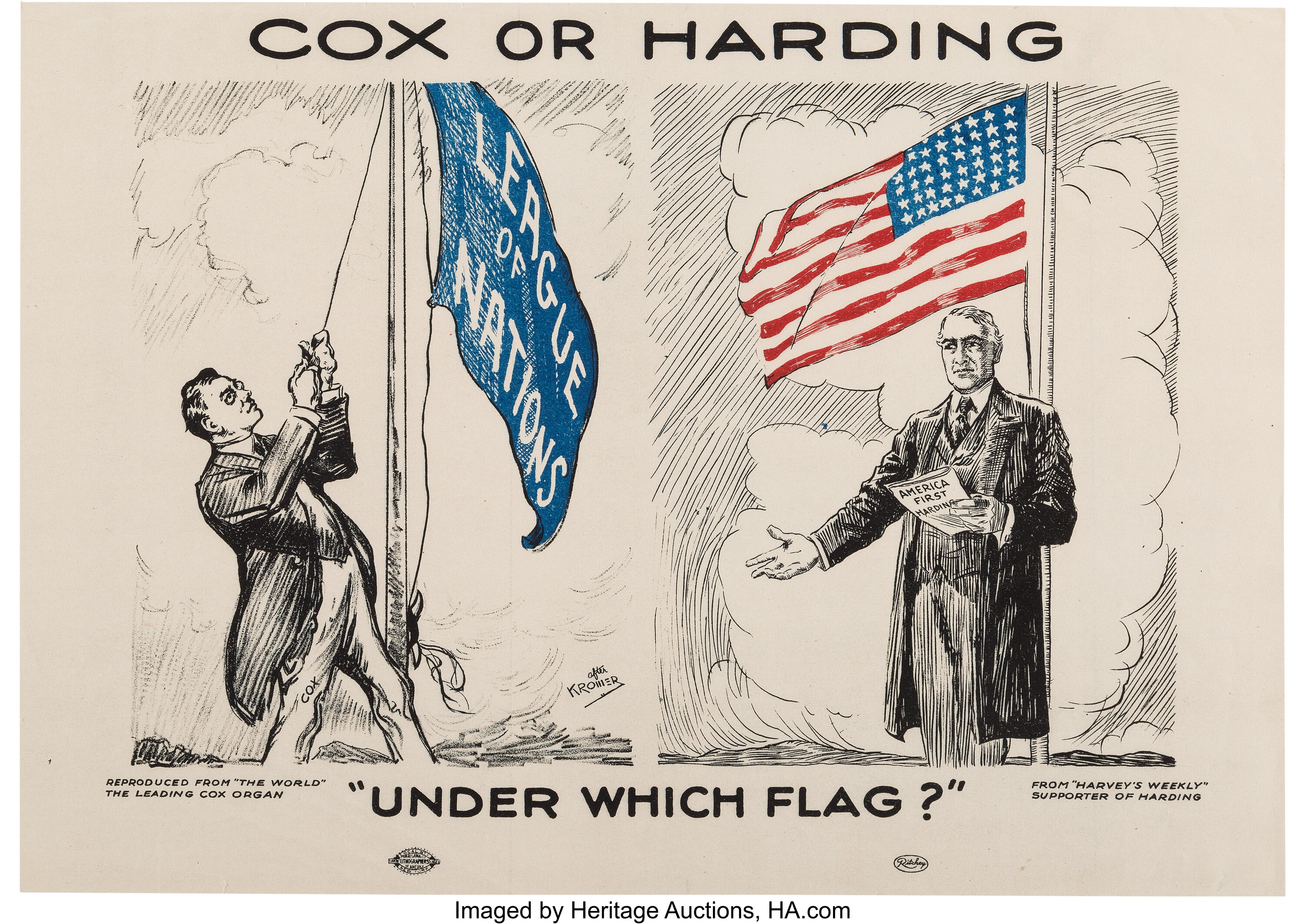
Most of all, after 2 years of America being in World War I, and 2 years of postwar disruption, Harding, to use a more recent expression, had his finger on the pulse of the nation. He wasn't particularly bright, but he knew what Americans wanted. With radio still in the process of being made public, no television, and no sound films, he made a phonograph record of his big speech, which was short on specifics, but had plenty of platitudes, and availed of alliteration:

America's present need is not heroics, but healing; not nostrums, but normalcy; not revolution, but restoration; not agitation, but adjustment; not surgery, but serenity; not the dramatic, but the dispassionate; not experiment, but equipoise; not submergence in internationality, but sustainment in triumphant nationality.

And enough Americans agreed with him to give him an overwhelming victory. When he died in office on August 2, 1923, just as the Teapot Dome scandal was breaking, he was still very popular. And the Democratic Party was divided enough that, even with the scandal, a living Harding probably would have won in 1924, anyway.

Instead, Harding died, and his Vice President, Calvin Coolidge, became President, and rode the "Coolidge Prosperity," the fact that he wasn't involved in Teapot Dome in any way, and the Democrats' division to ride to a landslide victory.

By the end of the decade, with the full revelations of the scandal, and of his affairs, including an illegitimate daughter, his reputation was in tatters. He is still often considered one of the country's worst Presidents, along with predecessors like Franklin Pierce, James Buchanan and Andrew Johnson; and successors like Herbert Hoover, Richard Nixon, George W. Bush and Donald Trump.

Regardless of who the Democrats ran in 1920, they would have lost. There was nothing Cox could have done that would have helped him. He was the better man, and may have had the better ideas, but he was the wrong man with the wrong ideas at the wrong time.

And what happened to Cox? He returned to his media empire, and ran it until his death in 1957. He is largely forgotten today, even by people who know the name Cox Communications, which his descendants have grown far beyond his imagination.

When he is remembered at all, it is for his connections to 2 Presidents: Harding, and his own Democratic nominee for Vice President, then the Assistant Secretary of the Navy: Franklin Delano Roosevelt.

In southern New Jersey, U.S. Route 40 is the Harding Highway. He was played by Harry Dean Stanton in The Legendary Curse of the Hope Diamond in 1975, George Kennedy in Backstairs at the White House in 1979, and Malachy Cleary on Boardwalk Empire in 2010.

*

November 2, 1920, like all modern American Election Days, was a Tuesday. There were no scores on this historic day: The baseball season was over, the football season was in midweek, the NHL season didn't start until December 22, and the NBA wasn't founded until 1946.

Friday, October 7, 2022

October 8, 1921: The 1st Football Game on Radio

The 1921 University of Pittsburgh football team

October 8, 1921: For the 1st time, a football game is broadcast on radio. KDKA in Pittsburgh, who had debuted by broadcasting the previous year's Presidential election results, and earlier this year had become the 1st station to broadcast a baseball game, heads for the gridiron.

Harold Arlin, a foreman at KDKA's parent company Westinghouse, was the announcer., for radio's 1st football game, as he had been 2 months earlier for radio's 1st baseball game. He was an engineer working for the station's owner, the Westinghouse Electric and Manufacturing Company. Although he had no background in the nascent radio industry, or in anything else that required the use of his voice, like stage acting, the company assigned him to call these games.

The opponents are the University of Pittsburgh and West Virginia University, a rivalry later nicknamed The Backyard Brawl, at Forbes Field, home of baseball's Pirates. Pitt wins, 21-13. 
Forbes Field

On September 14, 1923, Arlin became the 1st boxing announcer over radio, going to the Polo Grounds in New York, to announce Jack Dempsey's wild comeback to knock Luis Firpo out and retain the Heavyweight Championship of the World.

But after 1921, Arlin never broadcast the Pirates again. He became known as radio's first celebrity interviewer, conducting interviews with William Jennings Bryan, Lillian Gish, Will Rogers and Babe Ruth. He later moved to Mansfield, Ohio, and ran Westinghouse's plant there. He lived until 1896.

*

October 8, 1921 was a Saturday. Some of the other notable college football games of the day:

* The University of Iowa upset Notre Dame, the defending National Champions, 10-7 at Iowa Field in Iowa City. Iowa Stadium was built in 1929, and was renamed Kinnick Stadium in 1972.

* The University of California, on its way to being declared National Champions for 1921, beat the University of Nevada, 51-6 at California Field in Berkeley. California Memorial Stadium was built 2 years later, on the profits of Cal's "Wonder Team."

* Army beat Lebanon Valley College of Annville, Pennsylvania, 33-0 on The Plain at West Point, New York. Michie Stadium opened in 1924.

* Harvard beat Indiana University, 19-0 at Harvard Stadium in Boston. But 3 weeks later, Harvard would be the victims of a stunning upset, 6-0 at Harvard Stadium, by Centre College of Danville, Kentucky.

* In New York City, Columbia beat Wesleyan University, 14-3 at South Field. Baker Field, on which today's Wien Stadium was built, opened in 1923. Fordham beat the Catholic University of America, based in Washington, D.C., 10-0 at Fordham Field in The Bronx. And New York University lost to Brown, 13-0 at Andrews Field in Providence, Rhode Island. 

* In New Jersey, Princeton beat Colgate, 19-0 at Palmer Stadium. And Rutgers lost to Lehigh, 7-0 at Neilson Field in New Brunswick.

October 8 was an off-day in the World Series, which was played entirely at the Polo Grounds in Upper Manhattan, and which the New York Yankees led over the New York Giants, 2 games to 1. But the Giants would win it, 5 games to 3. This remains the last World Series not to be a best-4-out-of-7.

And Arsenal lost to Sunderland, 1-0 at Roker Park in Sunderland, in the North-East of England. 

Friday, August 5, 2022

August 5, 1921: Baseball On Radio

Harold Arlin. Yes, that thing in front of him is a microphone,
not a tiki torch or a giant chesspiece.

August 5, 1921: For the 1st time, a game in what would eventually be called Major League Baseball was broadcast on radio.

Radio station KDKA had gone on the air in Pittsburgh, at 1020 on the AM dial (hence the time of this post), on November 2, 1920, broadcasting election returns, and announcing that Warren G. Harding had been elected President.

So they were a natural to be the 1st station to broadcast baseball. On August 5, they brought their equipment across town to Forbes Field, home of the Pittsburgh Pirates, and set up to broadcast the Pirates' game against their cross-Pennsylvania rivals, the Philadelphia Phillies.

Harold Arlin was the announcer, as he had been for the Election Night debut. Not to be confused with a contemporary, songwriter Harold Arlen, Arlin was an engineer working for the station's owner, the Westinghouse Electric and Manufacturing Company. Although he had no background in the nascent radio industry, or in anything else that required the use of his voice, like stage acting, the company assigned him to call the game.
Forbes Field

The Phillies scored a run in the 1st inning, but the Pirates scored 2 in the 2nd. The Phillies came back with 3 in the 3rd, including a home run by Cy Williams. The Pirates closed to within 4-3 in the bottom of the 5th, and then took a 5-4 lead in the 6th.

The Phillies tied it in the top of the 8th. George "Possum" Whitted led off the bottom of the 8th with a single. James "Cotton" Tierney drew a walk. Three straight singles followed, by Ray Rohwer, Tony Brottem and Jimmy Zinn. This forged the final score: Pirates 8, Phillies 5. Zinn, who pitched 6 innings of relief, was the winning pitcher.
Jimmy Zinn

Westinghouse must have been satisfied with Arlin's work: The next day, they assigned him to become the 1st person to broadcast a tennis match over radio, a Davis Cup match in which Australia beat Great Britain.

On October 8 of that year, he became the 1st football broadcaster, again at Forbes Field, watching the University of Pittsburgh beat West Virginia University 21-13, in a rivalry that would later be known as "The Backyard Brawl." On September 14, 1923, he became the 1st boxing announcer over radio, going to the Polo Grounds in New York, to announce Jack Dempsey's wild comeback to knock Luis Firpo out and retain the Heavyweight Championship of the World.

But after 1921, Arlin never broadcast the Pirates again. He became known as radio's first celebrity interviewer, conducting interviews with William Jennings Bryan, Lillian Gish, Will Rogers and Babe Ruth. He later moved to Mansfield, Ohio, and ran Westinghouse's plant there.

Eventually, radio helped baseball regain popularity during the Great Depression. At first, team owners were afraid to "give away" games, for fear it would cause attendance to drop. The opposite happened: People who were now hearing games for the first time wanted to see them, and they were willing to play.

The Pirates didn't start regular broadcasts of their games until 1934, with Jimmy Murray and Walter E. Sickles. Starting in 1938, their main announcer was Albert "Rosey" Rowswell. When a Pirate hit a home run, he would imagine a little old lady with an apartment window facing Forbes Field, and yell, "Open the window, Aunt Minnie, here it comes!" Then he would smash a light bulb, to simulate the ball breaking Aunt Minnie's window, and say, "Too late!"

In 1947, Rowswell was joined by Bob Prince. Rowswell's last year was 1954: By this point, television began to take over -- KDKA aired Pirate games on Channel 2 -- and fans could see that what was behind the outfield fence at Forbes Field was Schenley Park and the Carnegie Library, not apartments, so Rowswell's Aunt Minnie shtick was no longer any good.

Prince was known as "The Gunner," and one of the great "homers" of baseball broadcasting. His "Gunnerisms" included this line, for when the Pirates, or "Bucs" or "Buccos," came from behind to win: "The Buccos had 'em all the way." A ball just foul was "foul by a gnat's eyelash." And, long before John Sterling began using the phrase with the Yankees, Prince said a two-run deficit was easy to overcome: "We need a bloop and a blast!" If it was three runs, he would make it, "A bleeder, a bloop and a blast!"

In 1969, Steve Arlin, grandson of Harold, became an original San Diego Padre. On June 18, 1972 -- the day after the Watergate break-in -- Steve was penciled in to pitch for the Padres against the Pirates at Three Rivers Stadium. It had been 51 years since Harold Arlin had broadcast a game for the Pirates, and Bob Prince invited him to call the game with him. Steve pitched a 2-hit shutout, and the Padres won, 1-0. Harold died in 1986, age 90; Steve followed in 2016, age 70.
Prince (left) and Arlin, June 18, 1972

Prince was fired after the 1975 season. Unlike Arlin and Rowswell, he received the Baseball Hall of Fame's award for broadcasters. From 1976 to 2008, the voice of the Pirates was Lanny Frattare. His partners included former Pirate pitchers Steve Blass, Jim Rooker and Bob Walk. Walk is still part of a Pirate broadcasting team that also includes Greg Brown, John Wehner, Joe Block, Kevin Young, Matt Capps and Michael McKenry.

*

August 5, 1921 was a Friday. This was the off-season for the NFL and the NHL, and there would be no NBA for another quarter of a century. But these other Major League Baseball games were played:

* The New York Yankees beat the Detroit Tigers, 7-3 at the Polo Grounds. Wally Schang hit a home run. Babe Ruth went 1-for-3, and his hit was just a single, but from right field, he threw a runner out at the plate. Carl Mays was the winning pitcher.

* The New York Giants beat the St. Louis Cardinals, 2-1 at Sportsman's Park in ST. Louis.

* The Brooklyn Robins beat the Cincinnati Reds, 6-1 at Redland Field in Cincinnati. The Robins would go back to their former name of Dodgers in 1922. The following year, Redland Field would be renamed Crosley Field.

* The Philadelphia Athletics beat the St. Louis Browns, 4-2 at Shibe Park in Philadelphia.

* The Washington Senators beat the Cleveland Indians, 4-1 at Griffith Stadium in Washington.

* The Boston Red Sox beat the Chicago White Sox, 10-1 at Fenway Park in Boston.

* And the Boston Braves beat the Chicago Cubs, 6-1 at Cubs Park in Chicago. It was renamed Wrigley Field in 1926. 

December 31, 1999 & January 1, 2000: The Millennium

December 31, 1999:  The Millennium arrives. The people of planet Earth survived. At a terrible cost. But we hadn't destroyed ourselves. ...