Showing posts with label 1932 world series. Show all posts

Monday, December 12, 2022

December 12, 1933: The 2nd Athletics Fire Sale

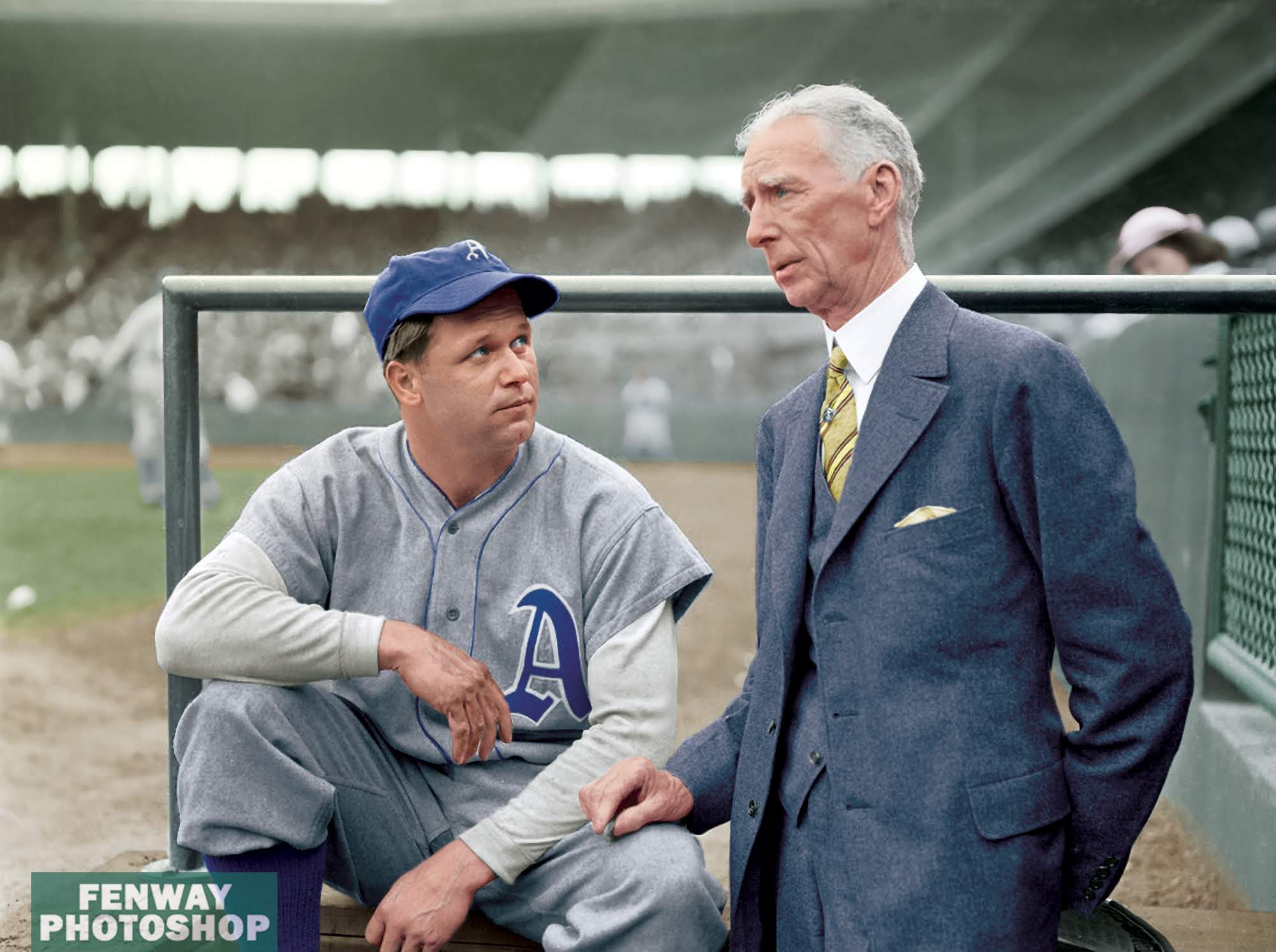
Jimmie Foxx (left) and Connie Mack

September 28, 1932: Connie Mack begins the breakup his of his Philadelphia Athletics. The 1st time he'd done so, in 1914-15, it was because he couldn't keep up with the salaries being offered by the Federal League teams. This time, it was personal.

In 1925, the A's went 88-64, and were only 8 1/2 games behind the 1st-place Washington Senators. But the rise of the "Murderers' Row" Yankees delayed Philadelphia's return to greatness. In 1929, they began a run of 3 seasons in which they won 313 games, and game within a Game 7 loss in 1931 of winning 3 straight World Series.

But Mack lost all of his non-baseball holdings in the stock market Crash of 1929. He couldn't fund the A's with any other income. So, after the 1932 season, despite a strong 94-60 record (but 13 games behind the Pennant-winning Yankees), he began to sell of his 2nd generation of stars.

On September 28, 1932, he sent left fielder Al Simmons, 3rd baseman Jimmy Dykes, and center fielder Mule Haas are all sold to the Chicago White Sox, for $100,000. Simmons would be elected to the Baseball Hall of Fame, and Dykes and Haas would have been perennial All-Stars had the All-Star Game been founded before 1933.

But the big day was...

December 12, 1933: When Mack made 3 separate moves:

* Pitchers Lefty Grove and Rube Walberg, and 2nd baseman Max Bishop, are traded to the Boston Red Sox for Bob Kline and Rabbit Warstler and $125,000. Along with Carl Hubbell, Grove was 1 of the 2 best lefthanded pitchers in the game, and would go to the Hall of Fame. Walberg was the 3rd starter on the A's, behind Grove and George Earnshaw, but would have been the ace on many teams.

Key to this deal was the fact that Tom Yawkey had recently turned 30 and come into his inheritance, and had bought the Red Sox, and could afford to spend whatever he wanted to build a championship team. He did try, but the Yankees' dynasty that was restarted in 1936 thwarted his early efforts.

Grove's 199 wins during the 1930s made him the winningest pitcher of the decade.

* Catcher Mickey Cochrane was traded to the Detroit Tigers for Johnny Pasek and $100,000. The Tigers subsequently named Cochrane player-manager, and won the next 2 American League Pennants.

* Finally, before the ink was dry on the previous 2 trades, Mack traded Pasek and Earnshaw to the White Sox for Charlie Berry and $100,000. So, in 1 day, Mack sold off his 3 best pitchers.

On December 10, 1935, 1st baseman Jimmie Foxx and pitcher Johnny Marcum were traded to the Red Sox for Gordon Rhodes, George Savino and $150,000. Foxx was the best righthanded slugger in the game, and would go to the Hall of Fame. Marcum was the Mackmen's best pitcher following the '33 fire sale, and Mack dumped him, anyway.

The A's went from 94-60 in 1932 to 79-72 in 1933, to 68-82 in 1934, to 58-91 in 1935, and to 53-100 in 1936. To make matters worse, Tom Shibe died in 1936, and Jack Shibe the next year. The deaths of these sons of Ben Shibe, with whom Mack founded the A's in 1901, pretty much left Mack, 74 years old at the time, in full control of the A's, and his control of his mental faculties began to diminish.

The A's never recovered. In 1950, Mack's sons, who seemed to agree on nothing else, ganged up in the senile 87-year-old man, and finally removed him from control, if not ownership, and the manager's job after his 50th season in charge. The Mack family ended up selling the team in 1954, to a buyer who moved them to Kansas City.

They failed there as well, and Charlie Finley bought them in 1960, moving them to Oakland in 1968. After 5 straight AL Western Division titles, 1971-75, including 3 straight World Series wins, 1972-74, he broke them up, and the team crashed. New owner Walter Haas rebuilt them in the early 1980s, but the pitching collapsed, preventing a new dynasty. The A's rebuilt again, and won 3 straight Pennants, 1988-90, but after another Division title in 1992, were broken up again.

The pattern held: By 2000, the "Moneyball" regime built a team that reached the Playoffs 5 times in 7 years, but won no Pennants. They sold off, rebuilt, and made 3 straight Playoffs, 2012-14. They couldn't afford to keep it going, sold off, rebuilt, and made 3 straight Playoffs, 2018-20. They couldn't afford to keep it going, and sold off. In 2022, the A's lost 102 games, their most since the Finley fire sale bottomed out at 108 in 1979.

Rumors of the A's moving again have been renewed, since they haven't been able to get a deal to replace the Oakland Coliseum. If they do move, how long will it be before they win again? And, if so, how long before they have a 9th fire sale?

One thing is for sure: The A's are not moving back to Philadelphia, where the Phillies, having won the 2022 NL Pennant, are overwhelmingly popular. The Delaware Valley is certainly big enough to support one winning Major League Baseball team, but not two MLB teams, regardless of performance. But, wherever they go, or if they stay, at some point, the A's will go back to their Philadelphia roots, by breaking it all down and starting all over again.

In 1949, Ogden Nash, my grandmother's favorite poet, wrote "Line-Up for Yesterday" for Sport magazine, an alphabetical list of star players. For the letter Q, Nash had to cheat a little, and wrote:

Q is for Don Quixote
Cornelius Mack;
Neither Yankees nor years
Can halt his attack.

He also had to cheat a little for the letter X:

X is the first
of two x's in Foxx
Who was right behind Ruth
with his powerful soxx.

But even that poem is now so far back in history that it hasn't raised their profiles. The Athletics' moves have left their Philadelphia era virtually forgotten, even though Foxx hit 534 home runs, Grove and Eddie Plank each won at least 300 games, and Eddie Collins collected over 3,000 hits and Al Simmons nearly did. Foxx hit 415 home runs during the 1930s, making him the decade's leader. And, unlike their Bay Area neighbors, the San Francisco Giants, the Oakland version of the A's doesn't really pay tribute to that era.

They have notations for Philadelphia's 1910, 1911, 1913, 1929 and 1930 World Series wins at the Oakland Coliseum, but, unlike the Giants with the top players from their New York era, they have not retired any uniform numbers from their time in Philly: The 2 of Mickey Cochrane, the 3 of Jimmie Foxx, the 7 of Al Simmons and the 10 of Lefty Grove remain in circulation. Earlier players like Plank and Collins did not have numbers that could be retired, though Collins later wore 32 as a coach. And, of course, wearing suits instead of uniforms, Connie Mack also never had a number to retire.

And it took until 2018 for them to establish a team Hall of Fame, and 2021 for them to honor any figures from the Philadelphia era: Mack, Plank, Collins, Cochrane, Foxx, Simmons, Grove, George "Rube" Waddell, Charles "Chief" Bender, Frank "Home Run" Baker, Bob Johnson and Eddie Joost.

*

December 12, 1933 was a Tuesday. Baseball was out of season. The NBA hadn't been founded yet. The NFL was going to play its 1st official Championship Game the following Sunday, and the Chicago Bears won it, 23-21 over the New York Giants.

There were 4 games played in the NHL that night:

* The Toronto Maple Leafs beat the Boston Bruins, 4-1 at the Boston Garden. This was the game in which Eddie Shore hit Ace Bailey over the head with his stick, ending his career. I have a separate entry for that event.

* The New York Americans beat the New York Rangers, 3-0 at the old Madison Square Garden, which was still fairly new at the time. The company that ran the Garden owned the Rangers, and the Amerks were tenants, so any win the tenants had over the landlords was considered big.

* The Detroit Red Wings beat the Chicago Black Hawks, 4-1 at the Olympia Stadium in Detroit.

* And the Montreal Canadiens and the Ottawa Senators played to a 1-1 tie at the Ottawa Auditorium.

Saturday, October 1, 2022

October 1, 1932: Babe Ruth's Called Shot

 
October 1, 1932: Game 3 of the World Series is played at Wrigley Field in Chicago. There was bad blood between the New York Yankees and the Chicago Cubs, because the Cubs had acquired former Yankee shortstop Mark Koenig late in the season, he'd helped them win the Pennant, and the team had announced that, whatever their individual players' shares of the World Series money would be, he would get only half as much.

The Yankees, including Babe Ruth himself, publicly called the Cubs cheap, and there was some rough stuff in the 1st 2 games at Yankee Stadium. When Ruth and his wife Claire got off the train at Union Station in Chicago, Cub fans were waiting for them, throwing garbage at them, and spitting on them. Neither was naive: The Babe had been treated badly before, and Mrs. Ruth, under her maiden name of Claire Hodgson, was an actress, and was used to rough customers. But this was over the line.
Wrigley Field, 1932

In Game 3, the Yankees took a 4-1 lead, including home runs by Ruth and Lou Gehrig (in that case, not back-to-back). But the Cubs tied it up in the bottom of the 4th. Ruth led off the top of the 5th, and the Cub fans were abusing him like crazy. In the Cubs dugout, the "bench jockeying" was nasty as well.

Ruth was no stranger to this. Because of his large, wide nose and big lips, there had been suggestions that he was part black. Research into his family history showed him to be almost completely German -- in fact, because his grandparents were born in Pennsylvania, before moving to Baltimore, they were "Pennsylvania Dutch" -- ethnically Amish, if practicing Catholics.

But that didn't stop people from indulging in rumors, and one of the names he was sometimes called was "(N-word) Lips." On one memorable occasion, which may be apocryphal, he heard this particular insult, walked over to the opposing dugout, and said, "Listen, you guys, call me 'bastard' or 'cocksucker,' or whatever you want, but lay off the personal stuff, would ya?"

Charlie Root was pitching for the Cubs, and he threw a called strike. The Babe didn't like the pitch, and the Cubs' bench jockeying got worse. A home movie -- sadly, silent, and with all the crowd noise, we probably wouldn't be able to hear what the players were saying, anyway -- shows Ruth waving his right hand at the Cub dugout, a classic "Ah, go on, ya bum" gesture.

The way the story is usually told, including on a newsreel by Ruth himself, there were only 3 pitches in this at-bat. In fact, Root's next 2 pitches were out of the strike zone, and called balls. His 4th pitch was called a strike. The home movie shows Ruth pointing directly at Root -- twice. His arm is not extended. Contrary to legend, he is not pointing at a spot beyond the outfield fence, as if to say, "I'm going to hit the next pitch there."

But he is sending a message. Cubs catcher Gabby Hartnett claimed Ruth said, "It only takes one." Another source said Ruth said, "You got one more, kid!" (To the Babe, who was terrible with names, if you were a young guy, you were "Kid"; if you were older, you were "Doc"; and if he didn't like you, or sometimes even if he did, you were "You son of a bitch!") Gehrig, in the on-deck circle, told a reporter that what Ruth yelled at Root was, "I'm gonna hit the next pitch right down your goddamned throat!"

So, yes, Babe Ruth called his shot.

Root threw him one more pitch. The Babe crushed it to dead center field. Longtime Cub observers said it was the longest home run ever hit in Wrigley Field to that point. The now-familiar center field scoreboard wouldn't go up until 1937, and no player has ever hit it with a home run. Supposedly, Roberto Clemente once missed it by less than a foot. Had it been there in 1932, the Babe's blast might have hit it.

The crowd knew that the Babe had made his point, and, like the Russian fans turning from Drago to Balboa in Rocky IV, switched sides, and cheered him as he rounded the bases, making a few more gestures, as if to say, "I told you so!"

Five days later, on October 6, on The Fleischmann's Yeast Hour, broadcast on NBC radio, and hosted by singer Rudy VallĂ©e, Gehrig was a guest, and said that he'd just gotten back from fishing with Ruth on Long Island Sound. He described the called shot:

He stands up there and tells the world he's going to sock that next one. And not only that, but he tells the world right where he's going to sock it: Into the center field stands. A few seconds later, the ball was just where he'd pointed: In the center field stands. He called his shot, and then made it. I ask you: What can you do with a guy like that?

It sounds like he was reading off a script. But we now know of two examples of Lou Gehrig backing the story up. Does he seem like the kind of man who would lie about it? 

For the rest of their lives, all the Cubs who had been interviewed on the subject said he didn't "call his shot." Charlie Root said that if Ruth had done that, "I'd have put one on his ear, and knocked him on his ass." Offered the chance to play himself in The Babe Ruth Story, the awful 1948 film starring William Bendix, Root, who went 201-160 for his career and died in 1970, said, "Not if you're going to show him pointing," and turned it down.

For the rest of their lives, all the Yankees who had been interviewed on the subject said he did it, including Charlie Devens, who pitched for the Yankees from 1932 to 1934, and was the last living player from the team.

There was one exception: Frank Crosetti, the Yankees' shortstop. I used to think that was why Crosetti never appeared at Old-Timers' Day between 1968, his last season as a Yankee coach, and 2002, when he died. It turned out that he simply didn't accept the invitation, preferring not to cross the country from his home in Stockton, California.

Franklin Delano Roosevelt, Governor of New York, and running for President, threw out the ceremonial first ball at the game, and according to a reporter covering his campaign, threw his head back and laughed when Ruth hit the home run. But through his entire 12-year Presidency, FDR never publicly offered his opinion on whether Ruth had "called his shot."

Francis Cardinal Spellman, then the Archbishop of New York, was at the game, and he said Ruth did it. So did John Paul Stevens, then a 12-year-old Chicago schoolkid, later a Justice of the U.S. Supreme Court, and a Cub fan to the end of his life in 2019. If a Cub fan could admit it, then that's good enough for me.

The next batter was Gehrig, and he also hit his 2nd home run of the game. The Yankees hung on to win, 7-5, and completed the sweep the next day.

It was Ruth's 10th World Series, and his 7th World Series win. And it was his 15th home run in World Series play. In each case, it would be his last. The Washington Senators would win the American League Pennant in 1933, and the Detroit Tigers in 1934 and 1935. Ruth retired early in the 1935 season. In 1936, Joe DiMaggio made his Yankee debut, teaming with Gehrig to start a new dynasty.

Ruth's Called Shot remains, along with Bobby Thomson's 1951 Pennant-winning "Shot Heard 'Round the World," one of the two most talked-about home runs in baseball history, more so even than the World Series Game 7-winning shot by Bill Mazeroski in 1960, or the home runs that broke Ruth's records: Single-season, 61 by Roger Maris in 1961, then 70 by Mark McGwire in 1998, then 73 by Barry Bonds in 2001; and career, 715 by Hank Aaron in 1974, then 756 by Bonds in 2007.

UPDATE: Among the Yankees' many traditions is Monument Park at Yankee Stadium. From this 1932 team, they have honored right fielder George "Babe" Ruth, and 1st baseman Lou Gehrig, with Monuments. They have honored manager Joe McCarthy, catcher Bill Dickey, and pitchers Charles "Red" Ruffing and Vernon "Lefty" Gomez with Plaques. McCarthy never wore a number, but the team retired Number 3 for Ruth, 4 for Gehrig, and 8 for Dickey. They have also honored team owner Jacob Ruppert and general manager Ed Barrow with Plaques.

Along with each of the preceding, 3rd baseman Joe Sewell is in the Baseball Hall of Fame. But it is for his earlier playing for the Cleveland Indians, and he is not honored in Monument Park.

The Cubs have a team Hall of Fame. Inducted from their 1932 Pennant winners have been catcher Charles "Gabby" Hartnett, 2nd basemen Rogers Hornsby and Billy Herman, 3rd baseman Stan Hack, left fielder Riggs Stephenson, right fielder Hazen "Kiki" Cuyler, pitcher Charlie Root, manager Charlie Grimm, team owner Philip K. Wrigley, executive Margaret Donahue, and public address announcer Pat Pieper.

*

Of course, this was the only baseball game of the day. And it was the off-season for the NHL. And the NBA hadn't been founded yet.

But October 1, 1932 was a Saturday, so while all the NFL games played that weekend were played the next day, there were college football games played, including 2 major rivalries.

The University of Michigan opened its season by beating Michigan State University, 26-0 at Michigan Stadium in Ann Arbor. This was the depth of the Depression, so only 33,786 fans came into what has since been nicknamed "The Big House," then seating 85,752, to see the Wolverines blank the Spartans. The Michigan went on to win the Big Ten Conference.

Another Big Ten team, the University of Minnesota, played its 1st game under head coach Bernie Bierman. They beat South Dakota State, 12-0 at Memorial Stadium in Minneapolis. Over the next 9 seasons, 1933 to 1941, Bierman would lead the Golden Gophers to 7 Conference Championships and 5 National Championships.

The University of Southern California beat Washington State University, 20-0 at the Los Angeles Memorial Coliseum. Only 35,000 paid to get into the 100,000-seat Coliseum. USC would go on to win the Pacific Coast Conference, a forerunner of today's Pac-12.

In a rivalry later to be known as "The Backyard Brawl," the University of Pittsburgh beat West Virginia University, 40-0 at the old Mountaineer Field in Morgantown, West Virginia. (Built in 1924, it was replaced with a new Mountaineer Field, now named Milan Puskar Stadium, elsewhere on campus in 1980.)

Pitt had no conference to win, but were invited to play USC in the Rose Bowl on January 2, 1933. USC left no doubt as to who was the better team, winning 35-0. But the various outlets that selected National Champions in those days were divided, some picking USC, some picking Michigan. Under the current format, USC would have played Michigan in the Rose Bowl to decide it.

The University of Notre Dame did not play that day, opening their season a week later. Army beat Furman University 13-0 at Michie Stadium in West Point, New York. Navy lost to the College of William & Mary, 6-0 at Thompson Stadium in Annapolis, Maryland.

In New York City, Columbia beat Lehigh 41-6 at Baker Field in Manhattan. Fordham beat the University of Baltimore, 69-0 at Fordham Field in The Bronx. New York University beat Hobart College, 33-0 at Ohio Field in The Bronx.

In New Jersey, Rutgers beat Pennsylvania Military Academy, 20-6 at Neilson Field in New Brunswick. And Princeton beat Amherst College at Palmer Stadium in Princeton.

Also, Arsenal beat Blackpool, 2-1 at Bloomfield Road, in Blackpool, Lancashire.

December 31, 1999 & January 1, 2000: The Millennium

December 31, 1999:  The Millennium arrives. The people of planet Earth survived. At a terrible cost. But we hadn't destroyed ourselves. ...