Showing posts with label southwest conference. Show all posts

Thursday, December 8, 2022

December 8, 1914: The Southwest Conference Is Founded

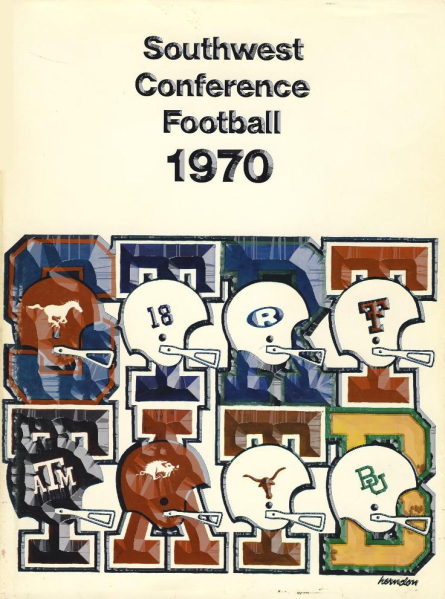
December 8, 1914: The Southwest Intercollegiate Athletic Conference is founded at the Rice Hotel in Houston, Texas, after previous organizing meetings in May at the Oriental Hotel in Dallas. L. Theo Bellmont, the athletic director at the University of Texas, convened the meetings that led to the league's foundation. 

The 8 original members were the University of Arkansas, in Fayetteville; Baylor University, of Waco, Texas; the University of Oklahoma, in Norman; Oklahoma A&M University, of Stillwater; Rice University, of Houston; Southwestern University; of Georgetown, Texas; the University of Texas, in Austin; and Texas A&M University, in College Station.

Southwestern dropped out in 1917. Southern Methodist University, a.k.a. SMU, of Dallas, joined in 1918. Oklahoma left for the league that became the Big Eight Conference in 1919, and Oklahoma A&M followed them in 1925, becoming Oklahoma State in 1958. Phillips University, of Enid, Oklahoma, was a member only for the 1920-21 schoolyear. Texas Christian University, a.k.a. TCU, of Fort Worth, joined in 1923.

That membership remained steady until 1956, when Texas Tech University, of Lubbock, were admitted. The University of Houston joined in 1972. So it was a 9-team league, with Arkansas and 8 Texas-based teams.

From its founding in 1937 to 1995, the Cotton Bowl Classic in Dallas usually invited the SWC football champion to participate. Of those 59 appearances: Texas made 16, Texas A&M 9, Arkansas 8, TCU 6, SMU 4, Rice 4, Houston 4, and Baylor and Texas Tech 2 each. There was no SWC team in the 1940 Cotton Bowl.

The Texas Longhorns dominated in football, and so every other school in the league hated them. Their rivalry with Texas A&M, usually on Thanksgiving Weekend, sometimes on Thanksgiving Day, inspired the saying, "If football is a religion in Texas, then this game is a holy war." The Longhorns also built a significant rivalry with Arkansas, culminating in the 1969 "Game of the Century." But many Texas fans consider Oklahoma, then of the Big 8, to be their biggest rival.

The intra-"Metroplex" rivalry of SMU in Dallas and TCU in Fort Worth is pretty intense, and resulted in an earlier "Game of the Century" in 1935. And intra-city rivals Houston and Rice can get pretty heated.

Houston made a pair of NCAA Final Fours before joining the SWC, and then became the league's premier basketball school. Texas, Texas A&M and Rice became great baseball schools, while Arkansas became one of the country's greatest track programs.

In 1991, Arkansas announced it was leaving the SWC for the Southeastern Conference (SEC). That left the SWC with only the 8 Texas schools. They could have added another school from the Lone Star State, possibly the University of Texas at El Paso: UTEP were then a member of the Western Athletic Conference, and their (relative) proximity to New Mexico and New Mexico State made for easier and cheaper travel.

Instead, in the 1995-96 schoolyear, Texas, Texas A&M, Texas Tech and Baylor applied for, and received, membership to the Big 8. The 4 remaining SWC schools -- Texas Christian, Southern Methodist, Houston and its crosstown rival Rice -- joined other leagues: Houston joined Conference USA, and the other 3 joined the WAC, though all would join C-USA at some point.

Thus did 2 of the great college sports leagues, the Big 8 and the SWC, come to an end, but a better league, the Big Twelve Conference, was formed. The 4 Texas schools and the 2 Oklahoma schools formed the South Division, the other teams the North Division.

But that league did not hold: Nebraska went to the Big Ten, Colorado went to the Pac-10, and Texas, Texas A&M and Oklahoma all left for the Southeastern Conference. The Big 12 had a connection to the old SWC, but little remains of that Texas (and Arkansas) collegiate sports tradition.

*

December 8, 1914 was a Tuesday. Baseball season was over. Football was in midweek. Professional basketball barely existed. There was professional hockey, in the forms of Eastern Canada's National Hockey Association, and Western Canada's Pacific Coast Hockey Association.

The NHA season didn't begin until December 26, but the PCHA season opened on December 8, with 1 game: The Vancouver Millionaires beat the Portland Rosebuds, 6-3 at the Portland Ice Arena. The Millionaires would win the PCHA title, and beat the NHA Champion Ottawa Senators for the Stanley Cup. No Vancouver team has won the Cup since.

This was also the day that Philadelphia Athletics manager Connie Mack, needing a quick infusion of cash, sold his best player, 2nd baseman Eddie Collins, ending his 1st dynasty, and beginning the A's tradition of "fire sales." I have a separate entry for that event.

Tuesday, December 6, 2022

December 6, 1969: Texas vs. Arkansas, "The Game of the Century"

December 6, 1969: One of college football's occasional "Games of the Century" is played.

They seemed to be coming every year. 1966 saw Michigan State vs. Notre Dame, in the Big Ten region if not a Big Ten game in its own right. 1967 saw USC vs. UCLA, in the league now known as the Pac-12. Now, it was Texas vs. Arkansas, for the Championship of the Southwest Conference.

Darrell Royal had been a quarterback under Bud Wilkinson at the University of Oklahoma. He never played pro football, but went into coaching. His 1st head coaching job was with the Edmonton Eskimos of the Canadian Football League of 1953. He must have gotten tired of the cold, because he went to Mississippi State University in 1954, and the University of Washington in 1956.

In 1957, he was hired at the University of Texas, one of Oklahoma's main rivals. By 1963, he had made Texas National Champions. In 1967, he installed the wishbone offense, and made his team nearly unstoppable. They won or shared the SWC title in 1959, 1961, 1962, 1963 and 1968.
They roared through the 1969 season, hanging 69 points on Texas Christian (TCU), 56 each on Navy and Baylor, 49 each on Texas A&M and Texas Tech, and 45 on Southern Methodist (SMU). But they only played 1 ranked team all season, beating Number 8 Oklahoma, 27-17 at the Cotton Bowl in Dallas. After beating A&M away on Thanksgiving Day, they were 9-0, and ranked Number 1 in the nation. They went into the game with an 18-game winning streak, their last loss to Texas Tech early in the 1968 season.

Frank Broyles had also been a college quarterback, at Georgia Tech, but not a pro one. He got his 1st head coaching job in 1957, at the University of Missouri. After just 1 year, the University of Arkansas was impressed enough to hire him away.

At the time, the Southwest Conference had 9 teams, and Arkansas, in Fayetteville, was the only 1 of them not in the State of Texas. The others were: Texas, in Austin; Texas A&M, in College Station; Texas Tech, in Lubbock; Texas Christian University (TCU), in Fort Worth; Southern Methodist University (SMU), in Dallas; Baylor, in Waco; and 2 schools in Houston, Rice University and the University of Houston.

But Broyles' Razorbacks held their own, winning the SWC title in 1959, 1960, 1961, 1964, 1965 and 1968, and taking the National Championship in a split poll in 1964. (Alabama won the other poll.) Future Dallas Cowboys head coach Jimmy Johnson and owner Jerry Jones played on his '64 National Champions.
Arkansas also had a fabulous season in 1969. Its offense wasn't as high-powered, but they scored 55 points on the University of Tulsa, 52 on Wichita State, 39 on Oklahoma State, 35 on Texas A&M, 33 on Texas Tech, and 30 on Rice. After beating Texas Tech on Thanksgiving, they were 9-0, and ranked Number 2, behind only Texas. They went into the game with a 15-game winning streak, their last loss being to Texas the season before.

The 1969 season marked the 100th Anniversary of college football, with Rutgers having beaten Princeton in the first game in 1869. Beano Cook, then an executive with ABC Sports, suggested moving the Texas-Arkansas game, normally played in October, to the 1st weekend in December, a week after most other teams had finished playing. The teams agreed, because it meant the entire country would be focused on their game, not on another.

And moving the game turned out to be a lucky break. Because, on November 22, Ohio State, defending National Champions and ranked Number 1, were upset by their arch-rivals, Michigan, handing Michigan the Big 10 title. That moved Texas up to Number 1 and Arkansas up to Number 2, without either of them even playing. All each team had to do was win their respective game on Thanksgiving, which they did: The 'Horns beat A&M 49-12, and the Hogs beat Texas Tech 33-0.

And so, on Saturday, December 6, 47,500 people shoehorned themselves into Razorback Stadium in Fayetteville. That was about 5,000 above normal capacity at the time, and later expansions have made it now a 76,000-seat facility.
Razorback Stadium, 1969. The practice fields in the upper left corner
are where Marine One landed, depositing Nixon.

Among those 47,500 fans, his Marine One helicopter landing on an adjacent practice field a few minutes before the scheduled kickoff, was the nation's Number 1 football fan, a former offensive lineman at Whittier College outside Los Angeles, the President of the United States, Richard Nixon. He had said that week that he would give a plaque to the winning coach, declaring them the National Champions. Of course, this was before the New Year's Day bowl games could have messed that up. 

Also among the fans was the Rev. Billy Graham, who delivered a pregame prayer over the public address system. Graham had a degree from Wheaton College, in Wheaton, Illinois, hometown of football legend Red Grange, although Grange went to the University of Illinois.

Not among the fans was Bill Clinton, then 23 years old, himself a future President, and a future Governor of Arkansas. At some point during his political career, a rumor got out that he had watched the game for free from a tree. The rumor grew, until it involved him flashing Nixon, or holding up an antiwar sign in front of Nixon. But he was then a Rhodes scholar at Oxford University in England, left to listen to the game on the Armed Forces Radio Network.

One time, while he was Governor, a man asked him if it was true he had heckled Nixon that day. Clinton told the truth, and denied it. Disappointed, the man said, "That's one of the reasons I voted for you!"

At the time, both schools had racially integrated student bodies, but all-white football team rosters, all-white bands, and all-white cheerleading corps. How many black fans were in the stands is unknown, but the number probably wasn't very large. In 2002, Terry Frei, who has written many books about football, published one about this game, fittingly titled Horns, Hogs, and Nixon Coming: Texas vs. Arkansas in Dixie's Last Stand, pointing out that, the last month of the 1960s, this was the last major all-white sporting event in America.

It was only 38 degrees at kickoff, and there was still some fog after an early morning rain when the game kicked off at 12:00 noon Central Time (1:00 PM Eastern Time). The game had to be held that early, because Razorback Stadium didn't yet have lights.

Broyles offered to move the game to War Memorial Stadium in Little Rock, which was a secondary home for the Razorbacks, did have lights, was a larger stadium, was in the central part of the State and thus closer to most people in Arkansas, and was closer to Austin, thus making it an easier roadtrip for the Texas fans. But ABC rejected this idea, dismissing that stadium's lights as not bright enough.

Arkansas, in red, kicked off, and benefited from Texas, wearing white, fumbling the ball away on their 2nd play from scrimmage. The Razorbacks converted that into a touchdown run by Bill Burnett. Their 7-0 lead held through halftime.

(If you get a chance to see this game, on a nostalgia network or online, you'll miss the 1st Arkansas touchdown: ABC only managed to save the last 3 quarters of their broadcast. The full game should be available on film.)

The Hogs started the 2nd half by driving through the Longhorn defense, resulting in a 29-yard touchdown pass from Bill Montgomery to Chuck Dicus. With 9:06 left in the 3rd quarter, it was Arkansas 14, Texas 0. And the Longhorns hadn't yet looked like scoring on the afternoon. This "Game of the Century" was not yet living up to the hype.

On the 1st play of the 4th quarter, Texas quarterback James Street made a 42-yard dash for a touchdown. Now, it was 14-6 Razorbacks. Royal, remembering the 1966 "Game of the Century" between Michigan State and Notre Dame that ended in a 10-10 tie, chose to go for a 2-point conversion. Street got over the goal line, to make it 14-8.

The Hogs were not fazed. On their next drive, Montgomery took them down to the Texas 7-yard line. But on 3rd and goal, his pass was intercepted in the end zone by Danny Lester. Had it merely been incomplete, a chip-shot field goal would have made it 17-8, a 2-score game, and probably cinched it for Arkansas.

Instead, it was still 14-8, and, with 4:47 left, Royal rolled the dice again, going for it on 4th and 3 from his own 43. Street threw to Randy Peschel, who caught it and took it deep, to the Arkansas 13. Two plays later, Jim Bertelsen scored a touchdown. The extra point by James "Happy" Feller gave the Longhorns a 15-14 lead. Now, with 3:58 left, the game was living up to the hype.

Arkansas refused to fold. They got to the Texas 40, and Campbell let a pass loose, but it was intercepted by Tom Campbell on the Texas 21 with under a minute to go. The Longhorns ran out the clock, and were 15-14 victors.

In the Longhorn locker room, ABC cameras captured Nixon's presentation of his National Championship plaque to Royal. But the bowl games were still left to play. Texas still had to beat Notre Dame in the Cotton Bowl in Dallas to truly be National Champions. They did, coming back from 10-0 down to win 21-17.
Nixon gives Royal the plaque. Number 24 is tailback Ted Koy.
Number 16 is quarterback James Street.

Arkansas went to the Sugar Bowl in New Orleans, and lost again, to Mississippi, 27-22. USC, undefeated at 9-0-1, beat Michigan in the Rose Bowl in the Los Angeles suburb of Pasadena, California. Undefeated and untied Penn State rose to Number 2 after Arkansas' loss to Texas, and won the Orange Bowl in Miami, 10-3 over Missouri, the Big 8 Champions and previously undefeated and untied.

Being undefeated, but with a tie, USC did not claim to be the National Champions over Texas. Undefeated and untied Penn State did, and felt robbed when both the AP and UPI published final polls listed Texas at Number 1 and Penn State at Number 2.

Penn State have no case. They had their chance. The Cotton Bowl committee invited Penn State, hoping Michigan would upset Ohio State, and thus make the Cotton Bowl to set up a Number 1 vs. Number 2 matchup with the SWC Champion, regardless of whether it turned out to be Texas or Arkansas. But Joe Paterno figured it wouldn't be Number 1 vs. Number 2, because he figured Ohio State would beat Michigan, and would still Number 1, and turned them down.

Paterno later said, "I've wondered how President Nixon could know so little about Watergate in 1973, and so much about college football in 1969." Nixon died in 1994, before everyone found out that Joe Paterno was a lesser human being, and presided over more felonies, than Tricky Dick.

James Street was also a pitcher on the Longhorn baseball team, and pitched a perfect game. He was drafted by the Cleveland Indians, but got hurt, and never played in the major leagues, nor in professional football. He became a successful settlement planner. He died in 2013, having lived to see his son, Huston Street, become a star major league reliever.

Happy Feller kicked in the NFL for Philadelphia in 1971 and New Orleans in 1972 and '73. As of December 6, 2022, he is still alive.

In 1970, Julius Whittier became the 1st black football player at the University of Texas. In 1972, the Longhorns had 1 touchdown pass all season long. Whittier caught it, in their Thanksgiving Day win over Texas A&M. He became a lawyer, and died in 2018.

Darrell Brown had tried to be the 1st black player at Arkansas, and played for their freshman team in 1965, but broke his ankle, and was unable to play a varsity down. Like Whittier, he became a lawyer, and died in 2015.

Due to Brown's injury, Arkansas didn't integrate its football team until 1974, after every other school in both the SWC and the Southeastern Conference had already done so. Leotis Harris was a guard, and played for their 1977 team that nearly won the National Championship. He played 6 seasons for the Green Bay Packers, and is still alive.

"A lot of other coaches from other schools used to talk about that Coach Broyles wouldn't have a black player on his team," Harris said. He found otherwise: "He was a fair guy. Some people said some things about him, about the black-white thing, but he was just a great man."
Broyles and Royal both retired as head coach after the 1976 season. Royal remained the Longhorns' athletic director until 1980. Broyles remained the Razorbacks' athletic director until 2007. Both men became broadcasters for ABC Sports. Royal lived until 2012; Broyles, until 2017.
And that plaque that Nixon gave Royal? Well, as it turned out, Nixon only posed with Royal and the plaque. He didn't give it to Royal. He said he would take it back to Washington, and have "TEXAS LONGHORNS" engraved above the words "NATIONAL CHAMPIONS."
After that, the plaque disappeared. No one knows where it is. The UT athletic department denies that it has possession. No player on the 1969 Longhorn team claims to have it, either. Nor does Royal's widow, Edith. Nor does the Nixon Presidential Library. Nor does the Lyndon B. Johnson Presidential Library, which was then being built across from Texas' Memorial Stadium in Austin. Nor does the White House. Nor does the National Archives. Nor does the Smithsonian Institution. Nor does the College Football Hall of Fame. Nor does the Texas Sports Hall of Fame, which is in Waco. Nor does the Texas State Capitol building, also in Austin.
Bill Little, the Texas football program's official historian, said on the game's 50th Anniversary in 2019, "No one's seen it in 50 years." Cotton Speyrer, a receiver on that Texas team, suggested, "Some Penn State fan had probably gotten the plaque and thrown it into Lake Erie." (Hayden Fox and Jack Geller, noted fictional throwers of football-related things into lakes, couldn't be reached for comment.)
In 2019, to celebrate the 50th Anniversary of the game, a replica of the plaque was made, and put on display at the Longhorn Hall of Fame, in the north end zone of what's now named Darrell K. Royal Texas Memorial Stadium.
*
December 6, 1969 was a Saturday. This was the day of the disastrous rock music festival at the Altamont Speedway in the San Francisco Bay Area. And "Na Na Hey Hey Kiss Him Goodbye," by the "studio group" Steam, hit Number 1. I have separate entries for these events.
There was 1 other college football game played that day: The Pasadena Bowl, held at the Rose Bowl stadium in Pasadena. San Diego State beat Boston University, 28-7.
There were 5 games played in the NBA:
* The New York Knicks beat the Milwaukee Bucks, 124-99 at Madison Square Garden. Rookie Lew Alcindor, later to become Kareem Abdul-Jabbar, scored 26 for the Bucks. But Willis Reed and Bill Bradley each scored 29 for the Knickerbockers.
* The Philadelphia 76ers beat the Cincinnati Royals, 120-102 at The Spectrum in Philadelphia.
* The Seattle SuperSonics beat the Baltimore Bullets, 132-129 in overtime at the Baltimore Civic Center (now the CFG Bank Arena). Bob "Golden" Rule scored 40 for the Sonics.
* The Chicago Bulls beat the Boston Celtics, 116-114 in overtime at the Chicago Stadium.
* And the Los Angeles Lakers beat the San Diego Rockets, 128-115 at the San Diego Sports Arena (now the Pechanga Arena). Elvin Hayes had 40 points and 20 rebounds in a losing effort. The Rockets moved to Houston in 1971.
There were 2 games played in the American Basketball Association. The Denver Rockets beat the Washington Capitols, 108-97 at the Washington Coliseum. (The Rockets became the Denver Nuggets in 1974.) And the New Orleans Buccaneers beat the Miami Floridians, 112-104 at the Miami Beach Convention Center.
There were 5 games played in the NHL:
* The Minnesota North Stars beat the Montreal Canadiens, 4-3 at the Montreal Forum.
* The Boston Bruins beat the Chicago Black Hawks, 6-1 at the Boston Garden.
* The Toronto Maple Leafs beat the Pittsburgh Penguins, 5-0 at Maple Leaf Gardens in Toronto.
* The Detroit Red Wings beat the St. Louis Blues, 5-1 at the St. Louis Arena.
* The Los Angeles Kings beat the Oakland Seals, 5-3 at The Forum outside Los Angeles in Inglewood, California.
* And the New York Rangers and the Philadelphia Flyers were not scheduled.
Also, Arsenal drew 2-2 with Southampton at Highbury in North London.

Friday, December 2, 2022

December 2, 1995: The End of the Southwest Conference

December 2, 1995: The University of Texas, the nation's Number 9-ranked college football team, defeats their arch-rivals, Texas A&M University, ranked Number 16. The score is Longhorns 16, Aggies 6, at A&M's home, Kyle Field in College Station.

Elsewhere in Texas, the University of Houston beat crosstown rival Rice University, 18-17 at Rice Stadium. These would be the last 2 football games ever played in the Southwest Conference.

It was appropriate that the SWC's finale was between the two biggest teams in its now one-and-only State. Someone once said that, if football is a religion in Texas, then Longhorns vs. Aggies is a holy war.

The SWC was founded in 1914, and played its 1st football season in 1915, with these founding members: The University of Arkansas, Baylor University, the University of Oklahoma, Oklahoma A&M University, Rice University, Southwestern University, the University of Texas, and Texas A&M University.

Southwestern University, in Georgetown, Texas, left after only 2 seasons. Oklahoma left after the 1919 season. Oklahoma A&M left after 1925, and changed their name to Oklahoma State in 1958.

Southern Methodist University (SMU), in Dallas, joined in 1918. Their Fort Worth rivals, Texas Christian University (TCU), joined in 1923. Texas Tech University joined in 1956, and the University of Houston joined in 1972. 

Arkansas left after the 1991 season, leaving the SWC as a Texas-only league. They joined the Southeastern Conference, in what turned out to be a foreshadowing of the SWC's end.

In 1994, Texas, Texas A&M, Texas Tech and Baylor reached a deal to join the Big Eight Conference, to form the Big Twelver Conference. Oklahoma and Oklahoma State would join them in a South Division, while the remaining Big Eight teams would form the North Division: Nebraska, Kansas, Kansas State, Missouri, Iowa State and Colorado. The remaining SWC teams -- SMU, TCU, Houston and Rice -- joined other leagues.

Texas A&M left the Big 12 for the SEC in 2011. Texas no longer had the revenue from that rivalry, but didn't want to give up the revenue from their rivalry with Oklahoma. So the Longhorns talked the Sooners into joining the SEC with them, and they will do so for the 2024 season.

*

December 2, 1995 was a Saturday. These other college football games were played that day:

* Number 2 Florida beat Number 23 Arkansas, 34-3, at the Georgia Dome in Atlanta, in the Southeastern Conference Championship Game.

* Army beat Navy, 14-13 at Veterans Stadium in Philadelphia.

* And Oklahoma State beat the University of Hawaii, 24-20 at Aloha Stadium in Honolulu.

Nebraska won the National Championship defeating Florida in the Fiesta Bowl. Texas lost the Sugar Bowl to Virginia Tech. Texas A&M beat Michigan in the Alamo Bowl in San Antonio. The last Cotton Bowl of the SWC era had no Texas-based team: Colorado beat Oregon, 38-6. Southern California beat Northwestern in the Rose Bowl, and Florida State beat Notre Dame in the Orange Bowl.

Baseball was out of season. There were 10 NBA games on this day:

* The New York Knicks beat the Philadelphia 76ers, 94-85 at Madison Square Garden.

* The New Jersey Nets beat the Cleveland Cavaliers, 79-78 at the Brendan Byrne Arena at the Meadowlands.

* The Washington Bullets beat the Boston Celtics, 135-107 at the USAir Arena (formerly the Capital Centre) in the Washington suburb of Landover, Maryland.

* The Detroit Pistons beat the Atlanta Hawks, 104-96 at The Palace in the Detroit suburb of Auburn Hills, Michigan.

* The Houston Rockets beat the Charlotte Hornets, 113-98 at The Summit in Houston. (The arena has since been converted into the Central Campus of the Lakewood Church, Dr. Joel Osteen's "megachurch.") Clyde Drexler scored 41 points. 

* The San Antonio Spurs beat the Phoenix Suns, 101-93 at the Alamodome in San Antonio. David Robinson scored 37 points.

* The Denver Nuggets beat the Minnesota Timberwolves, 109-105 at the McNichols Area in Denver.

* The Chicago Bulls beat the Los Angeles Clippers, 104-98 at the Los Angeles Memorial Sports Arena. Michael Jordan scored 37 points.

* The Golden State Warriors beat the Indiana Pacers, 100-97 at the Oakland Coliseum Arena.

* The Sacramento Kings beat the Orlando Magic, 109-106 at the Arco Arena in Sacramento.

There were 10 games played in the NHL:

* The New York Rangers beat the Ottawa Senators, 4-2 at the Ottawa Civic Centre (now the TD Place Arena).

* The New York Islanders beat the New Jersey Devils, 4-1 at the Nassau Coliseum.

* In an "Original Six" matchup, the Detroit Red Wings beat the Montreal Canadiens, 11-1 at the Montreal Forum. Vyacheslav Kozlov scored 4 of those Detroit goals. Mark Recchi had the lone tally for the Habs.

This was the game in which Canadiens' goalie Patrick Roy was infamously hung out to dry by Canadiens management, leading to him being traded 4 days later, leading to "The Curse of St. Patrick.," I have a separate entry for that event.

* The Boston Bruins beat the Buffalo Sabres, 6-4 at the FleetCenter (now the TD Garden) in Boston.

* The Florida Panthers beat the Hartford Whalers, 5-3 at the Hartford Civic Center (now the PeoplesBank Arena).

* The Toronto Maple Leafs and the Mighty Ducks of Anaheim played to a tie, 4-4 at Maple Leaf Gardens in Toronto.

* The Chicago Blackhawks and the Winnipeg Jets played to a tie, 2-2 at the Winnipeg Arena.

* The St. Louis Blues beat the Edmonton Oilers, 7-3 at the Edmonton Coliseum (formerly the Northlands Coliseum).

* The Dallas Stars and the Los Angeles Kings played to a tie, 2-2 at The Forum outside Los Angeles in Inglewood, California.

* The San Jose Sharks beat the Washington Capitals, 5-3 at the San Jose Arena (now the SAP Center).

* And the Philadelphia Flyers, the Pittsburgh Penguins, the Vancouver Canucks, the Calgary Flames, the Colorado Avalanche and the Tampa Bay Lightning were not scheduled.

And in English soccer, North London team Arsenal went to Birmingham, and played Aston Villa to a 1-1 draw at Villa Park.

Wednesday, November 30, 2022

November 30, 1935: The Game That Made Texas Football

November 30, 1935: If, as they say, football is a religion in the State of Texas, then this was their moment of evangelism, when they spread their gospel throughout the land.

Dallas is the largest city in North Texas. Fort Worth is the 2nd-largest. Dallas is home to Southern Methodist University. Fort Worth is home to Texas Christian University, affiliated with a different Protestant sect, the Disciples of Christ. SMU's Ownby Stadium and TCU's Amon G. Carter Stadium are just 40 miles apart, making their schools among the closest major rivals in college football. (For comparison's sake, in the State's biggest football rivalry, Texas and Texas A&M are 104 miles apart.)

Ownby Stadium was named for its benefactor, Jordan C. Ownby. Amon G. Carter was the publisher of the city's largest newspaper, the Fort Worth Star-Telegram, a.k.a. the Startle-gram. Left his fortune, his daughter Ruth Carter Stevenson spent much of it to found Fort Worth's Amon Carter Museum Museum of American Art, the most popular museum dedicated to art about the American West.

As with any other pair of big cities that are relatively close -- such as Minneapolis and St. Paul, Tampa and St. Petersburg, San Francisco and Oakland, etc. -- Dallas and Fort Worth don't like each other, despite all that they have in common. Fort Worthers think Dallasites are stuck-up, what with their nouveau riche money in oil, banking and insurance. Dallasites point to the fact that Fort Worth is known for its stockyards, and think of Fort Worthers as their country cousins, bumpkins.

From 1916 to 1921, interrupted by serving in World War I, Leo Robert Meyer, nicknamed Dutch because he was of German descent and people tended not to be able to tell the difference between "Dutch," from the Netherlands, and "Deutsch," the Germans' name for themselves, played end for TCU.

In 1923, he was named an assistant coach for them. In 1934, he was named head coach, and would remain so until 1952. He also coached baseball there, on and off, from 1926 to 1957; and basketball from 1934 to 1937. He was also their athletic director from 1950 to 1963, and lived until 1982, age 84.

In 1981, TCU graduate Dan Jenkins, the college football expert for Sports Illustrated, wrote an article for their College Preview Issue about growing up in Fort Worth as a TCU fan. He was just about to turn 7 when this game was played, but seemed to remember it well. He also claimed to remember Dutch Meyer once telling his players, "Football is a game played by men! Not by a bunch of damn sissies and city slickers from Dallas!"

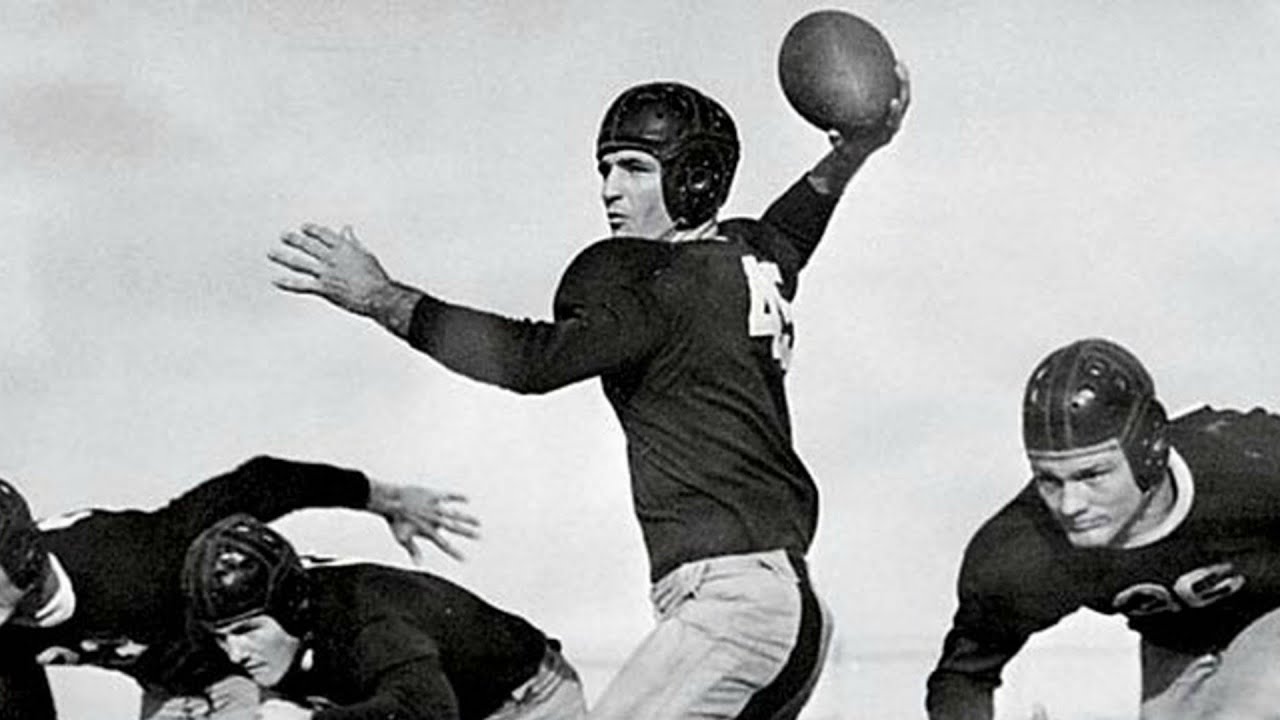
And how did the "men" play for the Horned Frogs of TCU in 1935? Pretty well: They came into the game 10-0, their defeated opponents including Texas, Texas A&M and Arkansas. They were led by a quarterback named Sammy Baugh. Slingin' Sammy was the greatest passer Texas had ever seen -- maybe the greatest anybody had ever seen to that point.

And how did the "bunch of damn sissies and city slicers from Dallas" play for the Mustangs of SMU that year? Equally well: They came into the game 10-0, their defeated opponents including Texas, Arkansas, and UCLA at the Los Angeles Memorial Coliseum. They had a game at Texas A&M yet to come. Their best player was halfback Bob Wilson.

They were coached by William Madison "Matty" Bell, who had also played end, although not at the school he was coaching now, but at Centre College in Kentucky. He had been TCU's head coach from 1923 to 1928, with Meyer on his staff. So perhaps Meyer was taking this personally.

So the rivals came into the game undefeated, with the championship of the Southwest Conference on the line. It could have even been for the National Championship, because the Rose Bowl was talking about inviting the winner. Four weeks earlier, Notre Dame had beaten Ohio State in a game that was called "The Game of the Century" by some people. But in Texas, this game was called "The Game of the Century." NBC decided to broadcast it live on radio to the entire country. A crowd of 36,000 packed into Carter Stadium to watch it in person.

The only scoring in the 1st quarter was an SMU touchdown. The Mustangs scored again early in the 2nd quarter. But Baugh led the Frogs on a touchdown drive, and the half ended 14-7 SMU. It remained that way through the 3rd quarter, but Baugh led a touchdown drive early in the 4th quarter, and the game was tied.

With 9 minutes left to play, and a 4th down and long to go, Bob Finley faked a punt and threw to Wilson, who took the ball in for a touchdown. The extra point was missed, so SMU's lead was 20-14, giving TCU fans hope of winning, 21-20.

With the clock winding down, Baugh took the Horned Frogs down the field, and got to the SMU 35-yard line. But on the final play, he threw into the end zone, and his receiver was too well-covered, and SMU's 20-14 lead held. SMU's band played "California, Here I Come."

Grantland Rice, the nation's leading syndicated sports columnist, covered the game, called it "one of the greatest football games ever played." It is credited with elevating the Southwest Conference to the college football equivalent of "major league" status. In 2017, The Dallas Morning News ranked it the greatest game ever played between the 2 rivals. However, having taken place in the age of radio, it tends to get passed over in "Game of the Century" discussions in Texas, in favor of the nationally-televised 1969 game between Texas and Arkansas.

SMU still had to play Texas A&M, but beat them, after which they were, indeed, invited to the Rose Bowl. But they lost it to Stanford. TCU went to San Francisco to play their last scheduled regular-season game, beating Santa Clara University. They were invited to the Sugar Bowl in New Orleans, and beat Louisiana State.

TCU, in spite of their loss to SMU, were named National Champions by the Williamson System. SMU, in spite of their loss to Stanford, were named National Champions by the Dickinson System, the Houlgate System, and, retroactively, by the Berryman System and the Sagarin Ratings. The University of Minnesota were selected as National Champions by United Press (UP, forerunners of United Press International or UPI), the Billingsley Report, the Boand System, the Helms Athletic Foundation, the Litkenhous System, the Poling System, and retroactively by the College Football Researchers Association and the National Championship Foundation.

This system didn't work too well. For the 1936 season, the Associated Press (AP) began polling the sportswriters who covered college football. Usually, they got it right. UP/UPI, which polled the nation's head coaches, usually named a National Champion, and it usually matched the AP's selection. On the occasions when it didn't, their selection was usually justifiable, if not the better choice. Still, this system proved unsatisfying. The Bowl Championship Series made things better, and the current College Football National Playoff system better still, but there have been flaws in every system yet tried.

Baugh went on to a great career with the NFL's Washington Redskins, and was a charter inductee into the College and Pro Football Halls of Fame. TCU won a legitimate National Championship in 1938, with another great quarterback, Heisman Trophy winner Davey O'Brien. But for the rest of the 20th Century, they tended to struggle, before a revival in the early 21st Century.

None of SMU's players did much in the pros, but they had a better record over the next few decades than TCU. In 1982, they nearly won the National Championship with their "Pony Express" backfield of Eric Dickerson and Craig James. But their cheating on top of cheating led them to become the 1st, and still the only, college football program ever to receive the NCAA's "death penalty," in 1986. They started play again in 1989, and they've been what college basketball fans call a "mid-major" school ever since. But then, so have TCU.

Carter Stadium still stands, with significant modernization. Ownby Stadium was demolished in 1998, and Gerald J. Ford Stadium was built on the site. Again, the new stadium was named for its funder. He was not related to Gerald R. Ford, the 38th President of the United States -- although that Gerald Ford was an All-American football player in 1935, a center at the University of Michigan.

*

November 30, 1935 was a Saturday. Comedian and director Woody Allen was born on this day.

These other notable college football games were played that day:

* Army beat Navy, 28-6 at Franklin Field in Philadelphia.

* Georgia Tech beat Georgia, 19-7 at Grant Field in Atlanta.

* Mississippi beat Mississippi State, 14-6 at Hemingway Stadium (now Vaught-Hemingway Stadium) in Oxford, Mississippi.

* Louisiana State beat Tulane, 41-0 at Tulane Stadium.

* Washington University beat crosstown rivals Saint Louis University, 26-0 at Walsh Memorial Stadium.

* Columbia beat Dartmouth, 13-7 at Baker Field in Manhattan.

* And Princeton beat Yale, 38-7 at the Yale Bowl in New Haven, Connecticut.

Actually, most of the big rivalries that weekend were played 2 days earlier, on Thanksgiving Day: Fordham beat New York University 21-0 in front of 72,000 at Yankee Stadium, Pittsburgh and next-door neighbors Carnegie Tech (now Carnegie-Mellon) played to a 0-0 tie, Kentucky beat Tennessee, Missouri and Kansas played to a 0-0 tie, Oklahoma beat Oklahoma State, and Utah and Utah State played to a 14-14 tie.

And, most important from the Lone Star State's perspective, for if football is a religion there, then this is its holy war: Texas A&M beat Texas, 20-6 at Kyle Field in College Station.

Baseball was out of season. The NBA hadn't been founded yet. There were 3 NHL games played that day:

* The New York Americans beat the Boston Bruins, 2-1 at the old (but then still relatively new) Madison Square Garden.

* The Montreal Maroons beat the Detroit Red Wings, 3-2 at the Montreal Forum.

* And the Toronto Maple Leafs beat their arch-rivals, the Montreal Canadiens, 8-3 at Maple Leaf Gardens in Toronto.

And in English soccer, North London team Arsenal went to Yorkshire, and played Huddersfield Town to a draw, 0-0 at Leeds Road in Huddersfield.

Saturday, January 1, 2022

January 1, 1937: The 1st Cotton Bowl

Slingin' Sammy Baugh

January 1, 1937: The 1st Cotton Bowl -- or, as it's officially known, the Cotton Bowl Classic -- is played at Fair Park Stadium on the Texas State Fair Grounds in Dallas. Texas Christian University (TCU) defeat Marquette University, 10-6.

This was the last collegiate game for Sammy Baugh, the greatest quarterback that football had yet seen, who threw a 55-yard pass for the Horned Frogs' only touchdown.

Before the Cotton Bowl, Fair Park had hosted the Dixie Classic 3 times: In 1922, 1925 and 1934. That game never caught on, but the dream of a New Year's Day bowl game in Dallas, like the Rose Bowl in Pasadena, California, wouldn't go away. And on New Year's Day 1935, the sunny cities of Miami and New Orleans began hosting the Orange Bowl and the Sugar Bowl, respectively.

So oil executive J. Curtis Sanford financed the game out of his own pocket. The Fair Grounds stadium was subsequently expanded to 37,000 seats, and renamed the Cotton Bowl, after the South's most famous agricultural product.

TCU had won its 1st title in the Texas Intercollegiate Athletic Association in 1920, and won SWC titles in 1929, 1932, 1938, 1944, 1951, 1955, 1958 and 1959, before going into a decline. They won one last SWC title in 1994, before the league split up in 1996. They won titles in the Western Athletic Conference in 1999 and 2000; in Conference USA in 2002; in the Mountain West Conference in 2005, 2009, 2010 and 2011; and in the Big 12 Conference in 2014.

The inaugural Cotton Bowl would be the only bowl appearance for Marquette, a Catholic school in Milwaukee. They dropped their program in 1960, and have never reinstated it. Known as the Golden Avalanche until then, they became the Warriors, before the appeal to drop Native American mascots took hold there in 1994. They have been the Golden Eagles ever since, and basketball has been their most successful sport, winning the National Championship in 1977 after reaching the Final in 1974.

Southern Methodist University (SMU), based in Dallas, used the Cotton Bowl stadium as their home field. The success of star running back Doak Walker, who led them to victory in the 1948 and 1949 Cotton Bowls, led to the stadium receiving an upper deck, and the nickname "The House That Doak Built." Walker won the Heisman Trophy in 1948, and finished 2nd in the voting in 1949.
The Cotton Bowl stadium

In 2010, the Cotton Bowl Classic was moved to the Dallas Cowboys' new AT&T Stadium in suburban Arlington, about halfway between the downtowns of Dallas and Fort Worth. It was never held at the Cowboys' previous home, Texas Stadium in suburban Irving, although SMU did play their home games there from 1979 to 1986. Today, the Cotton Bowl stadium's main purpose is soccer games and the annual Texas vs. Oklahoma game on the 2nd Saturday in October, the week of the State Fair.
The game, officially "The Cotton Bowl Classic," would have an affiliation with the Southwest Conference. Every year from its start in 1937 until 1995, the last year of the SWC, a team from that league would be in it, usually the league Champion. The breakup of the SWC ended the official relationship, but it still featured a former SWC team in 1998, 1999, 2000, 2002, 2003, 2005, 2006, 2008, 2009, 2011, 2012, 2013 and 2015.

The Cotton Bowl has hosted teams that won the National Championships for the calendar years of 1950, Tennessee; 1959, Syracuse; 1963 and 1969, Texas; 1964, Arkansas; 1977, Notre Dame; 2015, Alabama; and 2018, Clemson.

*

January 1, 1937 was a Friday. Also on this day, the Rose Bowl was played in the stadium of the same name, outside Los Angeles in Pasadena, California. The University of Pittsburgh beat the University of Washington, 21-0.

In the Orange Bowl, at Miami Field in Miami, Duquesne beat Mississippi State, 13-12.

In the Sugar Bowl, at Tulane Stadium in New Orleans, Santa Clara University beat Louisiana State University (LSU), 21-14.

And in the Sun Bowl, at Jones Stadium in El Paso, Texas, Hardin-Simmons University beat Texas Mines, 34-6. Texas College of Mines was renamed Texas Western University in 1948, and the University of Texas at El Paso (UTEP) in 1966.

One game was played in the NHL: The Chicago Black Hawks beat the Detroit Red Wings, 4-2 at the Chicago Stadium.

December 31, 1999 & January 1, 2000: The Millennium

December 31, 1999:  The Millennium arrives. The people of planet Earth survived. At a terrible cost. But we hadn't destroyed ourselves. ...