Showing posts with label naacp. Show all posts

Sunday, December 25, 2022

December 25, 1951: A Bloody Christmas for Civil Rights

Harriette (left) and Harry Moore

December 25, 1951: bomb explodes at the home of Harry T. Moore, President of the Florida branch of the NAACP, in Mims, Florida, not far from Cape Canaveral.
Moore was born on February 18, 1905, in Houston, on the Florida Panhandle, about halfway between Tallahassee and Jacksonville. By the early 1930s, he was secretary for the Florida chapter of the NAACP. He worked on housing and education, investigated lynchings, and registered black voters. By 1950, 31 percent of eligible black people in Florida were registered to vote, more than in any other Southern State.
But on the night of December 25, 1951, a bomb exploded at his house in Mims. The local hospital in Titusville would not treat black people, Moore was taken to the nearest one that would, 30 miles away in Sanford, and he died en route. He was 46 years old. His wife, teacher Harriette Moore, died from her injuries 9 days later, on January 3, 1952, at the Sanford hospital. She was 49.
The FBI investigated the murder, but not with any enthusiasm, and no one was ever prosecuted for it. In 2006, a State investigation suggested the perpetrators were 4 members of the Ku Klux Klan, all of them dead by that point, so there was nothing that could be done.
Moore was the 1st NAACP member to be assassinated for civil rights activism, and he and Harriette were the only husband and wife killed for it. They are considered the first martyrs of the Civil Rights Movement. Much of the community of Mims is now part of Harry T. and Harriette V. Moore Memorial Park.
Also on this day, Los Angeles policemen attack 5 Mexican-American and 2 white young men, leading to their hospitalization. Although they all survived, it became known as "Bloody Christmas." While 8 police officers were indicted, none were imprisoned. The event would be fictionalized in the 1990 novel and 1997 film L.A. Confidential.
*
December 25, 1951 was a Tuesday. Four games were played in the NBA, including a doubleheader at Madison Square Garden. In the opener, the Syracuse Nationals beat the Milwaukee Hawks, 70-65. In the nightcap, the New York Knicks beat the Fort Wayne Pistons, 72-65.
Also, the Rochester Royals beat the Indianapolis Olympians, 87-78 at the Edgerton Park Arena. And the Minneapolis Lakers beat the Boston Celtics, 100-93 at the Minneapolis Auditorium.
Two games were played in the NHL. The New York Rangers lost to the Detroit Red Wings, 2-1 at the Olympia Stadium. And the Chicago Black Hawks beat the Boston Bruins, 6-2 at the Boston Garden.
And in English soccer, Arsenal F.C. hosted Hampshire team Portsmouth at Highbury in North London, and won 4-1 on goals by Lewis, Logie, Freddie Cox and Peter Goring.

Thursday, December 1, 2022

December 1, 1955: Rosa Parks Holds Her Seat

December 1, 1955: Rosa Parks is told to get up and move. She says, "No." In so, doing, she made history.

As historian Laurel Thatcher Ulrich said, "Well-behaved women rarely make history."

Let the record show that Rosa Parks was not the first woman to make this kind of history. In 1943, 17-year-old Bernice Delatte was arrested for defying segregation rules on a bus in New Orleans. In 1944, a U.S. Army Lieutenant was told to go to the back of a bus, to make room for a lower-ranking soldier. He refused. He got court-martialed. He was acquitted. His name was Jack Roosevelt Robinson. Yes, that Jackie Robinson. And in 1953, a 6-day boycott got the buses in Baton Rouge, Louisiana desegregated.

On March 2, 1955, Claudette Austin was arrested in Montgomery, the capital of Alabama, for refusing to give up her seat to a white woman on a crowded, segregated bus. The National Association for the Advancement of Colored People had been waiting for a chance to challenge a "send the blacks to the back of the bus" law, in line with the decision the year before, by the U.S. Supreme Court, in Brown v. Board of Education of Topeka, Kansas, that accommodations that were officially "separate but equal" was unconstitutional.

But Claudette was 15 years old, unmarried, and pregnant. Parks later said, "If the white press got ahold of that information, they would have a field day. They'd call her a bad girl, and her case wouldn't have a chance." The NAACP would need a more sympathetic defendant. Nine months later -- perhaps an appropriate time period -- they found one: Parks herself.

Rosa Louise McCauley was born on February 4, 1913 in Tuskegee, Alabama, and grew up in Pine Level, outside Montgomery. She was bullied by white children, and never forgot it. In 1932, she married Raymond Parks, a barber who worked with the NAACP. She joined the Montgomery chapter in 1943, and was elected its secretary. During World War II, she rode on an integrated trolley at Maxwell Air Force Base in Montgomery. She later said, "You might just say Maxwell opened my eyes up."

On November 27, 1955, Rosa Parks was attending Dexter Avenue Baptist Church in Montgomery, whose pastor was 26-year-old Dr. Martin Luther King Jr. He had invited T.R.M. Howard, head of the Regional Council of Negro Leadership in Mississippi, to speak of the recent murder of Emmett Till, and the acquittal of the 2 men who did it.

It was still on her mind 4 days later, on December 1. At around 6:00 PM, she boarded a Montgomery City Lines bus downtown. Eventually, all of the White-only seats in the bus filled up. The bus reached the third stop, in front of the Empire Theater, and several White passengers boarded. The driver, James F. Blake, noted that two or three White passengers were standing, as the front of the bus had filled to capacity.

Blake moved the "colored" section sign behind Parks, and demanded that four Black people give up their seats in the middle section, so that the White passengers could sit. Three of them complied. Parks said, "I thought of Emmett Till, a 14-year-old African American who was lynched in Mississippi in 1955, after being accused of offending a White woman in her family's grocery store, whose killers were tried and acquitted – and I just couldn't go back." In her autobiography, she said:
People always say that I didn't give up my seat because I was tired, but that isn't true. I was not tired physically, or no more tired than I usually was at the end of a working day. I was not old, although some people have an image of me as being old then. I was forty-two. No, the only tired I was, was tired of giving in.
When Parks refused to give up her seat, Blake took to his radio, and called the police. When she was arrested, she asked the officer, "Why do you push us around?" She remembered him saying, "I don't know, but the law's the law, and you're under arrest."

She was charged with a violation of Chapter 6, Section 11, segregation law of the Montgomery City code. Edgar Nixon, president of the Montgomery chapter of the NAACP and leader of the Pullman Porters Union, and her friend Clifford Durr bailed Parks out of jail that evening.

On Sunday, December 4, plans for the Montgomery bus boycott were announced at Black churches in the area, and a front-page article in the Montgomery Advertiser helped spread the word. At a church rally that night, those attending agreed unanimously to continue the boycott until they were treated with the level of courtesy they expected, until Black drivers were hired, and until seating in the middle of the bus was handled on a first-come-first-served basis.

The next day, Parks was tried on charges of disorderly conduct and violating a local ordinance. The trial lasted 30 minutes. After being found guilty and fined $10, plus $4 in court costs -- the total of $14 worth about $155 in 2022 money -- she appealed her conviction, and formally challenged the legality of racial segregation.

It rained that day, but the Black community persevered in their boycott. Some rode in carpools, while others traveled in Black-operated cabs that charged the same fare as the bus, 10 cents. Most of the remainder of the 40,000 Black commuters walked, some as far as 20 miles.

The boycott lasted for an entire year. On December 20, 1956, the federal ruling Browder v. Gayle took effect, declaring the Alabama and Montgomery laws that segregated buses were unconstitutional. All the seats on all the buses were now open to all.

In 1957, Rosa and Raymond Parks moved to Detroit, living with her brother and sister-in-law. She became a fair housing activist, helped John Conyers get elected to Congress in 1964, and served as his secretary until 1988. She participated in the Selma-to-Montgomery march in 1965. Her husband and brother died within weeks of each other in 1977, and she stepped back from civil rights activities thereafter to care for her mother, who died in 1979.
She then returned to the struggle, adding Planned Parenthood to her causes. In 1994, she was robbed and assaulted in her Detroit home. Mike Ilitch, founder of Detroit-based pizza chain Little Caesars, and owner of baseball's Detroit Tigers and hockey's Detroit Red Wings, bought her an apartment in a high-rise riverfront condo.
The following year, in commemoration of the 40th Anniversary of her seated stand, President Bill Clinton invited her to the State of the Union Address. He said, "She's sitting down with the First Lady tonight, and she may get up, or not, as she chooses." Acknowledging a standing ovation, she briefly stood.
She died on October 24, 2005, at the age of 92, after years of ill health and cognitive decline. Although often called "the mother of the Civil Rights Movement," she had no children of her own. She became the 1st woman, the 2nd black person, and the 1st private citizen to lie in state under the Rotunda of the U.S. Capitol Building in Washington.
A statue of her stands in Montgomery, roughly where she was arrested. In her adopted hometown of Detroit, the bus terminal is named for her. The bus on which she was arrested was also moved to Detroit, to the Henry Ford Museum in adjoining Dearborn, where it is on display along with the limousine in which President John F. Kennedy was assassinated, and the Ford's Theatre chair in which President Abraham Lincoln was sitting when he was assassinated.
As has been said, Rosa Parks sat, so that Martin Luther King could march, so that Barack Obama could run.
Bernice Delatte, the 1943 New Orleans protestor, lived until 2010. Claudette Austin became a nurse, married, and took the name Claudette Colvin. As of December 1, 2022, she is still alive. (UPDATE: She died in 2026.)

*

December 1, 1955 was a Thursday. Baseball was out of season. Football was in midweek. Two games were played in the NBA. The New York Knicks lost to the Minneapolis Lakers, 97-90 at the Minneapolis Auditorium. And the Philadelphia Warriors beat the St. Louis Hawks, 115-98 at the Philadelphia Civic Center.

And 1 game was played in the NHL: The Montreal Canadiens beat the Boston Bruins, 2-1 at the Boston Garden.

Tuesday, August 30, 2022

August 30, 1967: The 1st Black Justice On the U.S. Supreme Court

August 30, 1967: President Lyndon B. Johnson appoints Thurgood Marshall to the Supreme Court of the United States. This made him its 1st black Justice.

Most new Justices are not familiar to the general public before their appointments. Marshall was: He was a man whose story would have to be told even if he had never received this appointment.

He was born on July 2, 1908 in Baltimore. On my 1st visit to that city, in 1987, my hotel was across the street from the Federal Courthouse. Although it was named for the recently-deceased Congressman Edward Garmatz, there was a statue of Marshall outside. It was the 1st time I had ever seen a statue of someone still living. In his case, he was even still serving on the Supreme Court. (Although a check of the facts shows that Garmatz was also still alive when the Courthouse was named for him.)

He attended Lincoln University, the country's oldest school for black students, outside Philadelphia in Chester, Pennsylvania, where he was a classmate of writer Langston Hughes. With the University of Maryland School of Law segregated, he went to the one at Howard University in Washington, D.C., known as "The Black Harvard."

In 1935, working as assistant to his former Howard professor, Charles Hamilton Houston, who was now the director-counsel for the Legal Defense and Educational Fund of the National Association for the Advancement of Colored People (NAACP), he won the case of Donald Gaines Murray, which ordered the desegregation of... the University of Maryland School of Law.

Key to this decision was the fact that the State of Maryland did not provide funding for, to use the expression used by the U.S. Supreme Court in its 1896 Plessy v. Ferguson case, "separate by equal" facilities: It was funding a law school for white residents of the State, but not black ones. In 1936, Marshall, again working under Houston, won a similar case with the University of Missouri.

Houston, a Washington native and a graduate of Harvard University School of Law, became known as "The Man Who Killed Jim Crow." This was a bit premature, but he had found a way around the segregation laws known as "Jim Crow": "If you want it 'separate but equal,' I will make it so expensive for it to be separate that you will have to abandon your separateness." He returned to Howard in 1938, with Marshall succeeding him as director-counsel of the NAACP Legal Fund. Houston died in 1950, before seeing Marshall's greatest success.

The full name of the case was Oliver Brown et al. v. The Board of Education of Topeka, Kansas. The named plaintiff, Oliver Brown, was a welder working for a railroad, and an assistant pastor. His daughter, Linda Carol Brown, was in the 3rd grade, and had to walk 6 blocks to her school bus stop to ride to Monroe Elementary School in Topeka, an all-black school, 1 mile away. Sumner Elementary School, all-white, was just 7 blocks away -- 1 block longer than the walk to the bus.

Thurgood Marshall led the legal team for the Browns. The defense counsel was John W. Davis, a former Congressmen from West Virginia, a former Solicitor General of the U.S., a former U.S. Ambassador to Britain, the Democratic Party's nominee for President in 1924, and a staunch segregationist. Davis was 81 years old, and spoke in flowery prose to support segregation. (He would be dead within a year, and is largely forgotten today.)

Marshall was 45, at the height of his powers, and spoke plainly: "The only possible justification for segregation is an inherent determination that the people who were formerly in slavery, regardless of anything else, shall be kept as near that stage as possible. And now is the time, we submit, that this Court should make clear that that is not what our Constitution stands for."

In a unanimous 9-0 ruling, the Supreme Court overturned the case of Plessy v. Ferguson in 1896, which ruled that "separate but equal" facilities be provided in public places. In Brown v. Board, the Supreme Court ruled that "separate educational facilities are inherently unequal." In 58 years, SCOTUS had gone from 1-8 in favor of integration to 9-0.

In 1961, President John F. Kennedy appointed Marshall to be a Judge of the U.S. Court of Appeals for the Second Circuit, covering the States of New York, Connecticut and Vermont. In 4 years, he authored 98 majority opinions. Not one of them has ever been overturned.

In 1965, President Lyndon B. Johnson appointed Marshall to be the 1st black U.S. Solicitor General, whose job is to argue in favor of the federal government when it is a party in a case before the Supreme Court. 

Not only had his 1954 opponent Davis held that post, but so had William Howard Taft, later to become the only man to serve as President and as a Justice of the Supreme Court. So had former Justices Stanley Reed and Robert H. Jackson. This was a signal that LBJ was preparing to make Marshall the 1st black Justice on the Supreme Court.

For 2 years, SCOTUS had no vacancy. So LBJ decided to create one: He got Nicholas Katzenbach, his Attorney General, to take a post as an Under Secretary of State, and appointed Ramsey Clark to be the new Attorney General. In order to avoid a conflict of interest, LBJ convinced Clark's father, Justice Tom Clark, to retire.

On June 13, LBJ announced Marshall's appointment. On August 30, the U.S. Senate confirmed by by a vote of 69-11. Which means that 20 Senators didn't vote. These were all Southern Democrats, and Johnson personally asked them not to vote at all, and they agreed. Not that it would have mattered, but it certainly made them look better than the 11 who did vote against him.

Marshall became a reliable member of a liberal coalition on the Court, under Chief Justices Earl Warren (1967-69) and Warren Burger (1969-86). But when William Rehnquist was promoted from Associate Justice to Chief Justice by President Ronald Reagan in 1986, the Court took a much more conservative turn. The retirement of William J. Brennan, a fellow liberal, in 1990 left him feeling depressed about the Court's progress.

By 1991, Marshall had had enough, and retired. At the press conference where he announced it, a reporter, concerned about his health, asked, "What's wrong with you, sir?" Marshall said, "What's wrong with me? I'm old! I'm getting old, and coming apart." He died on January 25, 1993, at the age of 84.

He had been married twice, and had 2 sons: Thurgood Marshall Jr. worked in the Clinton Administration and chaired the Board of Governors of the U.S. Postal Service in the Obama Administration; and John W. Marshall served as Director of Public Safety for the Commonwealth of Virginia for 8 years, making him the longest-serving person in the history of the Cabinet of Virginia's Governors.

*

August 30, 1967 was a Wednesday. These baseball games were played that day:

* The New York Yankees lost to the Boston Red Sox, 2-1 at Yankee Stadium. The American League Pennant race was incredibly tight: The Red Sox came into this game just half a game ahead of Minnesota and Detroit, and 2 1/2 ahead of Chicago. In contrast, the Yankees were 15 1/2 games back, and were struggling to avoid a repeat performance of the previous season's last-place finish. So every win was key for the Red Sox in what became known as their "Impossible Dream" season.

And the most key player was Carl Yastrzemski, on the way to winning the AL's Triple Crown. In the top of the 11th inning, he hit a home run off Al Downing, who had gone the distance for the Pinstripes. This made a winning pitcher of John Wyatt, who pitched 4 innings in relief of Jerry Stephenson. Mickey Mantle did not play in this game.

* The New York Mets lost to the St. Louis Cardinals, 2-0 at Busch Memorial Stadium. Larry Jaster took a 4-hit shutout into the 9th inning, and Ron Willis finished it. Tim McCarver, who would later broadcast for the Mets (and the Yankees) hit a home run for the Cardinals.

* The Chicago White Sox beat the Washington Senators, 5-1 at District of Columbia Stadium in Washington. (It was renamed Robert F. Kennedy Memorial Stadium in 1969.)

* The Pittsburgh Pirates beat the Atlanta Braves, 11-9 at Atlanta Stadium (It was renamed Atlanta-Fulton County Stadium in 1975.) Roberto Clemente went 2-for-5 with 2 RBIs. Willie Stargell went 2-for-4 with a home run and 4 RBIs. Joe Torre went 3-for-5 with a home run and 3 RBIs. Hank Aaron went 1-for-4, and did not hit a home run.

A year earlier, in the Braves' 1st game in Atlanta, Torre hit the 1st major league home run at the stadium, but Stargell hit one that won the game.

* The Cincinnati Reds beat the Philadelphia Phillies, 2-1 at Crosley Field in Cincinnati. Pete Rose went 2-for-4 with an RBI. Johnny Bench, who made his major league debut 2 days earlier, got his 1st major league RBI, a sacrifice fly off Chris Short in the 2nd inning; and his 1st major league hit, a single off Short in 7th.

* The Chicago Cubs beat the Houston Astros, 4-1 at Wrigley Field in Chicago. Ernie Banks went 0-for-4 with an RBI groundout. Joe Morgan went 2-for-5 for the Astros.

* The Kansas City Athletics beat the Cleveland Indians, 6-5 at Kansas City Municipal Stadium. (Both teams played at facilities named Municipal Stadium.) Danny Cater singled home the winning run in the bottom of the 12th inning.

* The Baltimore Orioles beat the Minnesota Twins, 4-2 at Metropolitan Stadium in the Minneapolis suburb of Bloomington, Minnesota. Brooks Robinson and Frank Robinson each went 1-for-4, and Frank's hit was a 2-run home run, off Dean Chance in the top of the 10th inning. Like Downing, Chance had pitched an entire extra-inning game but lost. Harmon Killebrew went 0-for-3 with a walk, and eventual Rookie of the Year Rod Carew went 1-for-3 with a walk and an RBI.  

* The California Angels beat the Detroit Tigers, 3-2 at Anaheim Stadium (now Angel Stadium of Anaheim). Al Kaline went 1-for-4.

* And the Los Angeles Dodgers beat their arch-rivals, the San Francisco Giants, 9-3 at Candlestick Park in San Francisco. Ron Fairly hit a home run in support of Don Drysdale. Willie Mays went 1-for-4 with a walk.

Tuesday, June 28, 2022

June 28, 1951: Everybody Turns On "Amos 'n' Andy" -- and Not In a Good Way

Top: Tim Moore as George "Kingfish" Stevens.
Bottom: Spencer Williams as Andy Brown (left)
and Alvin Childress as Amos Jones.

June 28, 1951: After 23 years on radio, Amos 'n' Andy premieres on CBS' television network. When people heard white actors on radio, pretending to be black, they loved it. But when they saw the roles they thought they knew played by actual black actors -- Alvin Childress as Amos Jones, Spencer Williams as Andy Brown, Tim Moore as George "Kingfish" Stevens, and Ernestine Wade as Kingfish's wife Sapphire -- they didn't like it. The NAACP objected as well, saying it indulged in racial stereotypes.

A total of 78 half-hour episodes were eventually produced. Childress and Williams were instructed to keep their voices and speech patterns close as possible to those of the roles' originators, Freeman Gosden and Charles Correll, respectively. Nevertheless, the show was a bust, lasting just 2 seasons.


Even if the show had succeeded, they would have had to replace Moore after his death in 1958. Williams lived until 1969, Wade until 1983, and Childress until 1986. To the end, though, Childress said he never thought the show was a negative portrayal of black people, because it was the only television show of the time to show them as businessmen, policemen, judges and doctors, rather than in subservient roles such as maids and janitors.

Black actors Redd Foxx and Marla Gibbs, both of whom starred in later sitcoms, emphasized the importance of the show featuring black actors in lead roles and expressed disagreement with the NAACP's objections that had contributed to the program's downfall.

The shows were preserved, and have been released on DVD, so that current viewers may decide for themselves if the show indulged in stereotypes, or was just good clean fun.

*

June 28, 1951 was a Thursday. Chris Speier, later an All-Star shortstop for the San Francisco Giants, was born.

And these baseball games were played:

* The New York Yankees beat the Washington Senators, 3-0 at Griffith Stadium in Washington. Tom Morgan pitched 7 innings, allowing 8 hits, but no runs. Joe Ostrowski finished the 9-0 shutout. Joe DiMaggio, in his last season, went 1-for-4. Mickey Mantle, in his 1st season, struck out as a pinch-hitter.

* The New York Giants beat their arch-rivals, the Brooklyn Dodgers, 5-4 at Polo Grounds. At the time, the Dodgers led the National League by 4 1/2 games. Jackie Robinson went 1-for-3 with a walk. Monte Irvin hit a 3-run home run in the bottom of the 8th inning to win it. Sheldon Jones was the winning pitcher, in relief of Dave Koslo. The losing pitcher was Ralph Branca. There was a bit of foreshadowing in that.

* The Philadelphia Phillies beat the Boston Braves, 3-2 at Shibe Park in Philadelphia. The winning run came home in the bottom of the 10th inning: Batting against Warren Spahn, Eddie Pellagrini grounded into what should have been an inning-ending double play, but Braves 2nd baseman Roy Hartsfield made a throwing error that allowed Tommy Brown to score. Hartsfield went on to become the 1st manager of the Toronto Blue Jays in 1977.

* The Pittsburgh Pirates beat the Cincinnati Reds, 7-5 at Crosley Field in Cincinnati. Ralph Kiner went 1-for-3 with a walk, and was hit by a pitch.

* The Chicago Cubs beat their arch-rivals, the St. Louis Cardinals, 8-0 at Sportsman's Park in St. Louis. Frank Hiller allowed only a walk to Tommy Glaviano in the 1st inning, and a single to Enos Slaughter in the 5th. Stan Musial went 0-for-3.

* The Chicago White Sox and the Detroit Tigers were rained out at Comiskey Park in Chicago. The game was made up as part of a doubleheader on September 7. The Tigers swept, 4-1 and 2-1. The game went 14 innings, and the Tigers' Virgil Trucks and the White Sox' Billy Pierce both went the distance. Trucks himself doubled home the winning run.

* And the Boston Red Sox, the Cleveland Indians, the Philadelphia Athletics and the St. Louis Browns were not scheduled.

Sunday, June 12, 2022

June 12, 1963: The Assassination of Medgar Evers

June 12, 1963: Medgar Evers, one of the leading figures in the Civil Rights Movement, is assassinated.

NOTE: This was the same day the Elizabeth Taylor and Richard Burton film Cleopatra opened. I have a separate entry for that event.

Medgar Wiley Evers was born on July 2, 1925 in Decatur, Mississippi. He fought in the U.S. Army in the Battle of Normandy in June 1944, and was a part of the D-Day invasion. He played football and ran track, and was on the debating team, at the historically black school now known as Alcorn State University in Mississippi. After marrying classmate Myrlie Beasley and graduating, he went to work for a black-owned insurance company. He and Myrlie had 3 children: Son Darrell, then daughter Reena, then son James.

Medgar became President of the Regional Council of Negro Leadership, leading its boycotts of segregated places. His brother Charles Evers also served in the RCNL. In 1954, Medgar was named field secretary for Mississippi by the National Association for the Advancement of Colored People (NAACP). He fought, without success, to get the 1955 murderers of 14-year-old Emmett Till convicted. And he led the efforts that eventually succeeded in getting James Meredith enrolled as the 1st black student at the University of Mississippi in 1962.

Evers became a target for white supremacists. On May 28, 1963, a Molotov cocktail was thrown into the garage of his house in Jackson, the capital of Mississippi. On June 7, 10 days later, he was nearly run down by a car after her walked out of the NAACP office in Jackson.

On June 11, 4 days after that, President John F. Kennedy gave a nationally televised speech, announcing the introduction of the bill that would become the Civil Rights Act of 1964. That same day, Kennedy's Attorney General, and brother, Robert F. Kennedy, sent his deputy, Nicholas Katzenbach, to Tuscaloosa, Alabama, to get Governor George Wallace out of the door of Foster Auditorium, which was both the main athletic building and the registration center for the University of Alabama, because Wallace was trying to stop the 1st black students from registering at the school. On threat of getting arrested on live national television, Wallace backed down. It was a good day for civil rights.

That night, Jackson met in Jackson with civil rights lawyers. As he drove home, it was after midnight, March 12. He got out of his car, carrying T-shirts printed by the NAACP, reading "Jim Crow Must Go." A bullet entered his back and went through his heart, knocking him down. Somehow, he got up, and walked 30 feet to his front door, before falling again. Myrlie found him, and her screams woke up the neighbors.

Medgar was taken to the nearest hospital. At first, he was denied entry, because it was an all-white hospital. Hospital officials were told who he was, and he was admitted, the 1st black person admitted to an all-white hospital in Mississippi. The delay wouldn't have mattered, as he never had a chance. He died 50 minutes after being admitted.

He was only 37 years old -- younger than Martin Luther King Jr., or Malcolm X, or either of the Kennedy brothers would be upon their assassinations. Myrlie had just turned 30, and was younger than any of those men's widows were at the time.

Dr. King led his funeral procession, and, as an honorably discharged American military veteran, he was entitled to have arranged for him, and received, burial at Arlington National Cemetery.

On June 21, Byron De La Beckwith, a Ku Klux Klan member, was arrested for the murder. In the segregated South, juries were made up of people on the voter rolls -- which meant that, at this point, all juries would be all-white. Twice, in February and April 1964, all-white juries deadlocked, and failed to reach a verdict.

This failure was critical: Unlike the Till case, where an acquittal was reached, there was not a verdict; therefore, De La Beckwith could possibly be tried again. It took until 1993 before De La Beckwith was taken back to court. On February 5, 1994, nearly 31 years after he murdered Medgar Evers, Byron De La Beckwith was convicted, and sentenced to life in prison. He died in 2001, at 80, having served nearly 7 years, and unrepentant.

Charles Evers was appointed field director in his brother's place. In 1969, he was elected Mayor of Fayette, Mississippi, and was re-elected in 1973 and 1977. Defeated for re-election in 1981, he regained the office in 1985, but was defeated again in 1989.

Somewhere along the line, he switched parties, endorsing Ronald Reagan in 1980 and 1984, and Donald Trump in 2016. He died in 2020 (not from COVID), at age 97.

Myrlie Evers remarried in 1976, to Walter Williams, a civil rights and union activist. He died in 1995. Shortly thereafter, she began serving as Chairperson of the NAACP, a post she held until 1998. In 2013, she gave the invocation at President Barack Obama's 2nd Inauguration. As of June 12, 2022, she is still alive.

In 2011, although Medgar had served in the Army, it was the U.S. Navy that chose to honor him, launching a cargo ship. the USNS Medgar Evers.

Two notable films have been made about the Evers assassination and its aftermath. In 1983, For Us the Living: The Medgar Evers Story was broadcast on PBS, starring Howard Rollins as Medgar and Irene Cara as Myrlie. In 1996, Ghosts of Mississippi premiered, with James Pickens Jr. and Whoopi Goldberg. In the scenes featuring De La Beckwith's 1994 trial, their adult daughter Reena Evers was played by Yolanda King, in real life the daughter of Martin Luther King Jr.

*

June 12, 1963 was a Wednesday. These baseball games were played that day:

* The New York Yankees beat the Baltimore Orioles, 3-2 at Yankee Stadium. Roger Maris singled home the winning run in the bottom of the 10th inning, making Marshall Bridges a winner in relief of Ralph Terry. Mickey Mantle was injured, and did not play. Yogi Berra only appeared as a pinch-hitter, unsuccessfully.

* The New York Mets lost to the Milwaukee Braves, 9-0 at Milwaukee County Stadium. Lew Burdette pitched a 3-hit shutout. Hank Aaron and Del Crandall hit home runs. Duke Snider, playing out the string with the Mets, went 0-for-3, although he did draw a walk.

* The Boston Red Sox beat the Washington Senators, 5-3 at Fenway Park in Boston. Carl Yastrzemski went 1-for-3 with a solo home run.

* The Cincinnati Reds beat the Pittsburgh Pirates, 3-0 at Crosley Field in Cincinnati. Jim O'Toole pitched a 3-hit shutout. Frank Robinson went 2-for-3 with an RBI. Rookie Pete Rose went 2-for-4. Roberto Clemente went 1-for-4.

* The Cleveland Indians beat the Detroit Tigers, 12-6 at Tiger Stadium in Detroit. Al Kaline went 3-for-5 with 2 RBIs, but it wasn't enough.

* A doubleheader was split at Comiskey Park in Chicago. The Chicago White Sox won the opener, 3-1. The Los Angeles Angels won the nightcap, 5-0. Former Yankee Cy Young Award winner Bob Turley allowed only 1 hit, a 6th-inning single by Pete Ward.

* A doubleheader was split at Metropolitan Stadium in the Minneapolis suburb of Bloomington, Minnesota. As Harmon Killebrew went, so went the Minnesota Twins: In the 1st game, he went 0-for-4, and the Kansas City Athletics beat the Twins, 12-4; in the 2nd game, he went 1-for-3 with a home run, 2 walks and 2 RBIs, and the Twins won, 8-1.

* The Philadelphia Phillies beat the St. Louis Cardinals, 6-2 at Busch Stadium in St. Louis. (It had been known as Sportsman's Park from 1909 to 1953.) Stan Musial went 2-for-3 with an RBI.

* The Los Angeles Dodgers beat the Houston Colt .45s, 9-1 at Dodger Stadium in Los Angeles. (The Colts became the Houston Astros in 1965.)

* And the San Francisco Giants beat the Chicago Cubs, 3-1 at Candlestick Park in San Francisco. Willie McCovey hit 2 home runs, Willie Mays went 1-for-4, and Ernie Banks went 0-for-3.

Tuesday, April 5, 2022

April 5, 1968: James Brown at the Boston Garden

April 5, 1968: A concert is held at the Boston Garden. It almost wasn't. That could have been disastrous.

The day before, Dr. Martin Luther King, America's foremost civil rights activist, was assassinated in Memphis. Many American cities broke out in riots. On the first night, Boston's black neighborhood of Roxbury suffered disturbances, but they were largely confined to that one neighborhood.

But James Brown, the black singer known as "The Godfather of Soul" (among many other nicknames, almost as many as Babe Ruth, hence Apollo Creed's affinity for him in the film Rocky IV), was scheduled to give a concert at the Boston Garden the next night. There was a fear that his fans, at that point almost entirely black, might riot at the concert.

So the city government considered canceling the concert, in the interest of public safety. But then, it was suggested that the cancellation might cause a riot. It was a "damned if you do, and damned if you don't" situation. And the Mayor of Boston had to decide.

He was one of the youngest big-city Mayors in the country, only 38 years old, having been elected as a Democrat the previous November, after having served 7 years as the Secretary of the Commonwealth of Massachusetts. His father and grandfather had both served as President of the City Council, making them 1st in line to fill a vacancy in the Mayor's office. He was facing the kind of challenge that most Mayors don't face only 3 months into the job. To make matters worse, his name was White. Kevin White.

Tom Atkins, a local NAACP leader, suggested that the concert be broadcast live on WGBH-Channel 2, Boston's station on National Educational Television (NET, which became the Public Broadcasting Service, PBS, in 1970). That way, anybody who didn't have a ticket could stay at home and watch it, instead of going to the streets around the Garden, where the situation might become figuratively, or even literally, inflamed.

White agreed, and met with Brown. Brown was concerned that if this was done, the concert wouldn't sell out. He was expecting $60,000 in gate receipts -- about $504,000 in 2022 money -- which had to be spread among himself and everybody working for him that night. White told him the City of Boston would pay any shortfall of the $60,000, and Brown agreed to let the show go on.

White went to the concert himself, taking the stage first. He reminded the crowd that Dr. King had gotten his doctorate of divinity from Boston University, and had come to love the city and its role in advancing freedom for all Americans, including black Americans. It hadn't always been apparent in recent times: Bill Russell, the great star of the Boston Celtics and by then their head coach, had called it a racist city. Events in the 1970s would deepen this perception nationally.

But White, who might have been the last person many of the fans wanted to see on that stage, spoke with great eloquence, closing with, "So all I ask you tonight is this: To let us look at each other, here in the Garden and back at home, and pledge that, no matter what any other community might do, we in Boston will honor Dr. King in peace."

The concert went on, with only one hitch: A couple of fans, both black, rushed the stage in mid-song, but Brown's bodyguards kept them from reaching him. He stopped his song, and told the fans to "cool it," waited a moment, and resumed.

But that was it. There were no further incidents inside the Garden. WGBH followed their broadcast of the concert with an immediate rebroadcast, then another. And there were no disturbances in Boston that night.

Despite losing many of his fellow Irish-Americans in standing up for the rights of black people, including during the school-busing crisis of 1974, White was re-elected in 1971, 1975 and 1979, leaving office at the beginning of 1984. His 16 years as Mayor tied the Boston record set by James Michael Curley, no 2 of whose 4 terms were consecutive. Thomas Menino would later break White's record, by being elected to 5 terms and serving 20 years.

Brown was elected to the Rock and Roll Hall of Fame as a charter member in 1986, and died in 2006. White died in 2012.

*

April 5, 1968 was a Friday. Singer Paula Cole was born.

Baseball season opened the following week. Football was out of season. The Stanley Cup Playoffs were underway, but no games were scheduled.

There were 2 games in the NBA. The Boston Celtics beat the Philadelphia 76ers, 127-118 at The Spectrum in Philadelphia. John Havlicek scored 35 points. And the Los Angeles Lakers beat the San Francisco Warriors, 133-105 at The Forum outside Los Angeles in Inglewood, California. These games were both Division Finals. The Celtics went on to beat the Lakers in the NBA Finals.

There was 1 game in the American Basketball Association Playoffs: The New Orleans Buccaneers beat the Dallas Chaparrals, 104-99 at the Loyola Field House in New Orleans.

Friday, February 18, 2022

February 18, 1915: "The Birth of a Nation" Is Screened at the White House

February 18, 1915: The Birth of a Nation is screened at the White House. It is the 1st film to receive this honor.

Based on The Clansman, a novel published in 1905 by Thomas Dixon Jr., the film -- of course, silent, and, in more ways than one, filmed in black and white -- is directed by D.W. (David Wark) Griffith. It is the longest feature film ever made to that point: 3 hours and 13 minutes.

It is the 1st American-made film to have a musical score for an orchestra. It is the 1st to have extensive use of close-ups and fade-outs, and the 1st to have hundreds of extras to film a battle scene.

About that battle scene: It's set during the American Civil War, and the film includes a staging of the assassination of President Abraham Lincoln. And it portrays the postwar Reconstruction period as a time when the nascent Ku Klux Klan is needed to perform heroic acts to save white women from the actions of scheming, sexually aggressive black men, most of them played by white actors in blackface makeup. For this reason, The Birth of a Nation has been called "the most reprehensibly racist film in Hollywood history."

And it didn't just generate that reputation in its future: Even at the time, black activists, including the National Association for the Advancement of Colored People (NAACP, founded in 1909) wanted it banned, for fears that it could incite racial violence. This was a legitimate concern, as it had been less than 5 years since Heavyweight Champion Jack Johnson knocked out Jim Jeffries, the former champion who white boxing fans were calling "The Great White Hope," resulting in riots around the country.

President Ulysses S. Grant, who had been the leading Union General in the Civil War, had gotten the original version of the Klan shut down in the 1870s. But this film led to a new version, and it became more powerful than ever: By 1924, it had over 4 million members, and essentially prevented Governor Alfred E. Smith of New York from being nominated for President. (They opposed Smith because they hated Catholics, too. By 1928, the backlash against them was strong enough that they could not stop Smith's nomination, although he lost the general election.)

So why was the film shown at the White House? Because President Woodrow Wilson wanted to judge for himself whether it would be dangerous to show it around the country.

Wilson was born in Virginia, and lived in both Carolinas and Georgia as a boy; but had gone to the school later known as Princeton University in New Jersey, later serving as University President and the State's Governor, before being elected the country's President in 1912. Surviving recordings of his voice show that he did not speak with a Southern accent.

But despite living his adult life in the Northeast, and governing a Union State, Wilson maintained his Southern beliefs. When he took office, he saw that federal government offices were racially integrated. He re-segregated them. He is said to have defended segregation on scientific grounds, and also to have told racist jokes in private.

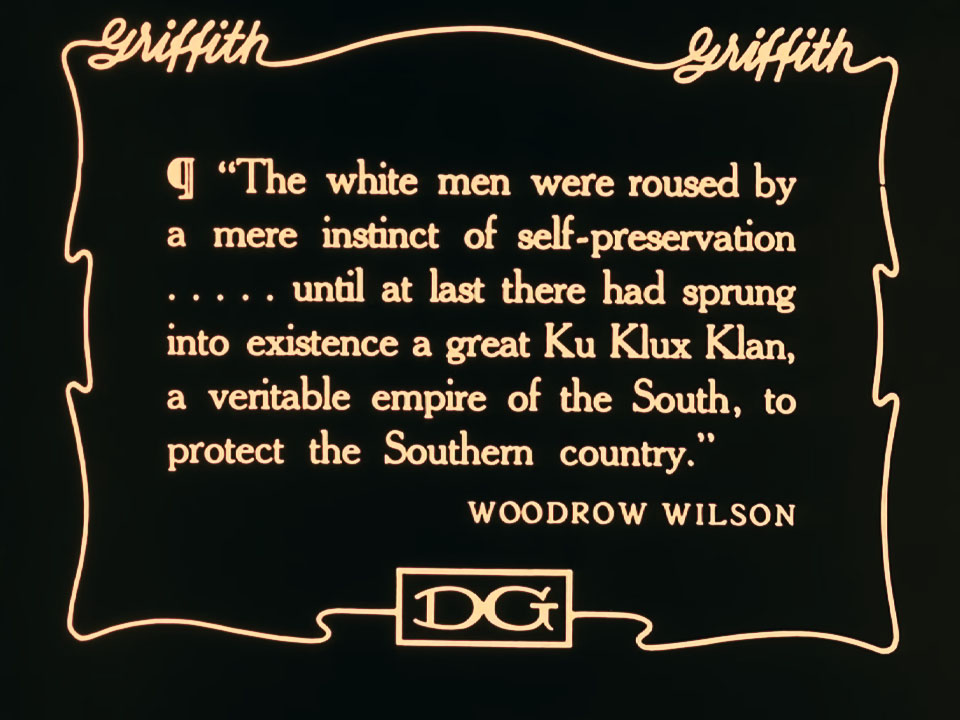
Moreover, a quote from a book he'd written was included in a title card for The Birth of a Nation:
And when he saw the film in the White House, he decided that it was not dangerous. What he actually said has been disputed. In 1937, years after Wilson's death, a magazine wrote that he said of the film, "It is like writing history with lightning. And my only regret is that it is all so terribly true."

Wilson had used the metaphor of illuminating history as if by lightning before, so historians tend to agree that he said the first half of the statement. The second half has no contemporary basis, but Wilson knew that the film was based on a novel, not on actual events.

With the unofficial stamp of approval of the President of the United States, The Birth of a Nation took its place in many "Lost Cause" tributes of the early 20th Century, when Southerners did their best (or their worst) to erase the gains of the Union and black Americans. Statues of Confederate war heroes went up all over the South over the next few years. Their names were placed on schools and stadiums.

And mostly-black towns all over the South were wiped off the map by developers -- and rioters. The burning of the "Black Wall Street" in Tulsa, Oklahoma in 1921 is now the most notorious example: Not just the destruction, but the fact of its very existence was written out of the history books. I didn't learn about it until I was over 30 years old.

Attending public schools in New Jersey, a Union State, in the 1970s and 1980s, I was taught nothing about Reconstruction, and nothing about the retrenchment against it. And when we were taught about Woodrow Wilson at all, it was mentioned that he had been President of Princeton and Governor of New Jersey, and that he guided the nation through World War I. His actual policies, beneficial and otherwise, were barely mentioned. And his connection to racism was not mentioned at all.

I took a film appreciation course in my senior year of high school. Only then did I learn about The Birth of a Nation. Aside from a few short clips, I still haven't seen the damn thing.

In 1983, the British television network ITV aired a film titled Birth of a Nation, but it was about the British educational system. So it was closer to my experience than those of the people in Griffith's film. In 2016, African-American director Nate Parker released his debut film, Birth of a Nation, about the 1831 slave rebellion led by Nat Turner, played by Parker himself.

The star of the original film was Lillian Gish. In 1927, Vanity Fair magazine called her "the First Lady of the Screen," as she pioneered silent-film acting techniques much as Griffith had pioneered their producing and directing. Her sister, Dorothy Gish, was also a major silent star.
Lillian Gish

In 1926, Lillian starred in a film version of Giacomo Puccini’s opera La Bohème, alongside John Gilbert. The fact that a silent film was being made of an opera appears to suggest that the Roaring Twenties didn't understand the concept of irony.

D.W. Griffith died in 1948, Dorothy Gish in 1963, and Lillian Gish fell short of making it to her 100th birthday, in 1993.

*

February 18, 1915 was a Monday. Baseball and football were out of season. Basketball hardly existed at the professional level. And while the National Hockey Association was playing, there were no games scheduled for that day. So there were no scores on this historic day.

Saturday, February 12, 2022

February 12, 1909: The NAACP Is Founded

February 12, 1909: The NAACP -- the National Association for the Advancement of Colored People -- is founded in New York City. The date was not chosen at random: It was the 100th Anniversary of the birth of the Great Emancipator, President Abraham Lincoln.

The NAACP grew out of the Niagara Movement, founded in 1905, but struggling for funding, as its membership was nearly all black, and absolutely all male. The former status was financially problematic, while the latter was morally untenable. Among the founders of the new group were academic W.E.B. Du Bois and journalist Ida B. Wells.

Through the 1940s, the NAACP would focus on anti-lynching efforts, to the point where lynchings became a rarity. In the 1950s, they shifted to desegregation. It was as their general counsel that Thurgood Marshall, later to become the 1st black Justice on the Supreme Court, got "separate but equal" struck down by that Court in 1954. The NAACP were also major backers of the Montgomery Bus Boycott in 1955-56, and of the March On Washington in 1963.

The group is still active today, headquartered in Baltimore -- Marshall's hometown, although that is largely a coincidence -- and, as recently as 2017, issued a travel warning for black people thinking of visiting Missouri, due to racist violence there. (UPDATE: In 2023, they did so for Florida as well.)

*

February 12, 1909 was a Friday. Baseball and football were out of season. And professional basketball and hockey barely existed. So there were no scores on this historic day.

February 12, 1900: The "Black National Anthem"

James Weldon Johnson (left) and J. Rosamond Johnson

February 12, 1900: "Lift Every Voice and Sing" is published, on what would have been the 91st birthday of President Abraham Lincoln. The lyrics were written by James Weldon Johnson, and the music by his brother, J. Rosamond Johnson. The men were from Jacksonville, Florida.

Written from the context of African-Americans in the late 19th century, the hymn is a prayer of thanksgiving to God, as well as a prayer for faithfulness and freedom, with imagery that evokes the biblical Exodus from slavery to the freedom of the "promised land."

President Theodore Roosevelt appointed James Weldon Johnson as U.S. Consul in Venezuela and Nicaragua from 1906 to 1913. In 1917, he was named Executive Secretary of the National Association for the Advancement of Colored People (NAACP), which adopted "Lift Every Voice and Sing" as "the Negro National Anthem." Eventually, it became known as "the Black National Anthem."

James Weldon Johnson served as Executive Secretary until 1918, and again from 1920 to 1929. He then began teaching at Fisk University, a historically black school in Nashville. In 1934, he was named the 1st African-American professor at New York University. He died in 1938, at the age of 67.

J. Rosamond Johnson wrote several Broadway musicals, and in 1935 he played Frazier in the original production of George Gershwin's black-themed musical Porgy and Bess. He lived until 1954.

The song gained new prominence in 2020, as part of the protests over the police murder of George Floyd. It was played before Super Bowl LV, and white supremacists protested. With that in mind, the normally conservative-to-a-fault NFL, in recognition of just how many people involved in it are black, decided to have it sung before every Super Bowl thereafter, along with "The Star-Spangled Banner," the official National Anthem.

*

February 12, 1900 was a Monday. Baseball and football were out of season. Basketball barely existed. There was 1 score on this day: The Winnipeg Victorias, holders of the Stanley Cup, beat the Montreal Shamrocks, 4-3 at the Montreal Arena. But it was a best-2-out-of-3 series, and the Shamrocks won on February 14 and 16, and took the Cup.

December 31, 1999 & January 1, 2000: The Millennium

December 31, 1999:  The Millennium arrives. The people of planet Earth survived. At a terrible cost. But we hadn't destroyed ourselves. ...