
February 18, 1915: The Birth of a Nation is screened at the White House. It is the 1st film to receive this honor.
Based on The Clansman, a novel published in 1905 by Thomas Dixon Jr., the film -- of course, silent, and, in more ways than one, filmed in black and white -- is directed by D.W. (David Wark) Griffith. It is the longest feature film ever made to that point: 3 hours and 13 minutes.

D.W. Griffith
It is the 1st American-made film to have a musical score for an orchestra. It is the 1st to have extensive use of close-ups and fade-outs, and the 1st to have hundreds of extras to film a battle scene.
About that battle scene: It's set during the American Civil War, and the film includes a staging of the assassination of President Abraham Lincoln. And it portrays the postwar Reconstruction period as a time when the nascent Ku Klux Klan is needed to perform heroic acts to save white women from the actions of scheming, sexually aggressive black men, most of them played by white actors in blackface makeup. For this reason, The Birth of a Nation has been called "the most reprehensibly racist film in Hollywood history."
And it didn't just generate that reputation in its future: Even at the time, black activists, including the National Association for the Advancement of Colored People (NAACP, founded in 1909) wanted it banned, for fears that it could incite racial violence. This was a legitimate concern, as it had been less than 5 years since Heavyweight Champion Jack Johnson knocked out Jim Jeffries, the former champion who white boxing fans were calling "The Great White Hope," resulting in riots around the country.
President Ulysses S. Grant, who had been the leading Union General in the Civil War, had gotten the original version of the Klan shut down in the 1870s. But this film led to a new version, and it became more powerful than ever: By 1924, it had over 4 million members, and essentially prevented Governor Alfred E. Smith of New York from being nominated for President. (They opposed Smith because they hated Catholics, too. By 1928, the backlash against them was strong enough that they could not stop Smith's nomination, although he lost the general election.)
So why was the film shown at the White House? Because President Woodrow Wilson wanted to judge for himself whether it would be dangerous to show it around the country.
Wilson was born in Virginia, and lived in both Carolinas and Georgia as a boy; but had gone to the school later known as Princeton University in New Jersey, later serving as University President and the State's Governor, before being elected the country's President in 1912. Surviving recordings of his voice show that he did not speak with a Southern accent.
But despite living his adult life in the Northeast, and governing a Union State, Wilson maintained his Southern beliefs. When he took office, he saw that federal government offices were racially integrated. He re-segregated them. He is said to have defended segregation on scientific grounds, and also to have told racist jokes in private.
Moreover, a quote from a book he'd written was included in a title card for The Birth of a Nation:
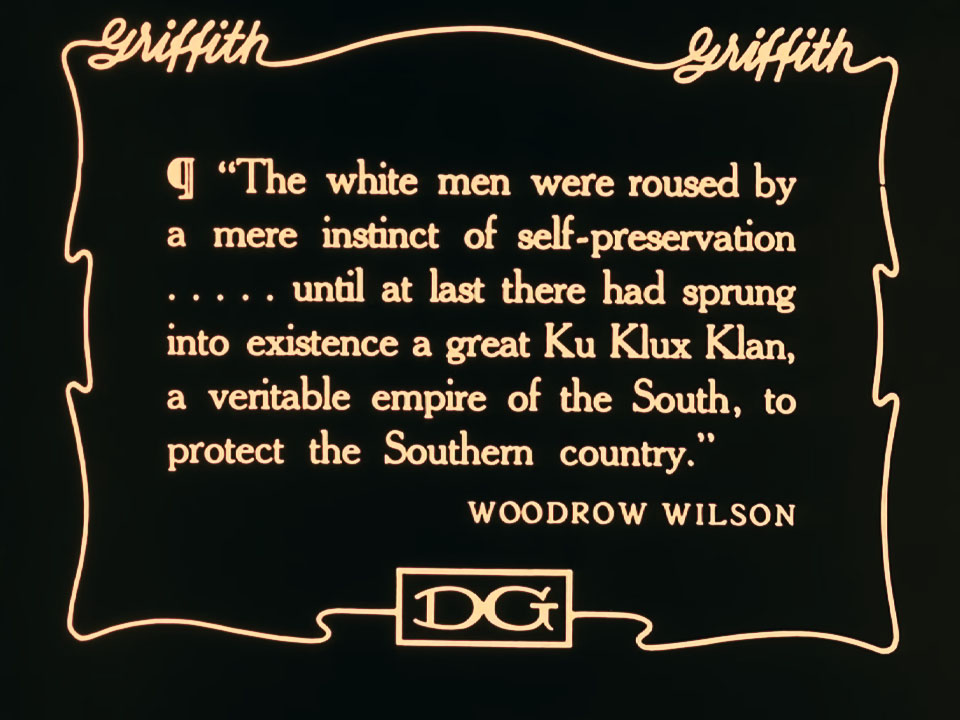
And when he saw the film in the White House, he decided that it was not dangerous. What he actually said has been disputed. In 1937, years after Wilson's death, a magazine wrote that he said of the film, "It is like writing history with lightning. And my only regret is that it is all so terribly true."
Wilson had used the metaphor of illuminating history as if by lightning before, so historians tend to agree that he said the first half of the statement. The second half has no contemporary basis, but Wilson knew that the film was based on a novel, not on actual events.
With the unofficial stamp of approval of the President of the United States, The Birth of a Nation took its place in many "Lost Cause" tributes of the early 20th Century, when Southerners did their best (or their worst) to erase the gains of the Union and black Americans. Statues of Confederate war heroes went up all over the South over the next few years. Their names were placed on schools and stadiums.
And mostly-black towns all over the South were wiped off the map by developers -- and rioters. The burning of the "Black Wall Street" in Tulsa, Oklahoma in 1921 is now the most notorious example: Not just the destruction, but the fact of its very existence was written out of the history books. I didn't learn about it until I was over 30 years old.
Attending public schools in New Jersey, a Union State, in the 1970s and 1980s, I was taught nothing about Reconstruction, and nothing about the retrenchment against it. And when we were taught about Woodrow Wilson at all, it was mentioned that he had been President of Princeton and Governor of New Jersey, and that he guided the nation through World War I. His actual policies, beneficial and otherwise, were barely mentioned. And his connection to racism was not mentioned at all.
I took a film appreciation course in my senior year of high school. Only then did I learn about The Birth of a Nation. Aside from a few short clips, I still haven't seen the damn thing.
In 1983, the British television network ITV aired a film titled Birth of a Nation, but it was about the British educational system. So it was closer to my experience than those of the people in Griffith's film. In 2016, African-American director Nate Parker released his debut film, Birth of a Nation, about the 1831 slave rebellion led by Nat Turner, played by Parker himself.
The star of the original film was Lillian Gish. In 1927, Vanity Fair magazine called her "the First Lady of the Screen," as she pioneered silent-film acting techniques much as Griffith had pioneered their producing and directing. Her sister, Dorothy Gish, was also a major silent star.

Lillian Gish
In 1926, Lillian starred in a film version of Giacomo Puccini’s opera La Bohème, alongside John Gilbert. The fact that a silent film was being made of an opera appears
to suggest that the Roaring Twenties didn't understand the concept of irony.
Among the black actors was Nellie Crawford, a.k.a. Madame Sul-Te-Wan. She was the 1st black actor, male or female, to sign a film contract and be a featured performer, and remained a star before and after the arrival of talking pictures. She kept her origins a secret, and was rumored to be part Indian -- either South Asian or Native American, depending on who was telling the story -- and part Hawaiian. Lillian Gish said, "We never did discover the origin of her name. No one was bold enough to ask."

Madame Sul-Te-Wan
D.W. Griffith died in 1948, Madame Sul-Te-Wan in 1959, Dorothy Gish in 1963, and Lillian Gish fell short of making it to her 100th birthday, in 1993.
*
February 18, 1915 was a Monday. Baseball and football were out of season. Basketball hardly existed at the professional level. And while the National Hockey Association was playing, there were no games scheduled for that day. So there were no scores on this historic day.


No comments:
Post a Comment