Showing posts with label estadio do maracana. Show all posts

Saturday, November 19, 2022

November 19, 1969: Pelé's 1,000th Goal

November 19, 1969: Pelé scores the 1,000th goal of his professional soccer career, the greatest career that any player has ever had.

Edson Arantes do Nascimento grew up in Bauru, in the Brazilian State of São Paulo. Like his father, and most other Brazilian "futebol" players, he became known by a single name. Often it's the player's first name, but it would not be "Edson" by which he would be known. Nor would it be "Dico," which his family had called him.

As a boy, his favorite player was a goalkeeper for Rio de Janeiro team Vasco da Gama, known as Bilé. But in his accent, "Bee-LAY" became "Peh-LAY." The more he was called "Pelé," the more he complained, and the more it stuck. While the Hebrew word for "miracle" is pronounced "Peh-LAY," the word "Pelé" has no known meaning in Brazil's main language, Portuguese.

In 1956, only 15 years old, he was signed to Santos Futebol Clube of Santos, an industrial and port city near the city of São PauloHe remained with Santos for 18 years, as the club refused all offers from the giants of South American, and eventually European, football. He helped them win the Campeonato Paulista, the State Championship, 10 times. He helped them win the Campeonato Brasileiro Série A, the National Championship, 6 times, including 5 in a row from 1961 to 1965.

He helped them win back-to-back titles in the Copa Libertadores, the South American continental club championship. Each time, they beat the winners of the European Cup to win the Intercontinental Cup (now called the FIFA Club World Cup): Benfica of Lisbon, Portugal, featuring Eusébio, in 1962; and AC Milan of Italy, featuring Gianni Rivera, in 1963. (Like Pelé, Eusébio, a native of the African nation of Mozambique, then a colony of Portugal, is the greatest player his continent has ever produced. Also like Pelé, he was nicknamed "The Black Pearl.")

He helped the Brazil national team win the World Cup in 1958, only 17 years old, and again in 1962. Although he had been heavily fouled in the 1966 edition, resulting in Brazil's knockout in the Group Stage, he continued to rise in popularity, mainly due to the world tours taken by Santos. Essentially, the ability to show Pelé around the world kept Santos in business.

On November 19, 1969, still only 29 years old, he led Santos into Brazil's national stadium, the Estadio do Maracanã in Rio de Janeiro, to play Vasco da Gama. In all competitions to that point, he had been credited with 999 goals. Since this game featured one of the big clubs in the biggest city, against the man known as O Rei (The King), it was nationally televised.

He thought he had his 1,000th goal when he was brought down in the penalty area. "It had to be a penalty," he said later. "It had to come when the whole world could stop, and not miss it." He got it, and a crowd of 125,000 in the gigantic stadium erupted in cheers, enough of them rushing the pitch that the game could not continue. (With renovations, including being made all-seater, it now has a capacity of 78,838.)

He would lead Brazil to the World Cup again in 1970, making him the tournament's only 3-time winner. In 1975, he was brought to America to play for the New York Cosmos, leading them to the North American Soccer League Championship in 1977, his last season.

Pelé finished his career claiming 1,283 goals in all competitions. FIFA, the governing body for world soccer, refusing to count friendlies, credits him with 757. For comparison's sake, see his 2 current challengers for the title of "Greatest Of All Time": Through the end of the 2021-22 season, Cristiano Ronaldo is credited with 833, Lionel Messi with 796. Diego Maradona, the other major contender for the title, had "only" 446 for Argentina and his clubs combined.

But those 3, between them, are 1-for-12 in World Cups, the 1 being Maradona's in 1986, and, more blatantly than Crissy or Messi ever did, he cheated. Pelé was 3-for-4. Maradona? Messi? Throw in
Alfredo di Stéfano, and it's possible that neither one of them is even the best Argentine player ever. Cristiano? Given the achievements of Ronaldo de Lima, including the 2002 World Cup, Cristiano is not even the best Ronaldo to have played for Real Madrid in the 21st Century.

These kids today, they don't know: Pelé is the greatest. It's why the Brazilians call him O Rei: The King.

*

November 19, 1969 was a Wednesday. Living Single actress Erika Alexander was born. And Apollo 12 landed on the Moon. I have a separate entry for that event.

The baseball season was over. Football was in midweek. There were 5 games played in the NBA that night:

* The Boston Celtics beat the Chicago Bulls, 122-106 at the Boston Garden.

* The San Diego Rockets beat the Philadelphia 76ers, 125-116 at The Spectrum in Philadelphia. (The Rockets moved to Houston in 1971.)

* The Baltimore Bullets beat the Phoenix Suns, 133-118 at the Baltimore Civic Center. (It's now named the CFG Bank Arena. The Bullets moved to Washington in 1973, and became the Washington Wizards in 1997.)

* The Los Angeles Lakers beat the Cincinnati Royals, 116-103 at the Cincinnati Gardens. (The Royals became the Kansas City Kings in 1972, and the Sacramento Kings in 1985.)

* And the Atlanta Hawks beat the Seattle SuperSonics, 137-116 at the Seattle Center Coliseum. (The Sonics became the Oklahoma City Thunder in 2008.)

There were 2 games played in the American Basketball Association. The New York Nets beat the Miami Floridians, 115-110 at the Island Garden in Hempstead. And the New Orleans Buccaneers beat the Washington Capitols, 122-115 at the New Orleans Municipal Auditorium.

There were 5 games played in the NHL:

* The New York Rangers played the Chicago Black Hawks to a tie, 1-1 at the Chicago Stadium.

* The Montreal Canadiens and the Detroit Red Wings played to a tie, 5-5 at the Montreal Forum.

* The Toronto Maple Leafs and the Los Angeles Kings played to a tie, 4-4 at Maple Leaf Gardens in Toronto.

* The St. Louis Blues beat the Pittsburgh Penguins, 4-0 at the Civic Arena in Pittsburgh.

* The Oakland Seals beat the Minnesota North Stars, 4-2 at the Metropolitan Sports Center in the Minneapolis suburb of Bloomington, Minnesota.

* And the Boston Bruins and the Philadelphia Flyers were not scheduled to play. 

Saturday, July 16, 2022

July 16, 1950: Maracanazo

July 16, 1950: The last game -- officially, not a "Final," since this edition was not a knockout tournament in the traditional sense -- of the World Cup is played at the Estádio do Maracanã in Rio de Janeiro, Brazil. Given the goal difference, all that hosts Brazil had to do was gain a draw, and they would be World Champions on home soil. Uruguay, on the other hand, had to win.

This was the 1st World Cup after World War II. Of the 3 main Axis nations, Germany and Japan were still banned; and Italy, allowed in the tournament, were still recovering from the Superga crash the year before, when most of the Torino team, and thus a big part of the national side, were killed. This tournament also featured the U.S.' upset of England. But the true shock, as far as the hosts were concerned, was in the last game.

The 1st half ended scoreless. Shortly after play resumed, Albino Friaça put Brazil on the board. The gigantic crowd of 199,854 was ecstatic. Being 1-0 up in the 2nd half made it look like the tremendous pre-tournament and pre-game hype and confidence had been worth it.

But Uruguay's Captain, Obdulio Varela, was smart: He went to the referee, an Englishman named George Reader, and disputed the validity of the goal. Varela didn't speak English, and Reader didn't speak Spanish. An interpreter was found, and Reader learned Varela's objection: He believed (or said he did) that Friaça was offside. Reader called the linesman over, and the linesman denied it. Reader made his decision final: The goal stood.

Varela didn't get everything he wanted, but he got a big thing that he wanted: He stopped Brazil's momentum. They were standing around, waiting for play to be allowed to resume. Their fans had calmed down a bit. The home-field advantage had been dented. Reader handed the ball to Varela, who took it to the center of the field, and shouted to his teammates, "Now, it's time to win!"

And they did as he wanted: They attacked. Brazil didn't have a defense as good as their offense, and, in the 66th minute, Pepe Schiaffino equalized for Uruguay. That didn't matter much: If that 1-1 score had held, Brazil would still be World Champions.

In the 79th minute, Alcides Ghiggia ran down the right sideline, and fired a low shot that went under Brazilian goalkeeper Moacir Barbosa. It was Uruguay 2, Brazil 1. Every Brazilian -- on the pitch, in the stadium, and listening on the radio -- was in shock. Brazil attacked the rest of the way, but couldn't find the all-important equalizer. The home crowd was quiet.
Alcides Ghiggia

Shortly after 5:00, Reader blew his whistle to end the match. Uruguay had now won 2 of the 1st 4 World Cups. Brazil had lost the world championship of their national sport, in their national stadium.

In that stadium, 3 fans died from heart attacks. Another, who had brought a gun in, killed himself.

There was no public ceremony after the game. FIFA President Jules Rimet wisely chose to present the trophy that would later bear his name to Uruguay in their locker room. Brazil manager Flavio Costa had to leave the stadium in disguise -- as a nanny. Yes, like some deposed dictators have done, he left in drag, so as not to be recognized.

The loss was a blow to the national psyche of Brazil, so often wrapped up in this sport of soccer. It is known as Maracanazo in Spanish, Maracanaço in Portuguese: "The Agony of Maracanã." The 1950 World Cup was supposed to be a statement for Brazil, showing the world that it was a modern country, worthy of respect and admiration around the postwar world. This was the country's coming-out party, and it was ruined.

Minister of Sport Aldo Rebelo said, "Losing to Uruguay in 1950 not only impacted on Brazilian football, it impacted on the country's self-esteem." Instead of hating Uruguay for the ruination, Brazilians blamed themselves.

Brazil have gone on to win the World Cup a record 5 times: Beating Sweden in the Final in Sweden in 1958, beating Czechoslovakia in the Final in Chile in 1962, avenging their defeated to Uruguay in the Semifinal and then beating Italy in the Final in Mexico City in 1970, beating Italy in the Final again in the Rose Bowl in 1994, and beating Germany in Japan in 2002. They have also lost the Final to France in Paris in 1998.

You will notice that none of those 5 wins have been in Brazil. The World Cup has returned to that country only once, in 2014, and Brazil got to the Semifinal, but had an even more stunning loss at the Maracanã. It wasn't that they lost to Germany, who then beat Argentina in the Final. It wasn't even that they were looking forward to beating Argentina in the Final in the Maracanã themselves. The truly shocking part was the score: Germany beat Brazil, in the Maracanã, by a score of 7-1.
The Maracanã is 1 of 2 stadiums to have hosted 2 World Cup Finals, along with the Estadio Azteca in Mexico City. And it's 1 of 4 stadiums to have hosted a World Cup Final and be the main stadium for the Olympic Games. The Azteca is not 1 of the other 4: Although it was used during the 1968 Olympics, it was not the main stadium for those games. The others are the old Wembley Stadium in London, and the Olympiastadions in Berlin and Munich. In 2024, the Stade de France outside Paris will make it 5.

Much as the 1980 and 2008 World Series wins have not fully erased the humiliation of the blown 1964 National League Pennant for Philadelphia Phillies fans, Brazilians still have not gotten over Maracanazo after 72 years, despite winning 5 World Cups and the admiration of the rest of the world.

Because of the soccer connection, it remains the most famous building on the entire continent. It is home to Rio’s 2 biggest teams, Flamengo and Fluminense, and "the Fla-Flu Derby" is the event of the year in Rio. (Aside from that whole Carnival business.)

Outside of soccer, in 1980, it hosted the largest crowd ever to watch a volleyball match, 95,000 to see the national teams of Brazil and the Soviet Union. It hosted the preaching of Billy Graham in 1960 and 1974, and Pope John Paul II in 1980, 1987 and 1997.

Frank Sinatra sang before 175,000 in 1980, and "Rock In Rio" brought more than that for Sting in 1987, Tina Turner in 1988, Paul McCartney in 1990, a-ha in 1991, Madonna in 1993, and the Rolling Stones in 1995.

In 1966, the stadium was officially renamed Estádio Jornalista Mário Filho, for a sportswriter who had just died, but everybody still calls it the Maracanã. A conversion to all-seater and renovations for the 2014 World Cup and the 2016 Olympics has reduced capacity to 78,838, making it still the largest stadium in South America.

UPDATE: An article for ESPN.com, published after the 2026 World Cup, ranking all 23 tournaments, rated this one tied for 8th, suggesting that the upsets overcame the comparative lack of star power.

*

July 16, 1950 was a Sunday. It was the off-season for the NFL, the NBA and the NHL. But, being a Sunday, a full slate of Major League Baseball games was played. as was the custom at the time, there were even doubleheaders:

* The New York Yankees split a doubleheader with the Chicago White Sox at Yankee Stadium. The Yankees won the opener 2-1. Gene Woodling's 2nd inning double allowed Vic Raschi to outpitch Billy Pierce. The White Sox won the nightcap 5-2, with Bob Cain outpitching Allie Reynolds.

* The New York Giants got swept in a doubleheader by the Cincinnati Reds at Crosley Field in Cincinnati. The Reds won the 1st game 16-4. The 2nd game went back and forth. The Giants jumped out to a 3-0 lead in the top of the 1st, but the Reds scored 4 in the bottom of the 1st. The Giants led 8-4 going to the bottom of the 5th, and 10-5 going to the bottom of the 6th. But the Reds tied it in the bottom of the 7th. An error by Hank Thompson gave the Reds the win in the 12th, 11-10.

* The Brooklyn Dodgers beat the St. Louis Cardinals, 10-2 at Sportsman's Park in St. Louis. Chris Van Cuyk was not one of the Dodgers' more prominent pitchers, but he got the win in this game, backed by home runs from Jackie Robinson and Duke Snider.

* A doubleheader was split at Fenway Park in Boston. The Boston Red Sox won the opener 13-10, and the Cleveland Indians won the nightcap 8-4. Ted Williams was injured, and did not play in either game.

* A doubleheader was split at Shibe Park in Philadelphia. The Philadelphia Athletics won the 1st game 5-2, and the Detroit Tigers won the 2nd game 7-6.

* A doubleheader was split at Griffith Stadium in Washington. The Washington Senators won the 1st game 5-1, and the St. Louis Browns won the 2nd game 10-8.

* A doubleheader was split at Forbes Field in Pittsburgh. The Boston Braves won the 1st game 9-5, and the Pittsburgh Pirates won the 2nd game 6-5.

* The Chicago Cubs swept a doubleheader with the Philadelphia Phillies at Wrigley Field in Chicago. They won the opener 8-0, and the nightcap 10-3. 

Wednesday, July 13, 2022

July 13, 2014: Götze 1, "GOAT" 0

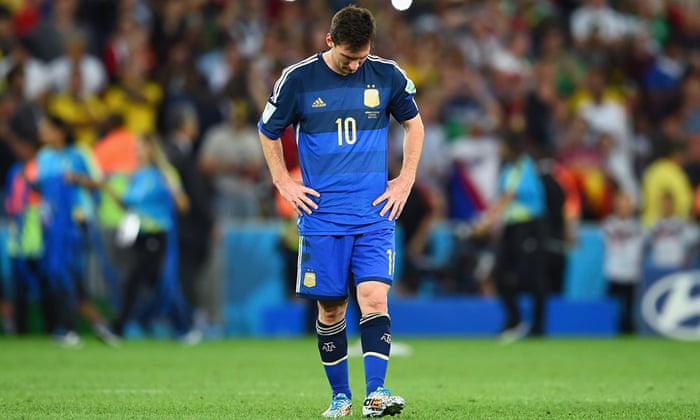
July 13, 2014: The World Cup Final is held at Estadio do Maracanã in Rio de Janeiro, the most famous building on the continent of South America.
Hosts Brazil are not in it. In a game even more stunning than their loss to Uruguay at that stadium in the 1950 Final, Germany beat them in the Semifinal, 7-1. To make matters worse for the home country, the other Semifinal was won by their arch-rivals, Argentina, who beat the Netherlands on penalties in the Semifinal.

The Final was broadcast in America in English on ABC, and in Spanish on Univision. The opponents were Argentina and Germany, and the game is billed as Lionel Messi, "the GOAT" (as in, "the greatest of all time") vs. the classic football pantomime villains, "Ze Germans." Neither billing is particularly accurate.

Argentina were managed by Alejandro Sabella, a former star midfielder for Buenos Aires of River Plate and Estudiantes de La Plata, who managed Estudiantes to the South American club championship, the Copa Libertadores, in 2009.

In addition to Messi, who served as Captain, their starting lineup featured Sergio Romero, goalkeeper for Sampdoria in Genoa, Italy; Pablo Zabaleta and Martín Demichelis, right back and centreback, respectively, for English team Manchester City; Javier Mascherano, a centreback for Spanish giants FC Barcelona, who had previously starred in his homeland for River Plate and in England for Liverpool; Ezequiel Lavezzi, a forward for French team Paris Saint-Germain; and Gonzalo Higuaín, a forward for Napoli of Naples, Italy, who had starred for River Plate and Spanish giants Real Madrid.

This team was so good that Sergio Agüero, whose goal won the 2012 Premier League title for Man City, could only come off the bench; while Real Madrid midfielder Ángel Di María didn't get into the game at all.

Germany were managed by Joachim "Jogi" Löw, a midfielder for SC Freiburg, whose biggest title as a manager thus far had been the 2002 Austrian Bundesliga title, with Tirol Innsbruck. He had, however, managed Germany to 2nd place at Euro 2008 and 3rd at the 2010 World Cup.

As usual, Die Mannschaft were dominated by players from Bayern Munich: Goalkeeper Manuel Neuer, right back and Captain Philipp Lahm, centreback Jérôme Boateng, midfielder Bastian Schweinsteiger, midfielder Toni Kroos, midfielder Mario Götze, forward Thomas Müller,

Centreback Mats Hummels, then with Borussia Dortmund, and forward Miroslav Klose, then with Lazio of Rome, Italy, had previously played for Bayern. Defender Benedikt Höwedes played for Schalke 04.

Three members of the German team played for North London team Arsenal FC, whom I support. But only midfielder Mesut Özil started. Centreback Per Mertesacker only got in at the end of the game, and forward Lukas Podolski did not play at all.

The game kicked off at 4:00 PM, local time, and also Argentina time -- 9:00 in most of Europe, including Germany, and 3:00 U.S. Eastern. Attendance in a stadium that once had a capacity, including standing room, of 200,000, was an all-seated 74,738. The weather was good, and the grass dry.

Each team missed a couple of shots in the 1st half-hour. Early on, Higuaín mis-hit a ball that he should have put in the net. In the 30th minute, Higuaín did put the ball in the net, but the goal was correctly ruled out for offside. Later Romero made a save. I am serious, and you can call the man who took the shot André Schürrle. He was a forward for West London team Chelsea FC. Messi had a shot blocked by Boateng. Just before the half, Höwedes hit the post, and was offside, anyway.

Argentina began the second half with Agüero replacing Lavezzi. Higuaín shot wide. Messi then had a one-on-one with the Neuer, but also shot wide. In the 56th minute, Neuer took down Higuaín in the penalty area, but no penalty was given, or even a card. Just before the hour, Klose had a shot that was caught by Romero. Messi had another miss in the 75th. Regular time ended, 0-0.

Early in extra time, Schürrle's close-range shot was stopped by Romero. Five minutes later, a lob by Rodrigo Palacio went just wide. In the 113th minute, Schürrle raced past 2 defenders on the left before crossing into the penalty area, where Götze controlled the ball on his chest, and then volleyed left-footed into the net. Germany were deservedly ahead.

Müller had a chance to double Germany's lead shortly afterward, but his shot went wide. With time running out, Messi, as if ordained by God, or "the football gods," or Fate, or FIFA, had a chance to be the hero, but he fired over the crossbar. That proved to be the last action of the game as the final whistle was blown, confirming Germany's 1–0 victory. It was their 4th win, matching Italy, trailing only Brazil with 5.

In 125 minutes, counting stoppage time, "greatest of all time" Messi neither scored a goal nor assisted on one. People who believed him to be the "GOAT" would have to wait.
Kroos was born in Greifswald, East Germany in 1990, 2 months after the Berlin Wall came down, and 9 months before reunification. He was the only player born, raised, and trained to play soccer in East Germany who ever played on a World Cup-winning team.

UPDATE: An article for ESPN.com, published after the 2026 World Cup, ranking all 23 tournaments, rated this one 15th.

*

July 13, 2014 was a Sunday. These Major League Baseball games were played:

* The New York Yankees lost to the Baltimore Orioles, 3-1 at Camden Yards in Baltimore, in a game shortened to 5 innings due to rain. Kevin Gausman, who usually pitches well against the Yankees, outpitched Chase Whitley. Chris Davis hit a home run for the O's. The Yankee run came on a homer by Brett Gardner. Derek Jeter, in his final season, went 1-for-2. Alex Rodriguez was suspended for the season.

* The New York Mets beat the Miami Marlins, 9-1 at Citi Field. Jacob deGrom was the winning pitcher.

* The Washington Nationals beat the Philadelphia Phillies, 10-3 at Citizens Bank Park in Philadelphia. Ryan Zimmerman and former Phillie Jayson Werth hit home runs for the Nats.

* The Tampa Bay Rays beat the Toronto Blue Jays, 3-0 at Tropicana Field in St. Petersburg, Florida. David Price pitched 8 innings of 5-hit shutout ball, and Jake McGee pitched a perfect 9th.

* The Cleveland Indians beat the Chicago White Sox, 3-2 at Progressive Field in Cleveland.

* The Cincinnati Reds beat the Pittsburgh Pirates, 6-3 at Great American Ball Park in Cleveland.

* The Atlanta Braves beat the Chicago Cubs, 10-7 at Wrigley Field in Chicago.

* The Milwaukee Brewers beat the St. Louis Cardinals, 11-2 at Miller Park (now American Family Field) in Milwaukee.

* The Kansas City Royals beat the Detroit Tigers, 5-2 at Kauffman Stadium in Kansas City.

* The Boston Red Sox beat the Houston Astros, 11-0 at Minute Maid Park (now Daikin Park) in Houston. This was when the Red Sox were defending World Champions, and the Astros were new to the American League and horrible, building up the draft picks that would, along with cheating, allow them to succeed the Red Sox as the AL's unfairly dominant team.

Clay Buchholz pitched a 3-hit shutout, striking out 12 and walking none. Astro starter Brad Peacock didn't get out of the 1st inning. The Red Sox got only 1 home run, from Brock Holt, who went 5-for-6. David Ortiz went 0-for-4, but drew 2 walks, and had RBIs on a bases-loaded walk and a groundout.

* The Los Angeles Angels beat the Texas Rangers, 10-7 at Globe Life Park in the Dallas suburb of Arlington, Texas.

* The Minnesota Twins beat the Colorado Rockies, 13-5 at Coors Field in Denver.

* The Los Angeles Dodgers beat the San Diego Padres, 1-0 at Dodger Stadium in Los Angeles. Hyun Jim Ryu pitched 6 innings, allowing 2 hits and no walks, striking out 10. Three relievers completed a 4-hit, 2-walk, 12-strikeout shutout. The only run scored in the 6th, when Yasiel Puig singled Dee Strange-Gordon home.

* The San Francisco Giants beat the Arizona Diamondbacks, 8-4 at AT&T Park (now Oracle Park) in San Francisco.

* And the Oakland Athletics beat the Seattle Mariners, 4-1 at Safeco Field (now T-Mobile Park) in Seattle.

Thursday, June 16, 2022

June 16, 1950: Estádio do Maracanã Opens In Rio de Janeiro, Brazil

June 16, 1950: The Estádio do Maracanã opens in the neighborhood of the same name in Rio de Janeiro, Brazil, as the country's national stadium and the centerpiece for the 1950 World Cup. When the Final is held there, a crowd of 199,854 pays to see it. And is traumatized by Brazil's loss to Uruguay.

In 1966, it was officially renamed Estádio Jornalista Mário Filho, for a sportswriter who had just died.In 2021, the Rio de Janeiro state legislature voted to change the venue's name to the Edson Arantes do Nascimento - Rei Pelé Stadium. Edson Arantes do Nascimento was Pelé's full name, while "Rei" means "King" in Portuguese. Bbut everybody still calls it the Maracanã.

It is home to Rio's 2 biggest teams, CR Flamengo (Clube de Regatas Flamengo, or Rowing Club, also named for a neighborhood in Rio) and Fluminense Football Club. The "Fla-Flu Derby" is the event of the year in Rio -- aside from that whole Carnival business.
Outside of soccer, in 1980, it hosted the largest crowd ever to watch a volleyball match, 95,000, to see the national teams of Brazil and the Soviet Union. It hosted the preaching of Billy Graham in 1960 and 1974, breaking the attendance record with 225,000; and Pope John Paul II in 1980, 1987 and 1997.

Frank Sinatra sang there before 175,000 in 1980, and "Rock In Rio" has brought more than that for Sting in 1987, Tina Turner in 1988, Paul McCartney in 1990, a-ha in 1991, Madonna in 1993, and the Rolling Stones in 1995.

A conversion to all-seater, and later renovations for the 2014 World Cup and the 2016 Olympics has reduced capacity to 78,838, making it still the largest stadium in South America. Because of the soccer connection, it remains the most famous building on the entire continent.

However, because of a dispute between the Brazilian Olympic organizing committee and the stadium's operating corporation, no cleanup was done after the Olympics, and the stadium was left in bad shape. A major renovation was necessary in 2017, and Flamengo and Fluminense put their differences aside and formed a joint management company to take up the stadium's maintenance. In the interim, both clubs played at Estádio Municipal General Sylvio Raulino de Oliveira in nearby Volta Redonda.

The Maracanã is 1 of 2 stadiums to have hosted 2 World Cup Finals, along with the Estadio Azteca in Mexico City. And it's 1 of 4 stadiums to have hosted a World Cup Final and be the main stadium for the Olympic Games. The Azteca is not 1 of the other 4: Although it was used during the 1968 Olympics, it was not the main stadium for those games. The others are the old Wembley Stadium in London, and the Olympiastadions in Berlin and Munich. In 2024, the Stade de France outside Paris will make it 5.

In 1954, a 12,000-seat indoor arena was built next door. Officially, it is named Ginásio Gilberto Cardoso, after a former president of Flamengo (the club sponsors teams in many sports, not just soccer), and is nicknamed the Maracanãzinho. It is widely known as the traditional home of Brazilian volleyball.
The Rajko Mitić Stadium, the stadium of Football Club Red Star in Belgrade, Yugoslavia, is popularly called Marakana in honor of the Brazilian stadium.

*

June 16, 1950 was a Friday. Since the World Cup didn't begin until June 24, the only scores on this historic day were in American baseball:

* The New York Yankees beat the St. Louis Browns, 7-5 at Sportsman's Park in St. Louis. Vic Raschi was the winning pitcher. Joe Collins hit 2 home runs, and Yogi Berra hit 1. Joe DiMaggio went 1-for-4.

* The New York Giants beat the Chicago Cubs, 6-1 at the Polo Grounds. Hank Thompson, who became the Giants' 1st black player a year earlier, hit a home run.

* The Brooklyn Dodgers beat the St. Louis Cardinals, 7-3 at Ebbets Field. Elwin "Preacher" Roe went the distance for the win. Roy Campanella went 2-for-4 with a home run and 2 RBIs. Jackie Robinson went 3-for-4. Duke Snider went 0-for-4. For the Cards, Stan Musial went 2-for-4 with a walk.

* The Boston Braves beat the Pittsburgh Pirates, 6-5 at Braves Field in Boston. This game went back-and-forth: It was 4-1 Braves after 6 innings, 4-4 going to the bottom of the 8th, 5-4 Braves after 8, the Pirates scored in the top of the 9th, and in the bottom of the 9th, Sam Jethroe singled Sibby Sisti home with the winning run. Johnny Sain was the winning pitcher. Walker Cooper and Earl Torgeson hit home runs for the Braves, Ralph Kiner for the Pirates.

* The Cleveland Indians beat the Philadelphia Athletics, 3-2 at Cleveland Municipal Stadium. Early Wynn went the distance for the win. Joe Gordon and Luke Easter hit home runs.

* The Detroit Tigers beat the Boston Red Sox, 4-1 at Briggs Stadium (later Tiger Stadium) in Detroit. Hal Newhouser went the distance for the win. Ted Williams went 0-for-2 with 2 walks.

* The Chicago White Sox beat the Washington Senators, 7-1 at Comiskey Park in Chicago.

* And the Cincinnati Reds and the Philadelphia Phillies were rained out at Shibe Park in Philadelphia. The game was made up as part of a doubleheader on September 15. The Phils swept, 2-1 and 8-7. They tied the nightcap in the bottom of the 9th, and the game went on and on. Robin Roberts pitched the 1st 7 innings, and Jim Konstanty pitched innings 9 through 18. Both teams scored 2 runs in the 18th inning. Eddie Waitkus led off the bottom of the 19th with a single, Richie Ashburn followed with a single, Willie "Puddin' Head" Jones drew a walk to loaded the bases with nobody out, and Del Ennis singled Waitkus home.

When the game was initially scheduled, the Phillies were in 3rd place, 3 1/2 games out of 1st. After it was actually played, 3 months later, they were in 1st place by 7 1/2 games. Nevertheless, they had to beat the Dodgers on the last day of the season to win the Pennant. With the 2nd game of the September 15 doubleheader in mind, and with a starting rotation sapped by injury and the draft for the Korean War, and exhausted from overuse, Phils manager Eddie Sawyer started Konstanty in Game 1 of the World Series. He pitched very well, but in defeat.  

December 31, 1999 & January 1, 2000: The Millennium

December 31, 1999:  The Millennium arrives. The people of planet Earth survived. At a terrible cost. But we hadn't destroyed ourselves. ...