Showing posts with label labor. Show all posts

Friday, December 23, 2022

December 23, 1975: The Reserve Clause Is Killed

Peter Seitz

December 23, 1975: The reserve clause is struck down, changing baseball forever.

The clause -- nothing Christmassy about this -- began in 1879, when the National League instituted it, allowing teams to reserve players for each season, unless a player opted out of his contract and did not play in the league for a year. This allowed the team owners to control salaries, since the players could not play one team owner off another and get higher bids for their salaries.

In 1890, the Sherman Antitrust Act was passed. To some people in baseball, the reserve clause sounded like a violation of that act. In 1922, in Federal Baseball Club v. National League, the U.S. Supreme Court ruled otherwise, saying, in a 9-0 unanimous vote, baseball was an "amusement," therefore did not constitute "interstate commerce," and therefore antitrust laws did not to apply to it. That ruling has never been overturned by a later Supreme Court ruling.

So opponents of the reserve clause had to find another way to get it struck down. In 1969, the St. Louis Cardinals traded Curt Flood to the Philadelphia Phillies, and, having a home and a business in St. Louis, and believing Philadelphia to be a racist city, he didn't want to go. He contacted the Chairman of the Major League Baseball Players' Association, Marvin Miller, to see what could be done about it.
Curt Flood

Miller decided that the reserve clause was a legitimate basis for negotiation in collective bargaining between players and owners. The case of Flood v. Kuhn went to the Supreme Court in 1972, and the decision was 5-3 in favor of the owners.

Finally, Miller got the team owners to agree to impartial arbitration. What he needed was two players to challenge the clause, by playing the 1975 season without signing a contract. This was because Miller realized that the clause only reserved the player for one year. The owners had always interpreted it to mean the player was reserved until he was released: Even if traded, his new team assumed the reservation.
Marvin Miller

It had to be two players, so that it wouldn't look like one embittered player, as Flood, fairly or not, seemed to be. Both players turned out to be pitchers. Dave McNally had been traded from the Baltimore Orioles to the Montreal Expos, and had determined that 1975 would be his last season, as he planned to retire to his ranch in Montana. So he had nothing to lose.

Andy Messersmith had much to lose. Born on the Jersey Shore in Toms River, and raised in the Orange County suburbs of Los Angeles, the righthander was 29, and had gone 20-6 in helping the Los Angeles Dodgers win the National League Pennant in 1974. He was in position to make a great deal of money if he could put his skills up for bid. But Miller convinced him that striking the reserve clause down was more important. So he played the '75 season with the Dodgers, without a contract, turned 30, and went 19-14.
Andy Messersmith

In an interview with The Sporting News for the 10th Anniversary of the decision, Messersmith said, "It was less of an economic issue at the time than a fight for the right to have control over your own destiny. It was a matter of being tired of going in to negotiate a contract and hearing the owners say, 'OK, here's what you're getting. Tough luck.'"

The owners were terrified. There is one thing that a sports team owner values more than money, and that is control. If the clause were struck down, the owners would have to pay more in salaries, but, from their perspective, the bigger problem was that they would lose some measure of control over the players' fates. They could have compromised, but were too stubborn and set in their ways to do so.

So the decision went to arbitration. A three-man panel was chosen. Miller represented the players. John Gaherin, the chief negotiator of the MLB Player Relations Committee, argued on behalf of the team owners. Together, they found an arbitrator acceptable to both of them: Peter Seitz, a 67-year-old lawyer who had negotiated New York City's labor relations law a decade earlier.

On December 23, the ruling was handed down. Surprising no one, Miller sided with the players, and Gaherin sided with the owners. Seitz had the deciding vote, and he sided with the players, saying:

The grievances of Messersmith and McNally are sustained. There is no contractual bond between these players and the Los Angeles and the Montreal clubs, respectively. Absent such a contract, their clubs had no right or power, under the Basic Agreement, the Uniform Player Contract or the Major League Rules to reserve their services for their exclusive use for any period beyond the renewal year in the contracts which these players had heretofore signed with their clubs...

The leagues involved in these proceedings, without delay, shall take such steps as may be necessary to inform and instruct their member clubs that the provisions of Major League Rules 4-A(a) and 3(g) do not inhibit, prohibit or prevent such clubs from negotiating or dealing with respect to employment with the grievants in this case; also, that Messersmith shall be removed from the reserve list of the Los Angeles Club and McNally from the reserve or disqualified lists of the Montreal Club.

The next day, the owners fired Seitz as arbitrator. But that did nothing to change the official result of his decision: The reserve clause was mortally wounded. It wasn't quite dead, as the owners had the right to appeal. On February 4, 1976, the Seitz decision was upheld in a federal district court. On March 10, it was upheld in a federal appeals court.

Finally, rather than take the apparently inevitable beatdown from the U.S. Supreme Court, the owners decided to make a deal. On July 12, an agreement was reached on a 4-year labor deal, giving players with at least 6 years' play in the major leagues the right to free agency. (This would later be reduced to 5 years.) Finally, on August 2, 1976, the players voted on ratification, and the reserve clause was formally buried.

A few years later, Cardinals owner and Anheuser-Busch beer magnate Gussie Busch met with the man he had traded to unwittingly set all this in motion, Curt Flood. No owner had been more vehement than Busch that the reserve clause had to be maintained, or else baseball would be "destroyed." But Busch told Flood he was right, and the owners were wrong, and apologized to him.

Flood had sacrificed his career for Messersmith and all the players who came after him. Messersmith signed with the Atlanta Braves, for $1 million over 3 years. But he didn't pan out with them, due to injuries. He went 11-11 in 1976, and only 5-4 in 1977. He was traded to the Yankees for 1978, but made only 7 appearances, going 0-3.

The Yankees released him, and, with some irony, he signed as a free agent with the Dodgers. This was possible because their owner, Walter O'Malley, champion of the cheap, had died, and his son, Peter O'Malley, was one of the owners willing to pay big money if he thought it would bring big results. In Messersmith's case, it didn't: He made just 11 appearances, going 2-4, and was done at age 34.

Messersmith later coached at a community college in Northern California, while McNally worked on his ranch and ran a car dealership. Neither worked in professional baseball again.

Seitz died in 1983, Flood in 1997, McNally in 2002, Miller in 2012. As of December 23, 2022, Messersmith is still alive, age 76.

*

December 23, 1975 was a Tuesday. Baseball was out of season. Football was in midweek. There were 7 games played in the NBA:

* The New York Knicks beat the Milwaukee Bucks, 110-108 at the Milwaukee Exposition, Convention Center and Arena, or "The MECCA." Since 2014, it has been named the UW-Panther Arena.

* The Buffalo Braves beat the Boston Celtics, 101-92 at the Buffalo Memorial Auditorium.

* The Washington Bullets beat the Detroit Pistons, 120-102 at Cobo Hall in Detroit.

* The Houston Rockets beat the Chicago Bulls, 103-94 at The Summit in Houston. (The arena has since been converted into the Central Campus of the Lakewood Church, Dr. Joel Osteen's "megachurch.")

* The Los Angeles Lakers beat the Kansas City Kings, 111-97 at The Forum outside Los Angeles in Inglewood, California.

* The Golden State Warriors beat the New Orleans Jazz, 105-97 at the Oakland Coliseum Arena.

* And the Portland Trail Blazers beat their arch-rivals, the Seattle SuperSonics, 125-100 at the Veterans Memorial Coliseum in Portland.

There were 3 games played in the American Basketball Association:

* The New York Nets beat the Kentucky Colonels, 107-102 at Freedom Hall in Louisville. Julius "Dr. J" Erving scored 31 points.

* The Spirits of St. Louis (that was their official name, not "The St. Louis Spirits") beat the Virginia Squires, 115-103 at The Scope in Norfolk.

* And the Indiana Pacers beat the San Antonio Spurs, 111-106 at the HemisFair Arena in San Antonio.

There were 5 games played in the NHL:

* The New York Rangers beat the Pittsburgh Penguins, 4-3 at Madison Square Garden.

* The Los Angeles Kings beat the Boston Celtics, 4-3 at the Boston Garden.

* The Philadelphia Flyers and the Atlanta Flames played to a tie, 2-2 at The Omni in Atlanta.

* The Chicago Black Hawks beat the St. Louis Blues, 4-1 at the Chicago Stadium.

* And the Buffalo Sabres beat the Kansas City Scouts, 5-1 at the Kemper Arena in Kansas City. It's now named the Hy-Vee Arena, and the Scouts became the Colorado Rockies in 1976, and the New Jersey Devils in 1982.

And there were 5 games played in the World Hockey Association:

* The Phoenix Roadrunners beat the Cincinnati Stingers, 5-3 at the Riverfront Coliseum in Cincinnati. (The arena is now the Heritage Bank Center.)

* The Minnesota Fighting Saints beat the Denver Spurs, 5-4 at the McNichols Arena in Denver.

* The Calgary Cowboys beat the Toronto Tors, 10-1 at the Stampede Corral in Calgary.

* The Winnipeg Jets beat the Edmonton Oilers, 6-2 at the Northlands Coliseum in Edmonton.

* And the San Diego Mariners beat the Quebec Nordiques, 10-4 at the San Diego Sports Arena. (The arena is now the Pechanga Arena.) 

Saturday, October 15, 2022

October 15, 1987: The End of "Scab Football"

October 15, 1987: The longest NFL players' strike to date ends, after 3 weeks of replacement players. Ever since, the NFL has had the weakest players' union of the big 4 North American sports.

This was also the end of "scab football": The team owners had signed players to replace the striking players, rather than cancel the games as they had in 1982, although one week's worth was still canceled.

Still, nobody wanted to see those fake teams: The Buffalo Counterfeit Bills, Chicago Spare Bears, Cincinnati Bungles, Cleveland Brownouts, Dallas Cowpies, Detroit Lyin’s, Indianapolis Dolts, Kansas City Griefs, Los Angeles Shams, New England Patsies, New Orleans Ain’ts (or Saint Elsewheres), New York Gi-ain’ts, New York Grounded Jets, Pittsburgh Stealers, San Francisco Phony Niners, Seattle Sea-scabs, Washington Scabskins.

On October 11, some of the Dallas Cowboys had broken the strike, and took the field at Texas Stadium, in the Dallas suburb of Irving, Texas, against a Philadelphia Eagles team pretty much staffed by "weekend warriors." The Cowboys won, 41-22: A lot of points, but not the kind of margin of victory one would have expected.

Two weeks later, on October 25, in the rematch at Veterans Stadium in Philadelphia, Eagles head coach Buddy Ryan called for a fake spike in the final seconds, as payback for Cowboy coach Tom Landry using the strikebreakers. Already up by 10 points, the Eagles scored a touchdown to win, 37-20.

Games like this, the later "Bounty Bowls" vs. the Cowboys, and the "Body Bag Game" against the Washington Redskins are why Eagles fans still love Buddy Ryan. Maybe they'd love him a lot more if he remembered that he had Randall Cunningham, the quarterback known as "The Ultimate Weapon." But, like his son Rex Ryan, Buddy was a defensive genius but clueless when it came to offense.

*

October 15, 1987 was a Thursday. Baseball was between its League Championship Series and its World Series. The Minnesota Twins would beat the St. Louis Cardinals in 7 games.

The NBA season began 22 days later. There were 3 games in the NHL:

* The New York Rangers and the Pittsburgh Penguins played to a tie, 6-6 at the Civic Arena in Pittsburgh.

* The New York Islanders beat the Philadelphia Flyers, 6-0 at The Spectrum in Philadelphia.

* And the Boston Bruins beat the Los Angeles Kings, 3-2 at The Forum outside Los Angeles in Inglewood, California.

Friday, September 23, 2022

September 23, 1944: President Franklin D. Roosevelt's "Fala Speech"

September 23, 1944: The President of the United States, running for re-election, makes his dog an issue in the campaign. Why not? They started it.

On April 7, 1940, a litter of Scottish terrier puppies was born at Wilderstein, in Rhinebeck, Dutchess County, New York. This mansion was the home of, among others, Margaret Suckley. Known as Daisy, she lived 10 miles up the Hudson River from Springwood, the Hyde Park home of her 6th cousin, the President of the United States, Franklin Delano Roosevelt. Whose wife, Eleanor Roosevelt, was a 5th cousin, and a niece of a previous President, Theodore Roosevelt. (FDR's own parents, James Roosevelt and Sara Delano, were 6th cousins. The Hudson Valley of the time saw quite a bit of inbreeding, often closer than that.)

Among the puppies was one that Daisy named Big Boy, although Scottish terriers, a.k.a. "Scotties," are not very big. She trained the dog to sit, roll over, and jump. She was closer to FDR than their blood relationship would suggest, although their physical distance wasn't much. (It was rumored that they were, how shall I put this, a little too close, but this has never been proven.) As a Christmas present, she gave the dog to FDR.

FDR, like many members of old, established New York State families, had (and many of those who didn't, claimed) patrilineal Dutch descent. But he also had Scottish descent, with a grandfather named John Aspinwall, and the Scottie reminded him of an ancestor, known as Murray the Outlaw of Falahill. This became the dog's formal name with the American Kennel Club. FDR called him "Fala" for short, and took him back with him to the White House, to which he had just been elected to an unprecedented 3rd term.

Within a few weeks, Fala was taken to a veterinary hospital. As it turned out, he had figured out how to reach the kitchen, and was being overfed. FDR gave orders to everyone, from kitchen staff to West Wing employees: No one but the President was to feed Fala.

In his 2nd campaign for President, in 1936, the Republicans relentlessly attacked FDR. They also attacked Eleanor, for various reasons. They even printed campaign buttons reading, "And that goes for Eleanor, too!" These attacks got harsher in 1940.

As America entered World War II, FDR's sons entered military service. Franklin D. Roosevelt Jr. served in the U.S. Navy, where he rose to the rank of Lieutenant Commander, served in combat, commanded the destroyer USS Ulvert M. Moore, and earned the Silver Star (for exposing himself under fire to carry a critically wounded sailor to safety), the Bronze Star, the Legion of Merit, the Purple Heart, and the nickname "Big Moose." FDR Jr. was a legitimate war hero.

Elliott Roosevelt, named for Eleanor's father and TR's brother, was also genuinely heroic in The War. (As my grandmother, who lived through it, explained, "It was always Capital T, Capital W.") He was classified 4-F, unfit for service, due to poor eyesight. He asked his father, as Commander-in-Chief, to overrule this so he could serve. He was given a Captain's commission in the U.S. Army Air Forces, and flew 89 combat missions, earning the Legion of Merit and the Distinguished Flying Cross. He later became, like actor and hero pilot Jimmy Stewart, a Brigadier General in the U.S. Air Force Reserve.

James Roosevelt, named for FDR's father, was already a military aide to his father before the attack on Pearl Harbor got America into The War, a Lieutenant Colonel in the U.S. Marine Corps. He served in combat in the Makin Raid (at what's now named Butaritari, in the Pacific Island nation of Kiribati) of August 17, 1942, received the Navy Cross (then as now, the Marines were part of the Department of the Navy), was promoted to full Colonel, and became a postwar Brigadier General in the Marine Corps Reserve.

Youngest son John Aspinwall Roosevelt was talked out of seeking conscientious objector status. He received an Ensign's commission in the Navy, and, according to brother James, "John was the only one of us who had no opportunity to lead a fighting unit, yet he, too, served under fire." He received the Bronze Star, and reached the rank of Lieutenant Commander. (Franklin and Eleanor also had a daughter, Anna, and a son, the 1st Franklin Jr., who died as an infant.)

Any or all of the 4 Roosevelt sons could have taken the easy way out. They could have gotten out of serving, by taking necessary (or "necessary") government jobs. They could have been given military posts that would have kept them stateside, or even in either the European or the Pacific Theater of Operations, but away from combat. Indeed, James already had a stateside, non-combat post. But they all served in combat, all were legitimately decorated, Franklin Jr. was wounded, and all but John were awarded commands.

Still, as FDR ran for a 4th term, the Republicans, who had nominated Governor Thomas E. Dewey of New York for President and Governor John Bricker of Ohio for Vice President (with the slogan, "Win the war quicker with Dewey and Bricker"), noted that all 4 sons started out as officers, not enlisted men working their way up. Which, as college graduates (except for Elliott: He refused to attend college, but the other 3 graduated from Harvard like their father), they were qualified to do, if not entitled.

Noting that all but John had received commands, and that any Naval officer who commands any unit is addressed by his crew as "Captain," regardless of his actual rank, the GOP made campaign buttons reading, "I wanna be a Cap'n too!" Never mind that Elliott and James weren't even in the Navy.

It got worse. There was a "whispering campaign" that FDR was dying. As it turned out, he was: The stress of The War, and his incessant smoking, had given him heart disease and very high blood pressure. But the details were kept out of reach of the media.

The GOP even spread a rumor that, while on an inspection tour of a base in the Aleutian Islands of Alaska, FDR had left Fala behind, and had, at significant cost to U.S. taxpayers, ordered a destroyer to get Fala and bring him back to the mainland. The story spoke to both corruption and a sense of entitlement on the Roosevelts' part.

The story was a total lie, as Republican rumors about the Democrats tend to be. FDR was angry. But Orson Welles, a great actor and director but not really known for comedy, suggested to the President that he use comedy on the Republicans.

In those days, before Primaries became deciding factors, and before "exploratory committees" became vital, Presidential campaigns didn't start nearly 2 years before the election. Sometimes, candidates didn't launch their official campaigns until after their nominating conventions. FDR not only could do this in 1944, but, given The War, he pretty much had to.

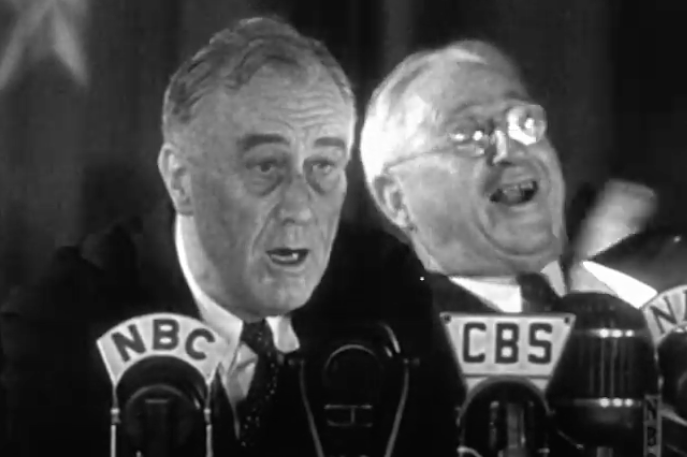
And so, his 1st campaign speech took place on September 23, in Washington, at a dinner of the International Teamsters Union, to emphasize his long connection with the labor unions. It lasted half an hour, and was broadcast by all American radio networks. He made the audience laugh, both in the room and in the living rooms:

Well, here we are, together again, after four years. And what years they have been!

You know, I am actually four years older, which is a fact that seems to annoy some people. In fact, in the mathematical field, there are millions of Americans who are more than eleven years older than when we started in to clear up the mess that was dumped in our laps in 1933.

We all know that certain people who make it a practice to depreciate the accomplishments of labor – who even attack labor as unpatriotic – they keep this up usually for three years and six months in a row. But then, for some strange reason, they change their tune, every four years, just before Election Day. When votes are at stake, they suddenly discover that they really love labor, and that they are anxious to protect labor from its old friends...

The whole purpose of Republican oratory these days seems to be to switch labels. The object is to persuade the American people that the Democratic Party was responsible for the 1929 crash and the Depression, and that the Republican Party was responsible for all social progress under the New Deal.

Now, imitation may be the sincerest form of flattery, but I am afraid that, in this case, it is the most obvious common or garden variety of fraud!...

Can the Old Guard pass itself off as the New Deal? I think not. We have all seen many marvelous stunts in the circus, but no performing elephant could turn a handspring without falling flat on his back.

He moved on to foreign policy, and the conduct of The War:

There are some politicians who kept their heads buried deep in the sand while the storms of Europe and Asia were headed our way, who said that the Lend-Lease bill "would bring an end to free government in the United States," and who said, "only hysteria entertains the idea that Germany, Italy, or Japan contemplates war on us."

These very men are now asking the American people to entrust to them the conduct of our foreign policy and our military policy. What the Republican leaders are now saying in effect is this: "Oh, just forget what we used to say. We have changed our minds now. We have been reading the public opinion polls about these things, and now we know what the American people want."

And if that wasn't enough, he addressed the rumor about his dog:

These Republican leaders have not been content with attacks on me, or my wife, or on my sons. No, not content with that, they now include my little dog, Fala!

Well, of course, I don't resent attacks, and my family don't resent attacks, but Fala does resent them!
FDR, and Daniel J. Tobin,
President of the International Teamsters Union

FDR waited for the laughter to subside, to provide the full effect for the radio audience, and continued:

You know, Fala is Scotch, and, being a Scottie, as soon as he learned that the Republican fiction writers -- in Congress, and out -- had concocted a story that I'd left him behind on an Aleutian Island, and had sent a destroyer back to find him, at a cost to the taxpayers of two, or three, or eight, or twenty million dollars... his Scotch soul was furious. He has not been the same dog since.

The next line wasn't funny in the slightest, but it still drew laughter from the room:

I am accustomed to hearing malicious falsehoods about myself. But I think I have a right to resent, to object, to libelous statements about my dog!

After that, Dewey's only chance was if FDR had died before the election. He did not. But he did die on April 12, 1945, less than 3 months into his 4th and final term.

After his death, Eleanor took Fala home with her to Val-Kill, her home in Hyde Park. (She and Franklin each had separate "retreats" away from the main Hudsonside mansion, Springwood. His was called Top Cottage.) Once, in her nationally-syndicated newspaper column, My Day, she wrote, "Fala accepted me after my husband's death, but I was just someone to put up with until the master should return."
Eleanor and Fala, 1951

In 1952, Fala's health began to fail. He was euthanized on April 5, 2 days before his 12th birthday, and was laid to rest on the grounds of Springwood, next to a previous Roosevelt dog, Chief, not far from where Franklin was buried, and where Eleanor would follow in 1962. Statues of Fala were placed at the entrance to the visitor's center at the FDR Library on the Springwood grounds, and at the FDR Memorial in Washington.
The FDR Memorial
Fala remains the most famous Presidential pet, though not for a lack of trying. On September 23, 1952, 8 years to the day after the Fala Speech, when his integrity was challenged, Richard Nixon, then the Republican nominee for Vice President, mentioned a gift he'd received from a supporter: A cocker spaniel that his daughter, Tricia, had named Checkers. The intention was to remind people of Fala, thinking it would annoy Democrats and thrill Republicans. Checkers lived until 1964, not making it into the White House when Nixon was eventually elected President in 1968.
Both George Bushes had dogs, and when the father's dog (actually, his wife Barbara's dog) Millie had puppies, the father said, "Those puppy pictures saved my first hundred days!" One of those puppies was adopted by the son, who named it Ranger after the baseball team he owned. By the time George W. became President, he had his own Scottish terrier, named Barney.
*
September 23, 1944 was a Saturday. These baseball games were played that day:
* The New York Yankees beat the Cleveland Indians, 7-2 at League Park in Cleveland. Nick Etten hit a home run in support of Bill Bevens. Most of the Yankees' stars were serving, including Joe DiMaggio and Red Ruffing in the Army Air Force, Bill Dickey and Phil Rizzuto in the Navy, Tommy Henrich in the Coast Guard, and Charlie Keller in the Merchant Marine. Yogi Berra was also in the Navy, but hadn't yet made his major league debut. He had already participated in the D-Day invasion, and would become the only man who had done so to also play in the major leagues. Indians ace Bob Feller was in the Navy.
* The New York Giants lost to the Pittsburgh Pirates, 6-4 at the Polo Grounds. Mel Ott, both player and manager by this point, was too old to be drafted. However, he did not put himself into this game.
* The Brooklyn Dodgers beat the Chicago Cubs, 12-3 at Ebbets Field. Manager Leo Durocher had retired as a player, and was too old to be drafted. But Pee Wee Reese, his successor as shortstop and already the team's Captain, was in the Navy, as was Cookie Lavagetto. Pete Reiser was in the Army. So was Jackie Robinson, but the Dodgers didn't know about him yet, unless they knew he'd played college football at UCLA.
* The Boston Braves beat the Cincinnati Reds, 4-0 at Braves Field in Boston. Al Javery pitched a 6-hit shutout. Warren Spahn had made his debut for the Braves in 1942, but didn't win a single game, then went into Army, where he was wounded at the Battle of the Bulge. Then he came back, and won 363 games in the major leagues.
* The St. Louis Cardinals beat the Philadelphia Phillies, 6-2 at Shibe Park in Philadelphia. Stan Musial went 2-for-4. The Cards were hit less by the manpower drain of The War than any other team. Hence, they won the National League Pennant every year from 1942 to 1946, except 1945, the year that Musial was in the Navy. However, they did lose Enos Slaughter to the Army Air Corps, where he served in action in the Pacific.
* The Detroit Tigers beat the Boston Red Sox, 8-2 at Briggs Stadium (later Tiger Stadium) in Detroit. Tigers superstar Hank Greenberg was in the Army, while the Red Sox' Ted Williams was in the Marines.
* The Chicago White Sox beat the Washington Senators, 5-4 at Comiskey Park in Chicago.
* And the St. Louis Browns, about to win their one and only Pennant under that name, beat the Philadelphia Athletics, 3-1 at Sportsman's Park in St. Louis.
All NFL games that weekend were played the next day. And it was too early for the basketball and hockey seasons. But there were college football games played that day. Among them:
* Army, understandably on its way to the National Championship, did not open its season until the following week. Nor did Navy, also understandably one of the best teams in the country. They would be ranked Number 2 when they faced Number 1 Army at Municipal Stadium in Baltimore, a game won by Army. Notre Dame also did not open its season until the following week, and would also be Number 2 when they lost to Number 1 Army.
* Ohio State did not open its season until the next week. It won the Big Ten Conference title and finished undefeated. It did not play in a bowl game, and was ranked Number 2 behind Army.
* Oklahoma did not open its season until the next week. It won the Big Six Conference title (a forerunner of the Big 12), but did not play in a bowl game.
* Georgia Tech did not open its season until the next week. It won the Southeastern Conference title.
* Two other SEC teams went to bowl games that season. Tennessee did not open its season until the next week. Like Georgia Tech, they went undefeated in SEC play, and did not play Tech, but a tie with Alabama cost them the title.
* Alabama also did not open its season until the next week. Despite going 3-1-2 in SEC play, they were 5-2-2 overall, and were invited to the Sugar Bowl.
* Duke beat the University of Richmond, 61-7 at Duke Stadium (now Wallace Wade Stadium) in Durham, North Carolina. then they lost 4 straight games, although 1 was to Army and the other was to Navy. They won the Southern Conference title, a precursor to the Atlantic Coast Conference, and beat Alabama in the Sugar Bowl. (It could have been called the Wallace Wade Bowl, since Wade had coached both schools.)
* The University of Tulsa beat North Texas Agricultural, now known as the University of Texas at Arlington, 47-6 at Skelly Field in Tulsa. They went on to beat Georgia Tech in the Orange Bowl.
* Oklahoma A&M (now Oklahoma State) beat West Texas State (now West Texas A&M), 41-6 at Lewis Field (now Boone Pickens Stadium) in Stillwater, Oklahoma.
* Texas Christian beat Kansas, 7-0 on neutral ground at Ruppert Stadium, later renamed Kansas City Municipal Stadium. TCU won the Southwest Conference title, but lost to Oklahoma A&M in the Cotton Bowl.
* The University of Southern California and the University of California at Los Angeles played to a 13-13 tie at the Los Angeles Memorial Coliseum. USC rebounded from this, and, due to wartime travel restrictions, played only on the West Coast, including a rematch with UCLA, winning 40-13, to win the Pacific Coast Conference, a forerunner of the Pac-12. USC went on to beat Tennessee in the Rose Bowl.
* There wasn't much local action in the New York Tri-State Area. In New York City, Fordham suspended its program for the duration of The War. Columbia opened its season the following week, New York University (NYU) the week after that. In New Jersey, Rutgers only played 5 games, and didn't play their 1st until October 28. Princeton only played 3 games, and didn't start until November 11.

Thursday, September 15, 2022

September 15, 1994: The Baseball Season Is Canceled

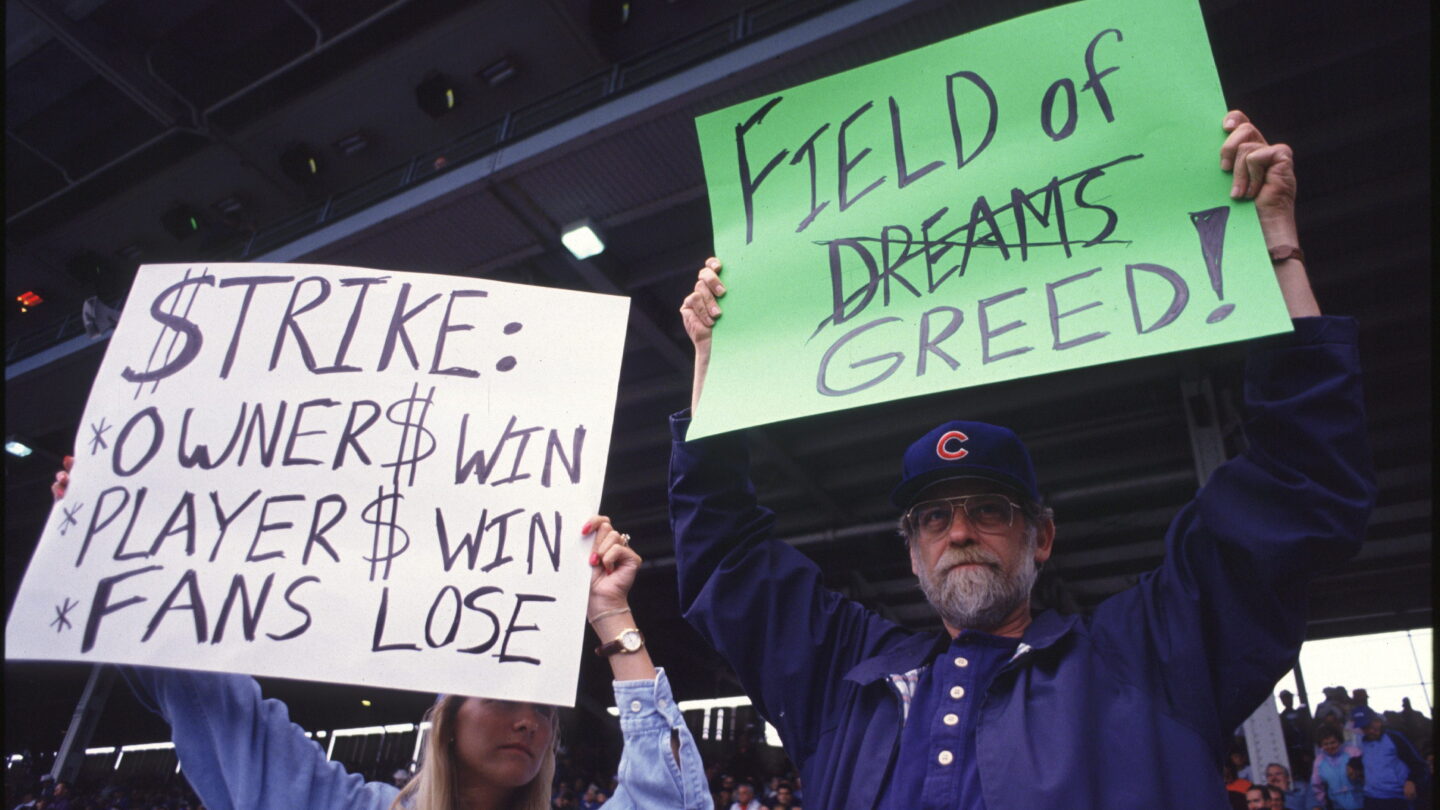
September 15, 1994: A date which lives in infamy. There is no joy in Mudville, or anywhere else.
Milwaukee Brewers owner Bud Selig, a walking conflict-of-interest as the Acting Commissioner of Major League Baseball, cancels the remainder of the regular season, and the postseason, including the World Series, following a vote of the team owners. No Commissioner, in any of the "big four" North American sports, had ever done that before.

The vote is 26-2. Oddly, the 2 who voted to go on with the season and not betray the fans were 2 of the most hated team owners of the era: Peter Angelos of the Baltimore Orioles and Marge Schott of the Cincinnati Reds.

There were 7 games originally scheduled for that Thursday, which was a travel day for the other teams then in the major leagues. All times listed below are Eastern Daylight Time:

* 2:05: Cleveland Indians vs. Milwaukee Brewers at Milwaukee County Stadium.

* 7:35: New York Yankees vs. Toronto Blue Jays at SkyDome (now the Rogers Centre) in Toronto.

* 7:35: St. Louis Cardinals vs. Philadelphia Phillies at Veterans Stadium in Philadelphia.

* 7:35: Florida Marlins (now the Miami Marlins) vs. Pittsburgh Pirates at Three Rivers Stadium in Pittsburgh.

* 8:05: Oakland Athletics vs. Chicago White Sox at the new Comiskey Park (now Guaranteed Rate Field) in Chicago.

* 8:05: Atlanta Braves vs. Houston Astros, at the Astrodome in Houston.

* 10:05: Cincinnati Reds vs. Los Angeles Dodgers, at Dodger Stadium in Los Angeles.

* Not scheduled to play: The Baltimore Orioles, the Boston Red Sox, the California Angels (now the Los Angeles Angels), the Chicago Cubs, the Colorado Rockies, the Detroit Tigers, the Kansas City Royals, the Minnesota Twins, the Montreal Expos (now the Washington Nationals), the New York Mets, the San Diego Padres, the San Francisco Giants, the Seattle Mariners and the Texas Rangers.

* Not yet established: The Arizona Diamondbacks and the Tampa Bay Rays.

This was in midweek of the NFL season, and a few weeks before the starts of the NBA and NHL seasons, so those leagues did not play on this day.

*

That strike, lasting from August 12, 1994 to April 25, 1995, was rough. Although President Clinton got the Crime Bill passed, his health care initiative failed, the Republican Party won control of both houses of Congress, and began passing bills slashing social services, which Clinton had to veto. A ferry carrying passengers from Estonia to Sweden sank, killing over 800 people. The Taliban was founded. A religious cult unleashed a sarin gas attack on the Tokyo subway, killing 13 and putting 5,000 in the hospital. Singer Selena (Quintanilla-Perez, not Gomez) was murdered. And, just before baseball started play again, a white "Christian" domestic terrorist blew up the federal government office building in Oklahoma City.

It wasn't all bad. A totalitarian government in Haiti fell. The Channel Tunnel opened, finally linking Britain with the European Continent by road. Sony released the first PlayStation. George Foreman regained the Heavyweight Championship of the World, 20 years after he lost it to Muhammad Ali, by knocking Michael Moorer out, making himself the oldest Heavyweight Champion ever, age 45.

Billy Wright, and Wilma Rudolph, and Howard Cosell died. Halsey, and Carlos Correa, and Giannis Antetokounmpo were born.

Thursday, August 11, 2022

August 11, 1994: The Strike of '94 Begins

August 11, 1994: With the Major League Baseball Players Association going on strike at Midnight, what turn out to be the last games of the season are played.

This includes the unintentionally early last baseball game at Mile High Stadium in Denver, which had hosted minor-league baseball from 1948 to 1992. The Colorado Rockies lose to the Atlanta Braves, 13-0. Greg Maddux pitched a 3-hit shutout. David Justice hits the stadium's last home run.

The Rockies moved into the new Coors Field when baseball resumed the following April. Mile High Stadium continued to host the NFL's Denver Broncos, as it had since 1960, through the 2000 season, when its replacement opened next-door, on the site of the McNichols Sports Arena.

The last game to end is at the Oakland Coliseum, with the host Athletics losing, 8-1 to the Seattle Mariners. Randy Johnson, outpitching former Met Ron Darling, closes it out by striking Ernie Young out at 9:45 PM Pacific Time – 12:45 AM on August 12, Eastern Time. Eric Anthony of Seattle hits the last home run… until Raul Mondesi of the Los Angeles Dodgers on April 25, 1995, 257 long days and many broken hearts later.

The A's trailed the Texas Rangers in the American League Western Division by 1 game; the Mariners, by 2. The Rangers actually had a terrible record, 52-62, but it was good enough, at the time, to lead the Division. With the 3-Division setup debuting this season, they could have become the 1st team ever ton win a Division title with a losing record. Through the 2021 season, that still has not happened.

*

August 11, 1994 was a Thursday. These other games were played:

* The New York Yankees lost to the Toronto Blue Jays, 8-7 at Yankee Stadium. This game went to extra innings, and I thought at the time that the players looked like they wanted to keep playing, and not go on strike. Each team scored a run in the 12th inning. Ed Sprague hit a home run off Joe Ausanio to lead off the top of the 13th. Danny Tartabull hit a home run for the Yankees. Don Mattingly went 1-for-5 with a walk.

The Yankees had the best record in the American League, 70-43, and were leading the American League Eastern Division by 6 1/2 games over the Baltimore Orioles. This was probably Mattingly's best chance to win a title, and it was over.

* The New York Mets lost to the Philadelphia Phillies, 2-1 at Veterans Stadium in Philadelphia. Ricky Jordan singled Billy Hatcher home with the winning run in the bottom of the 15th inning. So, between them, the 2 New York teams played 28 innings, and neither won.

* The St. Louis Cardinals beat the Florida Marlins, 8-6 at Joe Robbie Stadium (now Hard Rock Stadium) in Miami Gardens, Florida.

* The Pittsburgh Pirates beat the Montreal Expos, 4-0 at Three Rivers Stadium in Pittsburgh. Zane Smith pitched a 5-hit shutout. Despite this defeat, at 74-40, the Expos had the best record in MLB, leading National League Eastern Division by 6 games over the Braves.

The only 2 times that franchise ended a season in 1st place under the Montreal Expos name were in 1981 and 1994, both tainted by a strike. During the strike-affected off-season, the Expos would break up their team to save money. Just 10 years later, they moved, becoming the Washington Nationals.

* The Los Angeles Dodgers beat the Cincinnati Reds, 2-0 at Riverfront Stadium in Cincinnati. Ramón Martínez pitched a 7-hit shutout. The Dodgers were leading the NL Western Division, while the Reds were leading the NL Central. They would face each other in the Playoffs the next season, with the Reds sweeping, but not this season.

* The Milwaukee Brewers beat the Detroit Tigers, 10-5 at Tiger Stadium in Detroit.

* The San Diego Padres beat the Houston Astros, 8-6 at the Astrodome in Houston. Derek Bell went 3-for-5 with a home run and 3 RBIs. Tony Gwynn also went 3-for-5. The Astros were only half a game behind the Reds in the NL Central.

* The Chicago White Sox and the Cleveland Indians were among the teams not scheduled. The White Sox, who hadn't won a Pennant since 1959 or a World Series since 1917, were leading the AL Central. The Indians, who hadn't even been in a Pennant race since 1959, hadn't won a Pennant since 1954, and hadn't won a World Series since 1948, were just 1 game behind the ChiSox. Both got screwed by the strike. At the time, the White Sox were the one team that concerned me, as a Yankee Fan, with possibly being a better team.

Wednesday, August 10, 2022

August 10, 1978: The 1978 New York Newspaper Strike

August 10, 1978: A newspaper strike shuts down New York City's 3 major newspapers until November 5. It was a multi-union strike: Not just the reporters, but the paperhandlers, machinists keeping the presses literally rolling, and the mechanics and drivers for the delivery trucks. Over 10,000 employees were out.

Wages were not the main issue. When the strike was settled, the union won some concessions in benefits, while management eliminated some overtime. Both sides could legitimately claim victory.

The fact that there were fewer reporters to bother them, and to complain to (although there were still TV and radio guys), is often credited as being one of the reasons the New York Yankees made their epic comeback and won the World Series.

Unlike with the 1962-63 strike that immediately killed the New York Mirror (a tabloid), and led by 1966 to the deaths of the Herald Tribune, the Journal-American, and the World-Telegram & Sun (all broadsheets), all 3 major New York dailies survived the strike. The broadsheet Times was as strong as ever. The tabloids, the Daily News and the Post, would each have their problems over the next few years, and each almost went out of business at least once, but have survived.

I've often said that the Times is the face that New York City prefers to show to the rest of the world, the Daily News is the face the City prefers to show to itself, and the Post is a face that only a mother could love.

*

August 10, 1978 was a Thursday. These Major League Baseball games were played:

* The New York Yankees beat the Milwaukee Brewers, 9-0 at Yankee Stadium. Ron Guidry pitched a 3-hit shutout, with only a double by Robin Yount, and singles by Yount and Dick Davis. He advanced to 16-2 on the season. He would finish 25-3 -- 27-3 counting the postseason. Reggie Jackson did not play. Chris Chambliss went 3-for-4 with a walk and 4 RBIs.

* The Boston Red Sox beat the Cleveland Indians, 6-5 at Fenway Park in Boston. Andre Thornton had singled home the go-ahead run in the top of the 13th inning. But then, just after he giveth, Thornton taketh away: His error on a Butch Hobson grounder to start the bottom of the 13th led to another error on the same play, allowing Hobson to come all the way around to score. George Scott doubled, Gary Hancock pinch-ran for him, and Rick Burleson singled Hancock home.

On July 20, the Red Sox had led the Yankees by 14 games. After this game, their lead was 7 1/2. The Yankees would tie them on September 10, and they would finish in a tie for the American League Eastern Division title. The Yankees would win a Playoff, then the Pennant, and finally the World Series.

* The Philadelphia Phillies beat the Pittsburgh Pirates, 3-1 at Veterans Stadium in Philadelphia. Mike Schmidt went 1-for-3 with an RBI. The Pirates' only run came on a home run by Dave Parker. Willie Stargell went 1-for-4.

* The Baltimore Orioles beat the Kansas City Royals, 3-2 at Memorial Stadium in Baltimore. Ken Singleton hit a home run, and Eddie Murray went 1-for-4.

* The Toronto Blue Jays beat the Chicago White Sox, 7-3 at Exhibition Stadium in Toronto.

* The San Diego Padres beat the Cincinnati Reds, 15-3 at San Diego Stadium (later renamed Jack Murphy Stadium and Qualcomm Stadium). Gene Tenace went 3-for-5 with a home run and 5 RBIs. Dave Winfield went 1-for-3 with 2 walks. Pete Rose went 2-for-4. Johnny Bench only appeared as a pinch-hitter, and did not reach base.

* The Los Angeles Dodgers beat their arch-rivals, the San Francisco Giants, 12-2 at Dodger Stadium in Los Angeles.

* And the California Angels beat the Oakland Athletics, 16-5 at the Oakland Coliseum. Lyman Bostock went 3-for-4 with a walk and 5 RBIs. Having finished 2nd in the American League batting race to this then-teammate, Rod Carew of the Minnesota Twins, he was looking like a superstar in the making. Just 45 days later, he was dead.

Saturday, July 30, 2022

July 30, 1975: The Disappearance of Jimmy Hoffa

July 30, 1975: Jimmy Hoffa goes to a meeting. Nobody knows the result of this meeting, because nobody ever saw Hoffa again. Anybody who did see him after this meeting hasn't been talking.

James Riddle Hoffa was born on February 14, 1913 in Brazil, Indiana, outside Terre Haute. Controversial Bishop James Pike was born the exact same day, and he would also disappear, although he was found -- dead. New York Yankees broadcaster Mel Allen was born the same day. So was Ohio State football coach Woody Hayes.

Hoffa was 7 when his father died, and at 11, his mother moved him to Detroit, where he lived for the rest of his life. He dropped out of school to go to work at age 14. Because of the abuses he sustained on his job, he was drawn to union activity. By 1932, he was a member of the International Brotherhood of Teamsters, which then represented truck drivers and chauffeurs, although it now represents a diverse group of blue-collar and professional workers.

Hoffa proved to be an organizing genius: In his rise through the Teamsters, they grew from 75,000 members in 1933 to 420,000 in 1939, actually growing despite the manpower drain of World War II (for which Hoffa's leadership role within the union got him a draft deferment), and topping 1 million in 1951. By 1952, Hoffa was the union's national vice president, and was elected president in 1957.

By this point, the actions of the Teamsters had attracted some inconvenient attention. The U.S. Senate's Select Committee on Improper Activities in Labor or Management Field, chaired by John McClellan of Arkansas (and thus remembered as "the McClellan Committee"), called Hoffa's predecessor, Dave Beck, to Capitol Hill to testify on organized crime's influence on the union. He invoked his right against self-incrimination under the 5th Amendment to the Constitution of the United States 140 times, and was subsequently indicted and convicted of embezzlement. (He served 2 1/2 years in prison, and died in 1993, at age 99.) That allowed Hoffa to rise to the union's presidency sooner than would have been expected.

One of the members of the McClellan Committee was John F. Kennedy of Massachusetts. The legal counsel for the Committee was Kennedy's brother, Robert F. Kennedy. Bobby had discovered several financial irregularities, including the misappropriation of $9.5 million in union funds -- just under $100 million in 2022 money.

The exchange between Robert Kennedy and Hoffa was so intense, it inspired Bobby's 1st book, titled The Enemy Within. I found the book once, and couldn't believe that the man who wrote it was the same man who ran for President in 1968 on a message of peace and brotherhood. This Robert Kennedy was incredibly belligerent, and he didn't seem to have a nice thing to say about anybody. It later inspired a 1983 TV-movie, titled Blood Feud, starring Robert Blake as Hoffa and Cotter Smith as Bobby.

Hoffa was indicted for bribery over this. He was acquitted, but the controversy led the AFL-CIO to expel the Teamsters from its ranks. This didn't stop Hoffa: He managed to bring airline workers and transport workers (bus drivers and subway motormen) under the Teamsters' umbrella.

John F. Kennedy was elected President in 1960, and appointed Bobby as his Attorney General. (A law has since been passed prohibiting nepotism by a President.) Bobby wanted Hoffa imprisoned, very badly, and failed in his 1st attempt, being acquitted of conspiracy in 1962. In May 1963, Bobby got Hoffa indicted for jury tampering. On November 22, 1963, before the case could go to trial, President Kennedy was assassinated. According to the TV-movie, Hoffa hated Bobby so much that, when he was told, "Kennedy's been shot!" he asked, "Which Kennedy?"

Hoffa was convicted on March 6, 1964, and sentenced to 13 years. After 3 years of appealing, he went to prison on March 6, 1967. On December 23, 1971, President Richard Nixon -- perhaps to spite the Kennedys, and the memories of Jack and Bobby -- commuted Hoffa's sentence to time served, and he was free.

But there was a catch: As part of the deal, he was forbidden to "engage in the direct or indirect management of any labor organization." He couldn't stay away, and in 1973, he sued to invalidate the restriction, but lost his case.

He also found that he had lost support in the union, even in his native Detroit, where Anthony Provenzano, a caporegime in New York's Genovese crime family, had become the power behind the throne, along with the brothers Anthony and Vito Giacalone, major figures in the "Detroit Partnership," as the local Mafia were known. By 1975, the back-and-forth between Hoffa and the mobsters was nasty enough that Hoffa's son, James P. Hoffa, said, "I was increasingly afraid that the Mob would do something about it."

They did: They set up an alleged peace meeting between Tony Giacalone and Hoffa, for July 30, at 2:00 PM, at Machus' Red Fox restaurant in suburban Bloomfield Township, Michigan. Between 2:15 and 2:30, Hoffa's wife, Josephine, received a phone call from him, made from a payphone in front of Damman Hardware, behind the Red Fox, telling her that Tony hadn't shown up, and that he'd been stood up. He said he'd be home at 4:00 to grill some steaks for dinner.

Two men later admitted that they saw Hoffa, shook his hand and talked to him, and walked away without harming him. Another witness said he saw Hoffa in the back of a maroon car, either a Lincoln or a Mercury, with 3 other people, around 2:45 or 2:50, but, at the time, with no indication that he was in any kind of trouble. Hoffa was never reported as having been seen again. He was 62 years old.

The FBI investigated, but found through their wiretaps that mobsters were unwilling to talk about Hoffa's disappearance. Theories about it abound, but pretty much all of them end with Hoffa being killed, rather than running off with money (or perhaps another woman) and living to a ripe old age.

One of the theories is that, after being murdered by mobsters, Hoffa was buried in an oil drum underneath the end zone at Giants Stadium, then under construction in the Meadowlands in East Rutherford, New Jersey. When the stadium was demolished, no oil drums were found. So, whatever happened to Hoffa, this wasn't it.

Spoiler alerts for films based on Hoffa. In 1978, Sylvester Stallone starred in F.I.S.T., in which he played Johnny Kovak, head of the Federation of Inter-State Truckers. At the end of the movie, he is shot by the Mob. The aforementioned Blood Feud, with Robert Blake, ends with the notation that Hoffa disappeared, but offers no explanation for it. In the 1992 film Hoffa, he is played by Jack Nicholson, and is shot in his car along with another man.

In the 2019 film The Irishman, the real-life hitman Frank Sheeran, played by Robert De Niro, claims that, as a friend of Hoffa's, he was the only man the Mob trusted to pull the trigger on Hoffa, played by Al Pacino. In this film, Hoffa is told that the meeting was moved to a house where Provenzano was waiting for them. This matches the story that Hoffa was seen in the back seat of a car with no apparent trouble. When he got there, Sheeran shot him, and worked with other men to have Hoffa cremated, which would explain why no trace of his body has ever been found. If this story is true, then Sheeran never paid for his crime, avoiding prison until his death in 2003, age 83.

The building that housed Machus' Red Fox, at 6676 Telegraph Road, a.k.a. U.S. Route 24, 22 miles northwest of downtown Detroit, still stands, and is still a restaurant, an Italian steakhouse named Andiamo.

James P. Hoffa, whose wedding reception -- before his father's disappearance -- was held at the Red Fox, was elected to his father's old job of President of the Teamsters in 1998, and was continually re-elected until leaving office on March 21, 2022, at age 81.

*

July 30, 1975 was a Wednesday. These games were played in Major League Baseball that day:

* The Detroit Tigers, whose home of Tiger Stadium was 21 miles southeast of the Red Fox, were not at home that day. They played the New York Yankees at Shea Stadium, where the Yankees were playing home games while the original Yankee Stadium was being renovated. Given that the MLB schedule was set before the end of the previous regular season, it was almost certainly just a coincidence that the team from Hoffa's hometown was playing in the city where the order to kill Hoffa was most likely given.

The Yankees won, 2-1, Rudy May allowing just 3 hits, while Mickey Lolich allowed 5, both men going the distance. Ironically, the Tigers' run was driven in by a former Yankee player and future Yankee coach, manager and general manager: Gene Michael, on a sacrifice fly in the 5th inning. But the Yankees took the lead in the 6th thanks to doubles by Bobby Bonds and Roy White, and a single by Thurman Munson.

* The New York Mets lost to the St. Louis Cardinals, 5-2 at Busch Memorial Stadium in St. Louis. Lou Brock did not enter the game. For the Mets, Joe Torre went 2-for-5 with an RBI against his former team.

* The Milwaukee Brewers beat the Boston Red Sox, 6-2 at Fenway Park in Boston. Hank Aaron and Robin Yount both went 1-for-4, but the Brewers' only home run was hit by Sixto Lezcano. Carl Yastrzemski went 0-for-4. Fred Lynn got 3 hits, but the rest of the Red Sox combined hit only 3, including a home run by Dwight Evans.

* The Cleveland Indians beat the Baltimore Orioles, 3-1 at Memorial Stadium in Baltimore. Manager Frank Robinson, not yet retired as a player, did not put himself into the game against his former team. John Ellis and Charlie Spikes hit home runs for the Tribe. For the O's, Ken Singleton homered, but Brooks Robinson went 0-for-3.

* The Pittsburgh Pirates beat the Philadelphia Phillies, 8-1 at Three Rivers Stadium in Pittsburgh. Willie Stargell went 2-for-5 with an RBI, and the Pirates got homers from Manny Sanguillen and Al Oliver, both off Steve Carlton. Mike Schmidt went 0-for-3, Dick Allen went 1-for-4, and the Phils' only run came on a homer by Ollie Brown.

* The Cincinnati Reds beat the San Francisco Giants, 6-1 at Riverfront Stadium in Cincinnati. Pete Rose went 2-for-4. Johnny Bench went 3-for-3 with a walk and 2 RBIs. Joe Morgan went 1-for-3 with a walk.

* The Los Angeles Dodgers beat the Atlanta Braves, 8-2 at Atlanta-Fulton County Stadium.

* The Montreal Expos beat the Chicago Cubs, 6-1 at Wrigley Field in Chicago.

* The Kansas City Royals beat the Minnesota Twins, 6-4 at Metropolitan Stadium in the Minneapolis suburb of Bloomington, Minnesota. Harmon Killebrew, running out the string with the Royals, went 0-for-3 against his former team, although he did draw a walk. George Brett went 3-for-4 with an RBI. Rod Carew went 2-for-5.

* The Houston Astros beat the San Diego Padres, 8-4 at the Astrodome in Houston. Willie McCovey and Dave Winfield each went 1-for-4, and McCovey also had an RBI.

* The California Angels beat the Chicago White Sox, 5-4 at Anaheim Stadium (now Angel Stadium of Anaheim).

* And the Oakland Athletics beat the Texas Rangers, 1-0 at the Oakland Coliseum. Ken Holtzman came within 2 outs of a 5-hit shutout, but manager Alvin Dark brought in Rollie Fingers for 1 out and Paul Lindblad for the other, all to outpitch Ferguson Jenkins. Reggie Jackson went 0-for-3, and the only A's run came from an unlikely source, a home run by Bert Campaneris.

Thursday, July 28, 2022

July 28, 1954: "On the Waterfront" Premieres

Eva Marie Saint (left) and Marlon Brando

July 28, 1954: On the Waterfront premieres, directed by Elia Kazan. It is regarded as one of the greatest movies ever made.

The film is widely considered to be Kazan's answer to those who criticized him for identifying 8 Communists in the film industry before the House Committee on Un-American Activities (HUAC) in 1952. Budd Schulberg, who had previously written about boxers (and would again), wrote the script, after Kazan's friend, playwright Arthur Miller, backed out. Leonard Bernstein composed the musical score.

Terry Malloy (Marlon Brando) was a former boxer, who never made it, because his brother Charley (Rod Steiger), desperate for cash, made a deal with a corrupt union leader, Johnny Friendly (Lee J. Cobb), who strong-armed Terry into throwing a fight. In a famous scene in the back of a taxicab, Terry tells Charley, "You don't understand! I coulda had class! I coulda been a contender! I coulda been somebody! Instead of a bum, which is what I am. Let's face it."

(When people do impressions of Brando, they have multiple choices. It's often this scene. But they also do Stanley Kowalski yelling, "Stella!" from A Streetcar Named Desire; Colonel Kurtz's last words, "The horror... " from Apocalypse Now; and and various quotes from Don Vito Corleone in The Godfather.)

In saying this, Terry, now a poor longshoreman on the docks of Hoboken, New Jersey, across the Hudson River from Manhattan, tells Charley that he's going to testify against Friendly before the Waterfront Crime Commission. This is in revenge for Friendly having coerced him into luring Joey Doyle, a fellow dockworker, onto a rooftop, where Friendly's thugs pushed him to his death for testifying.

Terry had been dating Joey's sister Edie (Eva Marie Saint, in her 1st film role). She talks a local priest, Father Barry (Karl Malden), into rallying the dockworkers against Friendly. But they are more afraid of Friendly than than they are of God, and refuse. That fear grows the next day, when another boxer-turned-dockworker "owned" by Friendly, Timothy "Kayo" Dugan, testifies behind closed doors, in an attempt to keep his identity hidden, but it gets out, and he is killed.

Terry is subpoenaed, and Friendly sends Charley to tell him not to testify, leading to the conversation in the cab. Having failed in his mission, Charley is killed by Friendly, and left on a hook for Terry to see, as one final warning not to testify, meaning, if he does, he will be the next to go.

My mother told me her parents took her to see this movie, because they wanted to see it and they couldn't get a babysitter. She was 7 years old, and she said the sight of Charley on the hook traumatized her. I was 17 when I first saw it, and I can understand why.

The murder has the opposite effect on Terry: He is more determined than ever, and he does testify. The next day, He appears at the dock for the daily ritual where workers are chosen from the assembled longshoremen. Everyone is called to work except Terry, who taunts Friendly outside the nearby shack, shouting that he is proud of testifying. They get into a shouting match, and start fighting. Terry is winning until Friendly's thugs beat the hell out of him, leaving him all but dead.

Finally, the other dockworkers get it: They tell Friendly that they're on strike until Terry goes back to work. In his condition, he can't. Father Barry tells him that he lost the battle, but has a chance to win the war if he can walk into the warehouse. Father Barry and Edie get him on his feet, and he stumbles up the gangway to stand before the warehouse, where the boss nods to Terry, letting him in, and tells them to get to work. The men follow Terry inside, ignoring Friendly. Friendly threatens them all, but it's over: Even his thugs are no longer afraid of him, so his power is gone, and he is completely ignored.

Tony Galento, Tami Mauriello and Abe Simon, all of whom had fought Joe Louis for the Heavyweight Championship of the World, played dockworkers in this film. Fred Gwynne, later to star on The Munsters, played dockworker Mladen "Slim" Sekulovich. Mladen Sekulovich was Karl Malden's real name.

(Malden would also play the warden in The Birdman of Alcatraz, and "Sekulovich" was one of the names he rattled off in solitary confinement along with Burt Lancaster's Robert Stroud, the titular birdkeeper.)

The film was nominated for 12 Academy Awards. It won 8, including Best Picture, Best Actor for Brando, Best Supporting Actress for Saint, and Best Director for Kazan. Saint did not attend the award ceremony: She was pregnant, and her son Darrell Hayden was born 2 days later. Eva and director Jeffrey Hayden had one of the longest marriages in Hollywood history, marrying in 1951, and were still married when he died in 2016. In addition to Darrell, they later had a daughter, Laurette.

In 1999, Malden played a priest on an episode of The West Wing. Onto their Oval Office set, he brought the same Bible he'd used in On the Waterfront.

Cobb died in 1976, Bernstein in 1990, Steiger in 2002, Kazan in 2003, Brando in 2004, Malden and Schulberg in 2009. As of July 28, 2022, Saint is still alive, the last surviving actor from the film.

*

July 28, 1954 was a Wednesday. Hugo Chávez, dictatorial President of Venezuela from 1999 until his death in 2013, was born on this day.

And these baseball games were played:

* The New York Yankees beat the Chicago White Sox, 7-5 at Comiskey Park in Chicago. Mickey Mantle went 3-for-5 with a home run and 3 RBIs. Yogi Berra went 4-for-5 with an RBI. Still, Eddie Lopat only lasted 1 inning, and the Yankees trailed 5-1 after 7 innings, before coming from behind, scoring 3 runs in the 8th and 3 more in the 9th. Bob Grim was the winning pitcher in relief.

* The New York Giants beat the St. Louis Cardinals, 10-0 at the Polo Grounds. Johnny Antonelli allowed 10 hits, but only 1 walk, and kept the shutout. Dusty Rhodes hit 3 home runs. Willie Mays added 1.

* The Brooklyn Dodgers beat the Chicago Cubs, 3-1 at Ebbets Field. Roy Campanella hit a home run. Jackie Robinson went 0-for-3, but drove in a run with a bases-loaded walk. The only Cub run came on a home run by Ralph Kiner. Rookie Ernie Banks went 0-for-4.

* The Philadelphia Phillies beat the Cincinnati Redlegs, 3-2 at Connie Mack Stadium. (That ballpark had been Shibe Park until the year before. The Reds called themselves the Redlegs from 1953 to 1958, because of the Red Scare.)

* The Baltimore Orioles beat the Washington Senators, 2-1 at Memorial Stadium in Baltimore.

* The Milwaukee Braves beat the Pittsburgh Pirates, 6-4 at Forbes Field in Pittsburgh. Rookie Hank Aaron went 3-for-5 with 3 RBIs, although he did not hit a home run.

* The Cleveland Indians beat the Boston Red Sox, 2-1 at Cleveland Municipal Stadium. Early Wynn was the winning pithcer. Ted Williams went 2-for-4 with an RBI.

* The Detroit Tigers beat the Philadelphia Athletics, 10-2 at Briggs Stadium (renamed Tiger Stadium in 1961) in Detroit. Bud Souchock hit 2 home runs, and Al Kaline went 1-for-4.

December 31, 1999 & January 1, 2000: The Millennium

December 31, 1999:  The Millennium arrives. The people of planet Earth survived. At a terrible cost. But we hadn't destroyed ourselves. ...