Showing posts with label montgomery. Show all posts

Thursday, December 1, 2022

December 1, 1955: Rosa Parks Holds Her Seat

December 1, 1955: Rosa Parks is told to get up and move. She says, "No." In so, doing, she made history.

As historian Laurel Thatcher Ulrich said, "Well-behaved women rarely make history."

Let the record show that Rosa Parks was not the first woman to make this kind of history. In 1943, 17-year-old Bernice Delatte was arrested for defying segregation rules on a bus in New Orleans. In 1944, a U.S. Army Lieutenant was told to go to the back of a bus, to make room for a lower-ranking soldier. He refused. He got court-martialed. He was acquitted. His name was Jack Roosevelt Robinson. Yes, that Jackie Robinson. And in 1953, a 6-day boycott got the buses in Baton Rouge, Louisiana desegregated.

On March 2, 1955, Claudette Austin was arrested in Montgomery, the capital of Alabama, for refusing to give up her seat to a white woman on a crowded, segregated bus. The National Association for the Advancement of Colored People had been waiting for a chance to challenge a "send the blacks to the back of the bus" law, in line with the decision the year before, by the U.S. Supreme Court, in Brown v. Board of Education of Topeka, Kansas, that accommodations that were officially "separate but equal" was unconstitutional.

But Claudette was 15 years old, unmarried, and pregnant. Parks later said, "If the white press got ahold of that information, they would have a field day. They'd call her a bad girl, and her case wouldn't have a chance." The NAACP would need a more sympathetic defendant. Nine months later -- perhaps an appropriate time period -- they found one: Parks herself.

Rosa Louise McCauley was born on February 4, 1913 in Tuskegee, Alabama, and grew up in Pine Level, outside Montgomery. She was bullied by white children, and never forgot it. In 1932, she married Raymond Parks, a barber who worked with the NAACP. She joined the Montgomery chapter in 1943, and was elected its secretary. During World War II, she rode on an integrated trolley at Maxwell Air Force Base in Montgomery. She later said, "You might just say Maxwell opened my eyes up."

On November 27, 1955, Rosa Parks was attending Dexter Avenue Baptist Church in Montgomery, whose pastor was 26-year-old Dr. Martin Luther King Jr. He had invited T.R.M. Howard, head of the Regional Council of Negro Leadership in Mississippi, to speak of the recent murder of Emmett Till, and the acquittal of the 2 men who did it.

It was still on her mind 4 days later, on December 1. At around 6:00 PM, she boarded a Montgomery City Lines bus downtown. Eventually, all of the White-only seats in the bus filled up. The bus reached the third stop, in front of the Empire Theater, and several White passengers boarded. The driver, James F. Blake, noted that two or three White passengers were standing, as the front of the bus had filled to capacity.

Blake moved the "colored" section sign behind Parks, and demanded that four Black people give up their seats in the middle section, so that the White passengers could sit. Three of them complied. Parks said, "I thought of Emmett Till, a 14-year-old African American who was lynched in Mississippi in 1955, after being accused of offending a White woman in her family's grocery store, whose killers were tried and acquitted – and I just couldn't go back." In her autobiography, she said:
People always say that I didn't give up my seat because I was tired, but that isn't true. I was not tired physically, or no more tired than I usually was at the end of a working day. I was not old, although some people have an image of me as being old then. I was forty-two. No, the only tired I was, was tired of giving in.
When Parks refused to give up her seat, Blake took to his radio, and called the police. When she was arrested, she asked the officer, "Why do you push us around?" She remembered him saying, "I don't know, but the law's the law, and you're under arrest."

She was charged with a violation of Chapter 6, Section 11, segregation law of the Montgomery City code. Edgar Nixon, president of the Montgomery chapter of the NAACP and leader of the Pullman Porters Union, and her friend Clifford Durr bailed Parks out of jail that evening.

On Sunday, December 4, plans for the Montgomery bus boycott were announced at Black churches in the area, and a front-page article in the Montgomery Advertiser helped spread the word. At a church rally that night, those attending agreed unanimously to continue the boycott until they were treated with the level of courtesy they expected, until Black drivers were hired, and until seating in the middle of the bus was handled on a first-come-first-served basis.

The next day, Parks was tried on charges of disorderly conduct and violating a local ordinance. The trial lasted 30 minutes. After being found guilty and fined $10, plus $4 in court costs -- the total of $14 worth about $155 in 2022 money -- she appealed her conviction, and formally challenged the legality of racial segregation.

It rained that day, but the Black community persevered in their boycott. Some rode in carpools, while others traveled in Black-operated cabs that charged the same fare as the bus, 10 cents. Most of the remainder of the 40,000 Black commuters walked, some as far as 20 miles.

The boycott lasted for an entire year. On December 20, 1956, the federal ruling Browder v. Gayle took effect, declaring the Alabama and Montgomery laws that segregated buses were unconstitutional. All the seats on all the buses were now open to all.

In 1957, Rosa and Raymond Parks moved to Detroit, living with her brother and sister-in-law. She became a fair housing activist, helped John Conyers get elected to Congress in 1964, and served as his secretary until 1988. She participated in the Selma-to-Montgomery march in 1965. Her husband and brother died within weeks of each other in 1977, and she stepped back from civil rights activities thereafter to care for her mother, who died in 1979.
She then returned to the struggle, adding Planned Parenthood to her causes. In 1994, she was robbed and assaulted in her Detroit home. Mike Ilitch, founder of Detroit-based pizza chain Little Caesars, and owner of baseball's Detroit Tigers and hockey's Detroit Red Wings, bought her an apartment in a high-rise riverfront condo.
The following year, in commemoration of the 40th Anniversary of her seated stand, President Bill Clinton invited her to the State of the Union Address. He said, "She's sitting down with the First Lady tonight, and she may get up, or not, as she chooses." Acknowledging a standing ovation, she briefly stood.
She died on October 24, 2005, at the age of 92, after years of ill health and cognitive decline. Although often called "the mother of the Civil Rights Movement," she had no children of her own. She became the 1st woman, the 2nd black person, and the 1st private citizen to lie in state under the Rotunda of the U.S. Capitol Building in Washington.
A statue of her stands in Montgomery, roughly where she was arrested. In her adopted hometown of Detroit, the bus terminal is named for her. The bus on which she was arrested was also moved to Detroit, to the Henry Ford Museum in adjoining Dearborn, where it is on display along with the limousine in which President John F. Kennedy was assassinated, and the Ford's Theatre chair in which President Abraham Lincoln was sitting when he was assassinated.
As has been said, Rosa Parks sat, so that Martin Luther King could march, so that Barack Obama could run.
Bernice Delatte, the 1943 New Orleans protestor, lived until 2010. Claudette Austin became a nurse, married, and took the name Claudette Colvin. As of December 1, 2022, she is still alive. (UPDATE: She died in 2026.)

*

December 1, 1955 was a Thursday. Baseball was out of season. Football was in midweek. Two games were played in the NBA. The New York Knicks lost to the Minneapolis Lakers, 97-90 at the Minneapolis Auditorium. And the Philadelphia Warriors beat the St. Louis Hawks, 115-98 at the Philadelphia Civic Center.

And 1 game was played in the NHL: The Montreal Canadiens beat the Boston Bruins, 2-1 at the Boston Garden.

Wednesday, March 9, 2022

March 9, 1964: New York Times v. Sullivan

March 9, 1964: In the case of New York Times Co. v. Sullivan, the U.S. Supreme Court rules, in a 9-0 unanimous vote, that the freedom of speech protections in the First Amendment to the U.S. Constitution restrict the ability of public officials to sue for defamation.

The decision held that, if a plaintiff in a defamation lawsuit is a public official or candidate for public office, then not only must they prove the normal elements of defamation -- publication of a false defamatory statement to a third party -- they must also prove that the statement was made with "actual malice," meaning the defendant either knew the statement was false, or recklessly disregarded whether it might be false.

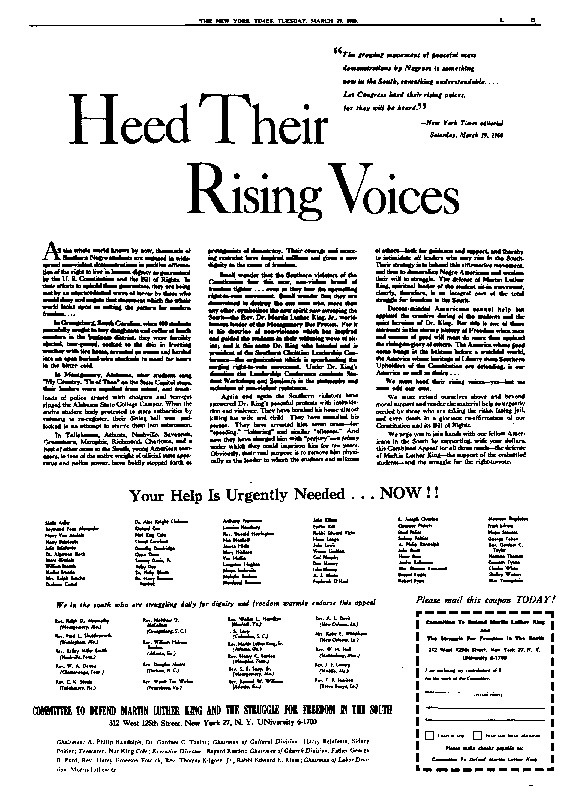
The underlying case began in 1960, when The New York Times published a full-page advertisement by supporters of Dr. Martin Luther King Jr. that criticized the police in Montgomery, the State capital of Alabama, for their treatment of civil rights movement protesters.
The ad had several inaccuracies regarding facts such as the number of times King had been arrested during the protests, what song the protesters had sung, and whether students had been expelled for participating.

Based on the inaccuracies, Montgomery Police Commissioner L.B. Sullivan sued the Times for defamation in Montgomery County Court. After the judge ruled that the advertisement's inaccuracies were defamatory per se, the jury returned a verdict in favor of Sullivan and awarded him $500,000 in damages -- about $4.8 million in 2022 money. The Times appealed first to the Supreme Court of Alabama, which affirmed the verdict, and then to the U.S. Supreme Court, which agreed to hear the case.
L.B. Sullivan

On March 9, 1964, the Court issued a 9–0 decision holding that the Alabama court's verdict violated the First Amendment. The decision defended free reporting of the civil rights movement campaigns in the Southern United States. It is one of the key decisions supporting the freedom of the press.

The Court reasoned that defending the principle of wide-open debate will inevitably include "vehement, caustic, and...unpleasantly sharp attacks on government and public officials." Before this decision, there were nearly $300 million in libel actions from the Southern States outstanding against news organizations, part of a collective effort by Southern officials to use defamation suits to prevent critical coverage of civil-rights issues in out-of-State publications.

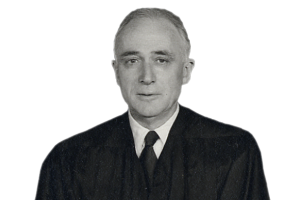
The Court held that the advertisement's inaccuracies did not remove its free-speech constitutional protections. In the official opinion, Justice William J. Brennan Jr. wrote:

The constitutional guarantees require, we think, a federal rule that prohibits a public official from recovering damages for a defamatory falsehood relating to his official conduct unless he proves that the statement was made with "actual malice" – that is, with knowledge that it was false or with reckless disregard of whether it was false or not.

The Supreme Court's decision, and its adoption of the "actual malice standard," reduced the financial exposure from potential defamation claims and frustrated efforts by public officials to use these claims to suppress political criticism. The Supreme Court has since extended Sullivan's higher legal standard for defamation to all "public figures." This has made it extremely difficult for a public figure to win a defamation lawsuit in the United States.

Lester Bruce Sullivan later served as Public Safety Director for the State of Alabama, and died of a heart attack in 1977, only 56 years old.

Byron White was both the last serving Justice on the Court from this case, retiring in 1993; and the last surviving one, living until 2002.

*

March 9, 1964 was a Monday. Baseball was in Spring Training. Football was out of season. And no games were scheduled in the NHL. There was 1 game in the NBA: The Los Angeles Lakers beat the Baltimore Bullets, 122-112 at the Los Angeles Memorial Sports Arena. Jerry West scored 37 points.

Friday, January 14, 2022

January 14, 1963: Governor George Wallace Declares "Segregation Forever!"

January 14, 1963: George Wallace is sworn in as Governor of Alabama for the first time. All Governors of that State are sworn in on a star on the portico of the State Capitol in Montgomery, marking the spot where Jefferson Davis was sworn in as the Presidency of the Confederate States of America (before the capital was moved to Richmond).

Wallace couldn't help that. What he could help was what he said in his Inaugural Address.

He was elected to the State House of Representatives in 1946. In 1948, as a Delegate to the Democratic National Convention, he did not join the walkout of Southern Delegates over the Party platform's civil rights plank. But he did consider President Harry Truman's civil rights program an infringement on States' rights.

In 1952, he was appointed a State Judge. Although he spoke to black lawyers, witnesses and defendants from the bench with the same courtesy that he gave their white counterparts, his rulings were always pro-white. He argued that he was a segregationist, but not a racist. As if that was possible.

In 1958, Wallace made his 1st campaign for Governor. At the time, with the Republican Party still thought of as "The Party of Lincoln," there was hardly any presence for it in the Southern States. Therefore, in such States, winning the Democratic Primary was said to be "tantamount to election."

But Wallace was beaten in the Primary by the State's Attorney General, John M. Patterson, 32 percent of the vote to 26. Patterson had taken a stand against organized crime in the State. But, in the wake of the Little Rock Crisis the year before, he announced, "If a school is ordered to be integrated, it will be closed down." He was endorsed by the Ku Klux Klan.

Wallace knew why he lost, but, in expressing it, he used a word that I won't use here. In cleaned-up language, Patterson had outdone him on racial issues, and he swore that no one would ever outdo him on racial issues again.

At the time, the State Constitution forbid a Governor from succeeding himself: He could wait out 4 years, then run and win again, but not in back-to-back terms. When a supporter asked why he started using racist messages, Wallace replied, "You know, I tried to talk about good roads and good schools and all these things that have been part of my career, and nobody listened. And then I began talking about (N-word)s, and they stomped the floor."

In the Primary, Wallace got 32 percent. State Representative Ryan deGraffenried Sr., who favored civil rights, got just over 25 percent. Big Jim Folsom, Patterson's predecessor as Governor, ran again, and got just 1,000 fewer votes than deGraffenried. Had he finished 2nd, the history of American politics might have been changed. But the runoff would have only the top 2 candidates, and Wallace won it with 55 percent.

And so, it was Wallace who was sworn in on Jeff Davis' star on January 14, 1963. In a speech written by Klansman and former radio host Asa Earl Carter, Wallace said, "In the name of the greatest people that have ever trod this Earth, I draw the line in the dust, and toss the gauntlet before the feet of tyranny, and I say, segregation now, segregation tomorrow, and segregation forever!" The crowd in Montgomery roared its approval.

Five months later, Wallace stood in the doorway of Foster Auditorium in Tuscaloosa to prevent the enrollment at the University of Alabama to 2 black people. Assistant Attorney General Nicholas Katzenbach and federal Marshals ordered him to get out of the doorway or face arrest on federal charges, and he got out.

America's racists chose to remember that he "stood in the schoolhouse door," and to forget that he caved in. Unlike Martin Luther King Jr., George Wallace wasn't man enough to defy a law he hated.

He had to leave the Governorship after the 1966 election, ran for President as a 3rd-party candidate in 1968, regained the Governorship in 1970, ran for President in the 1972, Democratic Primaries before being shot and paralyzed, left the Governorship again after the 1974 election, made one more Presidential run in 1976; and, with the State Constitution now allowing a Governor to run for re-election, was elected again in 1978 and 1982.

His near-death experience, and the pain caused by his condition, made him more compassionate, and led him to seek forgiveness from civil rights groups, and even embrace legislation that addressed their needs. He was forgiven by Coretta Scott King and Jesse Jackson.

On the other hand, he had, since his 4th and final term as Governor ended in 1987, fully embraced conservative ideology, though he never officially left the Democratic Party. and even what would later be called Christian Coalition, Tea Party and MAGA ideology.

In 1995, 3 years before his death, interviewed by John F. Kennedy Jr., the son and nephew of the men who sent Katzenbach to get him out of the schoolhouse door, for George magazine, Wallace said, "And now, segregation's gone. Good riddance." He died in 1998, and I'm sure he would have opposed Barack Obama every step of the way, but, somehow, I doubt he would have bought into the stupid Birther theories.

Former Governor John Patterson would also express regret for his racist campaigning and policy, and died in 2021, 4 months short of his 100th birthday.

Asa Earl Carter did not express any regret. Quite the opposite: He expressed regret that Wallace had a change of heart. He would later write the Western novel The Rebel Outlaw: Josey Wales, which was turned into a film starring and directed by Clint Eastwood. Carter died in 1979.

*

January 14, 1963 was a Monday. Film director Steven Soderbergh was born.

Baseball and football were out of season. No games were scheduled in the NHL. There was 1 game in the NBA: The San Francisco Warriors beat the New York Knicks, 142-134 at the Cow Palace, outside San Francisco in Daly City, California. It was just another day at the office for Wilt Chamberlain: He scored 48 points and grabbed 33 rebounds.

December 31, 1999 & January 1, 2000: The Millennium

December 31, 1999:  The Millennium arrives. The people of planet Earth survived. At a terrible cost. But we hadn't destroyed ourselves. ...