
The decision held that, if a plaintiff in a defamation lawsuit is a public official or candidate for public office, then not only must they prove the normal elements of defamation -- publication of a false defamatory statement to a third party -- they must also prove that the statement was made with "actual malice," meaning the defendant either knew the statement was false, or recklessly disregarded whether it might be false.
The underlying case began in 1960, when The New York Times published a full-page advertisement by supporters of Dr. Martin Luther King Jr. that criticized the police in Montgomery, the State capital of Alabama, for their treatment of civil rights movement protesters.
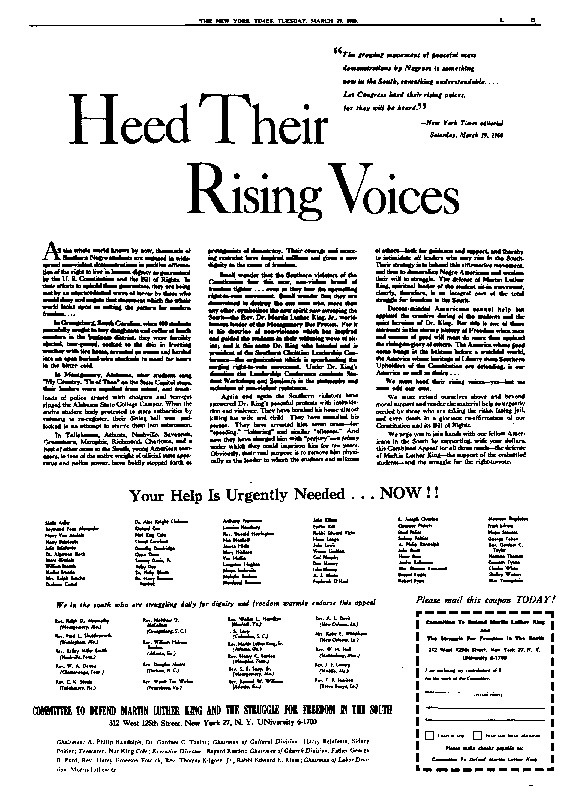
The ad had several inaccuracies regarding facts such as the number of times King had been arrested during the protests, what song the protesters had sung, and whether students had been expelled for participating.
Based on the inaccuracies, Montgomery Police Commissioner L.B. Sullivan sued the Times for defamation in Montgomery County Court. After the judge ruled that the advertisement's inaccuracies were defamatory per se, the jury returned a verdict in favor of Sullivan and awarded him $500,000 in damages -- about $4.8 million in 2022 money. The Times appealed first to the Supreme Court of Alabama, which affirmed the verdict, and then to the U.S. Supreme Court, which agreed to hear the case.
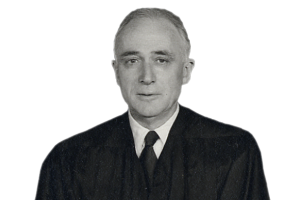
On March 9, 1964, the Court issued a 9–0 decision holding that the Alabama court's verdict violated the First Amendment. The decision defended free reporting of the civil rights movement campaigns in the Southern United States. It is one of the key decisions supporting the freedom of the press.
The Court reasoned that defending the principle of wide-open debate will inevitably include "vehement, caustic, and...unpleasantly sharp attacks on government and public officials." Before this decision, there were nearly $300 million in libel actions from the Southern States outstanding against news organizations, part of a collective effort by Southern officials to use defamation suits to prevent critical coverage of civil-rights issues in out-of-State publications.
The Court held that the advertisement's inaccuracies did not remove its free-speech constitutional protections. In the official opinion, Justice William J. Brennan Jr. wrote:
The constitutional guarantees require, we think, a federal rule that prohibits a public official from recovering damages for a defamatory falsehood relating to his official conduct unless he proves that the statement was made with "actual malice" – that is, with knowledge that it was false or with reckless disregard of whether it was false or not.
The Supreme Court's decision, and its adoption of the "actual malice standard," reduced the financial exposure from potential defamation claims and frustrated efforts by public officials to use these claims to suppress political criticism. The Supreme Court has since extended Sullivan's higher legal standard for defamation to all "public figures." This has made it extremely difficult for a public figure to win a defamation lawsuit in the United States.
Lester Bruce Sullivan later served as Public Safety Director for the State of Alabama, and died of a heart attack in 1977, only 56 years old.
Byron White was both the last serving Justice on the Court from this case, retiring in 1993; and the last surviving one, living until 2002.
*
March 9, 1964 was a Monday. Baseball was in Spring Training. Football was out of season. And no games were scheduled in the NHL. There was 1 game in the NBA: The Los Angeles Lakers beat the Baltimore Bullets, 122-112 at the Los Angeles Memorial Sports Arena. Jerry West scored 37 points.


No comments:
Post a Comment