Showing posts with label boston red stockings. Show all posts

Saturday, September 17, 2022

September 18, 1873: The Panic of 1873

Drawing of a bank run during the Panic

September 18, 1873: The American stock market begins a tailspin that becomes known as the Panic of 1873. It throws the country into its worst economic conditions yet seen to that point, known in hindsight as the Long Depression. It was what we would now call a gut punch to a country that was trying to embrace a "Gilded Age."

The American Civil War of the early 1860s was followed by a boom in railroad construction. Over 33,000 miles of new track were laid across the country between 1868 and 1873, with much of the craze in railroad investment being driven by government land grants and subsidies to the railroads. The railroad industry was the largest employer outside agriculture in the U.S., and a large infusion of cash from speculators caused spectacular growth in the industry and in the construction of docks, factories, and ancillary facilities. Most capital was involved in projects offering no immediate or early returns.

A period of economic overexpansion arose from the northern railroad boom before a series of economic setbacks. The Panic of 1869, a.k.a. Black Friday, did not cause a depression, the way the Panics of 1837 and 1857 had. But there were major fires in Chicago in 1871 and Boston in 1872. An outbreak of equine influenza in 1872 devastated American horses, and also pretty much every industry in America, which depended on horses. If anyone in America was yet thinking of "horseless carriages," they weren't doing anything about it, at least not publicly.

The decision of the German Empire to cease minting silver thaler coins soon after its founding in 1871 caused a drop in demand and downward pressure on the value of silver, which, in turn, affected the U.S., since much of the supply of silver was mined there. This also caused a crash in the Vienna Stock Exchange on May 9, affecting the Austrian Empire, with a ripple effect across the continent. France hadn't yet recovered from the Franco-Prussian War of 1870, and Italy was also a newly unified nation, and struggling economically. Europe was a mess.

As a result of what was going on there, the U.S. Congress passed the Coinage Act of 1873, which changed the national silver policy. Before the Act, the U.S. had backed its currency with both gold and silver, and minted both types of coins. The Act moved the country to a de facto gold standard, which meant it would no longer buy silver at a statutory price or convert silver from the public into silver coins, but it would still mint silver dollars for export in the form of trade dollars.

The Act had the immediate effect of depressing silver prices, hurting Western mining interests, who labeled the Act "The Crime of '73", but its effect was offset somewhat by the introduction of a silver trade dollar for use in Asia, and the discovery of new silver deposits at Virginia City, Nevada, that resulted in new investment in mining activity.

(Virginia City's role as a silver developer led to Nevada's Statehood in 1864, its nickname "The Silver State," and the 1959-73 TV show Bonanza, where the Cartwright family fortune was based on silver found near Virginia City, then invested in other interests like land, cattle and timber. Ben Cartwright, played by Lorne Greene, did not "put all his eggs in one basket": He had what would later be called "a diversified portfolio.")

The Act also reduced the domestic money supply, raising interest rates, and hurting farmers and others who normally carried heavy debt loads. The perception of instability in the U.S. monetary policy caused investors to shy away from long-term obligations, particularly long-term bonds. The problem was compounded by the railroad boom, which was then in its later stages.

Jay Cooke & Company, a major component of the country's banking establishment, found itself unable to market several million dollars in bonds it held in the Northern Pacific Railway, connecting Seattle, Washington with St. Paul, Minnesota; and, through St. Paul, with the East and its railroads.

Cooke, known as the Union's "Great Financier" during the Civil War, and his firm, like many others, had invested heavily in the railroads. Some investment banks were then anxious for more capital for their enterprises. President Ulysses S. Grant's monetary policy of contracting the money supply, and thus raising interest rates, made matters worse for those in debt. Businesses were expanding, but the money they needed to finance that growth was becoming scarcer.
Jay Cooke

Due to the financial crises in Europe, Cooke could not sell the securities abroad. Just as he was about to swing a $300 million government loan, reports circulated that his firm's credit had become nearly worthless. On September 18, the firm declared bankruptcy.

The New York Stock Exchange closed for 10 days, starting on September 20. (It was a Saturday, anyway, but it did not reopen on Monday, September 22.) Many insurance companies went out of business, as the deteriorating financial conditions created solvency problems for life insurers. By November, some 55 of the nation's railroads had failed, and another 60 had gone bankrupt by the first anniversary of the crisis. Construction of new rail lines, formerly one of the backbones of the economy, plummeted from 7,500 miles of track in 1872 to just 1,600 miles in 1875, and 18,000 businesses failed between 1873 and 1875.

Unemployment peaked in 1878, at 8.25 percent -- and that's just what was reported, so it was likely considerably higher. Building construction was halted, real estate values fell, and corporate profits vanished. So wages were cut, with the result that the number of people unemployed was most likely dwarfed by those who were paid so little that they couldn't support their families.

In 1874, Congress passed the Ferry Bill, proposed by Senator Thomas Ferry of Michigan, to allow for the printing of currency, increasing inflation and reducing the value of debts. Grant vetoed the bill. The poor economic conditions also caused voters to turn against Grant's Republican Party. In the 1874 Congressional elections, the Democratic Party won control of the House of Representatives for the first time since the Civil War.

The following year, Congress passed the Specie Resumption Act of 1875, which would back U.S. currency with gold. This helped curb inflation and stabilize the dollar. But public opinion made it difficult for the Grant Administration to develop a coherent policy on the Southern States, and the North began to steer away from Reconstruction.

With the depression, ambitious railroad building programs crashed across the South, leaving most of its States deep in debt and burdened with heavy taxes. Retrenchment was a common response of the South to State debts during the depression. One by one, each State fell to the Democrats in the South, and the Republicans lost power. So, as is usually the case, black people were hurt by a downturn in the American economy more than white people were.

What effect did the depression have on sports? Well, only one team sport was really organized in North America at the time, and that was baseball. According to historian Richard Hershberger, who specializes in both baseball and this period in American history:

The effects on the economy on the ground won't happen immediately. It will be the 1875 season that it really affects professional baseball, but it will hit hard. Professional baseball will go into decline, though there are some superficial changes that disguise this.

Early signs of recovery will appear late in the 1880 season. In 1881 baseball will be in full recovery mode, leading to the founding of the AA (the American Association) and a general expansion of the minors. In the meantime, the history of baseball, if you look past just the play on the field, doesn't make a lick of sense from 1875 through 1881 unless you take the depressed economy into account.

In other words, as would happen a few times in the years since, sports became a lagging indicator of American financial and social life.

The end of the crisis didn't come with any measure of the government. Rather, it came with an influx of labor, with the beginning of the great wave of immigration to the U.S., spurred on by both economic hardship and religious persecution in Europe. This wave of immigration enriched the country and its businesses, if not (in most cases) the immigrants themselves, and lasted until the early 1920s.

By 1880, Jay Cooke had managed to pay off his debts, and his investment in a Nevada silver mine had restored his fortune. He died in 1905, considered not a hero or a villain, but mostly as a relic of an earlier age.

*

September 18, 1873 was a Thursday. There were 2 games played in the biggest professional baseball league of the time, the National Association, which is now regarded by most, but not all, history-minded baseball fans as a "major league." Both included teams based in what would now be considered New York City, although Brooklyn did not become a part of the City until 1898; and both played a Philadelphia team.

The New York Mutuals beat the Philadelphia Athletics, 4-2 at the Union Grounds in Brooklyn. The Mutuals had played since 1857, and would become members of the National League in 1876, but folded after that season. The Athletics would also join the NL for 1876 and then drop out after 1 season, and bear no relation to the team of the same name that started in the American League in 1901, and is now located in Oakland.

In the other game, the Brooklyn Atlantics, another survivor of the amateur era, also dating to 1857, lost to the Philadelphia White Stockings, 9-4 at the Jefferson Street Grounds in Philadelphia, which was also the home of the Athletics. Neither of these teams even got as far as the Mutuals or the original A's: They were not invited to join the NL, and the White Stockings then folded, while the Atlantics carried on as independents until 1882.

Wednesday, July 13, 2022

July 14, 1881: The Death of Billy the Kid

July 14, 1881: Billy Bonney dies. Billy the Kid, however, lives on. And no one seems to get his story right.

On the 1973 album that launched him to stardom, Piano Man, Billy Joel included a song titled "The Ballad of Billy the Kid." He made the mistake of writing the lyrics first and doing the research second. He continued to play the song live through his tour for his album 52nd Street in 1978-79, saying, "Every word in this song is a lie," and has occasionally played it since.

BJ got the details really wrong. He said the Kid was from Wheeling, West Virginia. No source about him had said that before. He said the Kid started his criminal career by robbing a bank in Colorado, and eventually "robbed his way from Utah to Oklahoma." There is no evidence that he ever robbed a bank, or committed any crime in any of those 3 States. (BJ may have been confused by the fact that Butch Cassidy and the Sundance Kid operated out of Utah. But the Indian Territory wasn't even opened to white settlement, as the Oklahoma Territory, until 1889, 8 years after the Kid died.)

BJ said the Kid "soon put many older guns to shame." There is no evidence that he ever engaged in a classic Wild West gunfight. He said the Kid was hanged in front of a large crowd. He was caught, and he was sentenced to be hanged... but he escaped.

BJ also said, "He never had a sweetheart." Far from the truth: He thought his girlfriend was in the room with him when he was killed.

One thing BJ got absolutely right: "The cowboy and the rancher knew his name."

*

Or, at least, his nickname. He was born on September 17, 1859 in... New York. The same city as Billy Joel, a Bronx native. Apparently, the Kid was born in Manhattan, although Brooklyn was also claimed. At birth, his name was Henry McCarty, so it wasn't William. Or Bill, or Billy, or Mac, or Buddy. (Sorry for drifting into a Sheryl Crow song there.)

After his father died, his mother Catherine moved the family to Indianapolis, where she met William Antrim. They moved to Wichita, Kansas, where Catherine married William. But when she died, William left Henry and his brother Joseph. Desperate, Henry started robbing -- not banks, but groceries, clothing, and, finally, guns. He moved to Arizona and stole horses, and was first mentioned in a newspaper, listed as "Kid Antrim." Because of his stepfather, he began to be listed as "William Antrim." Soon, these were combined into "Billy the Kid."

He reached the New Mexico Territory (it became a State in 1912), and began using the name William H. Bonney. He began working for ranchers, including stealing horses. Those ranch owners were rich, the men working for them were not. The owners were like Mob bosses, and, in what became known as the Lincoln County War, they hired what would now be called hitmen. And Billy the Kid was one of them.

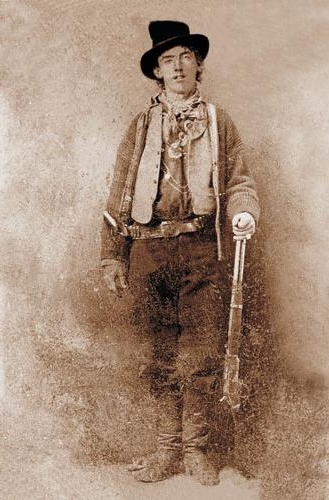
The photograph shown above is the only one of him known to exist. (There is one other alleged to show him and another man, but it hasn't been authenticated.) Usually, this photo shows him holding the rifle with his right hand, and a Colt revolver on his left hip. (The brand of firearm he used was pretty much the only detail the Billy Joel song got right.) This gave rise to the belief that he was lefthanded. In 1958, Paul Newman starred in a movie about him, titled The Left Handed Gun. Except the photo process meant that the image was reversed. The image shown above is how he would have appeared to the photographer. The Kid was righthanded, as were most of the men now remembered as Wild West gunfighters. (In the 1974 movie Blazing Saddles, Gene Wilder played Jim, "The Waco Kid," and he was a lefty.)

But myths about Billy abounded. He was already the subject of "dime novels," telling stories involving him that simply weren't true, or were exaggerations of what he actually did. People who knew him later told interviewers that he didn't like that, but he never killed anybody over it.

He was captured by Sheriff Pat Garrett in 1880, and was sentenced to be hanged. According to records, Judge Warren Bristol said, "You are going to hang until you are dead, dead, dead." Billy responded by saying, "You can go to Hell, Hell, Hell."

His execution was set for May 13, 1881, in Lincoln. But on April 28, he escaped. He is only known, for sure, to have killed 4 men in his life, and 2 of them were in his escape. And that was while his legs were still shackled, before he found an axe and cut the shackles. Whatever else he may have been in real life, Billy the Kid was no dummy, and he was no coward.

The Governor of the Territory was Lew Wallace, who had just published the novel Ben-Hur. He placed a $500 bounty on the Kid's head. Garrett, embarrassed by the Kid having escaped his custody, was determined to get him, as a matter of pride as much as money. He had heard that the Kid was in Fort Sumner, and took 2 deputies with him.

On July 14, 1881, Garrett found Pete Maxwell, son of a land baron and known to be a friend of the Kid. They talked for hours, until midnight. Then Billy walked in. This was less than 2 years after Thomas Edison made the first practical electric light bulb, so the light was poor, and Billy couldn't recognize Garrett. He had a Mexican girlfriend, and thought she might be there, so he asked, in Spanish, "¿Quién es? ¿Quién es?" ("Who is it?")

Garrett couldn't see Billy's face, but he recognized Billy's voice. Garrett fired 2 shots. The 2nd missed. The 1st hit Billy right in the chest, above the heart. He was dead, at age 21.

It took a year for the Territory to grant Garrett the $500 bounty. In the meantime, people glad to be rid of the Kid had contributed over $7,000 to Garrett. In 1882, he published The Authentic Life of Billy, the Kid, and that's where we learned most of what we thought we knew about him. A lot of it was lies, designed to make Billy look more evil and dangerous than he was (including the claim that he'd killed 21 men, one for every year of his life), thus making Garrett look more heroic for taking him down than he really was.

What happened to Garrett? He chose not to run for another term as Sheriff of Lincoln County, and returned to Texas, where he ran for the State legislature, and lost. He went into several businesses, all of which failed. In 1901, President Theodore Roosevelt appointed him Collector of Customs for the border city of El Paso, Texas. He was so bad at that office that people kept writing to TR, telling him to fire Garrett. In 1906, even the Rough Rider had had enough of him, and fired him.

On February 29, 1908, Garrett was shot and killed in Las Cruces, New Mexico, in a dispute over ownership of livestock. He was 57. While not the killer and thief that Billy the Kid was, he was no hero, either.

As is so often the case with teenagers and young adults, TV and movie portrayals of him tend to use actors much too old to play him. Newman was 33, as was Michael J. Pollard in the 1972 film Dirty Little Billy. Jack Beutel was 27 in the 1943 film The Outlaw. Emilio Estevez was 25 in the 1988 film Young Guns. And Kris Kristofferson was 36 in the 1973 film Pat Garrett and Billy the Kid.

And, as with Jesse James and Butch Cassidy, well into the 20th Century, and the rise of Westerns in films and even on TV, there were old men claiming to be Billy the Kid. One, Ollie P. Roberts, even asked Thomas J. Mabry, Governor of New Mexico in 1948, to fulfill his predecessor Lew Wallace's promise of a pardon if he'd turned himself in. Since the promise was only rumored, never confirmed, Mabry turned him down.

*

July 14, 1881 was a Thursday. There was one game played in the National League that day: The Boston Red Stockings beat the Detroit Wolverines, 3-2 at Recreation Park in Detroit.

The Red Stockings became the Boston Beaneaters in 1883, and went through other names before adopting Braves in 1912, moving to Milwaukee in 1953 and Atlanta in 1966. The Wolverines won the Pennant in 1887, but, with team owner Frederick Stearns unable to meet the new salary demands of championship-winning players, went out of business only a year later.

Saturday, May 14, 2022

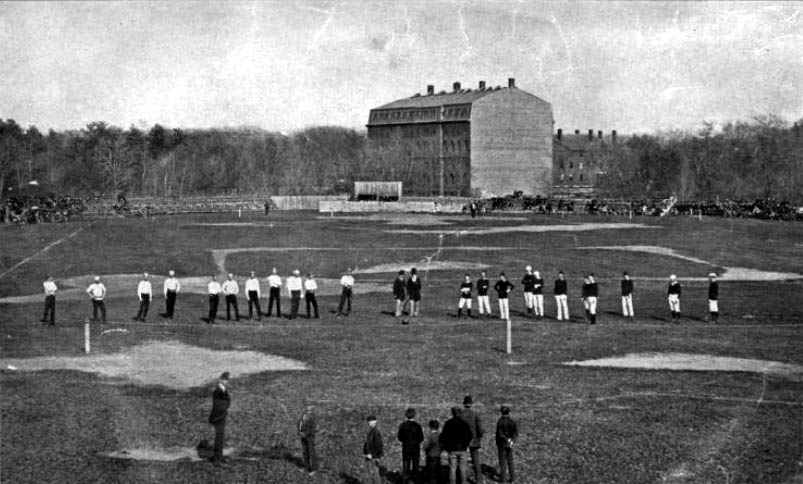
May 15, 1874: Harvard and McGill Invent American Football

 
May 15, 1874: American football is invented.

What's that? You thought that happened on November 6, 1869, between Rutgers and Princeton? Well, that was the 1st football game played in America. But that was essentially a soccer game, 25-a-side. In 1870, these 2 schools in New Jersey were joined by Columbia University, of New York City.

In 1872 came another New Jersey school, the Hoboken-based Stevens Institute of Technology; and Yale University, of New Haven, Connecticut. In 1873 came Harvard University, of Cambridge, Massachusetts, across the Charles River from Boston; and the 1st game in the South, between Washington & Lee University and the Virginia Military Institute (VMI), which are practically next-door to each other in Lexington, Virginia.

So what happened on May 15, 1874?

Essentially, McGill University, in Montreal, Quebec, is Canada's answer to Harvard, right down to the use of Crimson red as the school color. Both Harvard's men and McGill's men believed themselves to be sporting gentlemen, in the tradition of the Victorian Era that was pretty much at its peak in the 1870s.

As citizens of the British Empire, McGill's men believed themselves to be honest, brave, and examples for the youth of the world to follow. The University's motto is Grandescunt Aucta Labore, Latin for "By work, all things increase and grow."

As citizens of the United States of America, Harvard's men believed the same things of themselves, with the added touch of being the inheritors of the American Revolution. The University's motto is simply Veritas, Latin for "Truth."

Having heard that Harvard had one the best football teams in America, McGill started its football program in 1874, and challenged Harvard to a game of "football." It would be the 1st-ever "football" game between American and Canadian teams. Wishing to maintain their appearance as honorable sportsmen, Harvard happily accepted.

But when the McGill men got to Harvard's Jarvis Field on May 14, they discovered that the game Harvard thought they'd been invited to play was soccer -- which got shortened to "assoc." and eventually to "soccer." The McGill men expected that they would be playing rugby (which has frequently been called "rugger").

Being "sportsmen" and "gentlemen," the team captains met to discuss the discrepancy with civility. There may have been tea involved, or perhaps a stronger beverage.

They came up with a compromise: They would play a game under Harvard's "Boston game" rules, and another game under the "code" of "rugby union," the version of football most familiar to Canada at the time. (Indeed, the predecessor to the CFL, the Canadian Football League, was the CRU, the Canadian Rugby Union.)

At least, that's the story I'd been led to believe. But, as Richard Hershberger, a historian who specializes in the post-Civil War period, points out, an article in The Boston Globe of May 11 suggests that the teams already knew ahead of time about the discrepancy, and that the compromise was worked out, by either mail or telegram. (The telephone was invented 2 years later, also in Boston. Note that, just as baseball was often spelled as 2 words at the time, or hyphenated, "base ball" or "base-ball," so, too, is "foot-ball" hyphenated here.)
On May 14, Harvard won the soccer game 3-0. The following day, they met for the rugby match, which ended 0-0. As Hershberger puts it:

This is the most important game in the history of American sport. I write this with no exaggeration. This is the game that converted Harvard to the rugby rules. Harvard then went forth and explained to the other schools that Harvard is Harvard and you other schools are not, so that is that. Next year, rugby will be adopted as for intercollegiate matches. From there they will immediately begin fiddling with the rules, and by 1880 will have distinctive features of American football. Most schools in 1874 favored a kicking game. Were it not for today's game, college football would be soccer, or something very close to it.

The Harvard men liked the rugby version, including the "try." Later in the year, their officials met with officials from the other football-playing schools, and the rules were combined with those of the soccer generally considered "football" in America, and carrying the ball was officially allowed, and the "try" became the "touchdown."
So if you want to know why America plays the gridiron game instead of the sport that most of the rest of the world calls "football" or some variant, blame Harvard and McGill.


Like St. John's University in New York City's Queens, McGill used to call their team the Redmen. Despite the Indigenous heritage of Canada, it had nothing to do with the people then usually called "Indians": University founder James McGill, like many Scotsmen, had red hair. The name was used from 1927 to 2020, when it was changed to Redbirds.
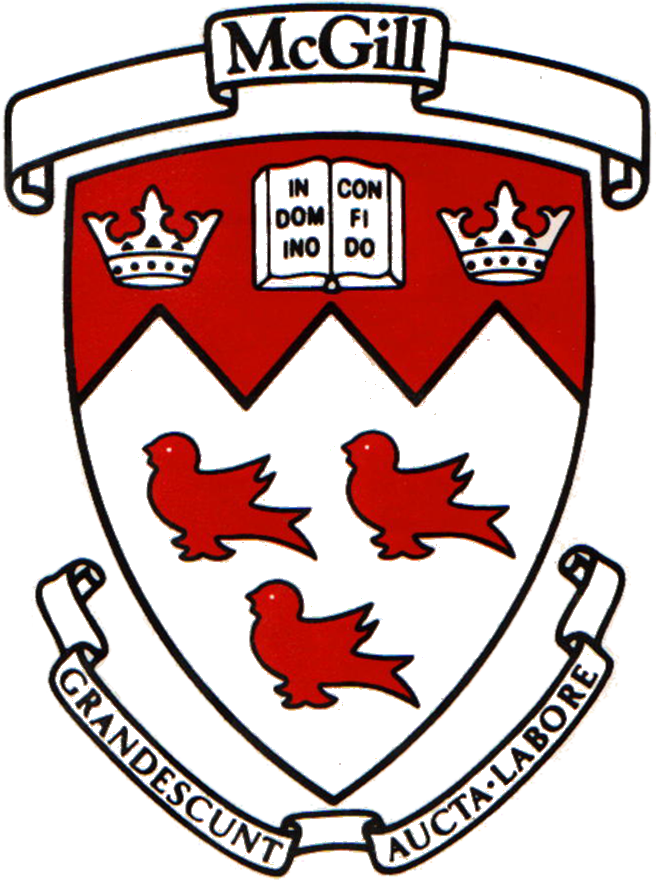
"Redbirds" was chosen as a match for the name for their women's teams, the Martlets. Their women's sports department was founded in 1976, and their women's teams were named for the birds shown on the McGill family crest.

*

May 15, 1874 was a Friday. There was another notable sporting event that day, a game played in the 1st professional baseball league, the National Association. The Boston Red Stockings beat the Brooklyn Atlantics, 8-2 at the Union Grounds in the Williamsburg section of Brooklyn.

Brooklyn remained a separate city from New York until 1898. By that point, the Atlantics had folded, and the Borough of Brooklyn was home to the team known today at the Los Angeles Dodgers. When the National League was founded in 1876, the Boston Red Stockings were admitted, and are known today as the Atlanta Braves.

December 31, 1999 & January 1, 2000: The Millennium

December 31, 1999:  The Millennium arrives. The people of planet Earth survived. At a terrible cost. But we hadn't destroyed ourselves. ...