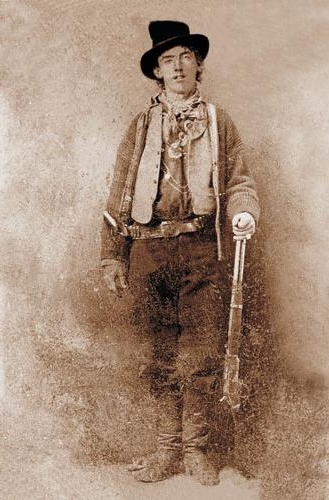
July 14, 1881: Billy Bonney dies. Billy the Kid, however, lives on. And no one seems to get his story right.
On the 1973 album that launched him to stardom, Piano Man, Billy Joel included a song titled "The Ballad of Billy the Kid." He made the mistake of writing the lyrics first and doing the research second. He continued to play the song live through his tour for his album 52nd Street in 1978-79, saying, "Every word in this song is a lie," and has occasionally played it since.
BJ got the details really wrong. He said the Kid was from Wheeling, West Virginia. No source about him had said that before. He said the Kid started his criminal career by robbing a bank in Colorado, and eventually "robbed his way from Utah to Oklahoma." There is no evidence that he ever robbed a bank, or committed any crime in any of those 3 States. (BJ may have been confused by the fact that Butch Cassidy and the Sundance Kid operated out of Utah. But the Indian Territory wasn't even opened to white settlement, as the Oklahoma Territory, until 1889, 8 years after the Kid died.)
BJ said the Kid "soon put many older guns to shame." There is no evidence that he ever engaged in a classic Wild West gunfight. He said the Kid was hanged in front of a large crowd. He was caught, and he was sentenced to be hanged... but he escaped.
BJ also said, "He never had a sweetheart." Far from the truth: He thought his girlfriend was in the room with him when he was killed.
One thing BJ got absolutely right: "The cowboy and the rancher knew his name."
*
Or, at least, his nickname. He was born on September 17, 1859 in... New York. The same city as Billy Joel, a Bronx native. Apparently, the Kid was born in Manhattan, although Brooklyn was also claimed. At birth, his name was Henry McCarty, so it wasn't William. Or Bill, or Billy, or Mac, or Buddy. (Sorry for drifting into a Sheryl Crow song there.)
After his father died, his mother Catherine moved the family to Indianapolis, where she met William Antrim. They moved to Wichita, Kansas, where Catherine married William. But when she died, William left Henry and his brother Joseph. Desperate, Henry started robbing -- not banks, but groceries, clothing, and, finally, guns. He moved to Arizona and stole horses, and was first mentioned in a newspaper, listed as "Kid Antrim." Because of his stepfather, he began to be listed as "William Antrim." Soon, these were combined into "Billy the Kid."
He reached the New Mexico Territory (it became a State in 1912), and began using the name William H. Bonney. He began working for ranchers, including stealing horses. Those ranch owners were rich, the men working for them were not. The owners were like Mob bosses, and, in what became known as the Lincoln County War, they hired what would now be called hitmen. And Billy the Kid was one of them.
The photograph shown above is the only one of him known to exist. (There is one other alleged to show him and another man, but it hasn't been authenticated.) Usually, this photo shows him holding the rifle with his right hand, and a Colt revolver on his left hip. (The brand of firearm he used was pretty much the only detail the Billy Joel song got right.) This gave rise to the belief that he was lefthanded. In 1958, Paul Newman starred in a movie about him, titled The Left Handed Gun. Except the photo process meant that the image was reversed. The image shown above is how he would have appeared to the photographer. The Kid was righthanded, as were most of the men now remembered as Wild West gunfighters. (In the 1974 movie Blazing Saddles, Gene Wilder played Jim, "The Waco Kid," and he was a lefty.)
But myths about Billy abounded. He was already the subject of "dime novels," telling stories involving him that simply weren't true, or were exaggerations of what he actually did. People who knew him later told interviewers that he didn't like that, but he never killed anybody over it.
He was captured by Sheriff Pat Garrett in 1880, and was sentenced to be hanged. According to records, Judge Warren Bristol said, "You are going to hang until you are dead, dead, dead." Billy responded by saying, "You can go to Hell, Hell, Hell."
His execution was set for May 13, 1881, in Lincoln. But on April 28, he escaped. He is only known, for sure, to have killed 4 men in his life, and 2 of them were in his escape. And that was while his legs were still shackled, before he found an axe and cut the shackles. Whatever else he may have been in real life, Billy the Kid was no dummy, and he was no coward.
The Governor of the Territory was Lew Wallace, who had just published the novel Ben-Hur. He placed a $500 bounty on the Kid's head. Garrett, embarrassed by the Kid having escaped his custody, was determined to get him, as a matter of pride as much as money. He had heard that the Kid was in Fort Sumner, and took 2 deputies with him.
On July 14, 1881, Garrett found Pete Maxwell, son of a land baron and known to be a friend of the Kid. They talked for hours, until midnight. Then Billy walked in. This was less than 2 years after Thomas Edison made the first practical electric light bulb, so the light was poor, and Billy couldn't recognize Garrett. He had a Mexican girlfriend, and thought she might be there, so he asked, in Spanish, "¿Quién es? ¿Quién es?" ("Who is it?")
Garrett couldn't see Billy's face, but he recognized Billy's voice. Garrett fired 2 shots. The 2nd missed. The 1st hit Billy right in the chest, above the heart. He was dead, at age 21.
It took a year for the Territory to grant Garrett the $500 bounty. In the meantime, people glad to be rid of the Kid had contributed over $7,000 to Garrett. In 1882, he published The Authentic Life of Billy, the Kid, and that's where we learned most of what we thought we knew about him. A lot of it was lies, designed to make Billy look more evil and dangerous than he was (including the claim that he'd killed 21 men, one for every year of his life), thus making Garrett look more heroic for taking him down than he really was.
What happened to Garrett? He chose not to run for another term as Sheriff of Lincoln County, and returned to Texas, where he ran for the State legislature, and lost. He went into several businesses, all of which failed. In 1901, President Theodore Roosevelt appointed him Collector of Customs for the border city of El Paso, Texas. He was so bad at that office that people kept writing to TR, telling him to fire Garrett. In 1906, even the Rough Rider had had enough of him, and fired him.
On February 29, 1908, Garrett was shot and killed in Las Cruces, New Mexico, in a dispute over ownership of livestock. He was 57. While not the killer and thief that Billy the Kid was, he was no hero, either.
As is so often the case with teenagers and young adults, TV and movie portrayals of him tend to use actors much too old to play him. Newman was 33, as was Michael J. Pollard in the 1972 film Dirty Little Billy. Jack Beutel was 27 in the 1943 film The Outlaw. Emilio Estevez was 25 in the 1988 film Young Guns. And Kris Kristofferson was 36 in the 1973 film Pat Garrett and Billy the Kid.
And, as with Jesse James and Butch Cassidy, well into the 20th Century, and the rise of Westerns in films and even on TV, there were old men claiming to be Billy the Kid. One, Ollie P. Roberts, even asked Thomas J. Mabry, Governor of New Mexico in 1948, to fulfill his predecessor Lew Wallace's promise of a pardon if he'd turned himself in. Since the promise was only rumored, never confirmed, Mabry turned him down.
*
July 14, 1881 was a Thursday. There was one game played in the National League that day: The Boston Red Stockings beat the Detroit Wolverines, 3-2 at Recreation Park in Detroit.
The Red Stockings became the Boston Beaneaters in 1883, and went through other names before adopting Braves in 1912, moving to Milwaukee in 1953 and Atlanta in 1966. The Wolverines won the Pennant in 1887, but, with team owner Frederick Stearns unable to meet the new salary demands of championship-winning players, went out of business only a year later.


No comments:
Post a Comment