Showing posts with label 1962 world cup. Show all posts

Friday, June 17, 2022

June 17, 1962: The Marv Throneberry Game

June 17, 1962: The early days of the New York Mets are full of myths about their ineptitude, but this one actually happened.

It was the 1st game of a Sunday doubleheader, against the Chicago Cubs, at the Polo Grounds. The Cubs won, 8-7. Lou Brock, not yet a St. Louis Cardinal, not yet known as a base stealer, and never really known for his power, hits a home run in the 1st inning, into the center field bleachers at the Polo Grounds. Only 2 players had ever done that before: Joe Adcock, and, in a Negro League game, Luke Easter. Hank Aaron of the Milwaukee Braves went on to do it the very next day.

Earlier in that inning, Marv Throneberry made an error at 1st base for the Mets. In the bottom of the inning, it looked like he'd redeemed himself: He hit a long drive, deep into the right-center field power alley, and he slid into 3rd base with a 2-run triple.

But the Cubs appealed, saying he didn't touch 2nd base. And 2nd base umpire Stan Landes ruled "Marvelous Marv" was out. Met manager Casey Stengel stormed out of the dugout -- as much as any 72-year-old man can storm, I suppose -- and was ready to argue. But 1st base coach Cookie Lavagetto told him, "Don't bother, Casey. He didn't touch 1st, either."

And Casey yelled, "Well, I know he touched 3rd, because he's standing on it!"

Ernie Banks also hit a home run. Billy Williams' triple gave the Cubs an 8-5 lead in the top of the 9th. In the bottom of the 9th, the Mets got an RBI double from former Yankee Gene Woodling, and an RBI single from Frank Thomas. But Don Elston got a strikeout to end it. Who was the last batter? Of course: Marv Throneberry.

The Cubs won the 2nd game, too, 4-3 when Ron Santo hit a home run off Wilmer "Vinegar Bend" Mizell in the top of the 9th. Williams also homered in this game. Throneberry didn't do so badly at the plate: He went 1-for-3, and had an RBI on a sacrifice fly. But he did also make an error.

Marv, once one of the Yankees' top prospects, and recipient of a 1958 World Series ring, but stuck at 1st base behind Moose Skowron and Joe Pepitone, became the symbol of the '62 Mets' ineptitude. Jimmy Breslin, then a columnist for the New York Herald Tribune, wrote a book about the '62 Mets, titled after a quote of Stengel's: Can't Anybody Here Play This Game? In it, he wrote, "Having Marv Throneberry play for your team is like having Willie Sutton work for your bank."

(From 1920 to until his arrest 1952, Sutton was America's most successful bank robber. He denied saying he robbed banks "Because that's where the money is," but later said he wished he'd said it, because it was true.")

He had enough power to be described with the old baseball cliché "oafish clout," which enabled him to hit 16 home runs down the close right-field line at the Polo Grounds. But he was nearly as bad a fielder at 1st base as Dick Stuart, later to be known as "Dr. Strangeglove" but a better power hitter. Still, Met fans loved Marv.

Early in 1963, he got sent down to the Buffalo Bisons, and was released from the Met organization early in the 1964 season. He never played a home game at Shea Stadium. He went back home to Tennessee, went into business for himself, returned to fame by making commercials for Miller Lite beer, and lived until 1994.

The Mets finished the season 40-120. The "winning" percentage of .250 was the lowest in Major League Baseball since the 1935 Boston Braves went 38-115, for .248. The 120 losses were the most since the 1899 Cleveland Spiders set the all-time low point in baseball performance by going 20-134.

And it wasn't just Throneberry. Stengel could point to any number of bad performers, but, instead, blamed them collectively. "Come and see my amazing Mets," he would say: "I been in this game for 100 years, but they've shown me ways to lose I never seen before." In good times and bad, they have been "the Amazin' Mets" or simply "The Amazin's" ever since.

Throneberry made 17 errors in only 97 games. Supposedly, on his birthday, September 2, Stengel told him, "We was gonna give you a cake, but we was afraid you would drop it." Rod Kanehl, who played pretty much any position, but none of them well, made 32 errors in 112 games.

Charlie Neal, a decent 2nd baseman for the Dodgers after Jackie Robinson retired, made 28 errors in 135 games. Shortstop Elio Chacón made 22 errors in 113 games. Félix Mantilla, their most-used 3rd baseman but a 2nd baseman by trade, made 20 errors in 129 games. Frank Thomas -- not the later Chicago White Sox Hall-of-Famer -- a left fielder with "oafish clout," but so big, slow and clumsy he was known as "Big Donkey," made 14 errors, an alarming total for an outfielder.

Part of the problem was that, knowing they couldn't attract fans with winning baseball, they tried to attract fans with familiar names. So they got as many former Yankees, New York Giants and Brooklyn Dodgers as they could. Throneberry was not a memorable Yankee, but Woodling was. From the Dodgers, they got Duke Snider, Gil Hodges and pitcher Roger Craig.

Craig had helped the Dodgers win the World Series in Brooklyn in 1955 and in Los Angeles in 1959. He later became a renowned pitching coach, and managed the San Francisco Giants to the 1989 National League Pennant. But in 2 seasons with the Mets, he went 10-24 and 5-22, despite not pitching all that badly. During a mound conference, he told Stengel he was doing the best he could, and Stengel told him, "You could strike them out. Don't you know we can't catch grounders?"

Their best player was center fielder Richie Ashburn, then 35 years old, a legend for the Philadelphia Phillies. When he was told he was named the team's Most Valuable Player, he decided being MVP for "the worst team ever" meant it was time to retire, and he went back to Philadelphia, and spent the last 35 years of his life in the Phillies' broadcast booth.

Aside from Throneberry missing the bases, the biggest '62 Mets story involved Ashburn and Chacón. A Venezuelan shortstop who had helped the Cincinnati Reds win the Pennant the year before, he kept backing up to catch pop-ups for which Ashburn had moved up and yelled, "I got it!" -- the universal signal to your teammates that you are going to catch the ball.

Well, maybe not so universal. Joe Christopher, an outfielder who had played on the Pittsburgh Pirates when they won the 1960 World Series (as had Mizell), had played Winter ball in a Caribbean league, and knew some Spanish. He reminded Ashburn that Chacón's English was bad, and that he should yell, "I got it!" in Spanish, which is, "¡Yo la tengo!"

So Ashburn practiced saying it. The next game, there was a pop-up, midway between the infield and center field. Ashburn moved up. Chacón moved back. Ashburn yelled, "¡Yo la tengo!" And Chacón stopped. He understood. But Thomas, in left field, didn't understand, and crashed into Ashburn. After the play, Thomas asked Ashburn, "What the hell is a yellow tango?" (In 1984, a group of Met fans formed a band named Yo La Tengo.)

And yet, the '62 Mets attracted 922,530 fans to their home games, 6th out of 10 teams in the NL. And it was a different kind of fandom. The media called these young Met fans, some of them too young to have gone to Giant or Dodger games on their own, but now old enough to do so, "The New Breed." In The New Yorker magazine, Roger Angell described them as follows:

Everybody thinks New York only cares about champions, but we cared about the Mets. I remember going to some games in June that year, and they were getting walloped, they were getting horribly beaten. But the crowds came out to Polo Grounds in great numbers and people brought horns and blew these horns.

After awhile I realized that this was probably anti-matter to the Yankees who were across the river and had won for so long. Winning is not a whole lot of fun if it goes on. But the Mets were human and that horn I began to realize was blowing for me because there’s more Met than Yankee in all of us. What we experience day to day in our lives, there’s much more losing than winning, which is why we love the Mets.

The Mets lost 111 games in 1963. They lost 109 games in 1964, their 1st season in Shea Stadium. They lost 112 games in 1965, their last with Stengel as manager. Slowly, they got better. When they finally got into contention for the first time, in 1969, going all the way and winning the World Series, the words "Amazin' Mets" were no longer ironic, they were fitting. But, based on how bad they were earlier, they were called the "Miracle Mets."

How bad were they? On May 26, 1964, they beat the Cubs 19-1 at Wrigley Field. This was before the Internet, and, with Wrigley Field not having lights, it was a day game, and some fan decided he couldn't wait for his evening newspaper to come out. So he called the paper -- which paper it is depends on who's telling the story -- and asked how the Mets did today.

The man on the other line said, "They scored 19 runs."
The caller said, "Did they win?"

I've also heard the story another way: Someone in the city room of the Herald Tribune yelled out that the Mets scored 19 runs, and it was Breslin who yelled out, "Did they win?"

Whoever it was asking, he knew his team. Until they became Tom Seaver's team in 1969, the Mets were Marv Throneberry's team, even in 1968.

But their fans loved them, whether at the crumbling old Polo Grounds or the brand-new, yet airplane-ridden, Shea Stadium. As Rihanna would sing, nearly half a century later, "We found love in a hopeless place."

*

June 17, 1962 was a Sunday. These other games were played in baseball:

* The New York Yankees also got swept, by the Cleveland Indians at Cleveland Municipal Stadium. The Indians won the opener, 6-1. Dick Donovan outpitched Bill Stafford, and rookie Jim Bouton allowed a run in 2 innings. The Tribe won the nightcap, 6-3. Pedro Ramos won, Bouton's future Seattle Pilots roommate Gary "Ding Dong" Bell got the save, and Jim Coates got shelled in 2 innings. Whitey Ford actually pitched a perfect 7th inning in relief.

Over the 2 games, Yogi Berra went 2-for-7 with a home run and 2 RBIs, Roger Maris went 2-for-7 with a walk and was hit by a pitch, and Mickey Mantle, battling injury, only appeared in the 2nd game, as a pinch-hitter, and struck out.

* The Philadelphia Phillies beat the Cincinnati Reds, 7-2 at Connie Mack Stadium in Philadelphia. Frank Robinson went 1-for-3 with a walk.

* The Baltimore Orioles beat the Washington Senators, 4-3 at District of Columbia Stadium in Washington. (It was renamed Robert F. Kennedy Memorial Stadium in 1969.) Brooks Robinson went 1-for-5.

* The Pittsburgh Pirates beat the Milwaukee Braves, 7-3 at Forbes Field in Pittsburgh. Hank Aaron went 2-for-4. So did Roberto Clemente, and he also had an RBI. Harvey Haddix outpitched Warren Spahn.

* A doubleheader was split at Tiger Stadium in Detroit. The Detroit Tigers won the 1st game, 8-5. Purnal Goldy, playing in place of the injured Al Kaline, hit 2 home runs for the Tigers. The Boston Red Sox won the 2nd game, 5-0. Frank Malzone hit home runs in both games for the Red Sox. Carl Yastrzemski went 1-for-5 with 3 walks.

* The Los Angeles Angels swept a doubleheader from the Chicago White Sox at Comiskey Park in Chicago, 5-3 and 6-5.

* The Kansas City Athletics beat the Minnesota Twins, 10-6 at Kansas City Municipal Stadium. Harmon Killebrew hit a 2-run homer, but it wasn't enough.

* The Los Angeles Dodgers beat the Houston Colt .45s (who became the Astros in 1965), 6-2 at Dodger Stadium in Los Angeles.

* And the San Francisco Giants beat the St. Louis Cardinals, 6-3 at Candlestick Park in San Francisco. Stan Musial went 0-for-3. Willie Mays went 2-for-4 with 2 RBIs.

And the Final of the World Cup was held at the Estadio Nacional in Santiago, Chile. Defending Champion Brazil made it back-to-back World Cups, beating Czechoslovakia, 3-1. I have a separate entry for this event.

June 17, 1962: Brazil's World Cup Repeat

Manuel Francisco dos Santos, a.k.a. Garrincha

June 17, 1962: The World Cup Final is held at the Estadio Nacional in Santiago, Chile. Brazil take on Czechoslovakia. This was also the 1st Final in which both teams came from the same group in the Group Stage.

The Czechs had reached the Final in 1934, and had a better team this time, led by Captain and defender Ladislav Novák, and midfielder Josef Masopust, a midfielder. Both men played for Dukla Prague, which dominated Czech soccer in the 1950s and '60s.

But Brazil would go into the Final with 10 of the 11 players who had started for them in the 1958 Final: Gilmar in goal, Djalma Santos at right back, Nílton Santos at left back, Mauro Ramos (also Captain) and Zózimo at centerback, Zito at right halfback, Didi at left halfback, Garrincha at right wing, Mário Zagallo at left wing, and forward Vavá.

The only change was at the other forward, with Amarildo coming in for Pelé. All games in Group 3 were played at Estadio Sausalito in Viña del Mar. In Brazil's opening game, Pelé scored to help them beat Mexico, 2-0. The next day, Czechoslovakia beat Spain, 1-0. Two days after that, Brazil and Czechoslovakia played each other, and Pelé tore a thigh muscle, and had to leave the game. With substitutes not allowed at the time, Brazil played about 2/3rds of the game with 10 men, and it ended in a 0-0 draw. Brazil beat Spain, 2-1; while Czechoslovakia lost to Mexico, 3-1, giving Brazil the Group.

In the quarterfinals, Brazil beat England, 3-1 in Viña del Mar, thanks to 2 goals from Garrincha; while the Czechs beat Hungary, 1-0 in Rancagua. In the Semifinals, Brazil again got 2 goals from Garrincha, and beat Chile, 4-2 at Santiago; while Czechoslovakia beat Yugloslavia, 3-1 in Viña del Mar. So the final was set for Santiago.
Brazil wore their traditional yellow shirts with blue shorts. The Czechs wore white shirts with red shorts. Masopust scored in the 15th. Amarildo, subbing for Pelé, equalized 2 minutes later. It stayed 1-1 until the 69th minute, when Zito put Brazil ahead. In the 78th, Vavá became the 1st player to score in back-to-back World Cup Finals, and it ended 3-1 to Brazil. After Italy in 1934 and '38, they became the 2nd country to win back-to-back World Cups.

Czechoslovakia won Euro 76, but 1962 remains the last time they, or either of their now-separate nations of Czechia (the Czech Republic) or Slovakia have reached the knockout stage of the World Cup. Czechia have not qualified at all since 2006; Slovakia, only in 2010.

Built in 1937, Estadio Nacional has been used by several teams in the Santiago area, most notably Universidad de Chile. Sadly, it was used as a prison by the Fascist government of Augusto Pinochet. It had a significant renovation in 2010, and is still used for soccer today.

UPDATE: An article for ESPN.com, published after the 2026 World Cup, ranking all 23 tournaments, rated this one 18th, citing the violence while admiring the star power.

*

June 17, 1962 was a Sunday. These baseball games were played:

* The New York Yankees were swept in a doubleheader by the Cleveland Indians, 6-1 and 6-3 at Cleveland Municipal Stadium. Mickey Mantle was injured, and did not play. Dick Donovan outpitched Bill Stafford in the opener, and Pedro Ramos beat Jim Coates in the nightcap. Over the 2 games, Yogi Berra went 2-for-7 with a home run and 2 RBIs, and Roger Maris went 2-for-7 with a walk.

* The New York Mets were swept in a doubleheader by the Chicago Cubs, 8-7 and 4-3 at the Polo Grounds. The 1st game was "The Marv Throneberry Game," and I have a separate entry for that event: Throneberry made an error in the field, then hit a triple, and was called out for not touching 2nd base. He didn't touch 1st base, either.

Also in that 1st game, Lou Brock, not yet known as a base stealer, and never really known for his power, hit a home run in the 1st inning, into the center field bleachers at the Polo Grounds. Only 2 players had ever done that before: Joe Adcock, and, in a Negro League game, Luke Easter. Hank Aaron of the Milwaukee Braves did it the very next day.

* The Philadelphia Phillies beat the Cincinnati Reds, 7-2 at Connie Mack Stadium in Philadelphia. Frank Robinson went 1-for-3 with a walk.

* The Baltimore Orioles beat the Washington Senators, 4-3 at District of Columbia Stadium (later Robert F. Kennedy Stadium) in Washington. Brooks Robinson went 1-for-5.

* The Pittsburgh Pirates beat the Milwaukee Braves, 7-3 at Forbes Field in Pittsburgh. Hank Aaron went 2-for-4. So did Roberto Clemente, and he also had an RBI. Harvey Haddix outpitched Warren Spahn.

* A doubleheader was split at Tiger Stadium in Detroit. The Detroit Tigers won the 1st game, 8-5. Purnal Goldy hit 2 home runs for the Tigers. He was playing right field, and Al Kaline didn't play in either game. The Boston Red Sox won the 2nd game, 5-0. Ike Delock pitched a 7-hit shutout. Frank Malzone hit a home run for the Red Sox in each game. Carl Yastrzemski went 1-for-5 with 3 walks.

* The Los Angeles Angels swept a doubleheader from the Chicago White Sox, 5-3 and 6-5 at Comiskey Park in Chicago.

* The Kansas City Athletics beat the Minnesota Twins, 10-6 at Kansas City Municipal Stadium. Harmon Killebrew and Lenny Green hit home runs for the Twins, while Norm Siebern hit 2 and Ed Charles hit 1 for the A's.

* The Los Angeles Dodgers beat the Houston Colt .45s (who became the Astros in 1965), 6-2 at Dodger Stadium in Los Angeles.

* And the San Francisco Giants beat the St. Louis Cardinals, 6-3 at Candlestick Park in San Francisco. Stan Musial went 0-for-3. Willie Mays went 2-for-4 with 2 RBIs.

Thursday, June 2, 2022

June 2, 1962: The Battle of Santiago

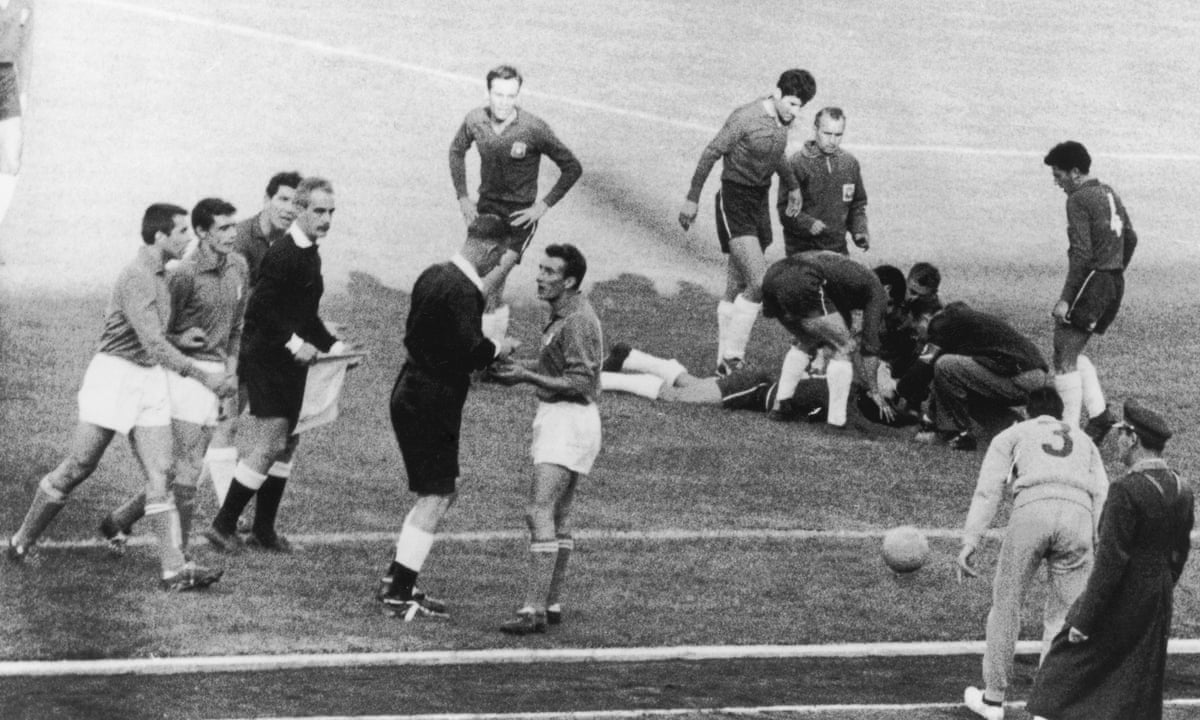
June 2, 1962: One of the nastiest matches in World Cup history is played, between host Chile and Italy. It becomes known as "The Battle of Santiago."

Chile got to host the 1962 World Cup because the last 2 World Cups had been held in Europe (Switzerland in 1954 and Sweden in 1958), and the South American nations threatened a boycott if their continent didn't get to host it.

An earthquake in 1960 devastated the country's capital, Santiago, and the country's recovery was slow, with more effort given to the host stadiums than to the national infrastructure. Only 1 World Cup host nation has ever forfeited its chance: Colombia for 1986, because of its civil war, to Mexico. In hindsight, Chile should have turned the host duties over to Argentina, who finished 2nd in the voting.

As a result, in the leadup to the tournament, 2 Italian journalists, Antonio Ghirelli and Corrado Pizznelli, called Santiago "a backwater dump":

The phones don't work, taxis are as rare as faithful husbands, a cable to Europe costs an arm and a leg and a letter takes five days to turn up...

Chile is a small, proud and poor country: it has agreed to organize this World Cup in the same way as Mussolini agreed to send our air force to bomb London (they didn't arrive). The capital city has 700 hotel beds. Entire neighborhoods are given over to open prostitution. This country and its people are proudly miserable and backwards.

Regardless of how close those statements were to the truth -- and they were true of some cities in Italy as well -- the proud and poor people of Chile were enraged.

To make matters worse, the Chilean and Italian were put into the same group. Things couldn't have been set up worse if they tried. Chile opened the tournament by beating Switzerland, 3-1 at the Estadio Nacional in Santiago. The next day, Italy could only manage a 0-0 draw with West Germany. And so, the stage was set for Chile and Italy to meet at the Estadio Nacional.

And the tournament was already rough: The 8 games played over the 1st 2 days featured 4 sending-offs, 3 broken legs, a fractured ankle and some cracked ribs.

Television, and conditions in Chile, being what they were at the time, broadcasting the match live outside of the country was next to impossible. So, for consumption in the British Isles, the BBC (British Broadcasting Corporation) sent a film crew, and announcer David Coleman to describe the match, and then have the film sent back to London by plane.

When people in the United Kingdom and the Republic of Ireland turned on their television sets to watch, they heard an introduction that Coleman had filmed for this match:

Good evening. The game you are about to see is the most stupid, appalling, disgusting and disgraceful exhibition of football in the history of the game. This is the first time these countries have met. We hope it will be the last.

The national motto of Chile reads, "By Reason or By Force." Today, the Chileans weren’t prepared to be reasonable, the Italians only used force, and the result was a disaster for the World Cup.

If the World Cup is going to survive in its present form, something has got to be done about teams that play like this. Indeed, after seeing the film tonight, you at home may well think that teams that play in this manner ought to be expelled immediately from the competition.
 
The referee was an Englishman, Ken Aston. He would later officiate at the 1963 FA Cup Final, Manchester United defeating Leicester City. After the 1966 World Cup, he got the idea, from traffic lights, for showing players charged with fouls a card: Yellow for a serious foul, two of them in one game grounds for being sent off; and red for a dangerous foul, and an immediate sending-off.

How many cards he would, and should, have shown in this game is in the eye of the beholder, but one wonders how many players might still have been on the pitch when he blew the final whistle. It might have been down to five-a-side.

Each team took the pitch wearing their usual home colors: Chile in red, Italy in blue (known as the Azzurri). It took 12 seconds for Aston to cite a player for a foul. In the 8th minute, he sent Italy's Giorgio Ferrini off for a foul on Honorino Landa. But Ferrini, a midfielder for Torino FC, refused to leave, and had to be escorted off by policemen.

Italian right back Mario David fouled Chile's Leonel Sánchez, who responded with a left hook, and David went down like a ton of bricks. Aston didn't see either action, and both men were allowed to continue. Later in the 1st half, Sánchez, an outside left for Universidad de Chile, punched Italy's Humberto Maschio, breaking the Atlanta inside left's nose. Aston didn't see this, either. But someone on the Italian side did, and a fight broke out. There was spitting from each side, and the police had to intervene again. In the 41st minute, Aston saw David do something, and sent the A.C. Milan player off. Italy went into the locker room down to 9 men, but the halftime score was still 0-0.

Finally, in the 73rd minute, Chile wore down the 9 remaining Italians, and Jamie Ramírez, an outside right for Universidad, scored on a header. In the 87th minute, Jorge Toro, a midfielder -- ironically, then playing for an Italian team, Modena -- added a low shot that made the final score 2-0 to Chile.

The win meant that Chile advanced to the Knockout Stage, regardless of their remaining game, which they lost to West Germany, 2-0. The loss meant that Italy were out, regardless of their remaining game, in which they beat Switzerland, 3-0. Both of those games were in Santiago.

David Coleman's wish was not granted: At the next World Cup, in England in 1966, Chile and Italy were again placed in the same group. This time, the play was rough, but not nearly as rough as it was in 1962, and Italy won, 2-0. But neither team advanced to the Knockout Round, because North Korea managed a draw with Chile and, in one of the greatest upsets in World Cup history, defeated Italy.

*

June 2, 1962 was a Saturday. In other games in that World Cup on this day:

* England beat Argentina 3-1 in Rancagua. Ron Flowers (a penalty), Bobby Charlton and Jimmy Greaves scored the England goals.

* Yugoslavia beat Uruguay 3-1 in Arica. There was rough play in this one, too, as each side had a player sent off.

* And Brazil and Czechoslovakia played to a 0-0 draw in Viña del Mar. This last game turned out to be a preview of the Final, which defending Champion Brazil won.

American-style football, basketball and hockey were all out of season. These baseball games were played:

* The New York Yankees lost to the Los Angeles Angels, 6-1 at Dodger Stadium in Los Angeles. Ken McBride outpitched Whitey Ford. Mickey Mantle was injured, and did not play. Roger Maris, moving over to center field, went 0-for-4. Yogi Berra got a hit pinch-hitting for Ford, but it wasn't enough.

* The New York Mets were swept by the San Francisco Giants in a doubleheader, 10-1 and 6-4. Willie Mays and Orlando Cepeda hit home runs in the opener, while Tom Haller and Harvey Kuenn hit them in the nightcap.

* The Philadelphia Phillies beat the Los Angeles Dodgers, 7-0 at Connie Mack Stadium in Philadelphia. Dennis Bennett pitched a 4-hit shutout, striking out 11.

* A doubleheader was split at Memorial Stadium in Baltimore. The Chicago White Sox won the 1st game, 10-2. The Baltimore Orioles won the 2nd game, 11-4. Brooks Robinson went 4-for-9 with a home run and 3 RBIs over the 2 games.

* The Pittsburgh Pirates beat the Houston Colt .45s, 9-2 at Forbes Field in Pittsburgh. Roberto Clemente hit a 3-run homer.

* The Detroit Tigers beat the Cleveland Indians, 5-3 at Tiger Stadium in Detroit. Al Kaline did not play for the Tigers, but, in his place in right field, Charlie Maxwell hit a home run. So did Billy Bruton and Rocky Colavito.

* The Cincinnati Reds beat the Chicago Cubs, 3-2 at Wrigley Field in Chicago. Frank Robinson went 2-for-4, and Wally Post hit a home run. Ernie Banks went 0-for-3, but had an RBI on a sacrifice fly.

* The Milwaukee Brewers beat the St. Louis Cardinals, 4-1 at Milwaukee County Stadium. Hank Aaron went 1-for-2 with a 2-RBI triple and a walk. Stan Musial went 1-for-4.

* The Minnesota Twins beat the Washington Senators, 9-2 at Metropolitan Stadium in the Minneapolis suburb of Bloomington, Minnesota. Harmon Killebrew went 0-for-3, but did draw 2 walks.

* And the Boston Red Sox beat the Kansas City Athletics, 5-2 at Kansas City Municipal Stadium. Carl Yastrzemski went 1-for-4 with 2 RBIs.

December 31, 1999 & January 1, 2000: The Millennium

December 31, 1999:  The Millennium arrives. The people of planet Earth survived. At a terrible cost. But we hadn't destroyed ourselves. ...