Showing posts with label staten island. Show all posts

Tuesday, December 13, 2022

December 14, 1894: The Consolidation of "Greater New York"

December 14, 1894: The New York State Board of Canvassers releases the official tally of the referendums on creating "The City of Greater New York." Most of the constituencies approved it.

Up to this point, the City of New York consisted of Manhattan Island and part of what became known as The Bronx. But Brooklyn was a separate city, and there were other separate cities around both, which is why the westernmost neighborhood in Queens is called Long Island City.

Queens County then consisted of Long Island City, and the Towns of Elmhurst, Flushing and Jamaica, and what are now called "The Rockaways," then part of the Town of Hempstead. Richmond County, making up the entirety of Staten Island, consisted of the Towns of Castleton, Middletown, Northfield, Southfield and Westfield.

The building of the Brooklyn Bridge in 1883, and the idea of building other bridges and a subway system connecting the two cities, replacing the old ferry boat system, helped put forward the idea of a single city that would be home to about 4 million people.

But Brooklyn, in particular, didn't want to do it: They liked their independence, and didn't want Manhattan telling them what to do. They'd already endured the heavy-handed control of the Manhattan-based Tammany Hall political machine dominating the State legislature, not to mention professional baseball teams calling themselves "New York" while playing at Brooklyn facilities such as the Union Grounds in Williamsburg and the Capitoline Grounds in Bedford-Stuyvesant. (Both had since been demolished.)

Nevertheless, the vote was taken, with a "Yes" vote meaning "For Consolidation," and a "No" vote meaning "Against Consolidation." Here were the results:

* Richmond County (Staten Island): 78.61 percent Yes. Over time, Staten Island would become the Borough the least satisfied with the setup, and has voted at least once to secede from the City, but this has not been permitted by the State government.
* Town of Pelham (in Bronx County): 62.13 percent Yes.
* Queens County: 61.93 percent Yes.
* New York County (Manhattan): 61.78 percent Yes.
* Town of East Chester (in Bronx County): 58.99 percent Yes. Eastchester (usually written as one word since then) has always been part of Bronx County, never Westchester County.
* Kings County (Brooklyn): 50.11 percent Yes. The winning margin was just 277 votes.
* Town of Westchester (in Westchester County): 50.04 percent No. The margin of victory was, literally, one single vote, 621 to 620.
* City of Mount Vernon (in Westchester County): 64.74 percent No. They remained separate, not joining Bronx County.

And so, on January 1, 1898, the Counties of New York, Bronx, Queens, Kings and Richmond became, respectively, the Boroughs of Manhattan, Bronx, Queens, Brooklyn and Staten Island; and, collectively, the City of New York. Westchester and Mount Vernon remained separate, and Mount Vernon became the seat of the new version of Westchester County.

The term "City of Greater New York" was never a legal or official designation; both the original Charter of 1898 and the newer one of 1938 use the name "City of New York." It is used today only to refer to the time period when the consolidation took place.

*

December 14, 1894 was a Friday. There were no scores on this historic day: Baseball was out of season, college football's regular season was over with only 4 postseason games (not yet called "bowl games") remaining to be played, hockey was all-amateur, and basketball was a new invention.

Monday, November 21, 2022

November 21, 1964: The Verrazzano-Narrows Bridge Opens

November 21, 1964: The Verrazzano-Narrows Bridge opens, connecting the New York City Boroughs of Brooklyn and Staten Island, via Interstate 278. It is the last great road project of New York's "master builder," Robert Moses. And, for the next 17 years, it is the longest suspension bridge in the world. In 2022, it remains the longest in the Americas.

In 1524, Italian (Florentine) explorer Giovanni da Verrazzano became the 1st European to sight the land that would become New York City, and its bodies of water, including the Hudson River (named for the later English explorer Henry Hudson) and "The Narrows," the strip of water between Brooklyn and Staten Island.

Up until the 1920s, Staten Island was isolated: Its only connections with any other land were by the Staten Island Ferry system, connecting it with Lower Manhattan, Brooklyn, and the New Jersey cities of Bayonne, Elizabeth and Perth Amboy. In 1928, the Outerbridge Crossing was built, connecting it with Perth Amboy, and the original Goethals Bridge (replaced by the current bridge in 2017) connected it with Elizabeth. In 1931, the Bayonne Bridge opened. But this didn't help people trying to get to and from the rest of New York City.

A "Liberty Bridge" and tunnel connecting the Subway system to Staten Island were proposed around this time, but federal funding for these projects was blocked by a Congressman from The Bronx -- Fiorello La Guardia, who was elected Mayor in 1933. He believed that a public necessity should not be provided by private interests. (The controversy over the Ambassador Bridge, built around that time between Detroit and the Canadian city of Windsor, Ontario, shows that he was right.)

In 1947, Moses was ready to try again, and got the federal government to approve a plan for a bridge, despite angry opposition from the people of Bay Ridge, the neighborhood where its Brooklyn anchorage would be. Considerably more people would be displaced on Staten Island, but, overall, the people of that Borough understood the benefits of having the bridge, and supported the idea. The Bay Ridge opposition led to the decision to put it, instead, at the uninhabited Fort Lafayette, so no houses would have to be demolished.

Still, it took years for the construction to be approved, and it did not begin until August 14, 1959. About 10,000 men worked on the construction. Three died: Paul Bessett, 58, who fell off the deck and struck a tower in 1962; Irving Rubin, 58, who fell off the bridge approach in 1963; and Gerard McKee, considerably younger at 19, who slipped off a catwalk in 1963. His death led to a strike by workers, demanding safety nets under the deck. After 5 days, they got the nets, and resumed work.

The opening ceremony was held on November 21, 1964, with a gold ribbon being cut by Mayor Robert F. Wagner Jr., Governor Nelson Rockefeller, and Borough Presidents Abe Stark of Brooklyn and Albert Maniscalo of Staten Island. (Stark had been a clothing store owner, who advertised on the right field wall at the Dodgers' Ebbets Field: "HIT SIGN WIN SUIT.")

The towers are 693 feet high, making each of them, easily, the tallest structures in their respective Boroughs at the time. Since 2019, 2 buildings higher than the bridge's towers have been constructed in Brooklyn. 

The towers are are 4,290 feet apart. In 1981, this world record was broken by the Humber Bridge in Hull, Yorkshire, England. In 2022, the 1915 Çanakkale Bridge, in the city of the same name in Turkey, opened, and set a new record of 6,637 feet.

There is no direct passenger rail connection between Staten Island and the rest of the City. The Staten Island Rapid Transit (SIRT) rail line goes from the St. George Ferry Terminal (St. George to South Ferry in Manhattan has long been the last remaining Staten Island Ferry) down the east and southern coast of the island to Tottenville, and is technically part of the City's Subway system. But the only way to get from it to the Subway proper is via the Ferry.

A bus line on Staten Island's Victory Boulevard was extended over the Verrazzano-Narrows Bridge to the 95th Street terminal of what's now the R Train in Brooklyn, but, unlike most Subway-to-bus (or vice versa) transfers in the City, this one is not free if done within 2 hours.

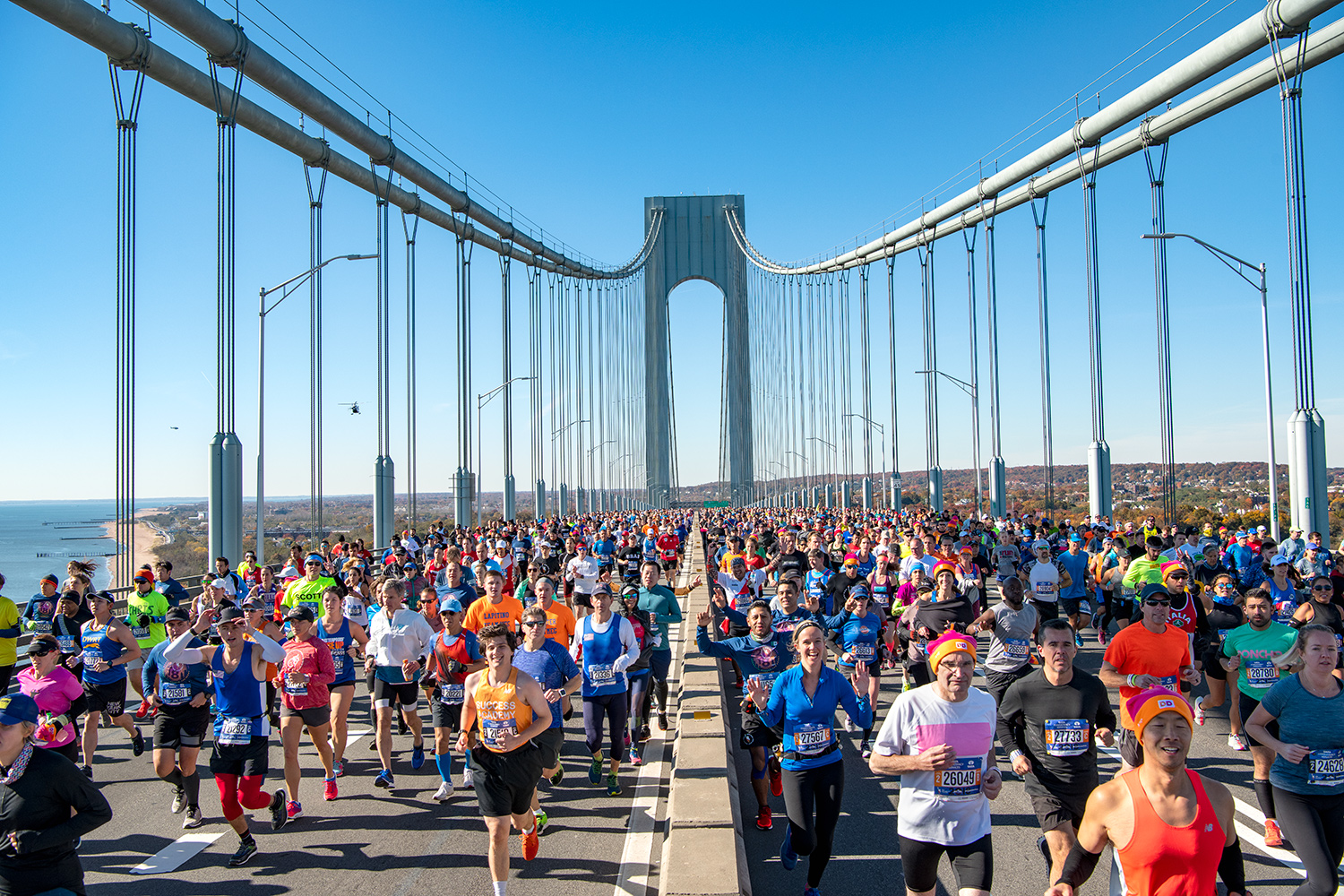
The Verrazzano -- the full name is rarely used -- is best known for 2 things: The highest tolls of any bridge or tunnel in the New York Tri-State Area, and being the starting point for the New York City Marathon. Since part of the idea for the Marathon was that it would use all Five Boroughs, the closest point between Staten Island and any other Borough was an easy choice, made even easier by the toll plaza being wide enough to accommodate thousands of runners.

*

November 21, 1964 was a Saturday. Among the college football games played on this day were the following:

* Number 1 Notre Dame beat Iowa, 28-0 at Notre Dame Stadium in South Bend, Indiana.

* Number 3 Arkansas beat Texas Tech, 17-0 at Jones Stadium in Lubbock, Texas.

* Rivalry: Number 4 Nebraska were upset by Oklahoma, 17-7 at Owen Field in Norman, Oklahoma.

* Rivalry: Number 6 Michigan beat Number 7 Ohio State, 10-0 at Ohio Stadium in Columbus.

* Rivalry: Number 8 Louisiana State beat Tulane, 13-3 at Tulane Stadium in New Orleans.

* Number 9 Syracuse were upset by West Virginia, 28-7 at the old Mountaineer Field in Morgantown, West Virginia.

* Rivalry: Number 10 Oregon were upset by Oregon State, 7-6 at Parker Stadium (now Reser Stadium) in Corvallis, Oregon.

* Rivalry: Harvard beat Yale, 18-14 at Harvard Stadium in Boston.

* Rivalry: Lehigh and Lafayette played to a tie, 6-6 at Fisher Field (now Fisher Stadium) in Easton, Pennsylvania.

* Rivalry: Penn State beat Pittsburgh, 28-0 at Beaver Stadium in St. College, Pennsylvania.

* Rivalry: Maryland beat Virginia, 10-0 at Scott Stadium in Charlottesville, Virginia.

* Rivalry: North Carolina beat Duke, 21-15 at Kenan Stadium in Chapel Hill, North Carolina.

* Rivalry: South Carolina beat Clemson, 7-3 at Memorial Stadium in Clemson, South Carolina.

* Rivalry: Florida State beat Florida, 16-7 at Doak Campbell Stadium in Tallahassee, Florida.

* Rivalry: Kentucky beat Tennessee, 12-7 at Neyland Stadium in Knoxville, Tennessee.

* Rivalry: Purdue beat Indiana, 28-22 at Ross-Ade Stadium in West Lafayette, Indiana.

* Rivalry: Wisconsin beat Minnesota, 14-7 at Camp Randall Stadium in Madison, Wisconsin.

* Rivalry: Missouri beat Kansas, 34-14 at Memorial Stadium (now Faurot Field) in Columbia, Missouri.

* Rivalry: Utah beat Utah State, 14-6 at Rice Stadium in Salt Lake City, Utah.

* Rivalry: The University of Southern California (USC) beat the University of California at Los Angeles (UCLA), 34-13 at the Los Angeles Memorial Coliseum.

* Rivalry: Stanford beat the University of California, 21-3 at the old California Memorial Stadium in Berkeley.

* Rivalry: Washington beat Washington State, 14-0 at Joe Albi Stadium in Spokane, Washington.

* And in New Jersey, Princeton beat Cornell, 17-12 at Palmer Stadium in Princeton; while Rutgers lost to Colgate, 20-7 at the old Rutgers Stadium in Piscataway.

There were 4 games played in the NBA:

* The New York Knicks beat the Baltimore Bullets, 103-94 at the old Madison Square Garden.

* The Philadelphia 76ers beat their arch-rivals, the Boston Celtics, 108-96 at the Boston Garden.

* The St. Louis Hawks beat the Detroit Pistons, 100-94 at the Kiel Auditorium in St. Louis.

* And the Cincinnati Royals beat the San Francisco Warriors, 111-104 at the Cow Palace in the San Francisco suburb of Daly City, California. For the Royals, Jerry Lucas had 29 points and 28 rebounds, Jack Twyman had 24 points, and Oscar Robertson had 21 points and 13 assists. For the Warriors, Wilt Chamberlain had 46 points and 21 rebounds -- just another day at the office for him.

Two games were played in the NHL. The Detroit Red Wings beat the Boston Bruins, also at the Boston Garden. And the Toronto Maple Leafs beat the Chicago Black Hawks, 1-0 at Maple Leaf Gardens in Toronto. The New York Rangers and the Montreal Canadiens were not scheduled.

And in English soccer, the North London soccer team I would one day root for, Arsenal, traveled to the Birmingham area, and played West Bromwich Albion to a 0-0 draw at The Hawthorns.

Wednesday, November 9, 2022

November 9, 1993: Wu-Tang Clan Release "Enter the Wu-Tang (36 Chambers)"

November 9, 1993: The rap group Wu-Tang Clan release their debut album, Enter the Wu-Tang (36 Chambers), on Loud Records. It becomes a landmark in hip-hop culture, certified as Platinum by the Recording Industry Association of America within 2 years.

The members of Wu-Tang Clan were New Yorkers, and some seem to have had multiple nicknames:

* Gary Eldridge Grice, born August 22, 1966, from Brooklyn: GZA and The Genius. As the oldest member and the 1st to get any kind of a record deal, he is called the group's "spiritual head."

* Russell Tyrone Jones, born November 15, 1968, from Brooklyn, this guy had more nicknames than James Brown: Ol' Dirty Bastard, ODB, Dirt Dog, Dirt McGirt, Old Dirty Chinese Restaurant, Ason Unique, Joe Bananas, The Specialist, Ossirus, Big Baby Jesus and Knifey McStab.

* Robert Fitzgerald Diggs, born July 5, 1969, from Brooklyn: RZA, Bobby Digital and The RZArector.

* Elgin Turner, who legally changed his name to Jamel Irief, born August 18, 1969 (as Woodstock was wrapping up), from Brooklyn: Masta Killa, Noodles and High Chief.

* Corey Woods, born January 12, 1970 in Brooklyn, but grew up in Staten Island: Raekwon The Chef, or Shallah Raekwon, or just Raekwon, or Lex Diamonds, probably a variation on 1920s New York gangster Legs Diamond.

* Dennis Coles, born May 9, 1970, from Staten Island: Ghostface Killah, Tony Starks and D-Love.

* Jason Richard Hunter, born July 6, 1970, from Staten Island: Inspectah Deck, Rollie Fingers (after the Baseball Hall of Fame reliever with the handlebar mustache), Fifth Brother and Rebel INS.

* Lamont Jody Hawkins, born November 10, 1970 in Brooklyn, but grew up on Staten Island: U-God, short for Universal God, or Golden Arms.

* Clifford Smith Jr., born March 2, 1971, from Hempstead, Long Island, but met some of the others while visiting his grandmother on Staten Island: Method Man, Johnny Blaze (after the Marvel Comics superhero Ghost Rider), Tical and Shakwon. He has since gone on to a successful acting career.

* Oliver Grant, born November 2, 1973 in Jamaica, but grew up in Staten Island: Power, because, while not actually a member of the group, he produced all their albums, and seriously funded 36 Chambers. He came into the group's orbit because he was friends with RZA's brother, Divine.

* Selwyn Bougard, who legally changed his name to El-Divine Amir Bey, born May 23, 1974 in Steubenville, Ohio, but raised on Staten Island: 4th Disciple.

RZA, GZA and ODB were cousins. They were also cousins of Flavor Flav of Public Enemy. RZA's brother Terrance Hamlin is a rapper, calling himself 9th Prince. Singer-songwriter SZA, a generation younger than RZA, GZA and ODB, is not related to them.

The group took their name from the 1983 martial arts film Shaolin and Wu Tang. The origin of the word "Wu-tang" derives from Wu Dang, the Taoist holy mountain located in the Central China in the Hubei Province. The album's title also came from martial arts films, Bruce Lee's 1973 epic Enter the Dragon, and the 1978 film The 36th Chamber of Shaolin.

At this point, New York City was widely seen as having forfeited leadership in rap to the West Coast, particularly to Los Angeles and, in the San Francisco Bay Area, Oakland. The Clan re-planted the Big Apple's flag, and drew blood from the ground. But they also -- intentionally -- drew some laughs. The balance of seriousness and humor helped, and helped inspire Brooklynites Notorious B.I.G., Jay-Z and Nas, and the Queens duo Prodigy and Havoc, a.k.a. Mobb Deep.

In 2020, Rolling Stone magazine ranked Enter the Wu-Tang 27th on their updated list of the 500 Greatest Albums of All Time, higher than any other rap album. In 2022, the album was selected by the Library of Congress for preservation in the National Recording Registry for being "culturally, historically or aesthetically significant."

ODB, long troubled by mental illness and drug use, did not live to see either of these honors: He died of a drug overdose at RZA's recording studio in Manhattan on November 13, 2004. He was 35 years old. As of November 9, 2022, all the other members are still alive.

Wu-Tang Clan fans consider Sgt. Pepper’s Lonely Hearts Club Band to be the 36 Chambers of white boy albums. Wu-Tang Clan fans are also frequently stoned out of their minds.

Still, if you type "Enter" into Wikipedia, this album comes up before Enter the Dragon. And if you type "cream" into YouTube, this song comes up before "Sunshine of Your Love." So when you can get precedence over Bruce Lee and Eric Clapton, that's an achievement.

UPDATE: Power Grant died on February 23, 2026, only 52 years old. No cause was released.

*

November 9, 1993 was a Tuesday. Baseball season was over. Football was in midweek. There were 10 games played in the NBA:

* The New York Knicks beat the Philadelphia 76ers, 95-86 at Madison Square Garden.

* The New Jersey Nets beat the Dallas Mavericks, 86-80 at the Reunion Arena in Dallas.

* The Orlando Magic beat the Indiana Pacers, 104-98 at the Orlando Arena. Shaquille O'Neal scored 37 points.

* The Cleveland Cavaliers beat the Charlotte Hornets, 113-108 at The Coliseum in the Cleveland suburb of Richfield, Ohio.

* The Washington Bullets beat the Detroit Pistons, 118-112 at The Palace in the Detroit suburb of Auburn Hills, Michigan.

* The San Antonio Spurs beat the Minnesota Timberwolves, 110-95 at the Alamodome in San Antonio. David Robinson led all scorers on the night with 43 points.

* The Houston Rockets beat the Golden State Warriors, 102-93 at the Oakland Coliseum Arena.

* The Phoenix Suns beat the Los Angeles Clippers, 114-99 at the Los Angeles Memorial Sports Arena. Dan Majerle and Kevin Johnson both scored 35 points for the Suns.

* The Portland Trail Blazers beat the Los Angeles Lakers, 109-102 at The Forum outside Los Angeles in Inglewood, California.

* And the Seattle SuperSonics beat the Denver Nuggets, 118-86 at the Seattle Center Coliseum.

And there were 7 games in the NHL:

* The New York Islanders lost to the Winnipeg Jets, 5-2 at the Nassau Coliseum.

* The Washington Capitals beat the Quebec Nordiques, 2-1 at the Capital Centre in the Washington suburb of Landover, Maryland.

* The Edmonton Oilers beat the Detroit Red Wings, 4-2 at the Joe Louis Arena in Detroit.

* The Pittsburgh Penguins and the St. Louis Blues played to a tie, 3-3 at the St. Louis Arena.

* The Calgary Flames beat the Los Angeles Kings, 3-2 at the Saddledome in Calgary.

* The Mighty Ducks of Anaheim beat the Dallas Stars, 4-2. This game was played at the Arizona Veterans Memorial Coliseum in Phoenix, as part of the NHL's experiment with neutral-site games, to see which markets were ripe for expansion.

* And the Toronto Maple Leafs and the San Jose Sharks played to a tie, 2-2 at the San Jose Arena (now the SAP Center).

Tuesday, September 13, 2022

September 13, 1970: The 1st New York City Marathon

September 13, 1970: The 1st New York City Marathon is held, organized by the New York Road Runners Association. They ran a little over 8 laps around Central Park -- 2.6 miles north-to-south, 110th to 59th Street, and 0.6 miles east-to-west, 5th to 8th Avenue -- adding up to the standard marathon distance of 26 miles, 385 yards, or 26.2 miles.

There were 127 runners that started, and 55 that finished, including Gary Muhrcke, who finished in 2 hours, 31 minutes, 38 seconds. Not among the finishers was Nina Kuscsik, the only woman in the race.

In 1976, the race was expanded to include all 5 Boroughs. Starting at 10:10 AM on the 1st Sunday in November at the Staten Island end of the Verrazzano-Narrows Bridge, with up to 45,000 runners, the race goes up 4th Avenue and Bedford Avenue in Brooklyn. It crosses the Pulaski Bridge into Long Island City, Queens, which is roughly the halfway point.

It goes over the Queensborough Bridge into Manhattan, and goes up the Upper East Side on 1st Avenue. It goes over the Willis Avenue Bridge in The Bronx, then quickly turns around at East 138th Street, and goes back into Manhattan over the Madison Avenue Bridge. It then goes down 5thAvenue, and into Central Park at East 90th Street. It goes through the Park until 59th Street, turns there, and reaches Columbus Circle. Then it goes back into the Park, with the finish line opposite the famed restaurant Tavern on the Green at West 66th Street and Central Park West.

The current record holders are Geoffrey Mutai of Kenya, with the fastest men’s time of 2:05:06, in 2011; and Margaret Okayo, also of Kenya, in 2003, with the fastest women’s time of 2:22:31. The race had been run every year until 2012, when it was canceled in the aftermath of Hurricane Sandy. It was canceled again in 2020, due to the COVID-19 epidemic.

UPDATE: In 2023, Tamirat Tola of Ethiopia set a new record, with 2:04.58.

*

September 13, 1970 was a Sunday. The NFL season began the following weekend. These Major League Baseball games were played:

* The New York Yankees lost to the Cleveland Indians, 3-1 at Cleveland Municipal Stadium. Steve Hargan allowed to hits to Mel Stottlemyre's 5. Future Yankee Graig Nettles and Buddy Bradford hit home runs for the Tribe. The Yankees got only singles from Roy White and Danny Cater. Their run came on Horace Clarke reaching on an error, White's single, and an RBI groundout from Bobby Murcer.

* The New York Mets lost to the St. Louis Cardinals, 5-4 at Shea Stadium. Joe Torre hit a home run in the top of the 13th inning. Nolan Ryan, not yet a star, pitched the 5th inning for the Mets, allowing a run.

* The Montreal Expos beat the Philadelphia Phillies, Jarry Park in Montreal.

* The Baltimore Orioles beat the Boston Red Sox, 13-2 at Memorial Stadium in Baltimore. Frank Robinson did not play, but Brooks Robinson went 2-for-4 with a walk and 2 RBIs. Carl Yastrzemski hit a home run.

* The Washington Senators beat the Detroit Tigers, 10-0 at Tiger Stadium in Detroit. Joe Coleman Jr. pitched a 3-hit shutout. Rick Reichardt went 3-for-4 with a home run and 2 RBIs. Al Kaline went 0-for-4.

* The Chicago Cubs beat the Pittsburgh Pirates, 3-2 at Wrigley Field in Chicago. Ernie Banks went 1-for-3. Roberto Clemente did not play, but Willie Stargell went 1-for-4.

* The Chicago White Sox beat the Minnesota Twins, 8-7 at Metropolitan Stadium in the Minneapolis suburb of Bloomington, Minnesota. Harmon Killebrew went 0-for-3 with 2 walks. Rod Carew did not play.

* The Kansas City Royals swept a doubleheader from the Oakland Athletics at Kansas City Municipal Stadium. Both games went to extra innings, with a score of 8-7. In the 1st game, the A's scored a run in the top of the 11th, but Lou Piniella tripled home 2 runs in the bottom half.

In the 2nd game, the A's scored 7 runs in the 2nd inning, but the Royals tied the game in the 8th, and Ed Kirkpatrick singled Jackie Hernández home in the 12th. Over the 2 games, Reggie Jackson went 6-for-9 with a home run, 2 walks and 3 RBIs.

* The Houston Astros beat the Atlanta Braves, 10-6 at the Astrodome in Houston. Hank Aaron went 0-for-2 with a walk before being replaced.

* The San Diego Padres beat the Cincinnati Reds, 5-4 at San Diego Stadium (later renamed Jack Murphy Stadium and Qualcomm Stadium). Pete Rose with a home run. Johnny Bench went 0-for-3 with a walk.

* The California Angels beat the Milwaukee Brewers, 2-1 at Anaheim Stadium (now Angel Stadium of Anaheim).

* And the Los Angeles Dodgers beat their arch-rivals, the San Francisco Giants, 5-3 at Candlestick Park in San Francisco. The Dodgers scored 4 runs in the top of the 10th, including a home run by former Giants catcher Tom Haller. The Giants scored 2 in the bottom of the 10th, but it wasn't enough.

Friday, July 29, 2022

July 30, 1871: The Westfield Disaster

July 30, 1871: The ferry Westfield II explodes while sitting in its slip at South Ferry at the southern tip of Manhattan Island, killing 125 passengers. It would be New York City's deadliest transit disaster until 1904, and remains 2nd in that regard.

Cornelius Vanderbilt started a ferry service between Manhattan and Staten Island in 1810. He grew his ferry business to the point where he became nicknamed "The Commodore." In the 1850s, he switched to railroads, and founded what became the New York Central Railroad.

His brother Jacob had founded the Staten Island Railroad, and bought the ferry service from Cornelius. Passengers often complained about the poor condition of the boats, as well as the ferry’s limited schedule. On July 30, 1871, to accommodate unusually heavy demand on a Sunday afternoon, the wooden-hulled side-wheeler Westfield II was pressed into service.

(An earlier ferryboat named Westfield was among the three commandeered by the Union during the Civil War. It was never returned to the ferry service. Both boats were named after a town in Staten Island, that became a neighborhood of the Borough after the Consolidation into Greater New York in 1898. The name had nothing to do with the Township of Westfield, a few miles away in New Jersey.)

As the Westfield II prepared to leave shortly after 1:00 PM, passengers congregated at the bow of the boat, facing Staten Island. But the Westfield II carried her coal bunker and boilers at this end of the boat, and at 1:27, one of the boilers exploded, immediately killing 66 passengers and injuring 200. Eventually, 59 of the injured would also die, putting the death toll at 125.

Jacob Vanderbilt was eventually charged with murder, but was acquitted. The Westfield II was repaired, and was returned to service as a hospital ship. It was junked in 1916.

In 1884, the Baltimore & Ohio Railroad gained control of the Staten Island Ferry company, which also ran service between the island and the New Jersey cities of Bayonne, Elizabeth and Perth Amboy. On June 14, 1901, another ferry, also with the Roman numeral for 2 on its name, the Northfield II, sank when another ferry collided with it, killing 5 people. That led to the City of New York taking over the service, and it runs the Ferry to this day, although it only runs the South Ferry to St. George line.

*

July 30, 1871 was a Sunday. Only one professional sports league was operating in America at that time, and that in its very 1st season: The National Association of Professional Base Ball Clubs. But it didn't play games on Sundays, partly because several States prohibited sports on Sundays. These included  New York, Pennsylvania and Massachusetts, which encompassed 4 of the 9 teams then in the league. So there were no scores on this historic day.

Sunday, January 30, 2022

January 30, 1979: Central Jersey is Hit With an Earthquake

January 30, 1979: A rare earthquake strikes Central Jersey, and affects nearby New York City.

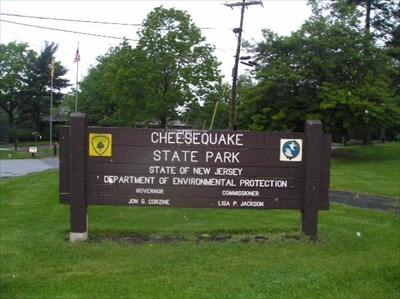
It hit at 11:31 AM, with an epicenter in Old Bridge, in an area, appropriately enough, named Cheesequake, which, as The New York Times' writeup of the event said, "is named for some quivering ground in a big tidal bog there."

It measured at 3.8 on the Richter scale, making it the biggest in the New York Tri-State Area since 1957. There had also been a minor quake in 1927, and a bigger one, the Amityville Quake of 1884, which shook all of New York City and was felt as far away as Vermont and Maryland.

This time, despite rattling windows across Raritan Bay in Staten Island, and even as far away as the Bensonhurst section of Brooklyn -- City residents described it variously as like "an explosion," like "a low‐flying jet," or "like a subway train running through a room" -- no damage was reported.

I was 9 years old, and in the 4th grade at Bowne-Munro Elementary School in East Brunswick, just 6 miles from the epicenter. None of us had ever felt anything like that before. We knew earthquakes were common in various places in the world, including in California, but we never expected to feel one in New Jersey. And we haven't since. So, even though there was no damage, it still stands out to us.

*

January 30, 1979 was a Tuesday. Baseball was out of season. Football season had ended 9 days earlier, with the Pittsburgh Steelers beating the Dallas Cowboys in Super Bowl XIII. There were 6 games played in the NBA:

* The New Jersey Nets lost to the Los Angeles Lakers, 127-108 at The Forum outside Los Angeles in Inglewood, California.

* The Washington Bullets beat the Atlanta Hawks, 109-105 at the Capital Centre in the Washington suburb of Landover, Maryland.

* The Indiana Pacers beat the Houston Rockets, 112-106 at the Market Square Arena in Indianapolis.

* The San Antonio Spurs beat the Chicago Bulls, 112-108 in overtime at the Chicago Stadium.

* The San Diego Clippers beat the Milwaukee Bucks, 117-113 at the San Diego Sports Arena (now the Pechanga Arena). Marques Johnson scored 39 in defeat for the Bucks.

* And the Portland Trail Blazers beat the Denver Nuggets, 82-76 at the Portland Memorial Coliseum.

There were 4 games played in the NHL:

* The New York Rangers beat the Vancouver Canucks, 5-3 at the Pacific Coliseum in Vancouver.

* The New York Islanders lost to the Minnesota North Stars, 5-4 at the Nassau Coliseum.

* The Detroit Red Wings beat the Washington Capitals, 7-4 at the Olympia Stadium in Detroit.

* And the St. Louis Blues beat the Los Angeles Kings, 7-1 at the Checkerdome, as the St. Louis Arena was then known.

And there were 2 games played in the World Hockey Association. The New England Whalers beat the Winnipeg Jets, 5-2 at the Springfield Civic Center (now the MassMutual Center) in Springfield, Massachusetts, where the Whalers were playing while the Hartford Civic Center was rebuilt after its snow-caused roof collapse the year before. And the Birmingham Bulls beat the Quebec Nordiques, 2-1 at the Birmingham-Jefferson Civic Center in Birmingham, Alabama.

December 31, 1999 & January 1, 2000: The Millennium

December 31, 1999:  The Millennium arrives. The people of planet Earth survived. At a terrible cost. But we hadn't destroyed ourselves. ...