Showing posts with label pete rose. Show all posts

Monday, October 24, 2022

October 24, 1999: The Major League Baseball All-Century Team

Top row, left to right: Johnny Bench, Willie Mays, Stan Musial.
Middle row: Mike Schmidt, Brooks Robinson,
Ken Griffey Jr., Sandy Koufax and Nolan Ryan.
Bottom row: Bob Gibson, Yogi Berra, Cal Ripken, Warren Spahn,
then-Commissioner Bud Selig, Roger Clemens and Hank Aaron.

October 24, 1999: The New York Yankees beat the Atlanta Braves, 7-2 at Turner Field (now Center Parc Stadium), behind the pitching of David Cone and 3 hits from Bernie Williams, and take a 2 games to 0 lead in the World Series.

Before the game, the winners in the fan balloting for the Major League Baseball All-Century Team were introduced. With some older players overlooked by young fans, some "wild cards" were added by a "select panel."

Pitchers
* Cy Young, born in 1867, pitched for several teams from 1890 to 1911. He died in 1955.
Christy Mathewson, born in 1880, New York Giants, 1900-16. He died in 1925, and was added by the panel.
Walter Johnson, born in 1887, Washington Senators, 1907-27. He died in 1946.
Robert "Lefty" Grove, born in 1900, Philadelphia Athletics and Boston Red Sox, 1925-41. He died in 1975, and was added by the panel.
* Warren Spahn, born in 1921, Boston/Milwaukee Braves, 1942-65. He was added by the panel. He was on hand for the ceremony, and threw out the ceremonial first ball before Game 1, even though he never pitched for the Braves in Atlanta. He died in 2003.
* Sandy Koufax, born in 1935, Brooklyn/Los Angeles Dodgers, 1955-66. He was on hand, making a rare public appearance, and joked that Spahn had to be added to the All-Century Team, "because he pitched for most of the century." As of October 24, 2022, he is still alive.
* Bob Gibson, born in 1935, St. Louis Cardinals, 1959-75. He was on hand for the ceremony, and died in 2020.
* Nolan Ryan, born in 1947, and pitched his best years with the California Angels and Houston Astros, pitching overall 1966-93. He was on hand, and is still alive.
* Roger Clemens, born in 1963, pitched his best years with the Boston Red Sox, was then still active with the Yankees, and would start and win Game 4. His career lasted 1986-2007. He was on hand, and is still alive.

Catchers
* Lawrence "Yogi" Berra, born in 1925, Yankees, 1946-63. He was on hand, and died 2015.
* Johnny Bench, born in 1947, Cincinnati Reds, 1967-83. He was on hand, and is still alive.

1st Basemen
* Lou Gehrig, born in 1903, Yankees, 1923-39. He died in 1941.
* Mark McGwire, born in 1963, Oakland Athletics and St. Louis Cardinals, 1986-2001. He was on hand, and then still active. He is still alive.

2nd Basemen
* Rogers Hornsby, born in 1896, best years with the St. Louis Cardinals, 1917-37. He died 1963.
* Jackie Robinson, born in 1919, Brooklyn Dodgers, 1947-56. He died in 1972. Joe Morgan, one of the finalists on the ballot, was part of the NBC broadcasting crew for this Series, and said that if he were one of the 2nd basemen chosen, and Robinson was not, he would forfeit his place to Robinson. Morgan finished 3rd in the 2B voting, so it wasn't necessary.

Shortstops
* John "Honus" Wagner, born in 1874, Pittsburgh Pirates, 1897-1917. He died in 1955, and was added by the panel.
* Ernie Banks, born in 1931, Chicago Cubs, 1953-71. He was on hand, and died in 2015.
* Cal Ripken Jr., born in 1960, Baltimore Orioles, 1981-2001. He was then still active, was on hand, and is still alive.

3rd Basemen
* Brooks Robinson, born in 1937, Baltimore Orioles, 1955-77. He was on hand, and is still alive.
* Mike Schmidt, born in 1948, Philadelphia Phillies, 1972-89. He was on hand, and is still alive.

Outfielders
* Ty Cobb, born in 1886, Detroit Tigers, 1905-28. He died 1961.
* Babe Ruth, born in 1895, Yankees, 1914-35. He died in 1948.
* Joe DiMaggio, born in 1914, Yankees, 1936-51. He had died earlier in 1999.

* Ted Williams, born in 1918, Boston Red Sox, 1939-60. He was on hand despite already being ill, and it turned out to be his last appearance in a big-league ballpark, following his emotional appearance at that season's All-Star Game at Fenway Park in Boston, his former home field. As he did on that occasion, he tipped his cap to the fans. He died in 2002.
* Stan Musial, born in 1920, St. Louis Cardinals, 1941-63. He was added by the panel. He was on hand, and died in 2013.
* Mickey Mantle, born in 1931, Yankees, 1951-68. He died in 1995.
* Willie Mays, born in 1931, New York/San Francisco Giants, 1951-73. He was on hand, and is still alive.
* Hank Aaron, born in 1934, Milwaukee/Atlanta Braves, 1954-76. He was on hand, and threw out the first ball that night. He died in 2021.
* Pete Rose, born in 1941, Cincinnati Reds and Philadelphia Phillies, 1963-86. He is probably better known as a 3rd baseman or a 1st baseman. Despite having been permanently banned from baseball, for betting on baseball games while a manager, he was permitted to attend, and did. He is still alive.
* Ken Griffey Jr., born 1969, Seattle Mariners and Cincinnati Reds, 1989-2010. He was still active, was on hand, and is still alive.

With the steroid accusations against Clemens and McGwire, the ban on Rose, and the "kid vote" for Griffey in mind, the next-highest vote getters at the positions in question were Greg Maddux (who was on hand as an active Brave) for Clemens' spot, Jimmie Foxx (who died in 1967) for McGwire's, and Roberto Clemente (who died in 1972) for Griffey's and Shoeless Joe Jackson (who died in 1951) for, with some irony, Rose's. So if Jackson, also banned permanently for gambling-related offenses, is also removed, the next-highest outfielder was Reggie Jackson (who was on hand, being a Yankee front-office man).

*

October 24, 1999 was a Sunday. These NFL games were played that day:

* The New York Giants beat the New Orleans Saints, 31-3 at Giants Stadium in the Meadowlands.

* The New York Jets lost to the Oakland Raiders, 24-23 at the Oakland Coliseum (then named the Network Associates Coliseum).

* The New England Patriots beat the Denver Broncos, 24-23 at Foxboro Stadium in the Boston suburb of Foxborough, Massachusetts.

* The Detroit Lions beat the Carolina Panthers, 24-9 at Ericsson Stadium (now Bank of America Stadium) in Charlotte.

* The Tampa Bay Buccaneers beat the Chicago Bears, 6-3 at Raymond James Stadium in Tampa.

* The Miami Dolphins beat the Philadelphia Eagles, 16-13 at Pro Player Stadium (now Hard Rock Stadium) in Miami Gardens, Florida.

* The Indianapolis Colts beat the Cincinnati Bengals, 31-10 at the RCA Dome in Indianapolis.

* The Minnesota Vikings beat the San Francisco 49ers, 40-16 at the Metrodome in Minneapolis.

* The St. Louis Rams beat the Cleveland Browns, 34-3 at the TWA Dome (now the Dome at America's Center) in St. Louis.

* The Dallas Cowboys beat their arch-rivals, the Washington Redskins, 38-20 at Texas Stadium in the Dallas suburb of Irving, Texas.

* The Green Bay Packers beat the San Diego Chargers, 31-3 at Qualcomm Stadium in San Diego.

* The Seattle Seahawks beat the Buffalo Bills, 26-16 at the Kingdome in Seattle.

* The preceding Thursday, the Kansas City Chiefs beat the Baltimore Ravens, 35-8 at PSINet Stadium (now M&T Bank Stadium) in Baltimore.

* The next night, on ABC Monday Night Football, the Pittsburgh Steelers beat the Atlanta Falcons, 13-9 at Three Rivers Stadium in Pittsburgh.

* And the Arizona Cardinals, the Jacksonville Jaguars and the Tennessee Titans all had a bye week.

The NBA season started 9 days later. There were 4 games in the NHL:

* The New York Rangers lost to the Vancouver Canucks, 3-0 at Madison Square Garden.

* The Philadelphia Flyers beat the Florida Panthers, 2-0 at the First Union Center (now the Xfinity Mobile Arena) in Philadelphia.

* The Boston Bruins beat the Mighty Ducks of Anaheim, 3-2 at the Arrowhead Pond of Anaheim (now the Honda Center).

* And the Los Angeles Kings beat the San Jose Sharks, 4-3 at the brand-new Staples Center (now the Crypto.com Arena) in Los Angeles.

Friday, October 21, 2022

October 21, 1975, The Carlton Fisk Game

October 21, 1975: In The Curse of the Bambino, his somewhat skewed history of his beloved Boston Red Sox, Boston Globe columnist Dan Shaughnessy called it "a brilliant autumn day in New England," following a 3-day delay for rain. Brilliant though the Tuesday afternoon may have been, Game 6 of the 1975 World Series is played at night at Fenway Park.

The Red Sox, Champions of the American League after winning its Eastern Division and beating the 3-time defending World Champions, the Oakland Athletics, in the AL Championship Series, trail the Cincinnati Reds, a.k.a. the Big Red Machine, Champions of the National League after winning its Western Division and beating the Pittsburgh Pirates in the NLCS, 3 games to 2, and must win to force a Game 7.

The Sox haven't won the World Series in 57 years, including a loss as recently as 1967. The Reds haven't won the World Series in 35 years, including 2 Series losses in this decade already. Boston is looking for its 1st title since 1918; Cincinnati, for its 1st since 1940. Both teams need it badly. Something's gotta give.

Just 14 years later, Shaughnessy wrote, "Game Six has taken on a life of its own in the years since it was played, and it gets larger and more thrilling in each retelling. Some distance allows that there may be other contenders for the title of The Greatest Game Ever Played, but by any measure, 1975's Game Six will stand as one of the top ten games in World Series history, and one that came at a time when baseball needed it most." Shaughnessy was right.

In The New Yorker magazine, Roger Angell wrote, "Game Six... what can we say of it without seeming to diminish it by recapitulation or dull it with detail?" Roger, one of the greatest writers ever on the subject of baseball, was wrong on this one: The details are necessary.

Due to the rain, Sox manager Darrell Johnson was able to start Luis Tiant, winner of Games 1 and 4, on full rest. Reds manager Sparky Anderson started Gary Nolan. Fred Lynn, who, that season, became the 1st player ever to be awarded his league's Rookie of the Year and its Most Valuable Player award in the same season, hit a home run that gave the Sox a 3-0 lead in the 1st inning, and Tiant pitched shutout ball through 4.

But, as they would say in English soccer, Three-nil, and they fucked it up. The Reds got 2 men on in the 5th, and Ken Griffey Sr. sent Lynn to the wall. Lynn crashed, telling NBC's Bob Costas years later that he'd hurt his ribs, and that, for a moment, he was barely conscious and couldn't feel his legs. Griffey's triple scored 2 runs, and then Johnny Bench singled Griffey home to tie the game. A 2-run double by George Foster in the 7th and a solo homer by Cesar Geronimo in the 8th gave the Reds a 6-3 lead, with just 6 outs to go for the title.

Typical Boston choke, leading to a Reds win? As ESPN college football analyst Lee Corso would say, "Not so fast, my friend!" Six-three, and they fucked it up. In the bottom of the 8th, Reds reliever Pedro Borbon (who, like Griffey, would later see his son and namesake play in the major leagues) gave up a single to Lynn and a walk to Rico Petrocelli.

Sparky brought in Rawley Eastwick, who struck out Dwight Evans and got Rick Burleson to line out to left. He got 2 strikes on Bernie Carbo, a former Red, pinch-hitting for pitcher Roger Moret (who had relieved Tiant in the 8th), but Carbo drove one to dead center, and tied it up.

In the bottom of the 9th, Denny Doyle drew a leadoff walk. Carl Yastrzemski singled him over to 3rd. Sparky brought in reliever Will McEnaney, and had him intentionally walk Carlton Fisk. Did Sparky have a premonition? If so, it didn't help him later on.

Lynn flew to left, and Foster threw home. Doyle tagged up and broke for home, because he thought Sox 3rd-base coach Don Zimmer was telling him, "Go, go, go!" In fact, Zim was saying, "No, no, no!" Doyle was out at the plate. Had he scored, winning it for the Sox right there, this would still have been a superb game, but not the legendary game that it became -- except within New England. Outside those 6 States, few baseball fans would have ranked it as an all-time great game. Instead, it went to extra innings.

Dave Concepcion singled and stole 2nd with 1 out in the top of the 10th, but Sox reliever Dick Drago stranded him. Pat Darcy sent the Sox down 1-2-3 in the bottom of the 10th.

Pete Rose led off the top of the 11th, and turned to Sox catcher Fisk, and said, "Can you believe this game?" (Some sources have Rose's comment as, "Some kind of a game, isn't it?") Fisk may not have taken kindly to that, because Drago -- who would bean Thurman Munson in a Yanks-Sox game at Fenway 3 years later -- hit Rose with a pitch.

Griffey bunted, and, unlike the Ed Armbrister play in Game 3, did not even appear to interfere with Fisk, who threw Rose out at 2nd. With Griffey on 1st and 1 out, Joe Morgan, who would be named the NL's MVP that season and the next, drove the ball to right field, and at Fenway the right-field fence was, and remains, only 3 feet high. Evans reached over the fence to make a great catch, and then started a double play, throwing to Yaz, who threw to Burleson who had run over to cover 1st, to eliminate Griffey and end the Reds' rally.

The Sox went down 1-2-3 in the bottom of the 11th. In the top of the 12th, Tony Perez and Foster singled off Rick Wise, but Wise stranded them.

At 12:34 AM on October 22, 1975, Fisk led off the bottom of the 12th against Darcy, and hit a 1-0 pitch down the left-field line. It had enough distance. But would it be fair? Or would it be foul? Fisk, as though it would actually influence the flight of the ball, waved his arms to his right. The ball hit the pole near its top, for a home run. Final score, Boston 7, Cincinnati 6. The Series was tied, and would go to a Game 7.

John Kiley, the organist at Fenway Park (and also at the Boston Garden, thus the answer to the corny old trivia question about "the only man to play for the Red Sox, Celtics and Bruins"), played George Friedrich Handel's "Hallelujah Chorus." Then he played "Stout-Hearted Men." Then he played "The Beer Barrel Polka." ("Roll out the barrel, we'll have a barrel of fun.") Then he played "Seventy-six Trombones" from the Broadway musical The Music Man. (I have no idea why he played that one.)

The shot of Fisk thinking he can wave the ball fair, which I've dubbed the Fenway Twist, is the most familiar clip in the history of televised sports. (As they had with every World Series since 1947, NBC was televising it, although they would begin to alternate with ABC starting with the 1977 season, until 1989.)

From seeing this clip so much, and hearing so much talk about Game 6 of '75 from Red Sox fans, a reasonable person might have asked (through 2004 anyway), "Wait a minute. The Red Sox haven't won the World Series since 1918. That means... they lost Game 7! So why do people make such a big deal about this homer?" Well, it won one game, not a World Series, but it was still one of sports' greatest epics.

Game 6 of the 1975 World Series has been called "The Greatest Baseball Game Ever Played" by many people. Certainly, it is in the discussion, along with Game 8 in 1912 (Game 2 was tied when called due to darkness), Game 7 in 1924, Game 7 in 1960, and Game 7 in 1991, and also with the 1951 Giant-Dodger Playoff and the 1978 Yanks-Sox Playoff.

In 1981, baseball historian John Thorn published Baseball's 10 Greatest Games. He included this game as one of them. In 2010, the MLB Network listed this game on top of their list of MLB's 20 Greatest Games -- limited in scope, due to the availability of surviving videotape, to 1975 onward. Due to the timing -- 1975 to 1980 -- along with the Bucky Dent Game, it was 1 of 2 games to make both lists.

Dick Stockton, born in Philadelphia but grew up in Queens, then the 32-year-old lead broadcaster on Sox games for WSBK-Channel 39, and previously for Boston Celtics games on WBZ-Channel 4, then an NBC station, was the lead broadcaster for NBC in this Series.

A 22-year-old writer from Quincy named Lesley Visser was part of The Boston Globe's coverage. Stockton and Visser would both go on to become key cogs in CBS Sports' programming. Supposedly, they met on this night. Other sources say they met at another Boston-based event in 1982. Either way, they married in 1983, but got divorced in 2010, and each has since married someone else.

And, of course, this game has also been cited in the 1997 film Good Will Hunting, discussed by the characters played by Robin Williams and Matt Damon.

Of course, as Shaughnessy pointed out in his book, in the 1986 World Series, Game 6 would prove disastrous for the Red Sox. So now, if you're in New England, or in the presence of a Red Sox fan anywhere else, and you say the words, "Game Six," they have to ask, "Which one?"

UPDATE: The Reds have a team Hall of Fame. Elected from this 1975 "Big Red Machine" have been 1st baseman Tony Pérez, 2nd baseman Joe Morgan, shortstop Dave Concepción, 3rd baseman Pete Rose, left fielder George Foster, center fielder César Gerónimo, right fielder Ken Griffey Sr., catcher Johnny Bench; pitchers Gary Nolan, Don Gullett, Pedro Borbón, Jack Billingham, Fred Norman and Clay Carroll; manager George "Sparky" Anderson, general manager Bob Howsam, and broadcasters Joe Nuxhall and Marty Brennaman.

The Red Sox also have a team Hall of Fame. From their 1975 Pennant winners, they have inducted 1st baseman Yastrzemski, 3rd baseman Petrocelli, catcher Carlton Fisk, shortstop Rick Burleson, left fielder Jim Rice, center fielder Fred Lynn, right fielder Dwight Evans, pitchers Luis Tiant and Bill Lee, team owner Tom Yawkey, general manager Dick O'Connell, scout George Digby, executives Edward Kenney and Dick Bresciani, groundskeeper Joe Mooney, guest relations director Al Green, public address announcer Sherm Feller, broadcasters Ken Coleman and Ned Martin, and longtime vendor Arthur D'Angelo. 1st baseman George Scott had been traded away, but would be brought back.

*

October 21, 1975 was a Tuesday. Tom Waits releases his album Nighthawks at the Diner, including the song “Eggs and Sausage.” In that song, he sings, "Baby, you gotta understand, I'm in a graveyard charade, a spaceship masquerade." Good metaphors for the 1970s.

It was midweek for football, and the World Football League folded. I have a separate entry for that event.

The NBA and the ABA wouldn't start their seasons for another 2 days. But 3 games were played in the NHL:

* The New York Islanders and the Vancouver Canucks played to a tie, 5-5 at the Nassau Coliseum.

* The Montreal Canadiens beat the Pittsburgh Penguins, 7-1 at the Civic Arena in Pittsburgh.

* And the St. Louis Blues beat the Los Angeles Kings, 6-1 at the St. Louis Arena. From 1977 to 1983, the Arena was named the Checkerdome, because the Blues were owned by St. Louis-based Ralston Purina, whose logo was (and is) a "checkerboard square."

In the World Hockey Association that night:

* The Quebec Nordiques beat the New England Whalers, 6-1 at the Colisee de Quebec.

* The Minnesota Fighting Saints beat the Indianapolis Racers, 2-1 at the Market Square Arena in Indianapolis.

* And the Winnipeg Jets beat the Cincinnati Stingers, 7-0 at the Winnipeg Arena. 

Saturday, October 8, 2022

October 8, 1973: Pete Rose vs. Bud Harrelson

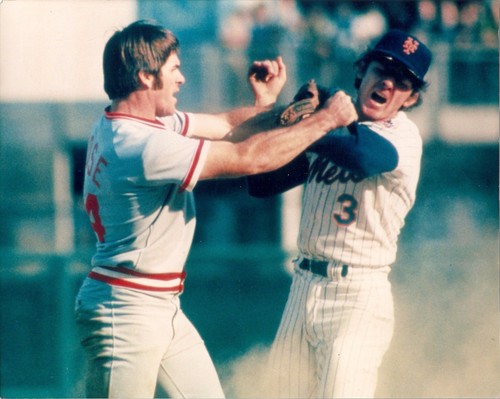
October 8, 1973: A year to the day after the Lerrin LaGrow-Bert Campaneris incident, there's another Playoff brawl, this time in the National League Championship Series.

The New York Mets beat the Cincinnati Reds, 9-2 in Game 3 at Shea Stadium, in a game that should have been remembered for Rusty Staub hitting home runs in the 1st and 2nd innings.

Instead, it is remembered for 5-foot-11, 200-pound Pete Rose breaking up a double play by crashing into 5-foot-11, 140-pound Bud Harrelson, and then starting a fight with the much thinner man.

With the fight broken up, Rose returns to his position in left field, where Met fans (understandably angry, but they were hardly justified in their actions) start throwing things at him. Reds manager Sparky Anderson takes his team off the field, fearing for their safety.

The umpires get a message to Loren Matthews, the Shea public address announcer, who announces that if the throwing doesn't stop, the game will be forfeited. Remember, the series is tied 1-1 and the Mets, barring a total (or even, dare I say it, Metlike) collapse, have this game won, and need only 1 more win for the Pennant. Lose it, even by forfeit, and it will be the Reds who are just 1 game from the Pennant.

Desperate, Met manager Yogi Berra takes Tom Seaver and Willie Mays out there, and the 3 of them plead for peace. Listening to the 3 New York baseball legends, the fans stop, and the Mets finish off the win.

The next day, with a banner hanging from Shea's upper deck reading, "A ROSE BY ANY OTHER NAME STILL STINKS" -- I guess they weren't willing to say "Sucks" in public in 1973 -- Rose will make his point by winning the game and tying up the series with an extra-inning home run. But the Mets will win Game 5 and the Pennant.

*

October 8, 1973 was a Monday. The American League Championship Series was on a travel day, with the Oakland Athletics and the Baltimore Orioles tied at 1 game apiece. The A's would beat the O's in 5 games, and then beat the Mets in the World Series.

The NBA season started the next day; the NHL and American Basketball Association seasons, the day after that. The World Hockey Association season had already begun, but it scheduled no games for this date.

And on ABC Monday Night Football, the Washington Redskins beat the Dallas Cowboys, 14-7 at Robert F. Kennedy Memorial Stadium.

If you've watched the superhero film X-Men: Days of Future Passed, you saw the villain Magneto (played as a younger man by Michael Fassbinder) rip RFK Stadium off its foundation in 1973, and move its circular form around the White House to block it off. As he begins this, the field is being lined for a baseball game. This means that, in the Marvel Cinematic Universe, the Washington Senators did not move to become the Texas Rangers after the 1971 season; or D.C. got yet another new team to replace the "New Senators" after the "Old Senators" became the Minnesota Twins after the 1960 season.

Wednesday, August 24, 2022

August 24, 1989: Pete Rose Is Banned From Baseball

August 24, 1989: Pete Rose is banned from baseball.

It didn't seem possible. For my generation, if there was a "face of baseball," Rose was it:

* 1963: National League Rookie of the Year with the Cincinnati Reds, his hometown team.

* 1965: Led the NL in hits.

* 1966: Hit 16 home runs, which turned out to be his career high.

* 1968: Led the NL in batting average, on-base percentage, and hits. Finished 2nd in the voting for NL Most Valuable Player.

* 1969: Led the NL in batting average and runs scored. His batting average of .348, his on-base percentage of .428, his slugging percentage of .512, and his total of 82 RBIs would remain career highs, while his 16 home runs matched his career high. Won a Gold Glove as a right fielder, after being a 2nd baseman until 1967, but would switch to left field by 1972, 3rd base in 1975, and 1st base in 1979.

* 1970: Led the NL in hits. Won another Gold Glove. Scored the winning run in the All-Star Game by crashing into American League catcher Ray Fosse. Led the Reds to the NL Pennant, but lost the World Series.

* 1972: Led the NL in hits. Led the Reds to another Pennant, but lost the World Series.

* 1973: Led the NL in batting average and hits. Won the NL MVP. Led the Reds to the NL Western Division title. Picked a fight with the much-smaller New York Mets shortstop Bud Harrelson in Game 3 of the NL Championship Series. Won Game 4 of the NLCS with an extra-inning home run. Lost Game 5.

* 1974: Led the NL in doubles and runs.

* 1975: Led the NL in doubles and runs. Won his 1st World Series, and was named its MVP.

* 1976: Led the NL in hits, doubles and runs. Won his 2nd World Series.

* 1978: Tied the NL record with a 44-game hitting streak. Led the NL in doubles. Collected his 3,000th career hit.

New York's WOR-Channel 9 broke away from their broadcast of the New York Mets' game to show Rose's at-bats in Game 44 and Game 45. That's how big Rose was. But, as he found out, he wasn't bigger than the game.

* 1979: Signed as a free agent with the Philadelphia Phillies. Led the NL in on-base percentage.

* 1980: Led the NL in doubles. Led the Phillies to their 1st World Series win, his 3rd.

* 1981: Led the NL in hits. Collected his 3,631st career hit, to become the NL's all-time leader.

* 1982: Played in all 162 games. He was 41 years old. And it was the NL, so he couldn't "take it easy" as a designated hitter, either.

* 1983: Led the Phillies to another Pennant, but lost the World Series. Overall, he was in 6 World Series, winning 3 of them.

* 1984: Signed with the Montreal Expos. Collected his 4,000th career hit. Was traded back to the Reds, and named their manager as well.

* 1985: Collected his 4,192nd career hit, to become Major League Baseball's all-time leader. (He actually did it with his 4,190th, but at the time, most people still considered 4,191 the record that Ty Cobb held, so the record was celebrated with Number 4,192.) Played in his last All-Star Game, his 17th. Managed the Reds to a 2nd place finish in the NL West.

* 1986: Played his last game, although never really retired as a player. Retired as MLB's all-time leader in games played (3,562), plate appearances (15,890), at-bats (14,053), hits (4,256) and times reached base (5,929). Managed the Reds to another 2nd place finish.

* 1987: Managed the Reds to another 2nd place finish.

* 1988: Managed the Reds to another 2nd place finish, their 4th in a row. He had yet to get them into the postseason, though. No Wild Card berths in those days.

His hits included 3,215 singles (a record), 746 doubles (2nd all-time to Tris Speaker), 135 triples and 160 home runs. In spite of this, his career "slash line" is not especially notable: Batting average .303, on-base percentage .375, slugging percentage .409.

His OPS+ is 118, meaning he was 18 percent better at producing runs than the average player during his career. To put that in perspective, compare it to those of his teammates who have been elected to the Baseball Hall of Fame: Frank Robinson, 154; Mike Schmidt, 148; Joe Morgan, 132; Johnny Bench, 126; Tim Raines, 123; Tony Perez, 122; Andre Dawson, 119; Gary Carter, 116.

(Admit it: You forgot that Rose played the first part of the 1984 season with the Montreal Expos. And you were also as surprised as I was that Morgan had a higher OPS+ than Bench, and that Raines had a higher one than Dawson and Carter.)

But he didn't have great power stats. As I said, he hit 160 home runs in 24 seasons, and had 1,134 RBIs. Over a full season, that's an average of about 7 home runs and 53 RBIs. Granted, he was usually a leadoff hitter, spending his entire career in the National League, when the batter in front of him would nearly always have been the pitcher or a weak pinch-hitter for the pitcher, thus reducing his chances of having a man on base. But he should have had more RBIs than that.

It was never just about the stats with Peter Edward Rose. He was nicknamed "Charlie Hustle," because he was always hustling. When he drew a base on balls, a.k.a. a walk, he wouldn't walk to 1st base. He would run. He only stole 198 bases in 24 years, topping out at 20 in 1979, and was caught stealing 149 times. But it's hard to tell how many extra bases he earned just by running harder.

He played the game with a boyish enthusiasm, but always reminded you that he was The Man. Lots of fans loved him. The ones who hated him still admitted that they loved the way he played the game.

For my generation of baseball fans, if any one person "was baseball," it was Pete Rose.

Thomas Boswell, the great baseball columnist of The Washington Post, spoke for me, and for millions of other baseball fans, when, interviewed by Ken Burns for his documentary Baseball, he said of Rose, "Fooled me completely."

*

Pete Rose was more than a compulsive compiler of baseball statistics and other achievements. He was also a compulsive attention-seeker. He was also a compulsive liar. He was also a compulsive womanizer. And, most damaging of all, he was also a compulsive gambler.

From the beginning of Major League Baseball, gambling has been what the sport has been most afraid of: The idea that a game was not honest, that a player would rather make money by losing a game on purpose, a.k.a. throwing the game, than play honestly and win. (Of course, if team owners weren't cheap, they could have avoided this by paying the players more than the gamblers would have.) There was a gambling scandal in 1877, and it resulted in the first time that players were permanently banned from baseball.

There was the Black Sox Scandal that resulted from 7 players from the Chicago White Sox being permanently banned for throwing the 1919 World Series -- to the Reds, eventually to be Rose's hometown team as well as the team for whom he played they most, so he should have known all about it. (An additional player was banned despite refusing to take part in the fix, because he knew about it but didn't report it.) Those players were permanently banned from working in baseball in any capacity, playing or otherwise. That has, to this day, over 100 years later, kept the White Sox' biggest star at the time, Joe Jackson, from being elected to the Hall of Fame.

Every MLB clubhouse has a sign giving the rule, known as Rule 21(d). Here is the text of the rule:

(1) Any player, umpire, or Club or League official or employee, who shall bet any sum whatsoever upon any baseball game in connection with which the bettor has no duty to perform, shall be declared ineligible for one year.

(2) Any player, umpire, or Club or League official or employee, who shall bet any sum whatsoever upon any baseball game in connection with which the bettor has a duty to perform, shall be declared permanently ineligible.

(3) Any player, umpire, or Club or League official or employee who places bets with illegal book makers, or agents for illegal book makers, shall be subject to such penalty as the Commissioner deems appropriate in light of the facts and circumstances of the conduct. Any player, umpire, or Club or League official or employee who operates or works for an illegal bookmaking business shall be subject to a minimum of a one-year suspension by the Commissioner. For purposes of this provision, an illegal book maker is an individual who accepts, places or handles wagers on sporting events from members of the public as part of a gaming operation that is unlawful in the jurisdiction in which the bets are accepted. 

In layman's terms:

(1) If you bet on a game in which you're not involved, you're suspended for one year -- 365 days -- from the date of the application of the suspension. In other words: This article was posted on August 24, 2022. If, on that date, you were employed by the New York Yankees, and you bet on that night's game between the Boston Red Sox and the Toronto Blue Jays (which the Jays ended up winning, 3-2 in 10 innings at Fenway Park), and the Commissioner of Baseball, Rob Manfred, found out about it, ran his investigation, and suspended you on September 1, then, you would be eligible to return to working in baseball on September 1, 2023.  

(2) If you bet on a game in which you are involved, you're gone, forever. Not for life: Forever.

(3) If you place a bet with a bookie, or someone working for a bookie, the Commissioner will decide what punishment would be appropriate, and then give it to you.

Again: The penalty for a baseball player or manager betting on any baseball game he's involved in is a permanent ban. Not for the rest of your life: Once you die, you're still banned. It's permanent. Forever. And everybody knows it.

Rose knew it. He knew what would happen if he broke the rule and got caught. He did it anyway. He thought he could get away with it. He thought he was bigger than the game. The only players who have ever been bigger than the game have been Jackie Robinson and maybe Babe Ruth. Not Pete Rose.

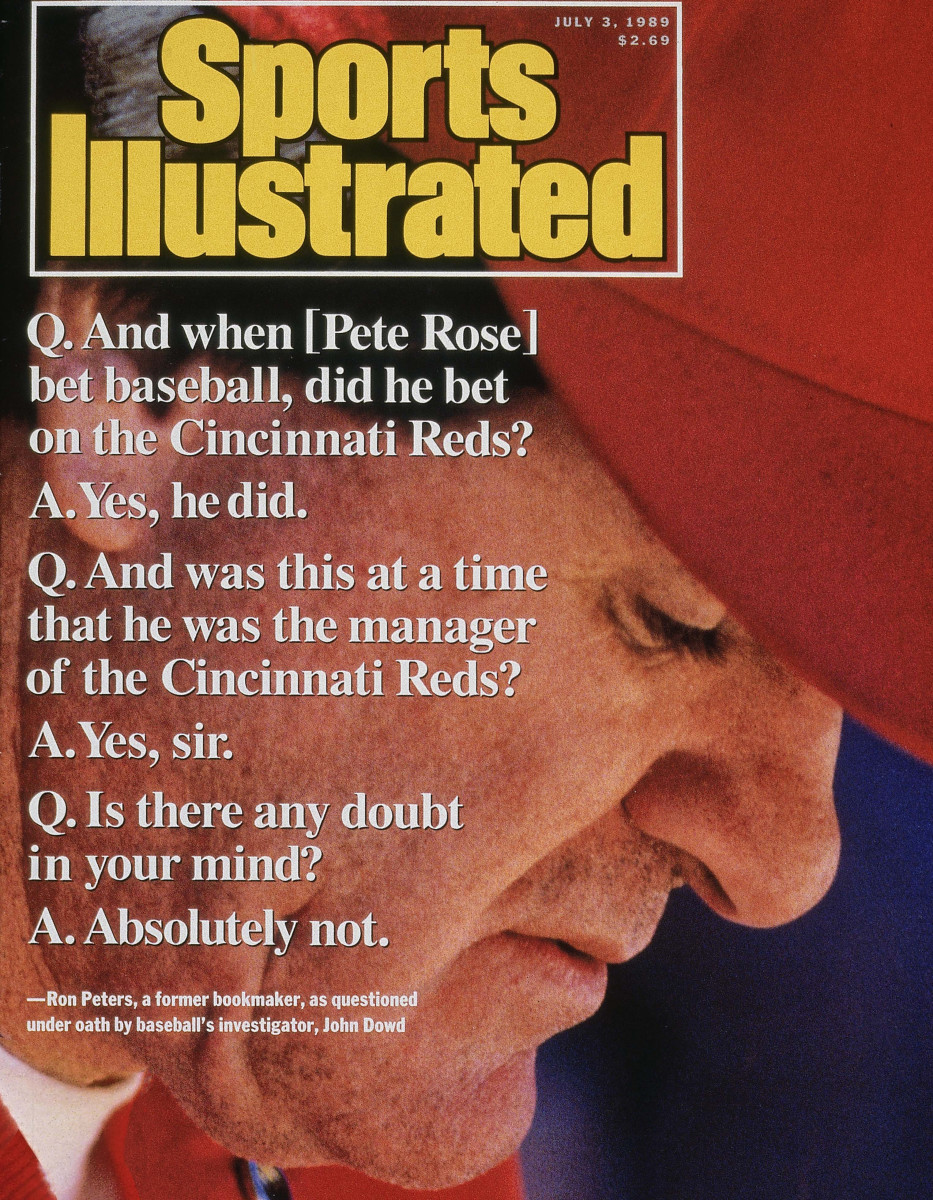
Commissioner Bart Giamatti found out that Rose had bet on Major League Baseball games. His investigator, former U.S. Justice Department official John Dowd, found the proof that Rose had bet on baseball games in which he had played, managed, and done both. When asked if he bet on baseball, Rose denied it.

But when confronted with the proof, he cut a deal: A permanent ban, and the loss of his job managing his hometown team, in exchange for the chance to apply for reinstatement.

On August 24, 1989, Commissioner Giamatti announced that the scandal, which had hung over the sport all season long, had come to a conclusion with Rose's banishment.

On September 1, 1989, 7 days later, Giamatti died of a heart attack. He was only 51 years old. He was replaced as Commissioner by Francis T. "Fay" Vincent. He would never reinstate Rose: As Rose pointed out, Vincent was Giamatti's best friend.

Vincent was fired by the team owners in 1992, and Milwaukee Brewers owner Allan "Bud" Selig became Commissioner. Being a team owner, Selig was never going to cave in to a player without the law stepping in, as was the case with the end of the Strike of 1994-95. In 2015, Selig was succeeded by Rob Manfred. Still in office as of August 24, 2022, he has never reinstated Rose, either.

Rose continued to lie about it until 2004. Even now, he insists that he never bet on his own team to lose. Whether he realizes it or not, this is a half-truth: Any game that he did not bet on the Reds to win was a signal to the gamblers that he didn't think the team would win that game, so they bet against his team.

In 1991, the Baseball Hall of Fame passed a rule stating that any player on Major League Baseball's list of permanently ineligible individuals could not appear on a ballot in any Hall of Fame election. Therefore, Rose is not eligible for election.

Some fans say that the Hall of Fame is not legitimate without the sport's all-time hit leader. Others say that keeping him out is a proper punishment; and, besides, there are plenty of artifacts from Rose's career on display at the Hall: Pieces of his uniforms, bats and gloves he used, balls he hit. After all, it isn't just the Baseball Hall of Fame: It is the National Baseball Hall of Fame and Museum.

Rose is still on the outside looking in. And he has apologized for the lie, but not for the actions that led to the lie. He has never apologized for betting on baseball. 

It's also worth noting that the Hall of Fame is run by a private corporation. It works with Major League Baseball, but MLB does not have any power over the Hall of Fame. It works both ways: The Hall could make Rose eligible, and he could be elected, but he would still be banned by MLB; and MLB could lift its ban, and the Hall could then make Rose eligible, and he still might not be elected, due to lingering anger over what he did.

So don't blame MLB, or the Hall of Fame, or anybody connected with the operation of either. The only person to blame for Pete Rose not being a member of the Baseball Hall of Fame is Pete Rose.

Rose also went to federal prison, on income tax evasion charges. Rose has also admitted to having an affair with a woman who was 14 years old when it began. Fourteen. Matching his uniform number.

Postscript: The Reds hired Lou Piniella to replace Rose as manager. He had starred as an outfielder for the Yankees' American League Pennant teams of 1976, 1977, 1978 and 1981; and had managed them to a 2nd-place finish in 1986. Out of respect to Rose, who wore Number 14, which Piniella also wore, Piniella reversed his uniform number to 41. The following season, 1990, he managed the Reds to win the World Series.

Giamatti's son Paul Giamatti became an award-winning actor. Pete Rose Jr. was less successful: In 1997, he was called up to the Reds, making 11 appearances, getting 2 hits, with 1 RBI. In other words, between them, the Pete Roses have 4,258 career hits.

"P.J." Rose continued to play in various independent and foreign professional leagues until 2009. In 2006, he served 1 month in prison for distributing a drug to help his teammates. So, while the father's offenses never included cheating -- at least, not within baseball -- the son did. But, unlike the father, the son came clean and cooperated with the corresponding authorities, and was allowed to return to professional baseball. From 2011 to 2016, he managed in the White Sox' organization.

As someone of my generation pointed out, the future didn't turn out like we expected: Pete Rose was banned from baseball and went to prison, O.J. Simpson murdered 2 people and went to prison (but for a separate crime), Bill Cosby went to prison, Bruce Jenner is a woman, pretty much every professional wrestling villain turned out to be a good guy in real life, while Hulk Hogan turned out to be a massive jerk, and Donald Trump became the President.

As the (practically self-appointed) symbol of baseball, Pete Rose didn't just break THE Rule, he betrayed everybody who loved the game. He betrayed us all. That's why what he did hurt so much. And that's why he should never be forgiven, regardless of his playing accomplishments.

UPDATE: Pete Rose died on September 30, 2024. He had not yet been reinstated. Lots of baseball fans insisted that he had "served his time" and should now be elected to the Hall of Fame. On May 13, 2025, Manfred announced that the permanent bans on Rose, Shoeless Joe Jackson, and 7 other deceased players were lifted, making them eligible for the Hall of Fame. He also announced that anyone later placed on the permanently ineligible list would have their bans lifted after death. Clearly, he either does not understand, or does not respect, the meaning of the word "permanent."

*

August 24, 1989 was a Thursday. The NFL season was about to begin. It was the off-season for the NBA and the NHL. Here are the MLB results from that day:

* The New York Yankees split a doubleheader with the Baltimore Orioles at Yankee Stadium. The Yankees won the 1st game 5-1. Chuck Cary went 8 innings for the win, and got 2 hits each from Steve Sax and Roberto Kelly, and Don Mattingly went 1-for-3 with a double and 2 RBIs. The Orioles won the 2nd game 9-2. Eric Plunk did not pitch well, giving up a home run to Larry Sheets.

* The St. Louis Cardinals beat the Atlanta Braves, 4-1 at Atlanta-Fulton County Stadium.

* The Toronto Blue Jays beat the Detroit Tigers, 11-3 at the SkyDome in Toronto.

* The Pittsburgh Pirates beat the Houston Astros, 3-2 at Three Rivers Stadium. Jose Lind won it with a sacrifice fly in the 14th inning.

* The Cleveland Indians beat the Seattle Mariners, 5-2 at Cleveland Municipal Stadium.

* The Minnesota Twins beat the Chicago White Sox, 6-4 at the Metrodome in Minneapolis.

* The California Angels beat the Kansas City Royals, 5-0 at Royals Stadium in Kansas City. (It was renamed Kauffman Stadium in 1993.) Bert Blyleven, age 38, pitched a 4-hit shutout.

* The Texas Rangers beat the Oakland Athletics, 6-2 at Arlington Stadium in the Dallas suburb of Arlington, Texas.

* In the American League, the Boston Red Sox and the Milwaukee Brewers were not scheduled.

* And in the National League, these teams were not scheduled: The Chicago Cubs, the Los Angeles Dodgers, the Montreal Expos, the New York Mets, the Philadelphia Phillies, the San Diego Padres, the San Francisco Giants, and, most notably, the Cincinnati Reds.

Wednesday, August 17, 2022

August 17, 1986: Baseball's Last Player-Manager

August 17, 1986: The San Diego Padres beat the Cincinnati Reds, 9-5 at Riverfront Stadium in Cincinnati. John Kruk hits a home run for the Padres, and Tony Gwynn goes 3-for-5 with an RBI.

For the Reds, Buddy Bell and Barry Larkin hit home runs. In the bottom of the 8th inning, Reds manager Pete Rose, 45 years old, sent himself up to bat, to pinch-hit for pitcher Ron Robinson. Against Padres reliever Goose Gossage, he struck out.

For Rose, in his major league career, it was his 3,562nd game played, his 15,890th plate appearance, his 14,053rd official at-bat, and his 9.797th out. Three days earlier, he had collected his 4,256th hit. Each of those statistics remains a major league record. And each of those would be his last.

Of those 4,256 hits: 3,215 were singles (ranking him 1st all-time), 746 were doubles (2nd, behind Tris Speaker with 792), 135 were triples (75th, but 9th among players who played all or mostly after World War II), and 160 were home runs (a total that should have been a lot higher, given the number of seasons he played and the era in which he did).

But his lifetime averages don't look nearly so gaudy: Batting average, .303; on-base percentage, .375; slugging percentage, .409; and OPS+, 118. RBIs: 1,314.

Among the 33 players with at least 3,000 hits, Rose's batting average ranks him 19th, his home runs rank him 21st (and of the 12 behind him, only 6 played all or mostly in the Lively Ball Era), and his RBIs rank him 21st. Given these stats, Rose might be the most overrated offensive player of all time.

This is not a post about condemning, or absolving, Rose for some of the things he's done. Nor is it a post suggesting that he should be elected to the Baseball Hall of Fame, or that his denial of eligibility for it should continue. In fact, Rose himself is almost incidental to the post.

Rather, it is a notation of an often overlooked milestone in baseball history. Not only did this turn out to be Rose's last game as a player, but it was also the last game ever for a player-manager in the sport.

Player-managers were still fairly common up until the 1950s. As late as 1948, Lou Boudreau was the manager of the Cleveland Indians, and still their starting shortstop. He led them to win the World Series, and had a season worthy of being named the Most Valuable Player of the American League. He was 31.

Harry Walker was fired as manager of the St. Louis Cardinals after the 1955 season, around his 37th birthday. When the Cards opened the 1956 season without him, it marked the 1st time ever that there were no player-managers in Major League Baseball.

And there were very few between Walker and Rose. Before Rose, the last one in the National League was Joe Torre, who retired as a player in 1977, 18 days after being named manager of the New York Mets, at 37. In 1978, at 36, Jim Fregosi of the Pittsburgh Pirates was offered the job of managing his former team, the California Angels, with the condition that he retire as a player. He did, and took them to the American League Western Division title in 1979.

That year, the Chicago White Sox named Don Kessinger as their manager. The former All-Star shortstop for the Chicago Cubs was still playing shortstop, until July 31, shortly after turning 37. On August 2, right after managing the White Sox to a sweep over the Yankees -- and mere hours before Yankee catcher Thurman Munson was killed in a plane crash -- he resigned as manager and retired as a player, making him the last player-manager in the AL.

When Torre managed the Yankees from 1996 to 2007, the Yankees sometimes had the AL Eastern Division title locked up before the last home game of the regular season. On such occasions, he let a player manage the last home game. Recipients of this honor included Paul O'Neill, Derek Jeter, Bernie Williams, and Andy Pettitte. Under his successor, Joe Girardi, it was bestowed on Jorge Posada, Mariano Rivera and Alex Rodriguez. I was at the 2006 finale, when Bernie sent himself up to pinch-hit in the bottom of the 9th, for his last regular-season at-bat, and he got a huge ovation. What he didn't get was a hit.

I don't think there will ever be another official player-manager in MLB. If there's an emergency -- say, if the incumbent manager dies, or is hospitalized, or has to step aside due to his health -- the interim manager is going to be one of his coaches, at least until an experienced manager can be brought in.

*

August 17, 1986 was a Sunday. These other Major League Baseball games were played that day:

* The New York Yankees lost to the Kansas City Royals, 5-0 at Royals Stadium (now Kauffman Stadium) in Kansas City. Mark Gubicza pitched a 6-hit shutout, no walks, 10 strikeouts. George Brett, Frank White and Willie Wilson hit home runs off Ron Guidry. Don Mattingly and Wayne Tolleson both went 2-for-4.

* A doubleheader was split at Shea Stadium. The New York Mets lost the opener to the St. Louis Cardinals, 2-1. Rick Aguilera had to leave the game with an injury in the 2nd inning, and John Tudor coasted to the win. The Mets won the nightcap, 9-2. Danny Heep, Tim Teufel and Lenny Dykstra hit home runs, to make a winning pitcher out of Randy Niemann.

* The Chicago Cubs beat the Montreal Expos, 2-1 at the Olympic Stadium in Montreal.

* The Boston Red Sox beat the Detroit Tigers, 7-5 at Fenway Park in Boston. Wade Boggs went 0-for-3, but did draw 2 walks. Marty Barrett went 3-for-4 with an RBI. Bill Buckner went 1-for-4 with 3 RBIs.

* The Philadelphia Phillies beat the Pittsburgh Pirates, 5-1 in a game shortened to 5 innings due to rain. Mike Schmidt went 1-for-3 with an RBI.

* The Atlanta Braves beat the Houston Astros, 4-3 at Atlanta-Fulton County Stadium. Nolan Ryan only went 5 innings for the Astros, although the losing pitcher turned out to be Larry Andersen, the winning pitcher Cliff Speck.

* The Toronto Blue Jays beat the Texas Rangers, 8-7 at Exhibition Stadium in Toronto. Ernie Whitt won the game with a home run in the bottom of the 11th inning.

* The Cleveland Indians beat the Baltimore Orioles, 11-6 at Cleveland Municipal Stadium. Cory Snyder went 3-for-4 with 2 home runs and 4 RBIs. Eddie Murray went 3-for-5, and Cal Ripken went 1-for-5 with an RBI.

* The Chicago White Sox beat the Milwaukee Brewers, 7-4 at Comiskey Park in Chicago. Ron Hassey, giving Carlton Fisk a day off, hit a home run, and he, Harold Baines, Daryl Boston and Guillén each had 3 hits. Robin Yount went 1-for-4. Paul Molitor went 2-for-4 with an RBI.

* The California Angels beat the Oakland Athletics, 7-3 at Anaheim Stadium (now Angel Stadium of Anaheim). Reggie Jackson went 1-for-2 with 2 walks.

* The Los Angeles Dodgers beat their arch-rivals, the San Francisco Giants, 2-0 at Candlestick Park in San Francisco.

* And the Seattle Mariners beat the Minnesota Twins, 11-1 at the Kingdome in Seattle.

Thursday, July 14, 2022

July 14, 1970: Pete Rose vs. Ray Fosse

July 14, 1970: Major League Baseball hosts its All-Star Game, at the brand-new Riverfront Stadium in Cincinnati, which had opened only 2 weeks before as the home of the Cincinnati Reds. It was the 2nd major league ballpark, and the 1st without a dome, to have artificial turf. (The Astrodome in Houston had opened in 1965, and had hosted the All-Star Game in 1968.) President Richard Nixon was on hand, and threw out the ceremonial first ball.

The starting pitchers were a rematch of the previous year's World Series: Tom Seaver of the New York Mets for the National League, and Jim Palmer of the Baltimore Orioles for the American League. As could be expected, the game was scoreless through the 1st 5 innings.

In the top of the 6th, Carl Yastrzemski of the Boston Red Sox gave the AL the lead, singling home Ray Fosse of the Cleveland Indians. Fosse, a catcher, hit a sacrifice fly to score Brooks Robinson of the Orioles in the 7th, making it 2-0 AL.

In the bottom of the 7th, Willie McCovey of the San Francisco Giants grounded into a double play, but that allowed Bud Harrelson of the Mets to score, closing the gap to 2-1. In the top of the 8th, Brooks Robinson hit a triple that scored Yastrzemski and Willie Horton of the Detroit Tigers, and the AL led, 4-1.

In the bottom of the 9th, Dick Dietz of the San Francisco Giants hit a home run off Jim "Catfish" Hunter of the Oakland Athletics. The NL threatened, and 2 New York Yankee pitchers were brought in to relieve. First, Fritz Peterson was unable to stop McCovey from singling home Harrelson. Then, Mel Stottlemyre was unable to stop Roberto Clemente of the Pittsburgh Pirates from hitting a sacrifice fly that scored Joe Morgan of the Houston Astros -- later to become a Hall-of-Famer with the Reds. But Stottlemyre struck Pete Rose of the Reds out to end the inning, and send the game to extra innings.

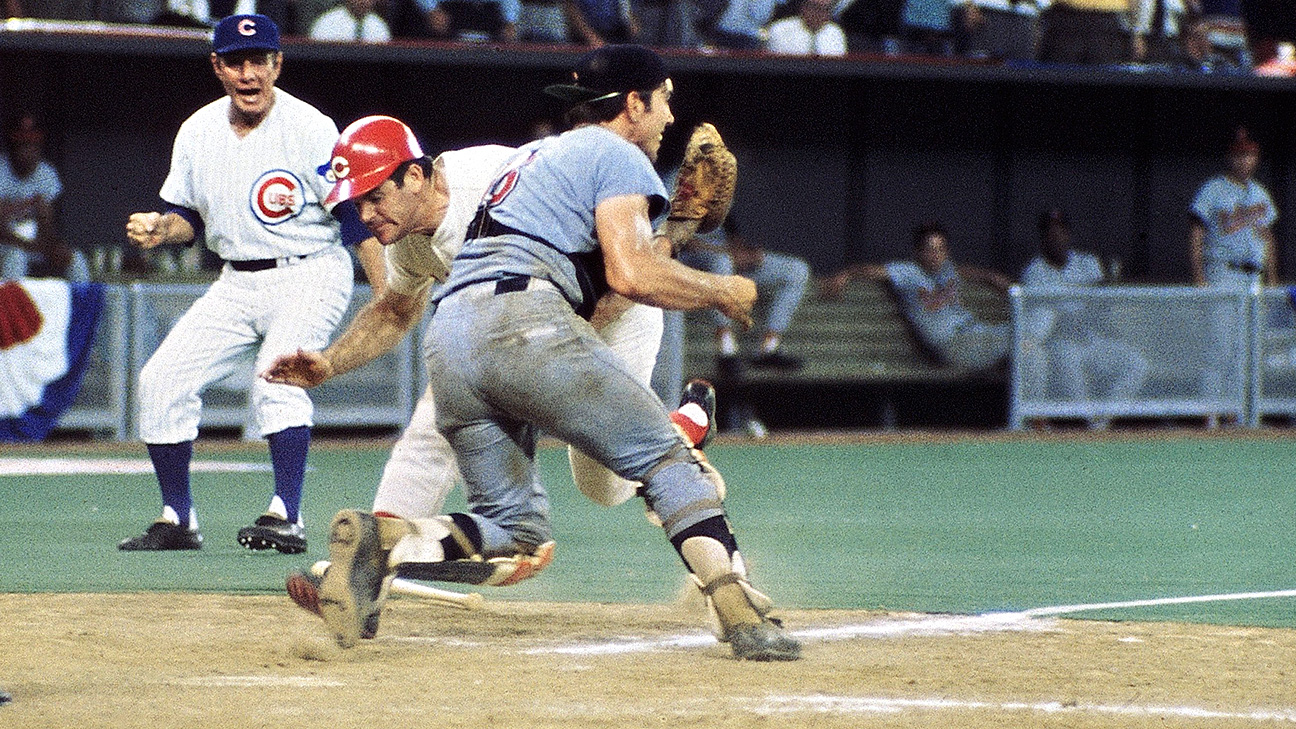
Neither team scored in the 10th or 11th inning. In the bottom of the 12th, Clyde Wright of the California Angels got the 1st 2 outs. But Rose and Billy Grabarkewitz of the Los Angeles Dodgers both singled. The next batter was Jim Hickman of the Chicago Cubs. He singled to center. Rose came around 3rd, waved home by the NL's 3rd base coach, Leo Durocher, former Pennant-winning manager of the Dodgers (in Brooklyn) and the Giants (in New York), now managing the Cubs.

Fosse took the throw from Amos Otis of the Kansas City Royals. Rose crashed into him, causing him to drop the ball. The NL had won, 5-4. Claude Osteen of the Dodgers was the winning pitcher.

The crash not only scored the winning run, it separated Fosse's shoulder. In a meaningless exhibition game.

Contrary to legend, this injury didn't curtail Fosse's career: He had a few more good years, playing on the Athletics' 1973 and 1974 World Champions, before another injury reduced his ability. So it didn't ruin Fosse.

It did, however, mark Rose as a hustler, a man who would do anything to win. That was when a majority of baseball fans liked him. Within 20 years, his reputation would be in tatters, and the crash into Fosse would be seen as an aspect of a very mean son of a bitch who cared more about fame than about the game.

Fosse died in 2021. As of July 14, 2022, Rose is still alive, age 81, and remains unrepentant. The only thing he's ever apologized for is lying about betting on baseball -- not for the act of betting on baseball, and certainly not for what he did to Fosse.

As you can see by the photo of the collision, above, Durocher loved the play. It was his kind of play. He had a lot in common with Rose. He, too, was an ass. And a compulsive liar. And a compulsive gambler. And a compulsive womanizer. Durocher's belief was "Nice guys finish last." (He didn't quite say that, but, once those exact words were attributed to him, they became the title of his memoir, which is full of lies.) Rose shared that ideal.

Durocher was not elected to the Baseball Hall of Fame while he was still alive. It is unlikely that Rose will be elected as long as he's alive. Probably for the same reason: No one wanted to hear Durocher's acceptance speech, and only Rose's apologists want to hear his.

There were, however, differences between Durocher and Rose. Rose had bad hair, while Durocher went bald from an early age. Rose favored wild sports jackets, while Durocher, to his credit, was always a snappy dresser. Rose was a very good player (although only an all-time great due to his compiling of statistics), while Durocher was a serviceable player at best. And Rose was not a good manager. Durocher was. Not as good as he thought he was. But he and Yogi Berra remain the only managers ever to win Pennants while managing 2 different New York teams.

July 14, 1970 was a Tuesday. Since baseball was in its All-Star Break, and the other North American sports were out of season, there were no other scores on this historic day. Actress Nina Siemaszko was born.

December 31, 1999 & January 1, 2000: The Millennium

December 31, 1999:  The Millennium arrives. The people of planet Earth survived. At a terrible cost. But we hadn't destroyed ourselves. ...