Showing posts with label northern ireland. Show all posts

Sunday, October 16, 2022

October 16, 1950: C.S. Lewis Begins His "Chronicles of Narnia"

October 16, 1950: C.S. Lewis publishes The Lion, the Witch and the Wardrobe, beginning his Chronicles of Narnia series.

Clive Staples Lewis was born on November 29, 1898 in Belfast, Northern Ireland. He taught at Oxford University, where he became close friends with his colleague J.R.R. Tolkien, to whom The Screwtape Letters was dedicated. In 1937, Tolkein published The Hobbit, establishing himself as a prominent fantasy writer, and would write sequels in the 1950s, which became the Lord of the Rings trilogy.

Tolkien was a Catholic. Lewis had been raised in largely-Catholic, but Protestant-controlled, Ireland as an atheist, but Tolkien's influence led him to Christianity. Except it was to the Protestant Church of England, so, from a certain point of view, Tolkien's efforts backfired somewhat.

Lewis' writings would be heavy with Christian imagery, including his own 1950s fantasy stories that would be collected under the title The Chronicles of NarniaLewis empathized with children who were suffering under the wartime conditions in Britain, and imagined a world where they could be heroes instead of victims. He described the origin of The Lion, the Witch and the Wardrobe in an essay entitled "It All Began with a Picture":

The Lion all began with a picture of a Faun carrying an umbrella and parcels in a snowy wood. This picture had been in my mind since I was about sixteen. Then one day, when I was about forty, I said to myself: "Let's try to make a story about it."

Narnia is a fantasy world of magic, mythical beasts and talking animals. It narrates the adventures of various children who play central roles in the unfolding history of the Narnian world. In order of publication, the books are:

1. The Lion, the Witch and the Wardrobe, published in 1950.
2. Prince Caspian, 1951.
3. The Voyage of the Dawn Treader, 1952.
4. The Silver Chair, 1953.
5. The Horse and His Boy, 1954.
6. The Magician's Nephew, 1955.
7. The Last Battle, 1956.

Except in The Horse and His Boythe protagonists are all children from the real world who are magically transported to Narnia, where they are sometimes called upon by the lion Aslan to protect Narnia from evil. In the 1st, Aslan, the region's true king, wants to free the land from the White Witch, who has turned it into a land "where it is always Winter, but never Christmas." For this, he enlists the help of the Pevensie children: Peter, 13 when the story begins in 1940, our time; Susan, 12; Edmund, 10; and Lucy, 8.

The books span the entire history of Narnia, from its creation in The Magician's Nephew to its eventual destruction in The Last Battle -- 2,500 years later from Narnia's perspective, but only 49 years later from Earth's. Spoiler Alert for a book over 60 years old: It's not as bad as it sounds, because Lewis' faith led him to write of Aslan leading his followers into the afterlife.

C.S. Lewis died on the same day as another renowned British writer, Aldous Huxley. Hardly anybody noticed, because that day was November 22, 1963, the day that President John F. Kennedy was assassinated. Tolkien lived another 10 years.

The 1st 3 books in the series were made into live-action, CGI-aided films in 2005, 2008 and 2010, respectively. Liam Neeson -- from Ballymena, about 30 miles from Lewis' Strandtown neighborhood of Belfast -- provided the voice of Aslan.

Neeson made his film debut in 1978, in Pilgrim's Progress, playing Jesus. In the 2010 version of Clash of the Titans, he played Zeus, king of the Greek Gods. And on a 2017 episode of The Orville, he played Captain Jahavus Dorahl, the descendants of whose crew had long since forgotten he was a mortal man, and worshipped him. So he has played a god in 4 different religions. I don't know if that's a record, but it's got to be at least close to one.

The joke continues: He played Qui-Gon Jinn, so he trained Obi-Wan Kenobi and Darth Vader; and Ra's al-Ghul, so he trained Batman. He played Sir Gawain, who fought at the side of King Arthur. As Michael Collins, he liberated his country. As Oskar Schindler, he saved 1,000 Jews from the Holocaust. He's also played Rob Roy, Jean Valjean, Douglas MacArthur, Philip Marlowe and Mark "Deep Throat" Felt. He also punches wolves. So why, as in the film Taken, would anyone try to kidnap a member of his family?

*

October 16, 1950 was a Monday. The baseball season had ended 9 days earlier, with the New York Yankees completing a 4-game sweep of the World Series over the Philadelphia Phillies. The NBA season began 2 weeks later. The NHL season was underway, but no games were scheduled. And football was in midweek. There would be no Monday Night Football for another 20 years. Therefore, there were no scores on this historic day.

However, this was also the day that Walter O'Malley won -- at a price that he was stunned that he would have to pay -- his power struggle with Branch Rickey over the Brooklyn Dodgers baseball team. I have a separate entry for that event.

Monday, May 23, 2022

May 23, 1972: Northern Ireland Beat England at Wembley

Captains Terry Neill (left) and Bobby Moore,
May 15, 1971, Windsor Park, Belfast. England won, 1-0.
They were the captains again a year later.

May 23, 1972: The national football (soccer) team of Northern Ireland beat England, 1-0 at Wembley Stadium in London, as part of the British Home Championship games. The goal is scored by centreback Terry Neill, who was also the Ulstermen’s manager at the time, playing his club football for Hull City in England, previously playing for Arsenal player. He would later manage Arsenal as well.

In addition to Neill, the team consisted of goalkeeper Pat Jennings from Tottenham Hotspur, and right back Pat Rice and left back Sammy Nelson from Arsenal, all of who would play for Neill on Arsenal and win the 1979 FA Cup; centre-half Allan Hunter of Ipswich Town; left have David Clements of Coventry City; centre-forward Derek Dougan and outside right Daniel Hegan, both of Wolverhampton Wanderers; inside right Alex McMordie of Middlesbrough; inside left Willie Irvine of Brighton & Hove Albion; and outside left Tommy Jackson of Nottingham Forest.

Despite having recently been considered by some to be the best player in the world, being a native of Belfast, and having previously played for the Norther Ireland team, Neill did not select Manchester United superstar George Best for the Home Championship.

Coming just 4 months after "Bloody Sunday" in Derry, this was a huge boost to the people of Northern Ireland. It showed them, and just as importantly showed England, that they could beat them at their own game, on their own soil.

On May 20, England had beaten Wales, 3-0 at Ninian Park in Cardiff, while Scotland had beaten Northern Ireland 2-0 at Hampden Park in Glasgow, with both goals coming in the last 5 minutes of regular time. This game should have been played at a place of Northern Ireland's choosing, as each team played 3 games, and got 1 home game. Most likely, it would have been at Windsor Park in Belfast. But death threats mailed in led to the game being moved. The 1972 Five Nations Rugby Championship (precursor to today's Six Nations) was also canceled.

Northern Ireland then beat England on May 23. On May 24, Scotland beat Wales, 1-0 at Hampden, on a 78th minute goal by Leeds United star Peter Lorimer.

And on May 27, England beat Scotland, 1-0 at Hampden, on a goal in the 28th minute by Alan Ball, then with Arsenal; while Northern Ireland could only manage a 0-0 draw with Wales at the Racecourse Ground in Wrexham. With 2 points for a win and 1 for a draw, England ended up winning the tournament, anyway, with 4 points, and a superior goal difference to Scotland, also with 4. Northern Ireland had 3, and Wales had 1.

Had Best been selected, a goal he scored or set up against Wales would have given Northern Ireland the tournament. But his disciplinary issues meant that his not being selected by Neill was his own fault.

*

May 23, 1972 was a Tuesday. These games were played in Major League Baseball:

* The New York Yankees lost to the Cleveland Indians, 3-0 at Yankee Stadium. Gaylord Perry pitched a 4-hit shutout, outpitching Mel Stottlemyre. Rich McKinney, the guy who was supposed to be the answer to the Yankees' 3rd base problem, got 2 of those 4 hits. After this failed season, he would be dumped for Graig Nettles, who went 0-for-3 with a walk for the Indians in this game.

* The New York Mets lost to the Chicago Cubs, 2-1 at Wrigley Field in Chicago. Gary Gentry had a nice start for the Mets, but in the bottom of the 8th inning, Tug McGraw gave up a single to Carmen Fanzone and a double to Paul Popovich. Fergie Jenkins went the distance for the win. Popovich and Glenn Beckert each got 3 hits for the Cubs. For the Mets, Rusty Staub went 4-for-4 with their only RBI. The newly-acquired Willie Mays did not play.

* The Montreal Expos beat the Philadelphia Phillies, 6-2 at Jarry Park in Montreal.

* The Boston Red Sox beat the Baltimore Orioles, 6-5 at Fenway Park in Boston. Rico Petrocelli singled Reggie Smith home with the winning run in the bottom of the 10th inning. Smith and Tommy Harper had hit home runs earlier. Carl Yastrzemski did not play. Brooks Robinson went 1-for-4.

* The Atlanta Braves beat the Cincinnati Reds, 2-1 at Riverfront Stadium in Cincinnati. Phil Niekro went the distance, and won the game himself with a home run. Hank Aaron went 0-for-3, but drew 2 walks. Pete Rose went 1-for-4. Johnny Bench went 0-for-2, then drew a walk, and was removed for a pinch-runner.

* The Milwaukee Brewers beat the Detroit Tigers, 3-0 at Tiger Stadium in Detroit. Jim Lonborg pitched a 4-hit shutout, outpitching Joe Coleman Jr. Al Kaline went 0-for-4.

* The Pittsburgh Pirates beat the St. Louis Cardinals, 6-2 at Busch Memorial Stadium in St. Louis. Roberto Clemente went 2-for-5 with an RBI. Willie Stargell went 0-for-5. Lou Brock went 1-for-5.

* The Chicago White Sox beat the Texas Rangers, 2-1 at Arlington Stadium in the Dallas suburb of Arlington, Texas.

* The Houston Astros swept a doubleheader from the San Diego Padres, 7-0 and 2-1 at San Diego Stadium (later Jack Murphy Stadium and Qualcomm Stadium). Tom Griffin pitched a 4-hit shutout in the opener.

* The Los Angeles Dodgers beat their arch-rivals, the San Francisco Giants, 8-5 at Dodger Stadium in Los Angeles. Don Sutton went the distance for the win. Frank Robinson, in his only season with the Dodgers hit the 507th and 508th home runs of his career. Willie McCovey did not play.

* The Oakland Athletics beat the California Angels, 3-2 at the Oakland Coliseum. Reggie Jackson won it with a home run in the bottom of the 9th inning, off Eddie Fisher. (Maybe the Angels should have started Dean Martin instead.) It ruined a nice start for Angel pitcher Rickey Clark, and made a winning pitcher out of Rollie Fingers in relief of John "Blue Moon" Odom.

* And the Kansas City Royals and the Minnesota Twins were rained out at Kansas City Municipal Stadium. The game was made up as part of a doubleheader on September 8. The Royals swept, 5-0 and 3-2. Tom Murphy pitched a 6-hit shutout in the 1st game, outpitching Bert Blyleven.

Harmon Killebrew went 0-for-3 with a walk in the 1st game, and drew a walk as a pinch-hitter in the 2nd game. Over the 2 games, Rod Carew went 2-for-7 with an RBI.

Thursday, May 5, 2022

May 5, 1981: The Death of Bobby Sands

May 5, 1981: Bobby Sands, Member of Parliament for Fermanagh and South Tyrone, dies at Her Majesty's Prison Maze in County Down, Northern Ireland, 66 days after starting a hunger strike there. He was 27 years old.

He was 15 when the Northern Irish civil war known as "The Troubles" began in 1969, and, as a Catholic, he discovered that Protestant kids who once considered him a friend would no longer even talk to him. He dropped out of school, and took a job building buses. Members of a Loyalist "Tartan gang" found him on the job, held him at gunpoint, and told him never to come back if he valued his life.

In 1971, he joined the Provisional Irish Republican Army. He served 3 years in prison on a gun charge. He and a colleague planned the bombing of the Balmoral Furniture Company in Dunmurry in 1976. A gun battle ensued, and Sands was among those arrested trying to escape. He and 3 other men were sentenced to 14 years in prison -- not for the bombing, but for possession of the gun used in the ensuing shootout. It was as if they were giving him the bombing's punishment for the much smaller charge.

Conditions at Maze were brutal. Guards frequently took prisoners, including Sands, and stripped them naked and beat them. This was in response to the end of "Special Category Status," as they began to be treated like any other criminal, and not like a political prisoner, and thus forced to wear prison uniforms.

A committee of prisoners, led by Sands, presented a list of demands, including the right not to wear a prison uniform, and more blankets for the Winter months. These demands were flat-out refused. On March 1, 1981, Sands began his strike, saying he and the other prisoners would not eat until the demands were met.

Four days later, Frank Maguire, Member of Parliament for the district of Fermanagh and South Tyrone, died of a heart attack, forcing a by-election for his seat on April 9. In solidarity, some potential candidates withdrew, and threw their support to Sands, who was unable to campaign, and was in no position to even intend to. He won, 30,493 votes to 29,046 for a Loyalist candidate, a 1,447-vote margin of victory, 51.2 percent of the vote.

But he would never be able to take that seat. He remained in prison, and his strike went on and on. Because of the large Irish presence in America, the national news here covered this story day after day, counting up the days just as they did with the recently-ended Iran Hostage Crisis.

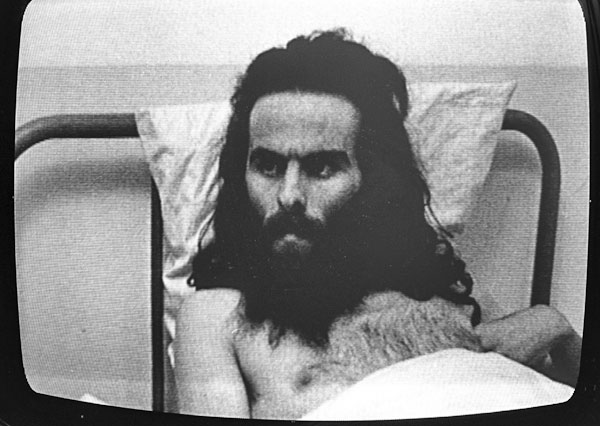
On Day 55 of the strike, ABC World News Tonight showed the photograph above, showing what Sands looked like before his conviction, and then, not having access to a current photograph, showed an artist's depiction of what he looked like at this point. I can't find that drawing on the Internet, but he looked like images I'd seen of newly-freed prisoners from the Nazi Holocaust. The only photograph I've seen shows him with a long beard that obscures how skinny he'd gotten, and it isn't clear how close to the end he was.
People from all over the world, including Pope John Paul II, head of the Roman Catholic Church, contacted British Prime Minister Margaret Thatcher, begging her to give in to the demands, rather than let a duly-elected Member of Parliament die. A Protestant and a hard-right-wing Conservative, she flat-out refused.

On Day 66, May 5, Sands died. Thatcher's official response, while addressing Parliament: "Mr. Sands was a convicted criminal. He chose to take his own life. It was a choice that his organization did not allow to many of its victims."

Over 100,000 people lined the route of Sands' funeral, and he was buried not far from his parents' home, in Milltown Cemetery in West Belfast.

The 1981 British Home Championships were canceled, because the "national" soccer teams of England and Wales refused to play away to Northern Ireland, not because they opposed Sands (not officially, anyway), but because they were afraid they would be attacked by the home fans.

In New York, the International Longshoremen's Association announced a 24-hour boycott of providing service to British ships; and the Archbishop, Terence Cardinal Cooke, offered a Mass of Reconciliation. Perhaps the greatest tribute was an agreement of the City's Irish bars: For 2 hours, they closed.

In New Jersey, the General Assembly, the lower house of the State legislature, voted 34-29 for a resolution honoring Sands' "courage and commitment." Just 28 miles away, in East Brunswick -- and with towns named Milltown and Old Bridge, also the names of towns in Northern Ireland, on either side -- the 11-year-old version of me couldn't understand why Thatcher let it happen.

President Ronald Reagan, an American of Irish descent, but a Protestant one, survived an assassination attempt during the hunger strike (although that had nothing to do with it), and made no public statement about Sands' cause, and made no statement on the occasion of Sands' death.

Another 9 hunger strikers would die, before the remaining strikers gave up. What did they gain? Publicity and sympathy, but nothing else.

On July 2, Parliament passed the Representation of the People Act 1981, automatically disqualifying anyone from election if they were serving more than one full year in prison. On August 20, a by-election for Sands' seat was held, and Owen Carron, a Sands ally, won with 49.1 percent of the vote, but with a larger margin of victory than Sands. Although never officially connected with terrorism, he lost his bid for re-election in 1983.

On October 5, James Prior, newly installed as the British government's Northern Ireland Secretary, agreed to Sands' original demands for the remaining political prisoners.

Thatcher remained Prime Minister until 1990. The Good Friday Agreement, not even remotely possible as long as she remained in office, ended The Troubles in 1998. HM Prison Maze was closed in 2000, and demolition began in 2006. Had the British government shown some humanity, and accepted his reasonable demands, Bobby Sands would have been 52 years old.

In 2013, Thatcher died, and while half of Great Britain, including the Protestant sectors of Northern Ireland, went into deep mourning, the other half, including the Catholic sectors of Northern Ireland, cheered. There was no holding of tongues by her opponents, as happened in America in 2004 upon Reagan's death.

Also in 2013, the Maze site was redeveloped into Balmoral Park, a showgrounds. With some irony, the main tenant is the Balmoral Show, an agriculture exhibition.

*

May 5, 1981 was a Tuesday. Actress Danielle Fishel was born. She played Topanga Lawrence on the sitcom Boy Meets World, and later, having married the earlier show's protagonist, Topanga Matthews on the sequel sitcom Girl Meets World.

These games were played in Major League Baseball:

* The New York Yankees lost to the California Angels, 6-2 at Anaheim Stadium (now Angel Stadium of Anaheim). Barry Foote hit a home run, but Reggie Jackson went 0-for-4, and Tom Underwood was removed when he couldn't get an out in the 4th inning. Brian Downing later hit a home run for the Halos.

* The New York Mets lost to the San Francisco Giants, 9-7 at Shea Stadium.

* The Montreal Expos beat the San Diego Padres, 4-3 at the Olympic Stadium in Montreal.

* The Philadelphia Phillies beat the Los Angeles Dodgers, 8-7 at Veterans Stadium in Philadelphia. Manny Trillo homered, and Mike Schmidt and Pete Rose each had a 2-RBI double.

* The Baltimore Orioles beat the Minnesota Twins, 3-2 at Memorial Stadium in Baltimore.

* The Houston Astros beat the Chicago Cubs, 4-3 at Wrigley Field in Chicago.

* The St. Louis Cardinals beat the Atlanta Braves, 4-1 at Busch Memorial Stadium in St. Louis.

* The Kansas City Royals beat the Boston Red Sox, 2-1 at Royals Stadium (now Kauffman Stadium) in Kansas City. George Brett went 1-for-4 for the Royals, while Carl Yastrzemski did not play for the Red Sox.

* The Texas Rangers beat the Chicago White Sox, 6-1 at Arlington Stadium in the Dallas suburb of Arlington, Texas.

* The Oakland Athletics beat the Detroit Tigers, 6-2 at the Oakland Coliseum.

* The Milwaukee Brewers beat the Seattle Mariners, 4-1 at the Kingdome.

* The Cincinnati Reds and the Pittsburgh Pirates were supposed to play each other at Three Rivers Stadium in Pittsburgh, but were rained out. The game was made up as part of a doubleheader on May 7, and the Pirates won both games, 3-1 and 7-1.

* The Cleveland Indians and the Toronto Blue Jays were supposed to play each other at Exhibition Stadium in Toronto. This game was never made up, due to the Strike of '81.

Football was out of season. The NBA Playoffs were in the Conference Finals. In the East, the Boston Celtics beat the Washington Bullets, 131-126 in double overtime at the Boston Garden, to move on to the Conference Finals. And the Milwaukee Bucks beat the Philadelphia 76ers, 110-98 at The Spectrum in Philadelphia. But, 2 nights later, the Sixers beat the Bucks to advance to face the Celtics.

In the West, the San Antonio Spurs eliminated the Seattle SuperSonics, 109-103 at the Kingdome in Seattle, setting them up to play the Los Angeles Lakers, who had already wrapped up their Conference Final berth. (Yes, the Kingdome hosted baseball and basketball on the same day.) In the NBA Finals, the Lakers beat the 76ers.

The Stanley Cup Playoffs were approaching their climax. The day before Sands' death, the New York Islanders had wrapped up their 3rd straight Finals bid, completing a 4-game sweep of the Quebec Nordiques. The day after his death, the Vancouver Canucks clinched their 1st Finals appearance, beating the Chicago Black Hawks in 5 games.

Tuesday, May 3, 2022

May 3, 1921: The Partition of Ireland

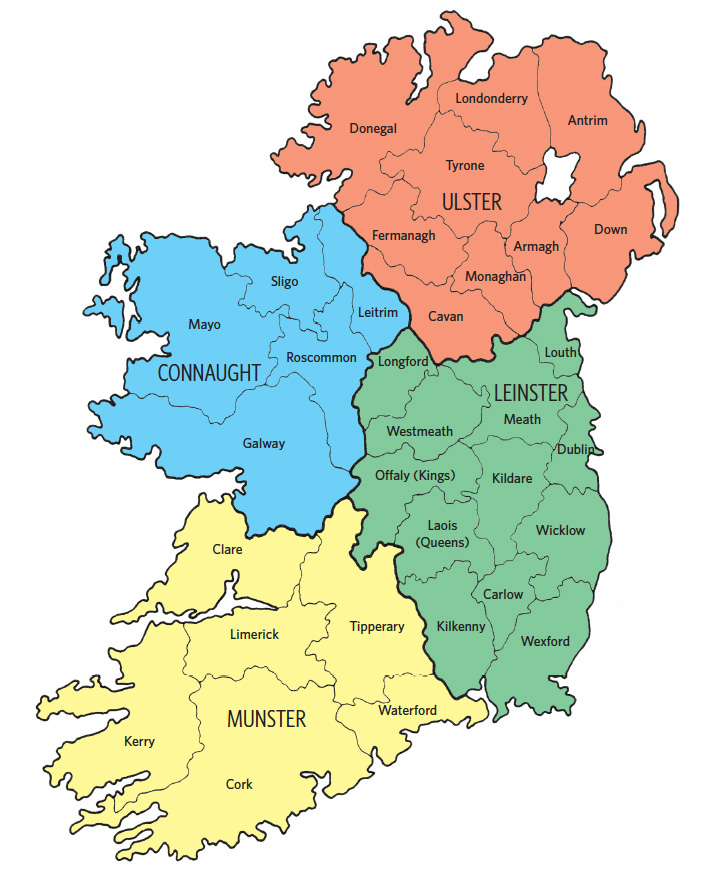
Map showing "Ireland's Four Courts"

May 3, 1921: The United Kingdom passes the Government of Ireland Act, creating the province of Northern Ireland, separate from what is then called the Irish Free State.

Of the traditional "Ireland's Four Courts," Ulster, with its 6 Counties of Antrim (including the capital of Belfast), Down, Armagh, Tyrone, Fermanagh and Derry, became Northern Ireland. The other three remained part of Ireland proper:

* Leinster: Carlow, Dublin, Kildare, Kilkenny, Laois (pronounced "Leesh"), Longford, Louth, Meath, Offaly, Westmeath, Wexford and Wicklow.

* Munster: Clare, Cork, Kerry, Limerick, Tipperary and Waterford. And:

* Connaught: Galway, Leitrim, Mayo, Roscommon and Sligo.

This partition of Ireland intended both territories to remain within the UK, and contained provisions for their eventual reunification. The smaller Northern Ireland was duly created with a devolved government (Home Rule), and remained part of the UK. The larger Southern Ireland was not recognized by most of its citizens, who instead recognized the self-declared 32-county Irish Republic.

Sent to London to negotiate peace terms, Michael Collins was offered a treaty that would establish the Irish Free State -- with an Oath of Allegiance to the Crown. The British Crown, held by King George V. In other words, this "Free State" would have another nation's head of state as its own -- just like Canada, Australia, and a few other "independent nations."

Collins accepted this compromise, calling it "the freedom to achieve freedom." Some in the Provisional Government did not, and the end of the Irish War of Independence led to the beginning of the Irish Civil War. This led to Collins' assassination on August 22, 1922.

On January 7, 1922, Dáil Éireann, the parliament of the Irish Republic, ratified the Anglo-Irish Treaty by a vote of 64–57 at Leinster House in Dublin.

On December 6, 1922, the Partition was complete. At that time, the territory of Southern Ireland left the UK,  and became the Irish Free State, now known as the Republic of Ireland.

Up until that moment, the British Empire had been at its greatest extent, ruling over one-quarter of the world's land, and over one-quarter of the world's people. That would never be the case again: Over the next 60 years, while some of the Empire would become part of the British Commonwealth, most of it would carry out its own "Brexit," and the old saying, "The Sun never sets on the British Empire," would no longer be true.

Today, the population of Northern Ireland is a little under 2 million, slightly more Protestant than Catholic; while that of the vast-majority-Catholic Republic is just under 5 million. The UK's recent "Brexit" deal has essentially reestablished a border between them.

*

May 3, 1921 was a Tuesday. These baseball games were played:

* The New York Yankees beat the Boston Red Sox, 2-0 at Fenway Park in Boston. Babe Ruth went 0-for-4, but catcher Wally Schang went 4-for-4. Bill Percy allowed 10 hits, but kept the shutout, outpitching future Yankee Herb Pennock.

* The New York Giants beat the Boston Braves, 7-2 at the Polo Grounds.

* The Brooklyn Robins (as the Dodgers were known while Wilbert Robinson managed them from 1914 to 1931) beat the Philadelphia Phillies, 4-3 at Ebbets Field. Brooklyn trailed 3-2 going to the bottom of the 9th, but a single by Zack Wheat and a triple by Ed Konetchy won the game.

* The Washington Senators beat the Philadelphia Athletics, 4-2 at Shibe Park in Philadelphia. Joe Judge tripled home 2 runs in the top of the 10th inning.

* And the the Detroit Tigers beat the Chicago White Sox, 13-1 at Navin Field (later Briggs Stadium and Tiger Stadium) in Detroit. Ty Cobb went 1-for-4 with a walk and 2 RBIs. Luzerne "Lu" Blue went 2-for-4 with 5 RBIs. For the White Sox, Eddie Collins went 1-for-4.

Sunday, April 10, 2022

April 10, 1998: The Good Friday Agreement

David Trimble (left) and John Hume

April 10, 1998: The Good Friday Agreement, a.k.a. the Belfast Agreement, is signed, ending "The Troubles," which had plagued Northern Ireland for about 30 years.

The agreement acknowledged that the majority of the people of Northern Ireland wished to remain a part of the United Kingdom, but also that a substantial section of the people of Northern Ireland, and the majority of the people of the island of Ireland, wished to bring about a united Ireland. Both sides agreed, for the first time, that both wishes were legitimate.

A governmental system was set up, and the 2 main belligerent groups -- the Provisional Irish Republican Army (IRA), representing Catholics, and the Ulster Volunteer Force (UVF), representing Protestants, agreed to lay down their weapons, and participate in the government. One group, the Protestant Ulster Defence Assocation (UDA), was notable in its refusal.

Signing the agreement were the Prime Minister of Great Britain, Tony Blair; the Secretary of State for Northern Ireland, Marjorie "Mo" Mowlam; the Taoiseach (Prime Minister) of the Republic of Ireland, Bertie Ahearn; and the Minister for Foreign Affairs of the ROI, David Andrews.

For negotiating the agreement, John Hume, Leader of the ROI's Social Democratic and Labour Party, and David Trimble, Leader of the Ulster Unionist Party and subsequently First Minister of Northern Ireland, shared the 1998 Nobel Peace Prize.

Peace is a precious commodity, but it doesn't solve everything. Belfast, the capital of Northern Ireland, may no longer be a city of paramilitary extrajudicial killings and terrorist bombings, each responding to the other. But it remains a city overseen by the British government, and subject to the national Conservative Party's backward policies, and the British class system, which has never truly gone away. 

As recently as 2011, singer Rihanna, a subject of the United Kingdom until her native Barbados declared itself a republic on 2021, had a Number 1 hit with a song whose video was filmed in Belfast. The title refrain sings, "We found love in a hopeless place."

John Hume died on August 3, 2020. As of April 10, 2022, David Trimble is still alive. (UPDATE: Trimble died on July 25, 2022.)

*

April 10, 1998 was, of course, a Friday. A full slate of Major League Baseball games was played, including the wildest home opener in Pinstriped history:

* The New York Yankees beat the Oakland Athletics, 17-13 at Yankee Stadium. The A's scored 5 runs in the 2nd inning, and 8 runs in the 5th to lead 13-12, and still lost the game. Rickey Henderson went 1-for-5 for the A's, but had no RBIs or stolen bases. For the Yankees, Tino Martinez went 3-for-4 with a home run and 5 RBIs. David Cone started, but didn't get out of the 5th inning. Mike Buddie blew the lead, but still ended up as the winning pitcher. He would win only 4 more games in the major leagues.

* The New York Mets lost to the Milwaukee Brewers, 5-3 at Milwaukee County Stadium.

* The Chicago Cubs beat the Montreal Expos, 13-0 at the Olympic Stadium in Montreal. Brant Brown and Henry Rodriguez hit home runs for the Cubs. Sammy Sosa did not, but would hit 66 for them that season.

* The Boston Red Sox beat the Seattle Mariners, 9-7 at Fenway Park in Boston.

* The Philadelphia Phillies beat the Atlanta Braves, 1-0 at Veterans Stadium in Philadelphia. Mike Lieberthal singled home the winning run in the bottom of the 9th, as Curt Schilling outpitched Greg Maddux.

* The Pittsburgh Pirates beat the Florida Marlins, 4-1 at Three Rivers Stadium in Pittsburgh.

* The team then known as the Cleveland Indians beat the team then known as the Anaheim Angels, 8-5 at the ballpark then known as Jacobs Field. (Current names: Cleveland Guardians, Los Angeles Angels, Progressive Field.) Jim Thome hit a 3-run home run to win the game in the bottom of the 10th.

* The Detroit Tigers beat the Baltimore Orioles, 7-1 at Tiger Stadium in Detroit.

* The Chicago White Sox beat the Tampa Bay Devil Rays, 3-0 at the new Comiskey Park in Chicago. (It's now named Rate Field.) Mike Sirotka and Matt Karchner combined on a 5-hit shutout.

* The Kansas City Royals beat the Minnesota Twins, 5-4 at Kauffman Stadium in Kansas City.

* The Texas Rangers beat the Toronto Blue Jays, 4-3 at what was then named The Ballpark at Arlington, in the Dallas suburb of Arlington, Texas. (It's now named Choctaw Stadium.)

* The Cincinnati Reds beat the Colorado Rockies, 18-7 at Coors Field in Denver.

* The San Diego Padres beat the Arizona Diamondbacks, 6-4 at Qualcomm Stadium in San Diego.

* The Los Angeles Dodgers beat the Houston Astros, 7-2 at Dodger Stadium in Los Angeles.

* And the San Francisco Giants beat the St. Louis Cardinals, 5-3 at Candlestick Park (then named 3Com Park at Candlestick Point) in San Francisco. John Mabry hit a home run for the Cardinals. Mark McGwire did not, but would go on to hit a record 70 for them that season. The Giants hit no home runs. Three years later, Barry Bonds would break McGwire's record with 73 of them.

The NFL was out of season. But there were 8 games played in the NBA:

* The Boston Celtics beat the Orlando Magic, 82-80 in overtime at the FleetCenter. (It's now named the TD Garden.)

* The Atlanta Hawks beat the Charlotte Hornets, 99-87 at the Charlotte Coliseum.

* The Miami Heat beat the Toronto Raptors, 111-105 at the Air Canada Centre in Toronto. (It's now named the Scotiabank Arena.)

* The Minnesota Timberwolves beat the Philadelphia 76ers, 107-102 at the Target Center in Minneapolis. Allen Iverson scored 43 for the Sixers, but the T-Wolves got 29 from Sam Mitchell, 28 from Stephon Marbury, and 26 from Kevin Garnett.

* The San Antonio Spurs beat the Seattle SuperSonics, 99-84 at the Alamodome in San Antonio.

* The Utah Jazz beat the Los Angeles Clippers, 126-109 at the Delta Center in Salt Lake City. 

* The Phoenix Suns beat the Los Angeles Lakers, 114-105 at The Forum outside Los Angeles in Inglewood, California. Antonio McDyess scored 37 points.

* And the Houston Rockets beat the Sacramento Kings, 97-85 at the ARCO Arena in Sacramento. (It is now named the Sleep Train Arena.)

Only 1 game was played in the NHL that day: The Buffalo Sabres beat the Montreal Canadiens, 2-1 at the Marine Midland Arena in Buffalo. (It is now named the KeyBank Center.)

Sunday, January 30, 2022

January 30, 1972: Bloody Sunday In Derry

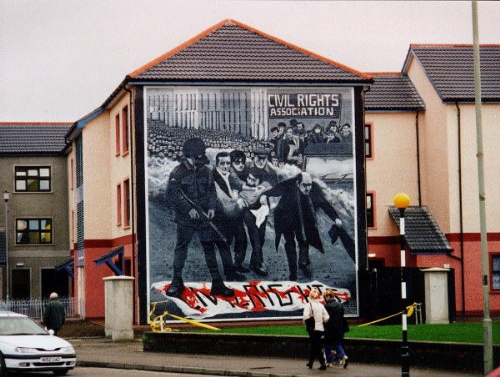
A commemorative mural in Derry

January 30, 1972: The Bogside Massacre occurs in Derry, Northern Ireland. It is one of many events in Ireland's history to be known as "Bloody Sunday."

NOTE: This event should not be confused with the Battle of the Bogside, also in Derry, a 3-day riot in August 1969.

Ireland had been controlled by England since 1649, until the settlement of the Irish War of Independence in 1922 founded the Republic of Ireland, and left only 6 Counties still under British control: Antrim, Armagh, Down, Fermanagh, Londonderry (including the city that the British call Londonderry and the Irish call simply Derry) and Tyrone. The capital of Northern Ireland, Belfast, straddles Antrim and Down.

By 1969, angry at the continued oppression they faced from the Protestant British establishment, and inspired by the Civil Rights Movement for black Americans, the Catholics of Northern Ireland had begun to assert their rights. The government, through the police, known as the Royal Ulster Constabulary (RUC), fought back, and what became known as "The Troubles" began.

An offshoot of the original Irish Republican Army (IRA) began attacking the RUC. In response, paramilitary groups like the Ulster Volunteer Force (UVF) began a campaign of atrocities. Each side kept upping the ante. The IRA had started out as a defensive force, but were, by no means, innocent.

An explosion was destined to happen. Hoping to avoid it, British Prime Minister Edward Heath sent the British Army in to keep the peace. Some Catholics accepted this as better than the RUC and the UVF. Some saw that the Army was every bit as hostile and biased.

On January 18, 1972, Prime Minister Brian Faulkner of Northern Ireland banned all political demonstrations -- Protestant and Catholic alike -- for the rest of the calendar year. But on January 22, a march was made to the internment camp at Magilligan Strand near Derry. The Army blocked the way. The marchers threw rocks, and the soldiers charged and beat people with their batons.

It was decided to hold another march on January 30. The Army decided to allow it to reach the Bogside, a neighborhood outside the old city walls of Derry, but not to reach Guildhall Square. About 15,000 people marched, and the peaceful nature of it was broken when some protestors, again, began throwing rocks at the soldiers.

This time, as with the Boston Massacre of 1770, British soldiers responded to the throwing of rocks by opening fire. There were 26 people wounded, with 13 dying immediately, and a 14th later dying of his injuries.

In April, the Widgery Tribunal issued a report, blaming the protestors, who were not only throwing rocks, which was true; but bombs, and were shooting, which was denounced as a lie.

With his band Wings, Paul McCartney, like the other ex-Beatles an Englishman of Irish descent, released a song: "Give Ireland Back to the Irish." It was banned by the BBC. Ex-Beatle John Lennon released a song titled "The Luck of the Irish," singing, "If you really had the luck of the Irish, you'd wish you were English instead." He wrote another song about the incident, "Sunday Bloody Sunday." Geezer Butler of Black Sabbath followed this by writing "Sabbath Bloody Sabbath." In 1983, the Belfast-based U2 released a different song titled "Sunday Bloody Sunday."

In 1998, the Good Friday Accord finally put an end to The Troubles. In 2010, the Saville Inquiry -- having nothing to do with the notorious English entertainer Jimmy Savile -- released a report saying that none of those shot on Bloody Sunday '72 were armed, no bombs were thrown by the protestors, and that the Army's shooting was "unjustified" and "unjustifiable." Prime Minister David Cameron offered an official apology on behalf of the British government.

*

January 30, 1972 was, as I said, a Sunday. Baseball and football were out of season. There were no games played in the American Basketball Association that day. But there were 6 games played in the NBA: 

* The Boston Celtics beat their arch-rivals, the Philadelphia 76ers, 130-114 at the Boston Garden. Billy Cunningham scored 41 in defeat for the Sixers.

* The Milwaukee Bucks beat the Baltimore Bullets, 116-112 at the Baltimore Civic Center (now the CFG Bank Arena). In a rematch of the previous season's NBA Finals, Kareem Abdul-Jabbar socred 39 for the Bucks.

* The Buffalo Braves beat the Cleveland Cavaliers, 99-98 at the Cleveland Arena.

* The Chicago Bulls beat the Detroit Pistons, 109-99 at the Chicago Stadium.

* The Phoenix Suns beat the Atlanta Hawks, 105-103 at the Arizona Veterans Memorial Coliseum in Phoenix.

* And the Los Angeles Lakers beat the Portland Trail Blazers, 153-131 at The Forum outside Los Angeles in Inglewood, California.

There were no games played in the ABA that day. But there were 6 NHL games played:

* The New York Rangers played the Minnesota North Stars to a tie, 1-1 at Madison Square Garden.

* The Boston Bruins beat the St. Louis Blues, 5-2 at the Boston Garden. Yes, the old North End barn hosted the Celtics and the Bruins on the same day.

* The Philadelphia Flyers beat the Pittsburgh Penguins, 4-0 at The Spectrum in Philadelphia.

* The Buffalo Sabres played the Los Angeles Kings to a tie, 2-2 at the Buffalo Memorial Auditorium.

* In an "Original Six" matchup, the Chicago Black Hawks beat their arch-rivals, the Detroit Red Wings, 4-2 at the Chicago Stadium. Yes, the old West Side barn hosted the Bulls and the Hawks on the same day.

* And the California Golden Seals beat the Vancouver Canucks, 2-0 at the Pacific Coliseum in Vancouver.

December 31, 1999 & January 1, 2000: The Millennium

December 31, 1999:  The Millennium arrives. The people of planet Earth survived. At a terrible cost. But we hadn't destroyed ourselves. ...