Showing posts with label liverpool. Show all posts

Sunday, December 25, 2022

December 25, 1940: Tommy Lawton's Christmas Doubleheader

Tommy Lawton

December 25, 1940: On this Christmas Day, a Wednesday, South Side Park burns down in Chicago. As far as anyone knows, the fire is not purposely set. It was the 1st home of the American League's Chicago White Sox (1901 to 1910), and of the Negro Leagues' Chicago American Giants (1910 to 1940). The American Giants won 7 Pennants while playing there, the White Sox 2.
There were 3 games played in the NHL. The New York Rangers played the Chicago Black Hawks to a tie, 3-3 at Madison Square Garden. The New York Americans lost to the Boston Bruins, 8-1 at the Boston Garden. And the Detroit Red Wings beat the Toronto Maple Leafs, 3-2 at the Olympia Stadium.
Also on this day, under the wartime conditions of depleted rosters, Tommy Lawton plays for Everton against Liverpool at Anfield in the morning. Liverpool win, 3-1. Then he is asked to play as a guest player for Merseyside club Tranmere Rovers at nearby Cheshire club Crewe Alexandra in the afternoon. As he recalled, "The Tranmere people came into the dressing room, and asked if anyone wanted to play, as they were two men short. I said, 'Go on, I'll help you out.' And I did."
He didn't help much: Crewe won the match, 2-1. Still, on Christmas Day 1940, Lawton played a full 90 minutes in the afternoon, after having already done so in the morning. Given the heavy leather balls and ragged pitches (especially in Winter) of the era, this may qualify as a Christmas miracle.
Just 4 days after Christmas, the Luftwaffe bombed the Rolls-Royce factory in Crewe, which had been making Spitfire planes for the Royal Air Force.
Also on this day, Arsenal lose 4-2 away to West Ham United. They finished 4th in the Southern Regional, the Hammers 2nd, and Crystal Palace of Southeast London won. 

Wednesday, October 19, 2022

October 19, 1963: "You'll Never Walk Alone" Is First Played at Anfield

October 19, 1963: The Gerry & the Pacemakers version of "You'll Never Walk Alone" is played at Anfield, home stadium of Liverpool Football Club, for the first time. It became a team tradition.

The song, with music by Richard Rodgers and lyrics by Oscar Hammerstein II, first appeared in 1945, in the Broadway musical Carousel, sung by Christine Johnson as Nettie Fowler, and later by John Raitt (father of rock music legend Bonnie Raitt) as Billy Bigelow, Jan Clayton as his wife Julie, and Bambi Linn as their daughter Louise.

The musical was made into a film in 1956. Gordon MacRae played Billy, Shirley Jones played Julie, Susan Luckey played Louise, Claramae Turner played Nettie, and Gene Lockhart played the Starkeeper and the doctor.

"You'll Never Walk Alone" became a standard. Jerry Lewis would use it to close his annual Labor Day telethon for research into muscular dystrophy and related conditions. Elvis Presley made it a mainstay of his live performances from his Las Vegas debut in 1969 until his death in 1977.

In 1963, Liverpool rock band Gerry & The Pacemakers recorded a version of it. In the 1960s, at Anfield, the home stadium of Liverpool F.C., games would be preceded by the public address system playing the Top 10 songs in the country. "You'll Never Walk Alone" debuted in the Top 10 on October 19, 1963, and so it was played at Anfield for the 1st time. Liverpool beat West Bromwich Albion, of the Birmingham area, 1-0 on a goal by Gordon Milne in the 32nd minute.
A recent photo of Anfield, seriously added-onto

Liverpool's other major team, Everton, who had won the League the previous season, traveled to the East End of London on this day, and lost to West Ham United, 4-2 at Upton Park. Everton fans would become sick of the song, and one of their fans' slogans is "I'd rather walk alone."

The Pacemakers were the 2nd-biggest band in Liverpool at the time, behind The Beatles, but their version of "YNWA" never became a hit in the song's country of origin, not even in the "British Invasion" year of 1964, when The Beatles caught fire in America and pretty much every other British band that was even remotely good followed them. The Pacemakers had a few songs reach the American charts, most notably "Don't Let the Sun Catch You Crying" and "How Do You Do It" in 1964, and "Ferry Cross the Mersey" (from the film of the same title) in 1965. But not "YNWA."

It did, however, hit Number 1 in Britain. But when it fell out of the Top 10, Liverpool fans demanded that it be played at Anfield, anyway, just before the team walked onto the pitch. This was done, and Liverpool, managed by Bill Shankly, won the Football League in 1964.

After that, in England, the song was considered a good-luck charm by fans of the Mersey Reds, and was irrevocably tied to the team. After the Hillsborough Disaster of 1989, the words of the song gave hope to a grieving city. The words "YOU'LL NEVER WALK ALONE" are now cast in iron atop the Shankly Gates leading into Anfield.

Most Liverpool fans don't even realize that the song debuted on Broadway, in New York, in America, during the waning days of World War II.

Fans of Celtic Football Club in Glasgow, Scotland also took it up. Like Liverpool fans, they sing it before every game, and after every win. In 2003, the teams faced each other in the UEFA Cup Quarterfinal, and Pacemakers singer Gerry Marsden was invited to sing it on the pitch before the game. He did so, wearing one of those "half scarves" produced before international matches with logos of both teams. Another British rocker, Rod Stewart, also attended, supporting Celtic.
Oscar Hammerstein died in 1960, having never learned of his song's connection with Liverpool. Richard Rodgers lived until 1979, and if he ever knew of the connection, he never made a public statement about it. Gerry Marsden died in 2021.

*

October 19, 1963 was a Saturday. North London team Arsenal traveled to Birmingham, and lost to Aston Villa, 2-1 at Villa Park.

In American football, among the college games played that day were these:

* Number 1 Texas beat Arkansas, 17-13 at War Memorial Stadium in Little Rock, Arkansas. Texas went on to win the Southwest Conference Championship.

* Number 2 Wisconsin beat Iowa, 10-7 at Iowa Stadium (now Kinnick Stadium) in Iowa City.

* Number 3 Pittsburgh beat West Virginia, 13-10 at the old Mountaineer Field in Morgantown, West Virginia. This is a rivalry known as "The Backyard Brawl."

* Number 4 Ohio State were upset by the University of Southern California (USC), 32-3 at the Los Angeles Memorial Coliseum. No, this was not the Rose Bowl game. And when that game was played, neither of these teams would be in it.

* Number 5 Mississippi beat Tulane, 21-0 at Tulane Stadium in New Orleans. "Ole Miss" went on to win the Southeastern Conference title.

* Number 6 Oklahoma beat Kansas, 21-18 at Owen Field in Norman, Oklahoma.

* Number 7 Illinois beat Minnesota, 16-6 at Memorial Stadium in Champaign, Illinois. With running back Jim Grabowski, and center and linebacker Dick Butkus, Illinois won the Big Ten Conference title.

* Number 8 Georgia Tech were upset by Auburn, 29-21 at Grant Field in Atlanta.

* Number 9 Alabama beat Tennessee, 35-0 at Legion Field in Birmingham, Alabama. Alabama didn't win the SEC title, but they didn't play Ole Miss. So those teams were matched up in the Sugar Bowl, the traditional home for the season's SEC Champion, and Alabama won. In fiction, that would have been the last game for 'Bama for running back Forrest Gump.

* Number 10 Navy beat the Virginia Military Institute (VMI), 21-12 at Foreman Field in Norfolk, Virginia. This was the annual Oyster Bowl game, which has featured Navy 10 times and VMI 16 times. These days, though, it's a game for FCS (formerly Division I-AA) teams, like the school for which Foreman Field, now named S.B. Ballard Stadium, is the home field, Old Dominion University. Although it was in VMI's home State, Norfolk, is home to America's largest naval base, so it felt more like a home field for Navy.

Navy were quarterbacked by Roger Staubach, who went on to win the Heisman Trophy, and rose to Number 2 in the country. Through the 2021 season, no service academy team has finished in the Top 10 since. They played Number 1 Texas for the National Championship in the Cotton Bowl, but Texas won.

* The University of Washington, then unranked, beat Stanford, 19-11 at Husky Stadium in Seattle. Washington went on to win the title in the American Association of Western Universities (AAWU, a forerunner of what's now the Pac-12), and beat Illinois in the Rose Bowl.

* Army beat Wake Forest, 47-0 at Michie Stadium in West Point, New York.

* Notre Dame beat UCLA, 27-12 at Notre Dame Stadium in South Bend, Indiana.

* In a rivalry game, North Carolina beat North Carolina State, 31-10 at Kenan Stadium in Chapel Hill, North Carolina.

* And among New Jersey teams, Rutgers beat Lehigh, 30-6 at Rutgers Stadium in Piscataway; while Princeton beat Colgate, 42-0 at Palmer Stadium in Princeton.

Neither the NFL nor the AFL played any games that day. But in Middlesex County, New Jersey, East Brunswick High School, which would one day be my Alma Mater, beat Bridgewater-Raritan, 27-21 at home, on a field that had no name, roughly where the school's practice field now is. Its stadium, later named Jay Doyle Field, wouldn't be built until 1965.

Baseball season had ended 13 days earlier, when the Los Angeles Dodgers completed a sweep of the New York Yankees in the World Series. There were 4 games played in the NBA:

* The New York Knicks lost to the Cincinnati Royals, 121-97 at the Cincinnati Gardens.

* The Detroit Pistons beat the Philadelphia 76ers, 124-121 at the Philadelphia Civic Center. This was only the 2nd regular-season game for the Sixers, and the 1st at home, after moving from being the Syracuse Nationals. I have a separate entry for that event. 

* The San Francisco Warriors beat the Baltimore Bullets, 103-102 at the Baltimore Civic Center (now the CFG Bank Arena). Walt Bellamy scored 36 points and grabbed 17 rebounds for the Bullets, who were played just their 3rd regular-season since moving from being the Chicago Zephyrs, and only their 2nd home game. They would last just 10 years before moving down Interstate 95, becoming the Washington Bullets, and eventually the Washington Wizards.

* And the St. Louis Hawks beat the Los Angeles Lakers, 117-108 at the Kiel Auditorium in St. Louis.

There were 2 games played in the NHL. The Montreal Canadiens beat the Boston Bruins, 2-0 at the Montreal Forum. And the Toronto Maple Leafs beat the Detroit Red Wings, 2-1 at Maple Leaf Gardens in Toronto. The New York Rangers and the Chicago Black Hawks were not scheduled.

Tuesday, October 18, 2022

October 19, 1901: Edward Elgar Debuts His "Pomp and Circumstance Marches"

October 19, 1901: Pomp and Circumstance March No. 1 and March No. 2 premiere, at Philharmonic Hall in Liverpool. The marches are conducted by their composer, Edward Elgar. Two days later, he conducts them again at Queen's Hall in London.

Elgar was born on June 2, 1857 in Lower Broadheath, Worcestershire, in the West Midlands of England. By the age of eight, Elgar was taking piano and violin lessons, and his father, who tuned the pianos at many grand houses in Worcestershire, would sometimes take him along, giving him the chance to display his skill to important local figures.

In 1879, he took up the post of conductor of the attendants' band at Powick Hospital, a psychiatric institution outside Worcester. In 1882, he became a violinist with a Birmingham orchestra. He married Alice Roberts in 1886, and they lived in her hometown of Great Malvern, outside Worcester. By 1892, his own compositions began to be performed. In 1899, his Enigma Variations made him world-famous.

Elgar took the phrase "Pomp and Circumstance" from Act 3, Scene 3 of William Shakespeare's tragedy Othello:

Farewell the neighing steed and the shrill trump,
The spirit-stirring drum, th'ear-piercing fife,
The royal banner, and all quality,
Pride, pomp, and circumstance of glorious war!

Pomp and Circumstance was written in 6 "Marches": No. 1 in D major in 1901; No. 2 in A minor, also in 1901; No. 3 in C minor in 1904; No. 4 in G major in 1907; No. 5 in C major in 1930; and No. 6 in G minor, which remained unpublished at his death on February 23, 1934, from colon cancer, at the age of 76.

The five original marches were dedicated to friends of Elgar's: The conductor Alfred E. Rodewald, the composer Granville Bantock, and the organists Ivor Atkins, G.R. Sinclair, and Percy Hull.

Pomp and Circumstance, March No. 1 includes the trio section "Land of Hope and Glory." It is the section that truly popularized the work, since it became the "Coronation Ode" for the Coronation of King Edward VII on August 9, 1902.

It is often known as "The Graduation March," and is played as the processional tune at many high school and college graduation ceremonies. It was first played at such a ceremony on June 28, 1905, at Yale University in New Haven, Connecticut, where the Professor of Music, Samuel Sanford, had invited his friend Elgar to attend commencement, and receive an honorary doctorate of music. Elgar repaid the compliment by dedicating his Introduction and Allegro to Sanford later that year.

*

October 19, 1901 was a Saturday. The only games played in North America that day were college football games. Among them were these:

* Harvard beat Army, 6-0 on The Plain at West Point, New York. Harvard finished 12-0 that season, and were generally regarded as the Champions of the East.

* Yale beat Penn State, 22-0 at Yale Field in New Haven, Connecticut.

* Columbia beat Hamilton College of Kirkland, New York, 12-0 at the Polo Grounds.

* Cornell beat the Carlisle Indian School, 17-0 at the Stadium of the Pan-American Exposition in Buffalo.

* Princeton beat Brown, 35-0 at University Field in Princeton, New Jersey.

* The University of Pennsylvania beat Bucknell, 6-0 at the original Franklin Field in Philadelphia.

* Rutgers lost to Swarthmore, 27-0 at Whittier Field in Swarthmore, Pennsylvania, outside Philadelphia.

* Navy beat Lehigh, 18-0 at Worden Field in Annapolis, Maryland.

* Michigan beat Northwestern, 29-0 at Regents Field in Ann Arbor, Michigan. This was coach Fielding Yost's "Point-a-Minute Team," outscoring 11 opponents 550-0 -- an average of 50-0, not quite a point for every minute, but, given time of possession, considerably more than that. They were generally considered to be what their song "Hail to the Victors" called them: "The Champions of the West," a title they seemed to secure by winning what is generally regarded as the 1st bowl game, beating West Coast champions Stanford on New Year's Day, January 1, 1902, 49-0.

* Notre Dame, not yet the power they would become, beat Chicago Eclectic Medical College, 32-0 at Cartier Field in South Bend, Indiana. Chicago Eclectic Medical changed its name the next year, to the American College of Medicine and Surgery. The school closed in 1917, due to the manpower drain of World War I, and never reopened.

* And Illinois beat the team then generally regarded as their rivals, the University of Chicago, 24-0 at Marshall Field in Chicago, named for Marshall Field, who ran the department store that also bore his name.

And in English soccer, Woolwich Arsenal, the South London team that would later become Arsenal F.C. of North London, traveled to Yorkshire, and lost to Middlesbrough F.C., 3-0 at Linthorpe Road West in Middlesbrough.

In 1979, having had to go to 4 replays in the 3rd Round of the FA Cup against Sheffield Wednesday, the last 3 of them on neutral ground at Filbert Street, home of Leicester City, Arsenal fans -- nicknamed "Gooners," after the team's nickname, "the Gunners" -- adapted Elgar's "Land of Hope and Glory" into this song:

We all follow The Arsenal
over land and sea!
(And Leicester!)
We all follow The Arsenal
on to victory!

The next season, after going to 3 replays of the FA Cup Semifinal against Liverpool, losing the Final to West Ham United, seeing Liverpool win the Football League title, and seeing Nottingham Forest win the European Cup, the Gooners redid the song again:

We hate Nottingham Forest!
We hate Liverpool, too!
(And Tottenham!)
We hate West Ham United!
But Arsenal, we love you!

Tuesday, September 27, 2022

September 28, 1884: Anfield Opens

September 28, 1884: Anfield opens on the edge of Stanley Park in Liverpool, England. The home team wins.

Present-day fans of Liverpool Football Club will not be surprised to learn this. But they may be surprised to learn that the home team was Everton Football Club. The "Toffees" beat nearby team Earlestown, 5-0, and went on to use Anfield as their home ground until 1892, when Goodison Park opened, a mile away on another side of Stanley Park.

Imagine if, instead of at their actual locations in The Bronx and Queens, respectively, Yankee Stadium had been built where the American Museum of Natural History is, at 79th Street and Central Park West; and Shea Stadium had been built across Central Park, 1 mile away, where the Metropolitan Museum of Art is, at 81st Street and 5th Avenue. That's how close Anfield and Goodison Park are.

The stadium is named after the surrounding area. The word "Anfield" originated in the combination of Old English and Middle English words, which mean "a field on a slope." An alternate explanation is that the name is linked to the influx of people fleeing the Irish potato famine of the 1840s, crossing the Irish sea from Dublin to Liverpool, and was associated with Annefield, outside New Ross, County Wexford.

A dispute between Everton and the land's owner, John Houlding, led to them moving to Goodison. Houlding was left with an empty stadium, and decided to form a new club to occupy it. Liverpool F.C.'s 1st game there was played on September 1, 1892, and they beat South Yorkshire team Rotherham Town, 7-1.

Seating capacity was originally 8,000, and was expanded to 11,000 in 1895. In 1906, a new stand was built along Walton Breck Road. Ernest Edwards, the sports editor of newspapers the Liverpool Daily Post (which went out of business in 2013) and the Liverpool Echo (still in business), named it the Spion Kop, after a famous hill in South Africa where a local regiment had suffered heavy losses during the Boer War in 1900. More than 300 men had died, many of them from Liverpool, as the British army attempted to capture the strategic hilltop. While many soccer stadiums would call one of their end sections the Spion Kop, most, like Liverpool's have been "The Kop" for short.

In 1928, the Kop was redesigned and extended, to hold 30,000 spectators, all standing. A roof was erected as well. The stadium got lights in 1957. In 1963, the old Kemlyn Road Stand was replaced by a cantilevered stand, accommodating 6,700 spectators. Two years later, responding to the demand for tickets following Liverpool's 1964 Football League title and 1965 FA Cup win, alterations were made at the Anfield Road Stand, turning it into a larger covered standing area with refreshments under the structure.

The biggest redevelopment came in 1973, when the old Main Stand was partially demolished and extended backwards with a new roof. In the 1980s the paddock in front of the Main Stand was turned into seating, and in 1982 seats were introduced at the Anfield Road Stand. The Shankly Gates were erected in 1982, a tribute to former manager Bill Shankly.

Across the Shankly Gates are the words "You'll Never Walk Alone." In the 1960s, at Anfield, games would be preceded by the public address system playing the Top 10 songs in the country. Gerry & The Pacemakers' version of "You'll Never Walk Alone," from the 1945 Broadway musical Carousel, debuted in the Top 10 on October 19, 1963, and so it was played at Anfield for the 1st time. It hit Number 1 in Britain. (It was not a hit in America.)

But when it fell out of the Top 10, Liverpool fans demanded that it be played at Anfield, anyway, just before the team walked onto the pitch. This was done, and Liverpool, managed by Shankly, won the Football League in 1964. After that, in England, the song was considered a good-luck charm by fans of the Mersey Reds, and was irrevocably tied to the team. Everton fans would become sick of the song, and one of their fans' slogans is "I'd rather walk alone."

Shankly retired after the 1973-74 season, but under his right-hand man, Bob Paisley, they actually got better. I've often compared Liverpool to American football's Pittsburgh Steelers: A "football" team from a hardscrabble, hardworking town, with the loss of so much industry casting a pall over the era, starts winning, dominating their league in the decade, and becomes everything to the people, many of them of Irish descent. The biggest difference between the teams is that, unlike the Steelers, the Mersey Reds did have some success before the 1970s.

In fact, they won 18 titles in the Football League Division One: 1901, 1906, 1922, 1923, 1947, 1964, 1966, 1973, 1976, 1977, 1979, 1980, 1982, 1983, 1984, 1986, 1988 and 1990. The Premier League was founded in 1992, and, infamously, it took them until the COVID season of 2019-20 for them to win it, as Manchester United surpassed them with a 19th and a 20th title, in 2011 and 2013, respectively.

They've also won the FA Cup, English soccer's season-long national tournament, 8 times: 1965, 1974, 1986, 1989, 1992, 2001, 2006 and 2022. And they've won the European Cup/UEFA Champions League 6 times, more than any other British team: 1977, 1978, 1981, 1984, 2005 and 2019. The 1985-86 season remains the only one in which they've won both the League and the Cup, known in England as "doing The Double."

They almost did it again in 1989. In the FA Cup Semifinal, they were playing Nottingham Forest, on neutral ground at Hillsborough Stadium in South Yorkshire, home of Sheffield Wednesday. A mistake in opening the gates led to the deaths of 97 people. The game was replayed, Liverpool won, and, as in 1986, they beat Everton in an All-Merseyside Final.

And with North London team Arsenal having blown a lead for the League title, all Liverpool had to do to win the League was avoid losing the last game of the season, home to Arsenal, by more than 1 goal. Arsenal hadn't won at Anfield in 15 years. With the home fans singing "You'll Never Walk Alone" with more emotion than ever, giving hope to a grieving city over the last few weeks, it seemed impossible for Arsenal to do what needed to be done. But a goal by Michael Thomas in stoppage time gave Arsenal a 2-0 win.

The Hillsborough Disaster led to, among other things, the conversion of English stadiums to all-seater. This would reduce capacity, without more building. The Kemlyn Road Stand was double-decked, and renamed the Cenentary Stand in 1992, in connection with the team's 100th Anniversary. The Kop was demolished and rebuilt in 1994, its capacity reduced to 12,390, but still the most intimidating stand in the sport. Overall, the stadium's seating capacity was down to 35,000. In 1998, a new, 2-tier Anfield Road Stand was opened, bringing capacity back up to 44,736.

In 2017, the Centenary Stand was renamed the Kenny Dalglish Stand, for the team's all-time greatest player, who had managed them to the 1986 Double while still playing.

Since the 2010 purchase of the team by Fenway Sports Group, owners of the Boston Red Sox, the stadium has been redeveloped and modernized. Unlike a ballpark, a four-sided soccer stadium can have parts demolished and rebuilt without the team having to leave. The new Main Stand (southeast) opened in 2016, raising capacity to 54,074. The new Anfield Road Stand (northeast) is set to open in 2023, raising capacity to 60,725. (UPDATE: It took until February 10, 2024.)

As of September 28, 2022, there are no plans to redevelop the Kop (southwest) or the Kenny Dalglish Stand (southeast, and as a 1992 construction the oldest current part of the stadium). 

Outside the stadium are a bust of builder John Houlding, statues of managers Bill Shankly and Bob Paisley, and a memorial to the victims of Hillsborough.

*

September 28, 1884 was a Sunday. In America, the only league sport of the time was baseball, and the National League prohibited its teams from playing on Sundays. The American Association allowed it, but had no games scheduled for the day. The Union Association, which played only in this season before folding, allowed Sunday ball, and 3 games were played:

* The Milwaukee Brewers beat the Washington Nationals, 5-0 at the Wright Street Grounds in Milwaukee. Both of these teams folded with the UA, and have no connection to the present-day National League teams of the same names.

* The St. Louis Maroons beat the Baltimore Monumentals, 12-1 at Union Base Ball Park in St. Louis. In those days, the sport's name was usually written as 2 words, "base ball." The Maroons were run by Henry V. Lucas, a St. Louis businessman and founder of the league. Naturally, he favored his team, and they ran away with the Pennant. That dominance, producing the feeling throughout the league that everybody else's games were meaningless, was a big reason for its demise.

* And the Kansas City Unions beat the Boston Reds, 6-1 at Athletic Park in Kansas City.

Wednesday, September 21, 2022

September 21, 1949: England 0-2 Ireland

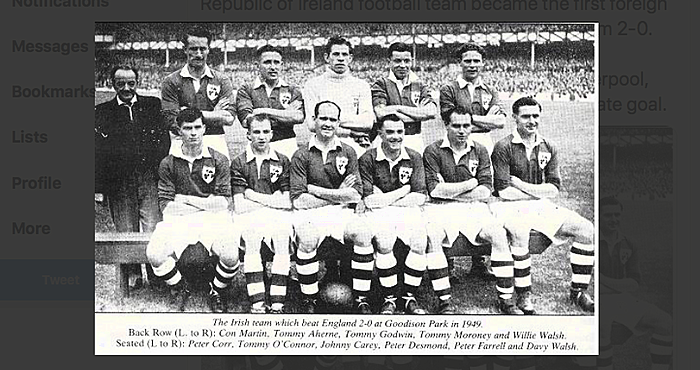
September 21, 1949: The Republic of Ireland soccer team defeats England 2-0 at Goodison Park in Liverpool, the home ground of Everton Football Club. As a result, Ireland become the 1st non-United Kingdom team to defeat England on English soil.

Cornelius "Con" Martin of Birmingham team Aston Villa, and Peter Farrell of Everton (thus playing on his home pitch), scored the goals. Davy Walsh, a forward whose best years were with Belfast team Linfield, Birmingham-area team West Bromwich Albion, and Aston Villa (where he was a teammate of Martin), was the last survivor from this team, living until 2016.

Things would get worse for England over the next few years: In 1950, they participated in the World Cup for the 1st time, and were humiliated by the U.S. team; followed by shreddings at the hands of the "Magnificent Magyars" of Hungary in 1953 and 1954, and poor performances in the 1954, 1958 and 1962 World Cups. It would take until 1966 for them to redeem themselves.

Ireland, however, were unable to follow up on this triumph. They didn’t make the World Cup until 1990 (reaching the Quarterfinals), doing so again in 1994 and 2002, but not since.

*

September 21, 1949 was a Wednesday. Basketball Hall-of-Famer Artis Gilmore was born.

And these baseball games were played that day:

* The New York Yankees lost to the Chicago White Sox, 10-9 at Yankee Stadium. The White Sox scored 3 runs in the 8th inning and 3 more in the 9th, to come from behind to win. Rocky Krsnich and Gus Zernial hit home runs for the Pale Hose. Joe DiMaggio did not play.

* A doubleheader was split at Crosley Field in Cincinnati. The New York Giants lost the opener to the Cincinnati Reds, 5-4. Sheldon "Available" Jones should not have been so available, as he walked Danny Litwhiler with the bases loaded in the bottom of the 10th inning. The Giants won the nightcap, 5-2. The game was called due to rain after 7 innings.

* A doubleheader was split at Sportsman's Park in St. Louis. The St. Louis Cardinals won the opener, 1-0. Max Lanier pitched a 5-hit shutout, outpitching Don Newcombe. The Brooklyn Dodgers won the nightcap, 5-0. Elwin "Preacher" Roe pitched a 2-hit shutout, while Harry Brecheen didn't get out of the 4th inning. Duke Snider hit a home run. Over the 2 games, Jackie Robinson went 0-for-6 with 2 walks, while tan Musial went 1-for-7.

* The Boston Red Sox beat the Cleveland Indians, 9-6 at Fenway Park in Boston. Ted Williams and Al Zarilla hit home runs for the Red Sox. Ellis Kinder won his 22nd game of the season.

* The Detroit Tigers beat the Philadelphia Athletics, 4-1 at Shibe Park in Philadelphia.

* The Washington Senators beat the St. Louis Browns, 7-0 at Griffith Stadium in Washington. Dick Welk pitched a 3-hit shutout.

* The Boston Braves beat the Pittsburgh Pirates, 9-7 at Forbes Field in Pittsburgh. Ralph Kiner hit 2 home runs for the Bucs, but it wasn't enough.

* And a doubleheader was split at Wrigley Field in Chicago. The Philadelphia Phillies won the 1st game, 3-1. The Chicago Cubs won the 2nd game, 9-6.

Sunday, August 14, 2022

August 15, 1892: William E. Gladstone Forms His Last Government

August 15, 1892: Having led his Liberal Party to the lead, but not a majority, in the recent general election, William Ewart Gladstone brings the Members of the House of Commons who belong to the Irish Nationalist Party into his coalition, forming a majority. He goes to Queen Victoria, and tells her, "I can form a government." Not really having the power to stop him, she lets him.

The Queen was 73 years old. The Prime Minister was 82, the oldest man ever to hold that office. (For comparison's sake, Joe Biden was elected President in 2020, just short of turning 78.) It is the 4th separate time that Gladstone had held the office.

Gladstone (the E was silent) was born on December 29, 1829 in Liverpool, the son of John Gladstone, a Scot who served in Parliament in the 1810s and 1820s. William was first elected to the House of Commons in 1832, to Robert Peel's faction of the Conservative Party. In 1846, Peel's faction broke away, and formed the Liberal Party.

He served in the Cabinets of 3 Liberal Prime Ministers: George Hamilton-Gordon, 4th Earl of Aberdeen; Henry John Temple, 3rd Viscount Palmerston; and John Russell, 1st Earl Russell. Under each of them, it included tenure as Lord of the Exchequer, Britain's equivalent to the Secretary of the Treasury.

His policies emphasized equality of opportunity and opposition to trade protectionism, which would eventually, as he became Prime Minister, became known as Gladstonian Liberalism, and earned him the nickname "The People's William." It also earned him initial nicknames, long before America ever had FDR or JFK: He was known by his actual initials as "WEG," and, eventually, as "the GOM," short for "the Grand Old Man."

When the Liberal Party gained a majority in the 1868 general election, Gladstone was named Prime Minister, taking office for the 1st time on December 3, succeeding the Conservative Leader, Benjamin Disraeli. The rivalry between the 2 men defined an era in British politics, and on February 17, 1874, having lost an election, Gladstone had to give way to Disraeli.

He regained the office on April 23, 1880, his election victory putting an end to Disraeli's career, and starting those of his sons Henry and Herbert Gladstone, who were also elected to Parliament. As in his first term, he pushed for easing of poverty, university reform, fairness toward Ireland, and a conciliatory foreign policy.

This time, what became known as "the Scramble for Africa" was on, and he opposed it. The victory in the Anglo-Egyptian War of 1882 was the highlight of his tenure, but the fall of Khartoum in the Sudan, including the death of the popular British commander George Gordon, led to the worst press treatment of his career. Critics inverted his nickname "GOM" into "MOG," for "Murderer of Gordon." Queen Victoria herself wrote him a telegram rebuking him, but offered him an earldom if he would resign. He resigned on June 9, 1885, but refused the earldom, which won him back some admirers.

But the new Conservative government of Robert Arthur Talbot Gascoyne-Cecil, 3rd Marquess of Salisbury, fell apart quickly over the issue of Irish Home Rule, in part due to a press release by Herbert Gladstone. (And you had a problem with Hunter Biden?) On February 1, 1886, Charles Stewart Parnell, known as "the Uncrowned King of Ireland," took his Irish Parliamentary Party out of Lord Salisbury's government, and allied with the elder Gladstone, who became Prime Minister for the 3rd time.

But rural voters in what had been Gladstone constituencies were not ready to support anything other than London domination of Ireland, and several Liberal Party members left, forming the Liberal Unionist Party. On July 21, 1886, not even 6 months after taking charge again, Gladstone was out for the 3rd time, and Salisbury was in for the 2nd.

But the Grand Old Man was not done. In 1889, he supported the London dockers' strike, regaining much of his former working-class support. An election in 1892 resulted in a minority government, and Gladstone once again cut a deal with Irish Members of Parliament to become Prime Minister for the 4th time on August 15. He got a Home Rule bill through the Commons on September 1, 1893, but the House of Lords overwhelmingly rejected it on September 8. He wanted to call a general election, on the sole subject of that bill, immediately, but was talked out of it.

Gladstone was the first Prime Minister to make it a condition of ministers to resign directorships of public companies in 1892. This was abandoned by Salisbury in 1895, but was restored by Liberal Henry Campbell-Bannerman in 1905, and has been observed ever since.

Gladstone decided to resign the Premiership, ostensibly on health grounds, on March 2, 1894. At 84, he remains the oldest person ever to hold the office. He had held the post for roughly 12 of the preceding 24 years. He resigned from Parliament the next year, after 63 years.

In his last years, he warned against "militarism" and "jingoism," apparently foreseeing the crisis that would result in World War I. He did not, however, foresee the Liberal Party's collapse, and its effective replacement by the Labour Party, in the decade after that. He died on May 19, 1898, at the age of 88, and was laid to rest in Westminster Abbey.

*

August 15, 1892 was a Monday. These games were played in baseball's National League:

* The New York Giants beat the Cincinnati Reds, 9-2 at League Park in Cincinnati.

* The Brooklyn Bridegrooms lost to the St. Louis Browns, 3-2 at an early version of Sportsman's Park in St. Louis. In the 1887-88 off-season, 6 players from the team formerly known as the Brooklyn Grays got married, so people began calling the team the Bridegrooms. In 1911, they took the name Dodgers. In 1900, the Browns became the Cardinals.

* The Washington Senators beat the Pittsburgh Pirates, 4-2 at Exposition Park in Allegheny, across the River of the same name from Pittsburgh proper. In 1907, Allegheny was annexed into Pittsburgh.

* The Boston Beaneaters beat the Cleveland Spiders, 5-0 at the 1890-1909 version of League Park in Cleveland. The Beaneaters went threw a few name changes before settling on "Braves" in 1912.

* The Philadelphia Phillies beat the Louisville Colonels, 2-1 at Eclipse Park in Louisville, Kentucky.

* And the Baltimore Orioles beat the Chicago Colts, 9-2 at South Side Park in Chicago. The Orioles, the Senators, the Spiders and the Colonels were all consolidated out of business by the NL after the 1899 season. In 1903, the Chicago franchise became the Cubs.

Saturday, July 23, 2022

July 23, 1966: Eusébio vs. North Korea

July 23, 1966: Coming off perhaps the greatest upset in World Cup history, North Korea faces Portugal, and the man who might be, for the moment, the greatest soccer player in the world.

Eusébio da Silva Ferreira was born on January 25, 1942, in Lourenço Marques, in Mozambique, on the east coast of southern Africa, then a colony of Portugal. In 1975, after the Carnation Revolution overthrew Portugal's fascist government, the overseas empire was broken up, and Mozambique gained its independence. Lourenço Marques was the capital, and its name was changed to Maputo.

By the age of 18, Sport Lisboa e Benfica, the Lisbon-based soccer team that was, then as now, the most successful, the most loved, and the most hated sports team in Portugal, signed him. Benfica won Portugal's Primeira Liga and the European Cup (the precursor tournament to today's UEFA Champions League) in 1961, but Eusébio played only 1 senior game that season. But in 1961-62, the season in which he turned 20, he became a world "football" superstar, leading them to win the Taça de Portugal (Portuguese Cup) and a repeat of the European Cup, scoring 5 goals in the tournament, including 2 goals in the Final against Real Madrid. 

(Infamously, Benfica have not won a European Final since, losing the European Cup/Champions League Final in 1963, '65, '68, '88 and '90; and the 2014 UEFA Europa League Final.)

With Eusébio, Benfica won the Premeira Liga 11 times between 1961 and 1975, and the Taça de Portugal 5 times between 1962 and 1972. In other words, they "did The Double" twice, in 1964 and '72. He scored 638 goals in 614 official matches for Benfica. In 1965, he was awarded the Ballon d'Or (Golden Ball) for world player of the year. He became known as O Rei (The King), the Black Pearl and the Black Panther. I don't know how Portuguese natives generally treated black people on the soil of the empire's seat, but he remained beloved in Portugal throughout his life. (Brazil's Pelé was also nicknamed O Rei and the Black Pearl.)

In 1966, Portugal qualified for the World Cup, and were placed in Group 3 with another of their former colonies, Brazil, the 2-time defending Champions; and 2 Eastern Bloc nations, Hungary and Bulgaria. On July 13, at Old Trafford, home ground of Manchester United, they beat Hungary, 3-1, with José AugustoEusébio's Benfica teammate, scoring 2 goals. On July 16, also at Old Trafford, they beat Bulgaria, 3-0, with Eusébio scoring. And on July 19, at Goodison Park in Liverpool, home of Everton F.C., they beat Brazil, 3-1, with Eusébio scoring twice.

Portugal and the Soviet Union were the only countries, out of the 16 to qualify, who got through the Group Stage 3-0. However, some bad fouls by Portuguese and Bulgarian defenders left Pelé injured, and so it was Hungary that joined Portugal in advancing to the knockout stage from Group 3.

The Quarterfinal was set for July 23, at Goodison: Portugal vs. North Korea. No one expected North Korea, coming off its epic upset of Italy in the last game of the Group Stage, to pull off a 2nd huge upset within 5 days. But Pak Seung-zin scored in the 1st minute, before many people had even gotten to their seats. Li Dong-woon scored in the 22nd, and Yang Seung-kook scored in the 25th. Portugal had only allowed 2 goals in the entire Group Stage, 270 minutes plus stoppage time. Now, in 25 minutes, they had allowed 3.

Eusébio to the rescue. He scored in the 27th. In the 43rd, Portugal were rightly awarded a penalty, and Eusébio took it, closing his team to within 3-2. In the 56th he hit a screamer that tied the game. The North Koreans decided to follow the Bulgarians' path, and foul the opposing star like crazy. In the 59th, a tackle worthy of an immediate dismissal -- yellow and red cards hadn't come into use yet -- injured Eusébio's knee. He took the penalty, anyway, and gave Portugal a 4-3 lead, completing the comeback. Somehow, he finished the game, and José Augusto capped the performance with a goal in the 80th. Portugal 5, North Korea 3 -- 3-0 to North Korea in the 1st 25 minutes, 5-0 to Portugal thereafter.

North Korea's fairy tale was over. Portugal's lasted just 1 more game. In the Semifinal, at Wembley Stadium in London, Bobby Charlton of Manchester United scored 2 goals for England. Portugal were awarded a penalty in the 82nd minute, and Eusébio took it, but they couldn't find an equalizer. West Germany beat the Soviet Union in the other Semifinal, and England won the Final, 4-2 after extra time.

Eusébio continued to be one of the world's best players for a few more years. In 1975, 33 years old, he did what so many aging soccer players were doing, and would do, and continue to do today: He came to North America to make a lot of money. He played in the original North American Soccer League.

In 1975, he played for the Boston Minutemen. In 1976, he played for Toronto Metros-Croatia (a merger of the Toronto Metros and Toronto Croatia), and they won the NASL title. In 1977, he played for the Las Vegas Quicksilvers. But he was 35, and dealing with constant pain and medical treatment on his knees. He scored only 2 goals. 

In 1978, he signed with the New Jersey Americans of the American Soccer League, who played their home games at Memorial Stadium in New Brunswick, Middlesex County. As a native of East Brunswick, I've seen many sporting events at that complex: Football, soccer, baseball. But I didn't know Eusébio played at Memorial Stadium until 2011 -- 33 years later. In 1979, he played with the Buffalo Stallions of the Major Indoor Soccer League, and then he retired, to work for Portugal's national team.

Eusébio died on January 5, 2014. He was just short of turning 72. The outpouring of memories of other legends of the sport showed that he was still held in very high esteem, all over the world.

*

July 23, 1966 was a Saturday. The other World Cup Quarterfinals were also played that day. England beat Argentina, 1-0 at Wembley. West Germany beat Uruguay, 4-0 at Hillsborough Stadium in Sheffield, Yorkshire. And the Soviets beat Hungary, 2-1 at Roker Park in Sunderland, in the North-East.

And these baseball games were played:

* The New York Yankees lost to the California Angels, 7-6 at Yankee Stadium. Mickey Mantle hit a grand slam, and the Yankees chased Angel starting pitcher Marcelino Lopez after 3 innings. But it wasn't enough, as Al Downing and Pedro Ramos couldn't hold the lead.

* The New York Mets lost to the Los Angeles Dodgers, 6-2 at Dodger Stadium in Los Angeles. Sandy Koufax went the distance for the win.

* The Minnesota Twins beat the Boston Red Sox, 10-4 at Fenway Park in Boston. Harmon Killebrew hit a home run. Carl Yastrzemski went 1-for-4 with an RBI.

* The Baltimore Orioles beat the Chicago White Sox, 5-4 at Memorial Stadium in Baltimore. Brooks Robinson went 0-for-3 with a walk, but Frank Robinson went 2-for-3 with a home run, a walk, and 3 RBIs.

* The Washington Senators beat the Kansas City Athletics, 8-1 at District of Columbia Stadium in Washington. (It was renamed Robert F. Kennedy Memorial Stadium in 1969.)

* The Cleveland Indians beat the Detroit Tigers, 6-5 at Cleveland Municipal Stadium. Al Kaline did not play.

* The St. Louis Cardinals beat their arch-rivals, the Chicago Cubs, 4-0 at Wrigley Field in Chicago. Bob Gibson pitched a 6-hit shutout, outpitching Robin Roberts, in his final season. Lou Brock hit a home run. Ernie Banks went 1-for-4.

* The Pittsburgh Pirates beat the Houston Astros, 4-3 at the Astrodome in Houston. Roberto Clemente went 2-for-5.

* The Philadelphia Phillies beat the San Francisco Giants, 8-0 at Candlestick Park in San Francisco. Jim Bunning pitched a 3-hit shutout, the hits all singles, by Willie Mays, Hal Lanier, and, oddly, the opposing starting pitcher, Bobby Bolin.

* And the Atlanta Braves and the Cincinnati Reds were rained out at Crosley Field in Cincinnati. The game was made up as part of a doubleheader the next day. Both games went 10 innings. The Reds won the opener, 4-3. Vada Pinson scored on a wild pitch by Dick Kelley. The Braves won the nightcap, 5-4. Joe Torre hit 2 home runs in the 2nd game, including the winner in the top of the 10th. Hank Aaron went 1-for-7 with a home run in the 2nd game, 2 walks and 2 RBIs. Pete Rose went 1-for-10.

Thursday, May 26, 2022

May 26, 1989: The Anfield Finale

How can I explain this story to people who, like me until 2008, had never heard it before?

Think of Liverpool Football Club as the 2001 New York Yankees: A storied past, a great present, but going into the finale having had an unbearable tragedy that still haunts the city to this day.

And think of Arsenal Football Club as the 1951 Brooklyn Dodgers, looking for that elusive championship, and it looks like it's finally going to happen, and then the collapse.

Now imagine that Bobby Thomson plays for the Dodgers, and you've got Michael Thomas.

May 26, 1989: Arsenal clinch the title in England's Football League, beating Liverpool, 2-0 at Liverpool's ground, Anfield. The way the tiebreakers worked, Arsenal had to beat Liverpool by 2 goals, and they get the 2nd from Michael Thomas in the last minute of the last game of the season.

Both soccer teams are among England's most historic. Liverpool had dominated the League in the 1980s, and were the defending Champions, having also reach the Final of the previous season's FA Cup. Arsenal were on the rise, having won the 1987 League Cup.

Liverpool were managed by Kenny Dalglish, who had played on those late 1970s to mid-1980s trophy winners, and had still not officially retired as a player, although he hadn't played in the 1988-89 season. He might have been the best player Scotland has ever produced, and the best player ever to suit up for Liverpool.

Arsenal were managed by George Graham, a key midfielder on their 1970-71 team that won both the League and the FA Cup, "The Double." (Dalglish had led Liverpool to The Double in 1986, as player and manager, a "double" of his own.) 

Graham was a good player, but was considered a bit lazy. His nickname was "Stroller," because he didn't seem to be running much, particularly in comparison to more athletic teammates like Charlie George, Ray Kennedy and George Armstrong. As a manager, he was so discipline-oriented that, like Herb Brooks of the 1980 Gold Medal-winning U.S. Olympic hockey team, his players nicknamed him "The Ayatollah." He freely admitted, "The player I was could never have played for the manager I am."

Dalglish was from Milton, on the North Side of Glasgow; Graham, from Bargeddie, east of Glasgow, about 9 miles from Milton.

There was history between the teams: Arsenal had beaten Liverpool in the FA Cup Final in 1950, and again in 1971 to win The Double. Liverpool edged Arsenal out for the League title in 1973. The teams had played an epic FA Cup Semifinal against each other in 1980, requiring 3 replays before Arsenal finally won it (and then lost the Final). And Arsenal had beaten Liverpool in the Final to win the aforementioned 1987 League Cup.

On New Year's Eve, December 31, 1988, Arsenal beat Aston Villa of Birmingham to take 1st place, while Liverpool lost to Manchester United on New Year's Day, leaving them 9 points adrift.

Arsenal remained on top at the end of January. At the end of February, Arsenal were still top, with Liverpool in 8th, 19 points back -- but with 4 games in hand, meaning, if they won all 4, they'd be only 7 points back. They did go on a tear: At the end of March, they were only 5 points behind League-leading Arsenal, with a game in hand.

Arsenal were still top on April 15, beating Newcastle United 1-0 in a League match, while the FA Cup Semifinals were scheduled for neutral sites. Both Merseyside teams had gotten that far. Everton beat Norfolk team Norwich City 1-0 at Aston Villa's Villa Park. And Liverpool were set to play East Midlands team Nottingham Forest at Hillsborough Stadium in Yorkshire, home of Sheffield Wednesday.

But just 6 minutes in, the game was abandoned, as fans came onto the field. This was not a hooligans' invasion: It was a disaster. A combination of too many fans let into the wrong section by the police, and perimeter fencing, designed to prevent a pitch invasion, led to people being crushed. Over 700 were hospitalized, and 94 died that day. Another died 3 days later. Another was in a coma for 4 years before finally passing away, bringing the death toll to the sad and now-familiar 96.

Games were postponed for the next 2 weeks, including Arsenal's visit to Anfield, which was set for the following Saturday. Games were resumed on May 1, a Bank Holiday Monday. Wins that day, at home at the Arsenal Stadium, a.k.a. Highbury, to Norwich, and on the following Saturday, away to North Yorkshire team Middlesbrough, meant that Arsenal only had to win their 2 remaining home games, and they would be League Champions no matter what Liverpool did.

Those 2 home games would be against East Midlands team Derby County in the originally-intended League finale on May 13, and against South London team Wimbledon in a rescheduled game on May 17. Win those, and they would have won the League, regardless of what happened at Anfield on May 26. But Arsenal didn't win either game: Derby beat them 2-1; and Wimbledon, winners of the previous year's FA Cup in a stunning Final upset of Liverpool, forged a 2-2 draw.

Meanwhile, Liverpool kept winning, with the city rallying around the team and the survivors of the victims. They went to Glasgow for a fundraiser for the victims on April 30, and beat Celtic 4-0. Both teams had adopted the Liverpool-based band Gerry & the Pacemakers' 1963 recording of "You'll Never Walk Alone," from the 1945 Rodgers & Hammerstein musical Carousel, as a theme song. In the wake of the Hillsborough Disaster, it came to mean more than ever.

They played the rescheduled Semifinal against Forest on May 7, and won 3-1. They beat Wimbledon on May 13, avenging their Cup Final defeat of the year before. And on May 16, they beat West London team Queens Park Rangers. This, combined with the points Arsenal dropped the next night against Wimbledon and the Saturday before against Derby, moved Liverpool top of the League.

And, on May 20, Liverpool beat Everton 3-2 in extra time, in an All-Merseyside FA Cup Final. Liverpool's season of tragedy included a major trophy. On May 23, they beat East London team West Ham United.

With only the Arsenal match 3 days later to play, Liverpool led the League by 3 points, and had the 1st tiebreaker, superior goal difference. So even if Arsenal, who once led them by 19 points, beat them at Anfield, something they hadn't done in 15 years, it might not be enough: A 1-goal win by Arsenal would give Liverpool the title, and The Double. Arsenal had to win by 2. There seemed to be nobody who thought they could do it.

British TV had the same idea with soccer that American TV had once had with baseball: Why give the product away? So few games were broadcast live. Instead, they would be filmed, and later videotaped, on the Saturday afternoon, and then shown in a package on Sunday afternoon, on the BBC's Match of the Day and ITV's The Big Match.

Only the biggest of matches -- such as the FA Cup Final, or the European Cup Final, whether an English team was in it or not -- was shown live. Well, this was the biggest of matches: At the time, the 2 biggest teams in the country, going at it for the League title. ITV broadcast it, live in prime time.

A crowd of 41,783 people shoehorned themselves into Anfield. Judging by how many Arsenal fans have said they were there, one could sarcastically infer that the attendance may have been 10 times that.

Graham made a serious gamble, having Arsenal line up in a 5-4-1, defense-oriented formation. This led to what was, in the days when uniform numbers were assigned to positions rather than to players, the rare occurrence a centreback, in this case Steve Bould, wearing Number 10, usually a forward or an attacking midfielder. It almost paid off very quickly: Arsenal's first shot on goal was a header from Bould.

Despite needing 2 goals, Graham told his players to focus on defending in the 1st half, and that, if that ended 0-0, he was confident they could get the 2 goals they needed in the 2nd half. As Graham put it in an interview years later, "If it works, you're a hero. And if it doesn't work, you're a villain." Having blown the League lead, he may have been putting his job on the line with this strategy.

Sure enough, Graham's prediction came true: There were no goals in the 1st half. In the 53rd minute, Liverpool Captain Ronnie Whelan committed a foul just outside the penalty area, narrowly avoiding a major gaffe. It's a lot harder to score from a free kick, which is what referee David Hutchinson correctly awarded Arsenal, than from a penalty.

Nigle Winterburn took it. Arsenal Captain Tony Adams looked like he was trying to head it in -- ITV announcer Brian Moore said, "Adams has made a darting little run in there" -- but he stumbled. But Alan Smith, who had already clinched the League scoring title, was right behind him, and headed it into the net. As the later song would say, "One-nil to The Arsenal."

In a tactic as old as the sport itself, the Liverpool players surrounded the referee, demanding that the goal be disallowed. Hutchinson saw no foul on the play. He called the linesman over. The linesman confirmed: There was no offside, there was no interference, and Smith had actually touched the ball. With all his questions answered, Hutchinson awarded the goal. Later, Liverpool's John Aldridge took a pass from John Barnes, and put it in the net, but it was correctly disallowed for offside.

As the 90th and last minute of regular time wound down, Steve McMahon could be seen holding up one finger, as if to let his Liverpool teammates known that there would be only one minute of stoppage time (or "injury time") added, and yelling, "Hey, come on!"

In fact, Hutchison awarded two minutes of stoppage time. Arsenal's Kevin Richardson had enough left in his tank to deny a drive by Barnes, and to get the ball to goalkeeper John Lukic, who threw the ball halfway up his own half, to Lee Dixon. Dixon sent a long through ball to Smith. Smith found Michael Thomas, who was followed by Steve Nicol. Seeing Nicol practically stepping on Thomas' heels, Smith remembered yelling at Thomas, "Mickey, you've got to shoot, you've got to shoot!"

At 91 minutes and 23 seconds of the match, Thomas shot. The ball seemed to glance off his right foot, to the left of Liverpool goalie Bruce Grobbelaar. Grobbelaar dove to stop it, but couldn't. Moore had the call:

Arsenal come streaming forward now, in what will surely be their last attack. A good ball by Dixon, finding Smith, to Thomas, charging through the midfield! Thomas! It's up for grabs now! Thomas!

Right at the end! An unbelievable climax to the League season! Well into injury time!

The Liverpool players are down, absolutely abject! Aldridge is down, Barnes is down, Dalglish just stands there, Nicol's on his knees, McMahon's on his knees!

It wasn't quite Russ Hodges' 1951 "The Giants win the Pennant!" Because the match wasn't over yet. The celebration meant that there would be a 93rd minute. And Liverpool did make one last go at it, but couldn't get close.

Moore saw Graham, 45 years old, in his dark suit, and 11 years removed from his last game, with the Anaheim-based California Surf of the North American Soccer League; and Dalglish, 38 and not yet officially retired, but not having selected himself for availability in the game, in his bright red Adidas jacket; and mentioned that they would both like to get out there and see if they can make a difference in that final minute.

Finally, at 92 minutes and 49 seconds, Hutchinson blew his whistle. Arsenal were the Champions. For Liverpool fans, after all they'd gone through, it was a crushing defeat, and it's almost as if the FA Cup they'd won was an afterthought.

As TV show host and Arsenal fan Dermot O'Leary (no relation to David) put it while hosting Arsenal: 501 Goals, "For many Arsenal fans, the greatest night of their lives. And, if you have to ask why, you're either too young, or you've bought the wrong tape."

Having guided Arsenal to the League Cup in 1987, and a lost Final in that tournament in 1988, Graham had given Arsenal its 1st League title in 18 years, one whose drama would stand alongside that 1971 title-clincher, and the last one before that, in 1953. He would lead Arsenal to another League title in 1991, the 1st-ever sweep of England's domestic Cups, the FA Cup and the League Cup, in 1993; and the European Cup Winners' Cup in 1994. A financial scandal, more than declining League form, forced his firing in 1995.

After managing Leeds United, and then Arsenal's arch-rivals, Tottenham Hotspur, including the 1999 League Cup, he got back into Arsenal fans' good graces -- the fact that "Spurs" fans had never fully trusted him, being an Arsenal man, helped -- and remains a beloved figure in Arsenal fandom.

David Rocastle, perhaps the most-skilled of his 1989 Arsenal players, died of lymphoma in 2001. All of the other Arsenal players from the Anfield finale, and Graham himself, are still alive as of May 26, 2022.

*

May 26, 1989 was a Friday. The NFL was in its off-season. The NBA's Conference Finals were underway. In the East, the Chicago Bulls and Detroit Pistons were on an off-day, tied 1-1. The Pistons would win the series in 6 games. In the West, the Los Angeles Lakers beat the Phoenix Suns, 110-107 at the Arizona Veterans Memorial Coliseum. This gave the Lakers a 3-0 lead, and they would clinch 2 days later. However, in the NBA Finals, the Pistons would sweep them in 4 straight, to win their 1st title.

In the NHL, the Stanley Cup had been clinched the night before. The Calgary Flames beat the Montreal Canadiens, 4-2 in Game 6, to win their 1st Cup. (It's still their only one.) It was the 1st time a team had clinched the Cup against the Canadiens at the Montreal Forum. (In 1928, the New York Rangers had clinched the Cup at the Forum, but that was against the Montreal Maroons.)

There was a full slate of Major League Baseball games that night:

* The Yankees lost to the Oakland Athletics, 4-0 at Yankee Stadium. Three A's pitchers -- Todd Burns, Rick Honeycutt (who got the last out in the 7th inning) and Eric Plunk (who pitched the 8th and the 9th) -- combined to allow just 1 hit, an infield single by Rickey Henderson in the 4th. Soon, the Yankees would trade Henderson back to the A's, who would win the World Series.

* The New York Mets beat the Los Angeles Dodgers, 8-2 at Dodger Stadium in Los Angeles.

* The California Angels beat the Boston Red Sox, 5-0 at Fenway Park in Boston. Chuck Finley pitched a 1-hit shutout to beat Roger Clemens. The only hit was a 2-out single by Jody Reed in the 8th, so Finley came within 4 outs of a no-hitter.

* The Toronto Blue Jays beat the Chicago White Sox, 11-3 at Exhibition Stadium in Toronto. Two days later, on May 28, the Jays beat the ChiSox 7-5 in the last game at that stadium, before moving into the SkyDome (now the Rogers Centre).

* The Houston Astros beat the Pittsburgh Pirates, 4-2 at Three Rivers Stadium in Pittsburgh.

* The Baltimore Orioles beat the Cleveland Indians, 5-2 at Cleveland Municipal Stadium.

* The Cincinnati Reds beat the Chicago Cubs, 10-8. Rolando Roomes won the game in the 12th inning, with a home run, 1 of just 9 he would hit in a brief career.

* The Seattle Mariners beat the Milwaukee Brewers, 7-2 at Milwaukee County Stadium.

* The Texas Rangers beat the Minnesota Twins, 5-3 at the Metrodome in Minneapolis.

* The St. Louis Cardinals beat the Atlanta Braves, 3-0 at Busch Memorial Stadium. Scott Terry allowed just 2 hits over the 1st 7 innings. Ken Dayley allowed 3, and had to be bailed out for the last out by former Kansas City closer Dan Quisenberry.

* The Kansas City Royals beat the Detroit Tigers, 6-3 at Royals (now Kauffman) Stadium in Kansas City.

* The Montreal Expos beat the San Diego Padres, 5-0 at Jack Murphy Stadium in San Diego. Bryn Smith pitched a 6-hit shutout.

* And the San Francisco Giants beat the Philadelphia Phillies, 6-1 at Candlestick Park in San Francisco.

Tuesday, May 10, 2022

May 10, 1986: The Dalglish Double

Kenny Dalglish (left) and Ian Rush

May 10, 1986: In the 1st (and still only) All-Merseyside FA Cup Final, Liverpool FC defeat Everton FC, 3-1, and complete their 1st (and still only) League and Cup "Double." Ian Rush (twice) and Craig Johnston score the goals.

Everton Football Club had been founded in 1878, in Liverpool. An intraclub dispute in 1892 led to a breakaway team, calling itself Liverpool Football Club. Over the years, they had battled for Merseyside supremacy. In the 1960s, Everton won the Football League in 1963, Liverpool won it in 1964, Liverpool won the FA Cup in 1965, Liverpool won the League and Everton won the Cup in 1966, and Everton won the League in 1970.

Both teams had a minor decline, but Liverpool going going again in the mid-1970s. In the 1980s, while Everton were successful, Liverpool were dominant. Liverpool won the League in 1980, 1982, 1983, 1984 and 1986; and the European Cup (the tournament now known as the UEFA Champions League) in 1981 and 1984. Everton won the Cup in 1984, and won the League and the European Cup Winners' Cup in 1985.

Each side has had some big moments since. Everton would win the League in 1987 and the Cup in 1995, but haven't won a major trophy since. Liverpool would win the League in 1988 and 1990, the Cup in 2001 and 2006, and the Champions League in 2005 -- but, infamously, would lose the Cup Final in an upset in 1988, and after winning the League since 1990, didn't win it again for 30 years, despite having spent a fortune and having some of the sport's most celebrated players.


*

May 10, 1986, like all FA Cup Final days, was a Saturday. These Major League Baseball games were played:

* The New York Yankees beat the Texas Rangers, 4-3 at Arlington Stadium in the Dallas suburb of Arlington, Texas. Ron Guidry was the winning pitcher. Bobby Meacham had maybe his best game, going 2-for-4 with 2 RBIs. Larry Parrish hit 2 homers for the Rangers.

* The New York Mets beat the Cincinnati Reds, 5-1 at Shea Stadium. Ron Darling outpitched Tom Browning. George Foster and Gary Carter hit home runs. Reds player-manager Pete Rose put himself in the starting lineup, and went 0-for-3 with a walk.

* The Montreal Expos beat the Los Angeles Dodgers, 3-2 at the Olympic Stadium in Montreal. Herm Winningham singled Al Newman home with the winning run in the bottom of the 11th inning.

* The Baltimore Orioles beat the Kansas City Royals, 5-2 at Memorial Stadium in Baltimore. Fred Lynn hit a home run. Eddie Murray went 1-for-4 with an RBI. Cal Ripken went 0-for-3 with a walk. George Brett went 1-for-3 with a walk.

* The Atlanta Braves beat the Philadelphia Phillies, 3-1 at Atlanta-Fulton County Stadium. Mike Schmidt went 1-for-3 with a walk.

* The Houston Astros beat the Pittsburgh Pirates, 6-3 at Three Rivers Stadium in Pittsburgh.

* The Chicago White Sox beat the Cleveland Indians, 4-0 at Cleveland Municipal Stadium. Two errors and a wild pitch doomed the White Sox in the top of the 11th inning.

* The Chicago Cubs beat the San Diego Padres, 6-5 at Wrigley Field in Chicago. Dennis Eckersley outpitched LaMarr Hoyt, and helped his own cause with a home run. Keith Moreland and Jody Davis also supported Eckersley with home runs. Graig Nettles and John Kruk homered for the Padres. Tony Gwynn went 1-for-5.

* The Minnesota Twins beat the Detroit Tigers, 12-2 at the Metrodome in Minneapolis.

* The St. Louis Cardinals beat the San Francisco Giants, 6-3 at Busch Memorial Stadium in St. Louis.

* The Milwaukee Brewers beat the California Angels, 4-2 at Anaheim Stadium (now Angel Stadium of Anaheim). Robin Yount went 2-for-3 with a walk. Paul Molitor did not play. Reggie Jackson appeared as a pinch-hitter, and did not reach base.

* The Boston Red Sox beat the Oakland Athletics, 4-2 at the Oakland Coliseum. Don Baylor hit a home run in the top of the 10th inning.

* And the Seattle Mariners beat the Toronto Blue Jays, 8-7 at the Kingdome in Seattle. Dave Henderson tied the game with a home run in the bottom of the 9th. In the top of the 11th, Lloyd Moseby hit a home run for the Jays. But, Cliché Alert: Walks can kill you, especially the leadoff variety. Ken Phelps led off the bottom of the 11th by drawing a walk. After 2 outs, Jim Presley doubled Phelps home to tie it, and Bob Kearny singled Phelps home with the winning run.

Football was out of season. There was 1 game in the NBA Playoffs: The Los Angeles Lakers beat the Houston Rockets, 119-114 at The Forum outside Los Angeles in Inglewood, California, in Game 1 of the Western Conference Finals. But the Rockets won the series, before losing the NBA Finals to the Boston Celtics.

And there was 1 game in the Stanley Cup Playoffs: The Calgary Flames beat the St. Louis Blues, 6-4 at the Saddledome in Calgary, in Game 5 of the Campbell Conference Finals. The Flames won the series in 7 games, before losing the Stanley Cup Finals to the Montreal Canadiens.

December 31, 1999 & January 1, 2000: The Millennium

December 31, 1999:  The Millennium arrives. The people of planet Earth survived. At a terrible cost. But we hadn't destroyed ourselves. ...