Showing posts with label henry wallace. Show all posts

Wednesday, November 2, 2022

November 2, 1948: "Dewey Defeats Truman"

November 2, 1948: The most famous newspaper headline of all time? It might be the New York Daily News of October 30, 1975: "FORD TO CITY: DROP DEAD." Or it might be the one the Chicago Tribune (a proud Republican paper at the time) put up the morning after today's Presidential election.

As it turned out, despite all predictions and despite all polls, Governor Thomas E. Dewey of New York, the Republican nominee, did not defeat the incumbent Democrat, President Harry S Truman. This made Truman, the 33rd President of the United States, the patron saint of every Presidential underdog since.

The problem is, Harry was smarter than most of them. Which is why he's enjoying himself so much in the photo above: He fooled 'em all.

But Dewey was dumb to have blown what should have been a sure win. How dumb was he? Well, maybe not that dumb:
Dewey remains the only major-party Presidential nominee
with facial hair since the Republicans nominated
Charles Evans Hughes in 1916.

The Republican Party didn't give him the support he needed, because they presumed he wouldn't need it. The polls all indicated a Dewey romp. 
Why? Because the Democratic Party had been splintered, from both wings. From the left: Henry A. Wallace, who had been Secretary of Agriculture in President Franklin D. Roosevelt's 1st 2 terms, Vice President in the 3rd, and Secretary of Commerce in FDR's 4th term before he died and it became Truman's 1st.

He was the darling of what's now called the progressive movement, but, then, it was an actual group named the Progressive Party. Aside from the name, it had no connection to the previous parties of that name, nominating Theodore Roosevelt in 1912 and Robert La Follette in 1924.
It was feared that Wallace would take the black vote. He did, but not as much as was feared. It was feared that he would take organized labor with him. He did, but with this, too, not as much as was feared. It was feared that his campaign would swing New York to Dewey. It did. It was feared that his campaign would swing California to Dewey. It didn't. And it was feared that losing New York and California, with a combined 72 Electoral Votes, would cost Truman the election. Even if Truman had lost California's 25 EVs, he still would have won.

From the right: Strom Thurmond, Governor of South Carolina, who welcomed the Southern Delegates who walked out of the Democratic Convention in Philadelphia (both parties held their Conventions at the Philadelphia Civic Center that year), following a pro-civil rights speech by the Mayor of Minneapolis, who was running for the U.S. Senate, and won: Hubert Humphrey.

Thurmond was happy to accept the Presidential nomination of the States' Rights Party, a.k.a. the Dixiecrats. A precursor to the 1968 independent candidacy of George Wallace (no relation to Henry), he managed to win his home State of South Carolina, plus Alabama, Mississippi, Louisiana, and 1 Electoral Vote in Tennessee.
Later famously the oldest U.S. Senator ever,
Thurmond was just 45 years old at this point.
I don't think a picture of him looking young exists.

And Dewey himself seemed to be a great candidate. A crusading District Attorney in Manhattan, he had put some of the nation's nastiest organized crime bosses in prison, including the creator of the governing body of the American Mafia, "the Commission," Charles "Lucky" Luciano.

He was in his 2nd term as a successful, popular Governor. He had been the Republican nominee for President in 1944, running against wartime Commander-in-Chief Roosevelt, and had done well enough to earn himself a shot at a vulnerable peacetime President in Truman. And he was a young, good-looking guy: Just 46, and there was the thought that he could redeem the idea of mustaches after the bad reputation they had recently gotten from Adolf Hitler.

Surely, with Dewey popular, Thurmond splitting the formerly "Solid South," and Wallace moving New York and California from the Truman column to the Dewey column, Dewey would win. Interviewed in 1995, even Thurmond -- who wasn't even on the ballot in all 48 States, and knew he had no chance, but was very much willing to spoil things for Truman -- admitted, "I thought Dewey would win."

On the day before the election, the nation's foremost political columnist, Drew Pearson of The Washington Post -- no relation to the later black football star of the same name -- wrote that any chance of a Truman victory was "impossible," and his column printed the day after the election stated that Pearson had "surveyed the closely-knit group around Tom Dewey who will take over the White House 86 days from now." Another national columnist, Walter Winchell, reported that gambling odds were 15 to 1 against Truman.

More than 500 newspapers, accounting for over 78 percent of the nation's total circulation, endorsed Dewey. Truman picked up 182 endorsements, accounting for just 10 percent of America's newspaper readership, being surpassed by Thurmond, who got the remaining 12 percent from many Southern papers.

Alistair Cooke, writing in England for the Manchester Guardian, published an article on the day of the election entitled "Harry S. Truman: A Study of a Failure." For its 1st-ever television coverage of a Presidential election, NBC News had constructed a large cardboard model of the White House containing two elephants that would pop out when NBC announced Dewey's victory. Since Truman's defeat was considered certain, no donkeys were placed in the White House model.

As Truman made his way to his hometown of Independence, Missouri
, 10 miles east of downtown Kansas City, to await the election returns, some among his inner circle had already accepted other jobs, and not a single reporter traveling on his campaign train thought that he would win. Some prominent Republicans, anticipating serving in a Dewey Presidency, had already bought homes in Washington.

But the Republicans got too complacent. Truman did win California after all, by a razor-thin margin of 18,000 votes. And there was no State that Thurmond threw from Truman to Dewey -- although Maryland was close enough, and its largest city Baltimore black enough, that Wallace, who got 10,000 votes there, might have thrown it to Dewey.

The Cold War was supposed to be Dewey's winning issue. Instead, it was Truman's, with the Truman Doctrine protecting Greece and Turkey from Communist takeover, the Marshall Plan aiding Western Europe before the Soviet Union could, and the Berlin Airlift preventing the Soviets from starving West Berlin into capitulation.

Also, after 16 years, voters still didn't trust the Republicans with the economy. Truman never mentioned Herbert Hoover, the last Republican President and the man who presided over the start of the Great Depression, by name, because they were on good terms. (Whereas Hoover was definitely not on good terms with FDR -- or with his own Republican predecessor, Calvin Coolidge.) So he blamed the Republicans in general for the Depression of the 1930s, and it worked.
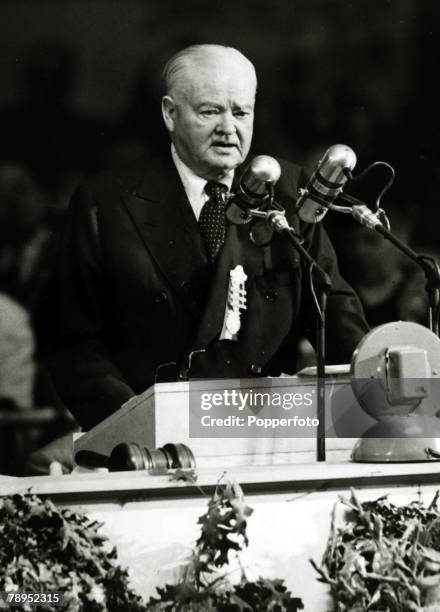
Hoover at the 1948 Republican Convention in Philadelphia.
They continued to invite him to every Convention,
and he kept coming until 1960.

From their days as fellow members of the U.S. Senate, Truman was good friends with Alben Barkley, the Kentuckian who was the Democrats' Senate Leader, and had no problem accepting him as the nominee for Vice President. But he hitched his wagon to the legacy of Franklin Delano Roosevelt, effectively making the New Deal his platform (his 1949 State of the Union Address would update it for the times as "the Fair Deal"), and FDR's ghost his running mate.
Truman and Roosevelt, at FDR's Hyde Park estate,
after the 1944 Democratic Convention

Truman knew he could win, and he knew how he could do it: By going to the people themselves, in what the GOP derisively called "a whistle-stop campaign," a phrase Truman ran with, and explaining the truth to people where they were, and in terms they could understand -- without talking down to them, as Donald Trump does today. He connected with people the same way FDR did, even though they were very different men.

The crowds Truman got at the "whistle stops" were huge. Writers for conservative papers tried to say that it was just people coming out to the political equivalent of a vaudeville show. Walter Lippman, often called "the Father of American Journalism," pointed out that it took Truman away from Washington for 16 days, and inadvertently proved how little he mattered.

But Lippman had never left Washington. Nor had most of the tour's critics seen it. As would be said today, they remained inside their bubble. Or, as Bob Dylan would sing in 1965, "Something is happening here, but you don't know what it is, do you, Mr. Jones?"

On Election Night, NBC announcer H.V. Kaltenborn announced, "Well, the President is leading by over a million votes in the popular vote, but we believe that when the country vote comes in, he will be defeated by an overwhelming majority." Indeed, at one point, he saw something that suggested that the election had swung to Dewey, and proclaimed him the winner.

On his way back from Kansas City to Washington, Truman stopped at Union Station in St. Louis, and was presented with a copy of that morning's Chicago Daily Tribune. The publication calling itself "The World's Greatest Newspaper" (hence the call letters of the radio station they founded, WGN) was published by "Colonel" Robert McCormick, the Rupert Murdoch of his era: A man who would tell any lie and spread any rumor, so long as it fulfilled his principle of electing more Republicans, so he could make more money.

But the Trib had violated what would later be called the Felix Unger Rule: "You should never assume, because, when you ASSUME, you make an ASS of U and ME." The result was the most famous headline in newspaper history, and Truman was delighted to see his old enemy the Colonel make an ass of himself. After all, it wasn't enough for the Colonel to have his paper say, in a huge headline, "DEWEY WINS" or "DEWEY ELECTED." He wanted to rub it in, telling the President he hated so much that he had lost: "DEWEY DEFEATS TRUMAN." Oops.

At a celebratory dinner in Washington a few days later, Truman threw the guests into laughter, imitating Kaltenborn's clipped delivery. He also thanked those who had stood by him, and those who should have: "The September Democrats and the October Democrats... and the Monday Democrats, and the Tuesday Democrats, and the Wednesday Democrats!"

Ever since, Ol' Harry S has been the patron saint of political underdogs, of the people who are told they can't possibly win.

(There's no period on his middle initial, since it legally didn't stand for anything, as his parents couldn't agree on whether to name him after one of his grandfathers, Anderson Shippe Truman or Solomon Young. So his entire middle name was the letter S, with no period. His mother's brother was Harry Young, and the name was "Harry," not "Henry" or "Harrison." His legal name was "Harry S Truman.")

Even Republicans cite him as an inspiration. As Truman himself would have said, "Well, that's just political conversation." Or, as his only child, Margaret, who became a noted writer of mystery novels after a failed singing career, put it while editing one of her father's books, and seeing the words "political conversation" written down, "My father originally used a shorter word here, but decided to change it." Clearly, Margaret was too much of a lady, even then, to say what the word was. Just as clearly, the word was "bullshit."

Truman did love him some of what I like to call "George Carlin words." Legend has it that Harry and his wife Bess (formerly Elizabeth Wallace) toured a greenhouse, and Harry, a former farmer himself, told the owner, a woman, that she "must have used some good manure." The owner pulled Bess aside and said, "Can't you get the President to say, 'Fertilizer'?" And Bess said, "It's taken me this long just to get him to say, 'manure'!"

Truman won 24.1 million votes, Dewey 22.0 million, Thurmond 1,175,930, Wallace 1,157,328. Popular vote share: Truman 49.5 percent, Dewey 45.1, Thurmond 2.41, Wallace 2.37. States: Truman 28, Dewey 16, Thurmond 4, Wallace none. Electoral Votes, with 266 being a majority: Truman 303, Dewey 189, Thurmond 39, Wallace none. Wallace got 8.2 percent of the popular vote in New York, 4.7 percent in California, and in no other State did he get more than 4 percent.

After the election, a study by the University of Michigan revealed that "14 percent of Truman's voters, or 3,374,800, had decided to vote for him in the last fortnight of the campaign." In the last 2 weeks.

Gallup and Roper also did an analysis of the votes: They "learned that one voter in every seven (6,927,000), made up his mind in the last two weeks before the election. Of these, 75 percent picked Truman."

The Democrats also swept back into power in Congress, taking 75 seats in the House of Representatives and 9 in the Senate. Notable newly-elected Senators included Democrats Humphrey, Estes Kefauver of Tennessee, Paul Douglas of Illinois, and Bob Kerr of Oklahoma. Only 2 new Republicans were elected: Margaret Chase Smith of Maine (making her the 1st woman to serve in both houses of Congress) and Robert Hendrickson of New Jersey. Indeed, of the 91 Republicans newly elected to the House in 1946, more than half of them went down to defeat.

Charles Bennett of Florida was the last Congressman elected in 1948 still continuously serving, retiring before the 1992 election. However, Sidney Yates of Illinois, elected in 1948, left the House in 1962 to run for the Senate. He lost, but regained his House seat in 1964, and remained until retiring before 1998.

The truth was, it wasn't that close. People who voted for Dewey were basically voting for him simply because he was the Republican nominee. Outside New York State, he was not especially popular. Even people who met him didn't find him personally likable. In 2 elections as the Republican nominee for President, he only won a total of 288 Electoral Votes, barely enough to win 1. This time, the non-Republican vote was 54.3 percent. Truman had made the election a referendum on the Republicans, and it worked in his favor. 

The polls had gotten it all wrong. Radio comedian Fred Allen used a horse racing metaphor: He said that Truman had become the 1st man to lose in a Gallup and win in a walk. 

If Dewey hadn't been so complacent, he would have realized that Truman was reaching the hearts and minds of the people. And he might have gone out to answer Truman's charges against him and "that do-nothing Republican 80th Congress." Maybe the Republicans, as a party, blew it for Dewey. But he also blew it for himself.

No friend of Truman's, or any Democrat's, Time magazine boss Henry Luce named Truman his magazine's Man of the Year for 1948, as he had for 1945. I suspect it was more for the Marshall Plan and the Berlin Airlift than it was for the election.

Truman could have run for what would have amounted to a 3rd term in 1952, but didn't. He went back to Independence, where he built, opened, operated, and lectured at his Presidential Library, until a broken hip in 1965 put an end to his public life. He died in 1972.

Vice President Barkley ran a half-hearted campaign to succeed Truman in 1952, but, already 74 years old and a Southerner, he knew he had little chance. He died in 1956.

Dewey was elected to a 3rd term as Governor of New York in 1950, and left office after that 3rd term. The New York State Thruway is also known as the Governor Thomas E. Dewey Thruway. Despite being 17 years younger, he died in 1971, a year before Truman.

Wallace drifted into obscurity, and wrote books about farming, his specialty. He died in 1965, of Lou Gehrig's disease. Thurmond returned to the Democratic fold, was elected to the Senate in 1956, became a segregationist leader, switched to the Republican Party after the signing of the Civil Rights Act of 1964, and kept getting re-elected to the Senate until 2002, when, approaching his 100th birthday, even he had to admit that he wouldn't survive another term. He died the next year.

Truman's Presidential Library opened in Independence, 10 miles east of downtown Kansas City, on July 6, 1957. The USS Harry S Truman is a nuclear-powered aircraft carrier, CVN-75, a.k.a. The HST, in service since 1996. There are high schools named for Truman in Independence (naturally), New York City (as part of the Co-Op City complex in The Bronx), the suburbs of Philadelphia (Levittown, Pennsylvania), Detroit (Taylor, Michigan) and Seattle (Federal Way, Washington). And there is a Truman College in Chicago.
Statue, U.S. Capitol Building

Truman remains the only President born in Missouri, or representing it in politics. Aside from Ulysses S. Grant, he remains the only one to have lived there for a significant amount of time; and, unlike Grant, it was for his entire life.

He has been played by Robert Vaughn in The Man from Independence in 1974, James Whitmore in Give 'em Hell, Harry! in 1975, E.G. Marshall in Collision Course: Truman vs. MacArthur in 1976, Ed Flanders in MacArthur in 1977, Harry Morgan in Backstairs at the White House in 1979, Walker Edmiston in J. Edgar Hoover in 1987, Richard Dysart in Day One in 1989, Gary Sinise in Truman in 1995, David Patrick Kelly in Flags of Our Fathers in 2006, and Bob Gunton in Project Blue Book in 2019. (UPDATE: He was played by Gary Oldman in Oppenheimer in 2023.)

Charles F. Brannan was the last surviving member of the Truman Cabinet, serving as Secretary of Agriculture in the 2nd term. He lived until 1992.

As for Dewey, in 1964, the New York State Thruway, which he got built as Governor, was officially renamed the Governor Thomas E. Dewey Thruway, although most people in the State call it just "The Thruway."

Robert McCormick died in 1955. The Tribune dropped "Daily" from its name in 1963, and began its shift away from doctrinaire conservatism in 1969. Still, it didn't endorse a Democrat for President until 2008, with home-State Senator Barack Obama.

*

November 2, 1948, like all modern Election Days in America, was a Tuesday. The baseball season was over. There were no football games played. The NBA season had started the day before, but there were no games on this day. And the NHL also had no games scheduled. So there were no scores on this historic day.

Saturday, July 23, 2022

July 23, 1948: The Progressive Convention Nominates Henry Wallace

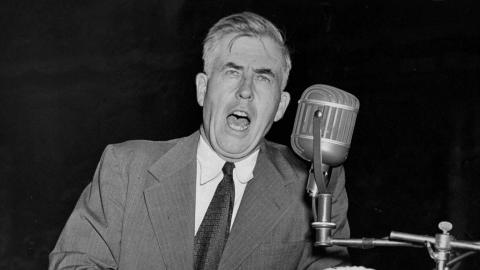
July 23, 1948: As the Democratic and Republican Parties both did this year, the Progressive Party holds its Convention at the Convention Hall of the Philadelphia Civic Center. The left-wing party, with little connection besides name to the Theodore Roosevelt party of that name of 1912 and the Robert LaFollette version of 1924, nominates Henry Wallace for President.

Henry Agard Wallace was born on October 7, 1888 in Orient, Iowa, and grows up in Des Moines, Iowa. In 1923, when his father, Henry Cantwell Wallace, was serving as U.S. Secretary of Agriculture under Presidents Warren Harding and Calvin Coolidge, the younger Henry actually did more to support American farmers and feed people all over the world, developing a hybrid corn he called Copper Cross. It revolutionized corn production.

A split between the Wallaces and U.S. Secretary of Commerce Herbert Hoover, himself an Iowa native, led to the Wallaces leaving the Republican Party and supporting the Progressive Party candidacy of Governor Robert La Follette of Wisconsin in 1924. It may also have hastened the death of the elder Henry, right before the election, which Coolidge won.

When Hoover was elected President in 1928, the stock market Crash of 1929 and the Great Depression followed within a year, devastating the already hard-hit American farmers. In 1932, the younger Henry Wallace worked for the election of Democratic Governor Franklin D. Roosevelt of New York. When FDR won, he appointed Wallace to his father's old post. Historian Arthur Schlesinger Jr. wrote that Wallace was "the best Secretary of Agriculture the country has ever had," but also that he was "an incorrigibly naive politician."

In 1940, FDR ran for a 3rd term, with Wallace as his Vice President. Farmers, labor leaders and civil rights activists were happy with this, but Southerners didn't like his closeness to black leaders, and big business didn't like his openness to the Soviet Union. In 1942, he gave a speech, citing a term coined by Time magazine publisher Henry Luce, saying, "Some of have spoken of the 'American Century.' I say that the century on which we are entering, the century which will come into being after this war, can be, and must be, the Century of the Common Man."

But the Democratic Party's conservative wing, believing (correctly, as it turned out) that FDR was a sick man, and might not survive a 4th term, didn't want Wallace succeeding him. In 1944, for one of the few times in his career, FDR got ganged-up-on, and dropped Wallace from the ticket, in favor of Senator Harry Truman of Missouri.

With some irony, Wallace was appointed to Hoover's old job, Secretary of Commerce. FDR died in 1945, and Truman became President. Wallace split with Truman over Cold War policy, resigned in 1946, and ran for President to Truman's left in 1948.

The Vice Presidential nominee was Senator Glen H. Taylor of Idaho, also normally a Democrat. Just 44 years old, and in his 1st term, he had run for the Senate in 1940 (a special election) and 1942, and finally won in 1944. He was considered the 2nd-most liberal Senator, behind Wayne Morse of Oregon, a Republican who eventually became an Independent, and then a Democrat. In 1945, he submitted a resolution to the Senate, "favoring the creation of a world republic." A one-world government has long been a great fear of conservatives, afraid that it would, by nature, be Communist.
Taylor (left) and Wallace

Before going into politics, Taylor had been recorded singing country music, and his sister was a jazz singer under her married name, Lee Morse. (Her husband, though a supporter of Glen's, was no relation to Wayne.)

Wallace gave his acceptance speech outdoors -- not at nearby Franklin Field, owned by the University of Pennsylvania, and not exactly welcoming to leftists, but halfway across the city, at Shibe Park, then the home of baseball's Athletics and Phillies and football's Eagles.

You talk about your "Hollywood liberals": The Progressives had the support of John Huston, Lee J. Cobb, Uta Hagen, Judy Holliday, Sam Jaffe, and, singing its campaign songs, Paul Robeson.

Also: Writers W.E.B. DuBois, Howard Fast, Dashiell Hammett, Lillian Helman, Garson Kanin, Thomas Mann, Arthur Miller, Clifford Odets, S.J. Perelman, Budd Schulberg, I.F. Stone, Mark Van Doren, and the big new thing in American letters, Norman Mailer, who had published his debut novel, the World War II story The Naked and the Dead, a few weeks earlier. Also: Musical personalities Aaron Copland, Artie Shaw and Burl Ives; scientist Linus Pauling; and architect Frank Lloyd Wright.

However, the Wallace campaign also had big support from the Communist Party, which tainted it in the eyes of average Americans. It was tainted to the point that most conservatives didn't both to attack it. An exception was far-right fanatic Westbrook Pegler, of William Randolph Hearst's newspaper syndicate: He called Wallace a "messianic fumbler" and "off-center mentally." The former charge had some reason, as he had some religious views that were considered unacceptable then, and would even be odd now; the latter charge could have been leveled at Pegler himself.

The fear among Democrats was that the Progressives would pull enough liberal votes -- hard-left, labor and black -- from New York City to cost Harry Truman New York State, Philadelphia to cost him Pennsylvania, Boston to cost him Massachusetts, Detroit to cost him Michigan, Chicago to cost him Illinois, and Los Angeles and San Francisco to cost him California, thus costing him the election. And, of course, Governor Strom Thurmond of South Carolina had temporarily left the Democrats to lead the States' Rights Party, the "Dixiecrats," and Democrats feared that would help cost them the election as well.

In the end, the popular vote was as follows: Truman, a little over 24 million; Dewey, a little under 22 million; Thurmond, 1,176,023; and Wallace, 1,157,328. Percentages: Truman 49.5, Dewey 45.0, Thurmond 2.41, Wallace 2.37. Electoral Votes: Truman 303, Dewey 189, Thurmond 39, Wallace none. Wallace did not win a single State, or even a single County. He couldn't even beat a segregationist, who wasn't even on the ballot in all the States, for 3rd place overall.

Dewey did, indeed, win New York (where he lived), Pennsylvania and Michigan (where he was born). And Wallace did win 60 percent of the votes he would win in New York State and California alone.

Had Wallace also thrown Illinois and California to Dewey, Dewey would have led in Electoral Votes, 252-250, but fallen short of the 269 needed to be elected. The election would have been thrown to the House of Representatives, then controlled by the Republicans, and Dewey would have won. Instead, Truman hung on to Illinois by 33,000 votes, and California by 18,000 votes, and won.

Wallace got 2.37 percent of the popular vote. Openly leftist candidates have struggled to do even that well since. In 2000, Ralph Nader got 2.74 percent. In 2016, Jill Stein got 1.07 percent. Each time, it was enough to cost the Democratic nominee the election, something Wallace was unable to do.

He turned back toward earlier stances after 1948. He repudiated the Soviet Union in 1952, and did not endorse a candidate in that year's election. He endorsed President Dwight D. Eisenhower for re-election in 1956, and refused to endorse a candidate in 1960. Nevertheless, he supported Democratic Presidents John F. Kennedy and Lyndon B. Johnson.

In 1963, as part of a discussion of the 30th Anniversary of FDR's Inauguration and the New Deal in 1933, he appeared on the NET (forerunner of PBS) talk show The Open Mind, hosted by Rutgers University professor Richard D. Heffner. The other guests were James Roosevelt, FDR's son and a close aide, and later a Congressman from California; James A. Farley, FDR's campaign manager and Postmaster General; Thomas G. Corcoran, a.k.a. Tommy the Cork, a New Deal official who had become an advisor to LBJ; and Ernest K. Lindley, who covered the FDR Administration for the New York Herald Tribune and later The Washington Post.

Shortly after that appearance, in which he barely moved and looked stiff and uncomfortable, Wallace was diagnosed with amyotrophic lateral sclerosis. Like the most famous ALS patient, whose name was given to the disease, Lou Gehrig, he consulted numerous specialists and tried various methods of treating the disease, saying, "I look on myself as an ALS guinea-pig, willing to try almost anything." Nothing worked, and he died on November 18, 1965, at the age of 87.

The Henry A. Wallace Beltsville Agricultural Research Center, the largest agricultural research complex in the world, was named for him, and is located in the Washington suburb of Beltsville, Maryland. The visitor center at the Franklin D. Roosevelt Presidential Library and Museum at Hyde Park, New York is named the Henry A. Wallace Visitor and Education Center. It doesn't have a statue of Wallace, but it does have one of what FDR called "my little dog, Fala."

None of Wallace's children entered politics, but his grandson, Scott Wallace, was the Democratic nominee for the U.S. House of Representatives in Pennsylvania's 1st District in 2018, losing a close race with nearly 49 percent of the vote.

Wallace's running mate, Glen Taylor, lost his bid for re-election in the 1950 Democratic Primary, and ran and lost again in 1954 and 1956. Having lost his hair earlier than most men, he wore homemade hairpieces, and began designing and selling them after leaving politics. By 1960, Taylor Topper was America's leading hairpiece company. It is now known as Taylormade Hair Replacement.

He also went back to show business, appearing in 9 episode of The Adventures of Ozzie and Harriet. He died in 1984, at the age of 80.

*

July 23, 1948 was a Friday. These baseball games were played:

* The New York Giants beat the Chicago Cubs, 5-0 at Wrigley Field in Chicago. Larry Jansen pitched a 5-hit shutout. Johnny Mize hit a home run.

* The Brooklyn Dodgers beat the Pittsburgh Pirates, 4-3 at Forbes Field in Pittsburgh. Erv Palica was the winning pitcher. Pee Wee Reese and Tommy Brown hit home runs. Jackie Robinson went 2-for-4 with a stolen base and an RBI. For the Pirates, Ralph Kiner went 0-for-3 with a walk.

* The Boston Red Sox beat the Chicago White Sox, 13-1 at Fenway Park in Boston. Ted Williams went 2-for-4 with a walk and 3 RBIs. The only Boston home run was hit by Bobby Doerr. The best White Sox player of the era, Luke Appling, went 0-for-3 with a walk.

* The Detroit Tigers beat the Washington Senators, 11-5 at Griffith Stadium in Washington.

* The Philadelphia Phillies beat the Cincinnati Reds, 6-1 at Crosley Field in Cincinnati.

* The St. Louis Cardinals beat the Boston Braves, 7-5 at Sportsman's Park in St. Louis. Stan Musial went 3-for-4 with a walk and an RBI.

* The Philadelphia Athletics and the St. Louis Browns were rained out at Shibe Park in Philadelphia. The game was made up as part of a doubleheader on August 27. The A's swept, 6-0 and 9-1. Dick Fowler pitched a 3-hit shutout in the opener.

* And the New York Yankees and the Cleveland Indians were not scheduled.

Thursday, July 21, 2022

July 21, 1944: "The Second Missouri Compromise"

Truman and Roosevelt at FDR's home in Hyde Park, New York,
after the Convention. The color is real.
Truman was 60 and healthy. FDR was 62 and not.

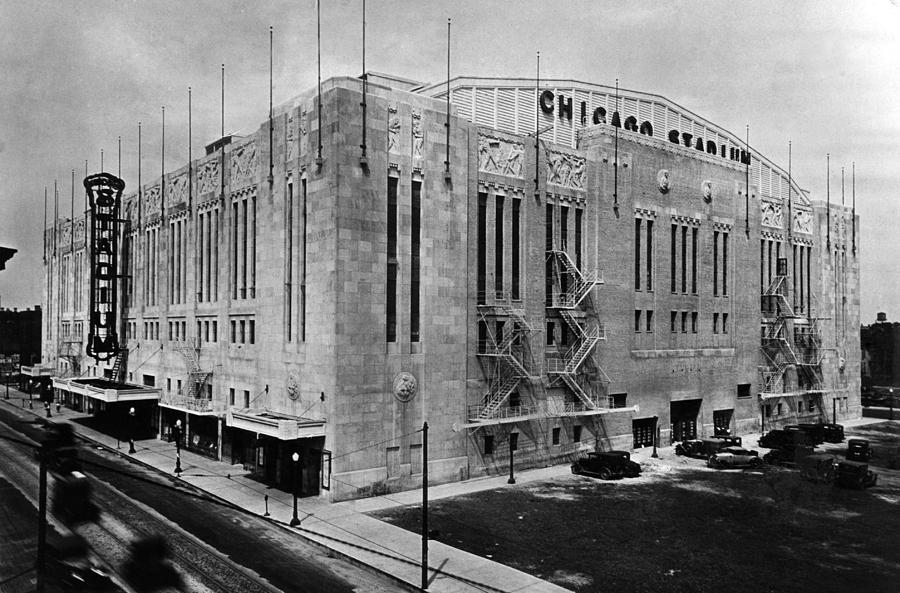
July 21, 1944: The Democratic Convention is held at Chicago Stadium. 12 years earlier, at the same building, Franklin Delano Roosevelt was nominated for President for the 1st time, and, decided to show his physical vitality (and dampen the rumors polio having rendered him an invalid) by flying there, something that was considered truly daring at the time, and became the 1st nominee of either major party to delivers acceptance speech in person.

This time, his 4th nomination, he became the last major party nominee to not show up, a concession to his worsening health, but use the excuse that World War II was keeping him at home. Instead, a radio hookup was made to the White House, so he could give his acceptance speech remotely.

To make matters worse, the more conservative elements in the party demanded that he dumped Vice President Henry Wallace from the ticket, because he was seen as being too friendly to the Soviet Union, which was still our ally at the time; but also because he was too friendly with both organized labor and the civil rights movement. They thought FDR might be dying, and they didn't want Wallace as President.

The more conservative elements of the Party, especially the Southern wing, wanted James F. Byrnes. On paper, he was definitely qualified to be President, let alone Vice President. He had served South Carolina in both houses of Congress, had briefly been an Associate Justice of the U.S. Supreme Court, and was, at this point, the Director of the Office of War Mobilization. But, like most Southern politicians of the time, he was racist and anti-labor. And both the civil rights movement and the labor movement, both friendly to Wallace, wouldn't allow Byrnes to be nominated.

So the Convention was at an impasse. And Party insiders knew what the general public did not: FDR was already ill, and the thought had come to them that he might not survive a full 4th term. Whoever they chose as Vice President to the 32nd President was likely to be the 33rd. That's why civil rights and labor wanted Wallace, and the South wanted Byrnes: They wanted the next President to be one of their guys, and wanted it badly.

FDR -- having once told a reporter, "You know, I'm a juggler, and I have to keep several balls in the air at the same time" -- needed a Vice Presidential nominee was acceptable to both the Byrnes side of the party and the Wallace side. What became known as "The Second Missouri Compromise" was made, and that State's Senator, Harry Truman, was chosen.

(The first "Missouri Compromise" was in 1820, designed to keep the number of free States and slave States even: Missouri would be admitted as a slave State, while Maine was separated from Massachusetts, and added as a free State.)

Truman wasn't a total unknown: He had chaired the Senate committee that exposed war profiteers, and had appeared on the cover of Time magazine the year before. He was in his 2nd term, and was qualified. One thing bugged some people: He had come out of the "political machine" in Kansas City, run by the crooked Thomas Pendergast. But no one ever found any evidence of corruption on Truman's part.

Truman was offered the nomination, but wasn't sure. FDR had to convince him over the phone, and he accepted. But FDR wanted to assure labor leaders that the choice was a good one. Robert Hannegan was the Chairman of the Democratic National Committee, and, as a native of St. Louis, on the other side of Missouri, was an ally of Truman, and key to his nomination. Referring to Sidney Hillman, President of the Congress of Industrial Organizations, "And clear everything with Sidney!"

Founded in 1935 as a more liberal labor group than the American Federation of Labor, the CIO had been assailed as Communist by conservatives. When FDR's demand that Truman's nomination be cleared with Hillman reached the press, Republican-leaning newspapers suggested that Hillman was actually running the Party. Hillman had actually worked hard to keep Communists out of the CIO. Nevertheless, someone wrote a limerick, a Red-baiting smear -- and possibly an anti-Semitic one, as Hillman was Jewish:

Clear it with Sidney, you Yanks.
Then offer Joe Stalin your thanks.
You'll bow to Sid's rule
no matter how cruel
for that's a directive of Frank's.

The Republicans nominated Governor Thomas E. Dewey of New York for President, and Governor John Bricker of Ohio for Vice President. This allowed them to write one of those campaign slogans that occasionally rhymes with the ticket: "Win the war quicker with Dewey and Bricker."

Despite the Republicans' insistence that they could win The War quicker (which was unlikely), and the insinuations that FDR was dying (which he was) and his Administration was loaded with Communists (which it wasn't), Roosevelt and Truman won. It had little to do with Dewey's youth and inexperience (he was just 41, and had been Governor less than 2 years after several years as a crusading District Attorney), and more to do with FDR being the man America knew, and knew it could trust to win The War and avoid another depression after it.

Just 3 months into his 4th term, with the European phase of The War nearly won, FDR died, and Truman became President. After V-E Day, Truman decided that Secretary of State Edward Stettinius was too cozy with the Soviet Union, fired him, and replaced him with Byrnes, who had been a friend in the Senate. But relations between them soured after V-J Day, and Byrnes lasted just a year and a half in the office.

In 1950, he was elected Governor of South Carolina. This was unusual, especially at the time, because it usually worked the other way around: Southern Governors often used their jobs as springboards for the Senate, mainly because their State Constitutions usually prevented Governors from serving consecutive terms. (Most now can, with Virginia the only exception.) In South Carolina, this has since included Strom Thurmond and Ernest "Fritz" Hollings. Unfortunately, Byrnes was a typical Southern politician of his time, and resisted desegregation. After leaving the Governorship after his mandated single term, he never ran for office again.

Byrnes never endorsed another Democrat for President, endorsing Thurmond over Truman in 1948, independent segregationist Harry Byrd Sr. in 1956, and Republicans Dwight D. Eisenhower in 1952, Richard Nixon in 1960 and 1968, and Barry Goldwater in 1964. That year, over the Civil Rights Act, Thurmond, who had returned to the Democratic Party after the 1948 election, became the 1st major Southern politician to switch to the Republican Party, and Byrnes supported him, though himself remaining officially a Democrat.

Byrnes died in 1972, 8 months before Truman did, and 7 years after Wallace. By this point, Byrnes had been mostly forgotten outside his home State, with most Americans being unaware of how close he came to becoming President of the United States. Wallace came even closer. Truman actually made it.

*

July 21, 1944 was a Friday. Paul Wellstone was born, and, like Truman and Byrnes, would be elected to the U.S. Senate, in his case Minnesota. He became one of the most liberal Senators, and many people wanted him to run for President. He never did, dying in a suspicious plane crash while running for re-election in 2002.

These baseball games were played:

* The New York Yankees beat the St. Louis Browns, 8-2 at Sportsman's Park in St. Louis. Atley Donald went the distance for the win. In spite of this, the Browns won their one and only American League Pennant this season, ending the Yankees' run of 3 straight and 7 out of 8.

* The New York Giants lost to the St. Louis Cardinals, 5-0 at the Polo Grounds. Harry "the Cat" Brecheen pitched a 5-hit shutout. Mel Ott, now the Giants' player-manager, got 1 of those hits. So did former Cincinnati catching star Ernie Lombardi, now running out the string with the Giants. Stan Musial, one of the few big stars not yet serving in The War (he would spend the 1945 season in the Navy), went 2-for-5.

* The Brooklyn Dodgers lost to the Cincinnati Reds, 3-2 at Ebbets Field in Brooklyn.

* The Chicago Cubs beat the Boston Braves, 4-2 at Braves Field in Boston.

* And the Pittsburgh Pirates beat the Philadelphia Phillies, 5-3 at Shibe Park in Philadelphia.

* The Cleveland Indians beat the Philadelphia Athletics, 4-1 at Cleveland Municipal Stadium.

* The Detroit Tigers beat the Washington Senators, 6-5 at Briggs Stadium (later Tiger Stadium) in Detroit. Dizzy Trout outpitched Early Wynn.

* The Chicago White Sox beat the Boston Red Sox, 5-3 at Comiskey Park in Chicago.

Saturday, July 16, 2022

July 16, 1940: "We Want Roosevelt!"

July 16, 1940: The Democratic National Convention is being held at the Chicago Stadium, the big Midwestern city's largest arena, home of the NHL's Chicago Black Hawks. (Starting in 1986, the official spelling became one word: "Blackhawks.")

It's not going well. The Democratic Party is badly divided. Their leader, the incumbent President, Franklin Delano Roosevelt, is in his 8th year, the last year of his 2nd term. Only 2 of the previous 30 men to hold the Presidency have run for a 3rd term, or what would have amounted to one: Ulysses S. Grant and FDR's cousin, Theodore Roosevelt. Only 2 others have even seriously considered it, before realizing that they were unlikely to win: Grover Cleveland and Woodrow Wilson.

But FDR has made no announcement as to whether he would run again. To make matters worse, the Democrats appear to have no obvious successor in place:

* Vice President John Nance Garner was a Southerner, from Texas. Although Andrew Johnson had become President upon the death of Abraham Lincoln, and Woodrow Wilson had been a Virginia native but the Governor of New Jersey when he was elected, no politician representing a Southern State had been elected President since Zachary Taylor from Kentucky in 1848. And even he wasn't exactly a "politician": He was the leading General of a war that had just been won, and had never run for office before. Garner was also considered too conservative outside the South.

* The other major candidate was the Chairman of the Democratic National Committee, who was also in FDR's Cabinet, as Postmaster General: James A. Farley of New York. Farley was considered a great organizer, but didn't really have name recognition among the general public, and was a Catholic. Except for Alfred E. Smith, who lost the general election of 1928 very badly, no Catholic had ever even been nominated for President by a major party.

* FDR might have wanted his Secretary of State, Cordell Hull, to be the next President. But Hull was another Southerner, having served Tennessee in both houses of Congress. What's more, Hull had a speech impediment on top of his Southern accent, which would have ruined a campaign in this era of radio and newsreels.

* Another would-be President, Joseph P. Kennedy, the U.S. Ambassador to Great Britain, a Boston native who thought that his large personal fortune and network of personal contacts could make him the 1st Catholic President, but his isolationism and apparent favoritism toward Nazi Germany made him persona non grata in the Party.

* Several potential Presidential candidates had been defeated in the Republican tide of the 1938 elections, including James Michael Curley, the former Mayor of Boston and Governor of Massachusetts, who lost a Senate race that year. And, besides, he was a Catholic.

* And then, of course, there were the Republicans. Having gotten clobbered in the elections of 1930, 1932, 1934 and 1936, they didn't have a clear President-in-the-making, either. They ended up nominating Wendell Willkie, a man with no political experience, but a strong anti-New Deal message, but also a willingness to help Britain against Nazi Germany in World War II, while otherwise keeping the U.S. out of it -- in other words, FDR's position.

FDR had been thinking about running for a 3rd term, even in 1939, but he really wanted to retire to his mansion on the Hudson River in Hyde Park, New York. Certainly, the Republicans' rhetoric at their Convention, in Philadelphia, suggested that they were running against him, as the avatar of American liberalism, rather than against the Democratic Party in general.

What made FDR run again was the Nazis' leader, Adolf Hitler. In May, his troops began marching across Western Europe. By mid-June, it had all fallen to him, even France. Britain was next in their sights, and whoever was going to be President starting on January 20, 1941, the end of FDR's 2nd term, was going to have to deal with Hitler's seemingly limitless ambition. And he, Roosevelt, was the only person in the country who was even remotely experienced enough to take Hitler on.

The problem was, being that he was seeking an unprecedented 3rd term, he had to do what Presidential candidates used to do, before his time: Make it look like he wasn't actively running. The idea was that the office should seek the man, not the other way around. So he drafted a statement for the Convention Chairman, Senate Majority Leader Alben Barkley of Kentucky, to read to the Delegates. It concluded:

The President has never had, and has not today, any desire or purpose to continue in the office of President, to be a candidate for that office, or to be nominated by the convention for that office. He wishes in earnestness and sincerity to make it clear that all of the Delegates in this Convention are free to vote for any candidate.

The Delegates sat in shocked silence for a moment. Then came a voice thundering over the stadium loudspeakers: "We want Roosevelt! We want Roosevelt! We want Roosevelt!"

The voice belonged to Thomas D. Garry, Superintendent of Chicago's Department of Sanitation -- in other words, the sewer department. He was a trusted henchman of Chicago Mayor Edward J. Kelly, the Convention's host, an FDR loyalist, and, himself, chief engineer of the Chicago Sanitary District during the 1920s.

Garry was stationed in a basement room with a microphone, waiting for that moment. Kelly had posted hundreds of Chicago city workers and precinct captains around the Stadium. Other Democratic bosses had brought followers from their home territories. All of them joined Garry's chant. Within a few seconds, hundreds of delegates joined in. Many poured into the aisles, carrying state delegation standards for impromptu demonstrations. Whenever the chant began to die down, State chairmen, who also had microphones connected to the speakers, added their own endorsements: "New Jersey wants Roosevelt!" "Arizona wants Roosevelt!" "Iowa wants Roosevelt!"

Despite coming out of the loudspeakers, Garry was in the basement, and thus became known as "The Voice From the Sewers." Life magazine, conservative as always, called it a "shabby pretense" that "fooled nobody." Nevertheless, on the 1st ballot, FDR got 946 Delegates, Farley 73, Garner 61, and others got 20. There would be no 2nd ballot.

It would be harder to get the Vice President FDR wanted. Nobody wanted Garner to have the job for a 3rd term, including Garner himself: The former Speaker of the House had said, "The job isn't worth a pitcher of warm piss." For public consumption, it was printed as "a pitcher of warm spit."

FDR wanted his Secretary of Agriculture, Henry Wallace. There were problems with this: Wallace was a former Republican, was pro-civil rights, and was considered to have questionable ties, both to the Soviet Union and to Nicholas Roerich, a Russian painter, writer and philosopher with some odd views. The conservative Southerners were adamant that Wallace not be nominated.

So FDR sent First Lady Eleanor Roosevelt to Chicago, to speak on behalf of Wallace. She flew there, and told the Delegates, "You cannot treat this as you would an ordinary nomination in an ordinary time." It was the best-received speech of the Convention, and Wallace defeated the Speaker of the House, William Bankhead of Alabama, on the 1st ballot.

Perhaps Bankhead would have made a stronger bid for the office had he not been ill, and he died 2 months later. His father, John, had served Alabama in both houses of Congress; his brother, John II, was a Senator and a Delegate to the Convention; and his daughter, Tallulah Bankhead, was one of America's greatest actresses.

Unlike in 1932 in Chicago, and in 1936 in Philadelphia, FDR felt he had to stay in Washington, and so he delivered his acceptance speech remotely, by radio, which was piped into the Convention. He would do the same in Chicago in 1944. He was the 1st Presidential nominee to deliver his acceptance speech in person, and he remains, through the 2020 election, the last one to not do so.
The 1940 Convention was not one of the Democratic Party's best. But it did show a commitment to the principles that FDR had stood for, and wanted to stand for. For all intents and purposes, it is still his Party.

Ed Kelly served as Mayor of Chicago from 1933 to 1947, and lived until 1950. Thomas D. Garry, who had worked on a sewer survey under Kelly, served as Assistant Commissioner until 1963, and who always insisted that the D stood for "Democrat," lived until 1976.

*

July 16, 1940 was a Tuesday. These baseball games were played:

* Elsewhere in Chicago, at Wrigley Field, the New York Giants lost to the Chicago Cubs, 2-0. Vern Olsen pitched a 6-hit shutout, outpitching Harry Gumbert. Phil Cavarretta drove in both runs with a 7th-inning single. Mel Ott went 1-for-3 with a walk.

* The New York Yankees lost to the Chicago White Sox, 5-1 at Yankee Stadium. Johnny Rigney outpitched Marius Russo. Joe Kuhel hit a home run. Joe DiMaggio went 1-for-4, driving in the Yankees' only run.

* The Brooklyn Dodgers lost to the Pittsburgh Pirates, 5-3 at Forbes Field in Pittsburgh.

* The Philadelphia Athletics beat the Detroit Tigers, 3-1 at Shibe Park in Philadelphia. Hank Greenberg went 1-for-4.

* The Washington Senators beat the Cleveland Indians, 11-8 at Griffith Stadium in Washington.

* The St. Louis Cardinals beat the Boston Bees, 4-3 at Sportsman's Park in St. Louis. This was the last of 5 seasons in which the Boston team of the National League used the Bees name. The next season, they went back to their former name, the Boston Braves.

* The Boston Red Sox and the St. Louis Browns moved their game scheduled for today back 2 days, to have a Sunday doubleheader and a bigger gate. The BoSox won the opener, 5-4. Roger "Doc" Cramer doubled Dom DiMaggio (Joe's brother) home with the winning run in the bottom of the 11th inning. This made Emerson Dickman the winning pitcher in relief of Lefty Grove. Dickman would win 22 games in his career; Grove, 300.

The Red Sox won the nightcap, 7-3. Over the 2 games, Ted Williams went 1-for-9.

* And the Cincinnati Reds and the Philadelphia Phillies were rained out at Crosley Field in Cincinnati. It was agreed to play the game on July 28, as part of a Sunday doubleheader, and move it to Shibe Park. The Reds won the 1st game, 7-2. The Phils won the 2nd game, 4-1.

Thursday, April 14, 2022

April 14, 1942: Major League Baseball's Youngest Non-Interim Manager

April 14, 1942: The Cleveland Indians beat the Detroit Tigers, 5-2 at Briggs Stadium in Detroit. (The ballpark will be renamed Tiger Stadium in 1961.) It is the Indians' 1st game with their new manager, who is also their shortstop, perhaps the best shortstop in the game: Lou Boudreau.

Boudreau was named the Tribe's manager on November 25, 1941. He was an All-Star shortstop, well-respected by his teammates, and had been Captain of the basketball team at Bradley University in his native Peoria, Illinois. Sounds like it was a sensible decision, right?

He was only 24 years old. Roger Peckinpaugh, also a shortstop, was named interim manager of the Yankees at the end of the 1914 season, at age 23. Boudreau was, and remains, the youngest regular manager in Major League Baseball history.

Ironically, the Indians manager that Boudreau replaced was Peckinpaugh, who had previously managed the Indians from 1928 to 1933, and again in 1941 -- at the ages of 37 to 42, and 50. He had also been a shortstop, and helped the Washington Senators to win the 1924 World Series. They, too, had a "boy manager," 2nd baseman Bucky Harris, who was 27. He held the record for youngest regular manager until Boudreau broke it.

As time went on, Boudreau was still considered a great player, but his managing skill was in doubt, until 1948, at age 31, when he managed the Indians to victory in the World Series, and was named the American League's Most Valuable Player.

He last managed in 1960, with the Chicago Cubs, and became a broadcaster for them. He was elected to the Baseball Hall of Fame, the Indians retired his Number 5, and he was beloved in both Illinois and Ohio until his death in 2001.

*

April 14, 1942 was a Tuesday. Valery Brumel, the Soviet competitor who once held the world record in the high jump, was born on this day.

These other baseball games were played that day:

* The New York Yankees beat the Washington Senators, 7-0 at Griffith Stadium in Washington. President Franklin D. Roosevelt had thrown out the ceremonial first ball at Griffith Stadium in each of his 1st 9 years as President. But, just as Woodrow Wilson stepped aside from the ceremony at the start of World War I, FDR did so now that America was in World War II. Vice President Henry Wallace did the honors instead.

Charles "Red" Ruffing pitched a 3-hit shutout, and went 2-for-4 with 2 RBIs. (He was a very good hitter for a pitcher, with a .269 lifetime batting average, 36 home runs, and 273 RBIs.) Joe DiMaggio went 1-for-5 with an RBI.

* The Brooklyn Dodgers beat their arch-rivals, the New York Giants, 7-5 at the Polo Grounds. Curt Davis was the winning pitcher, while Hall-of-Famer Carl Hubbell couldn't get out of the 4th inning. Pee Wee Reese hit a home run for the Dodgers, while Johnny Mize hit one for the Giants.

* The Boston Red Sox beat the Philadelphia Athletics, 8-3 at Fenway Park in Boston. Ted Williams went 3-for-5 with a home run and 5 RBIs, starting a season in which he would win the American League's Triple Crown.

* The Boston Braves beat the Philadelphia Phillies, 2-1 at Shibe Park in Philadelphia.

* The Pittsburgh Pirates beat the Cincinnati Reds, 4-2 at Crosley Field in Cincinnati.

* The St. Louis Browns beat the Chicago White Sox, 3-0 at Comiskey Park in Chicago. Bob Muncrief pitched a 3-hit shutout.

* And the Chicago Cubs beat their arch-rivals, the St. Louis Cardinals, 5-4 at Sportsman's Park in St. Louis. Rookie Stan Musial went 2-for-5.

December 31, 1999 & January 1, 2000: The Millennium

December 31, 1999:  The Millennium arrives. The people of planet Earth survived. At a terrible cost. But we hadn't destroyed ourselves. ...