/cdn.vox-cdn.com/uploads/chorus_image/image/66933018/homer-in-the-gloamin.0.jpg)
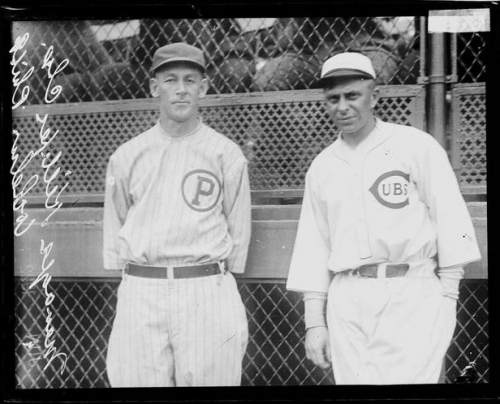
This is the first photo I've ever seen from this game.
As you can see, it was kind of dark.
September 28, 1938: There was a time before 2016 when the Chicago Cubs were the beneficiaries of miracles, not the victims of fate. Okay, it was well before then. But it did happen.
The Cubs won the National League Pennant in 1929, and in 1932, and in 1935. In 1938, they had one of the best teams in baseball. Catcher Charles "Gabby" Hartnett and 2nd baseman Billy Herman would be elected to the Hall of Fame. 1st baseman Phil Cavarretta and 3rd baseman Stan Hack were among the best at their positions. Pitcher Bill Lee (no relation to the later Boston Red Sox pitcher of the same name) won 22 games, while Clay Bryant won 19.
Through the 1st half of the season, they stayed close to the New York Giants (2-time defending NL Champions) and the Pittsburgh Pirates (who hadn't won a Pennant since 1927) for the NL lead. But they tailed off, and by July 12, after losing 2 straight to the Pirates to cap a 6-game losing streak, they were 8 1/2 games behind the Giants.
Then they went on a 7-game winning streak. But it ended on July 19 against the Brooklyn Dodgers, and Cubs owner Philip K. Wrigley had had enough: He fired manager Charlie Grimm, and named Hartnett the interim manager.
Things did not sufficiently improve, at least not right away. A 4-game winning streak was immediately followed by a 4-game losing streak. By August 20, they were 9 games back of the Pirates. The only good news seemed to be that the Giants had run out of gas.
Also out of gas was Dizzy Dean. From 1933 to 1937, as a St. Louis Cardinal, Jay Hanna Dean had been, along with the Giants' Carl Hubbell, the Yankees' Lefty Gomez, and the Negro Leagues' Satchel Paige, 1 of the top 4 pitchers on the planet. But an injury in the 1937 All-Star Game forced him to alter his pitching motion, leading to a worse injury in his elbow. By mid-1938, his great fastball was gone, and the Cards were ready to trade him. The Cubs picked him up. The change of scenery did him some good, as he went 7-1 for the Cubs.
A run of 6 out of 7 in late August got the Cubs to within 5 games of the Pirates. A 6-game winning streak in early September got them to within 3 1/2. A 4-game sweep of the Philadelphia Phillies and a 3-game sweep of the Cards set up a 3-game showdown between the Cubs and the Pirates at Wrigley Field, starting on September 28.
The Cubs started the series a game and a half back, and there were 7 games to go. They won the series opener, 2-1, with Dean getting the win. Now, they were half a game back, with 6 games left.
By 1948, Wrigley Field would be the last Major League Baseball stadium without lights. But at the end of the 1938 season, only Crosley Field in Cincinnati and Ebbets Field in Brooklyn had them. So games being called due to darkness were still very common.
The Cubs opened the scoring with an unearned run in the bottom of the 2nd inning. In the 6th, the Pirates scored 3 runs, but the Cubs scored 2 to tie it. Each team scored 2 in the 8th. The Cubs nearly took the lead on a single by Herman that scored Billy Jurges, but when Joe Marty, who had pinch-hit for starting pitcher Bryant, tried to score the go-ahead run, he was thrown out at the plate by the Pirates' Paul Waner. (Waner would make the Hall of Fame, but more for collecting over 3,000 hits than for his fielding, as good as this throw was.)
The Pirates didn't score in the top of the 9th. The umpires noted how dark it was getting, and announced that if the Cubs didn't score in the bottom of the 9th, the game would be called, and would have to be replayed in its entirety the next day, as part of a doubleheader.
Cavarretta led off, but flied to center. Carl Reynolds grounded to 2nd. Now, Hartnett, the catcher on 3 Cub Pennant winners and now the manager, 38 years old, stepped to the plate against Mace Brown. ("Mace" was his birth name, not short for "Mason" or anything else.) That 1938 season, Brown became the 1st pitcher used mainly in relief to be selected for the All-Star Game.
Brown got ahead of Hartnett, no balls and 2 strikes. But Hartnett connected with his 3rd pitch. The way I first heard the story, the ball went down the left-field line, and it was so dark that the Pirates insisted that it was a foul ball. That was not the case: It was a clean shot to the left-field bleachers, no doubt about it, and there was no protest about it: Home run. Cubs win, 6-5.
Fans poured onto the field. Hartnett was barely able to get around the bases and back to the dugout. The Cubs were now in 1st place by half a game, with 5 games to go. The shot became known as "The Homer in the Gloamin'."
Memory sometimes plays tricks on us: Not only did some people incorrectly remember the homer as being down the line, but some incorrectly remembered it as clinching the Pennant. But there was more to do, and the Cubs did it. They won the series finale the next day, 7-1. They won the Pennant by 2 games.
The New York Yankees swept the Cubs 4 straight in the World Series. The highlight was Game 2, known as "Ol' Diz's Last Stand." Dean battled Lefty Gomez, and was leading 3-2 after 7 innings. But a home run by Frank Crosetti in the 8th made it 4-3 Yankees, and another by Joe DiMaggio in the 9th made it 6-3. Dean was 28 years old, and had won 141 games in the major leagues. His elbow wrecked, he would win only 9 more, but still make the Hall of Fame.
Mace Brown never faced the kind of ridicule faced by other pitchers who gave up famous home runs, like Ralph Branca and Mitch Williams. Or Charlie Root, who gave up Babe Ruth's "called shot" in the 1932 World Series. Or Ralph Terry, who gave up Bill Mazeroski's home run to win the 1960 World Series for the Pirates, which was the next time the Pirates were even in a Pennant race.
But, just as Terry redeemed himself by winning Game 7 of the 1962 World Series for the Yankees with a 1-0 shutout, so, too, did Root get a measure of redemption: He was the winning pitcher in the "Homer in the Gloamin'" game.
Brown would eventually play for 2 Pennant winners: The 1941 Brooklyn Dodgers and the 1946 Boston Red Sox. But both lost the World Series. He remained with the Red Sox organization after he retired, eventually becoming their pitching coach in 1965. The manager he served? One of his opponents in this game, Billy Herman. The Cubs won their next Pennant after 1938 in 1945, but didn't win another until 2016.
Hartnett died in 1972. Mace Brown outlived him by 30 years. But Hartnett is a Hall-of-Famer with a signature moment. Brown is only remembered for being on the other end of that moment. Phil Cavarretta was the last living player from this game, living until 2010.
UPDATE: The Cubs have a team Hall of Fame. Inducted from their 1938 Pennant winners have been catcher and manager Charles "Gabby" Hartnett, 1st baseman Phil Cavarretta, 2nd baseman Billy Herman, 3rd baseman Stan Hack, pitcher Charlie Root, team owner Philip K. Wrigley, executive Margaret Donahue, and public address announcer Pat Pieper.
The Pirates also have a team Hall of Fame. From this 1938 near-miss, they have inducted manager and former 3rd baseman Harold "Pie" Traynor, right fielder Paul Waner, his brother the center fielder Lloyd Waner, and shortstop Joseph "Arky" Vaughan. Ralph Kiner is the only player inducted into this Hall from their next period, the 1940s and '50s, prior to their 1960 World Championship.
*
September 28, 1938 was a Wednesday. Singer Ben E. King was born on this day.
These other Major League Baseball games were played:
* The New York Yankees lost to the Washington Senators, 4-1 at Yankee Stadium. DiMaggio, Crosetti and Red Rolfe each got 2 hits in the game, but that's all the hits the Yankees got. Buddy Lewis hit a home run for the Senators.
* The Boston Red Sox beat the Philadelphia Athletics, 2-1 at Shibe Park in Philadelphia.
* The Boston Bees beat the Philadelphia Phillies, 3-1 at National League Park in Boston. Following a disastrous 1935 season, the Braves tried what would now be called a "rebranding," becoming the Boston Bees, and changing the name of Braves Field to National League Park, with the press nicknaming it "The Bee Hive." In 1941, the names "Boston Braves" and "Braves Field" were restored.
* The Detroit Tigers beat the St. Louis Browns, 12-0 at Briggs Stadium in Detroit. (The ballpark was renamed Tiger Stadium in 1961.)
* The Chicago White Sox beat the Cleveland Indians, 14-11 at League Park in Cleveland.
* The St. Louis Cardinals beat the Cincinnati Reds, 8-7 at Sportsman's Park in St. Louis.
* And the New York Giants and the Brooklyn Dodgers were supposed to play at Ebbets Field. But the game was rained out, and was never rescheduled.