Showing posts with label newark. Show all posts

Sunday, December 18, 2022

December 18, 2009: Martin Brodeur Breaks the NHL Record for Games By a Goaltender

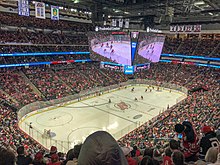
December 18, 2009: It was my 40th Birthday, and I celebrated by attending the New Jersey Devils' game against the Ottawa Senators, at the Prudential Center in downtown Newark, New Jersey.

The Devils won, 4-2. They got goals by Jamie Langenbrunner in the 1st period, Brian Rolston and Jay Pandolfo in the 2nd, and Bryce Salvador in the 3rd. The Ottawa goals came from Alexandre Picard and Jarkko Ruutu, both in the 2nd.

Only 13,728 fans attended. The fans who could have attended, but chose not to, may not have realized they had the chance to witness a historic occasion. Honestly, I didn't know it was one, beyond being a milestone birthday for me. But the announcement was made that Devils goaltender Martin Brodeur was playing in the 1,030th game of his career, a new record for goaltenders.
He surpassed the record of 1,029, set between 1984 and 2003 by Patrick Roy. Roy also held the record for most career wins by a goalie, with 551. Brodeur broke that record, and raised it to 691.

Brodeur ended his career by playing in 1,266 regular-season games, all with the Devils, except for the last 7, with the St. Louis Blues. He played in an additional 205 in the Stanley Cup Playoffs, helping the Devils win the Cup in 1995, 2000 and 2003, losing in the Finals in 2001 and 2012.

*

December 18, 2009 was a Friday. There were 5 other NHL games that day:

* The Florida Panthers, 6-3 at the BankAtlantic Center (now the Amerant Bank Arena) in the Miami suburb of Sunrise, Florida.

* The Buffalo Sabres beat their arch-rivals, the Toronto Maple Leafs, 5-2 at the HSBC Arena (now the KeyBank Center) in Buffalo.

* In an "Original Six" matchup, the Chicago Blackhawks beat the Boston Bruins, 5-4 in a shootout at the United Center in Chicago.

* The Tampa Bay Lightning beat the St. Louis Blues, 6-3 at the Enterprise Center in St. Louis.

* And the Vancouver Canucks beat the Washington Capitals, 3-2 at General Motors Place (now the Rogers Arena) in Vancouver.

Baseball was out of season. Football was in midweek. There were 11 games in the NBA:

* The New York Knicks beat the Los Angeles Clippers, 95-91 at Madison Square Garden.

* The New Jersey Nets lost to the Toronto Raptors, 118-95 at the Air Canada Centre (now the Scotiabank Arena) in Toronto.

* The Philadelphia 76ers beat their arch-rivals, the Boston Celtics, 98-97 at the TD Garden in Boston.

* The Atlanta Hawks beat the Utah Jazz, 96-83 at the Philips Arena (now the State Farm Arena) in Atlanta.

* The Memphis Grizzlies beat the Indiana Pacers, 107-94 at the FedEx Forum in Memphis.

* The New Orleans Hornets beat the Denver Nuggets, 98-92 at the New Orleans Arena (now the Smoothie King Center) in New Orleans.

* The Oklahoma City Thunder beat the Detroit Pistons, 109-98 at the Oklahoma City Arena (now the Paycom Center) in Oklahoma City.

* The Houston Rockets beat their arch-rivals, the Dallas Mavericks, 116-108 in overtime at the American Airlines Arena in Dallas.

* The Cleveland Cavaliers beat the Milwaukee Bucks, 85-82 at the Quicken Loans Arena (now the Rocket Arena) in Cleveland.

* The Minnesota Timberwolves beat the Sacramento Kings, 112-96 at the Target Center in Minneapolis.

* And the Washington Wizards beat the Golden State Warriors, 118-109 at the Oracle Arena (as the Oakland Coliseum Arena was then known). Gilbert Arenas led all scorers on the night with 45 points.

Thursday, November 24, 2022

November 24, 1932: The Pulaski Skyway Opens

November 24, 1932: The Pulaski Skyway opens, connecting the downtowns of Newark and Jersey City via an ugly bridge that carries U.S. Routes 1 & 9 over the Passaic and Hackensack Rivers.

The "Black Beast" is a 3.5-mile long, ugly iron monstrosity, a steel deck truss cantilever bridge that connects the downtowns of Newark and Jersey City, over the New Jersey Turnpike, the Passaic River and the Hackensack River.

When the New Jersey Turnpike was being designed in the 1940s, there was a dilemma. Building it under the Skyway would have been a tight fit, especially for the kind of trucks that would be going under it. Building it over the Skyway would have been safer, but it would have required a very high bridge, costing a lot more money and taking a lot more time. They decided to build the Turnpike under the Skyway. There's never been a problem.

At only 56 feet wide, its 4 lanes of traffic are too narrow. By the dawn of the 21st Century, it was in bad shape. It underwent a major renovation between 2014 and 2018, as it was considered too expensive to build a new bridge and demolish the old one.

Kazimierz Michał Władysław Wiktor Pułaski was born on March 6, 1745 in Warsaw, the capital of Poland. He became one of the leading defenders of the Polish-Lithuanian Commonwealth, but was driven into exile after the First Partition of Poland in 1772.

He escaped to France, where he met Benjamin Franklin. He recommended Pulaski to the Continental Congress. He served alongside George Washington, saving his life at the disastrous Battle of Brandywine outside Philadelphia in 1777. He survived the frigid encampment at Valley Forge, Pennsylvania in 1777-78.
On Washington's direction, he reformed the Continental Army's cavalry units, and is recognized as "The Father of the American Cavalry" and "The Soldier of Liberty." He was killed at the Battle of Savannah in Georgia, dying on October 11, 1779, 2 days after being shot. He was only 34 years old.

Although Pulaski lived as a man -- he had a mustache that made him look a bit like later American author Edgar Allan Poe -- an examination of his bones in 1996 showed features that suggested that the person buried under the Pulaski Monument in Savannah was female. And yet, other factors, such as age, locations of wounds, and a DNA match to a Pulaski relative, conclusively proved the bones were his.

This led to a theory that Pulaski may have been transgender, "a woman living as a man," as has been the case with a few soldiers who later gained fame; or that he may have been "intersex," having both male and female features; or may simply have had an adrenal deficiency that would explain the female features of his bones. The organizations celebrating Pulaski since have treated him as exclusively male.

Along with Andrzej Tadeusz Bonawentura Kościuszko, he is the top hero of Polish-Americans, and Pulaski Day is a holiday in many places with high concentrations of Poles, on the 1st Monday in March (near his birthday), or on the 2nd Sunday in October (near the anniversary of his death, which is when New York holds its parade, usually the day before the big Italian-American parade on Columbus Day).

Pulaski is 1 of 8 foreign citizens to have been granted honorary U.S. citizenship by an act of Congress. Fellow Revolutionary heroes Gilbert du Motier, Marquis de Lafayette, of France, and Bernardo de Gálvez, of Spain, are among them. Not so included, as yet, are Kościuszko; French hero Jean-Baptiste Donatien de Vimeur, Comte de Rochambeau; and German hero Friedrich von Steuben of Prussia (Germany). The others are Pennsylvania founders William and Hannah Penn, Winston Churchill, Mother Teresa, and Swedish diplomat Raoul Wallenberg, who saved thousands from the Holocaust of World War II.

Another bridge, the Pulaski Bridge, built in 1954, connects the highly-Polish Greenpoint neighborhood of Brooklyn with Long Island City in Queens, over Newtown Creek. Another connector, the Kościuszko Bridge, part of the Brooklyn-Queens Expressway (BQE), built in 1939 and replaced in 2017, is also over Newtown Creek, between Greenpoint and the Queens neighborhood of Maspeth.  
The Pulaski Bridge, Brooklyn to Queens

Both Newark and Jersey City once had large Polish populations, but no longer. Two of my great-grandparents came from Borki Wielke, in the northeast of Poland, to Newark, where my grandfather and father were born. On the Waterfront at Jersey City's Exchange Place, where a major Pennsylvania Railroad station once stood, and there is now a PATH station, stands the Katyń Memorial, a 34-foot-high statue that stands as a tribute to Polish soldiers massacred by the Soviet Union's Red Army in 1940.

*

November 24, 1932 was a Thursday, Thanksgiving Day. There were 3 games in the NFL:

* The New York Giants and the Staten Island Stapletons played to a tie, 13-13 at Thompson Stadium on Staten Island.

* There were then 3 NFL teams in New York City, including 1 named the Brooklyn Dodgers. They lost to the Green Bay Packers, 7-0 at Ebbets Field.

* And the Chicago Bears beat the Chicago Cardinals, 24-0 at Soldier Field.

Among the college football games played that day were these:

* New York University beat Carnegie Tech, 13-6 at before 30,000 at Yankee Stadium. NYU were the only New York City school playing that day, or even that week. Nor did either of New Jersey's teams, Rutgers or Princeton, play that week.

NYU dropped its football program after the 1952 season. In 1967, the Carnegie Institute of Technology merged with another Pittsburgh school, the Mellon Institute for Industrial Research, and the combined school became Carnegie Mellon University. The following year, its athletic program was dropped to what's now called NCAA Division III.

* The University of Pennsylvania beat Cornell, 13-7 at Franklin Field in Philadelphia.

* Maryland beat Johns Hopkins, 23-0 at Municipal Stadium in Baltimore. Memorial Stadium would be built on the site in 1954. Johns Hopkins now play in Division III.

* Oklahoma and George Washington University played to a tie, 7-7 at Griffith Stadium in Washington. GWU dropped football after the 1966 season.

* Virginia beat North Carolina, 14-7 at Scott Stadium in Charlottesville, Virginia.

* Virginia Tech beat Virginia Military Institute, 26-0 at Maher Field in Roanoke, Virginia. VMI now play in the NCAA's Football Championship Subdivision (FCS, formerly known as Division I-AA).

* The University of Richmond beat the College of William & Mary, 18-7 at City Stadium in Richmond, Virginia. Both schools now play in the FCS.

* Tennessee beat Kentucky, 26-0 at Shields-Watskins Field (now Neyland Stadium) in Knoxville, Tennessee. Tennessee finished undefeated.

* Alabama beat Vanderbilt, 20-0 at Dudley Field in Nashville.

* The University of Mississippi (a.k.a. Ole Miss) beat Mississippi State, 13-0 in the "Egg Bowl" at Scott Field (now Davis Wade Stadium) in Starkville, Mississippi.

* Texas beat Texas A&M, 21-0 at Memorial Stadium in Austin.

* Nebraska beat Missouri, 21-6 at Memorial Stadium in Lincoln, Nebraska.

* In a traditional Rocky Mountain rivalry, Colorado A&M beat Wyoming, 23-0 at Colorado Field in Fort Collins, Colorado. A&M was renamed Colorado State in 1957.

* Washington State beat UCLA, 3-0 at the Los Angeles Memorial Coliseum.

* The University of Southern California beat the University of Washington, 9-6 at Husky Stadium in Seattle. USC finished undefeated, beat the University of Pittsburgh in the Rose Bowl, and were awarded the National Championship.

* Two days later, Notre Dame beat Army, 21-0 in front of 80,000 fans at Yankee Stadium.

Baseball was out of season. The NBA hadn't been founded yet. There were 3 games in the NHL, which was then based in Canada, whose Thanksgiving is held on the 2nd Monday in October:

* The New York Rangers and the Chicago Black Hawks played to a tie, 1-1 at the old (but then relatively new) Madison Square Garden.

* The Ottawa Senators beat the Montreal Maroons, 6-3 at the Montreal Forum.

* And the Toronto Maple Leafs beat the Montreal Canadiens, 2-0 at Maple Leaf Gardens in Toronto.

Tuesday, October 25, 2022

October 25, 2007: The Prudential Center Opens

October 25, 2007: The Prudential Center opens, at 165 Mulberry Street in Newark, with a concert by Jon Bon Jovi.

Eventually, the address would be changed to 25 Lafayette Street. It is bounded by Edison Place on the north, Mulberry Street on the east, Lafayette Street on the south, and Broad Street on the west, although there is a row of buildings between Broad Street and the arena.

It replaces the Meadowlands Arena, in East Rutherford, known from 1981 to 1996 as the Brendan Byrne Arena; then until 2007 as the Continental Airlines Arena; and thereafter as the Izod Center. That arena had opened on July 2, 1981, with a concert by Bruce Springsteen & the E Street Band. So it was somewhat appropriate that the replacement was opened with a concert by a later New Jersey rock and roll legend.

It has been home to the NHL's New Jersey Devils and Seton Hall University's basketball team since it opened. It was also a temporary home to the NBA's New Jersey Nets from 2010 to 2012, and the WNBA's New York Liberty in 2011 and 2012.
Its location, in the downtown of New Jersey's largest city, 3 blocks from Newark's version of Pennsylvania Station, makes it considerably more convenient an arena than the Meadowlands, which, until New Jersey Transit built the Meadowlands Rail Spur in 2009, was only accessible by 1 of 2 ways: Driving, or a bus that had to be picked up at the Port Authority Bus Terminal in Midtown Manhattan. Since 2007, a person wanting to see a Devils game can take the train, on NJT's Northeast Corridor or North Jersey Coast Lines; or a bus, the Number 67.

The Devils won 3 Stanley Cups, reached 1 other Stanley Cup Finals, and won 7 Division titles at the Meadowlands. Since moving into "The Rock," nicknamed for Prudential Insurance's use of the Rock of Gibraltar as a symbol, they have won 2 Division titles, and reached the Stanley Cup Finals in 2012 -- but have missed the Stanley Cup Playoffs in 9 of the last 10 years. And the building has replaced the Meadowlands Arena as New Jersey's leading rock concert venue.

*

October 25, 2007 was a Thursday. The Devils opened the season on the road, because it wasn't clear that the arena would be ready when the 2007-08 NHL season opened -- and, as it turned out, it wasn't. They played the 1st game there 2 days later, losing 4-1 to the Ottawa Senators. Chris Neil scored the 1st goal, while Brian Gionta scored the 1st Devils goal. On Halloween, 4 days later, they got their 1st win in the new building, 6-1 over the Tampa Bay Lightning.

These 9 NHL games were played on October 25:

* The Devils lost to their arch-rivals, the New York Rangers, 2-0 at Madison Square Garden. Nigel Dawes scored both goals.

* The Boston Bruins beat the Chicago Blackhawks, 3-1 at the building now named the TD Garden in Boston.

* The Tampa Bay Lightning beat the Philadelphia Flyers, 5-2 at the St. Pete Times Forum in Tampa. (It's now named the Benchmark International Arena.)

* The Toronto Maple Leafs beat the Pittsburgh Penguins, 5-2 at the Civic Arena in Pittsburgh. (It was then named the Mellon Arena, before reverting to its original name.)

* The Columbus Blue Jackets beat the St. Louis Blues, 3-0 at Nationwide Arena in Columbus.

* The Nashville Predators beat the Atlanta Thrashers, 3-0 at the Sommet Center in Nashville. (It's now named the Bridgestone Arena.)

* The Edmonton Oilers beat the Minnesota Wild, 5-4 in a shootout, at the Northlands Coliseum in Edmonton.

* The Phoenix Coyotes beat the Anaheim Ducks, 1-0 at the Honda Center in the Los Angeles suburb of Anaheim, California.

* And the Los Angeles Kings beat the Dallas Stars, 2-1 at the Staples Center in Los Angeles. (It's now named the Crypton.com Arena.)

The 2007-08 NBA season opened 5 days after the Prudential Center did. There was one other sporting event of note on October 25: Game 2 of the World Series. The Boston Red Sox beat the Colorado Rockies, 2-1 at Fenway Park in Boston. The Rockies got to Curt Schilling for a run in the 1st inning, but the Sox tied the game in the 4th, and that ended the only lead Colorado had in the entire Series, which Boston swept.

Sunday, October 23, 2022

October 23, 1935: Dutch Schultz Is Rubbed Out

October 23, 1935: Mobster Dutch Schultz is rubbed out, along with 2 bodyguards and his accountant, at the Palace Chophouse at 12 E. Park Street in Newark. He was 34 years old.
(The address no longer exists, as the 60 Park Place Building has wiped it out. A restaurant called Dutch's Lounge has opened at 24 E. Park.)
Schultz had asked the Mafia Commission for permission to kill the U.S. Attorney investigating him in New York, Thomas Dewey. They refused, because it would have meant the U.S. government declaring all-out war on them, a war the Mob knew it couldn't win. They thought he might try it anyway, and rival Charles "Lucky" Luciano sent 2 hitmen from Murder, Incorporated to do it. He was shot at 10:15 that night, and died at 2:20 the next morning.
Born on August 6, 1901 as Arthur Simon Flegenheimer, Dutch Schultz started as a bouncer at a Bronx speakeasy, whose owner, Joey Noe, took a liking to him for his ruthlessness in throwing guys out. He joined Noe's bootlegging operation, and took over when Noe was rubbed out in 1928, as part of the Castellamarese War. Schultz may have ordered the 1928 killing of Arnold Rothstein, the gambler who fixed the 1919 World Series; and the 1930 attempted rubout of Legs Diamond, who recovered, only to be killed by another gang the following year.
When Prohibition ended in 1933, Schultz moved into a numbers racket (an illegal lottery) and extortion. But Dewey, remembering how Al Capone was brought to justice, indicted Schultz for tax evasion. So Schultz made his request, and it ended up backfiring.
He didn't die immediately, and was still conscious when he was loaded into an ambulance that would take him to Newark City Hospital (now University Hospital). He had $3,000 in cash (about $64,000 in 2022 money) on him, and gave it to an intern in the ambulance, because, "It's not going to do me any good where I'm going." When it looked like Schultz might live, the intern got scared that Schultz might want the cash back, and gave it to the police.
Schultz lived for 29 hours, and remained lucid long enough for the police to question him, and ask him if he knew who shot him, or if he knew who sent them. Keeping the Mob's code of silence, he wouldn't say.
With a tombstone bearing his real name, he is buried in Gate of Heaven Cemetery in Hawthorne, New York -- the same cemetery as Babe Ruth, Billy Martin, Ralph Branca, Giants owners Tim and Wellington Mara, Heywood Broun, Dorothy Kilgallen, Conde Nast; steel magnate Charles M. Schwab (no relation to the investment guru Charles R.), Fred Allen, James Cagney, Sal Mineo and 1920s Mayor Jimmy Walker.
One of the gunmen, Charles Workman, served 23 years in prison. The other, Emmanuel Weiss, was arrested for a different murder, and executed in 1944. Albert Anastasia, the Commission head, "the boss of all bosses," remained in power until getting whacked himself in 1957.
Lucky Luciano and his business partner Meyer Lansky allowed their friend Abner "Longy" Zwillman, a former bootlegger and the king of Newark's "numbers racket," to take over Schultz's New Jersey operations. He became the most powerful gangster between the Hudson and Delaware Rivers, until his tax problems piled up, and he was found dead in his West Orange home in 1959, shortly before he was to testify before a Senate Committee in Washington. It's been alleged that Vito Genovese, head of the New York crime family that still bears his name, ordered it, with Lansky's blessing.
Luciano was convicted in 1936, a case prosecuted by Dewey, but the charges had nothing to do with the Schultz murder, for which he was never charged. He was sentenced to 30 to 50 years in prison. During World War II, he accepted a deal with the federal government, negotiated by Lansky: Through his operations, he had naval knowledge that could help win The War. In 1946, his sentence was commuted, on the condition that he accept deportation back to Italy. He accepted, and died in Naples in 1962. Lansky lived on until 1983, his power and fortune having waned, but he was never imprisoned. Nor was he assassinated, like the Hyman Roth, the character based on on him for the film The Godfather Part II.
Schultz has been played by Lawrence Dobkin on 3 episodes of the TV series The Untouchables in 1959, Vic Morrow in Portrait of a Mobster in 1961, Vincent Gardenia in Mad Dog Coll the same year, James Remar in The Cotton Club in 1984, Dustin Hoffman in Billy Bathgate in 1991, and Tim Roth in Hoodlum in 1997.
In 1998, Michael Walsh published As Time Goes By, an authorized combination prequel and sequel to the film Casablanca. It imagines Humphrey Bogart's character as a young man named Yitzik Baline, working for Solly Horowitz, a mobster based on Schultz. When Horowitz is rubbed out on October 23, 1935, "Rick" Baline, by then running Horowitz' speakeasy, has to flee the country, and changes his name to Richard Blaine.
*

October 23, 1935 was a Wednesday. Puerto Rican golfer Juan Antonio "Chi-ChiRodríguez was born.

The baseball season was over, the hockey season didn't start for another 2 weeks, there was no NBA, and it was a Wednesday, so there were no football games. So there were no scores on this historic day.

Tuesday, September 27, 2022

September 27, 1925: The New York Football Giants Debut

September 27, 1925: The New York Giants football team, named for the already-legendary baseball team, plays its 1st game. Founded by professional bookmaker Tim Mara, they travel to Dreamland Park, and play the Newark Red Jackets. The Giants win, 3-0.

Although the Giants were members of the National Football League, the Red Jackets were not. Nor were the Giants' next opponents, All-New Britain. The Giants traveled to New Britain, outside the Connecticut capital of Hartford, and beat them 26-0.

Then the Giants began playing NFL teams. On October 11, they went to the Cycledrome in Providence, Rhode Island, and lost to the Providence Steam Roller, 14-0. (That's how their name was written: Two words, no S on the end.) On back-to-back days, October 17 at Frankford Stadium in Northeast Philadelphia, and October 18 in their 1st true home game at the Polo Grounds, the Giants played the Philadelphia NFL team of that era, the Frankford Yellow Jackets, losing both games, 5-3 and 14-0, respectively.

Then they won their next 8 games, 7 of them at the Polo Grounds. They beat the Cleveland Bulldogs 19-0, the Buffalo Bisons 7-0, the Columbus Tigers 19-0, the Rochester Jeffersons 13-0, the Steam Roller 13-12, the Kansas City Cowboys 9-3, the Staten Island Stapletons 7-0, and the Dayton Triangles 23-0.

The Stapletons, or "Stapes" for short, were founded in 1915, and played in the Stapleton neighborhood of Staten Island. Their November 26, 1925 game against the Giants was the 1st Thanksgiving Day game involving an NFL team. It was played at the Stapes' home, Thompson Stadium, which stood from 1924 to 1933. The Stapes did not join the NFL until the 1929 season, and the Great Depression knocked them out in 1932. Berta A. Dreyfus Intermediate School is now on the site of Thompson Stadium, at 101 Warren Street.

Despite a strong 10-3 start, the Giants were not doing well at the box office. To the rescue came the Chicago Bears, who had recently signed the biggest name in college football, two-way back Harold "Red" Grange. A crowd of 75,000 crammed into the Polo Grounds, and Grange led the Bears to a 19-7 victory. The gate receipts saved the NFL's New York franchise -- and since no league can survive for long without a New York franchise, that game may even have saved the NFL. But Grange was injured in the game. A week later, at Wrigley Field, with Grange unavailable, the Giants won the return match, 9-0, finishing 11-4.

Bob Folwell, the Giants' 1st head coach, formerly the head man at the University of Pennsylvania and the U.S. Naval Academy, was fired after that 1st season. For 1926, he was replaced by Joseph "Doc" Alexander. He lasted only 1 season as well, before Earl Potteiger was given the reins for 1927. That season, he led the Giants to the NFL Championship, by finishing 1st in the single-division league.

They won the NFL Championship Game in 1934, 1938 and 1956; and lost it in 1933, 1935, 1939, 1941, 1944, 1946, 1958, 1959, 1961, 1962 and 1963. It took a while after the start of the Super Bowl era, but they won the Super Bowls in the seasons for calendar years 1986, 1990, 2007 and 2011, losing in 2000. Their 8 NFL Championships are 3rd only to the 13 of the Green Bay Packers and the 9 of the Bears.

Tim Mara died in 1959. He left the team to his sons Jack and Wellington. In 1991, Wellington bought his brother out. He died in 2005, and he and Tim were the 1st father-son pair in the Pro Football Hall of Fame. He left the team to his son John. Jack's children include son Tim Mara II, who married Kathleen Rooney, granddaughter of Pittsburgh Steelers founding owner Art Rooney. Their daughters are actresses Kate Mara and Rooney Mara, so they are great-granddaughters of the founding owners of 2 NFL teams. Kate has sung the National Anthem at home games for both teams.

And the site of that first game for "the New York Football Giants"? Dreamland was an amusement park, similar to the one of the same name that had stood at Coney Island in Brooklyn. It was demolished in 1938.

In 1941, a housing project, the Seth Boyden Terrace, a.k.a. the Seth Boyden Houses, was built on the site, at 737 Frelinghuysen Avenue, a.k.a. New Jersey Route 27. The occupants have been moved elsewhere, and the project was demolished in 2022. Lionsgate Newark Studios is now planned for the site, alongside a housing facility for the elderly.
No photograph of the football field on the site
seems to survive, although there are some
of the inside of the roller rink.
This is the new Seth Boyden Elderly House.

UPDATE: The New York Giants have a Ring of Honor. The inductees include:

* From their 1927 NFL Champions: Owners Tim and Jack Mara (brothers), and offensive tackle and head coach Steve Owen.

* From their 1934 NFL Champions: The Mara brothers, Owen (now only head coach), center and linebacker Mel Hein, and halfback Ken Strong. From their 1938 NFL Champions, the preceding, and fullback Alphonse "Tuffy" Leemans. Leemans' Number 4, Hein's Number 7 and Strong's Number 50 have been retired. End Ray Flaherty, not in the Ring of Honor but in the Hall of Fame, was on the 1934 team, and his Number 1 was retired, but has been re-activated with his family's permission for Malik Nabers.

* The Giants have honored 2 of their players who went on to be killed in action in World War II: End Jack Lummus and tackle Al Blozis. Both of them had been honored with plaques on the wall of the clubhouse at the Polo Grounds. Blozis' Number 32 has been retired, but Lummus' Number 29 has not.

* From their 1956 NFL Champions: The Mara brothers, Tim's son Wellington (now an executive), head coach Jim Lee Howell, quarterback Charlie Conerly; running backs Frank Gifford, Kyle Rote and Alex Webster; offensive tackle Roosevelt "Rosey" Brown, defensive end Andy Robustelli, linebacker Sam Huff, safeties Emlen Tunnell and Jim Patton, and trainer John Johnson. Gifford's Number 16 and Conerly's Number 42 have been retired.

Despite their contributions to this era of Giants football, neither offensive coodrinator Vince Lombardi, who became Green Bay Packers coach in 1959, nor defensive coordinator and former cornerback Tom Landry, who became Dallas Cowboys coach in 1960, have been honored by the Giants.

* From their teams that lost the NFL Championship Game in 1958, '59, '61, '62 and '63, but not the one that won it in 1956: quarterback Y.A. Tittle, running back Joe Morrison, and cornerback Dick Lynch. Tittle's Number 14 and Morrison's Number 40 have been retired.

* From the 1960s: Kicker Pete Gogolak.

* From the 1970s: Linebacker Brad Van Pelt and punter Dave Jennings.

* From their Super Bowl XXI winners in 1987: Owner Wellington Mara, general manager George Young, head coach Bill Parcells, trainers John Johnson and Ronnie Barnes, quarterback Phil Simms, running backs Ottis Anderson and Joe Morris, tight end Mark Bavaro; defensive ends George Martin and Leonard Marshall; and linebackers Lawrence Taylor, Harry Carson and Carl Banks. Simms' Number 11 and Taylor's Number 56 have been retired.

* From their Super Bowl XXV winners in 1991: Mara, Young, Parcells, Johnson, Barnes, Simms, Anderson, Bavaro, Marshall, Taylor, Banks, and running back Rodney Hampton.

* From their 2000 NFC Champions that lost Super Bowl XXXV: Co-owners Wellington Mara and Bob Tisch, general manager Ernie Accorsi, trainers John Johnson and Ronnie Barnes; running back Tiki Barber, receiver Amani Toomer, defensive end Michael Strahan, and linebacker Jessie Armstead. Head coach Jim Fassel and quarterback Kerry Collins have not been inducted.

* From their Super Bowl XLII winners in 2008: Accorsi, Johnson, Barnes, Toomer, Strahan; head coach Tom Coughlin, quarterback Eli Manning, guard Chris Snee, and defensive ends Osi Umenyiora and Justin Tuck. Manning's Number 10 and Strahan's Number 92 have been retired.

* From their Super Bowl XLVI winners in 2012: Coughlin, Barnes, Manning, Snee, Umenyiora and Tuck. General manager Jerry Reese has not yet been inducted. Nor have any players from since that game.

*

September 27, 1925, as you might guess, was a Sunday. There were other NFL games played that day:

* The aforementioned Chicago Bears lost to the team that would become their arch-rivals, the Green Bay Packers, 14-10 at Green Bay City Stadium.

* The team that was then the Bears' arch-rivals, the Chicago Cardinals, lost to the Hammond Pros of nearby northwestern Indiana, 10-6 at Comiskey Park. But the Cardinals finished 11-2-1, and were controversially awarded the NFL Championship.

* The Canton Bulldogs beat the Rochester Jeffersons, 14-7 at League Field in Canton, Ohio.

* The Detroit Panthers beat the Columbus Tigers, 7-0 at Navin Field, later renamed Briggs Stadium and Tiger Stadium. But the Panthers folded after the 1926 season,a nd have no connection to the Detroit Lions.

* The Rock Island Independents and the Dayton Triangles played to a 0-0 tie, at Douglas Park in Rock Island, Illinois, one of the "Quad Cities" on either side of the Mississippi River in Illinois and Iowa.

* The Frankford Yellow Jackets did not play that day. Until 1933, professional sports on Sundays was illegal in the Commonwealth of Pennsylvania. Hence, the October 17/18 back-to-back days solution: The Jackets played in Frankford on Saturday and in Harlem on Sunday. The day before the Giants' debut, the Jackets beat the Buffalo Bisons, 27-7 at Frankford Stadium.

* The Pottsville Maroons beat the Bisons, 28-0 at Minersville Park in Pottsville, Pennsylvania. They finished 10-2, and contended that the Cardinals had unfairly been chosen NFL Champions, and that they should have been awarded the title.

* The Akron Pros beat the Cleveland Bulldogs, 7-0 at League Park in Akron. Yes, Cleveland, Akron and Canton all had teams; and Cleveland and Canton both had teams called the Bulldogs. The NFL wasn't exactly logical in its early years.

* And the Kansas City Cowboys beat the Duluth Kelleys, 3-0 at Athletic Park in Duluth, Minnesota.

There were Major League Baseball games played that day:

* There was a doubleheader at Yankee Stadium. The New York Yankees lost the 1st game to the Detroit Tigers, 10-5. Babe Ruth and Bob Meusel hit home runs, but Sad Sam Jones didn't get out of the 4th inning. Ty Cobb was then player-manager for the Tigers, but did not play in this game.

The 2nd game was tied 1-1 after 5 innings, when it was called due to darkness. Cobb didn't play in this game, either, and Ruth didn't get a hit.

* The Brooklyn Robins beat the New York Giants, 5-4 at Ebbets Field. The Robins were then named for their manager, Wilbert Robinson. After he was fired in 1931, they went back to the name they had before: The Brooklyn Dodgers.

* The Washington Senators beat the St. Louis Browns, 8-0 at Griffith Stadium in Washington. Curly Ogden pitched a 3-hit shutout. 

* The Pittsburgh Pirates were leading the Cincinnati Reds, 4-3 at Crosley Field, when the game was called due to rain after 5 innings.

* The Chicago Cubs beat the Philadelphia Phillies, 3-1 at Cubs Park in Chicago. Chewing gum magnate William Wrigley Jr. had recently bought full control of the Cubs, and their ballpark would be renamed Wrigley Field before the next season.

* A doubleheader was split at Sportsman's Park in St. Louis. The St. Louis Cardinals beat the Boston Braves, 6-5 in 10 innings in the 1st game. In the 2nd game, the Braves led 7-6 after 7 innings, before the game was called due to darkness.

* Not scheduled to play: The Boston Red Sox, the Cleveland Indians, the Boston Braves and the Cincinnati Reds.

Thursday, September 15, 2022

September 15, 1958: The Newark Bay Rail Disaster

September 15, 1958: A commuter train derails off a bridge, and plunges into Newark Bay, killing 48 people, and injuring 48 more. Among the dead was a former Yankee star.

George Henry Stirnweiss was born on October 26, 1918 in Manhattan, and grew up in The Bronx. He remains the closest thing to a Yankee Legend who grew up in the Bronx Bombers' home Borough. Lou Gehrig grew up in Manhattan; Willie Keeler, Waite Hoyt and Willie Randolph in Brooklyn; and Phil Rizzuto and Whitey Ford in Queens. 

His father had been a respected taxi driver, but got caught up in criminal activity, disgracing the family while George was a baseball, football and basketball star at Fordham Preparatory School. This may have been why, when he received scholarship offers, he didn't stay in The Bronx and go to Fordham University, but went south, to the University of North Carolina at Chapel Hill.

At Chapel Hill, he won the school's highest athletic honor, the Patterson Medal, which is awarded based on "athletic ability, sportsmanship, morale, leadership and general conduct." In 1940, the NFL's Chicago Cardinals drafted him. But, as with later University of Mississippi quarterback Jake Gibbs, the Yankees made him an offer, and he abandoned football for baseball.

It's not clear when, or why, George Stirnweiss first got the nickname "Snuffy." Maybe, playing in the South, either at UNC or for the Norfolk Tars, a Yankee farm team, he picked up the habit of chewing tobacco or using its nasal cousin, snuff. He certainly didn't resemble the rural comic strip character Snuffy Smith.

In 1943, defending American League Most Valuable Player Joe Gordon was called up into World War II. Snuffy was not. That led the Yankees to bring him to the major league roster as the starting 2nd baseman, giving him uniform Number 1. The Yankees won the World Series, although Snuffy was not a major contributor that season. But in 1944, he batted .319 and fielded brilliantly, finishing 4th in the MVP voting. In 1945, he batted .309, and that was enough to win the batting title and finish 3rd in the MVP voting.
With The War ending, there was a question of whether Snuffy had bulked up his stats on weakened pitching. Gordon returned as the starting 2nd baseman in 1946, and it looked like Snuffy's day in the Sun was over. But after that season, the Yankees traded Gordon to the Cleveland Indians for pitcher Allie Reynolds. This was a brilliant trade for both teams: Gordon helped the Indians win the World Series in 1948, while the Yankees essentially got 2 players: Reynolds, their pitching ace through 1954, and the "return" of Stirnweiss.

He helped the Yankees win the World Series again in 1947, getting 7 hits and drawing 8 walks in the 7 games. But by the time of their 1949 title, he had been replaced as starting 2nd baseman by Jerry Coleman. He was traded to the St. Louis Browns in 1950 and the Indians in 1951, and retired after the 1952 season.

Snuffy managed in the minor leagues, with the Philadelphia Phillies' Class AA team, the Schenectady Blue Jays; then for the Yankees' team in the same league, the Binghamton Triplets. But he didn't like managing, and it didn't pay well, and he had a wife and 6 children to support. He worked for a bank, but had a heart attack in 1957, and never returned to work for them.

Instead, he went to work for Caldwell & Company, a manufacturer of light fixtures, in Manhattan. Every morning, he would go to the Central Railroad of New Jersey station near his home in Red Bank, Monmouth County, and take the train up the Raritan Bayshore, past Newark Airport, and over Newark Bay, to the Communipaw Terminal in Jersey City, where he would take a ferry across the Hudson River into The City.

On September 15, 1958, he got on CRRNJ train #3314 in Red Bank, but the train never made it to Communipaw. The Newark Bay lift bridge was left open, and at 10:01 AM, the train went straight through signals, and 2 of the cars fell into the Bay. George H. "Snuffy" Stirnweiss was 1 of 48 people killed. He was just short of turning 40.
The locomotive crew were among those killed, so there was no one to interview about the cause of the crash. The investigation turned up nothing. No one was charged.

Increased car sales, the building of the New Jersey Turnpike (particularly the Newark Bay Extension in 1956) and the Garden State Parkway, and a 2nd and 3rd tube for the Lincoln Tunnel meant that the Jersey Central had already begun to decline, and it pretty much abandoned the bridge by 1967. Conrail took over the railroad's operations in 1976, stopped passenger service in 1978, and demolished the bridge in 1980.

The spot where Snuffy Stirnweiss and the others fell to their deaths is a few feet from the Jersey Gardens Mall in Elizabeth, Union County. He was buried in Mount Olivet Cemetery, across the Navesink River from Red Bank, in Middletown. Legendary football coach Vince Lombardi is also buried there, because Red Bank was his wife Marie's hometown.

*

September 15, 1958 was a Monday. It was before the NBA and the NHL started their seasons. The NFL season wouldn't start for another 2 weeks, and there was no Monday Night Football in those days, anyway. And, as Monday is often a travel day in Major League Baseball, only 2 of a possible 8 games were played:

* The Philadelphia Phillies beat the St. Louis Cardinals, 6-2 at Connie Mack Stadium in Philadelphia. Robin Roberts outpitched Wilmer "Vinegar Bend" Mizell. Jim Hegan got 3 hits for the Phils; Richie Ashburn, Bob Bowman and Ted Kazanski 2 each. (That's Ted Kazanski, not Ted Kaczynski, the future Unabomber.) The only home run of the game was hit by the Cards' Irv Noren, a former Yankee, playing left field in place of Stan Musial, who did not get into the game.

* And the Milwaukee Braves beat the Los Angeles Dodgers, 8-3 at Milwaukee County Stadium. Joe Adcock hit a home run. Hank Aaron did not, but did go 2-for-3 with an RBI. John Roseboro hit a home run in defeat for the Dodgers, in their 1st season in L.A. Gil Hodges 2-for-4, but Duke Snider did not play.

The Braves, defending World Champions, would win the Pennant again, but the Yankees -- who did not add a black armband to their left sleeves in memory of Stirnweiss -- would avenge their loss to the Braves in the 1958 World Series.

Saturday, August 20, 2022

August 20, 1916: The 1st Game of the U.S. National Soccer Team

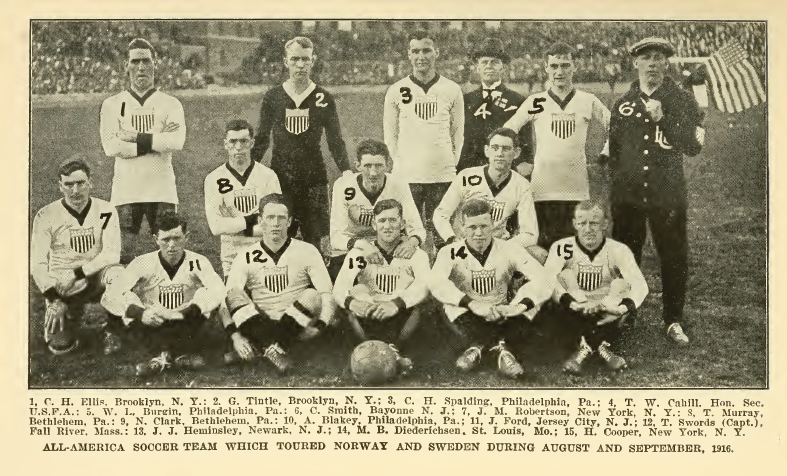
August 20, 1916: The United States of America fields a national soccer team for the 1st time.

Sponsored by the United States Soccer Federation (USSF), founded in 1913, the team took the pitch against Sweden at the Stockholm Olympiastadion, site of the 1912 Olympics, where Jim Thorpe had won the decathlon. A crowd of 16,000 attended. The referee was Hagbard Vestergaard of Denmark.

This was the U.S. team for the game, keeping in mind that uniform numbers were not used in soccer until 1933:

* Goalkeeper: George Tintle of Harrison, New Jersey
* Right Back: Tommy Murray of Bethlehem, Pennsylvania
* Left Back: Jimmy Robertson of New York
* Defender: Dick Spalding of Philadelphia
* Defender: Neil Clarke of Scotland, moved to Paterson, New Jersey
* Defender: Clarence Smith of Bayonne, New Jersey
* Outside Right: Jimmy Ford of Kearny, New Jersey
* Inside Right: Charles Ellis of New York
* Center Forward: John Hemingsley of Newark
* Inside Left: Thomas Swords of Fall River, Massachusetts (Captain)
* Outside Left: Harry "Buck" Cooper of Newark

As you can see, the tradition of soccer in Newark, its across-the-Passaic-River towns of Harrison and Kearny, and its across-Newark-Bay town of Bayonne goes back at least this far. Bethelehem, in the Lehigh Valley of northeastern Pennsylvania, was home to Bethlehem Steel Football Club, a "company team" (or, as the English would have called it, a "works side"), one of the top U.S. teams of the era.

And Fall River and nearby New Bedford, Massachusetts, manned by Portuguese immigrants and their sons, would have strong teams into the 1950s, including the legendary Ponta Delgada, named for an island in the Portugal-controlled Azores Islands. Because of Massachusetts' "blue laws," if these teams wanted to play on Sunday, they would go right across the State Line, and play at St. Mark's Stadium in Tiverton, Rhode Island.

James Robertson is a very common name among soccer players, especially in Scotland. A later Jimmy Robertson was the 1st player ever to score for both Tottenham Hotspur against Arsenal and for Arsenal against Tottenham in the North London Derby.

Konrad Törnqvist scored for Sweden, in only the 7th minute of the game. But Spalding equalized in the 22nd. Ellis scored in the 53rd. Cooper scored in the 68th. Törnqvist brought the Swedes back within 1 in the 81st, but the U.S. defense held on for a 3-2 win.

On September 3, still in Scandinavia, the U.S. team played Norway to a 1-1 draw in Kristiana. Ellis scored the only goal.

History seems to have lost track of some of these players. As far as I can tell, the last survivor was Cooper, who died in 1963.

The stadium still stands. Djurgårdens IF, Sweden's most successful soccer team, played there until the new Tele2 Arena opened, but maintain their offices there.
Due to World War I continuing through 1918, and then for longer for reasons I don't have, the U.S. national team didn't play another game until 1924, and then seemed to play only 2 or 3 games a year until World War II. This may have held them back. The U.S. team didn't play its 1st game on home soil until November 8, 1925, beating Canada 6-1 at Ebbets Field in Brooklyn, thanks to 5 goals from Archie Stark. Like so many early U.S. soccer stars, Stark was born in Glasgow, Scotland but grew up in Kearny, New Jersey.

This period did include reaching the Semifinal of the 1st World Cup in 1930, and reaching the World Cup again in 1934, before failing to qualify in 1938.

*

August 20, 1916 was a Sunday. Because many States still banned professional sports on Sunday, only 3 games were played in what would later be known as Major League Baseball:

* The New York Giants lost to the St. Louis Cardinals, 5-0 at Robison Field in St. Louis. Bob Steele allowed the Giants 8 hits, but kept the shutout. Rogers Hornsby, a rookie, went 2-for-2 with 2 walks for the Cardinals.

* The Boston Braves beat the Cincinnati Reds, 4-3 at Redland Field (renamed Crosley Field in 1934) in Cincinnati.

* The Brooklyn Robins (as the Dodgers were known from 1914 to 1931) beat the Chicago Cubs, 1-0 at Weeghman Park (renamed Cubs Park in 1920 and Wrigley Field in 1926) in Chicago. Jack Coombs allowed only 1 hit, a single by Max Flack. Coombs even got a hit for Brooklyn. So did the man who is still the Dodger franchise's all-time leader in hits, Zack Wheat. So did future managing legend Casey Stengel.

Thursday, July 14, 2022

July 14, 1887: Baseball Draws the Color Line

Moses Fleetwood Walker

July 14, 1887: Professional baseball commits its greatest crime: Drawing "the color line." It was something that was already in the works for a while.

On August 10, 1883, the Chicago White Stockings (the team now known as the Cubs) were scheduled to play an exhibition game against the Toledo Blue Stockings, then running away with the Pennant in the Northwestern League. The Chicago 1st baseman and manager was Adrian Constantine Anson, known as "Cap," short for "Captain." He was the best player in baseball, and the most popular.

He was also the most openly racist. And the Blue Stockings' catcher was Moses Fleetwood Walker. "Fleet" Walker was black. While Bill White, who played 1 game at 1st base for the Providence Grays in 1879, was black, he passed as white, making Walker the 1st player known to be black on any previously all-white team. Anson refused to play the game.

Blue Stockings manager Charlie Morton told Anson that if they refused to play, they would forfeit the gate receipts. Anson decided that the color green was more important than the color white, and the game was played. But he used the N-word throughout the game, and declared he would never play another game against a black man.

(It wasn't just black people that Anson hated. He eventually wrote a memoir in which he told of growing up in Iowa, and saying rotten things about Native Americans living nearby.)

Moses Walker was born on October 7, 1856, in Mount Pleasant, on the Ohio side of the Ohio River, across from West Virginia, and not far from the Pennsylvania line and Pittsburgh. The family moved to nearby Steubenville, Ohio, where his brother, Weldy Wilberforce Walker, was born on July 27, 1860. Both graduated from Steubenville High School.

Moses had been an athlete as Oberlin College, in Oberlin, Ohio, the 1st racially integrated college in America; and at the University of Michigan, where he became the 1st black athlete to earn a varsity letter. Weldy also played baseball at Oberlin and Michigan. In 1883, both brothers signed with the Blue Stockings.

Having won the Northwestern League Pennant in 1883, the Blue Stockings were invited to join the American Association, then a major league, for the 1884 season. That season, they scheduled another exhibition game where they were supposed to host the White Stockings, for July 25. But a showdown was avoided, because Moses Walker had an injured hand, and was unable to play.

Not wanting to deal with it anymore, the Blue Stockings caved in to the bigots. Weldy last played for them on August 6, and Moses on September 4. Both were released after the season. Moses had batted .263 in 42 games, with his RBIs not recorded. Weldy batted .222 in 5 games, with 2 RBIs. Not surprisingly, given the era, neither hit a home run.

Which brings us back to July 14, 1887. Again, it was the Chicago White Stockings and Cap Anson involved. The White Stockings were in Newark, New Jersey, to play an exhibition game against the Newark Little Giants of the International League, then as now one of the top minor leagues. This team included both Moses Walker and George Stovey, a 21-year-old pitcher and outfielder from Williamsport, Pennsylvania. This made Walker and Stovey the 1st all-black "battery" (pitcher & catcher combination) in otherwise-white baseball history.
The best picture of Stovey I could find

Going in, Anson was not aware that Walker was on this team. But he read the Newark News, and saw that Stovey was the scheduled Newark starting pitcher, and the article mentioned that Stovey was black. Anson objected, and Stovey did not pitch. Walker did not play, either. The Little Giants beat the White Stockings, anyway.

The News' evening edition -- my parents both grew up in Newark, and were ardent readers of the Newark Evening News until it went out of business in 1972 -- wrote, "Stovey was to have pitched for Newark, but he complained of sickness, and so (Mickey) Hughes was substituted."

On July 17, the Newark Sunday Call said, "Stovey was expected to pitch in the Chicago game. It was announced on the ground that he was sulking, but it has since been given out that Anson objected to a colored man playing. If this be true, and the crowd had known it, Mr. Anson would have received hisses instead of the applause that was given him when he first stepped to the bat." The New York Telegram published this, word-for-word, the next day.

Also on July 14, the IL team owners had a meeting in Buffalo, and voted 6-to-4 to exclude African-American players from future contracts. Despite going 34-14 with a 2.46 ERA, Stovey never played in what would eventually be called "organized ball" ever again, although he continued to play in black leagues. Nor did either of the Walker brothers play any more pro ball.

In the years to come, baseball team executives tried to sneak black players onto their roster by claiming they were Native Americans or, if they were light-skinned enough, either Cuban or possibly even white. It never worked: The only way they could even try to get away with it would have been in Spring Training, and any black baseball fans in town would give the player away, by cheering especially hard when he came to bat or made a play in the field.

Moses Walker died on May 11, 1924, at 67; Weldy on November 23, 1937, at 77. Both brothers had been involved in various businesses in the interim, including together. Stovey died on March 23, 1936, at 69. And Bill White died on March 29, 1937, at 76. (As far as I can tell, he had no connection, other than race and profession, to later star 1st baseman, broadcaster and National League President Bill White.)

In 1942, Brooklyn Dodger manager Leo Durocher charged that there was a "grapevine understanding" keeping black players out of baseball. He was summoned to the Chicago office of the Commissioner of Baseball, Kenesaw Mountain Landis. Afterward, each man addressed the press. Durocher said that he had been misquoted -- not the biggest lie he would ever tell, but neither was it one he enjoyed telling. Landis went next: 

Negroes are not barred from organized baseball by the Commissioner, and never have been in the 21 years I have served. There is no rule in organized baseball prohibiting their participation, and never has been to my knowledge. If Durocher, or if any other manager, or all of them, want to sign one, or 25, Negro players, it is all right with me. That is the business of the managers and the club owners. The business of the Commissioner is to interpret the rules of baseball, and to enforce them.

Officially, Landis was telling the truth: Aside from the 1887 International League vote, there had never been a rule keeping any player out of the major leagues, or the minor leagues, because of his race. Unofficially, it was a bald-faced lie. Landis' word was law in baseball, and there was never going to be a black player in the professional ranks as long as he lived.

Landis died on November 25, 1944. On October 23, 1945, 331 days later, Branch Rickey, president of the Brooklyn Dodgers, having looked over existing reports, sent out his scouts, read their reports, and deciding that he had found his man, signed Jackie Robinson to a contract. On April 15, 1947, Robinson made his major league debut.

It had been 63 years since a black man had played in the major leagues. Cap Anson had been dead for 25 years, Moses Walker for 23, George Stovey for 11, Bill White and Weldy Walker for 10, and Judge Landis for 2 1/2.

*

July 14, 1887 was a Thursday. There was 1 game were played in the National League that day: The Detroit Wolverines beat the Boston Beaneaters, 7-4 at the South End Grounds in Boston. The Wolverines won the Pennant, but that led to their players demanding higher salaries for 1888. Owner Frederick K. Stearns couldn't keep up, and the team folded at the end of the season.

The Beaneaters went through a few name changes until in 1912, when they took on the name they have since carried to Milwaukee and Atlanta: The Braves.

These games were played in the American Association:

* The New York Metropolitans beat the Louisville Colonels, 18-9 at Eclipse Park in Louisville. The "original New York Mets" went out of business after this season. The Colonels joined the NL in 1892, after the AA folded, and but were contracted out of it after the 1899 season.

* The Brooklyn Grays lost to the St. Louis Browns, 6-4 at Sportsman's Park in St. Louis. This was not the first ballpark in St. Louis to bear that name, nor would it be the last. The Grays joined the NL in 1890, the Browns in 1892. The Grays would go through a few name changes, before becoming the Dodgers in 1911. The Browns became the Cardinals in 1900.

* The Washington Nationals beat the Pittsburgh Alleghenys, 5-3 at Swampoodle Grounds in Washington. Swampoodle was the name of a neighborhood in Washington, and also of a neighborhood in Philadelphia. These Nationals went out of business in 1889, and bear no connection to the current NL team of the same name. The Alleghenys joined the NL in 1890, and a move they made a year later was described by another team as "piratical," they became known as the Pittsburgh Pirates.

* The Baltimore Orioles beat the Cleveland Blues, 5-2 at National League Park in Cleveland. The Blues became the Spiders in 1889, and moved to the 1st League Park in 1891. They and the Orioles both joined the NL in 1892, and both were contracted out of it after the 1899 season.

* The Cincinnati Red Stockings beat the Philadelphia Athletics, 3-2 at League Park in Cincinnati. This was the 1st of 4 ballparks on land on which the team now known as the Cincinnati Reds would play from 1884 to 1970, the last being built in 1912 and known for most of its existence as Crosley Field. The Reds joined the NL in 1892, but this version of the Athletics folded with the AA after the 1891 season.

Wednesday, July 13, 2022

July 13, 1967: The Newark Riots

July 13, 1967: Riots break out in Newark, New Jersey, over the issue of racial injustice. There were 26 deaths, over 700 injuries, and over 1,400 arrests.

My parents both grew up in Newark, in the 1950s. My mother taught me that, up until the riots, Newark was fantastic, with a thriving downtown shopping and entertainment district. Those things were, indeed, thriving.

But my father's 1964 yearbook from the Newark College of Engineering -- which merged with the New Jersey School of Architecture in 1973, forming the New Jersey Institute of Technology (NJIT) -- used these specific words to describe the city, 3 years before the riots: "Newark needs our help."

And Tom Hayden, in between writing The Port Huron Statement, the founding document of the Students for a Democratic Society in 1962, and his participation in the 1968 events that got him indicted as one of the Chicago Eight, worked in Newark with the Economic Research and Action Project (ERAP). His writing on the subject showed just how devastating urban poverty could be for black people -- and got him unwanted attention from the old version of the FBI run by J. Edgar Hoover, without which he probably wouldn't have been noticed in Chicago.

There had, of course, been racial disturbances in the years leading up to this. Birmingham, Alabama in 1963, except that wasn't the civil rights demonstrators doing the rioting, it was the police with their response. In 1964, New York's Harlem, and North Philadelphia. In 1965, the Watts section of Los Angeles. In 1966, the East Side of Cleveland and the West Side of Chicago.

At 9:40 PM on July 12, 1967, Newark Police officers John DeSimone and Vito Pontrelli pursued and pulled over a taxicab. It was driven by a black man, John William Smith. The officers discovered that he was driving with a revoked license. (Driver's license, not taxi license.) But he was desperate for money, and kept driving his cab.

Had he been white, he probably would have been let off with a warning. Instead, he was arrested, beaten on the scene, and taken to the 4th Precinct house at 247 16th Avenue, across from West Side Park. A rumor went around that he had been beaten to death inside. There was no social media then, and a lot of Newark's slums didn't even have telephones, so this was mostly word of mouth. A crowd gathered outside the precinct house, and began throwing things through the windows.
The 4th Precinct house, 2022

The Congress of Racial Equality (CORE) was contacted. They demanded to see Smith, and upon seeing his injuries, demanded that he be taken to Beth Israel Hospital. This was done. Things began to calm down. If that had been the end of it, we wouldn't be talking about the Newark Riots for the last 55 years.

On July 13, civil rights groups met with Mayor Hugh Addonizio. First elected to Congress in 1948, he first ran for Mayor of Newark in 1962, saying he wanted the job "because you can make a million dollars there."

The demands he received were as follows: Suspend the arresting officers, conduct an investigation, and promote the highest-ranking black person on the NPD, Lieutenant Eddie Williams, to Captain.

A reasonable man would have done all 3. Addonizio said he needed 48 hours to consider the demands. When word of that got out, a protest was set, and the organizers lost control. Again, the windows of the 4th Precinct were smashed, and a police car was set on fire. (No one was in it.) Then the rioters went down Springfield Avenue, the main drag of the Central Ward, and started smashing and looting things there.

All police were placed on emergency duty. At 1:00 AM on July 14, all officers were ordered to "fire if necessary." At 2:20, Addonizio called Governor Richard J. Hughes, calling for the New Jersey State Police to come as reinforcements. Ten minutes later, he called again, asking for the New Jersey National Guard. Hughes sent both. It took 3 days and change for it to be enough, until July 17. 

My father was in the U.S. Army, at this heightening point of the Vietnam War, stationed along the Korean Demilitarized Zone, knowing that, at any moment, thousands of Communist soldiers could come pouring over the border, but they never did.

Meanwhile, my mother, who married him only 2 months earlier, had to get from home in the Forest Hill section in the North Ward to her job Downtown, and on the bus, she heard shooting. She was in more of a war zone than he was, and she had no way of knowing who was firing the shots she heard: The rioters, the people protecting their businesses, street vigilantes, the NPD, the State Police, or the National Guard.

The riots ended. Mom survived. Dad was discharged in August 1968, and in February 1969, they got out of their hometown, and found a garden apartment in adjoining Bloomfield, close enough to the people and the things they loved, but safe. I was born at the end of the year -- not in Newark, or in semi-suburban Bloomfield, but in very suburban Livingston, because that was where my mother's doctor worked.

The investigation into Addonizio's actions during the riots uncovered the fact that he certainly tried his best to make a million bucks as Mayor. He was indicted in 1969, and, in 1970, before going on trial, he lost his bid for re-election to Ken Gibson, who became Newark's 1st black Mayor. He had been the city's chief engineer. Before that, like my father, he had been a civil engineer who served in the Army and worked for the New Jersey Highway Department.

Addonizio was convicted and imprisoned. Gibson served 4 terms, and did some good for the city, but ended up with the same fate: Under indictment in 1986, he lost his bid for re-election to Sharpe James, and went to prison.

James, too, eventually fell under criminal suspicion, chose not to run for re-election in 2006, went to prison, and the man who nearly beat him in 2002, before the charges against him were fully known, won the election. His name was Cory Booker, and he's now a U.S. Senator -- the 1st man to leave the office of Mayor of Newark while not under a cloud in over half a century.

The property damage from the riot amounted to about $10 million -- around $87 million in 2022 money. And, as I said, 26 people died. But what it did to the culture of Newark was incalculable. It left the Central Ward a scar on the city. It wasn't until the 1990s that things like supermarkets and movie theaters began to come back to the neighborhood. The city, always the largest in the State of New Jersey, had a population of 460,000 in 1960. By 1990, it was down to 260,000.

The riots entered popular culture. In 1997, Philip Roth, a native of the Weequahic section of Newark, on the South Side, published American Pastoral, and mentioned the riots' effects. It was made into a movie in 2016.

In 1999, the North Jersey-based TV series The Sopranos aired an episode titled "Down Neck," which is a nickname for the Ironbound section of town, the East Side. It featured a flashback to 1967 and the riots. The 2021 film The Many Saints of Newark is a prequel to the show -- Christopher's family name, Moltisanti, is Italian for "many saints" -- and includes a scene set during the riots. And the 2019 film Joker, set in 1981, shot a scene in downtown Newark. Given how little Newark's architecture had changed, filming these period-piece scenes was easy: Just replace some signs, and get period-specific clothes and cars in there.

In spite of his corruption, Mayor Gibson was able to restore some of the city's pride in the 1970s, revamped the Police Department, and -- through methods above board, and some methods under the table -- was able to get people to invest in the city's Downtown again. Mayor James was able to do the same thing, but, like an old-time city political boss, only seemed to invest in those neighborhoods that had voted for him, like his native South Side.

The demographics of Newark began to change. Just as the G.I. Bill's housing provisions enabled "white flight" after World War II, making it a majority-black city, the Clinton Administration's crime bill and economic measures meant that crime and poverty eased enough in the 1990s that black families who could move to neighboring towns did so.

This led to poor Hispanics coming from other countries and moving in. Mayor Booker recognized that the city had become plurality-Hispanic, and that the things that Gibson and James had done that worked needed to be adapted to the new situation.

Newark wasn't the only city stricken by race riots in July 1967. The one in Detroit, 2 weeks later, was even worse. And those weren't the only cities stricken that Summer. In June, there were riots in Boston's Roxbury, Tampa's Central Park, Cincinnati's Avondale, Atlanta's Dixie Hills, and Buffalo's East Side. In July, in between Newark and Detroit, North Minneapolis broke out. At the same time as Detroit, possibly "inspired" by it, 60 miles to the south, Toledo, Ohio. After these, the West Side of Milwaukee.

It may have been a "Summer of Love" in San Francisco, but, in so many other places, it was "The Long Hot Summer" and "The Year of Living Dangerously." And it was all because of the lingering effects of what America's white aristocracy had done to black people. In 1968, the Kerner Commission released a report saying that these factors had resulted in an America that was "two societies, one white, one black, separate and unequal."

For most of my life, from various sources, I had heard that Newark was "coming back" -- or even that it had "come back." In 1999, I visited Detroit. One look at Detroit, which has become the byword for failed cities in America, and how much it hadn't come back, showed me just how much Newark had.
In 2022, under Mayor Ras Baraka, a more effective Police Department, and a population of about 285,000, Newark is better off now than it was before July 1967. That's the good news. The bad news is, it already wasn't as well off as it should have been.

*

July 13, 1967 was a Thursday. It was the off-season for the NFL, the NBA and the NHL. In Major League Baseball, the Atlanta Braves and the Philadelphia Phillies were not scheduled to play, but everybody else was:

* The New York Yankees lost to the Cleveland Indians, 4-3 at the old Yankee Stadium. Mickey Mantle went 1-for-6, singling and scoring in the 7th inning. Mel Stottlemyre went 8 innings for the Pinstripes, and Luis Tiant did so for the Tribe. But the game went 15 innings, until Thad Tillotson allowed a double to Max Alvis, a sacrifice bunt by Tony Horton, and an RBI groundout by Joe Azcue.

* The New York Mets split a doubleheader at Crosley Field in Cincinnati. The Metropolitans beat the Cincinnati Reds 7-3 in the opener, and lost 6-3 in the nightcap.

* A doubleheader was split at Fenway Park in Boston. The Boston Red Sox won the 1st game 4-2, and the Baltimore Orioles won the 2nd game 10-0.

* The Washington Senators swept a doubleheader from the Detroit Tigers, at District of Columbia Stadium in Washington. The Senators won the 1st game 8-3, and the 2nd game 6-1. D.C. Stadium was renamed Robert F. Kennedy Memorial Stadium in 1969.

* The Chicago White Sox beat the California Angels, 1-0 at Comiskey Park in Chicago. Gary Peters (7 innings) and Hoyt Wilhelm (2) combined on a 6-hit shutout.

* The Minnesota Twins beat the Kansas City Athletics, 3-2 at Metropolitan Stadium in the Minneapolis suburb of Bloomington, Minnesota.

* The Pittsburgh Pirates beat the St. Louis Cardinals, 8-5 at Busch Memorial Stadium in St. Louis.

* The Chicago Cubs beat the Los Angeles Dodgers, 2-1 at Dodger Stadium in Los Angeles.

* And the San Francisco Giants beat the Houston Astros, 5-4 at Candlestick Park in San Francisco. An error in the 10th inning gave the Giants the winning run.

December 31, 1999 & January 1, 2000: The Millennium

December 31, 1999:  The Millennium arrives. The people of planet Earth survived. At a terrible cost. But we hadn't destroyed ourselves. ...