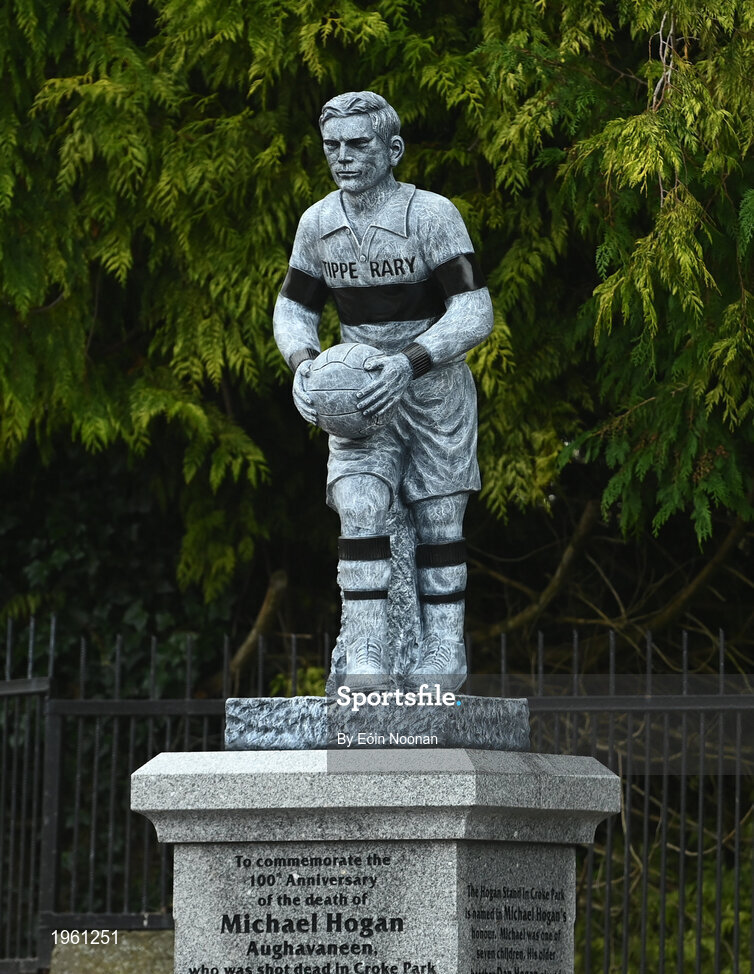
November 21, 1920: Ireland has had a few tragic days in its history that have become known as "Bloody Sunday." This is one of them.
Michael Hogan, 24, was a player in Gaelic football, Ireland's take on the sport. He played right full back, and was Captain of the Tipperary County team. He was also an officer in the Irish Volunteers, a paramilitary organization whose declared primary aim was "to secure and maintain the rights and liberties common to the whole people of Ireland."
On November 21, 1920, with the Irish War of Independence ongoing, for Tipperary in a challenge match against Dublin County, at Croke Park in Dublin. During the game, officers of the Royal Ulster Constabulary, Protestants in the British Army, entered the stadium. In retaliation for General Michael Collins' "Squad" having killed 15 members of the Cairo Gang, a group of British Intelligence officers, earlier in the day, these "Black and Tans," already known and hated for their extrajudicial killings, and opened fire.
Hogan was 1 of 14 people killed. He died in the arms of his teammate, Tommy Ryan, who heard his last words: "Jesus, Mary and Joseph, I'm done for." Another teammate, Jim Egan, was wounded, but survived.
This was the middle portion of an all-day assault by the RUC. In the morning, they opened fire at the Gresham Hotel. At night, they shot people at Dublin Castle. At least 30 people died on the day.

A modernized Croke Park
In 1924, a new stand was built at Croke Park. It was named the Hogan Stand in his memory. In 1999, as part of the stadium's redevelopment, a new Hogan Stand was built. A plaque at the now 82,300-seat stadium commemorates Bloody Sunday, including Hogan's death. A statue of Hogan has been dedicated in Tipperary.
Other "Bloody Sundays" in Ireland include August 31, 1913, when the Dublin Metropolitan Police killed 1 demonstrator and injured 400; July 10, 1921, when the IRA and the police fought in Belfast, with 20 dead, over 100 wounded, and over 200 houses destroyed; and January 30, 1972, "The Battle of the Bogside," when an intended peace demonstration in Derry was fired upon, killing 14 people.
*
November 21, 1920 was a Sunday. Baseball was out of season. The NBA hadn't been founded yet. And the NHL season was a month away from starting. The NFL was in its 1st season, then named the American Professional Football Association. There were 7 games played, and 6 of them ended in shutouts. This was not unusual for that era:
* The Rochester Jeffersons beat a cross-town team that wasn't in the NFL, the Rochester Scalpers, 16-0 at the Rochester Baseball Park in Rochester, New York.
* The Canton Bulldogs beat the Buffalo All-Americans, 3-0 at Canisius Field in Buffalo.
* The Cleveland Tigers beat the Toledo Maroons, 14-0 at League Park in Cleveland.
* The Akron Pros beat the Dayton Triangles, 13-0 at League Park in Akron, Ohio.
* The Columbus Panhandles and a non-NFL team, Zanesville Mark Gray, played to a 0-0 tie at Neil Park in Columbus, Ohio.
* The Chicago Cardinals beat a non-NFL team, Lansing Oldsmobile, 14-0 at Normal Park on the South Side of Chicago.
* And the Decatur Staleys, the team that would become the Chicago Bears, beat the Hammond Pros, 28-7 at Staley Field in Decatur, Illinois.


