Showing posts with label serial killer. Show all posts

Tuesday, December 20, 2022

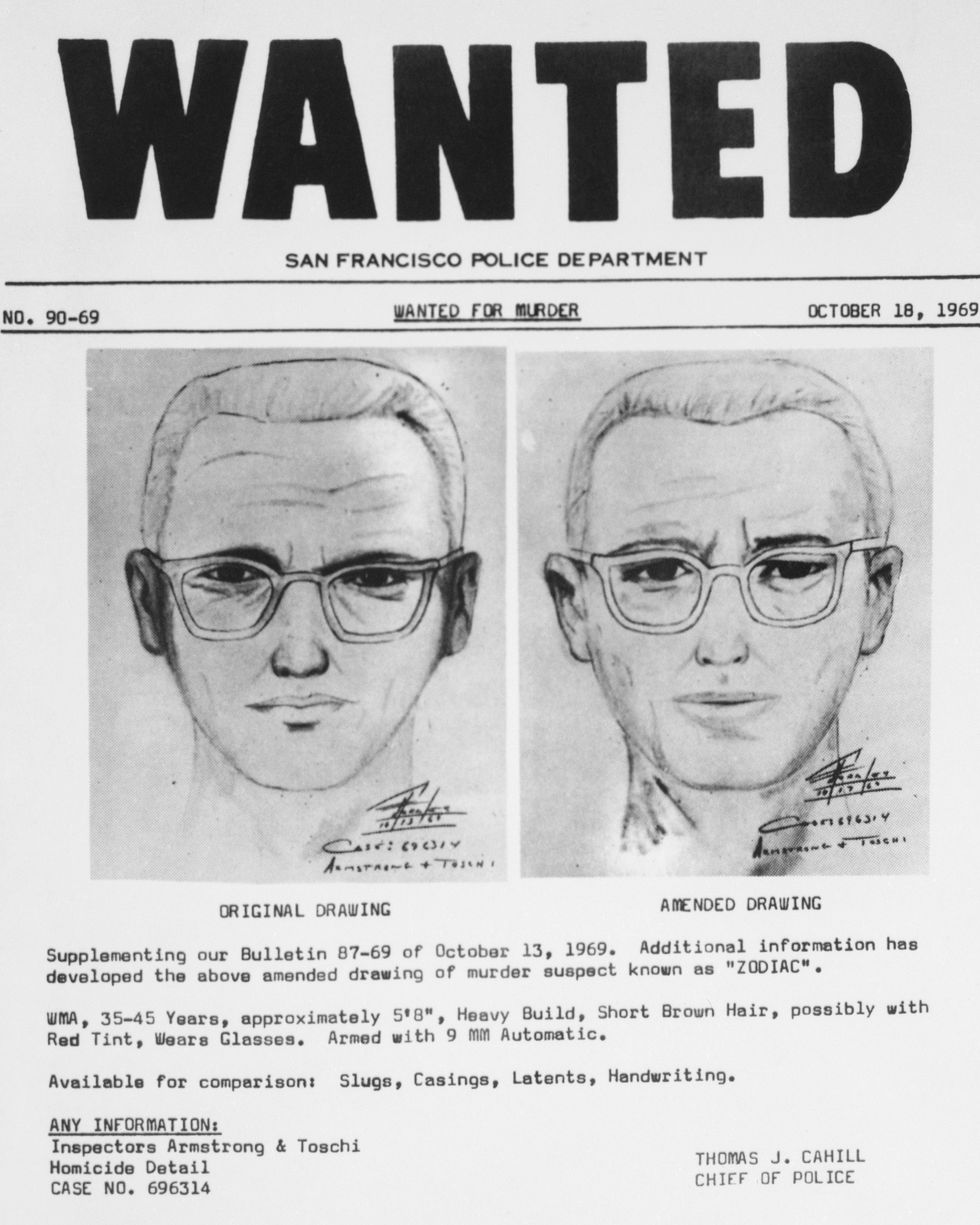
December 20, 1968: The Zodiac Killings Begin

December 20, 1968: The Zodiac killings begin in the San Francisco Bay Area. Murders claimed over the next year: 37. Confirmed by the San Francisco Police Department: 5. The killer: Officially, still unknown.

The Zodiac's known attacks took place in the City and County of San Francisco proper (the City and the County are contiguous); Benicia and Vallejo, in the East Bay region; and unincorporated Napa County, to the north of the city. He attacked three young couples and a lone male cab driver. Two of these victims survived.

The Zodiac coined his name in a series of taunting messages that he mailed to regional newspapers, in which he threatened killing sprees and bombings if they were not printed. He also said that he was collecting his victims as slaves for the afterlife. He included four cryptograms or ciphers in his correspondence. Two were solved in 1969 and 2020, and two remain unsolved.

In 1974, the Zodiac claimed 37 victims in his last confirmed letter. This tally included victims in Southern California, such as Cheri Jo Bates, who was murdered in Riverside in 1966. Despite many theories about the Zodiac's identity, the only suspect authorities ever named was Arthur Leigh Allen, a former elementary school teacher and convicted sex offender, who died in 1992.

Detective Dave Toschi, the lead investigator on the case, told Mark Ruffalo, who played him in the 2007 film Zodiac, about Allen, "As soon as that guy walked in the door, I knew it was him." Ruffalo told an interviewer, "He was sure he had him, but he never had a solid piece of evidence. So he had to keep investigating every other lead." And the evidence against Allen was only circumstantial. But the letters did stop after Allen was convicted and sent to prison on a separate charge.

Toschi served as the model for 2 fictional San Francisco lawmen: Steve McQueen as Lieutenant Frank Bullitt in the 1968 film Bullitt; and Clint Eastwood as Inspector Harry Callahan, starting in the 1971 film Dirty Harry. In that film, Callahan faces a serial killer who calls himself "Scorpio," one of the signs of the zodiac. The real Toschi died in 2018.

The unusual nature of the case led to international interest that has been sustained throughout the years. The SFPD marked the case "inactive" in 2004 but re-opened it prior to 2007. The case also remains open in the California Department of Justice, the FBI, the City of Vallejo, as well as in Napa County and Solano County.

The last message the killer sent to the police and the newspapers was in 1974. He may even still be alive.

*

December 20, 1968 was a Thursday. Baseball was out of season. Football was in midweek. There were 5 games played in the NBA:

* The New York Knicks beat the Detroit Pistons, 135-87 at Cobo Hall (now Huntington Place) in Detroit.

* The Baltimore Bullets beat the Chicago Bulls, 125-102 at the Baltimore Civic Center (now the CFG Bank Arena).

* The Milwaukee Bucks beat the Seattle SuperSonics, 100-92 at the Milwaukee Exposition & Convention Center Arena, a.k.a. The MECCA. (It's now the UW-Milwaukee Panther Arena.)

* The Philadelphia 76ers beat the San Diego Rockets, 116-109 at the San Diego Sports Arena (now the Pechanga Arena).

* And the Los Angeles Lakers beat the San Francisco Warriors, 133-101 at The Forum outside Los Angeles in Inglewood, California.

There was 1 game in the American Basketball Association: The Minnesota Pipers beat the Houston Mavericks, 123-103 at the Sam Houston Coliseum in Houston. Connie Hawkins of the Pipers led all scorers in both leagues on the day, with 35 points.

There was 1 game in the NHL: The St. Louis Blues beat the Oakland Seals, 1-0 at the Oakland Coliseum Arena. Tim Ecclestone scored the only goal, with 2:43 left in the 2nd period.

Tuesday, December 13, 2022

December 13, 1934: The Arrest of Albert Fish

December 13, 1934: Albert Fish is arrested in New York. I'll try to make this post as PG-rated as possible. It won't be easy.

Hamilton Howard Fish was born on May 19, 1870 in Washington, D.C. In spite of his name and birthplace, he appears not to be related to the political family that produced Hamilton Fish, a Governor of New York and U.S. Senator who served as President Ulysses S. Grant's Secretary of State; his sons, Hamilton Fish II, a Congressman, and Nicholas Fish, an Ambassador; a grandson, Hamilton Fish III, an All-American football player at Harvard and a longtime Congressman, where he was a Hudson Valley neighbor and nemesis of President Franklin D. Roosevelt; his son, Hamilton Fish IV, also a longtime Congressman; and his son, Hamilton Fish V, a failed Congressional candidate who runs the magazine The Washington Spectator.

This Hamilton Fish was 5 years old when his father died, and his mother put him in an orphanage. He was physically abused, but began to enjoy the physical pain. There, he was nicknamed "Ham and Eggs," and he eventually asked to be called Albert, after a dead sibling.

There had already been mental illness in the family, but Albert took it to an extreme. By the time he was 20, he was living in New York, prostituting himself and molesting boys. His mother arranged a marriage for him, hoping it would guide him to a normal life. The marriage produced 6 children, and there is no evidence that he ever abused any of them.

But marriage did nothing to stop him. In 1903, he was imprisoned -- for grand larceny, not for what would then have been quaintly called a "morals charge." By 1910, he took to kidnapping and torturing boys. He chose victims he believed wouldn't be searched for: The intellectually disabled, and African-Americans. His wife left him in 1917, but they hadn't divorced when he illegally married another woman in 1930.

On May 28, 1928, he kidnapped, murdered and ate 10-year-old Grace Budd of Manhattan. In 1930, another man was arrested for the murder, tried, and acquitted. In the meantime, Fish was committed to the famed psychiatric ward at Bellevue Hospital in New York. Finally, in November 1934, a letter arrived at the Budd family home. The police put the evidence together, and arrested Fish on December 13.

Fish was insane, so his claims of over 100 murders can't possibly be verified. He ended up being tried for 3. The sensational headlines led to nicknames: The Boogey Man, the Brooklyn Vampire, the Werewolf of Wysteria and the Moon Maniac. He was convicted, and was executed in the electric chair at Sing Sing Prison in Ossining, New York on January 16, 1936.

*

December 13, 1934 was a Thursday. Baseball was out of season. Football was in midweek. The NBA hadn't been founded yet. There were 3 games in the NHL:

* The New York Americans beat the Boston Bruins, 4-3 at the old Madison Square Garden. David "Sweeney" Schriner scored the winning goal, 2:12 into overtime.

* The Toronto Maple Leafs beat the Montreal Maroons, 4-2 at the Montreal Forum. This game also went to overtime. However, at the time, the NHL did not play until there was a winning goal: If a goal was scored in an overtime period, they kept playing to the end of the period. As a result, the Leafs got overtime goals from Charlie Conacher at 5:09, and Frank "Buzz" Boll at 7:53.

* And the Detroit Red Wings beat the St. Louis Eagles, 11-2 at the St. Louis Arena. The shell of the Ottawa Senators moved to St. Louis for the season, and didn't make it to the next one. The Wings got 3 goals from Cooney Weiland (better known as a Bruins player), and 2 each from Ebbie Goodfellow and Lorne Duquid.

Tuesday, November 8, 2022

November 9, 1888: Jack the Ripper's Last Murder

Who the bloody hell was he?

November 9, 1888: Jack the Ripper strikes again. This time, it is the most brutal of his murders.

In the last few years of the reign of Queen Victoria, London was the biggest and most advanced city in the world. But it was also one of economic extremes: Great wealth, and dire poverty. Dreamers came from all over the British Isles, and from all over the world, in the hopes of making their living, or even their fortune, in the seat of the British Empire, which stretched all over the world, and thus, it was said, the Sun never set on it.

As with other cities -- in America from that time onward, the leading example has been New York, and would be joined by Los Angeles -- in London, that hope soon vanished in a morass of deprivation. Unless a woman had a man to work alongside, the only living most women could make was through prostitution.

And while there was always a market for it, that didn't mean that one would meet that market every night. Paying rent on even the meagerest of lodgings was hard. And as for keeping yourself well-fed, clean and healthy, and thus attractive enough for your potential customers, that was unlikely. Not that some men cared: They would take whatever they could afford.

Being a prostitute was a good way for a woman to get killed. Every year, a few "ladies of the evening" were murdered in London. But it didn't happen often enough for the police to notice a pattern. In 1887, there was a murder in the East End that some later tried to tie to the Ripper killings, but most people who've studied the case don't see enough similarities to think it was one.

The murders of Emma Elizabeth Smith on April 3, 1888 and Martha Tabram on August 7 of that year, both in the Whitechapel district of the East End, bear some resemblance to the Ripper killings, but the differences were noticeable enough for them to be ruled not the work of the Ripper. Generally, there are 5 murders said to be his work, known as "the Canonical Five." I'll spare you the most gruesome, and the most intimate, details.

1. August 31, 1888. Mary Ann Nichols, 43 years old, from Soho, West London. She was discovered on Buck's Row, now Durward Street, in Whitechapel -- current London postcode, E1 5BA. Found at about 3:40 AM by her roommate, Emily Holland. It was a vicious knife attack, by anyone's standards. Still, the area had seen killings like this before.

2. September 8, 1888. Annie Chapman, not quite 48, from Paddington, West London. Found at about 6:00 AM at 29 Hanbury Street, Spitalfields, E1 6QS, about a mile west of the Nichols murder. A witness had seen her half an hour earlier, "in the company of a dark-haired man wearing a brown deer-stalker hat and dark overcoat."

This was just 8 days after the Nichols murder, and the details were very similar. Now, people in the neighborhood were getting scared. Already, guesses were being made, based on the wounds. The killer was lefthanded. Or not. The killer was used to using knives. Maybe he was a surgeon. Or a barber. Or a butcher. Or a shoemaker. (Hence the 1st nickname the London press gave him: "Leather Apron.") Maybe he was of one of the immigrant groups in the East End. An Irishman. A Russian. A Pole. A Hungarian. A Jew. Take your pick of bigotries: It was available.

On September 27, the Central News Agency received a letter postmarked that same day, dated September 25. On September 29, they gave it to the London police, collectively called Scotland Yard after their headquarters' address. It read (grammar, spelling and underlining are shown here exactly as written):
Dear Boss,
I keep on hearing the police have caught me but they wont fix me just yet. I have laughed when they look so clever and talk about being on the right track. That joke about Leather Apron gave me real fits. I am down on whores and I shant quit ripping them till I do get buckled. Grand work the last job was. I gave the lady no time to squeal. How can they catch me now. I love my work and want to start again. You will soon hear of me with my funny little games. I saved some of the proper red stuff in a ginger beer bottle over the last job to write with but it went thick like glue and I cant use it. Red ink is fit enough I hope ha. ha. The next job I do I shall clip the ladys ears off and send to the police officers just for jolly wouldn't you. Keep this letter back till I do a bit more work, then give it out straight. My knife's so nice and sharp I want to get to work right away if I get a chance. Good Luck. Yours truly
Jack the Ripper
Dont mind me giving the trade name

PS Wasnt good enough to post this before I got all the red ink off my hands curse it. No luck yet. They say I'm a doctor now. ha ha


Was this letter actually from the killer? Or was it someone having a little fun with the police? The police weren't sure if they should take it seriously. And then...

3. September 30, 1888: Elizabeth Stride, 44, a Swedish immigrant born Elizabeth Gustafsdotter, and known as Long Liz for her unusual height. She was found at around 1:00 AM in Dutfield's Yard, off Berner Street (now 71 Henriques Street), E1 1LZ. The places where Nichols and Chapman were found were both less than a mile away.

Witnesses said they had seen Stride talking to a man on the street a few hours earlier, but their descriptions did not agree, split on both his complexion and his clothes. This murder was also different in that there was only one incision, across her neck. This had been done to Nichols and Chapman, but they'd had more done.

This led to 2 competing theories: Either the Ripper was disturbed in mid-murder, and left so he wouldn't be caught, and thus felt he had to kill another prostitute, in order to fulfill his compulsion; or Stride was killed by someone other than the Ripper, possibly what would now be called a "copycat killer," and it happened to have occurred right before an actual Ripper murder. But the next one is almost universally agreed to be the Ripper's work:

4. September 30, 1888: Catherine Eddowes, 46, from Wolverhampton in the West Midlands, near Birmingham. Found in Mitre Square, not in the East End but in "The City of London," EC3A 5DE. Still, this was within a one-mile walk of the other murders.

She was found at around 1:45 AM -- only about 45 minutes after Stride was found. Certainly, an able-bodied man would have been able to walk less than one mile within 45 minutes. And part of her ear was missing, just as "the Dear Boss Letter" had suggested would happen -- something the police would have known, but the general public would not have, meaning that, almost certainly, this killer was no copycat.

At 2:55 AM, a bloody apron was found in front of a tenement on Goulston Street, about 6 blocks away from Mitre Square. It was recognized as belonging to Eddowes. Above it, someone had written in chalk, "The Juwes are The men That Will not be Blamed for Nothing." (Again, I have not changed the text.) Was this graffito already there? Or was it a suggestion that Jack was Jewish? Police Commissioner Charles Warren thought it might spark an anti-Semitic riot, and ordered it washed away before dawn -- thus removing potential evidence.

Two murders in 45 minutes? It became known as "The Double Event." Now, the whole city was in terror, and the newspapers and magazines of the time didn't help, publishing sensational stories of the murders, with wild theories.

On October 1, 1888, the day after the Double Event, the Central News Agency received a postcard, postmarked that day. It read:

I was not codding dear old Boss when I gave you the tip, you'll hear about Saucy Jacky's work tomorrow double event this time number one squealed a bit couldn't finish straight off. Had not time to get ears off for police thanks for keeping last letter back till I got to work again.
Jack the Ripper

In 1931, 43 years later, a reporter claimed that he'd written all the correspondence attributed to the Ripper to "keep the business alive." In 2018, a handwriting expert concluded that, at the very least, "The Dear Boss Letter" and "The Saucy Jacky Postcard" were definitely written by the same person. Which didn't mean that said person was the actual killer, or somebody riding his attention.

By October 16, there had not been another murder resembling those of Nichols, Chapman, Stride and Eddowes. Things had not calmed down, however. The Whitechapel Vigilance Committee had been formed, a group of local volunteers who patrolled the streets at night, looking for the Ripper. Their chairman was George Lusk, a 49-year-old builder.

On October 16, Lusk received a letter, postmarked the day before. Again, I have not changed the text, leaving the misspellings and grammar intact:

From hell.
Mr Lusk,
Sor
I send you half the Kidne I took from one women prasarved it for you tother piece I fried and ate it was very nise. I may send you the bloody knif that took it out if you only wate a whil longer
signed
Catch me when you can Mishter Lusk

To me, someone who grew up outside New York City and remembers 1977, the Dear Boss Letter looks reminiscent of the letters that David Berkowitz, the Son of Sam, sent to the police and the New York Daily News. But "The From Hell Letter" sounds more like Hannibal Lecter, the villain of Thomas Harris' novels including The Silence of the Lambs. (In 2014, the Internet series Epic Rap Battles of History had the Ripper, played by English online celebrity Dan Bull, face Lecter, played by "Epic" Lloyd Ahlquist.)

It was noted that the handwriting on the From Hell Letter was different from the Dear Boss Letter and the Saucy Jacky Postcard. Nor did it mention, let alone taunt, the police. Nor did it include a prediction of a murder to come. Nor did it include the name "Jack the Ripper" or any derivation thereof. But it did come with a box containing half a human kidney. If the journalist who claimed in 1931 to have written the 2 earlier notes was telling the truth, then the From Hell Letter may be the only real thing.

And then came a killing that truly seemed to come from Hell itself:

5. November 9, 1888: Mary Jane Kelly. Less is known about her than the other victims. She was apparently 25 years old, or around that age, making her young enough to be the daughter of the 1st 4. She claimed to have come from Limerick, Ireland, and grown up in Wales.

This murder was different, and not just because of the victim's age or origin. For one thing, her body was found indoors, at 13 Miller's Court, off Dorset Street, Spitalfields. The street names have changed since: It's at the corner of Brushfield Street and Commercial Street, E1 6AG. One big similarity: Each of the other 4 murder sites was within a one-mile walk, and Chapman's was right around the corner.

Because she wasn't murdered on the street, where she could be easily found by a passerby, it took until 10:45 AM to find her. There were morgue photos taken of the 1st 4, so we have facial photos of them, if not living ones. That was impossible with Kelly: Her face was "hacked beyond all recognition," and it was, by far, the bloodiest and goriest of the Canonical Five crime scenes.

Five prostitutes murdered, all in the same neighborhood, all within 70 days. And then... the killings stopped.

Or... did they? After 1888, pretty much anytime a woman, especially a prostitute, anywhere in the world, was stabbed to death, people blamed Jack the Ripper. There were "Rippers" all over the world. Later murders of prostitutes in Whitechapel were attributed to the Ripper, including those of Alice McKenzie, known as "Clay Pipe Alice," on July 17, 1889; and Frances Coles, known as "Carrotty Nell" for her carrot-orange hair, on February 13, 1891. But the differences in the details of the killings dismissed the unknown killer as theirs.

But the killer was never officially identified, and this is what keeps the Ripper case active in public memory. Who was he? There were several immigrants who were questioned, but the evidence against them wasn't strong enough to bring a case: Doctors like Irish-American Francis Tumblety and Russian Michael Ostrog, and shoemakers like Pole Aaron Kosminsky.

A popular theory is that it was Dr. William Gull, a physician working for the royal family, who killed prostitutes known to have been visited by Prince Albert Victor, Duke of Clarence and Avondale, eldest son of the Prince of Wales, grandson of Queen Victoria, and thus would have been King of England had he lived. Gull -- possibly acting on the Queen's orders -- had to silence these women. There's even a theory that the Duke himself, a.k.a. "Prince Eddy," was the Ripper, leading to the title of a book: Frank Spiering's 1981 Prince Jack.

It wasn't Prince Eddy: Records show that he was at Windsor Castle, 25 miles away, at the time of every one of the Ripper's "canonical five murders." Given the transportation available at the time, there was no way he could have gotten to the murder sites and back without blowing his cover. It wasn't Gull, either: He was 71 years old, and had suffered a stroke, and was unlikely to have been able to overpower the women enough to kill them. If he ever killed anybody, it was through medical mistake, not willful murder.

Another theory, proposed by the initial investigator, Inspector Frederick Abberline, is that Jack was actually a Jill: A midwife would have carried blades, would be able to move around a poor neighborhood at night without raising suspicion, would have known how to render a patient/victim unconscious, could have bloodstained clothing explainable by her work, and would have known how to perform the particulars of some of the mutilations of the Ripper victims. And, since everyone was looking for a man, "Jill the Ripper" was far less likely to become a suspect. Two female murderers contemporary to the Ripper case have been identified as suspects, but circumstances make either seem unlikely.

A theory with some merit is that the last murder, that of Mary Jane Kelly, shocked even the Ripper himself, so deeply that whatever sanity he had left snapped, and that he was found mad on the street, and committed, and no one ever found out that the Ripper had, in fact, been caught -- because he was not identified as the Ripper.

A similar theory is that he was so guilt-stricken by what he'd done to Kelly that he killed himself, possibly by drowning himself in the River Thames. His body would have been found, and, even if identified, no one would ever have known he was the Ripper. Either way, it would explain why Kelly was the last "canonical victim."

Then there are those who notice that the 3rd and 5th killings, those of Stride and Kelly, don't really match the others, and suggest that, while Nicholas, Chapman and Eddowes were killed by the same man, Stride and Kelly were murders separate from them, and separate from each other. Some take this theory to the next logical step: All 5 killings were done by different people, and the name "Jack the Ripper" was totally made up. In other words, There was no Jack the Ripper. Given the nature of crime at the time, there is some logic to this theory.

DNA evidence is useless: The artifacts of the case that survive have been handled by so many people, a positive identification is impossible. In 2014, a shawl belonging to Eddowes was discovered to have DNA from both her and Aaron Kosminsky. But all that proves is that they had sex. She was, after all, a prostitute, and he did live in the same neighborhood. It could have been a one-time thing, or he could have been a regular customer. It doesn't even prove that they were together on the night of her murder, let alone that he was the Ripper.

Most cultural depictions of the Ripper make up fictional characters with which to identify him, including the 1979 film Time After Time: Malcolm McDowell, better known for playing bad guys, is cast not as the Ripper, but as H.G. Wells, author of The Time Machine. In this film, Wells himself invents a time machine, and discovers a friend of his, Dr. John Stevenson, played by David Warner, is the Ripper. Stevenson escapes to the present day, and Wells has to follow him. Stevenson decides to stay, believing that the late 20th Century is much better suited to his sadistic, homicidal ways.

The 1989 DC Comics story Gotham By Gaslight, which puts Batman in the Victorian era, and has his civilian identity, Bruce Wayne, convicted of Ripper-like slayings in Gotham City, before he breaks out of jail and discovers that the Ripper and the man who killed his parents were, in this story, one and the same: Jacob Packer, a man who was in love with Martha Wayne, and kills her and Thomas out of jealousy. This graphic novel launched DC's Elseworlds line, out-of-canon stories involving their characters in "worlds that don't, couldn't, or shouldn't exist."

Other authors have tried to link the Ripper killings to such Victorian-based characters as Wells' The Invisible Man and Robert Louis Stevenson's Strange Case of Dr Jekyll and Mr Hyde; to have Arthur Conan Doyle's Sherlock Holmes, a contemporary of the Ripper, solve the case; and, in one novel, Michael Dibdin's 1978 The Last Sherlock Holmes Story, combine all three: Holmes tries to find a cure for his cocaine addiction, which leads him to become a Hyde-like character, and commit the Ripper murders.

Barring the invention of an actual time machine, we will never know.

In a 2014 episode of the YouTube series Epic Rap Battles of History, British comedian Dan Bull played the Ripper, against "Epic" Lloyd Ahlquist as Hannibal Lecter from Silence of the Lambs.

*

November 9, 1888 was a Friday. The baseball season was over. Hockey was still all-amateur. Basketball wouldn't be invented for another 3 years. And no college football games were played. So there were no scores on this historic day.

It was the birthdate of Jean Monnet, a French civil servant and diplomat, who is considered one of the founding fathers of the European Union.

Thursday, October 27, 2022

October 27, 1964: The Boston Strangler Is Arrested… Or Is He?

October 27, 1964: Albert DeSalvo is arrested after breaking into a woman's home and sexually assaulting her. He confesses to being the serial killer known as the Boston Strangler.

There were 13 murders attributed to the Strangler, between June 14, 1962 and January 4, 1964. Even the assassination of President John F. Kennedy, a Boston native, didn't deter the killer: Joanne Marie Graff, 22, was killed the day of the funeral, November 25, 1963.

Aside from the fact that they were all unmarried women, there seemed to be very little pattern. Five murders were outside the city limits of Boston, but nearby: One in Cambridge, one in Lynn, one in Lawrence, and two in Salem (home of the witch trials of the 1690s). The women were all white, but seemed not to be targeted based on age, ethnicity, religion, type of employment, level of income, or a shared hobby that could connect them to someone who preyed on a person with that hobby. Nor did any of them seem to have ever met any of the others.

They ranged in age from 19 to 85. The 85-year-old, Mary Mullen, died of a heart attack, and DeSalvo claimed that she collapsed as he grabbed her. But one victim, Beverly Samans, was stabbed, meaning that 2 victims were not strangled.

Even with the ones that were strangled, the method wasn't wholly consistent. Of the 11, 8 were strangled with their own nylon stockings after being raped. The 1st victim, Anna Elsa (Legins) Å lesers, was strangled with the belt of her bathrobe. With 2 others, the object used to strangle them wasn't revealed to the public. Four of the victims did not appear to have been sexually assaulted.

The 1st 4 victims had been found within 16 days in June 1962, the last 3 of these within 3 days, the last 2 on the same day, June 30. On July 8, the Boston Sunday Herald published an article with the title "Mad Strangler Kills Four Women in Boston." At other times, he was known as the "Phantom Strangler" or the "Phantom Fiend." In 1963, Jean Cole and Loretta McLaughlin, reporters for the Boston Record American, with 10 victims to the killer's count, wrote a 4-part series on the case, giving the killer the nickname that stuck: "The Boston Strangler."

Two things that all the victims had in common: All were attacked in their own homes, and none of the homes showed any sign of forced entry. Since the women didn't seem to know each other, it ruled out a common regular acquaintance of all of them. Perhaps he was someone to be expected, or disguised as such: An apartment maintenance man, a repairman, a deliveryman. Some women in the Boston area bought tear gas, some new locks and deadbolts for their doors. Some left town. Still, the Boston Police were not convinced they were all the work of one man.

The youngest victim was Mary Ann Sullivan, 19, on January 4, 1964. And then... no more. Twice before, there had been 4-month gaps. By June 1964, that had been exceeded, but there were no more murders anywhere near Boston that fit the Strangler's modus operandi. For over 9 months, there were no new killings that suggested the Strangler. Perhaps he had died, or had been arrested and jailed on a separate charge.

And then, on October 27, a woman not identified by the police let a stranger in, posing as a detective. He knocked her down, carried her to her bed, tied her to it, sexually assaulted her... and then, instead of killing her, said, "I'm sorry," and left. When the actual police came, she gave a description that other women identified as their attacker. They seemed to have found a rapist known as "The Measuring Man" and "The Green Man."

The police found the man the assault victims described: Albert DeSalvo, 33, originally from Chelsea, Massachusetts, living in nearby Malden at this point. At age 21, he was sent to a reform school, for robbery. After being released, he was sent back for stealing a car. He then served in the U.S. Army -- ironically, with service as a Military Policeman.

In custody, DeSalvo confessed -- to the Boston Strangler murders. Although there was absolutely no physical evidence to tie him to those murders -- DNA testing did not come into wide use until the 1990s -- he gave the police details that they had not released to the general public, details only the killer, or someone working on the case (which DeSalvo was not) could know.

DeSalvo hired F. Lee Bailey has his defense attorney. Bailey, a native of the Boston area, had successfully gotten the murder conviction of Dr. Sam Sheppard, the man on whom the TV series The Fugitive was allegedly based, thrown out. Since there was no evidence other than his confession to tie DeSalvo to the Strangler killings, he was charged with the Green Man rapes instead. Bailey insisted that his client was not guilty by reason of insanity, or else why would he confess to a series of murders, crimes that were more serious?

DeSalvo was convicted on January 9, 1967, and sentenced to life in prison. In February 1967, he and 2 fellow inmates escaped from Bridgewater State Hospital, Massachusetts' facility for the criminally insane. He gave himself up the following day, and was transferred to the maximum-security State Prison in Walpole. There, on November 25, 1973, he was stabbed to death in the prison infirmary. He was 42 years old. His killer was never identified. Maybe the authorities didn't feel like trying very hard.

At any rate, after January of 1964, let alone October of that year, there were no more murders that fit the Boston Strangler's M.O. The police figured they'd gotten their man. But several experts on the subject of murders, including those of serial killers, have pointed out many inconsistences. A wide opinion is that, like the 1888 Whitechapel Murders in London, the murders ascribed to one man were likely committed by more than one man, perhaps several, and that, as with "Jack the Ripper," a single "Boston Strangler" never really existed.

In 2013, however, with DNA evidence available, it was conclusively proven that DeSalvo did kill Mary Ann Sullivan, the last and youngest (19) victim attributed to the Strangler. The other 12? Maybe he killed all of them, or some of them, or none of them. We may never know.

F. Lee Bailey became the most famous defense lawyer in America since Clarence Darrow in the 1920s, but, in most of his high-profile cases, he lost, managing, at best, to get his clients reduced sentences. He defended Patty Hearst against bank robbery charges, and lost. Twenty years later, he was part of O.J. Simpson's defense "dream team," and won. But his actions in that trial were bad enough that another member of the dream team, Robert Shapiro, said in an interview a few hours after the verdict that he would never speak to Bailey again. Bailey later got disbarred for business fraud, and died in 2021.

On April 8, 1964, after the Sullivan murder but before DeSalvo's arrest, Allied Artists released the film The Strangler, starring Victor Buono as the killer. The film's murders bore little resemblance to the real thing. In fact, since the film's victims were nurses, it looked more like a case yet to come, that of Richard Speck in Chicago in 1966. (The 2000 film Frequency also dealt with a serial killer of nurses, albeit a fictional one, in New York in 1969.)

In 1968, 20th Century Fox released The Boston Strangler, starring Tony Curtis as DeSalvo, and Henry Fonda and George Kennedy as the cops who identify and arrest him. DeSalvo was the only person whose real name was used. Nearly everything else was made up, including the suggestion that DeSalvo was afflicted with multiple personality disorder, something that had never been alleged in real life. In 2008, David Faustino starred in Boston Strangler: The Untold Story.

In the 1966 song "Dirty Water" by The Standells, the fadeout has the narrator seem to suggest he's the killer: As the other members refrain, "I love that dirty water," he says, "Have you heard about the strangler? I'm the man, I'm the man!" In 1969, The Rolling Stones sang "Midnight Rambler," and Mick Jagger compares his murdering character to the Boston Strangler.

In 1968, Harvard University, based across the Charles River in Cambridge, where one of the murders had taken place, but playing their home games at Harvard Stadium on the Boston side, went undefeated, and their defense was called "The Boston Stranglers." In the early 1980s, Andrew Toney of the Philadelphia 76ers played such tough defense against the Sixers' arch-rivals, the Boston Celtics, that he was known as "The Boston Strangler."

Some people can make a joke about anything. Henny Youngman, "King of the One-Liners," infamous for, "Take my wife -- please!" came up with this one, longer than most of his jokes:

I took my wife on vacation to Boston. There was a knock on the hotel room door. "Who is it?" I asked. The voice on the other side said, "The Boston Strangler!" I said, "It's for you, dear!"

A year later, I went to Boston on business. There was a knock on the hotel room door. "Who is it?" I asked. The voice on the other side said, "The Boston Strangler!" I said, "I gave last year!"

*

October 27, 1964 was a Tuesday. Mary T. Meagher, who won 3 Gold Medals in swimming at the 1984 Olympics, was born. This was also the day of Ronald Reagan's televised campaign speech for Republican Party Presidential nominee Barry Goldwater. I have a separate entry for that event.

Baseball season had ended 12 days earlier, when the St. Louis Cardinals beat the New York Yankees in Game 7 of the World Series. Football was in midweek.

There were 3 games played in the NBA that night, including a doubleheader at the old Madison Square Garden. The Philadelphia 76ers beat the St. Louis Hawks, 100-81. Then, the Boston Celtics, unaware of the arrest made back home, beat the New York Knicks, 131-103. And the San Francisco Warriors beat the Baltimore Bullets, 101-90 at the San Francisco Civic Auditorium (now the Bill Graham Civic Auditorium).

One game was played in the NHL: The Toronto Maple Leafs beat the Chicago Black Hawks, 3-2 at the Chicago Stadium.

Wednesday, August 10, 2022

August 10, 1977: The Son of Sam Is Caught

August 10, 1977: The New York Police Department finally cracks the case, and arrests 24-year-old Yonkers mailman David Berkowitz as "The Son of Sam," whose 8 shootings in New York City in the last year wounded 13 people, killing 6 of them, permanently blinding another, and permanently paralyzing another.

Even though I was only 7 years old, and certainly didn't fit the profile of one of his victims, I followed the case intently on the local news. I was fascinated about how the big tough City collectively lost its mind over this one guy, and how they celebrated around 1:30 in the morning on August 11, when Mayor Abe Beame announced that they got him.

There were 2 other stories that really freaked me out as a kid: The Jonestown Massacre in November 1978, and the Three Mile Island nuclear plant meltdown in March 1979.

*

1st shooting: July 29, 1976, Pelham Bay Park, The Bronx: Donna Lauria, an 18-year-old medical technician, and her co-worker, Jody Valenti, a 19-year-old nurse, were sitting in Valenti's car, after returning from a disco in nearby New Rochelle. A man fired 3 shots, killing Lauria, while Valenti sustained a minor wound. The shooter got away, and Valenti gave the police a description of him.

2nd shooting: October 23, 1976, Flushing, Queens: Carl Denaro, a 20-year-old Citibank security guard, and Rosemary Keenan, an 18-year-old student at Queens College, were sitting in Keenan's car next to Bowne Park. 

Apparently, only one shot was fired, but Denaro was hit in the head. Keenan was cut by broken glass, but otherwise unharmed. She sped away, and got Denaro to a hospital, where he was saved, but a metal plate was needed to replace part of his skull. Neither of them saw the shooter.

3rd shooting: November 27, 1976, Floral Park, Queens: Two students at Martin Van Buren High School, 18-year-old Joanne Lomino and 16-year-old Donna DeMasi, were talking on the porch of Lomino's house when a man shot each of them once. DeMasi was hit in the neck, but her wound was not life-threatening. Lomino was hit in the back, and paralyzed.

Both girls said they didn't see the shooter's face. A neighbor said she saw a blond man running with a pistol in his left hand.

4th shooting: January 30, 1977, Forest Hills, Queens: After midnight, John Diel, a 30-year-old bartender, and his fiancé, Christine Freund, a 26-year-old secretary, were in Diel's car, having just seen the big hit movie of the moment, Rocky. Three shots were fired into the car. Diel was cut by broken glass, but not shot. He drove to a hospital, to no avail: Freund, hit twice, was dead within hours.

She lived long enough to tell the police that she hadn't seen the shooter. Diel said he didn't see the shooter, either. So far, the shooter had been very lucky -- at least, in terms of getting away with it.

Only now did the police begin to piece these crimes together. Each of these four shootings used .44 caliber bullets, and the shooter seemed to be targeting young women with long dark hair. But they were working on the theory that there were different shooters, because the suspect from the Lauria-Valenti shooting (the 1st) had black hair, and the one from the Lomino-DeMasi shooting (the 3rd) had blond hair.

5th shooting: March 8, 1977, Forest Hills, Queens: Virginia Voskerichian, 19, was returning home from her studies at Columbia University, when she saw a man point a gun at her head. She put her textbooks in front of her face to protect herself, but it wasn't enough: A single shot broke through the books, hit her, and killed her instantly. 

This was the only Son of Sam shooting that had a single victim, rather than having a pair of targets. This was just one block from the Freund-Diel shooting.

On March 10, the police announced that there were 5 shootings that all seemed to be the work of one man, whom they were calling "The .44-Caliber Killer," in lieu of evidence that would have suggested another name at the time.

The year before, Australian press baron Rupert Murdoch had bought the New York Post. Previously, it had been a liberal paper, particularly popular with Jewish intellectuals. Murdoch made it a hard right-wing newspaper, slamming the City's liberals, the State's liberals, the country's liberals, for allowing crime to go unchecked, for allowing government spending to go unchecked, you know, the usual right-wing bullshit. 

The City's other major tabloid that survived the big newspaper closings of the 1960s was the Daily News. (The words "New York" have never been in the official title, but their masthead has called them "New York's Picture Newspaper" and "New York's Hometown Paper.") It had previously been a populist conservative paper, due to its roots as having been a part of the Chicago Tribune Company. But with the Post taking a rightward turn, the News realized it needed to shift and fill the Post's former void, and they became a left-populist paper -- not Communist, or even Socialist, but definitely liberal. 

Murdoch's sensationalism, which he had perfected in his native country and then in Britain, was brought to the Post, and its huge, salacious headlines brought its circulation to unheard-of levels. The Daily News was forced to fight fire with fire. And the .44-Caliber Killer drove both papers' circulation to the higher points than they'd had in years.

6th shooting: April 17, 1977, Pelham Bay Park, The Bronx: Just a few blocks from the Lauria-Valenti shooting, Alexander Esau, a 20-year-old tow truck operator, had borrowed his brother's car for a date with Valentina Suriani, an 18-year-old student at Lehman College in The Bronx.

Four shots were fired. Both were hit in the head. Suriani died instantly. Esau died a few hours later, remaining conscious just long enough to tell the police that he didn't see the shooter. This was the first time that two people died in one of the shootings, and the first time with a male fatality.

It was here that the story took on macabre turn. A letter was found at the scene, addressed to the leader of the task force looking for the killer, Captain Joseph Borelli. The killer called himself "the Son of Sam." According to him, "Father Sam" was a demonic figure who commanded him to kill. The Son closed the letter with a warning that he would be back.

On May 30, Daily News columnist Jimmy Breslin -- whom, in a post I wrote after his death, I called "America's greatest newspaper writer" -- received a letter claiming to be from the killer. Now, he had sent a letter to the police and to a newspaper writer, matching the most famous serial killer in history, Jack the Ripper of 1888 London, who, as best as could be determined then, was never identified and never caught. This letter to Breslin was full of lurid prose, and Breslin said, "This guy could take my job."
Jimmy Breslin: A New Yorker's New Yorker.

Breslin conferred with the police, and they agreed with him that the letter should be published. After all, at the time, the Daily News had the highest circulation (most individual papers bought) of any newspaper in the country, over 2 million, and some of those two million people might find clues to the killer's identity in the writing style.. 

(Today, with the high cost of ink and paper, and the Internet, both having rewritten the rules, the Times gets about 830,000, no other single-city paper in America gets even 500,000, the Daily News gets about 260,000, and the Post is down to 230,000. It doesn't help that those high costs have driven up the cost of the newspapers themselves: From 1977 to 2021, the Times has gone from 25 cents to $4.00, the Daily News from 20 cents to $3.00, and the Post from 25 cents to $2.00.)

The Daily News did publish the letter, on Sunday, June 5, along with an editorial written by Breslin. Here's that front page:
Things weren't going so well in Chicago at the time, either.

The killer did not give up. And now, with his targets believed to be young women with long dark hair, women were tying their hair up, and afraid to go out to discos, as disco had taken over from Rock and Roll as the dominant form of music.

7th shooting: June 26, 1977, Bayside, Queens: Sal Lupo, a 20-year-old mechanic, and Judy Placido, 17, who had just graduated from high school, were not afraid to go to a disco, in this case Elephas in Bayside. But when they got into Lupo's car, Placido was scared to be just sitting there, even reminding Lupo that the Son of Sam was still on the loose. 

Sure enough, three shots were fired. Lupo was wounded in the arm. Placido was shot in the head, neck and shoulder. Incredibly, both survived. But neither one of them got a good look at the shooter. 

In spite of the fact that both had survived, the city's hysteria, and the hype from the media, both print and broadcast, became out of control. The first anniversary of the first shooting was coming up on July 29, and the NYPD were sure, based on something the killer had written in the Breslin letter, that this would be the date that he would strike again.

It turned out to be a fakeout. He waited one more night.

8th shooting: July 31, 1977, Bath Beach, Brooklyn: One night, plus a few hours (making it the 31st instead of the 30th), later. Robert Violante, a clothing store salesman, and Stacey Moskowitz, a secretary, both of them 20 years old, were sitting in Violante's car. Violante leaned over to kiss Moskowitz, when four shots were fired into the car. 

Both were hit in the head. Violante was blinded, and saw nothing after a flash of light, meaning the gunshot itself. Moskowitz hung on for 2 days, unconscious and unable to talk to the police, before she died.

This was the first shooting in Brooklyn, and Moskowitz was the first blonde victim. Perhaps the killer was changing his modus operandi to mess with the police. Whatever his intentions, the City was shaking with fear, and the media didn't help the situation. It seems like nothing they printed brought the police any closer to finding the guy.

But this time, he did something else he hadn't done before: He made a mistake. However insane he was suspected to be, he had always gotten away without leaving a clue behind. This time, the police looked for whatever witnesses they could find, and thought that, perhaps, people who got parking tickets near the latest shooting might be witnesses.

On August 10, they found a ticket given to a yellow 1970 Ford Galaxie, belonging to David Berkowitz, 24, an Army veteran living in Yonkers, just over the City Line, and who was working for the Post Office with a Bronx delivery route. 
Berkowitz's Galaxie

They made a call to the Yonkers police, and from talking to them, decided that Berkowitz no longer sounded like a potential witness, and now sounded like a potential suspect. 

When they found the Galaxie, they opened the trunk, and saw guns and other incriminating evidence. At night, they waited for him to come out of the apartment building at 35 Pine Street. He did, and approached the car. Was he on his way to kill again? This time, it didn't matter. When they arrested him, he asked, "What took you so long?"
The Post had the better headline. The Daily News had one that was much more subdued:
Berkowitz pleaded guilty to all eight shootings, thus avoiding a sensational trial, and possibly also the death penalty. In other words, he wasn't totally insane.

Years later, in prison, he would tell an interviewer that he had done the first shooting and the sixth, but not the others. In the Breslin letter, he referred to what he called "The Twenty Two Disciples of Hell." This has led to speculation that there were many people involved in the killings, in various capacities. It's also worth noting that Berkowitz did not match the description given by Jody Valenti, or the front-page-plastered police sketch.

He said that he was driven mad buy a barking dog, that he said told him to kill. The dog belonged to a neighbor, Sam Carr, the father of two of his friends. So that's where the name "Son of Sam" came from.

The Summer of '77 was a tough one for the City. In addition to the killings, crime in general seemed to be out of control, there was a terrible heat wave, a blackout on July 13 led to some of the worst looting the City has ever had, and the race to elect the Mayor got very nasty, leading to Beame's defeat after just one term, and the election of Ed Koch. And the City was still struggling to climb out of its financial crisis that bottomed out in the Autumn of 1975.

Between the arrest of the Son of Sam, and the Yankees going on the hot streak that led to a World Series win, this was the week that began to pull New York City out of the abyss, and let people feel optimistic again, reminding everyone just how good New York could be.

You know, before the mid-1980s' further escalations of crime, racial tension and municipal corruption reminded everyone just how bad New York could be.

Now 69 years old, Berkowitz remains in prison, at Shawangunk Correctional Facility in Shawangunk, Ulster County, New York. Since the early 1990s, he has claimed to be a born-again Christian, active in prison ministry, calling himself the Son of Hope. He says he doesn't expect to ever be released, and that may be for the best -- not because he could kill again, but because, even after all these years, someone might try to avenge his victims and kill him. After all, in 1979, he was stabbed in prison and nearly died.
Unlike Charles Manson, who maintained his crazy look until the end, Berkowitz no longer has the crazy eyes and the sadistic smirk. Now, he looks completely harmless. Maybe he is. But he still deserves to spend the rest of his life in prison.

As for those of his victims who survived: As far as I can tell, all of them are still alive as of this writing, 45 years later. Thus far, Jody Valenti, Carl Denaro and Robert Violante are the only ones to have spoken publicly about their experiences. Denaro is among those who believe that Berkowitz did not act alone.

Despite his blindness, Violante managed to get a job, and stay at it for 35 years until he retired. With some irony, it was with the U.S. Postal Service.

I should note that the expression "going postal," meaning carrying out a moment of madness that results in death, is not attributed to Berkowitz. It happened a few years later, when a different postal worker carried out a mass shooting.

*

August 10, 1977 was a Wednesday. It was the offseason for the NFL, the NBA and the NHL. Yes, I know this post is long. You probably thought I was never going to get around to the scores. Well, here are the Major League Baseball games that were played that night:

* The New York Yankees beat the Oakland Athletics, 6-3 at the original Yankee Stadium. Earlier in the day, Yankees owner George Steinbrenner called manager Billy Martin into his office, and gave him an ultimatum: Bat Reggie Jackson 4th, every game, or you're fired.

Billy had been betting Reggie 3rd, 5th and 6th, but didn't want him in the cleanup spot. Billy never respected Reggie, citing his poor defense (which was a gross exaggeration) and the fact that "His strikeouts are gonna mess up my running game."

Billy has often been called a genius. He wasn't. He had Reggie Jackson, Graig Nettles, Thurman Munson, Chris Chambliss and Lou Piniella. With hitters like those, he didn't need a running game. He did have one, though, with Mickey Rivers and Willie Randolph. Not wanting to lose the only job he ever wanted, Billy caved in, and batted Reggie 4th in every game remaining in that season, except for two when he gave Reggie a day off. 

Result? In this game, Reggie went 2-for-4 with an RBI, Nettles hit a home run, and Ron Guidry outpitched Vida Blue. The Yankees went on a hot streak, overtook the Boston Red Sox and the Baltimore Orioles, won the American League Eastern Division, beat the Kansas City Royals to win the AL Pennant, and beat the Los Angeles Dodgers to win the World Series. George's ultimatum worked.

* The New York Mets lost to the St. Louis Cardinals, 3-1 at Shea Stadium. That's right, both New York teams were at home on the same night. Incredibly, while the Yankees were winning and the Mets were collapsing, the Mets actually had the higher attendance on the night, although just barely, 16,463 to 16,440.

Soon, though, the move made by team president M. Donald Grant, including the trading away of Tom Seaver two months earlier, would begin to drive attendance down so far that Shea became known as Grant's Tomb.

* The Philadelphia Phillies swept a doubleheader from the Montreal Expos at Veterans Stadium in Philadelphia, winning both games by a 6-1 score. The Phils got home runs from Bake McBride in the opener, and Greg Luzinski and Bob Boone in the nightcap. (Yes, kids, that's Aaron Boone's father. Although he was best known as a good defensive catcher, he could hit a little.)

* The Boston Red Sox beat the California Angels, 11-10 at Fenway Park in Boston. The Angels led 10-5 going into the bottom of the 7th, but the Red Sox came back, sparked by a home run by Bernie Carbo.

* The Baltimore Orioles beat the Seattle Mariners, 5-4 at Memorial Stadium in Baltimore.

* The Pittsburgh Pirates beat the Chicago Cubs, 2-1 at Three Rivers Stadium in Pittsburgh. This was the longest game of the season, won by a sacrifice fly by Pirate catcher Ed Ott in the bottom of the 18th inning.

Like their fellow Chicagoans on the South Side, the North Side's Cubs were in 1st place in their division, the NL East, at the All-Star Break. But they faltered, as they so often did before 2016. It wasn't as dramatic as their regular-season collapse of 1969, but it was bad enough.

* The Detroit Tigers beat the Milwaukee Brewers, 5-3 at Tiger Stadium in Detroit.

* The Cleveland Indians beat the Chicago White Sox, 6-1 at Comiskey Park in Chicago. The White Sox, powered by a group of sluggers known as the South Side Hit Men, had led the AL Western Division for most of the season, but had just gotten swept at home by the Kansas City Royals, dooming them.

* Speaking of the Royals, they beat the Texas Rangers, 4-3 at Arlington Stadium in the Dallas suburb of Arlington, Texas.

* The San Diego Padres swept a doubleheader from the Atlanta Braves at San Diego Stadium. The Padres won the 1st game 8-6. They won the 2nd game 2-1 in the bottom of the 11th inning.

Jerry Turner led off the inning with a single. Dave Winfield hit a double, but Turner couldn't score. George Hendrick was intentionally walked, to load the bases and set up the play at any base. It didn't work, as Gene Tenace drew an unintentional walk to end it. Cliché Alert: Walks can kill you. (Mind you, that's only a metaphor. It's not actually going to end your life, the way the Son of Sam did for 6 people.)

* The Los Angeles Dodgers beat the Cincinnati Reds, 1-0 at Dodger Stadium in Los Angeles. Rick Rhoden pitched a 2-hit shutout to outduel Fred Norman. The "Big Red Machine" had won 5 of the last 7 National League Western Division titles, to the Dodgers' 1. This series would shift the dominance L.A.'s way, as the Dodgers made the Playoffs in 7 of the next 12 years, while the Reds only did so once over that stretch.

* And the game between the Minnesota Twins and the Toronto Blue Jays, scheduled for Exhibition Stadium in Toronto, was rained out. Because both teams finished far out of their respective Division races, it was never rescheduled.
Friday, July 22, 2022

July 22, 1991: Jeffrey Dahmer and Mike Tyson Are Arrested

July 22, 1991: Jeffrey Dahmer and Mike Tyson are arrested. Not at the same time, and not for the same thing, although Tyson did once (actually, twice) bite a man's ear.

Tyson had been Heavyweight Champion of the World until February 11, 1990, when he was knocked out by James "Buster" Douglas. When Douglas was subsequently knocked out by Evander Holyfield, an attempt was made to set up a fight between them. It was scheduled for November 8, 1991.

But Tyson was arrested in July 1991 for the rape of 18-year-old Desiree Washington at the Canterbury Hotel in Indianapolis. Washington, who had previously been crowned "Miss Black Rhode Island," was a contestant in the Miss Black America pageant, which was being held in Indianapolis. Tyson was convicted on February 10, 1992, and sentenced to 6 years in prison. He ended up serving 3.

Jeffrey Lionel Dahmer was born on May 21, 1960 in Milwaukee, and grew up in the Cleveland suburb of Bath, Ohio. As a boy, he became fascinated with dead animals and collected their bones. As a teenager, he discovered that he was gay, and, thinking himself weak, began to develop fantasies where he would be stronger than his partners, killing them and even dissecting them like animals. He developed a drinking problem.

He committed his 1st murder in 1978, shortly after graduating from high school, in nearby Chippewa Lake Park. The following year, at his father's urging, he joined the U.S. Army, but he was discharged in 1981, due to his drinking.

Since his grandmother, who lived in the Milwaukee suburbs, was the only family member who seemed to respond well to him, his father sent him to live with her. Things seemed to go well until 1985, when a male coworker propositioned him. Although he didn't accept, it reawakened his repressed tendencies, and he immersed himself in Milwaukee's underground gay subculture. In 1987, at a hotel, he awoke from a drunken stupor to discover he had killed his partner, with no memory of having done so.

He began taking men home, drugging them, sometimes only having his way with them, sometimes also killing them. He did not always properly dispose of their remains, and, in 1988, complaining about the drinking, the strange men, and the strange smells, his grandmother threw him out. Shortly thereafter, he was arrested for molesting a teenage boy, and pleaded guilty, serving 10 months. But law enforcement was still unaware of the murders he had committed.

On July 22, 1991, with Dahmer having killed 17 victims, ranging in age from 14 to 32, an intended victim, Tracy Edwards, escaped from Dahmer's Milwaukee apartment, and flagged down a police car. The policemen found the knife under his bed, and arrested him.

On February 15, 1992, after hearing evidence of Dahmer's sadism, including storing body parts in his freezer for alleged later consumption -- but, contrary to popular belief, he was never accused of eating the flesh of his victims -- Dahmer was convicted on 15 counts of murder, and sentenced to life in prison, plus 10 years, for each of them. He later pleaded guilty to a 16th count.

He was sent to the Columbia Correctional Institution in Portage, Columbia County, Wisconsin. By the time Mike Tyson got out of prison and started boxing again, Dahmer had left prison -- in a coffin. On November 28, 1994, inmate Christopher Scarver bludgeoned Dahmer and another inmate, Jesse Anderson, to death. Dahmer was 34 years old.

Tyson has since, sort of, been rehabilitated. Dahmer is still considered a monster.

*

July 22, 1991 was a Monday. These 4 Major League Baseball games were played:

* The Atlanta Braves beat the Pittsburgh Pirates, 7-3 at Three Rivers Stadium in Pittsburgh. John Smoltz outpitched former Brave Zane Smith. Barry Bonds went 1-for-3 with a walk.

* The Chicago White Sox beat the Milwaukee Brewers, 5-4 at the new Comiskey Park (now Rate Field) in Chicago. Dan Pasqua hit a home run for the Pale Hose. Robin Yount did not play. Paul Molitor went 0-for-5.

* The St. Louis Cardinals beat the Houston Astros, 9-1 at Busch Memorial Stadium in St. Louis.

* And the Texas Rangers beat the Boston Red Sox, 2-1 at Arlington Stadium in the Dallas suburb of Arlington, Texas. José Guzmán outpitched Roger Clemens.

Monday, February 14, 2022

February 14, 1991: "The Silence of the Lambs" Premieres

February 14, 1991: The film The Silence of the Lambs premieres, based on the 1988 novel by Thomas Harris. It premieres on Valentine's Day, but it's no love story.

The lead character is FBI Agent Clarice Starling. Jodie Foster read the book just after winning the Academy Award for Best Actress in The Accused, but director Jonathan Demme didn't think she was right for the role. But he was turned down by Michelle Pfeiffer, with whom he had made Married to the Mob, and Meg Ryan, and the studio, Orion Pictures, flat-out turned down his next choice, Laura Dern. Foster was bankable and she wanted the role, so he gave it to her.

The other main character is Dr. Hannibal Lecter, a psychiatrist, a genius, a sophisticate, a Holocaust survivor (as is found out in later films)... and a cannibalistic multiple murderer. Demme first offered the role to Sean Connery, the Scottish actor known for playing James Bond, who turned it down. Demme then remembered Welsh actor Anthony Hopkins in his role as a psychiatrist in The Elephant Man.

When Hopkins's agent told him that a script was on his way titled The Silence of the Lambs, Hopkins responded, "Is it a children's story?" He called his agent back after reading the first 10 pages and said, "This is the best part I've ever read." He accepted the role after having dinner with Demme. Hopkins developed his portrayal of Lecter by drawing inspiration from the HAL 9000 computer, as voiced by Douglas Rain in 2001: A Space Odyssey, and from the vocal patterns of writer Truman Capote.

Ironically, Hopkins admitted to being intimidated by Foster, who had just won an Academy Award, and initially felt scared to talk to her.

Lecter isn't the main villain of the film. The details of him, Jamie Gumb, a.k.a. Buffalo Bill (played by Ted Levine), and his crimes, are too gruesome to list here. Suffice it to say that Lecter helps Starling figure out how to find him, before breaking out of his dungeon at the Baltimore State Hospital for the Criminally Insane. Horror film directors Roger Corman and George A. Romero have roles, as FBI Director Hayden Burke and a jailer, respectively.

It was nominated for 7 Academy Awards, and became the 3rd and most recent film, after It Happened One Night in 1934 and One Flew Over the Cuckoo's Nest in 1975, to sweep the 5 major Oscars: Best Picture (and it remains the only horror film to win that), Best Director for Demme, Best Actor for Hopkins (even though he was onscreen for only 25 minutes), Best Actress for Foster, and Best Adapted Screenplay for Ted Tally.

The 2001 film sequel Hannibal saw Hopkins return as Lecter, but Demme didn't want to direct, and Foster didn't want to star. Ridley Scott directed, and Starling was played by Julianne Moore. There would be 2 prequels: Red Dragon in 2002, with Demme directing, but no appearance by the Starling character; and Hannibal Rising in 2007, directed by Peter Webber, with Gaspard Ulliel as a young Lecter.

Previously, in 1986, Manhunter had been adapted by Michael Mann, from the 1981 novel of Red Dragon that introduced the character. In the script, the character is listed as "Hannibal Lecktor," and was played by Scottish actor Brian Cox.

In 2003, the American Film Institute named Lecter the Number 1 film villain of all time, and Starling 6th among film heroes, behind Atticus Finch (Gregory Peck in To Kill a Mockingbird), Indiana Jones in his movies (Harrison Ford), James Bond in his movies (with Connery being the 1st of several), Rick Blaine (Humphrey Bogart in Casablanca) and Marshal Will Kane (Gary Cooper in High Noon).

Due to a legal quirk, there's been an NBC TV series titled Hannibal, set before the events of Red Dragon and Silence of the Lambs, starring Danish actor Mads Mikkelsen, but it couldn't use the character of Clarice Starling; and a CBS series titled Clarice, set after the events of Silence of the Lambs but before those of Hannibal, but it couldn't use the character of Hannibal Lecter. Each was allowed to use any other character in the Lecter novels' canon, including either of the two main opponents, but not both of them. Allusions to the Silence of the Lambs case were made in Clarice, but Lecter was not mentioned. And Hannibal was a prequel, so there was no reason to mention Starling.

In a 2014 episode of the YouTube series Epic Rap Battles of History, "Epic" Lloyd Ahlquist played Lecter, against British comedian Dan Bull, who played Jack the Ripper.

*

February 14, 1991 was a Thursday. Baseball and football were out of season. There were 8 games played in the NBA:

* The New York Knicks lost to the Chicago Bulls, 102-92 at Madison Square Garden.

* The Seattle SuperSonics beat the Orlando Magic, 102-90 at the Orlando Arena.

* The Miami Heat beat the Denver Nuggets, 141-112 at the Miami Arena.

* The Houston Rockets beat the Washington Bullets, 129-117 at The Summit in Houston. The arena is now the Central Campus of the Lakewood Church, Dr. Joel Osteen's "megachurch."

* The Phoenix Suns beat the San Antonio Spurs, 106-97 at the HemisFair Arena in San Antonio. Tom Chambers scored 37 for the Suns.

* The Detroit Pistons beat the Milwaukee Bucks, 102-94 at the Bradley Center in Milwaukee.

* The Boston Celtics beat the Golden State Warriors, 128-112 at the Oakland Coliseum Arena. Chris Mullin scored 35 in defeat for the Warriors.

* And the Sacramento Kings beat the Philadelphia 76ers, 98-81 at the ARCO Arena in Sacramento. Lionel Simmons scored 38 for the Kings.

And there were 5 games in the NHL:

* The New York Islanders lost to the Pittsburgh Penguins, 5-2 at the Civic Arena in Pittsburgh.

* The New Jersey Devils played the Winnipeg Jets, 3-3 at the Brendan Byrne Arena at the Meadowlands.

* The Chicago Blackhawks beat the Quebec Nordiques, 2-1 at the Chicago Stadium. Jeremy Roenick scored the winning goal with 3:34 left in overtime.

* And the St. Louis Blues beat the Vancouver Canucks, 3-2 at the Pacific Coliseum in Vancouver. Brett Hull scored his 61st goal of the season, 2:46 into the 3rd period, and that was the winning goal.

Sunday, January 2, 2022

January 2, 1981: The Yorkshire Ripper Is Caught

January 2, 1981: Peter Sutcliffe, a 34-year-old truck driver, is arrested in Sheffield. The police have caught the man they had called the Yorkshire Ripper.

Four months later, he was found guilty of murdering 13 women and attempting to murder seven others between July 5, 1975 and November 17, 1980. He was sentenced to 20 concurrent sentences of life imprisonment.

Born on June 2, 1946 in Shipley, West Yorkshire, Sutcliffe initially attacked women and girls in residential areas, but appears to have shifted his focus to red-light districts, because he was attracted by the vulnerability of prostitutes, and the perceived ambivalent attitude of police to their safety.

If the number of 13 murders is correct, then it's more than twice the total of the original "Ripper" of prostitutes, Jack the Ripper, in London in 1888. The manhunt for him broke the record set by Jack for the biggest in the history of British law enforcement.

Like another serial killer, parking-ticket dope David "Son of Sam" Berkowitz, and a later mad bomber, Timothy McVeigh, it was a minor automotive infraction that led to his being caught: He was driving with phony license plates.

He was caught by Probationary Constable Robert Hydes, in the driveway of Light Trades House on Melbourne Avenue in Sheffield, South Yorkshire. In the car with him was Olivia Reivers, a 24-year-old prostitute, who, had they not been caught, could well have become his next victim. He was arrested, and transferred to Dewsbury police station in West Yorkshire. There, Sutcliffe was questioned in relation to the Ripper case as he matched many of the known physical characteristics.

He confessed on January 4. Just as the "Dear Boss" letter in the Jack the Ripper case said, 93 years earlier, Sutcliffe abhorred prostitutes. "The women I killed were filth," he told the police. "Bastard prostitutes who were littering the streets. I was just cleaning up the place a bit."

He went on trial on May 5, and was convicted on May 22. Despite being found sane at his trial, Sutcliffe was diagnosed with paranoid schizophrenia. Attempts to send him to a secure psychiatric unit were blocked. Three times, fellow inmates tried to kill him, all unsuccessfully.

He only left prison briefly, to be treated at University Hospital of North Durham, where he died from complications of both diabetes and COVID-19 on November 13, 2020. He was 74, and it was no great loss.

*

January 2, 1981 was a Friday. Baseball was out of season. The major college football bowl games had been played the day before, but 1 remained for this day: The University of Miami, ranked Number 20, beat Virginia Tech, 20-10 in the Peach Bowl, at Atlanta-Fulton County Stadium.

There were 10 games in the NBA -- with few distractions, unlike the day before with the major bowl games, and the next 2 days with the NFL Playoffs, it was a good day to scheduled them:

* The New York Knicks lost to the Detroit Pistons, 102-100 at the Silverdome in the Detroit suburb of Pontiac, Michigan.

* The New Jersey Nets lost to the Cleveland Cavaliers, 111-105 at the Rutgers Athletic Center (now the Jersey Mike's Arena) in Piscataway, New Jersey. Mike Mitchell scored 34 for the Cavs.

* The Chicago Bulls beat the Washington Bullets, 92-82 at the Capital Centre in the Washington suburb of Landover, Maryland.

* The Indiana Pacers beat the Atlanta Hawks, 109-106 at The Omni in Atlanta.

* The Kansas City Kings beat the Utah Jazz, 101-95 at the Kemper Arena (now the Hy-Vee Arena) in Kansas City.

* The Houston Rockets beat the Dallas Mavericks, 124-120 at the Reunion Arena in Dallas. The Mavs were a 1st-season expansion team, so this was not yet a rivalry. Moses Malone led all scorers on the day with 40 points for the Rockets, also grabbing 15 rebounds.

* The San Antonio Spurs beat the Los Angeles Lakers, 118-112 at the HemisFair Arena in San Antonio. Kareem Abdul-Jabbar scored 36 in defeat.

* The Phoenix Suns beat the Denver Nuggets, 133-132 at the McNichols Arena in Denver.

* The Golden State Warriors beat the Boston Celtics, 121-106 at the Oakland Coliseum Arena.

* And the Philadelphia 76ers beat the Seattle SuperSonics, 120-117 in overtime at the Seattle Center Coliseum. Julius "Dr. J" Erving scored 36 points.

And there were 6 games in the NHL:

* The New York Rangers beat the New York Islanders, 3-1 at Madison Square Garden. By winning the Stanley Cup the season before, something the Rangers hadn't done since 1940, the Islanders definitively supplanted the Boston Bruins as what they had pretended to be since a 1975 Playoff win: The Rangers' arch-rivals.

* The Montreal Canadiens beat the Hartford Whalers, 3-1 at the Hartford Civic Center (now the PeoplesBank Arena).

* The Detroit Red Wings and the Vancouver Canucks played to a tie, 2-2 at the Joe Louis Arena in Detroit.

* The Winnipeg Jets beat the Philadelphia Flyers, 4-3 at the Winnipeg Arena.

* The Calgary Flames beat the Los Angeles Kings, 7-6 at the Stampede Corral in Calgary.

* And the Edmonton Oilers beat the Boston Bruins, 7-5 at the Northlands Coliseum in Edmonton.

December 31, 1999 & January 1, 2000: The Millennium

December 31, 1999:  The Millennium arrives. The people of planet Earth survived. At a terrible cost. But we hadn't destroyed ourselves. ...