Showing posts with label milan. Show all posts

Friday, December 23, 2022

December 24, 1871: "Aida" Premieres

December 24, 1871: Aida premieres at the Khedivial Opera House in Cairo, the capital of the country where the opera takes place, Egypt. Antonietta Anastasi-Pozzoni plays Princess Aida of Ethiopia. Pietro Mongini plays Captain of the Guard Radamès. The conductor is Giovanni Bottesini. The libretto was written by Antonio Ghislanzoni. And the composer is Giuseppi Verdi, making a triumphal return to opera after some time away.

Before I go any further: This is the earliest work of classical music for which I felt it necessary to do one of these entries. Some other notable works that came before my 1869 cutoff date:

* Johann Sebastian Bach: Toccata and Fugue in D Minor (a.k.a. the Phantom of the Opera's song), 1704; the Brandenburg Concertos, 1721.
* George Frideric Handel: Water Music, 1717; Messiah, including its "Hallelujah Chorus," 1741.
* Christian Petzol: Minuet in G, 1720. Long thought to have been written by Bach in 1725, in 1965 it was adapted by Sandy Linzer and Denny Randell as "A Lover's Concerto," a hit by female vocal group The Toys.
* Antonio Vivaldi: The Four Seasons, 1725.
* Wolfgang Amadeus Mozart: The Marriage of Figaro, 1786; Eine kleine Nachtmusik (A Little Night Music) and Don Giovanni (Don Juan), 1787; Symphony No. 40, 1788; The Magic Flute, 1791.
* Ludwig van Beethoven: Piano Sonata No. 14 (a.k.a. the Moonlight Sonata, a name not given to it until long after his death), 1801; Bagatelle No. 25 in A Minor (a.k.a. Für Elise), 1810, although it wasn't published until 1867; and his 9 Symphonies, 1800, 1803, 1805, 1807, 1808, 1808, 1813, 1814, and 1824.
* Niccolo Paganini: Carnival of Venice, 1829.
* Gioachino Rossini: William Tell, including its Overture (a.k.a. the Lone Ranger Theme), 1829.
* Johan Strauss: The Blue Danube, 1867.
* Edvard Grieg: Piano Concerto No. 1, 1869.

*

Giuseppe Verdi -- or, as the Danish pianist and comedian Victor Borge liked to call him, Joe Green, for the literal English translation of his name is "Joseph Green" -- was born as Giuseppe Fortunino Francesco Verdi on October 9, 1813 in Le Roncole, outside Parma, Italy. He would remain the greatest composer born on an October 9, until 1940, when John Lennon was born in Liverpool, England.

By the age of 8, Verdi was already paid to be the organist at his church. Although he liked to associate himself with the common people, his parents were landowners, so they could afford to assist his love of music. He was writing operas by 1834, and married Margherita Barezzi in the Spring of 1836. By the Summer of 1838, they had a daughter and a son; by the Summer of 1840, Margherita and both children had died. So many operas have been tragic, but, by 27, Verdi had already sustained more tragedy than anyone should.

In 1847, at 34, Verdi wrote I Masnadieri, (The Robbers), based on Friedrich Schiller's play Die Räuber. The female lead was Giuseppina Strepponi. At 32, she was famous for her voice, and infamous for already having had 5 (or 6, depending on who was telling the story) illegitimate pregnancies, although only 2 children survived infancy. She moved in with him, and, in mostly-Catholic, very conservative 19th Century Italy, that caused a scandal that hurt him commercially.

He didn't care, especially since her linguistic skill made her a good translator. From French, she translated Victor Hugo's 1832 play Le Roi S'Amuse (The King Amuses Himself), and it became Verdi's 1851 opera Rigoletto, with perhaps the most famous song in all of Italian opera, the Duke of Mantua's "La Donna è Mobile" ("Woman is Fickle").

From Spanish, she translated the 1836 play El Trovador (The Troubadour) by Antonio García Gutiérrez, and it became Verdi's 1853 opera Il Trovatore, which, thanks in large part to its Anvil Chorus, brought the public back over to his side. Also in 1853, in her honor, he wrote La Traviata (The Fallen Woman), based on La Dame aux Camélias (The Lady of the Camellias) by Alexandre Dumas fils, which eventually became the Greta Garbo film Camille.

In 1859, Verdi stepped back from composing, having married Strepponi, although they had no children together; and inherited his family's lands, and concentrated on running them. He supported the unification of Italy, which occurred in 1861, and became friends with King Victor Emmanuel II, who kept his numbering as King of Piedmont when he became King of united Italy. One of Verdi's few works in this period was La Forza del Destino (The Force of Destiny, or The Power of Fate), in 1862, another of his works to be based on a Spanish play.

Isma'il Pasha, the Khedive (Sultan) of Egypt, offered Verdi 150,000 francs to write an opera for his new Opera House in Cairo. Difficulties led to delays, which resulted in the 1st opera being performed there, on November 1, 1869, being an established Verdi work, Rigoletto. Verdi was living in Paris, and had sets and costumes made for the original work that he had intended to open the Opera House, but the Franco-Prussian War of 1870-71 prevented him from leaving the country with them. Finally, on December 24, 1871, Aida could premiere at the Khedivial Opera House.

The story tells of a war between Egypt, during its Old Kingdom period (2700-2200 BC, also known as the Age of the Pyramid Builders), and Ethiopia, and the love between Egyptian warrior Radamès and Aida, the captured daughter of the King of Ethiopia.

Verdi did not attend the premiere in Cairo, and was angry that the audience consisted of invited dignitaries, politicians and critics, but no members of the general public. He therefore considered the European premiere, in which he was heavily involved at every stage, to be its real première: February 8, 1872, at the home of Italian opera, Teatro alla Scala (usually written as just "La Scala") in Milan.

He had written the role of Aida for the Czech spinto soprano Teresa Stolz, and she sang it at that premiere. She was then engaged to Angelo Mariani, and asked him to conduct, but he declined, and Bottesini conducted it again. Giuseppe Fancelli played Radamès.

In his later years, having already turned Macbeth into an opera, Verdi wrote some operas based on other works of William Shakespeare, including Otello (the lack of an H differentiates it from the play Othello), The Merry Wives of Windsor, and Falstaff.

Giuseppina died in 1897, and Verdi was heartbroken. He died on January 27, 1901, 6 days after suffering a stroke. He was buried next to his wife at the Casa di Riposo (House of Repose) in Milan.

Isma'il Pasha was deposed as Khedive in 1879, and died in 1895. Pietro Mongini, the Cairo premiere's Radamès, died of a heart ailment in 1874, only 45 years old. Giuseppi Fancelli, the Milan premiere's Radamès, lived until 1887; conductor Giovanni Bottesini, until 1889; librettist Antonio Ghislanzoni, 1893; Teresa Stolz, the Milan premiere's Aida, until 1902; Antonietta Anastasi-Pozzoni, the Cairo premiere's Aida, until 1917. 

The Khedivial Opera House burned down on October 28, 1971, and wasn't replaced until a new Cairo Opera House opened at a different location in 1988. The site of the original building is now a parking garage, but its street is still named Opera Square.

Verdi's operas Rigoletto, Aida, Il Trovatore and La Forza del Destino were mentioned in "Does Your Mother Know You're Out, Rigoletto?" an episode of The Odd Couple that aired on ABC on November 5, 1971, almost exactly 100 years after Aida premiered -- and mere days after the Khedivial Opera House burned down.

*

December 24, 1871 was a Sunday. It was Christmas Eve. No major sporting events were held that day.

Friday, December 16, 2022

December 16, 1899: Soccer Comes to Italy

Herbert Kilpin

December 16, 1899: The Milan Foot-Ball and Cricket Club is founded in Milan, Lombardy. Its founder is an expatriate Englishman, Herbert Kilpin. It is the 1st professional soccer team in Italy.

Kilpin, a 29-year-old native of Nottingham, had played for Notts Olympic, and went to Italy to work for a textile merchant linked with his employer in Nottingham. There, he joined Internazionale FC Torino. (Both teams were defunct by 1916.) He founded the Milan club, giving it the English Cross of St. George as its crest, and shirts of red and black stripes, giving it the nickname Il Rossoneri, the Red and Black. He said, "We will be a team of devils. Our colours will be red like fire and black like the fear we will invoke in our opponents." 

He led the team to Italian titles in 1901, 1907 and 1909, and married an Italian woman, before dying from the effects of alcoholism in 1916, only 46 years old. In 1908, a dispute led to some players leaving the team, and forming a new one, Internazionale Milano, or "Inter." They chose black and blue stripes, making them Il Nerazzurri, the Black and Blue. The existing team became Associazione Calcio Milan, or "A.C. Milan," or just "Milan."
The Duomo of Milan, flanked by the badges
of Inter (left) and AC Milan

The Italian national team play in blue shirts, blue being the color of the former royal House of Savoy, and are thus known as the Azzurri (the Blues). Their 1st match was on May 15, 1910, at the Arena Civica in Milan, and they beat France, 6-2.

Since 1926, A.C. Milan have played their home games at a stadium in the San Siro neighborhood, and it is called "The San Siro." Inter have played there since 1947. Ironically, its official name is Estadio Giuseppe Meazza, after an Inter player who helped Italy win the 1934 and 1938 World Cups. Although it is the most famous sports venue in the country, both teams have expressed interest in replacing it, with plans being suggested that they would collaborate, or build separate stadiums.
The San Siro, prior to an AC Milan match
in the UEFA Champions League

Through the 2021-22 season, A.C. Milan have won Italy's national league, Serie A, 19 times, including in said 2021-22 season; the Coppa Italia, Italy's version of the FA Cup, 5 times, most recently in 2003;  and the European Cup/UEFA Champions League 7 times, more than any team except Real Madrid: In 1963, 1969, 1989, 1990, 1994, 2003 and 2007.

Inter have also won Serie A 19 times, and the Coppa Italia 8, including in 2021-22. Unlike A.C. Milan, they have won the League and Cup "Double," in 2006 and 2010. They have won the European Cup/Champions League 3 times, in 1964, 1965 and 2010 -- meaning that, in 2010, they won the only "European Treble" in Italian history. (UPDATE: In 2023, Inter won a 9th Coppa Italia; in 2024, a 20th Serie A title.)

Both teams trail the 30 Serie A titles won by Turin-based Juventus Football Club, and their 14 Coppi Italia, althtough both have exceeded Juve's 2 Champions League titles, of 1985 and 1996. (UPDATE: Juve won a 15th Coppa Italia in 2024.)

Calendar year 1899 was a great year for soccer, as, in addition to A.C. Milan, several other legendary clubs were founded:

* January 8: SK Rapid Wien, in Vienna, Austria.
* March 8: Frankfurter Fußball-Club Victoria von 1899, the predecessor of Eintracht Frankfurt, in Frankfurt, Germany.
* May 3: Ferencvárosi Torna Club, commonly known as Ferencváros, in Budapest, Hungary.
* May 13: Esporte Clube Vitória, in Salvador, Brazil.
* May 14: Club Nacional de Football, in Montevideo, Uruguay.
* May 27: Rangers Football Club, in Glasgow, Scotland.
* August 31: Olympique de Marseille in Marseille, France.
* November 29: FC Barcelona in Barcelona, Spain.

*

December 16, 1899 was a Saturday. Actor and playwright Noël Coward was born.

In North America, baseball and football were out of season, basketball barely existed, and hockey was still all-amateur. In England, the soccer team I would one day support, then known as Woolwich Arsenal, Burton Swifts of Stoke-on-Trent, Staffordshire, to a 1-1 draw at the Manor Ground in Plumstead, South-East London.

Monday, November 14, 2022

November 14, 1986: “Hoosiers” Premieres

November 14, 1986: Hoosiers premieres. It tells the story of the basketball team at Hickory High School in rural Indiana, and its improbable run to the State Championship in 1952, led by coach Norman Dale, played by Gene Hackman.

Māris Valainis, a real-life former Indiana high school basketball star of Lithuanian descent, plays the star player, Jimmy Chitwood. Barbara Hershey, Dennis Hopper, and Sheb Wooley -- famous for his 1958 novelty song "The Purple People Eater" -- also star.

It becomes an inspirational movie to sports underdogs everywhere. It was based on a true story – sort of. March 13, 1954: Milan High School (pronounced MYE-lan, not Mih-LAHN like the Italian city), enrollment 161, defeated Muncie Central High School, enrollment over 1,600, 32-30 -- no shot cloick to win the title. But Milan had reached the State Semifinal in 1953, so, while it was an upset, it wasn't a gigantic upset. Maybe a 10-to-1 shot, but not a 1,000-to-1 shot. Think of it like if Gonzaga beat Duke in the NCAA Tournament Final.

Or if Butler University, of Indianapolis, beat Duke. The Final was filmed where the actual Finals were held at the time, the Butler Fieldhouse. Built in 1928, in 1966 it was named for Tony Hinkle, Butler's basketball coach from 1926 to 1970, its football coach from 1935 to 1969, its baseball coach from 1921 to 1970, and its athletic director from 1926 to 1970 -- in each case, except for during World War II.

*

November 14, 1986 was a Friday. Baseball was out of season. Football was in midweek. There were 6 games in the NBA:

* The New York Knicks lost to the Milwaukee Bucks, 106-103 at the Milwaukee Exposition and Convention Center Arena, a.k.a. The MECCA. (It's now the UW-Milwaukee Panther Arena.)

* The Boston Celtics beat the Chicago Bulls, 110-98 at the Chicago Stadium. Michael Jordan scored 48 points.

* The Atlanta Hawks beat the Detroit Pistons, 105-100 at the Silverdome in the Detroit suburb of Pontiac, Michigan.

* The Denver Nuggets beat the Dallas Mavericks, 142-138 at the McNichols Arena in Denver.

* The Phoenix Suns beat the Philadelphia 76ers, 127-97 at the Arizona Veterans Memorial Coliseum in Phoenix.

* And the Portland Trail Blazers beat the Los Angeles Clippers, 119-109 at the Veterans Memorial Coliseum in Portland.

There were 4 games played in the NHL:

* The New York Rangers beat the Philadelphia flyers, 2-1 at Madison Square Garden.

* The New Jersey Devils beat the Pittsburgh Penguins, 5-4 at the Brendan Byrne Arena at the Meadowlands.

* The Quebec Nordiques beat the Washington Capitals, 4-1 at the Capital Centre in the Washington suburb of Landover, Maryland.

* And the Winnipeg Jets beat the Vancouver Canucks, 3-2 at the Pacific Coliseum in Vancouver.

And in New Jersey high school football, for the last time while I was a student there, East Brunswick High School played, beating Sayreville, 33-6 at Jay Doyle Field in East Brunswick. We missed the Central Jersey Group IV Playoffs, but backed into the Greater Middlesex Conference Red Division title when another school lost on Thanksgiving Day.

Monday, September 19, 2022

September 19, 1926: The San Siro Opens

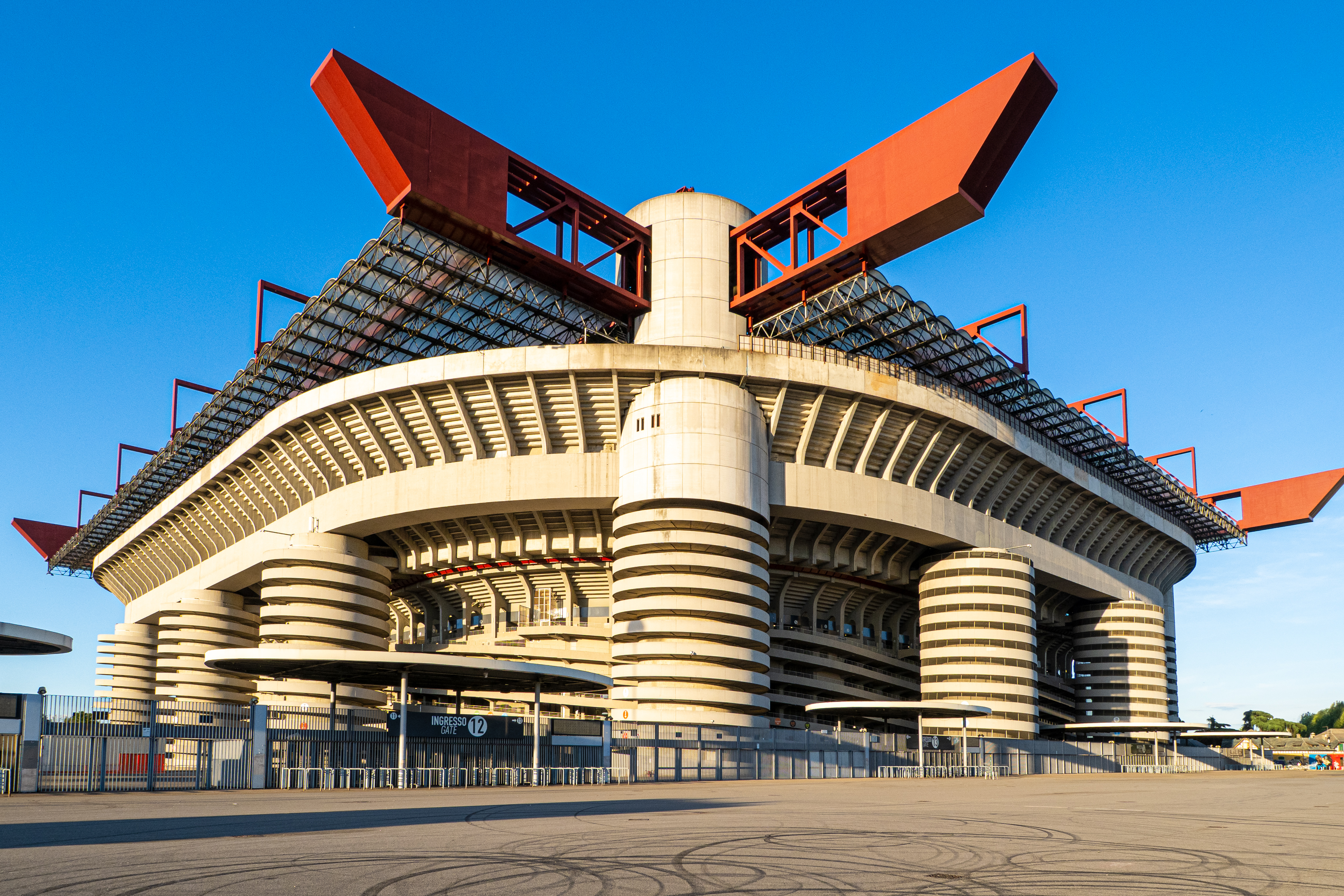
September 19, 1926: Nuovo Stadio Calcistico San Siro -- San Siro New Football Stadium -- opens in the San Siro section of Milan, Italy, about 3 miles west of the center of town. Unlike most sports stadiums in Europe at the time, it was designed specifically for soccer -- known in Italy as "calcio," not a variation of "football" -- without a running track.

The 1st match is a Milan Derby -- or Derby della Madonnina, as Milan is known as "The Madonna's City" -- and Internazionale Milano defeats Associazione Calcio Milan, 6-3. A full house of 35,000 attends.

A.C. Milan, known as simply Milan for short, and as the Rossoneri for their shirts of red and black stripes, have played their home games there ever since. Inter Milan, or just Inter, known as the Nerazzurri for their shirts of black and blue stripes, began playing home games there in 1947.

Expansions were undertaken in 1935 and 1955. In 1987, a renovation began to prepare the stadium for the 1990 World Cup. A minor renovation was undertaken in 2015-16. Current capacity is 75,817, making it the largest stadium in Italy, as well as the most famous.
The stadium hosted 3 games of the 1934 World Cup, which Italy won, as they did in France in 1938, in large part due to Giuseppe Meazza, the Milan-born Inter striker. He died in 1979. The following year, the stadium was officially renamed Stadio Giuseppe Meazza. But it is still called "The San Siro" around the world, and it has surpassed the Duomo as Milan's most famous building.

Since moving in, both Milan teams have been remarkably successful. AC Milan have won 19 league titles, 16 of them in Italy's Serie A since moving in: 1951, 1955, 1957, 1959, 1962, 1968, 1979, 1988, 1992, 1993, 1994, 1996, 1999, 2004, 2011 and 2022. They have won the Coppa Italia 5 times: 1967, 1972, 1973, 1977 and 2003 -- although they've never won "The Double," the league and the cup in the same season. They've won the European Cup/UEFA Champions League 7 times, 2nd only to Real Madrid: 1963, 1969, 1989, 1990, 1994, 2003 and 2007.

Inter have also won 19 titles, with both Milan teams tied for 2nd among Italian teams behind Juventus. They've won 14 since moving into the San Siro: 1953, 1954, 1963, 1965, 1966, 1971, 1980, 1989, 2006, 2007, 2008, 2009, 2010 and 2021. They've won the Coppa Italia 8 times, 7 since moving in: 1978, 1982, 2005, 2006, 2010, 2011 and 2022. This means they've won 2 Doubles, in 2006 and 2010. And they've won the European Cup/Champions League 3 times: Back-to-back titles in 1964 and 1965, and in 2010, making them the 1st, and still the only, Italian team to win a "European Treble."

(UPDATE: Inter won the Coppa Italia again in 2023 and 2026, and Serie A again in 2024 and 2026.) 

The 1960s was the golden age of Italian soccer, with both Milan teams practicing "catenaccio," meaning "padlock," a supreme defensive strategy. Between them, Milan and "Il Grande Inter" won 4 European Cups, and Inter lost 1 other Final, in 7 seasons.

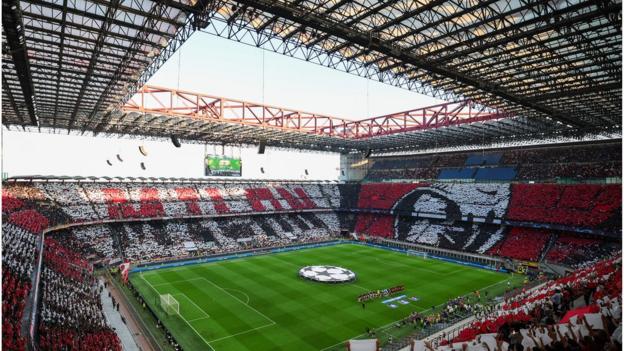
Milan's fans sit in the Curva Sud, the south end; Inter's in the Curva Nord, the north end. Unlike such other Italian rivalries as Roma-Lazio and Juventus-Torino, this rivalry tends to be mostly talk, and violence is rare.
The San Siro hosted 3 games of UEFA Euro 1980, 6 games of the 1990 World Cup, and 4 Finals of the European Cup: 1965, 1970, 2001 and 2016.

By a coincidence that I, as a fan of theirs, have enjoyed, North London team Arsenal F.C. became the 1st British team to beat each of the hosts at the San Siro, both in Champions League play: Inter in 2003, and AC Milan in 2008.

In 2019, a plan to build a new 70,000-seat stadium next door, to be used by both teams, was put forward, intended to be ready for the 2022-23 season. As of September 19, 2022, construction has not yet begun.

UPDATE: It has been announced that the San Siro will also host the opening ceremony of the 2026 Winter Olympics, which will be divided between Milan and 1956 hosts Cortina d'Ampezzo. In 2023, AC Milan announced plans for a separate stadium, next to their club headquarters in the city's southern suburbs. This would have left the new San Siro to be home to Inter only. This plan also fell through.

In 2025, the two clubs announced an agreement on a new stadium, adjacent to the current one. Construction is set to begin in late 2027.

*

September 19, 1926 was a Sunday. Baseball Hall-of-Famer Duke Snider was born. So was Inside the Actors Studio host James Lipton.

These baseball games were played:

* The New York Yankees beat the Cleveland Indians, 8-3 at League Park in Cleveland. Babe Ruth went 2-for-4 with a home run, a walk, and 2 RBIs. Lou Gehrig went 4-for-5 with a home run and 4 RBIs. Tris Speaker, also the Indians' manager, went 0-for-3 with a walk.

* The New York Giants beat the St. Louis Cardinals, 6-5 at the Polo Grounds. Bill Terry went 0-for-4. Frankie Frisch went 1-for-4. Rogers Hornsby, also the Cardinals' manager, went 1-for-3 with 2 walks and an RBI.

The Cardinals went on to beat the Yankees in the World Series. After the season, each having worn out their welcome with team management, Frisch and Hornsby were traded for each other. Hornsby wore out his welcome with the Giants in only 1 year, and was traded again; Frisch became not just a bigger star in St. Louis, but the manager.

* The Brooklyn Robins (as the Dodgers were known while Wilbert Robinson managed them from 1914 to 1931) lost to the Pittsburgh Pirates, 7-4 at Ebbets Field. Paul Waner went 3-for-5 with 2 RBIs. He was a rookie then, and his brother Lloyd came up the next season. Zack Wheat only appeared as a pinch-hitter, and did not reach base.

* The Detroit Tigers beat the Washington Senators, 8-7 at Navin Field (later Briggs Stadium and Tiger Stadium) in Detroit. Walter Johnson only lasted 6 innings, although he was not the losing pitcher. The Senators scored 3 in the top of the 9th to bail him out. But in the bottom of the 9th, Ty Cobb, also the Tigers' manager, singled home Johnny Neun and Heinie Manush to win it.

* The Chicago White Sox beat the Boston Red Sox, 6-3 at Comiskey Park in Chicago.

* The St. Louis Browns beat the Philadelphia Athletics, 5-4 at Sportsman's Park in St. Louis. Ken Williams hit a sacrifice fly in the bottom of the 10th, to score Gene Robertson with the winning run.

* Because professional sports on Sunday was still illegal in the Commonwealths of Massachusetts and Pennsylvania, the Boston Braves, who were at home, had the day off, having finished a home series with the Chicago Cubs the day before, and starting a new one with the Cincinnati Reds the next day.

* Likewise, the Philadelphia Phillies had finished one with the Cardinals on Saturday the 18th, and started one with the Pirates on Monday the 20th.

And the NFL season opened, with these 4 games:

* The Chicago Cardinals beat the Columbus Tigers, 14-0 at Comiskey Park in Chicago.

* The Chicago Bears beat the Milwaukee Badgers, 10-7 at Borchert Field in Milwaukee.

* The Green Bay Packers beat the Detroit Panthers, 21-0 at City Stadium in Green Bay, Wisconsin.

* And the Duluth Eskimos beat the Kansas City Cowboys, 7-0 at Athletic Park in Duluth, Minnesota.

Sunday, May 22, 2022

May 22, 1963: The Triumph of "Catenaccio"

May 22, 1963: The European Cup Final, the championship game of European soccer, is held at the old Wembley Stadium in London. This was the 1st year that Wembley had its familiar roof going all the way around the stadium.

Benfica, of Lisbon, Portugal, had won the last 2 titles, and were back for an attempt at a 3rd. They are known as Os Encarnados for their red shirts, As Águias for the eagle on their crest, and O Glorioso for their "glorious" success. Tapping into Portugal's African colonies, Benfica were led by Eusébio da Silva Ferreira, the Mozambique-born striker known as the Black Pearl. His quick-strike ability meant that, to put it in baseball terms, Benfica were always in scoring position.

Their opponents were Associazione Calcio Milan. (The Italian word for "soccer" is "calcio," rather than any variation on the word "football," like it is in most countries.) Known as the Rossoneri for their red-and-black-striped uniforms, A.C. Milan had lost the European Cup Final to Real Madrid in 1958. The year before, Fiorentina, of Florence, had lost to Real Madrid. So Milan were aiming to become the 1st Italian team to win the Cup.

Their manager, Nereo Rocco, had a tight defensive style. So did the team with whom they shared a stadium, the San Siro: Internazionale Milano, known as the Nerazzurri, for their shirts of blue and white stripes. Managed by Helenio Herrera, an Argentine of Italian descent, they were also one of the era's best defensive teams. The style became known as "catenaccio," meaning "padlock."

Each team had a sensational attacker: Milan with forward Gianni Rivera, and "Inter" with midfielder Sandro Mazzola. But it was the defense that defined each team, with Milan captained by centre-halfback Cesare Maldini (whose son, Paolo Maldini, would later star for them); and Il Grande Inter by fullbacks Tarcisio Brugnich and Giacinto Facchetti, and their sweeper and Captain, Armando Picchi.

The Milan clubs had come to dominate Italian soccer to the point that Gianni Brera, the Milan-based sportswriter who dominated Italian soccer coverage for the latter half of the 20th Century, liked to say that the ideal football match would end 0-0. (Brera, knowing that it would be professional suicide to say he supported either team, and not the other, claimed to be a Genoa fan.)

With Benfica wearing all red, Milan wore their "change strip" of all white. Eusébio scored in the 19th minute. Given the nature of Milan's play, this would seem to have locked Benfica in to victory. It didn't: José Altafini, a Brazilian of Italian descent, tied the game in the 58th, and gave Milan the lead in the 69th. Benfica never recovered from this dual assault, and Milan held the 2-1 lead until the final whistle.

Inter went on to win the next 2 European Cups, and lost the Final in 1967 and 1972. AC Milan won the European Cup again in 1969. Between them, they spread the word of catenaccio worldwide. It would take until the late 1980s, when AC Milan brought in Dutch players, before either team became known for attack rather than defense. The European Cup was renamed the UEFA Champions League in 1992. Milan have won it 7 times, Inter 3.

*

May 22, 1963 was a Wednesday. These baseball games were played:

* The New York Yankees beat the Kansas City Athletics, 8-7 at Yankee Stadium. The Bronx Bombers scored 7 runs in the bottom of the 2nd inning, oddly without a home run. Bill Stafford took a shutout into the top of the 8th, then fell apart: Between them, Stafford, Marshall Bridges and Ralph Terry allowed 6 runs. Terry gave up a home run to future Met Ed Charles in the 9th.

Mickey Mantle led off the bottom of the 11th against Bill Fischer. He hit a rocket high into the night in right field. No player had ever hit a fair ball completely out of Yankee Stadium. Mantle had come close twice in 1956, both times to right field. He and Frank Howard had both come close to left field. Yogi Berra jumped out of his seat, and, thinking this one was going out, yelled, "My God, that's it!"

It wasn't it. The ball smashed into the frieze atop the roof, maybe 6 inches from the top, and rebounded all the way back to the infield. The spot it hit was 374 feet from home plate. Somebody suggested at the time that, had there been no obstruction, it would have gone 620 feet. Mantle later called it the hardest ball he ever hit, and it was the closest anybody ever came to hitting a fair ball out of Yankee Stadium. More importantly, it won the game, making a winning pitcher out of Steve Hamilton. I have a separate entry for this event.

* The New York Mets lost to the Los Angeles Dodgers, 7-3 at Dodger Stadium in Los Angeles. Duke Snider hit a home run for the Mets against his former team. But Tommy Davis and Frank Howard hit home runs in support of Don Drysdale.

* The Minnesota Twins beat the Boston Red Sox, 3-1 at Fenway Park in Boston. Harmon Killebrew went 1-for-5. Carl Yastrzemski went 1-for-4.

* The Baltimore Orioles beat the Detroit Tigers, 2-1 at Memorial Stadium in Baltimore. Steve Barber, proving that his arm was neither sore nor a little stiff (Ball Four reference), outpitched Jim Bunning. The Orioles' Brooks Robinson and the Tigers' Al Kaline, in his hometown, each went 1-for-3.

* The Chicago White Sox beat the Washington Senators, 9-3 at District of Columbia Stadium in Washington. (D.C. Stadium would be renamed Robert F. Kennedy Memorial Stadium in 1969.)

* The Los Angeles Angels beat the Cleveland Indians, 7-6 at Cleveland Municipal Stadium. The Angels led 6-0 going into the bottom of the 4th inning, and blew it. But in the top of the 11th inning, Gary Bell loaded the bases, and forced in the winning run by hitting Lee Thomas with a pitch. (Bell would later to be Barber's teammate on the 1969 Seattle Pilots, and a featured figure in Ball Four, since he roomed with the book's author, Jim Bouton.)

* The Chicago Cubs beat their arch-rivals, the St. Louis Cardinals, 7-6 at Wrigley Field in Chicago. Stan Musial, in his final season, went 3-for-4 with a home run and 2 RBI. Ernie Banks only appeared as a pinch-hitter, and did not reach base. Lou Brock went 2-for-5 with a walk -- for the Cubs, as that epic trade had not yet been made. Ken Aspromonte singled Brock home with the winning run in the bottom of the 11th inning.

* The Pittsburgh Pirates beat the Houston Colt .45s, 4-3 at Colt Stadium in Houston. The Colts took a 3-0 lead into the top of the 9th, and blew it, capped by a pinch-hit 2-RBI single by Roberto Clemente. The Colts became the Houston Astros in 1965.

* The San Francisco Giants beat the Philadelphia Phillies, 10-2 at Candlestick Park in San Francisco. Willie Mays went 2-for-4 with a walk and an RBI.

* And the Milwaukee Braves and the Cincinnati Reds were postponed at Milwaukee County Stadium -- according to Baseball-Reference.com, due to cold weather. In late May. Anyway, it was rescheduled for July 29. The Braves won, 8-2. Warren Spahn went the distance for the win. Hank Aaron went 3-for-5 with a home run and 4 RBIs -- just another day at the office. Home runs were also hit by the Braves' Lee Maye (not to be confused with future Reds and Orioles star Lee May), and by the Reds' Frank Robinson and Vada Pinson.

Thursday, April 28, 2022

April 28, 1945: The Execution of Benito Mussolini

April 28, 1945: Benito Mussolini, the fascist dictator of Italy from 1922 to 1943, is captured by Communist partisans and executed. He was 61 years old, and few wept for him.

Mussolini was originally a journalist who entered politics as a Socialist. He served in the Italian Army in World War I, and was wounded in 1917. His experience shifted him from left to right. On October 28, 1922, thinking the postwar Italian national government weak, he led the Fascists in a March On Rome. The government fell rather than oppose him with the Army, and King Victor Emmanuel III appointed Mussolini to be the country's youngest Prime Minister ever to that point. He became known as Il Duce (The Leader).

After removing all political opposition through his secret police, and outlawing labor strikes, Mussolini and his followers consolidated power through a series of laws that transformed the nation into a one-party dictatorship. In 1924, he ordered the assassination of Giacomo Matteotti, the Leader of the country's Socialist Party. In 1929, he signed the Lateran Treaty with the Holy See, to establish Vatican City.

His supporters, including in America, liked to say, "He made the trains run on time." In fact, they ran no better under him than under the previous government. They also liked to say he put an end to the Mafia. This also wasn't true. It would be more accurate to say that he made a deal with the Mafia, a non-aggression pact: Leave my officials -- including policemen, prosecutors and judges -- alone, let them do as they please, or, rather, as I please; and I'll do the same for you.

He also wanted to build a new Roman Empire. He established a protectorate over nearby Albania, and in 1935 invaded Ethiopia, annexing it into Italian East Africa (comprised of the current nations of Somalia and Eritrea). From 1936 to 1939, he and Adolf Hitler, the dictatorial Chancellor of Nazi Germany, aided fellow fascist Francisco Franco in his takeover of Spain.

(This included Hitler sending his air force, the Luftwaffe, to bomb opposing cities; and Mussolini sending troops, which became known as Franco's Italian Army. In the 1970s, this name would be adapted by Italian-American fans of the Pittsburgh Steelers, who formed a fan club for the half-Italian, half-black running back Franco Harris. Not to be outdone, a group of black fans honored defensive tackle Joe Greene with "Mean Joe Greene's Ethiopian Brigade." Given what Mussolini's men did in Spain and Ethiopia, both names should already have been considered cringeworthy.)

With the onset of World War II, Mussolini brought Italy into the Axis with Nazi Germany and Imperial Japan. But the reputation of Italy having a weak army -- which both Mussolini and Giuseppe Garibaldi had taken advantage of in the preceding 80 years -- still held, as British and American troops kicked them out of North Africa, and then invaded Sicily, and finally the Italian mainland.

On July 25, 1943, his own Grand Council of Fascism passed a vote of no confidence in him, and the King who had appointed him dismissed him as Prime Minister after 21 years, and ordered his arrest. The King then agreed to an armistice with the Allies.

German paratroopers broke Mussolini out of prison, resulting in a civil war. The Allies did not intervene, since their focus had moved to Western Europe. This time, Mussolini did not have enough troops to even oppose the regular Italian Army.

On April 25, 1945, Mussolini took his mistress, Clara Petacci -- leaving his wife and 6 children behind -- along with 13 others, including Clara's brother, who was posing as a Spanish consul, and fled. They set out for adjoining and neutral Switzerland, intending to board a plane and escape to also-neutral Spain, under Franco's protection.

But on April 27, they were stopped by Communist partisans near Lake Como, just 20 miles from the Swiss border. On April 28, instead of being turned over to the United Nations, as per Allied agreement in the event that he should be captured, they were executed in a village named Giulini de Mezzegra, on the orders of a partisan named Walter Audisio.

The witnesses' accounts of his last words differed. One said that he was defiant to the end, telling them, "Aim at my heart!" One said that he was a coward, yelling, "No! No!" The other said that Mussolini said nothing at all as the rifles were raised.

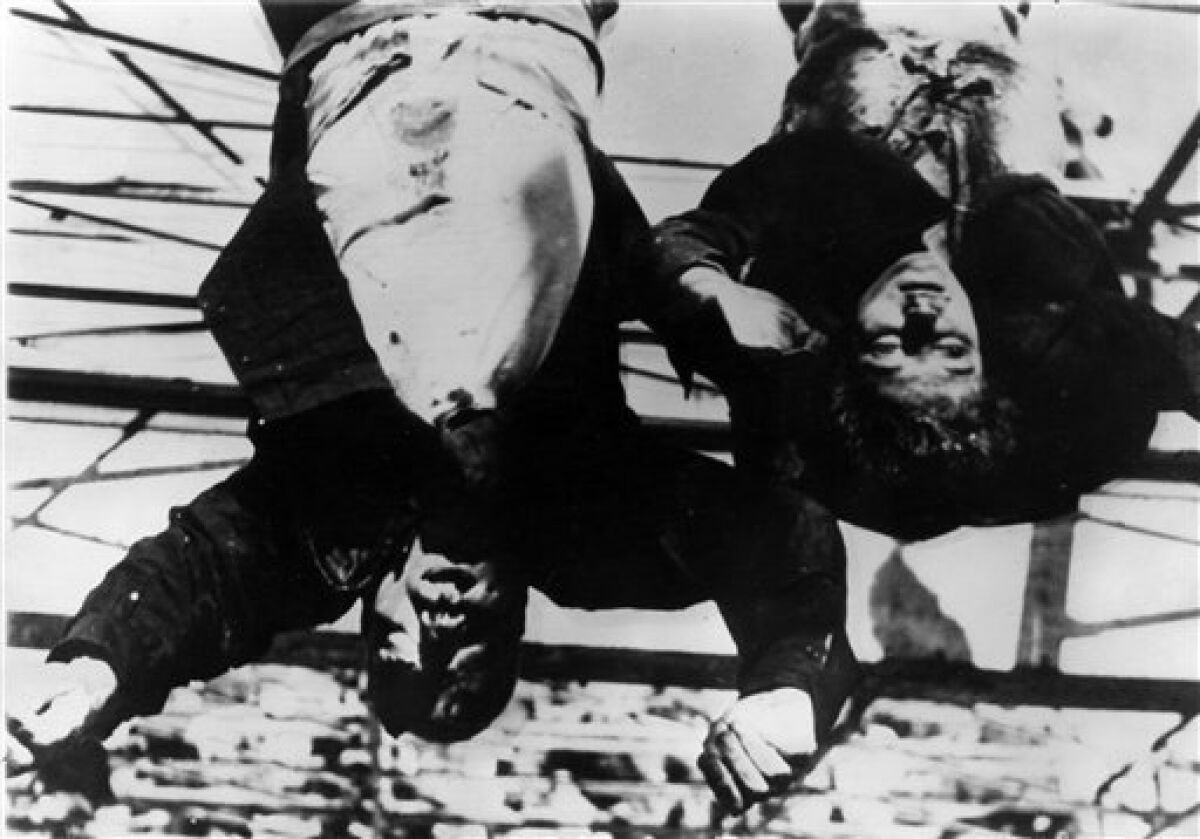
On April 29, the bodies of the executed were loaded in a van and moved to Milan, the largest city in northern Italy. They were dumped on the ground in the Piazzale Loreto, where people kicked them and spat on them. Finally, the bodies of Mussolini and the Petaccis were hung, upside-down, from the roof of an Esso gas station, and people threw stones at them.
On April 30, upon hearing a report of what happened to Mussolini, and knowing that the Soviet Union's Red Army had Berlin surrounded, and that his own escape was unlikely, Hitler decided that he was not going to face the same fate. The Nazi dictator killed himself.

Initially, Mussolini was buried in an unmarked grave. In 1946, his body was dug up and stolen by Fascist supporters. Four months later, it was recovered by the authorities, who then kept it hidden. In 1957, his remains were allowed to be interred in the Mussolini family crypt in his hometown of Predappio. His tomb has become a place of pilgrimage for neo-fascists, and the anniversary of his death is marked by neo-fascist rallies.

His granddaughter, Alessandra Mussolini, is a member of the European Parliament, and has been one of the leaders of far-right politics in Italy since the early 21st Century. Her son, Romano Mussolini, plays for SS Lazio, the Rome-based team known for a Fascist fan base. He says he has no interest in politics.

*

April 28, 1945 was a Saturday. This was also the day American troops rescued the Lipizzaner horses from Czechoslovakia, saving them from extinction. I have a separate entry for that event.

The National Football League was in its off-season. The National Hockey League had already completed its season, with the Toronto Maple Leafs having won the Stanley Cup. And the National Basketball Association wouldn't begin play for another year and a half. But there were baseball games played that day:

* The New York Yankees beat the Washington Senators, 2-1 at Yankee Stadium. Nick Etten singled home the winning run in the bottom of the 13th inning.

* The Brooklyn Dodgers beat their arch-rivals, the New York Giants, 4-3 at Ebbets Field in Brooklyn. The Giants led 3-1 going into the bottom of the 9th, but the Dodgers scored 3 runs, with the winning run driven in on a single by center fielder Goodwin "Goody" Rosen.

* The Boston Braves beat the Philadelphia Phillies, 8-7 at Braves Field in Boston.

* The Boston Red Sox beat the Philadelphia Athletics, 8-4 at Shibe Park in Philadelphia.

* The Detroit Tigers beat the Cleveland Indians, 5-1 at League Park in Cleveland.

* The Cincinnati Reds beat the St. Louis Cardinals, 1-0 at Crosley Field in Cincinnati. Arnold Carter pitched a 6-hit shutout.

* The Chicago Cubs beat the Pittsburgh Pirates, 6-0 at Wrigley Field in Chicago. Hank Wyse lost a no-hitter in the 8th inning, on a single by Bill Salkeld.

* And the Chicago White Sox and the St. Louis Browns were rained out at Sportsman's Park in St. Louis. The game was made up as part of a doubleheader the next day. The ChiSox started the season 5-0, but the Browns swept the doubleheader, 3-2 and 10-4.

And while England's Football Association had shut Football League and FA Cup competition down for the duration of the war, there was Football League South play. Arsenal beat Chelsea, 3-0 at White Hart Lane in Middlesex.

Yes, The Arsenal used the ground of their arch-rivals, Tottenham Hotspur, because their home, Arsenal Stadium, a.k.a. Highbury, in North London was appropriated by the government for defense purposes. The London Government Act 1963 redrew the boundaries of the city of London (not to be confused with "The City of London") so that White Hart Lane was inside the city for the first time.

Tuesday, April 12, 2022

April 12, 2005: Fireworks at the San Siro

Marco Materazzi of Inter (left) and Rui Costa of AC Milan

April 12, 2005: The two main soccer teams from Milan, Italy face each other in a Quarterfinal tie of the UEFA Champions League. It becomes the most famous game in Italy's most famous sports rivalry.

Associazione Calcio Milan -- "Calcio" is the Italian name for the sport that Americans call "soccer," but most of the world calls "football" -- or AC Milan, or simply "Milan," were founded in 1899. With their red and black stripes, they are known in Italian as the Rossoneri.

Football Club Internazionale Milano, or Inter Milan, or simply "Inter," were founded in 1908, when some members left AC Milan in a dispute. With their black and blue stripes, they are known as the Nerazzurri. The rivalry between these teams is known as the Derby della Madonnina, after one of the symbols of the city of Milan, a statue of the Virgin Mary atop the city's cathedral, the Duomo.

AC Milan built a stadium in the San Siro neighborhood in 1926. They have played there ever since, except for 1941 to 1945, when Italian football was suspended due to World War II. They sold the stadium to the City of Milan in 1935. Inter have played there since 1947. In 1980, the stadium was renamed Stadio Giuseppe Meazza, after the Inter star who helped the Italy national team win the World Cup in 1934 and 1938. Despite this name, most people still call it "The San Siro." At 80,018, it is easily the largest stadium in Italy.
Through the 2021-22 season, AC Milan and have each won Italy's national league, Serie A, 19 times. Only Juventus, of Turin, with 36, have won it more times. As is frequently the case in various sports, "Juve," wearing white and black stripes, the Bianconeri, as the most successful team in their league, are the most-loved team, but also the most-hated, and there are more people who hate them. As intense as the Milan-Inter rivalry is, their fans will team up to oppose Juve.

In the 1960s, with both teams using a defensive style called "catenaccio" (meaning "padlock"), the Milan clubs not only dominated Italian football, but made their mark continent-wide: AC Milan won the European Cup, the tournament known since 1992 as the UEFA Champions League, in 1963 and 1969. Inter won it in 1964 and 1965, and were runners-up in 1967 and 1972.
AC Milan fans in the south end, the Curva Sud

But while Milan were able to have the occasional European breakthrough over the rest of the 20th Century, Inter found it difficult, though they did win the secondary European tournament, the UEFA Cup (now the UEFA Europa League), 3 times in the 1990s.
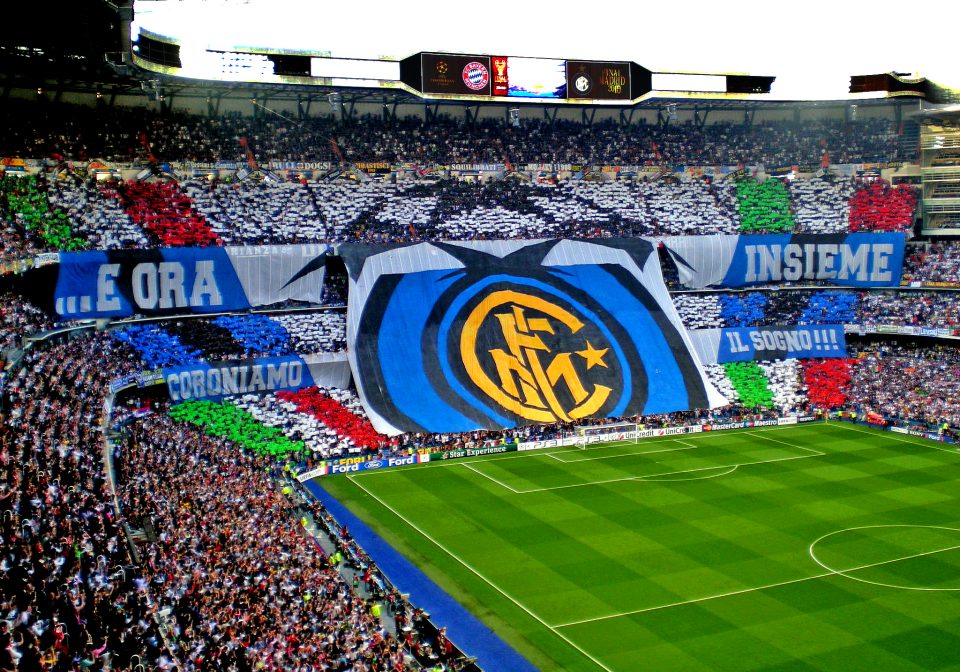
Internazionale Milano fans in the north end, the Curva Nord

In 2005, both teams reached the Quarterfinals of the Champions League. So both the "home leg" and the "away leg," for each team, would be held at the San Siro. Milan were the hosts for the 1st leg, and won, 2-0, on goals by Dutch centreback Jaap Stam and Ukrainian forward Andriy Shevchenko.

Six days later, the teams played the 2nd leg at the San Siro, in front of 82,734 fans. Inter needed to score 2 goals, without Milan scoring an "away goal," to send the game to extra time. Any goal by Milan, and even scoring 3 goals would not have helped Inter, as Milan would have won on "away goals."

The talent on the pitch was staggering. For Inter: Italian defender Marco Materazzi, Croatian defender Siniša Mihajlović, Argentine defender Javier Zanetti, Serbian midfielder Dejan Stanković, Argentine midfielders Juan Sebastián Verón and Esteban Cambiasso, and Italian forward Christian Vieri.

For Milan: Brazilian goalkeeper Dida, Italian defenders Paolo Maldini and Alessandro Nesta, Brazilian defender Cafu, Dutch defender Jaap Stam, Georgian defender Kakha Kaladze, Italian midfielders Andrea Pirlo (who had previously played for Inter) and Gennaro Gattuso, Brazilian midfielder Kaká, Dutch midfielder Clarence Seedorf, Portuguese midfielder Rui Costa, Argentine forward Hernán Crespo, and Ukrainian forward Andriy Shevchenko.

The game was fairly even for the 1st half-hour, but Shevchenko scored in the 30th minute. That made it 3-0 Milan on aggregate, and Inter were pretty much done, with the rest of the game a seeming formality. Not that they didn't try, but Dida put on a masterclass in goal; while Cafu, Nesta, Staam and Maldini were so tight in defense, it brought back memories of the catenaccio defense of both Milan teams of the 1960s.

But the individual match would not end benignly. In the 71st minute, Cambiasso thought he had scored an equalizer (for the game, though not for the tie), but the referee, Markus Merk of Germany, waved it off. He ruled that Julio Cruz, Inter's Argentine forward, had fouled Dida.

This was in front of the Curva Nord (North Stand), where Inter's most fervent fans stand (and rarely sit). Milan's equivalent are in the Curva Sud (South Stand). Those Inter fans began throwing flares onto the pitch. One hit Dida on the shoulder, then bounced up and off his head. He went down like a ton of bricks. When he got up, he held his shoulder, and walked off the field.

Merk called Captains Maldini and Zanetti over, and told them the game was abandoned and forfeited to the visiting team, since the home team could not control their fans and keep the pitch playable. Officially, the game ended 3-0 to Milan, and the tie 5-0 to Milan.

Zanetti and Veron, who had seen plenty of displays like this in their native Argentina -- in spite of it being a Spanish-speaking country on a mostly-Spanish-speaking continent, their largest ethnic group is Italians -- and assisted the firemen in removing the flares. A photographer took the famous photo above, of Materazzi and Rui Costa watching the smoke from the flares. It wasn't quite Pelé and Bobby Moore swapping shirts at the 1970 World Cup, but it was a sign that one of the roughest "derbies" in the sport could still have some sportsmanship, even at its worst moment to date.

UEFA fined Inter, and ordered them to play their next 4 European games behind closed doors: Everybody necessary for the operation of the stadium during the match would be admitted, but no fans.

It has been alleged that Dida was never the same since that incident, especially in light of losing the penalty phase of the Champions League Final to Liverpool. However, 2 years later, in 2007, Milan reversed that result, beating Liverpool in the Final, with Dida keeping a clean sheet until the 89th minute.

Milan won Serie A in 2011, then went into a down period. Although they won Serie A again in 2022, they have never again been to a CL Final. Inter won the CL in 2010, becoming the 1st Italian team to win a "European Treble": Serie A, the Coppa Italia, and the Champions League. But they have never been back to the CL Final. (UPDATE: They got back in 2023, losing to Manchester City.)

In 2019, AC Milan announced plans for a new stadium, next-door to the San Siro, to be home to both teams. The plan fell through, as the city government intends to keep the stadium open through the 2026 Winter Olympics, at which point the oldest parts of the stadium will be 100 years old. The current plan is for a shared stadium, away from the San Siro area.

*

April 12, 2005 was a Tuesday. There was 1 other Champions League Quarterfinal that day: Bayern Munich beat Chelsea, 3-2 at the Olympiastadion in Munich, Bavaria, Germany. However, Chelsea, of West London, won the tie on aggregate, 6-5. In the Semifinals, Liverpool beat Chelsea, and Milan beat Dutch team PSV Eindhoven. In the Final, Liverpool came from behind to beat Milan, a story worthy of its own entry.

The NHL team owners locked their players out, and Commissioner Gary Bettman canceled the entire 2004-05 season, so there were no games on this day.

These Major League Baseball games were played:

* The Washington Nationals beat the Atlanta Braves, 4-3 at Turner Field (now Center Parc Stadium in Atlanta). Two days later, the Nationals, who had been the Montreal Expos from 1969 to 2004, played their 1st home game in Washington.

* The Baltimore Orioles beat the Tampa Bay Devil Rays, 7-6 at Tropicana Field in St. Petersburg, Florida.

* The Florida Marlins beat the Philadelphia Phillies, 8-2 at Dolphins Stadium (now Hard Rock Stadium) in Miami Gardens, Florida.

* The Pittsburgh Pirates beat the Milwaukee Brewers, 4-2 at Miller Park (now American Family Field) in Milwaukee.

* The Minnesota Twins beat the Detroit Tigers, 5-4 at the Metrodome in Minneapolis.

* The St. Louis Cardinals beat the Cincinnati Reds, 5-1 at Busch Memorial Stadium in St. Louis.

* The Los Angeles Angels beat the Texas Rangers, 13-8 at Ameriquest Field (now Choctaw Stadium) in the Dallas suburb of Arlington, Texas.

* The Arizona Diamondbacks beat the Colorado Rockies, 4-2 at Chase Field in Phoenix.

* The Los Angeles Dodgers beat their arch-rivals, the San Francisco Giants, 9-8 at Dodger Stadium in Los Angeles. The Giants led 8-5 going into the bottom of the 9th, but Armando Benitez melted down, as he so often did, until Milton Bradley singled home the winning run. Barry Bonds did not play for the Giants in this game.

* And the Toronto Blue Jays beat the Oakland Athletics, 5-2 at the Oakland Coliseum (then named the McAfee Coliseum).

Monday, April 11, 2022

April 11, 1902: The 1st Million-Selling Record

April 11, 1902: Enrico Caruso, the preeminent opera singer of the era, records "Vesti la giubba," for the Gramophone Company in Milan, Italy. It becomes the first record, anywhere in the world, to see over one million copies.Vesti la giubba

"Vesti la giubba" means "Put on the costume," and comes from the 1892 opera Pagliacci by Ruggero Leoncavallo. Pagliacci is the tale of Canio, actor and leader of a commedia dell'arte theatrical company, who, seeing his wife Nedda, who plays Columbina, who is unfaithful to Canio's character of Pagliaccio the clown, make life imitate art by fooling around with Silvio, ends up killing both of them in revenge.

At the conclusion of Act I, between his discovery and his decision to commit the murders, he sings "Vesti la giubba," because he must prepare for his performance as Pagliaccio, because, as an already-old saying went, "The show must go on."

Born in Naples on February 25, 1873, Caruso made his stage debut in 1895, and became a legend for his portrayals of Canio and Rodolfo in Giacomo Puccini's La bohème. He put his performances on record, making him the world's 1st recording star. He toured all over the world, and was in San Francisco at the time of their 1906 earthquake. While not injured, he swore he would never return, and he kept that vow.

Too old to be drafted in World War I, he entertained troops of Allied nations, including holding Liberty Bond drives in the U.S. He died on August 2, 1921, only 48 years old, after battling lung and kidney trouble for a year.

*

April 11, 1902 was a Friday. Baseball was in Spring Training. Football was out of season. Basketball barely existed. And the Stanley Cup was awarded the previous month, to the Winnipeg Victorias. So there were no scores on this day. 

Monday, March 28, 2022

March 28, 1994: The Rise of Silvio Berlusconi

March 28, 1994: Media mogul Silvio Berlusconi leads his party, Forza Italia, to victory in the Italian parliamentary elections, making him the next Prime Minister.

He was born in Milan on September 29, 1936, while Benito Mussolini was Italy's Fascist dictator. He graduated from law school, and got a job singing on a cruise ship. He had a daughter and a son with his 1st wife, 2 daughters and a son with a mistress, and 2 daughters and a son with his 2nd wife.

Like Donald Trump, he was involved in construction and real estate before going into politics. Unlike Trump, he didn't need his father's money to make money: He actually was a good businessman. Also unlike Trump, he knew he was going bald, and didn't try to hide it.

He went into the media business, turning a small cable-TV network into the national network Canal 5 (pronounced "Can-AL SIN-kwa"). His fortune was aided by Bettino Craxi, leader of the Italian Socialist Party, Prime Minister from 1983 to 1987, and the best man at Berlusconi's 2nd wedding.

From 1986 to 2017, Berlusconi owned A.C. Milan. One of the top soccer teams in Italy, and his favorite team, he made it one of the best in the world. Under his ownership, they won the UEFA Champions League (Europe's top club competition) 5 times, and Serie A (the Italian national league) 8 times, but the Coppa Italia (Italy's version of the FA Cup) only once. He also wrote the team's anthem with Italian music producer and pop singer Tony Renis.

His ownership of the Rossoneri -- named for their shirts of red and black stripes -- posed a problem for some fans. Milan traditionally have a left-of-center fanbase (as opposed to their fellow occupants of the San Siro Stadium, Internazionale Milano, or "Inter," whose fans tend more to the right), but while the fans loved him for building one of the greatest teams in the world, many of them despised him for his politics.

Because, as it so often is for such men, having unlimited money, any woman you want, and a measure of influence over your country is not enough. Silvio Berlusconi wanted power. He formed a conservative political party, Forza Italia -- meaning "Force" or "Strength" for Italy. Still thinking of himself as an entertainer, he wrote the party's anthem with opera director Renato Serio.

Representing the district of Lazio 1, in the national capital of Rome, he ran for the Chamber of Deputies, the lower house of the national legislature, because he had to have a seat in it in order to be Prime Minister, and led Forza Italia into the national election of March 27 and 28, 1994. He ran as a reform candidate, an anti-Communist candidate, and as a unifier for the Pentapartito, the 5 parties that had, between them, governed Italy on and off since the fall of Fascism and the end of World War II. His reform message went far in the wake of the 1992 Tangentopoli ("Bribe City") scandal. Hundreds of Italian political figures were arrested, and 12 are known to have committed suicide rather than face prison.

Forming what he called "the Pole of Freedoms," a coalition between Forza Italia, the Christian Democratic Centre, the National Alliance and the neo-Fascist Lega Nord (Northern League), and running countless campaign commercials on the networks he owned, Berlusconi's movement won 366 seats in the Chamber, enough for a majority, and enough to make him the Prime Minister, the most conservative head of government in Italy since... well, since Mussolini.

Berlusconi took office on May 11, 1994, and began his reforms quickly. But the scandal that had allowed him to take power soon enveloped him, too. Apparently, he had done the campaign-contribution version of placing bets on every horse. The self-righteous Lega Nord backed out, and on January 17, 1995, the Berlusconi government fell.

On March 6, a center-left coalition called The Olive Tree was founded, and it bided its time while the caretaker government straightened things out and called a new election for April 21, 1996. The Olive Tree won it, making Romano Prodi the Prime Minister. It was able to hold office for 5 years, until another election had to be called. By that point, Berlusconi had been able to shore up his support, and won the election of May 13, 2001, returning as Prime Minister.

Italian governments are like Italian soccer team managers: They rarely stay in power for very long. A full 5 years is an eternity, and in the ensuing 5 years, Berlusconi continued to anger pretty much anybody who wasn't, as we would say in America, a staunch conservative. On April 10, 2006, Italians went to the polls again. It was close, and Prodi claimed victory, his coalition having won 341 seats to Berlusconi's 281, although the Senate race was very close, Prodi leading 158-156.

Berlusconi never conceded, things remained a mess, and Prodi lost a vote of no confidence. He was replaced as leader of the center-left coalition by former Mayor Walter Veltroni of Rome. He couldn't match Berlusconi for message or charisma, and, on April 14, 2008, Berlusconi became Prime Minister for a 3rd time.

But the scandals piled up. Berlusconi was already the most-loved and the most-hated man in the country. Pier Luigi Bersani, a Cabinet minister under Prodi and Veltroni, built a new center-left coalition, Italy Common Good, and, on February 25, 2013, ended Berlusconi's last run for Prime Minister. He moved from the Chamber of Deputies to the Senate, where he was allowed to be Party Leader, but not Prime Minister.

Five months later, on August 1, Berlusconi was convicted of tax fraud, but his sentence was commuted to community service due to his age. He was expelled from the Senate, although managed to win a seat in the European Parliament in 2019. In 2017, he sold AC Milan. Italy is scheduled to hold an election on September 25, 2022, and Berlusconi is attempting to regain his Senate seat. He will be 4 days short of his 86th birthday.

UPDATE: The election was won by Fratelli d'Italia (Brothers of Italy), a far-right coalition that includes Forza Italia and Lega Nord. In spite of its masculine-sounding name, its leader is a woman, Giorgia Meloni. On October 22, 2022, she was sworn in as the 1st female Prime Minister of Italy. She is one of many female leaders who has proven that electing women to run governments is no guarantee of progress: She has surpassed Berlusconi as the farthest-right Italian leader since Mussolini.

Berlusconi did win his Senate seat back. But he did not enjoy it for long: He died on June 12, 2023, of leukemia.

Electing a corrupt right-wing businessman as your head of government, just because he's very rich and charismatic, and panders to the people who like a show, including sports. How could a supposedly modern country be so stupid? Wait a minute…

*

March 28, 1994 was a Monday. Baseball was in Spring Training. Football was out of season. There were 2 games in the NBA. The Indiana Pacers beat the Los Angeles Clippers, 126-93 at the Market Square Arena in Indianapolis. And the Seattle SuperSonics beat the Denver Nuggets, 111-97 at the Seattle Center Coliseum.

And there were 3 games played in the NHL:

* The Montreal Canadiens beat the Ottawa Senators, 3-2 at the Montreal Forum.

* The Dallas Stars beat the Florida Panthers, 5-4 at the Miami Arena.

* And the Vancouver Canucks beat the Toronto Maple Leafs, 3-2 at the Pacific Coliseum in Vancouver. Murray Craven scored the winning goal with 1:03 left in overtime.

December 31, 1999 & January 1, 2000: The Millennium

December 31, 1999:  The Millennium arrives. The people of planet Earth survived. At a terrible cost. But we hadn't destroyed ourselves. ...