
April 28, 1945: Benito Mussolini, the fascist dictator of Italy from 1922 to 1943, is captured by Communist partisans and executed. He was 61 years old, and few wept for him.
Mussolini was originally a journalist who entered politics as a Socialist. He served in the Italian Army in World War I, and was wounded in 1917. His experience shifted him from left to right. On October 28, 1922, thinking the postwar Italian national government weak, he led the Fascists in a March On Rome. The government fell rather than oppose him with the Army, and King Victor Emmanuel III appointed Mussolini to be the country's youngest Prime Minister ever to that point. He became known as Il Duce (The Leader).
After removing all political opposition through his secret police, and outlawing labor strikes, Mussolini and his followers consolidated power through a series of laws that transformed the nation into a one-party dictatorship. In 1924, he ordered the assassination of Giacomo Matteotti, the Leader of the country's Socialist Party. In 1929, he signed the Lateran Treaty with the Holy See, to establish Vatican City.
His supporters, including in America, liked to say, "He made the trains run on time." In fact, they ran no better under him than under the previous government. They also liked to say he put an end to the Mafia. This also wasn't true. It would be more accurate to say that he made a deal with the Mafia, a non-aggression pact: Leave my officials -- including policemen, prosecutors and judges -- alone, let them do as they please, or, rather, as I please; and I'll do the same for you.
He also wanted to build a new Roman Empire. He established a protectorate over nearby Albania, and in 1935 invaded Ethiopia, annexing it into Italian East Africa (comprised of the current nations of Somalia and Eritrea). From 1936 to 1939, he and Adolf Hitler, the dictatorial Chancellor of Nazi Germany, aided fellow fascist Francisco Franco in his takeover of Spain.
(This included Hitler sending his air force, the Luftwaffe, to bomb opposing cities; and Mussolini sending troops, which became known as Franco's Italian Army. In the 1970s, this name would be adapted by Italian-American fans of the Pittsburgh Steelers, who formed a fan club for the half-Italian, half-black running back Franco Harris. Not to be outdone, a group of black fans honored defensive tackle Joe Greene with "Mean Joe Greene's Ethiopian Brigade." Given what Mussolini's men did in Spain and Ethiopia, both names should already have been considered cringeworthy.)
With the onset of World War II, Mussolini brought Italy into the Axis with Nazi Germany and Imperial Japan. But the reputation of Italy having a weak army -- which both Mussolini and Giuseppe Garibaldi had taken advantage of in the preceding 80 years -- still held, as British and American troops kicked them out of North Africa, and then invaded Sicily, and finally the Italian mainland.
On July 25, 1943, his own Grand Council of Fascism passed a vote of no confidence in him, and the King who had appointed him dismissed him as Prime Minister after 21 years, and ordered his arrest. The King then agreed to an armistice with the Allies.
German paratroopers broke Mussolini out of prison, resulting in a civil war. The Allies did not intervene, since their focus had moved to Western Europe. This time, Mussolini did not have enough troops to even oppose the regular Italian Army.
On April 25, 1945, Mussolini took his mistress, Clara Petacci -- leaving his wife and 6 children behind -- along with 13 others, including Clara's brother, who was posing as a Spanish consul, and fled. They set out for adjoining and neutral Switzerland, intending to board a plane and escape to also-neutral Spain, under Franco's protection.
But on April 27, they were stopped by Communist partisans near Lake Como, just 20 miles from the Swiss border. On April 28, instead of being turned over to the United Nations, as per Allied agreement in the event that he should be captured, they were executed in a village named Giulini de Mezzegra, on the orders of a partisan named Walter Audisio.
The witnesses' accounts of his last words differed. One said that he was defiant to the end, telling them, "Aim at my heart!" One said that he was a coward, yelling, "No! No!" The other said that Mussolini said nothing at all as the rifles were raised.
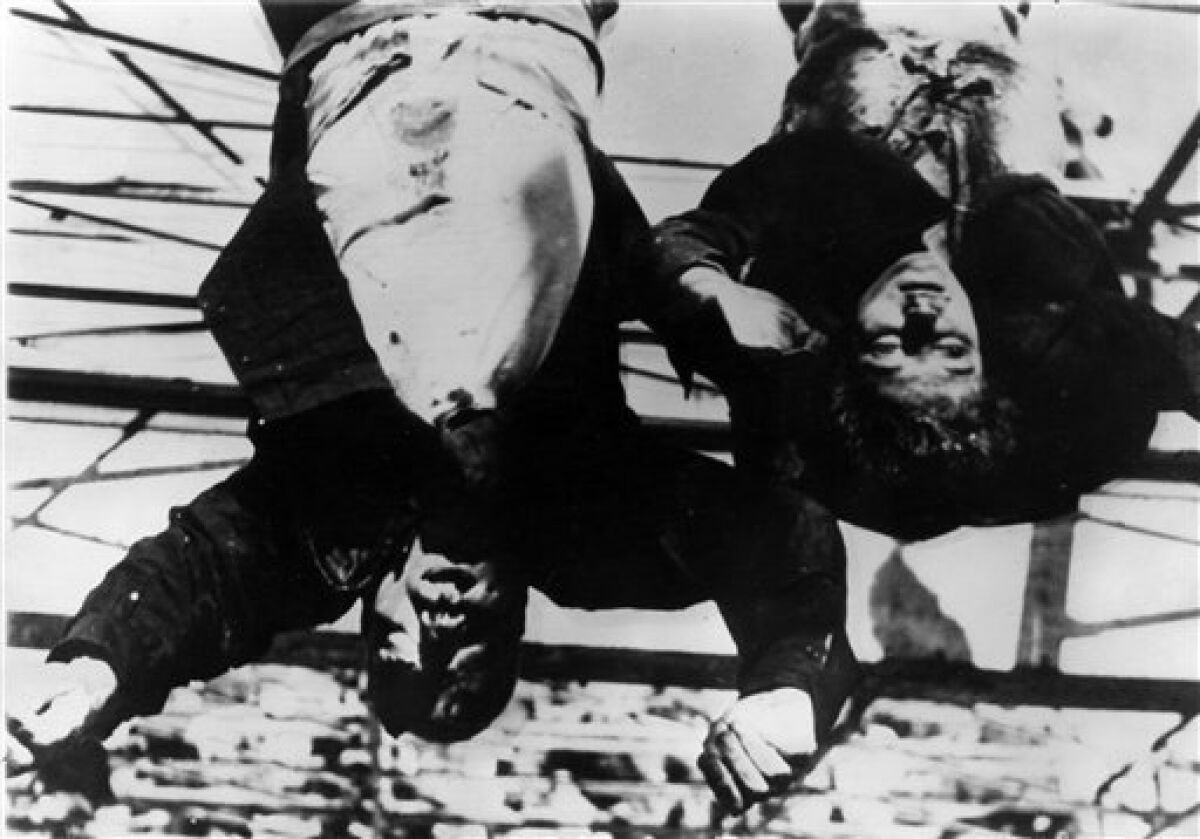
On April 29, the bodies of the executed were loaded in a van and moved to Milan, the largest city in northern Italy. They were dumped on the ground in the Piazzale Loreto, where people kicked them and spat on them. Finally, the bodies of Mussolini and the Petaccis were hung, upside-down, from the roof of an Esso gas station, and people threw stones at them.
On April 30, upon hearing a report of what happened to Mussolini, and knowing that the Soviet Union's Red Army had Berlin surrounded, and that his own escape was unlikely, Hitler decided that he was not going to face the same fate. The Nazi dictator killed himself.
Initially, Mussolini was buried in an unmarked grave. In 1946, his body was dug up and stolen by Fascist supporters. Four months later, it was recovered by the authorities, who then kept it hidden. In 1957, his remains were allowed to be interred in the Mussolini family crypt in his hometown of Predappio. His tomb has become a place of pilgrimage for neo-fascists, and the anniversary of his death is marked by neo-fascist rallies.
His granddaughter, Alessandra Mussolini, is a member of the European Parliament, and has been one of the leaders of far-right politics in Italy since the early 21st Century. Her son, Romano Mussolini, plays for SS Lazio, the Rome-based team known for a Fascist fan base. He says he has no interest in politics.
*
April 28, 1945 was a Saturday. This was also the day American troops rescued the Lipizzaner horses from Czechoslovakia, saving them from extinction. I have a separate entry for that event.
The National Football League was in its off-season. The National Hockey League had already completed its season, with the Toronto Maple Leafs having won the Stanley Cup. And the National Basketball Association wouldn't begin play for another year and a half. But there were baseball games played that day:
* The New York Yankees beat the Washington Senators, 2-1 at Yankee Stadium. Nick Etten singled home the winning run in the bottom of the 13th inning.
* The Brooklyn Dodgers beat their arch-rivals, the New York Giants, 4-3 at Ebbets Field in Brooklyn. The Giants led 3-1 going into the bottom of the 9th, but the Dodgers scored 3 runs, with the winning run driven in on a single by center fielder Goodwin "Goody" Rosen.
* The Boston Braves beat the Philadelphia Phillies, 8-7 at Braves Field in Boston.
* The Boston Red Sox beat the Philadelphia Athletics, 8-4 at Shibe Park in Philadelphia.
* The Detroit Tigers beat the Cleveland Indians, 5-1 at League Park in Cleveland.
* The Cincinnati Reds beat the St. Louis Cardinals, 1-0 at Crosley Field in Cincinnati. Arnold Carter pitched a 6-hit shutout.
* The Chicago Cubs beat the Pittsburgh Pirates, 6-0 at Wrigley Field in Chicago. Hank Wyse lost a no-hitter in the 8th inning, on a single by Bill Salkeld.
* And the Chicago White Sox and the St. Louis Browns were rained out at Sportsman's Park in St. Louis. The game was made up as part of a doubleheader the next day. The ChiSox started the season 5-0, but the Browns swept the doubleheader, 3-2 and 10-4.
And while England's Football Association had shut Football League and FA Cup competition down for the duration of the war, there was Football League South play. Arsenal beat Chelsea, 3-0 at White Hart Lane in Middlesex.
Yes, The Arsenal used the ground of their arch-rivals, Tottenham Hotspur, because their home, Arsenal Stadium, a.k.a. Highbury, in North London was appropriated by the government for defense purposes. The London Government Act 1963 redrew the boundaries of the city of London (not to be confused with "The City of London") so that White Hart Lane was inside the city for the first time.


No comments:
Post a Comment