Showing posts with label 1876. Show all posts

Friday, December 9, 2022

December 10, 1876: New York & Philadelphia Are Kicked Out of the National League

William Hulbert.
I looked for photos of the teams' operators,
William Cammeyer of New York and Al Wright of Philadelphia,
but it appears none of either survive.

December 10, 1876: The teams representing New York, the biggest city in the country, and Philadelphia, the 3rd-biggest, are kicked out of the National League, the only major league in the sport, or in any sport in North America, at the time.

The NL had begun play in 1876, with 8 teams. Going east to west, they were: The Boston Red Caps, the Hartford Dark Blues, the New York Mutuals, the Philadelphia Athletics, the Cincinnati Reds, the Louisville Grays, the Chicago White Stockings and the St. Louis Brown Stockings. (At this point, coming up with a clever name for your team was not necessary.)

The 1st game was played on April 22, at the Jefferson Street Grounds in Philadelphia. Boston beat Philadelphia, 6-5. There was a decent Pennant race, with Chicago finishing 6 games ahead of both Hartford and St. Louis, 15 ahead of Boston (who had won the last 4 titles in the National Association, and would win the next 2 titles in the NL), 22 ahead of Louisville, 26 ahead of New York, and 34 1/2 ahead of Philadelphia.

It was not treated as odd that the top 2 teams were Chicago, owned by NL founder William Hulbert; and Hartford, owned by the NL's President, Morgan Bulkeley, a Hartford banker who would later be elected Mayor of Hartford, and as Connecticut's Governor and U.S. Senator. But it was a bit odd that New York and Philadelphia hadn't done well.

The New York Mutuals had been founded in 1857, and won more games recognized as "official" than any other team in 1863 and 1864. While the Boston Red Stockings (who became the Red Caps, and went through several name changes before settling in 1912 on "Braves") dominated the National Association, the "Mutes" finished 3rd in 1872 and 2nd in 1874.

They played their home games not in Manhattan, but in Brooklyn, which would be a separate city until 1898. Their owner, William Cammeyer, had built the first enclosed baseball facility, the Union Grounds, in the Williamsburg section of Brooklyn, in 1862, and the Mutes continued to play there.

Like the Mutes, the Philadelphia Athletics were considered one of the top teams in baseball's amateur era, before professionalism came in 1869. They had been founded in 1860, won more games than any other team in 1867, and finished 2nd in 1865, 1866 and 1868. In 1871, they won the NA's 1st Pennant.

But the depression that began with the Panic of 1873 hit baseball hard. NA teams couldn't afford to complete their schedules by going on roadtrips. This was a major reason that Hulbert founded the NL: He wanted teams to stick to their schedules, to make the Pennant race more honest. Chicago beat Hartford at home, 7-6, on September 26, to clinch the Pennant. (As early as 1858, the team with the best overall record would be permitted to fly a flag, or "pennant," reading, "CHAMPIONS" at their ballpark, and the name stuck.)

On September 11, 1876, Al Wright, manager of the Athletics, informed the NL office that they could not afford to make their last Western roadtrip, to Chicago and St. Louis. He did, however, have a backup officer: The White Stockings and Brown Stockings could come east, play additional games in Philadelphia, and take a larger than normal portion of the gate receipts, so they could raise enough money to finish their schedule. The NL denied this reasonable suggestion. On September 16, the Mutuals announced that they couldn't afford to make their last roadtrip, either.

And so, on December 10, the NL held its Winter Meetings in Cleveland. After Bulkeley declined to run for re-election, Hulbert was elected President. He immediately moved for the expulsion of the Mutuals and the Athletics from the League. In spite of the role each already had in baseball's relatively short history, the other team owners did Hulbert's bidding.

It would be 1883 before both cities returned to the NL, with the teams that would become known as the New York Giants and the Philadelphia Phillies. By the start of the 1878 season, only 2 of the original 8 teams would be left: Boston and Chicago. But those 2 teams still exist, as the Atlanta Braves and the Chicago Cubs.

*

December 10, 1876 was a Sunday. The NL forbid games on Sundays, but, apparently, they were more than willing to make decisions affecting any and all League teams on the day. Since basketball did not yet exist, hockey barely did, and college football, itself in its early days, did not play on Sundays, there were no scores on this historic day.

Sunday, December 4, 2022

December 5, 1876: The Brooklyn Theatre Fire

Before the fire

December 5, 1876: A fire breaks out at the Brooklyn Theatre, killing at least 278 people.

The City of Brooklyn was founded in 1854, the result of a merger of several towns, and it would remain a city separate from the City of New York until 1898, the result of a consolidation referendum the year before that also included The Bronx, Queens and Staten Island.

The Brooklyn Theatre opened in 1871, near the corner of Washington Street and Johnson Street, 3 blocks north of the City Hall that would be renamed Borough Hall in 1898. On December 5, 1876, it was staging The Two Orphans, an 1874 play by French authors Adolphe d'Ennery and Eugène Cormon, set during the French Revolution. Two years earlier, it had made a star out of actress Kate Claxton, who was appearing in it again at the Brooklyn.

Over 1,000 people, a full house, were in attendance. At about 11:20 PM, just as the 5th and final act of the play was set to begin, a fire was discovered. Its cause has never been definitively determined. Most of the fatalities were in the highest tier of the theatre, the "family circle." It was accessible by only one stairway, making escape difficult.
After the fire

The fire was the deadliest public building fire in American history up to that point. It has been exceeded by the 1903 Iroquois Theatre fire in Chicago, the 1942 Cocoanut Grove fire in Boston, and in one other fire that did not involve a theater: The 2001 terrorist attack on the World Trade Center.

In Brooklyn's Green-Wood Cemetery, a large memorial stands over the graves of over 100 unidentified victims.

The intersection of Washington and Johnson Streets no longer exists. Johnson Street does, but Washington Street has been replaced by Cadman Plaza, and the site of the Brooklyn Theatre is now a park adjacent to the Kings County Supreme Court building, across from the Cadman Plaza Post Office. A statue of the Theatre's contemporary, the Brooklyn-based minister Henry Ward Beecher, is adjacent.

*

December 5, 1876 was a Tuesday. The only professional team sport in America at the time was baseball, which was out of season. So there were no scores on this historic day.

Sunday, November 6, 2022

November 7, 1876: Samuel Tilden Is Elected President, But Not Really

November 7, 1876: Samuel Jones Tilden, former Governor of New York, wins the popular vote and the Electoral Vote in the Presidential election, defeating the Governor of Ohio, Rutherford B. Hayes. Tilden got 51 percent of the popular vote, to Hayes' 48; and 204 Electoral Votes, to Hayes' 165.

What's that? You've never heard of Tilden? That's not surprising, unless you're a history buff, or are from Brooklyn where there's a high school named for him, or Nebraska where there's a town named for him (the hometown of Baseball Hall-of-Famer Richie Ashburn). He didn't get to become President, because the Republicans stole the Electoral Votes of Louisiana (8), South Carolina (7) and Florida (4), plus 1 in Oregon.

So the final count, not made official until the Electoral Commission made its ruling on a pure party-line vote of 8-7 on March 2, 1877 -- 2 days before the Inauguration -- was Hayes 185, Tilden 184.

Hayes, nicknamed "Rutherfraud," "His Fraudulency" and "Old 8 to 7," announced he would serve only 1 term, and kept his promise. Tilden was convinced he was robbed, but did not run again in 1880 or 1884, due to ill health, and died in 1886.

But was he robbed? The Democrats, then the nation's conservative party, may have engaged in serious intimidation of newly-enfranchised black voters in Southern States. It's possible they tried every bit as hard to steal those States on Election Day as the Republicans did afterward. We may never know who truly deserved to win. Regardless, there is absolutely no known evidence that either Hayes or Tilden participated in any election fraud on his own behalf.

Hayes' home in Delaware, Ohio, Spiegel Grove, was converted into one of the earliest Presidential Libraries, opening in 1916. Tilden didn't get one, although there is a high school in Brooklyn named after him. Hayes was played by John Dilson in the 1944 film Buffalo Bill. The USS President Hayes, an attack transport, was in service from 1941 to 1949.
Hayes Statue, Delaware, Ohio

The only high school named for Hayes is in his hometown of Delaware. Tilden, being a former Governor of New York, got a high school named for him in the Flatbush section of Brooklyn. Fort Tilden, an Army base, was in service in the Rockaways section of Queens from 1914 to 1978.

Nathan Goff Jr. was the last surviving member of Hayes' Cabinet. He served as Secretary of the Navy for the final 2 months of Hayes' presidency, January 7 to March 4, 1881, and lived until 1920.

*

November 7, 1876 was a Tuesday. No sporting events were played that day.

Sunday, September 25, 2022

September 26, 1876: The 1st National League Pennant

September 26, 1876: The Chicago White Stockings beat the Hartford Dark Blues, 7-6 at the 23rd Street Grounds in Chicago. This clinches the Pennant in the National League, in its 1st season of operation.

William Hulbert, the founder of the NL, was the team's owner. Al Spalding, though only 25 years old when the season began, was the manager and pitched 61 of 66 games; Cal McVey, one of the 1869-70 Cincinnati Red Stockings, the 1st openly professional team, pitched 11.

The catcher was James "Deacon" White. Adrian Constantine Anson was the 3rd baseman, and the team captain, so he was nicknamed "Cap." He would eventually move to 1st base, which McVey played when he wasn't pitching. Charles Roscoe "Ross" Barnes played 2nd base, hit the 1st National League home run, and won the 1st NL batting title with a .429 average. John Peters was the shortstop. The outfield was John Glenn in left, Paul Hines in center, and Bob Addy in right. Fred Andrus and Oscar Bielaski were backups.

The NL standings ended up as follows:
TeamWLPct.GBHomeRoad
Chicago White Stockings5214.78825‍–‍627‍–‍8
Hartford Dark Blues4721.691623‍–‍924‍–‍12
St. Louis Brown Stockings4519.703624‍–‍621‍–‍13
Boston Red Caps3931.5571519‍–‍1720‍–‍14
Louisville Grays3036.4552215‍–‍1615‍–‍20
New York Mutuals2135.3752613‍–‍208‍–‍15
Philadelphia Athletics1445.23734½10‍–‍244‍–‍21
Cincinnati Reds956.13842½6‍–‍243‍–‍32
What happened to these teams? Only two still exist. In 1903, the former White Stockings became the Chicago Cubs. In 1912, the former Red Caps became the Boston Braves; in 1953, the Milwaukee Braves; in 1966, the Atlanta Braves. There would later be teams named the Philadelphia Athletics, the Cincinnati Reds and the St. Louis Browns, but they were not holdovers from 1876.

The 23rd Street Grounds, also known as 23rd Street Park and the State Street Grounds, was built after the White Stockings' previous home, the Union Base-Ball Grounds, was destroyed in the Great Chicago Fire in 1871. It was bordered by 23rd, State, 24th and Dearborn Streets. They played there from 1872 to 1877. 
23rd Street Grounds

Hulbert, Spalding, Anson and White have been elected to the Baseball Hall of Fame. White was the last survivor of the 1876 White Stockings, living until 1939. Hulbert, Spalding and Anson were elected to the Chicago Cubs Hall of Fame.

September 26, 1876 was a Tuesday. The Chicago-Hartford game was the only one played that day.

Tuesday, September 6, 2022

September 7, 1876: The Great Northfield, Minnesota Raid

The James Brothers: Jesse (left) and Frank

September 7, 1876: Jesse James, his brother, and his friends decide to rob a bank. It doesn't go so well.
Jesse James and his brother Frank were from Kearney, Missouri, outside Kansas City. During the American Civil War, when Missouri remained in the Union but had Southern sympathies, the James Brothers joined William Quantrill and his group, Quantrill's Raiders. They called themselves "bushwhackers," but, in modern terms, they were terrorists. Shortly after the war ended, Union troops shot Quantrill, who took nearly a month to die as a result of his wound.
The James brothers made it back to Missouri, and brought Cole Younger into their operations. He brought in his brothers, Bob and John. They robbed banks and trains all over what would now be called the Midwest. In modern terms, they were an organized crime family. Not Italian, but a Missouri Mafia, a Confederate Cosa Nostra.
The Younger Brothers
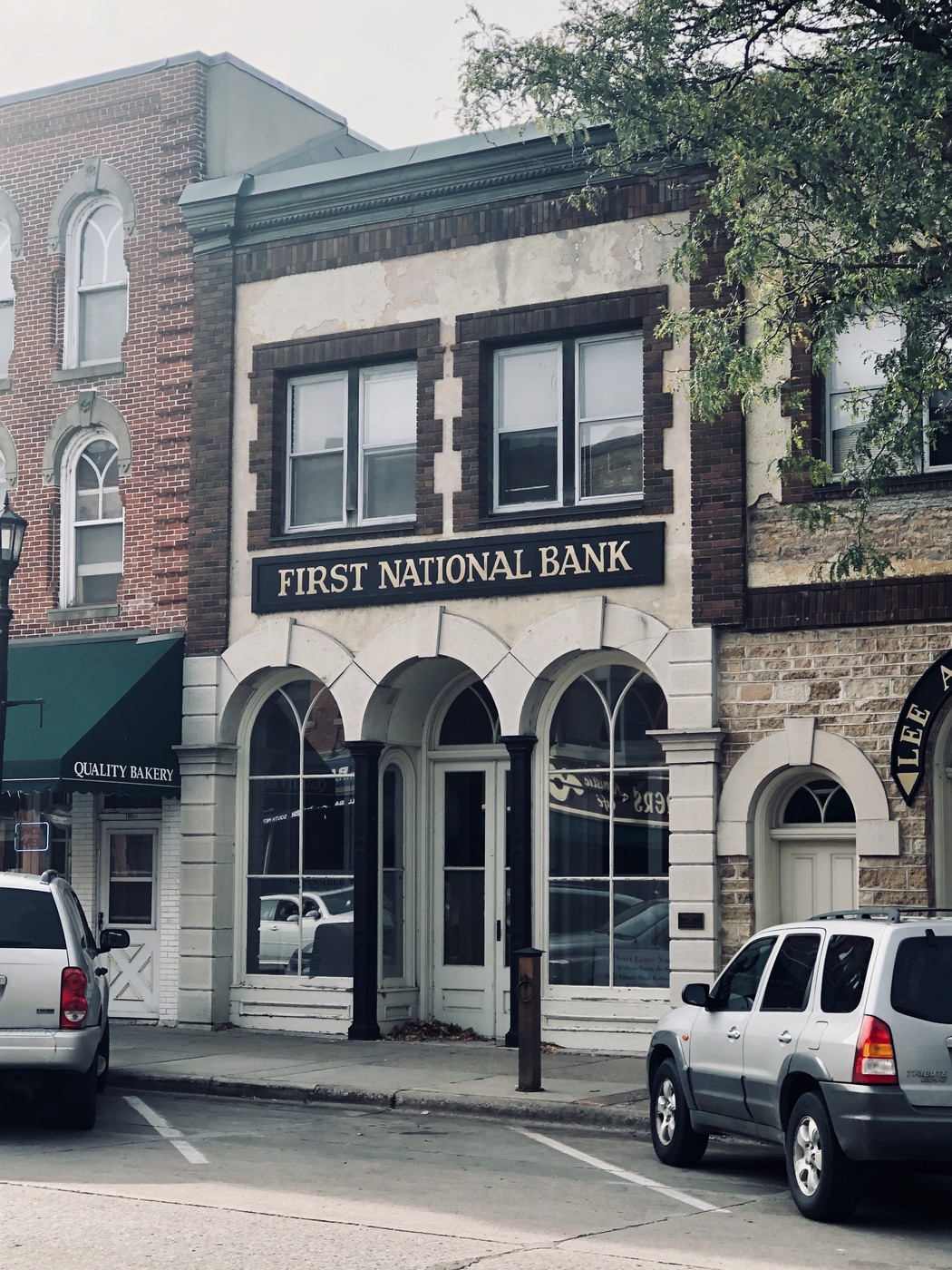
John Younger had already been killed in an ambush in 1874. In 1876, Bob Younger wanted to go well outside the James-Younger Gang's usual territory, to the First National Bank in Northfield, Minnesota, about 40 miles south of Minneapolis.
His explanation was its connection to 2 Union Generals who had become Republican politicians: Benjamin Franklin Butler, a Congressman from Massachusetts (and later its Governor), who had famously insulted the women of New Orleans during the war; and Governor Adelbert Ames of Mississippi, who supported civil rights for black people, including freed slaves.
Ames had married Butler's daughter, and his father owned the Ames Mill in Northfield. There was a rumor that the elder Mills had deposited $50,000 in cash in that bank. (About $1.36 million in 2022 dollars, a very tempting sum.)
The bank building, preserved
Cole tried to talk his brother out of the plan, thinking it too risky. But Bob refused to back down. Reluctantly, Cole agreed to go, writing to their brother Jim, then in California, to come home. Jim had never wanted anything to do with Cole's outlaw activities, but he agreed to go, out of family loyalty.
Hardware store merchant J.S. Allen saw the outlaws, figured out what was happening, and yelled, "Get your guns boys, they're robbing the bank!" That spurred Northfield men into action, arming themselves with long guns in a street shootout that lasted around 7 minutes, leaving 2 gang members dead in the street: Clell Miller and Bill Caldwell. Bob Younger's horse was killed, and Frank James murdered First National Bank acting cashier Joseph Lee Heywood. Swedish immigrant Nicolaus Gustafson was shot in the head by Cole Younger, and died of his injuries four days later. Bank teller Alonzo Bunker was shot in the shoulder as he tried to escape, but survived.
The James brothers escaped west into the Dakota Territory, while the remaining gang members were killed or taken into custody. The Younger brothers pleaded guilty on November 20, 1876, and were sentenced to life terms in prison.
Jesse James was killed by a supposed ally in 1882. Bob Younger died in prison of tuberculosis in 1889. Cole and Jim Younger were paroled in 1901. Jim committed suicide in 1902. Cole traveled to Missouri, where he joined a "Wild West" show with Frank James. Frank died in 1915, and Cole the following year.
The raid has been portrayed, with varying levels of accuracy, in 3 films: The True Story of Jesse James in 1957, The Great Northfield Minnesota Raid in 1972, and The Long Riders in 1980.
*
September 7, 1876 was a Thursday. The only major sports league in North American was baseball's National League, but no games were played on this day.

Tuesday, August 16, 2022

August 17, 1876: Richard Wagner Completes His "Ring Cycle"

August 17, 1876: Götterdämmerung premieres, as part of the opening festival of the Bayreuth Festspielhaus in Bayreuth, Bavaria, Germany. It is the 1st performance in the final part of Richard Wagner's operas, Der Ring des Nibelungen (The Ring of the Nibelung).

Born on May 22, 1813 in Leipzig, Saxony, Richard Wagner (pronounced "REE-kard VOG-ner"), 61 years old at the time of the opening, had the concert hall designed to his specifications, and, in a 5-day stretch, it produced all 4 parts of the "Ring Cycle":

* August 13: Das Rheingold (The Rhine Gold). Premiering in Munich in 1869, it tells the story from Norse mythology of Alberich, from the race of dwarves known as the titular Nibelung, stealing gold from the Rhine River in Germany, and making an all-powerful ring from it. Wotan (usually written as "Odin"), king of the Norse gods, steals the ring, and Alberich puts a curse on the ring and its possessors. (J.R.R. Tolkien wouldn't publish The Hobbit until 1937.) 

* August 14: Die WalkĂĽre (The Valkyrie). Premiering in Munich in 1870, it tells of the valkyrie BrĂĽnnhilde, who saves the lives of the unwittingly incestuous couple Sieglinde and Siegmund, and of the retribution of the gods that each of them must face.

* August 15: A night off.

* August 16: Siegfried. As with Götterdämmerung the next evening, this was the 1st performance of this opera.

* August 17: Götterdämmerung (The Twilight of the Gods -- in Norse, Ragnarök). A final battle occurs, and the world as the Norse gods knew it is destroyed, and humanity must start over without them.
Wagner Festspielhaus

The Cycle was one of the greatest successes in the history of classical music, and, despite its length (about 18 hours if played straight through) and its elaborate costuming, remains popular today. This is in spite of the familiar jab, "Wagner's music is better than it sounds." This is one of many quotes attributed to Mark Twain. Of course, many quotes attributed to Twain actually came from other people, and he properly credited another humorist of that time, Edgar Wilson "Bill" Nye. (He was not related to the later Bill Nye the Science Guy.)

It is also in spite of the fact that it has led to the association of horned helmets with the Norse gods and Viking warriors. Such headgear would be ridiculous, because it would give an opponent something to grab onto, and hold a fighter in place. Still, football teams named the Vikings, including the NFL team in Minnesota, with its large population of people of Scandinavian descent, have renderings of horns as their helmet logo.

It's also given rise to the image of BrĂĽnnhilde as a fat woman wearing armor and a horned helmet, and the stereotyping of female opera singers in general as fat. As BrĂĽnnhilde is the last character to sing in the Cycle, it led to the expression, "The opera ain't over 'til the fat lady sings."

The Cycle's continued popularity is also in spite of the fact of Wagner's recorded anti-Semitism, and thus his music's embrace by the Nazis over half a century later, particularly by Adolf Hitler himself. Since the story ties ancient Germany to the Norse mythology (however dubiously), Hitler once gave a speech saying that Wagner's works "glorified the heroic Teutonic nature." He ordered that Wagner's music be played at many Nazi events.

(Not all Nazis liked it, though: Hanns Johst, a poet approved by the Nazis, said, "When I hear the word 'culture,' I reach for my gun." That line is usually misattributed to Hitler's second-in-command, Hermann Göring.)

Act 3 of Die WalkĂĽre begins with an orchestral piece titled Ritt der WalkĂĽren, or Ride of the Valkyries. Lasting only 3 minutes, it is Wagner's best-remembered composition, and has been used in many films and TV shows, sometimes in parody.

D.W. Griffith used it for his silent film epic Birth of a Nation in 1915 (as if Wagner hadn't been connected to bigotry enough). Francis Ford Coppola used it for a helicopter scene in his 1979 Vietnam War film Apocalypse Now -- although, in the Ring Cycle, it's Götterdämmerung that is the apocalypse.

In 1957, Warner Brothers made the Bugs Bunny cartoon What's Opera, Doc? in which Elmer Fudd, wearing a Viking "magic helmet," claims, singing to the tune, that he wants to "Kill de wabbit, kill de wabbit, kill de wabbit!" And he does, and yet is remorseful over it. The movie ends with Bugs coming back to life, breaking the fourth wall, and saying, "Well, what did you expect in an opera, a happy ending?"

Because the field of play for boxing is known as a ring, even though it is square in modern times, the Rocky films have also been nicknamed "The Ring Cycle."

Wagner died on February 13, 1883, at age 68, still a big musical star by the standards of the era, but before any of this legacy was cemented.

Katharina Wagner, great-granddaughter of Richard, a great-great-granddaughter of Hungarian pianist and composer Franz Liszt, and a noted opera singer and director in her own right, is the current director of the annual Bayreuth Festival. She had previously co-run it with her much-older half-sister, Eva Wagner-Pasquier, who retired in 2010.
Katharina Wagner

In 2010, she announced that she was going to visit Israel, to invite the Israel Chamber Orchestra to come to the 2011 Bayreuth Festival, in the hopes of reconciliation between her ancestor's music and the people it indirectly harmed. The angry response of Holocaust survivors led her to cancel the visit, and Wagner's works are still banned in Israel. In 2015, she had the concert hall, now named the Richard-Wagner-Festpielhaus, renovated to modern standards of safety and comfort.

*

August 17, 1876 was a Thursday. It was the 1st season of baseball's National League, and 2 games were played. The Philadelphia Athletics beat the New York Mutuals, 13-5 at the Jefferson Street Grounds in Philadelphia. Both of these teams folded after the season, and these Philadelphia Athletics bear no connection besides name to the American League team founded in 1901, and since 1968 playing in Oakland.

And the St. Louis Brown Stockings beat the Chicago White Stockings, 3-0 at Sportsman's Park in St. Louis. The White Stockings still exist, and since 1903 have been known as the Chicago Cubs. The American League team founded in 1901 took the former name, and since 1904 have been known as the Chicago White Sox, predating the Boston team's use of "Red Sox" by 3 years.

The Brown Stockings lasted until 1877, and a new team founded in 1882 took up the name "St. Louis Browns," becoming the St. Louis Cardinals in 1900. In 1902, the St. Louis team in the American League took the Browns name. There were several ballparks named Sportsman's Park in St. Louis, all built on the same site on the city's north side. The last one opened in 1909 as the home of the Browns. The Cardinals moved in for the 1920 season. The Browns moved in 1954 to become the Baltimore Orioles, and the Cardinals left in 1966, moving downtown to Busch Memorial Stadium.

Monday, August 1, 2022

August 2, 1876: The Death of Wild Bill Hickok

August 2, 1876: James Butler Hickok is shot and killed in Deadwood, Dakota Territory, now in the State of South Dakota. He was 39 years old.

He grew up on the Illinois plains, in what's now the Chicago suburb of Troy Grove. At age 18, he thought he'd killed a man in a fight, and fled, taking his father's name, William Hickok. Knowing that his father had used the family house as part the Underground Railroad, assisting fleeing slaves, he joined the Union Army, and later served as a U.S. Army scout. "Wild Bill" served several towns as a lawman, but his chief means of income appears to have been gambling, especially cardplaying.

There are so many legends about the Wild West, including the belief that any saloon you could walk into would have a poker game going on. Poker was Hickok's favored game, but the most common card game in the Wild -- or "Old" -- West was a different game played with a standard deck of cards, faro.

To play bridge in the Wild West was to risk ridicule, as that was considered a game for gentlemen -- and gentlemen were considered more "gentle" than "men," in the West, and had to work harder to prove themselves to the men, as Theodore Roosevelt would eventually find out. Faro, a game dating to 17th Century France, was popularly with manly men, but poker overtook it as such in the early 20th Century, around the time that "the frontier closed," and "dime novels" telling tales of the Wild West began to surpass reality.

Hickok was good at poker, better than he was at enforcing the law. Fortunately for him, he was also a good marksman. Nevertheless, the English writer Joseph G. Rosa (1932-2015), who published They Called Him Wild Bill: The Life and Adventures of James Butler Hickok in 1974, and is considered the foremost authority on him, has been able to document "only" 6 kills. (Among Rosa's other books are The Gunfighter: Man Or Myth?, and books about the guns such men used.)

On August 1, 1876, having had a run of bad luck, Hickok went to Deadwood, home of Nuttal & Mann's saloon. There, he had a good game, taking a gambler named Jack McCall for all he had. As McCall turned to leave, Hickok gave him back the money, and suggested that McCall get something to eat.

Instead of comforting McCall, as it could have, it infuriated him, and he had Hickok set up. Knowing how many enemies he had made, Hickok always sat with his back to the wall when he played cards. But on his visit to Nuttal & Mann's for another poker game the next day, every chair with a back to the wall was taken. So he couldn't see who was coming in.

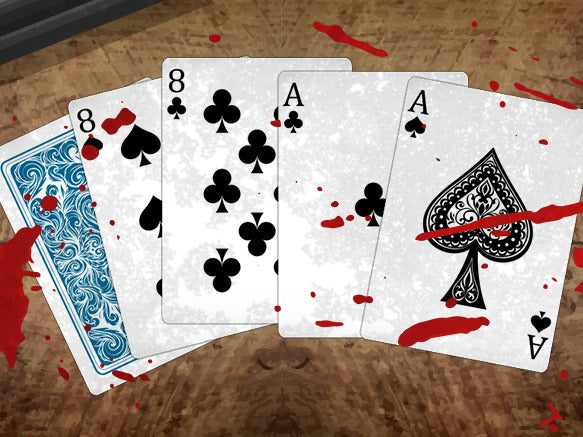
McCall came in. He shot Hickok in the back of the head, killing him instantly, and freezing his face in a smile. Hickok was holding two pairs: The aces and eights of spades and clubs, all black. This became known as "The Dead Man's Hand."
(In my hometown in New Jersey, I once saw a car with a personalized license plate: "ACESN8S.")

Hickok was a friend of Martha Jane Canary, the frontierswoman and scout known as Calamity Jane. Those who love the legends of the Wild West like to imagine that they were lovers, and that Wild Bill was the father of at least one of Jane's children. Certainly, she cared enough about him to try to avenge him, going after McCall with a meat cleaver, later claiming it was because she had left her guns at her rooming house and it was the only weapon available.
Calamity Jane at Wild Bill's grave, sometime in the 1890s

A native of Kentucky, McCall was hanged for the crime on March 1, 1877. He was 24 years old. Calamity Jane, a native of Missouri, and also 24 at the time of Wild Bill's death, later joined Buffalo Bill Cody's Wild West Show, and died from the effects of her drinking in 1903, at 51.

In 1941, a woman named Jean Hickok Burkhardt McCormick came forward, claiming to be the daughter of Wild Bill and Calamity Jane. The documentation she came up with -- which gave September 25, 1873 as both the date of their marriage and the date of her birth, making her almost 68 years old at the time of her claim -- have been disputed ever since, and she got no government benefits from it.

James Butler Hickok, a.k.a. Wild Bill, has been played by William S. Hart in the 1923 silent film Wild Bill Hickok, Wild Bill Elliott in the 1940 film Prairie Schooners, Guy Madison and later Andy Devine in the 1951-58 CBS series The Adventures of Wild Bill Hickok, Lloyd Bridges on a 1964 episode of The Great Adventure, Jeff Corey in the 1970 film Little Big Man, Charles Bronson in the 1977 film The White Buffalo, Josh Brolin in the 1989-92 ABC series The Young Riders, William Russ in a 1995 episode of Legend, Sam Shepard in the 1999 TNT film Purgatory, and Luke Hemsworth in the 2017 film Hickok.

Martha Jane Canary, a.k.a. Calamity Jane, has been played by Jane Russell in the 1948 film The Paleface, Norma Crane on an 1961 episode of Have Gun -- Will Travel, Stefanie Powers on a 1963 episode of Bonanza (which pairs her up with not Wild Bill but John "Doc" Holliday, whom she appears never to have met in real life), and Catherine O'Hara in the 1995 Disney film Tall Tale: The Unbelievable Adventures of Pecos Bill. (Pecos Bill was a fictional cowboy and folk hero, something of a Wild West version of Paul Bunyan.)

And, together, they were portrayed in the 1936 film The Plainsman by Gary Cooper and Jean Arthur, in the 1940 film Young Bill Hickok by Roy Rogers and Sally Payne, in the 1953 film Calamity Jane by Howard Keel and Doris Day, on a 1966 episode of Death Valley Days by Rhodes Reasons and Fay Spain, in the 1984 CBS movie Calamity Jane by Frederic Forrest and Jane Alexander, in the 1995 film Wild Bill by Jeff Bridges (Lloyd's son) and Ellen Barkin, in the 1995 CBS movie Buffalo Girls by Sam Elliott and Anjelica Huston, and by Keith Carradine and Robin Weigert in the 2004-06 HBO series Deadwood (and Jane by Weigert again in its 2019 film sequel).

UPDATE: Stephen Amell, who played Oliver Queen, a.k.a. the superhero Green Arrow, and Emily Bett Rickards, who played his crimefighting associate and later wife Felicity Smoak, on the TV show Arrow, played Hickok and Canary in the 2024 film Calamity Jane.

*

August 2, 1876 was a Wednesday. Only one game was played that day, in the National League. The Hartford Dark Blues beat the Philadelphia Athletics, 15-5 at the Hartford Ball Club Grounds in the Connecticut capital. Neither of these teams would survive the 1877 season, and the A's founded in Philadelphia in 1901, who have been in Oakland since 1968, have no connection to them besides name.

But, thus far, "Wild Bill" has been a nickname for 14 Major League Baseball players, most notably William Edward Donovan, who won 185 games, pitching mostly for the 1900s and 1910s Detroit Tigers; and William Anthony Hallahan, who won 102 games, and was with the St. Louis Cardinals when they won the World Series in 1926, 1931 and 1934.

Sunday, July 31, 2022

August 1, 1876: Colorado Is Admitted As the 38th State

The State Flag

August 1, 1876: Colorado is admitted to the Union as the 38th State.

Aside from the continuing readmission of the Confederate States, this was the 1st new State since Nebraska, 9 years earlier. The previous States were admitted in this order, with the 1st 13 being listed by when their legislatures ratified the new Constitution of the United States:

1. Delaware, December 7, 1787.
2. Pennsylvania, December 12, 1787.
3. New Jersey, December 18, 1787.
4. Georgia, January 2, 1788.
5. Connecticut, January 9, 1788.
6. Massachusetts, February 6, 1788.
7. Maryland, April 28, 1788. 
8. South Carolina, May 23, 1788.
9. New Hampshire, June 21, 1788. Getting 9 of the 1st 13, or three-quarters, guaranteed the Constitution's overall ratification.
10. Virginia, June 25, 1788.
11. New York, July 26, 1788. Getting the largest Northern State, New York, and the largest Southern State, Virginia, was seen as vital for overall acceptance of the Constitution. Hence, The Federalist Papers, designed to persuade legislators to ratify the document, were written by Alexander Hamilton of New York, plus 5 by John Jay, also of New York; and James Madison of Virginia, who had written the bulk of the Constitution.
12. North Carolina, November 21, 1789, the 1st State admitted after the 1st convening of Congress on March 4, 1789, and the 1st admitted after the Inauguration of the 1st President, George Washington, on April 30, 1789. Georgia, Virginia and both Carolinas are the only States to have been part of the Original 13 and the Confederate 11.
13. Rhode Island, May 29, 1790.
14. Vermont, March 4, 1791, the 1st State admitted that was not part of what we now tend to call "The Original 13 Colonies."
15. Kentucky, June 1, 1792, the 1st "Western" State.
16. Tennessee, June 1, 1796.
17. Ohio, March 1, 1803, the 1st State admitted as a result of the Northwest Ordinance of 1787.
18. Louisiana, April 30, 1812, the 1st State admitted as a result of the Louisiana Purchase of 1803.
19, Indiana, December 11, 1816.
20. Mississippi, December 10, 1817.
21. Illinois, December 3, 1818.
22. Alabama, December 14, 1819.
23. Maine, March 15, 1820.
24. Missouri, August 10, 1821. Maine and Missouri were admitted, albeit a year and a half apart, as a result of the Missouri Compromise of 1820, an attempt to assure a balance of Free States and Slave States. Maine's land had been part of Massachusetts.
25. Arkansas, June 15, 1836.
26. Michigan, January 26, 1837.
27. Florida, March 3, 1845.
28. Texas, December 29, 1845.
29. Iowa, December 28, 1846.
30, Wisconsin, May 28, 1848.
31. California, September 9, 1850, the 1st State from the land won from the Mexican-American War, and the 1st State on the Pacific Coast.
32. Minnesota, May 11, 1858.
33. Oregon, February 14, 1859.
34. Kansas, January 29, 1861, the last State admitted before the American Civil War, admitted as some Southern States were seceding.
35. West Virginia, June 20, 1863. Virginia had seceded from the Union, so West Virginia seceded from Virginia, and rejoined the Union.
36. Nevada, October 31, 1864.
37. Nebraska, March 1, 1867, the 1st State admitted after the Civil War.

A reminder: My cutoff date for this project is 1869, because of 3 significant events that occurred that year, 2 of them sporting events on back-to-back days: The completion of the 1st transcontinental railroad, the end of the 1st professional baseball season, and the 1st American football game.

Colorado is in the Rocky Mountains, which include the State's most famous physical feature, the 14,115-foot-high Pikes Peak. The Colorado Territory had been separated from the Kansas Territory, which was obtained as part of the Louisiana Purchase. It has become known for gold mining (a gold rush in 1859 helped start the movement for Statehood) and skiing (Aspen and Vail are world-famous ski resorts).

In politics, it was traditionally Republican until 1992, when a large influx of Hispanic voters switched it to being usually Democratic. Still, there is a bit of a divide: Denver and Boulder, the latter having a Hippie image, make for "The People's Republic of Boulder." The rest of the State is so conservative, it might as well be called "West Nebraska" or "East Utah."

No Colorado native has ever become President. Its highest-ranking politician has been Federico Peña, who served as Mayor of Denver (1983-91), and, in the Administration of President Bill Clinton, served as Secretary of Transportation (1993–1997) and Secretary of Energy (1997–1998). Senator John Kerry of Massachusetts, was born in Denver, and was the Democratic nominee for President in 2004, but lost. Mamie Eisenhower, wife of President Dwight D. Eisenhower, grew up in Denver.

It is home to the University of Colorado in Boulder, Colorado State University in Fort Collins, the University of Denver (multi-time National Champions in hockey), and the U.S. Air Force Academy in Colorado Springs.

Its capital, Denver, is also its largest city. Denver is home to MLB's Colorado Rockies, the NFL's Denver Broncos, the NBA's Denver Nuggets, the NHL's Colorado Avalanche, and MLS' Colorado Rapids. (UPDATE: The NWSL's Denver Summit began play in 2026.)

Denver has never hosted a Super Bowl, although the Broncos have been in 8; and was not selected as a host city for the 1994 World Cup. The Broncos have won the Super Bowl in 1998, 1999 and 2015; and the Avalanche have won the Stanley Cup in 1996, 2001 and 2022. The Rockies have won the National League Pennant in 2007, but never the World Series. The Nuggets reached the ABA Finals in 1976, but never the NBA Finals. The Rapids won the 2010 MLS Cup.

(UPDATE: Denver was not selected as a host city for the 2026 World Cup. But the Nuggets won the 2023 NBA Championship.) 

*

August 1, 1876 was a Tuesday. The only major sports league in North American was baseball's National League, and these 3 games were played:

* The Hartford Dark Blues beat the Philadelphia Athletics, 8-4 at the Hartford Ball Club Grounds in Hartford, Connecticut.

* The St. Louis Brown Stockings beat the Cincinnati Reds, 19-3 at the Avenue Grounds in Cincinnati.

* And the Chicago White Stockings beat the Louisville Grays, 15-7 at Louisville Baseball Park in Louisville, Kentucky.

Despite some later teams having similar names to these, the only one of these teams still in existence today is the Chicago White Stockings, who have been known as the Chicago Cubs since 1903.

Thursday, June 30, 2022

July 1, 1876: The Dewey Decimal System

July 1, 1876: The publication Library Journal publishes its 1st issue, in Boston. It is founded and largely written by Melvil Dewey, a 25-year-old librarian originally from Adams Center, New York, on Lake Ontario. In this issue, Dewey explained his new cataloguing system for library books, which has come to be known as the Dewey Decimal System.

Dewey was also a believer in the metric system, as it was also a base-ten system. But that's never caught on in America.

Dewey, identifying himself as "the author," explained his system as follows, with my editing:

The plan of the following Classification and Index was developed early in 1873. It was the result of several months' study of library economy as found in some hundreds of books and pamphlets, and in over fifty personal visits to various American libraries.

In this study, the author became convinced that the usefulness of these libraries might be greatly increased without additional expenditure. Three years practical use of the system here explained, leads him to believe that it will accomplish this result; for with its aid, the catalogues, shelf lists, indexes, and cross-references essential to this increased usefulness, can be made more economically than by any other method which he has been able to find. The system was devised for cataloguing and indexing purposes, but it was found on trial to be equally valuable for numbering and arranging books and pamphlets on the shelves.

The library is first divided into nine special libraries which are called Classes. These Classes are Philosophy, Theology, &c., and are numbered with the nine digits. Thus Class 9 is the Library of History; Class 7, the Library of Fine Art; Class 2, the Library of Theology.

These special libraries or Classes are then considered independently, and each one is separated again into nine special Divisions of the main subject. These Divisions are numbered from 1 to 9 as were the Classes. Thus 59 is the 9th Division (Zoology) of the 5th Class (Natural Science). A final division is then made by separating each of these Divisions into nine Sections which are numbered in the same way, with the nine digits. Thus 513 is the 3d Section (Geometry) of the 1st Division (Mathematics) of the 5th Class (Natural Science).

This number, giving Class, Division, and Section, is called the Classification or Class Number, and is applied to every book or pamphlet belonging to the library. All the Geometries are thus numbered 513, all the Mineralogies 549, and so throughout the library, all the books on any given subject bear the number of that subject in the scheme.

Where a 0 occurs in a class number, it has its normal zero power. Thus, a book numbered 510, is Class 5, Division 1, but no Section. This signifies that the book treats of the Division 51 (Mathematics) in general, and is not limited to any one Section, as is the Geometry, marked 513. If marked 500, it would indicate a treatise on Science in general, limited to no Division. A zero occurring in the first place would in the same way show that the book is limited to no Class.

The classification is mainly made by subjects or content regardless of form; but it is found practically useful to make an additional distinction in these general treatises, according to the form of treatment adopted. Thus, in Science we have a large number of books treating of Science in general, and so having a 0 for the Division number.

These books are then divided into Sections, as are those of the other Classes according to the form they have taken on. We have the Philosophy and History of Science, Scientific Compends, Dictionaries, Essays, Periodicals, Societies, Education, and Travels,--all having the common subject, NATURAL SCIENCE, but treating it in these varied forms. These form distinctions are introduced here because the number of general works is large, and the numerals allow of this division, without extra labor for the numbers from 501 to 509 would otherwise be unused. They apply only to the general treatises, which, without them, would have a class number ending with two zeros.

A Dictionary of Mathematics is 510, not 503, for every book is assigned to the most specific head that will contain it, so that 503 is limited to Dictionaries or Cyclopedias of Science in general. In the same way a General Cyclopedia or Periodical treats of no one class, and so is assigned to the Class 0. These books treating of no special class, but general in their character, are divided into Cyclopedias, Periodicals, etc. No difficulty is found in following the arithmetical law and omitting the initial zero, so these numbers are printed 31, 32, etc., instead of 031, 032, etc.

In other words:

* 000: Computer Science, Information and General Works
* 100: Philosophy and Psychology
* 200: Religion
* 300: Social Sciences
* 400: Language
* 500: Pure Science, not covered under any of these other categories
* 600: Technology
* 700: Arts and Recreation
* 800: Literature
* 900: History and Geography

Most entries on this blog would fall under 700, with Music coming in at the 780s, Movies and Television at 792, and Sports at 796; or 900, under History, with 920 being Biography, the 930s for the History of the Ancient World (not coverable here), the 940s for the History of Europe, the 950s for Asia, the 960s for Africa, the 970s for North America, the 980s for South America, and the 990s for "Other Areas," like Oceania (Australia, New Zealand and Pacific islands) or the polar regions.

A book with a Dewey number of 000 would be for computer science. A book with a Dewey number of 999 would be for "extraterrestrial worlds." If the sports entries in this blog were published in book form (unlikely to happen in my lifetime), the sticker on the spine would read 796 PAC, for sports and the 1st 3 letters of my surname. If I included only those entries relating to baseball, it would be 796.357 PAC.

In 1897, when the present Library of Congress building opened, it instituted its own system, the Library of Congress Classification. While some libraries have adopted it, the Dewey Decimal System remains considerably more popular. 

From 1883 to 1888, Melvil Dewey was the chief librarian at the Columbia College Libraries; then, through 1906, the director of the New York State Library. In 1895, at Lake Placid, New York, he and his wife Annie founded the Lake Placid Club, which, by 1924, helped to establish the Winter Olympics, which have been hosted in Lake Placid in 1932 and 1980. In 1926, he moved to Florida, and established a town named Lake Placid there. He died there in 1931.

In the years since his death, unsettling revelations about him have reached the public, including racism, anti-Semitism, and sexual harassment of women. His System has been of great help to anyone using a library, either employee or visitor; but he must be forever consigned to the realm of, "Yes, but... "

*

July 1, 1876 was a Saturday. The only professional sports league in North America at the time was baseball's National League, and 2 games were played in it on this day. The Boston Red Stockings beat the Louisville Grays, 10-2 at the Louisville Baseball Park in Kentucky. And the Chicago White Stockings beat the Philadelphia Athletics, 18-10 at the State Street Grounds in Chicago.

This version of the Philadelphia Athletics dropped out of the NL after the season, while the Grays folded after the 1877 season. The Boston team eventually became the Boston, Milwaukee and Atlanta Braves; while the Chicago team became the Cubs, and both teams would see their original names adopted by teams that began play in the American League in 1901: The Boston Red Sox and the Chicago White Sox.

Friday, June 24, 2022

June 25, 1876: The Battle of the Little Bighorn

June 25, 1876: The Battle of the Little Bighorn is fought in the Montana Territory. The 7th Cavalry of the U.S. Army fights several tribes of Native Americans. The tribes win.

The main group of Natives was the Lakota Sioux, led by Sitting Bull and Crazy Horse. The Cavalry was led by Lieutenant Colonel George Armstrong Custer. He had graduated 35th and last in his class at the U.S. Military Academy at West Point in 1861. Because the Civil War was raging, he rose fast, and had the brevet (temporary) rank of Major General. After the war, his questionable actions led the Army to drop him back down to Lieutenant Colonel.
Custer had managed some victories against Natives in the intervening 11 years, and began to believe he was invincible. But on the Little Bighorn River, he found out otherwise. The legend that there were no U.S. Army survivors isn't even close to being true, but of the 700 men under Custer's command, 274, including Custer himself, a 36-year-old Ohioan, died. The Natives lost about half that many, out of around 2,500.

Reports of the battle began to reach the Eastern United States on Centennial Day, July 4, 1876. The anger of "the white man" toward "the red man" was stronger than ever. A year later, Crazy Horse was captured and executed. Sitting Bull, too, would eventually face what the white man would call "justice," in 1890, at Standing Rock, South Dakota, not long before the last major battle with the Natives, called Wounded Knee.
The most familiar photograph of Sitting Bull.
There is no known photograph of Crazy Horse,
due to a Native superstition about a camera "capturing the soul."

The battle was nicknamed Custer's Last Stand, and Custer was seen as a hero. In truth, he was an unearned egomaniac, and deserves to be ridiculed by history.

The site of the battle is now part of the Crow Indian Reservation, in the southeastern part of the State of Montana. The closest city is Billings, 60 miles to the northwest. The closest major league city is Denver, nearly 500 miles south -- unless you consider the Canadian Football League to be a "major league," in which case the closest is Regina, home of the Saskatchewan Roughriders, 460 miles northeast.

In 1960, novelty singer Larry Verne had a Number 1 hit with "Mr. Custer." Even by the standards of that time, in which Westerns dominated television and were still big in movies, it was racist as hell toward Natives. It also perpetuated the myth of the cavalry charge order, "Forward, ho!" No such order has ever existed in the U.S. Army.

*

June 25, 1876 was a Sunday. As a result, even though this was the 1st season of baseball's National League, there were no games, because the NL forbid Sunday ball until 1892. Football was in its infancy, hockey was a newborn sport even at the most mildly organized level, and basketball wouldn't be invented for another 15 years. So there were no scores on this historic day.

December 31, 1999 & January 1, 2000: The Millennium

December 31, 1999:  The Millennium arrives. The people of planet Earth survived. At a terrible cost. But we hadn't destroyed ourselves. ...