
August 2, 1876: James Butler Hickok is shot and killed in Deadwood, Dakota Territory, now in the State of South Dakota. He was 39 years old.
He grew up on the Illinois plains, in what's now the Chicago suburb of Troy Grove. At age 18, he thought he'd killed a man in a fight, and fled, taking his father's name, William Hickok. Knowing that his father had used the family house as part the Underground Railroad, assisting fleeing slaves, he joined the Union Army, and later served as a U.S. Army scout. "Wild Bill" served several towns as a lawman, but his chief means of income appears to have been gambling, especially cardplaying.
There are so many legends about the Wild West, including the belief that any saloon you could walk into would have a poker game going on. Poker was Hickok's favored game, but the most common card game in the Wild -- or "Old" -- West was a different game played with a standard deck of cards, faro.
To play bridge in the Wild West was to risk ridicule, as that was considered a game for gentlemen -- and gentlemen were considered more "gentle" than "men," in the West, and had to work harder to prove themselves to the men, as Theodore Roosevelt would eventually find out. Faro, a game dating to 17th Century France, was popularly with manly men, but poker overtook it as such in the early 20th Century, around the time that "the frontier closed," and "dime novels" telling tales of the Wild West began to surpass reality.
Hickok was good at poker, better than he was at enforcing the law. Fortunately for him, he was also a good marksman. Nevertheless, the English writer Joseph G. Rosa (1932-2015), who published They Called Him Wild Bill: The Life and Adventures of James Butler Hickok in 1974, and is considered the foremost authority on him, has been able to document "only" 6 kills. (Among Rosa's other books are The Gunfighter: Man Or Myth?, and books about the guns such men used.)
On August 1, 1876, having had a run of bad luck, Hickok went to Deadwood, home of Nuttal & Mann's saloon. There, he had a good game, taking a gambler named Jack McCall for all he had. As McCall turned to leave, Hickok gave him back the money, and suggested that McCall get something to eat.
Instead of comforting McCall, as it could have, it infuriated him, and he had Hickok set up. Knowing how many enemies he had made, Hickok always sat with his back to the wall when he played cards. But on his visit to Nuttal & Mann's for another poker game the next day, every chair with a back to the wall was taken. So he couldn't see who was coming in.
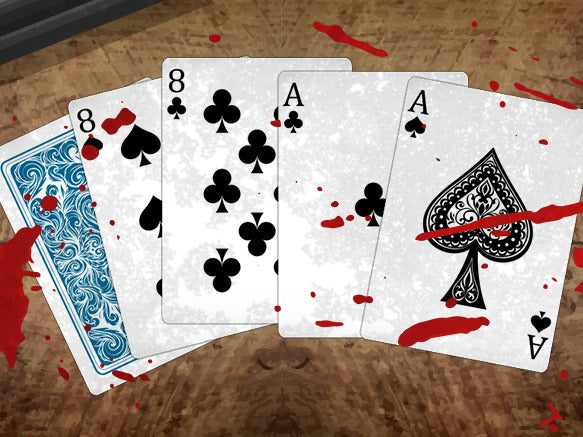
McCall came in. He shot Hickok in the back of the head, killing him instantly, and freezing his face in a smile. Hickok was holding two pairs: The aces and eights of spades and clubs, all black. This became known as "The Dead Man's Hand."
Hickok was a friend of Martha Jane Canary, the frontierswoman and scout known as Calamity Jane. Those who love the legends of the Wild West like to imagine that they were lovers, and that Wild Bill was the father of at least one of Jane's children. Certainly, she cared enough about him to try to avenge him, going after McCall with a meat cleaver, later claiming it was because she had left her guns at her rooming house and it was the only weapon available.

Calamity Jane at Wild Bill's grave, sometime in the 1890s
A native of Kentucky, McCall was hanged for the crime on March 1, 1877. He was 24 years old. Calamity Jane, a native of Missouri, and also 24 at the time of Wild Bill's death, later joined Buffalo Bill Cody's Wild West Show, and died from the effects of her drinking in 1903, at 51.
In 1941, a woman named Jean Hickok Burkhardt McCormick came forward, claiming to be the daughter of Wild Bill and Calamity Jane. The documentation she came up with -- which gave September 25, 1873 as both the date of their marriage and the date of her birth, making her almost 68 years old at the time of her claim -- have been disputed ever since, and she got no government benefits from it.
James Butler Hickok, a.k.a. Wild Bill, has been played by William S. Hart in the 1923 silent film Wild Bill Hickok, Wild Bill Elliott in the 1940 film Prairie Schooners, Guy Madison and later Andy Devine in the 1951-58 CBS series The Adventures of Wild Bill Hickok, Lloyd Bridges on a 1964 episode of The Great Adventure, Jeff Corey in the 1970 film Little Big Man, Charles Bronson in the 1977 film The White Buffalo, Josh Brolin in the 1989-92 ABC series The Young Riders, William Russ in a 1995 episode of Legend, Sam Shepard in the 1999 TNT film Purgatory, and Luke Hemsworth in the 2017 film Hickok.
Martha Jane Canary, a.k.a. Calamity Jane, has been played by Jane Russell in the 1948 film The Paleface, Norma Crane on an 1961 episode of Have Gun -- Will Travel, Stefanie Powers on a 1963 episode of Bonanza (which pairs her up with not Wild Bill but John "Doc" Holliday, whom she appears never to have met in real life), and Catherine O'Hara in the 1995 Disney film Tall Tale: The Unbelievable Adventures of Pecos Bill. (Pecos Bill was a fictional cowboy and folk hero, something of a Wild West version of Paul Bunyan.)
And, together, they were portrayed in the 1936 film The Plainsman by Gary Cooper and Jean Arthur, in the 1940 film Young Bill Hickok by Roy Rogers and Sally Payne, in the 1953 film Calamity Jane by Howard Keel and Doris Day, on a 1966 episode of Death Valley Days by Rhodes Reasons and Fay Spain, in the 1984 CBS movie Calamity Jane by Frederic Forrest and Jane Alexander, in the 1995 film Wild Bill by Jeff Bridges (Lloyd's son) and Ellen Barkin, in the 1995 CBS movie Buffalo Girls by Sam Elliott and Anjelica Huston, and by Keith Carradine and Robin Weigert in the 2004-06 HBO series Deadwood (and Jane by Weigert again in its 2019 film sequel).
UPDATE: Stephen Amell, who played Oliver Queen, a.k.a. the superhero Green Arrow, and Emily Bett Rickards, who played his crimefighting associate and later wife Felicity Smoak, on the TV show Arrow, played Hickok and Canary in the 2024 film Calamity Jane.
*
August 2, 1876 was a Wednesday. Only one game was played that day, in the National League. The Hartford Dark Blues beat the Philadelphia Athletics, 15-5 at the Hartford Ball Club Grounds in the Connecticut capital. Neither of these teams would survive the 1877 season, and the A's founded in Philadelphia in 1901, who have been in Oakland since 1968, have no connection to them besides name.
But, thus far, "Wild Bill" has been a nickname for 14 Major League Baseball players, most notably William Edward Donovan, who won 185 games, pitching mostly for the 1900s and 1910s Detroit Tigers; and William Anthony Hallahan, who won 102 games, and was with the St. Louis Cardinals when they won the World Series in 1926, 1931 and 1934.


No comments:
Post a Comment