Showing posts with label st. louis browns. Show all posts

Thursday, October 20, 2022

October 21, 1918: Harry Chapman Dies In Service

Harry Chapman

October 21, 1918: Harry Chapman dies of the Spanish Flu epidemic at a U.S. Army base in Nevada, Missouri. He was 30 years old, and 1 of 8 Major League Baseball players to die in the service during World War I -- in his case, in Nevada, Missouri, having been returned to the U.S. to treat combat injuries, unsuccessfully as it turns out.
A native of Severance, Kansas, Chapman was a catcher, who played for the Chicago Cubs in 1912, the Cincinnati Reds in 1913, the St. Louis Terriers of the Federal League in 1914 and 1915, and the St. Louis Browns in 1916. Only in the FL was he anything like a regular player. His lifetime batting average was just .198, with 1 home run and 44 RBIs.
There is no memorial to him at Wrigley Field in Chicago, home of the Cubs; Great American Ball Park in Cincinnati, home of the Reds; or Busch Stadium in St. Louis, home of the Cardinals.
Eugene Mayer also dies while serving in World War I on this day. The former halfback, sprinter, long jumper, shot putter and law school graduate at the University of Virginia, a native of Norfolk, never gets to play in the nascent NFL, because he dies at Camp Joseph E. Johnston in Jacksonville, Florida, a casualty of the Spanish Flu Epidemic. "Buck" Mayer was 26, and was posthumously elected to the Virginia Sports Hall of Fame.
Buck Mayer

*

October 21, 1918 was a Monday. The War Department had ordered that the baseball season end a month early, in September, and that all players obey the "work or fight order": Enlist, or get a job in an industry essential to the war effort, or get an otherwise necessary job (like police or firemen), or be subject to the military draft. Football was in midweek. Professional basketball barely existed. And hockey season hadn't started yet. So there were no scores on this historic day.

Sunday, October 9, 2022

October 9, 1944: The Trolley Series

The 1944 World Series game program. "Worlds" is incorrect.
The Browns' logo featured the statue of the city's namesake,
the "Crusader King" Louis IX of France.

October 9, 1944: The only all-St. Louis World Series comes to an end. While the World Series that have been played between the New York Yankees and either the New York Giants or the Brooklyn Dodgers have been labled "Subway Series," this one, because of St. Louis' streetcars, is known as "The Trolley Series."

(The musical film Meet Me in St. Louis, with its "Trolley Song," did not premiere until November 22, 6 weeks later, so that had no effect on the coverage of the Series.)

The St. Louis Browns had been, along with the Washington Senators, symbolic of futility in the American League. The Senators, to go along with George Washington, for whom their city was named, were said to be "First in war, first in peace, and last in the American League." With St. Louis being a major city for shoemaking and brewing, observers of the Browns countered that St. Louis was "First in shoes, first in booze, and last in the American League."

In 1902, their 1st season, the Browns finished 2nd to the Philadelphia Athletics, 5 games out of 1st place. In 1908, they were 4th, 6 1/2 behind the Detroit Tigers. In 1922, they were 2nd, just 1 game behind the New York Yankees. Indeed, up until 1926, they were usually the better team in town. What's more, they owned Sportsman's Park, built in 1909, the latest in a series of ball grounds on the same site that had stood since 1866; while, after leaving tiny Robison Field in 1920, the Cardinals were not only their tenants, but the much weaker team.

But in 1926, with Branch Rickey as their general manager and Rogers Hornsby as both their manager and their big hitting star, the Cardinals won their 1st Pennant in 40 years, and beat the Yankees in the World Series. Rickey and Hornsby had a falling-out, but Rickey rebuilt, and the Cards won Pennants in 1928, 1930, 1931 and 1934, taking the World Series in 1931 and 1934.

Rickey had just rebuilt the Cardinals again when he was hired to run the Dodgers. The team he left behind would win National League Pennants in 1942, 1943, 1944 and 1946. They beat the Yankees in the 1942 World Series, before losing to them in the 1943 edition.

Meanwhile, the Browns fell apart -- mainly because they had fired Rickey in 1916, allowing him to be signed by the Cardinals. After 1922, they didn't get closer than 15 games of 1st place again until 1944, including losing 108 games in 1937 and 111 in 1939. They weren't just bad, they were boring, compared to the hard-hitting, hard-running, hard-pitching and hard-drinking Cardinals, known as "the Gashouse Gang." And still, the Cards paid monthly rent to the Browns, which, at times, especially during the Great Depression of the 1930s, seemed to be the only thing keeping the Browns afloat.

After the 1941 season, the Browns' owners wanted to move the team to Los Angeles, so they would no longer have to compete with the Cardinals for St. Louis fans' attention. A meeting of American League owners was set to discuss how this could be done, given that there was no team west of St. Louis, and coast-to-coast travel was still iffy, given the length of train rides and the condition of airplanes. The meeting was scheduled for December 8. The day before, Pearl Harbor was bombed, America was in World War II, and the meeting was never held. The Browns stayed in St. Louis -- for now.

But The War's manpower drain meant that every team lost good players, though some lost more than others. The Browns went 89-65 in 1944, and that was enough to finish 1 game ahead of the Detroit Tigers and 6 ahead of the Yankees. They finally had their 1st Pennant. And they would play the Cardinals. With the exception of 2020, when COVID restrictions meant that all games were played at Globe Life Field in the Dallas suburb of Arlington, Texas, the 1944 edition remains the last World Series where all games were played at a single venue, Sportsman's Park.
Cardinal pitcher Mort Cooper had been one of the heroes of the 1942 World Series. Denny Galehouse has gone down in history for his poor performance for the Boston Red Sox in the 1948 AL Playoff against the Cleveland Indians. But in Game 1 of the 1944 World Series, Galehouse outpitched Cooper, and was supported by a home run from 1st baseman George McQuinn. The Browns won, 2-1. 

The Cards struck back in Game 2, with Ken O'Dea's pinch-hit single winning it in the 11th. Game 3, on October 6, 1944, marked the all-time peak of the history of the St. Louis Browns. Jack Kramer -- no relation to the man of the same name who was then America's best tennis player -- struck out 10 batters, and the Browns won, 6-2. They now led the Series, 2 games to 1.
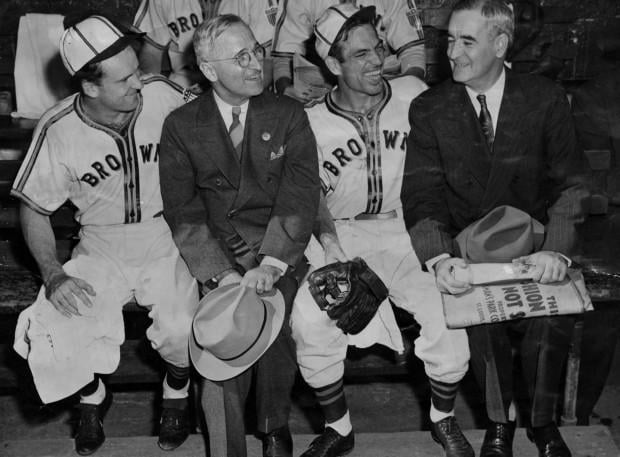
Left to right: George McQuinn, U.S. Senator Harry S Truman of Missouri,
Don Gutteridge, and State Senator Phil Donnelly, before Game 3.
A month later, Truman was elected Vice President of the United States,
and Donnelly was elected Governor. Shortly before the next Opening Day,
President Franklin D. Roosevelt died, and Truman became President.

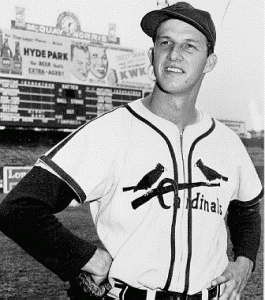
But the Cardinals had Stan Musial. Not yet known as "Stan the Man," he had been in the majors 3 full seasons, and the Cards had won the Pennant all 3 times. He hit a home run of Sigmund "Sig" Jakucki, to help pitcher Harry "the Cat" Brecheen. The Cards won, 5-1, and they never looked back: They took Game 5, 2-0, with Cooper getting revenge on Galehouse; and Game 6, 3-1, with Emil Verban driving in all 3 runs, Max Lanier as the starting and the winning pitcher, and Ted Wilks retiring all 11 Browns he faced in relief.
Stan the young man

In the International League, the Baltimore Orioles saw their home, Oriole Park, burn down on the 4th of July. They had to move to Municipal Stadium, a football stadium a few blocks away. Somehow, they recovered and won the IL Pennant. At the exact same time that the Cards were dusting off the Browns, in front of a full house of 31,630, a crowd of 52,833, then a record for a minor league game, saw the Orioles fall to the Louisville Colonels, 5-4 in Game 4 of the "Junior World Series." But the Orioles would win that series in 6 games.

This team, and how well it drew, raised Baltimore's profile, and made its return to the majors for the first time since 1902 (unless you count the Federal League of 1914 and '15) possible.

In 1945, the Browns came close to following up, but finished 3rd, 6 games behind the Tigers. The Cardinals didn't win the Pennant, either, as their 2 best players, Musial and Enos Slaughter, were in the service, in the final year of The War. In 1946, everybody was back, and the Cards won another Series. In terms of Pennants, Musial was now 4-for-4. Nobody knew it yet, but he would play another 17 seasons, putting together a record that makes him perhaps the best lefthanded hitter in NL history, but would never win another Pennant.

At least the Cardinals were occasionally in contention in those years. The Browns went back to their losing ways. Even Bill Veeck, who owned the Cleveland Indians and won the 1948 World Series, could not buy the Browns and make them contend, or, despite all kinds of promotions and stunts, get big crowds out to the North Side of St. Louis.

In 1953, Gussie Busch, owner of Anheuser-Busch Breweries and maker of Budweiser beer, bought the Cardinals. With billions in beer bucks behind Busch, Veeck knew that the game was up: St. Louis and its metropolitan area were only big enough for 1 Major League Baseball team, and he didn't have the money to compete.

He sold Sportsman's Park to Busch, who renamed it Busch Stadium. Ironically, Veeck sold the Browns to another brewing tycoon, Jerrold Hoffberger of Baltimore, another city with a beermaking tradition. In 1954, the team took the field as the Baltimore Orioles. It took them until 1966 to win another Pennant, and to become the last of the classic 8 AL franchises to win a World Series.

The 1944 season would remain the only time the Cardinals and the Browns/Orioles franchise both made the postseason until 1996, when each team lost its respective League Championship Series. They both made it again in 2012 and 2014. But, despite winning 17 Pennants between them since 1944, they have never faced each other in another World Series.

The last survivor of the 1944 Cardinals was Musial, living until 2013. The last survivor of the only Browns Pennant winner was Don Gutteridge, who lived until 2008.

*

October 9, 1944 was a Monday. Football was in midweek. Hockey was out of season. And the NBA hadn't been founded yet. So there were no other scores on this historic day.

Three rock and roll legends were born on this day: John Entwistle, the bass guitarist for The Who; Nona Hendryx, who sang with Patti LaBelle's group Labelle; and reggae singer Peter Tosh.

October 9, 1910: The Controversial End to the "Chalmers Race"

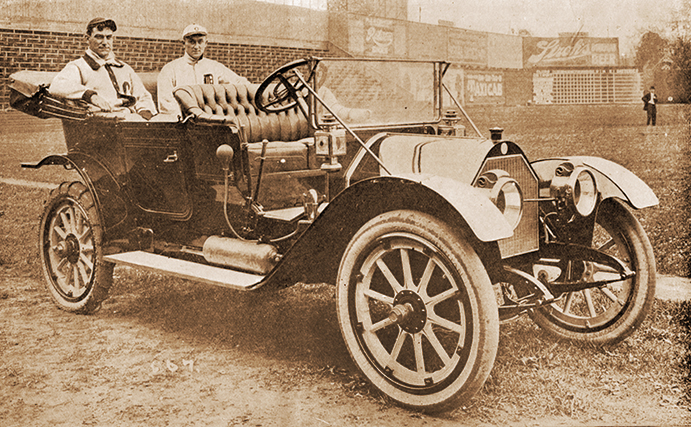
Nap Lajoie (left) and Ty Cobb, in the back seat
of the model of car to be awarded, a 1911 Chalmers 30.

October 9, 1910: The battle for the American League batting title is decided on the final day of the regular season‚ when Ty Cobb of the Detroit Tigers edges Nap Lajoie of the Cleveland… Naps. (Seriously, the team was named after their star 2nd baseman and manager. They would be renamed the Indians in 1915.) Cobb's final average is .385, Lajoie's is .384. Or, more precisely, Cobb's was .385069, and Lajoie's was .384095.

Cobb‚ rather than risk his average‚ sits out the last 2 games‚ the Tigers beating the Chicago White Sox in today's finale‚ 2-1 at the new Comiskey Park in Chicago.

Meanwhile, in a doubleheader with the St. Louis Browns‚ at Sportsman's Park in St. Louis, Lajoie goes 8-for-8, accepting 6 gift hits on bunt singles, on which Browns rookie 3rd baseman Red Corriden is apparently purposely stationed at the edge of the outfield grass.

The prejudiced St. Louis scorer also credits the popular Nap with a "hit" on shortstop Bobby Wallace's wild throw to 1st. In Lajoie's last at-bat‚ he is safe at 1st on an error call‚ but is credited with a sacrifice bunt since a man was on, and thus is not charged with an at-bat.

The St. Louis Post is just one of the papers to be openly critical of the move against Cobb, then the best, but also the most unpopular, player in baseball: "All St. Louis is up in arms over the deplorable spectacle‚ conceived in stupidity and executed in jealousy." The Browns win the opener‚ 5-4‚ and Cleveland takes the nightcap‚ 3-0, with both managers‚ Jack O'Connor and Jim Maguire, catching in the otherwise meaningless game. O'Connor is behind the plate for just an inning‚ but Maguire goes all the way.

AL President Byron Bancroft "Ban" Johnson investigates, and clears everyone concerned‚ enabling Cobb to win the 3rd of 9 straight batting crowns. 
Ty didn't exactly cover himself with glory by sitting it out -- after all, 31 years later, Ted Williams insisted on playing both games of a last-day doubleheader that he went into at .39955, and went 6-for-8 on the day to finish at .406 -- but neither he nor Nap did anything illegal.

The embarrassed Chalmers Auto Company, which had promised a brand-new car to the winner of the batting title, awards cars to both Ty and Nap. Cobb didn't care that Lajoie also got one, as he admired Lajoie: He went on record as saying he badly wanted the car, for the sake of the award, as a measure of respect.

In 1978, baseball historian Pete Palmer uncovered an mistake, which had credited a 2-for-3 game to Cobb twice, that‚ if corrected‚ would have given the batting title, and the "Chalmers Race," to Lajoie, .384 to .383. But the Commissioner's office voted unanimously to leave the stats changed, but not the title. In 1989, The Sporting News looked at the records again, and confirmed Palmer's analysis that one of Cobb's games had been counted twice. In 1991, among other rulings -- including giving Roger Maris full possession of the single-season home run record, and redefining a "no-hitter," the Commissioner's office ruled Cobb's revised totals to be correct.

This reduced Cobb's career hit total from 4,191 to 4,189 (thus meaning that Pete Rose broke the record 3 days before we thought he did, although it was still celebrated when he reached 4,192, due to the number 4,191 being so ingrained in the public memory), and his lifetime batting average from .367 to .366 (although that's still easily a record). Lajoie finished with 3,243 hits, and his lifetime average was .339.

In case you're wondering, in that 1910 season, Cobb had a better on-base percentage than Lajoie, .456 to .445; the higher slugging percentage, .551 to .514; the higher OPS, 1.008 to .960; and the higher OPS+, 206 to 199.

Neither Detroit nor Cleveland seriously challenged the Philadelphia Athletics for the Pennant. The A's finished 14 1/2 games ahead of the 2nd-place New York Highlanders (1 of only 3 times the team that became the Yankees in 1913 finished as high as 2nd before their 1st Pennant in 1921), 18 ahead of the 3rd-place Tigers, and 32 ahead of the 5th-place Naps.

So the Tigers were 14 games ahead of the Naps, meaning that, both stats-wise and standings-wise, Cobb unquestionably had a better season than Lajoie. Lajoie lived until 1959, age 84; Cobb, until 1961, at 74.

The NL Pennant race had no drama in 1910, either, as the Chicago Cubs won their 4th flag in the last 5 years, beating the Giants by 13 games. The Brooklyn Superbas, forerunners of the Dodgers, finished 6th, a whopping 40 games back. So it was A's vs. Cubs in the World Series, and the A's won it in 5 games.

*

October 9, 1910 was a Sunday. Professional football was still minor-league at this point. Professional hockey, and basketball in any form, were still in their infancy. There were 2 other games were played that day in what would eventually be called Major League Baseball. The Cincinnati Reds beat the Pittsburgh Pirates, 7-1 at the Palace of the Fans in Cincinnati. And the Chicago Cubs beat the St. Louis Cardinals, 4-3 at West Side Park in Chicago.

Saturday, October 1, 2022

October 1, 1944: The St. Louis Browns Win Their Only Pennant

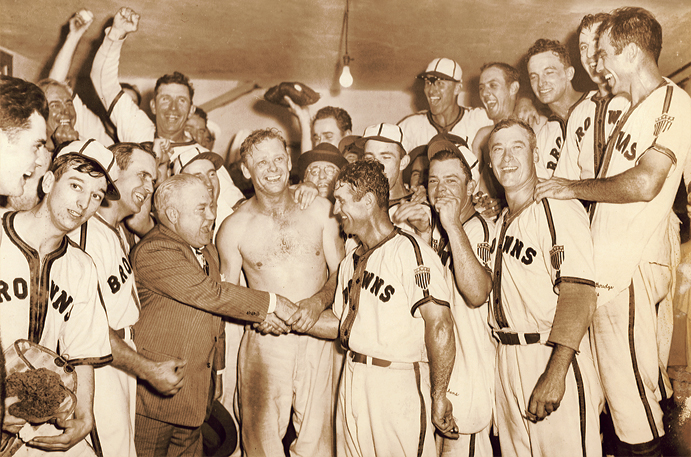
October 1, 1944: The St. Louis Browns beat the New York Yankees, 5-2 at Sportsman's Park in St. Louis. This, combined with the Detroit Tigers' 4-1 loss to the Washington Senators at Briggs Stadium in Detroit, enables the Browns to clinch the American League Pennant. It is their first. They are the last of Major League Baseball's "Original 16" teams (a term not used back then) to do so.

Had the Tigers won, or had both they and the Browns lost, a 1-game Playoff for the Pennant would have been held between them. Sportsman's Park was renamed Busch Stadium in 1953, and Briggs Stadium was renamed Tiger Stadium in 1961.

This was only the 2nd time a team had beaten the Yankees to clinch a Pennant. It had previously happened in 1904, when the team that would become known as the Boston Red Sox did it. It would not happen again until the Kansas City Royals did it in the 1980 AL Championship Series. (It has since been done by the Red Sox in 2004, the Texas Rangers in 2010, the Detroit Tigers in 2012, and the Houston Astros in 2017 and 2019.)

Sigmund "Sig" Jakucki outpitches Mel Queen, despite falling behind 2-0 in the 3rd inning. Mike Kreevich led off the bottom of the 4th with a single, followed by a game-tying home run from Chet Laabs. In the 5th, same combination: Single by Kreevich, homer by Laabs. Vern Stephens added a homer in the 8th.

Managed by Luke Sewell, brother of Cleveland Indians Hall-of-Famer Joe Sewell, the Browns finished the season 89-65, finishing 1 game ahead of the Detroit Tigers and 6 ahead of the defending World Champion Yankees. They had previously come the closest to a Pennant in 1922, when, with what was almost certainly a better team, they went 93-61 but finished a game behind the Yankees.

For most of their history, they were terrible, losing 107 games in back-to-back seasons, 1910 and 1911; 108 in 1937; and 111 in 1939. Noting that St. Louis was the center of America's leather industry and the home of several breweries, someone countered the insult of the Washington Senators -- "Washington: First in war, first in peace, and last in the American League" -- with "St. Louis: First in shoes, first in booze, and last in the American League."

In contrast, the St. Louis Cardinals had won National League Pennants in 1926, '28, '30, '31, '34, '42 and '43, and did so again in '44. The Browns were the landlords at Sportsman's Park, the Cards the tenants, but the tenants were more successful.

And it just so happened that the Cards stood in the Browns' way in their 1st World Series. The Browns won Games 1 and 3, bringing them 2 wins from a World Championship. But this would be the high-water mark of the team, as the Cards took the next 3 games for the title.

When World War II ended, and everybody's players came back from the service, the Browns fell back into a condition where mediocrity would have been an improvement. After the 1953 season, they were moved to become the Baltimore Orioles. They did not win another until Pennant, and did not win the franchise's 1st World Championship, until 1966.

The Browns/Orioles franchise and the Cardinals have never played each other in another World Series. Both teams made the Playoffs in the seasons of 1996, 2012 and 2014, but neither team won its respective Pennant in the years in question.

After 1944, there would not be another team winning their 1st Pennant until September 23, 1957, when the Milwaukee Braves do it -- or, if you don't count moved teams, until October 6, 1969, when the Mets pull off their "Miracle."

The last survivor of the 1944 Browns was 2nd baseman Don Gutteridge -- who, ironically, started his career with the St. Louis Cardinals. He lived until 2008, age 96.

*

October 1, 1944 was a Sunday. These other baseball games were played that day:

* A doubleheader was split at the Polo Grounds. The New York Giants beat the St. Louis Cardinals in the opener, 6-5. George Haussmann drew a bases-loaded walk in the bottom of the 13th inning to win it. Giants manager Mel Ott, not yet retired as a player, put himself in the game as a pinch-hitter, but did not reach base.

The Cardinals won the nightcap, 10-6. Ott did not put himself into this game. Stan Musial and Whitey Kurowski hit home runs. The reason the Cardinals dominated the war years is that they lost fewer players to the military draft than most teams. Especially telling is the fact that they won the Pennant every year from 1942 to 1946, except for 1945, the 1 year that Musial missed while serving in the U.S. Navy.

* The Philadelphia Athletics swept a doubleheader from the Cleveland Indians at Cleveland Municipal Stadium, 5-2 and 5-0. Mel Harder had pitched 9 shutout innings in the 2nd game, but ran out of gas, and the A's torched him for 5 runs in the top of the 10th.

* A doubleheader was split at Comiskey Park in Chicago. The Boston Red Sox won the 1st game, 3-1. The Chicago White Sox won the 2nd game, 4-1.

* The Brooklyn Dodgers beat the Cincinnati Reds, 6-5 at Ebbets Field.

* A doubleheader was split at Braves Field in Boston. The Chicago Cubs won the 1st game, 4-3. The Boston Braves won the 2nd game, 7-6.

* And a doubleheader was split at Shibe Park in Philadelphia. The Pittsburgh Pirates won the 1st game, 9-1. The Philadelphia Phillies won the 2nd game, 7-1.

There was only 1 game played in the NFL: The Green Bay Packers beat the Detroit Lions, 27-6 at the Dairy Bowl in the Milwaukee suburb of West Allis, Wisconsin. The Dairy Bowl was a football stadium built in the infield of a speedway, now known as the Milwaukee Mile, at the Wisconsin State Fair Park.

October 1, 1939: Marvel Comics #1

October 1, 1939: Marvel Mystery Comics #1, produced by Timely Comics, premieres. By 1950, the company would take the name Marvel Comics. The issue now usually referred to as just "Marvel #1" featured Prince Namor of Atlantis, the Sub-Mariner; the original version of the Human Torch, an android; a gun-toting crimefighter called the Angel; and Ka-Zar the Great, a Tarzan ripoff.

In Fantastic Four #4, May 1962, as part of Marvel's attempt to re-establish itself as DC Comics' main rival, and perhaps even its superior, the new Human Torch, Johnny Storm of the titular hero team, finds the long-lost, amnesiac Sub-Mariner, and restores his memory, but with terrible results. Namor is often referred to as comic books' 1st "anti-hero": A man who helps when he feels like it, but also causes great harm.

In X-Men #1, September 1963, a new superhero named the Angel would be introduced, a man with wings who could fly. Aside from the name, and large wealth, this new Angel, Warren Worthington III, has nothing in common with his predecessor, a private detective named Thomas Halloway.

Marvel #1 sold for 10 cents, equivalent to about $2.10 today. If you can find a copy in good condition today, it will set you back about $350,000.

*

October 1, 1939 was a Sunday. It was the last day of baseball's regular season. In other words, if the film The Natural were a true story, the next day would have been the Playoff for the National League Pennant, and Roy Hobbs shooting out the lights with a walkoff home run.

In real life, these games were played:

* The New York Giants beat the Boston Bees, 5-0 at National League Park in Boston. This was during the 1936-40 experiment in changing names, an experiment that failed: Everyone still called the team the Boston Braves and the ballpark Braves Field, so they switched back. Harry Gumbert pitched a 4-hit shutout. Mel Ott, the leading Giant of his generation, did not play in this game.

* The Brooklyn Dodgers beat the Philadelphia Phillies, 3-2 at Ebbets Field.

* A doubleheader was split at Forbes Field in Pittsburgh. The Cincinnati Reds won the opener, 9-1, getting 3 hits each from Billy Werber and Ival Goodman, and 2 hits each from Lonny Frey, Frank McCormick, Harry Craft, Wally Berger and Billy Meyers.

The Pittsburgh Pirates won the nightcap, 8-0. Ken Heintzelman pitched a 4-hit shutout. Paul Waner went 3-for-5 with an RBI, and Maurice Van Robays went 2-for-5 with 3 RBIs.

* A doubleheader was split at Briggs Stadium in Detroit. The Cleveland Indians won the 1st game, 8-3, with Bob Feller as the winning pitcher. The Detroit Tigers won the 2nd game, 1-0, called after 5 innings due to darkness. (Briggs Stadium was the last ballpark in the American League to get lights, in 1948. It was renamed Tiger Stadium in 1961.) Over the 2 games, Lou Boudreau went 2-for-5 with 2 walks and an RBI, while Hank Greenberg went 1-for-7.

* The Chicago Cubs beat their arch-rivals, the St. Louis Cardinals, 2-1 at Wrigley Field in Chicago.

* The St. Louis Browns beat the Chicago White Sox, 4-3 in 10 innings at Sportsman's Park in St. Louis. This season finale might have been the highlight of the Browns' season even without the dramatics, because it put them out of their misery: They finished 43-111.

* The New York Yankees and the Boston Red Sox had each completed their schedule the day before, against each other. The Yankees went on to sweep the Reds in the World Series.

* The Philadelphia Athletics and the Washington Senators had each completed their schedule the day before, against each other.

Friday, September 30, 2022

September 30, 1934: The Oldest MLB Player to Get a Hit

September 30, 1934: Baseball's regular season comes to a close. Among the games played on this day, the Detroit Tigers sweep a doubleheader from the St. Louis Browns, 10-6 and 6-2 at Navin Field in Detroit. The ballpark will be renamed Briggs Stadium in 1938, and Tiger Stadium in 1961. The Tigers played in it from 1912 to 1999.

The game doesn't mean much: The Tigers won the American League Pennant by 7 games over the New York Yankees, while the Browns, as was usually the case, were far in the other direction, 6th place, 33 games out of 1st.

But in the top of the 6th inning, Charley O'Leary pinch-hit for Browns pitcher George Blaeholder, and singled off Elden Auker. Following a single by Jake Garms and a double by Jack Burns, he scored.

At first glance, this doesn't seem all that remarkable. But it was: O'Leary had just become the oldest player in Major League Baseball history, the oldest to bat, the oldest to get a hit, and the oldest to score a run.

Charles Timothy O'Leary was born on October 15, 1875 in Chicago. A weak-hitting shortstop, he played regularly from 1904 to 1913, including for the Tigers' Pennant-winners of 1907, '08 and '09. He coached under Miller Huggins with both the St. Louis Cardinals and the Yankees. With the Yankees, he was a part of the team that won the 1923, '27 and '28 World Series. In 1920, he made the mistake of getting in a car driven by Babe Ruth, who had an accident. O'Leary was thrown from the car, but survived. In 1932, he was a coach for the Chicago Cubs, and they won a National League Pennant, but lost the World Series to the Yankees.

In 1934, Rogers Hornsby, his former Cardinal and Cub teammate, was managing the Browns, and brought him onto his coaching staff. On that last day of the season, Hornsby sent him up to bat, at age 58, 15 days shy of his 59th birthday. He remained on the Browns' staff until Hornsby was fired in 1937. He died on January 6, 1941, at age 65.

On September 25, 1965, the Kansas City Athletics activated legendary Negro League pitcher Leroy "Satchel" Paige, and he pitched the 1st 3 innings, without allowing a run. He came to bat, but didn't get a hit. At 59, he became the oldest player to play, the oldest to pitch, and the oldest to bat.

On September 12, 1976, the Chicago White Sox swept a doubleheader from the California Angels at Comiskey Park, 2-1 (in 10 innings) and 5-1. Minnie Miñoso, age 53, a coach for the White Sox and once a great player for them, batted 9th as the designated hitter, and went 1-for-3, singling off Sid Monge in the 2nd inning, making him the oldest player in major league history to get a hit.

Or so everybody thought. At the time, O'Leary was believed to have been born in 1882, so Miñoso got credit for breaking his record. Later, it was discovered that O'Leary was born in 1875. So, while Miñoso's achievement was remarkable, it was not unprecedented. In 1980, White Sox owner Bill Veeck sent him up to bat again, making him a 5-decade player (1940s to 1980s), but he did not get a hit. So O'Leary remains the oldest player to come to bat, the oldest to get a hit, and the oldest to score a run.

*

September 30, 1934 was a Sunday. These other baseball games were played.

* The New York Yankees lost to the Washington Senators, 5-3 at Griffith Stadium in Washington, despite a home run from Lou Gehrig. Babe Ruth goes 0-for-3, and it turns out to be his last appearance for the Yankees.

The Yankees finished 2nd in the AL, 7 games behind the Tigers. This is in spite of having players winning both the batting and the pitching Triple Crown. Gehrig batted .363, with 49 home runs and 165 runs batted in. Vernon "Lefty" Gomez won 26 games (against just 5 losses, and no Yankee has matched those 26 wins since), had a 2.33 earned-run average, and struck out 158 batters. All of those figures led the League. Gehrig and Mickey Mantle remain the only Yankees to win batting Triple Crowns.

So why didn't the Yankees win the Pennant? Yes, the Tigers had a great team, but that didn't usually stop the Yankees between 1921 and 1964. Part of the problem was injuries. Center fielder Earle Combs hit his head on an unpadded outfield wall on July 24, played only 63 games, and was never the same. In addition, 3rd baseman Red Rolfe played only 89 games. And while Gomez and Charles "Red" Ruffing were, as usual, the best lefty-righty combo in AL pitching, there wasn't really a good 3rd starter, let alone a 4th.

* The Brooklyn Dodgers beat their arch-rivals, 8-5 at the Polo Grounds. The Giants' 3rd-best pitcher, "Fat" Freddie Fitzsimmons, noted for his usually beating the Dodgers, did not pitch well, although he helped his own cause with a home run. In the top of the 10th inning, neither the Giants' starter and 2nd-best pitcher, Hal Schumacher, nor their ace, "King" Carl Hubbell, could hold off a Dodger rally.

The preceding January, a sportswriter had asked Bill Terry, the 1st baseman who had also managed the Giants to win the previous year's World Series, who would be their top challengers in 1934. He said, "Pittsburgh, St. Louis, and Chicago will be the teams we'll have to beat. I don’t think the Braves will do as well as they did last year. I was just wondering, Is Brooklyn still in the league?"

Over the last 3 games of the regular season, the Dodgers proved that, yes, Brooklyn was still in the National League. That sweep of a doubleheader on Saturday and the single game on Sunday cost the Giants the Pennant. Had the Giants won 2 out of 3, they would have finished in a tie for the Pennant, and forced a best-2-out-of-3 Playoff with St. Louis.

For Dodger fans, who hated the Giants even more than Red Sox fans would eventually hate the Yankees, it was a rare moment in the Sun. In 1941, they won their 1st Pennant in 1920, with their ace being... a 40-year-old Freddie Fitzsimmons.

I have a separate entry for this event.

* A doubleheader was split at Fenway Park in Boston. The Boston Red Sox won the opener, 5-0. George Hockette allowed 8 hits, but kept the shutout. The Philadelphia Athletics won the nightcap, 4-2. Over the 2 games, Jimmie Foxx went 1-for-6 with 3 walks and an RBI.

* The Chicago White Sox won the 1st game of a doubleheader against the Cleveland Indians, 9-5 at League Park in Cleveland. Ted Lyons was the winning pitcher, and former Athletics star Al Simmons went 5-for-5. The Indians were leading the 2nd game, 5-3 after 5 innings, when the game was called due to darkness.

* The Boston Braves swept the Philadelphia Phillies, 4-3 and 5-4 at Baker Bowl in Philadelphia. The 1st game went 10 innings, and the 2nd was called due to darkness after 7. (This was the day the U.S. switched from Daylight Savings Time to Standard Time.)

The Braves finished 78-73, in 4th place, 16 games out of 1st. But the next year, they had one of the worst seasons in baseball history, going 38-115, the most losses of any MLB team between 1916 and 1962. For the 1936 season, as would be said today, they "rebranded": They became the Boston Bees, and Braves Field became National League Park, a.k.a. the Bee Hive. Neither name caught on, and in 1941, they went back to "Boston Braves" and "Braves Field."

* The Chicago Cubs swept the Pittsburgh Pirates, 8-2 and 7-5 at Wrigley Field in Chicago. The next season, Crosley Field in Cincinnati became the 1st major league ballpark with lights. From 1948 to 1988, Wrigley was the last one without lights. Yet, on this day, despite the doubleheader and the early sunset, they got a full 18 innings in. (Well, 17, as neither game needed a bottom of the 9th.)

* And the St. Louis Cardinals beat the Cincinnati Reds, 9-0 at Sportsman's Park in St. Louis. The Cards needed a win, or a Giant loss, to clinch the Pennant on this final day. They got both. Jay "Dizzy" Dean pitched a 7-hit shutout, to advance to 30-7 on the season. No NL pitcher has won 30 games in a season since. Only 1 has won 28, and only 1 other has won 27.

Like the Giants, they had a player-manager. Like Fitzsimmons would in 1941, he was an ex-Giant who came back to haunt his former team: Frankie Frisch, the graduate of Fordham University in The Bronx who was nicknamed "The Fordham Flash." On this day, he went 3-for-5. The Cards got home runs from Bill Delancey and James "Ripper" Collins.

The Cardinals went on to beat the Tigers in the World Series. They are remembered as "The Gashouse Gang," but that nickname wouldn't come until the next season.

There were 4 games played in the NFL:

* The football version of the New York Giants lost to the Green Bay Packers, 20-6 at City Stadium in Green Bay, Wisconsin.

* The football version of the Brooklyn Dodgers beat the Boston Redskins, 10-6 at Ebbets Field.

* The Chicago Bears beat the Cincinnati Reds, 21-3 at Crosley Field in Cincinnati.

* And the Detroit Lions beat the Chicago Cardinals, 6-0 at the University of Detroit Stadium.

September 30, 1945: Lieutenant Hank Greenberg Clinches the Pennant

Swinging two bats in the on-deck circle
was a common sight before the Yankees' Elston Howard
invented the "bat donut" in the 1960s.
Hank Greenberg was one of the few players
who was strong enough to swing three bats.

September 30, 1945: Hank Greenberg, recently discharged from the U.S. Army, hits a grand slam off Nelson Potter in the top of the 9th inning, and gives the Detroit Tigers a 6-3 win over the St. Louis Browns at Sportsman's Park, clinching the American League Pennant, which the Browns had won the previous season, for the only time in their history. The Tigers go on to win the World Series over the Chicago Cubs in 7 games.
The 1st player to go into the service was Philadelphia Phillies pitcher Hugh Mulcahy, drafted on March 8, 1941, and he served for the duration of The War. As my grandmother taught me, she and everyone else who lived through it, even if they never left "the home front," always called it "The War," Capital T, Capital W. 
Greenberg had been the 1st major baseball star to volunteer for the U.S. armed forces in preparation for World War II, inducted into the Army on May 7, 1941. So it was only natural that he was the 1st player to return, discharged on June 14, 1945, with Nazi Germany having surrendered, but not, as yet, Imperial Japan. He had scouted bombing targets for B-29 bombers in the China/India/Burma Theater of Operations, and was discharged with the rank of 1st Lieutenant.
Already known as Hammerin' Hank before Henry Aaron was even born, he had lost his seasons of age 31, 32 and 33, and the 1st half of his age 34 season. He finished his career with a lifetime batting average of .313 and 331 home runs. He should have had at least 150 more home runs. He never regretted it, saying, "My country comes first."
Nor did Chief Petty Officer Bob Feller, U.S. Navy, who lost his seasons of ages 23, 24, 25 and most of 26. He won 266 games and struck out 2,581 batters, all for the Cleveland Indians. Based on his 1941 and 1946 performances, he should have had at least another 90 wins and 1,000 strikeouts, which could have made him the all-time strikeout leader, and, with another 98 wins, the pitcher with the most in the post-1920 Lively Ball Era.
He knew The War was more important. He also knew that people like Ty Cobb and Ohio State football coach Woody Hayes, who compared sports to war, were blowhards, saying, "Anybody who says sports is war has never been in a war."
Warren Spahn had appeared in 4 games before going into the service, and was the winning pitcher in exactly none of them. By the time he rejoined the Boston Braves, 1st Lieutenant Warren Spahn, U.S. Army, had missed his age 22, 23 and 24 seasons, and had gotten frostbite in the Battle of the Bulge and been wounded at the Remagen Bridge.
But his wartime experience may have matured him. From age 25 to 44, he did become the Lively Ball Era's winningest pitcher, and the winningest lefthanded pitcher regardless of era, with 363. So maybe his stats didn't suffer.
The stats of Sergeant Joe DiMaggio, U.S. Army Air Force, did suffer, as he lost his age 28, 29 and 30 seasons. He finished with a .325 batting average, and 2,214 hits including 361 home runs. He should have had at least another 550 hits and another 75 home runs.
And then there was Ted Williams, who served as a flight instructor in World War II and a fighter pilot in the Korean War. By the time he left the service for the last time in 1953, Captain Theodore S. Williams, U.S. Marine Corps, had damaged hearing, and had lost his seasons of age 24, 25 and 26, and most of those of age 33 and 34.
He batted .344 for his career, with 2,654 hits and 521 home runs. It shouldn't surprise people who know a little about baseball history that Ted reached 500 homers, only the 4th to do so after Babe Ruth, Jimmie Foxx and Mel Ott. But it is surprising that the man often called "The Greatest Hitter Who Ever Lived" didn't even get close to 3,000 hits. (He also never got 200 hits in a season.) By missing 4 1/2 prime seasons, he may have missed out on as many as 600 hits and 200 home runs, which would have put him past the 714 of Ruth, the record before Aaron reached 755.
In contrast, Ruth only missed 1 month due to World War I, September 1918, and that was because everybody missed at least that much, since the season was cut short. And Aaron was never drafted. Mickey Mantle was classified 4-F, medically unfit for service.
Willie Mays did serve in the Korean War, missing most of his age 21 season and all of his 22, probably costing him around 350 hits on top of his 3,293, and at least 50 homers on top of his 660, meaning he might have gotten to 715 before Aaron did. Yankee pitcher Whitey Ford (1951 and '52) and Brooklyn Dodger pitcher Don Newcome (1952 and '53) also missed 2 seasons serving in Korea.)
Seaman 1st Class Stan Musial, U.S. Navy, the best hitter in the National League while Ted was the best in the American League, only missed 1945, his age 24 season, due to World War II. He had 3,630 hits and 475 home runs, so he may have missed 200 hits and maybe the 25 homers that would have put him over 500.
One man was a veteran of both D-Day and Major League Baseball. In his case, he was just 19 when he was in a U.S. Navy ship off the coast of Normandy, and his service probably didn't delay his entry into the major leagues by much. He may have been the calmest man in the battle, later saying that the exploding shells looked like fireworks. He was Seaman 2nd Class Lawrence Peter Berra. Yogi.
Yankee shortstop and Seaman 1st Class Phil Rizzuto missed his age 25, 26 and 27 seasons due to those huckleberries Hitler and Tojo. His Dodger counterpart, Chief Petty Officer Harold "Pee Wee" Reese, missed his age 24, 25 and 26 seasons. And Army 1st Lieutenant Jack Roosevelt Robinson missed his age 24, 25 and 26 seasons in the Army. Of course, at that point, he had no idea that he would ever play professional baseball in any capacity, much less the one that would make him the most important player of all time.
UPDATE: Bobby Shantz, who turned 100 on September 26, 2025, became the last remaining veteran of both World War II and Major League Baseball. 
*
September 30, 1945 was a Sunday. These other baseball games were played that day:
* The New York Yankees beat the Boston Red Sox, 12-2 at Yankee Stadium. Tuck Stainback and Charlie Keller hit home runs. Keller had also recently returned, from the U.S. Merchant Marine. Joe Page, who would go on to be much better known as a reliever, started and went the distance for the win.
* The New York Giants beat the Boston Braves, 1-0 at Braves Field in Boston, in the 1st game of a doubleheader. Napoleon "Nap" Reyes, a 3rd baseman, light-skinned enough to be allowed to play even though he was Hispanic, and from Cuba so he wouldn't be drafted to fight in The War, hit a home run in the top of the 13th inning. Don Fisher pitched all 13 innings for the shutout. The nightcap was tied 2-2 after 7 innings, when Massachusetts' 7:00 PM curfew for Sunday sports kicked in and stopped the game.
* The Brooklyn Dodgers beat the Philadelphia Phillies, 4-1 at Shibe Park in Philadelphia.
* The Chicago Cubs beat the Pittsburgh Pirates, 5-3 at Forbes Field in Pittsburgh.
* The St. Louis Cardinals beat the Cincinnati Reds, 3-2 at Crosley Field. Del Rice won the game with a home run in the top of the 12th inning.
* The Washington Senators completed their 154-game schedule, but played their 154th game on September 23, a week before the regular season was supposed to end. Wartime travel restrictions, and the desire to get Griffith Stadium ready for the NFL's Washington Redskins, led to the Senators' condensed schedule. As a result, when their season ended, the Senators were 1 game behind the Tigers for the AL Pennant; but when the season finally ended, the Tigers were a game and a half ahead.
* The Chicago White Sox played their 149th game on September 25, and never played their last 5 games. The Philadelphia Athletics played their 150th game on September 27, and never played their last 4. The Cleveland Indians played their 145th game on September 28, and never played their last 9. Most likely, these were also due to wartime travel restrictions, even though The War had ended with the Japanese' official surrender on September 2 (following their unofficial surrender on August 14, which is recognized as V-J Day).
There were 2 NFL games played that day. The Green Bay Packers beat their arch-rivals, the Chicago Bears, 31-21 at Green Bay City Stadium. And the Cleveland Rams beat the Chicago Cardinals, 21-0 at League Park in Cleveland.
And Ehud Olmert, who served as Prime Minister of Israel from 2006 to 2009, was born on this day.

Wednesday, September 28, 2022

September 28, 1947: Ol' Diz Makes His Point

This photo is not a mockup for an "alternate history" website.
This actually happened.

September 28, 1947: The St. Louis Browns start Dizzy Dean against the Chicago White Sox at Sportsman's Park in St. Louis. Dean had been retired for 6 years due to an arm injury, and was broadcasting for the Browns. A few days earlier, frustrated with their pitching, he said, on the air, "Doggone it, I can pitch better than 9 out of the 10 guys on this staff." (He never did say who the 10th guy was, the one who could pitch better than he could.)

The Brown pitchers' wives complained to management, and they decided to put their money where Dean's mouth was. Since Dean was still only 37, they chose the last day of the season, when the spectator-poor Browns would have even more trouble than usual filling Sportsman's Park, to have Dean pitch for the Browns. It doesn't work: Attendance is only 15,910, about half the ballpark's capacity.

He goes 4 innings, and gets a hit off future Yankee All-Star Eddie Lopat, but pulls a muscle rounding 1st base, and has to leave the game. The Browns' bullpen proves Ol Diz' point as much as he does, losing the game for him: Although the game is scoreless going into the 9th inning, it ends White Sox 5, Browns 2. Lopat goes the distance for the win for the Pale Hose.

Interviewed on what would normally be his own postgame radio show, Diz says, "I said I can pitch better than 9 out of the 10 guys on this staff, and I can. But I'm done playing. Talking's my game now, and I'm glad that muscle I pulled wasn't in my throat."

He broadcast for the Cardinals from 1941 to 1946, the Browns from 1941 to 1948, the Yankees in 1950 and 1951, Mutual Broadcasting in 1952, ABC in 1953 and 1954, CBS from 1955 to 1965 (doing the Game of the Week with former Brooklyn Dodger shortstop Pee Wee Reese), and the Atlanta Braves -- probably since he was the best-known living Southern-born baseball figure -- from their debut in 1966 to 1968.

He was known for his fractured syntax ("Zarilla slud into third" being the best-remembered example), and was the template for football quarterback turned broadcaster Terry Bradshaw: The redneck who wasn't nearly so dumb as he appeared. He died in 1974.

In 1949, Ogden Nash, my grandmother's favorite poet, wrote "Line-Up for Yesterday" for Sport magazine, an alphabetical list of star players. For the letter D, he wrote: 

D is for Dean,
The grammatical Diz,
When they asked, Who's the tops?
Said correctly, I is.


*

September 28, 1947 was a Sunday. In other baseball games:

* The New York Yankees beat the Philadelphia Athletics, 5-3 at Yankee Stadium, in a game played after holding their 1st official Old-Timers Day. Johnny Lindell hits a home run off Lou Brissie, the war hero who has to wear a metal plate on his shin to protect his surgically-repaired leg. The winning pitcher is Bill Wight -- not to be confused with Bill White, later a fine 1st baseman, a longtime Yankee broadcaster, and a President of the National League.

* The Brooklyn Dodgers, having already clinched the National League Pennant, lose their meaningless regular-season finale, 3-2 to the Boston Braves at Braves Field. Johnny Sain pitches 5 innings in relief to pick up his 21st win of the season.

The game ends on a run scored due to an error by the Dodgers' 1st baseman. It's not Jackie Robinson, who got the day off. With poetic justice, it is Ed Stevens, one of the Southerners who'd signed the petition to keep Robinson off the Dodgers in Spring Training. He never appears for the Dodgers again: In the off-season, he's traded to Pittsburgh.

* The New York Giants split a doubleheader with the Philadelphia Phillies at Shibe Park in Philadelphia. The Jints win the opener, 4-1. The Phils win the nightcap, 3-1. Despite having hit a major league record 221 home runs this season, led by the 51 of Johnny Mize, the Giants hit no homers in this doubleheader, and only finished 4th in the NL, 13 games behind the Pennant-winning Dodgers.

* The Washington Senators beat the Boston Red Sox, 5-1 at Griffith Stadium in Washington. Ted Williams of the Red Sox goes 2-for-4. With the regular season over, Williams has won the Triple Crown for the 2nd time: He batted .343, hit 32 home runs, and had 114 RBIs. But Joe DiMaggio had led the Yankees to the Pennant, and ended up leading them to the World Championship. Again, DiMaggio, not Williams, is named the American League's Most Valuable Player.

* The Pittsburgh Pirates beat the Cincinnati Reds, 7-0 at Forbes Field in Pittsburgh. Former Yankee Ernest "Tiny" Bonham pitches a 2-hit shutout. Ralph Kiner finishes 1-for-4 with a RBI. He does not hit a home run, finishing with 51 on the season, tying Mize for the NL and major league lead. Not entering the game for the Pirates is Hank Greenberg, who is retiring, and played his last game 10 days earlier.

* The Detroit Tigers beat the Cleveland Indians, 1-0 at Cleveland Municipal Stadium. Fred Hutchinson, later to manage the Reds to a Pennant, pitches a 6-hit shutout, to beat Bob Feller.

* And the Chicago Cubs beat their arch-rivals, the St. Louis Cardinals, 3-0 at Wrigley Field in Chicago. Bill Nicholson, known as "Swish" because he struck out a lot by the standards of the era, was kind of a precursor to Dave Kingman: All or nothing. This time, he got all of one, hitting the game's only homer. Johnny Schmitz pitched a 5-hit shutout. Stan Musial did not enter the game for the Cards.

Since it was a Sunday, there were also NFL games played, but only 3 of them:

* The Philadelphia Eagles beat the Washington Redskins, 45-42. Wikipedia and Pro-Football-Reference.com agree that the game was played at Shibe Park. Except it couldn't have been, unless it was played at night, after the Phillies finished their doubleheader with the Giants. It's much more likely that the game was moved to Municipal Stadium (later renamed John F. Kennedy Stadium) or Franklin Field.

* The Chicago Cardinals beat the Detroit Lions, 45-21 at Comiskey Park in Chicago. This one is possible, since the White Sox were in St. Louis -- oddly, the city the football Cardinals would move to in 1960.

* And The Green Bay Packers beat their arch-rivals, the Chicago Bears, 29-20 at Green Bay City Stadium.

And there were 2 games in the All-America Football Conference. The football version of the New York Yankees beat the Baltimore Colts, 21-7 at Municipal Stadium in Baltimore. And the San Francisco 49ers beat the Buffalo Bills, 41-24 at Civic Stadium (later War Memorial Stadium) in Buffalo.

Tuesday, September 27, 2022

September 27, 1953: The End of the St. Louis Browns

September 27, 1953: The Chicago White Sox beat the St. Louis Browns, 2-1 at the original Busch Stadium, known as Sportsman's Park until this season, in St. Louis. Minnie Miñoso doubled home the winning run in the top of the 11th inning. Attendance: Only 3,174. It was the last game the Browns ever played: The next season, they were sold, and moved to become the Baltimore Orioles.

Although they were the landlords at Sportsman’s Park, and the Cardinals were their tenants, the Cards were always more successful. Even in the one and only season in which the Browns won an American League Pennant, 1944 – the year they desegregated the stands at the ballpark, including for Cardinals’ games, over that team’s objections – the Cards beat them in the World Series.
Bill Veeck, who formerly owned the Cleveland Indians and the minor-league version of the Milwaukee Braves, bought the Browns in 1951, and, knowing that Cardinals owner Fred Saigh was in financial difficulty, thought he could force the Cards to move, and have the St. Louis market all to himself. It was necessary: St. Louis was big enough to support one major league baseball team, but not two.

It almost worked: Saigh, was imprisoned for tax evasion, and, according to Major League Baseball's rules, this meant that he had to sell the team. He came very close to selling the Cards to a group that was going to move them to Milwaukee for 1953.

But August Anheuser Busch Jr. stepped in. The grandson of Adolphus Busch and the great-grandson of Eberhard Anheuser, founders of the St. Louis-based brewing company that bears their names, wasn't a baseball fan at first. But he liked being a bigshot, which sports team owners are. And he wanted to sell lots and lots of beer, under the brand he'd been selling it under, Budweiser, named for the Budweis region of Austria, from which his grandfather Adolphus had come.

Someone told him that the Cardinals were for sale, and that their radio network, which reached all over the Midwest and into the South, could be used to sell Budweiser. That was all Gussie needed to hear: He bought the Cardinals from Saigh, and then bought Sportsman's Park, from Veeck, ending the odd status of the legendary loser Browns being the landlords, and the far more successful Cardinals (who had won 13 Pennants and 5 World Series, including beating the Browns in '44), being the tenants.

From that day onward, the Browns were doomed, because Gussie was rich as hell, and, like Tom Yawkey of the Boston Red Sox, and later George Steinbrenner of the New York Yankees and Earvin "Magic" Johnson of the Los Angeles Dodgers, he wasn't afraid to spend big if he thought it would get him big results.

Veeck knew the game was up. He applied to the AL to move the Browns to Baltimore for 1954. But the other AL team owners hated his guts, and they voted to let the move happen, but only on the condition that Veeck sell the team to a Baltimore-based group. Ironically, it was a brewery that bought them: Gunther Brewing Company, led by Jerry Hoffberger. (In the 1950s, Baltimore was every bit a brewing town as St. Louis and Milwaukee.)

The Browns weren't just unable to win Pennants, they were always broke, so they were usually terrible. Just as the Washington Senators were "First in war, first in peace, and last in the American League," St. Louis, because of its influence in the American leather and brewing industries, were said to be "First in shoes, first in booze, and last in the American League." They did have a sharp logo, showing St. Louis' namesake, Louis IX, the "Crusader King" of France.

In contrast, in their 1st 30 seasons in Baltimore, the franchise won 6 Pennants – although they haven’t won one in the 40 years since.

The end of the Browns had one other consequence, although it wasn't realized for a full year. Yankee catcher Lawrence "Yogi" Berra was from St. Louis, and when the Yankees made roadtrips to play the Browns, he would bring teammates over for Sunday dinner. The Yankees won the Pennant in 1947, just missed it in 1948, then won again in 1949, '50, '51, '52 and '53.

But with the Browns having moved, there was no trip to St. Louis -- like St. Louis, Baltimore had a large Italian community, and still does, but the Berras didn't live there -- and the Yankees didn't win the Pennant in 1954: They won 103 games, the most the franchise would win between 1942 and 1963, but finished 8 games behind the Cleveland Indians.

Pitcher Whitey Ford later said, "You know, we didn't win the Pennant in 1954, even though we had one of our best teams. And after the season, when we were fishing around for a reason why we didn't win, some of us would say it was because we didn't get to eat at the Berras' house."

After the 1954 season, the Browns-turned-Orioles and the Yankees, made the biggest trade by number of players in baseball history: 17. One of the players the Yankees got was Don Larsen, who pitched a perfect game for them in the 1956 World Series. He retired in 1967, as the last active former St. Louis Brown.

UPDATE: Billy Hunter, another player the Yankees acquired in that 17-man trade, became the last living former St. Louis Brown, living until July 3, 2025. He was their only All-Star in their final season, and played shortstop in that last game, as well as for the Orioles in their 1st game.

Browns players George Sisler, Bobby Wallace, Rogers Hornsby (more for what he did with the Cardinals), Don Gutteridge, Ned Garver, Roy Sievers and Satchel Paige have been elected to the St. Louis Sports Hall of Fame. So has team owner Bill Veeck and general manager Bill DeWitt Sr., whose son Bill Jr. had been the team batboy, and who lent his "Number 1/8th" uniform to Eddie Gaedel, the little person that Veeck sent up to pinch-hit in 1951.

Sievers, Gutteridge and Satchel Paige (more for what he did with the Negro Leagues' Kansas City Monarchs) have been elected to the Missouri Sports Hall of Fame.

*

September 27, 1953 was a Sunday. Italian soccer star Claudio Gentile was born on this day.

These other major league baseball games were played:

* The New York Yankees lost to the Boston Red Sox, 2-1 at Yankee Stadium. Bill Henry outpitched Whitey Ford, allowing only 2 hits, a double by Billy Martin and an RBI triple by Yogi Berra. Mickey Mantle went 0-for-3 with a walk. Ted Williams went 1-for-3 before leaving for a defensive replacement. It didn't matter: The Yankees had won the American League Pennant, with the Cleveland Indians the closest team, 8 1/2 games behind.

* The Brooklyn Dodgers beat the Philadelphia Phillies, 8-2 at Connie Mack Stadium in Philadelphia. Russ Meyer started, but only lasted 3 innings against his former team, thus not qualifying as the winning pitcher, who turned out to be Billy Loes. Robin Roberts fell to 23-16 on the season for the Phils. Jackie Robinson went 0-for-4, but drew a walk, and had an RBI on a sacrifice fly.

The Dodgers won 105 games, taking the National League Pennant by 13 games over the Milwaukee Braves, and might have had their most powerful lineup in franchise history. But they didn't yet have Don Newcombe back from the Korean War, while the Yankees had Whitey Ford back from it, and that helped make the difference, as the Yankees won the World Series in 6 games.

* The New York Giants lost to the Pittsburgh Pirates, 6-4 at Forbes Field in Pittsburgh. In the kind of odd move that sometimes happens in season finales, Alvin Dark, the Giants' Captain and usual shortstop, was the starting pitcher, going just 1 inning and allowing 2 runs, before giving way to Rubén Gómez, who went 7 innings. But it would be Al Corwin who gave up a game-winning homer in the bottom of the 9th, to Preston Ward. Cal Hogue went the distance for the Pirates.

Willie Mays was still in the U.S. Army, despite the Korean War being over. He would return during the next season's Spring Training, and would remain on the Giants' roster until May 11, 1972.

* The Philadelphia Athletics beat the Washington Senators, 9-2 at Griffith Stadium in Washington. A year later, the A's would leave Philly. Six years after that, the Senators would also move, replaced by a new team. That team would also move, after 11 years.

* The Detroit Tigers beat the Cleveland Indians, 7-3 at Cleveland Municipal Stadium. Al Aber outpitched Bob Feller. Ray Boone, father of Bob, and grandfather of Bret and Aaron, hit a home run for the Tigers. Rookie Al Kaline went 0-for-3 with a walk.

* The Milwaukee Braves beat the Cincinnati Redlegs, 8-2 at Crosley Field in Cincinnati. This was the 1st of 6 seasons in which the Reds caved in to anti-Communist pressure, and dropped the "Reds" name, before realizing it was stupid, and reclaiming their name.

* And the Chicago Cubs beat their arch-rivals, the St. Louis Cardinals, 3-2 at Wrigley Field in Chicago. At least the Cardinals would still be in St. Louis the next season. Stan Musial went 2-for-5. For the Cubs, Ralph Kiner went 0-for-4, and rookie Ernie Banks went 0-for-3.

And it was the opening Sunday of the NFL season. These games were played:

* The New York Giants lost to the Los Angeles Rams, 21-7 at the Los Angeles Memorial Coliseum.

* The Baltimore Colts beat the Chicago Bears, 13-9 at Municipal Stadium in Baltimore. That facility was being converted into Memorial Stadium for the 1954 baseball season. It had been a 70,000-seat football stadium, a horseshoe with the open end at the south, and the baseball diamond in the northwest corner, into a 50,000-seat multipurpose stadium, a horseshoe with the open end at the north, and the diamond in the south end.

* The Detroit Lions beat the Pittsburgh Steelers, 38-21 at Briggs Stadium (later Tiger Stadium) in Detroit.

* The Washington Redskins beat the Chicago Cardinals, 24-13 at Comiskey Park in Chicago.

* The Cleveland Browns beat the Green Bay Packers, 27-0 at Milwaukee County Stadium.

* And the San Francisco 49ers beat the Philadelphia Eagles, 31-21 at Kezar Stadium in San Francisco. 

Thursday, September 8, 2022

September 9, 1928: The Death of Urban Shocker

September 9, 1928: Urban Shocker dies of heart failure. He was only 37 years old and, technically, still an active pitcher in baseball.

Today, a man with a name like "Urban Shocker" would be welcomed with open arms in New York sports. And every rapper would ask himself why he didn't think of that for a stage name. (New Orleans-based rapper Vyshonn King Miller named himself "Silkk the Shocker" -- instead of going with, oh, I don't know, "King Miller.")

He was of French-Canadian descent, born Urbain Jacques Shockcor in Cleveland, on September 22, 1890. He threw a breaking ball and a spitball with great success, and ended up as 1 of the 17 active pitchers who was allowed to continue throwing the spitball after the 1920 season.

In 1914, pitching for the Ottawa Senators of the Canadian League, he went 20-8; in 1915, 19-10. That led the New York Yankees to sign him, but he appeared in only 12 games, going 4-3, before going back to Canada, loaned to the Toronto Maple Leafs of the International League. (Both the Senators and the Maple Leafs would have their names borrowed by hockey teams that survived them.) There, he went 15-3 with a 1.31 ERA.

He went 8-5 for the Yankees in 1917, but the new manager, Miller Huggins, had little faith in him. On January 22, 1918, the Yankees traded Shocker, Fritz Maisel, Les Nunamaker, Nick Cullop, Joe Gedeon and $15,000 to the St. Louis Browns for Eddie Plank and Del Pratt.

From 1918 to 1924, Shocker went 126-80 for the Browns -- an average of 18-11. He won 27 games in 1921, leading the major leagues, and 24 in 1922, with 149 strikeouts, which doesn't sound like much today, but it was good enough to lead both Leagues that season.

Shocker's absence nearly cost the Yankees the Pennant in '22, may have cost them the Pennant in '20 (20-10) and '24 (16-13), and may have been a reason why they lost the World Series in '21 and '22. Never mind the other players the Yankees gave up: Getting rid of Shocker was a mistake.

What about what they got in return? Plank was a genuine Hall-of-Fame pitcher, with a career record of 326-194 before the trade. But he was 42, and never threw another professional pitch, retiring because the stress of the game had given him stomach problems. (The stress must have gotten worse: He died of a stroke in 1926, just 8 years after the trade.)

Pratt was a good 2nd baseman, and led the AL in RBIs in 1916. In 1920, he attained career highs while with the Yankees in batting .314 with 108 RBIs. But the Yankees traded him, anyway -- to the Red Sox for pitcher Waite Hoyt and catcher Wally Schang. That was a great trade.

In his 1979 book This Date In New York Yankees History, Nathan Salant called trading Shocker away the worst trade in Yankee history to that point. But there are 2 reasons why it isn't that bad: The fact that it was, essentially, Shocker for Hoyt (a Hall-of-Famer) and Schang (an All-Star-caliber player, had there been an All-Star Game back then); and the fact that the Yankees did get Shocker back from the Browns, on December 17, 1924, sending them another star pitcher, Bullet Joe Bush, and 2 other guys.

He was only 12-12 in 1925, as the Yankees were in transition: The hitting stars of their Pennant streak of 1921-23 had stopped hitting. They were replaced with new stars, like Lou Gehrig, Earle Combs and Tony Lazzeri, joining Babe Ruth. In 1926, Shocker went 19-11, and the Yankees won the Pennant. In 1927, the year the Yankees became known as "Murderers' Row" and "The Greatest Team Ever," Shocker went 18-6.

But he had a swollen heart, causing him constant pain. Supposedly, his condition was so severe, he had to sleep either sitting or standing up. He was too ill to appear in the 1927 World Series, and appeared in only 1 game in 1928, on May 30, pitching 2 innings in a mop-up role, as the Yankees lost to the Washington Senators, 5-0.

Like many people before him with either a bad heart or bad lungs, he went to Denver, Colorado, thinking that the thin mountain air would be good for him. He asked the Yankees for his release, and they gave it to him. On August 6, 1928, Shocker appeared in an exhibition tournament in Denver, and pitched in a game against a team from Cheyenne, Wyoming, but fared poorly. Shortly thereafter, he contracted pneumonia, and was hospitalized shortly thereafter.

The Yankees began September 9, 1928 half a game behind the Philadelphia Athletics. The Yankees had 19 games left in the regular season; The A's, 18. And they were about to face each other in a 4-game series at Yankee Stadium, starting with a Sunday doubleheader that brought 85,265 fans to the big ballyard in The Bronx. With the Stadium's triple-decked stands not curled around the right-field foul pole until 1936, newspaper accounts estimated that another 5,000 people were able to watch the games from rooftops on River Avenue.

The Yankees won the opener, 5-0. George Pipgras allowed 9 hits, but kept a shutout. Then the Yankees won the nightcap, 7-3, coming back from 3-0 down at the 7th inning stretch to score 2 runs in the 7th, and a grand slam by Bob Meusel meant 4 in the 8th. Hoyt beat Eddie Rommel, a knuckleballer about to turn 41.

Over the 2 games, Babe Ruth went 1-for-6 with 2 walks, and Lou Gehrig went 3-for-6 with a walk and an RBI. For the A's, Jimmie Foxx went 1-for-8, and Mickey Cochrane went 1-for-7 with a walk. With the A's at the end of long and glorious careers, Eddie Collins got a hit as a pinch-hitter in the 1st game, while Ty Cobb and Tris Speaker, both available, did not get into either game. Cobb played in the last game of the series, on September 11, a 5-3 Yankee win, popping up to shortstop as a pinch-hitter for Max Bishop. It was his last major-league appearance. Speaker had made his last on August 30. Collins played 16 more games over the 1928, '29 and '30 seasons, and retired.

The Yankees ended the day a game and a half ahead of the A's. They roared into their clubhouse, and were ready to celebrate, when they saw Mark Roth, the team's traveling secretary, standing by a telephone, and looking sad. He told them he had just heard that Shocker was dead. The players knew Shocker was sick, but they had no idea how sick. They ended the season 2 1/2 games ahead of the A's, and won the World Series again.

Urban Shocker compiled a record of 187-117 with an ERA of 3.17, and an ERA+ of 124. He's not in the Hall of Fame, but he should be.

*

September 9, 1928 was a Sunday. These other baseball games were played that day:

* The Brooklyn Dodgers beat the New York Giants, 3-2 at Ebbets Field. The Dodgers were actually called the Brooklyn Robins from 1914 to 1931, while Wilbert Robinson was their manager. In this game, Jake Flowers singled Babe Herman home with the winning run in the bottom of the 9th. Dazzy Vance, the best pitcher the Dodger franchise ever had until Sandy Koufax found his control, went the distance for the win.

* A doubleheader was split at Griffith Stadium in Washington. The Boston Red Sox won the 1st game, 3-2. The Washington Senators won the 2nd game, 5-3.

* The Chicago White Sox beat the Cleveland Indians, 10-1 at League Park in Cleveland.

* The St. Louis Browns beat the Detroit Tigers, 8-6 at Navin Field (later renamed Briggs Stadium and Tiger Stadium).

* The Chicago Cubs beat the Cincinnati Reds, 2-0 at Wrigley Field in Chicago. Guy Bush, later to become famous as the pitcher who gave up Babe Ruth's 714th and last career home run, pitched a 2-hit shutout.

* The Pittsburgh Pirates beat the St. Louis Cardinals, 8-7 at Sportsman's Park in St. Louis. The Cards scored 5 runs in the bottom of the 7th, but the Bucs scored 5 in the top of the 8th.

* And the Boston Braves and the Philadelphia Phillies took the day off. They didn't have a choice: The 2 previous days, they'd played at Baker Bowl in Philadelphia, but, until 1933, playing a professional sporting event on a Sunday was illegal in Pennsylvania. Come to think of it, 1928 was also the year Sunday ball was legalized in Massachusetts, so they couldn't move a game they wanted to play on this day to Braves Field in Boston, either.

December 31, 1999 & January 1, 2000: The Millennium

December 31, 1999:  The Millennium arrives. The people of planet Earth survived. At a terrible cost. But we hadn't destroyed ourselves. ...