Showing posts with label yogi berra. Show all posts

Saturday, October 15, 2022

October 15, 1964: The Last Day of the Old Yankee Dynasty

Bob Gibson pitching to Mickey Mantle, Sportsman's Park

October 15, 1964: Game 7 of the World Series is played at Sportsman's Park – or, as Cardinals owner and Anheuser-Busch beer baron August Anheuser Busch Jr., a.k.a. "Gussie" Busch, has renamed it, Busch Stadium. The Cardinals start Bob Gibson, loser of Game 2 but winner of Game 5, on 2 days' rest. The Yankees start rookie Mel Stottlemyre, who had defeated Gibson in Game 2.

Lou Brock's 5th-inning home run triggers a 3-run frame and a 6-0 lead for Gibson. Mickey Mantle‚ Clete Boyer‚ and Phil Linz homer for New York – for Mantle, the record 18th and final Series homer of his career – and the Yanks close to within 7-5 in the 9th. But it's not enough, as an exhausted Gibson finds enough gas in his tank to finish the job, and the Cards are the World Champions.

Both Boyers‚ Ken for the Cards and Clete for the Yankees‚ homer in their last Series appearance. While they had homered in back-to-back games, Clete in Game 3 and Ken a grand slam in Game 4, this remains the only time in Series history that 2 brothers have both homered in the same game.

The three games at Yankee Stadium had attendances of 67,101, 66,312 and 65,633. In contrast, of the four games at Busch Stadium, built in 1909, three had an official attendance of 30,805, while Game 7 had one of 30,346. Never again has a World Series been played in front of a crowd so low, or in a stadium with a seating capacity so low -- or in a stadium built before 1912. One of many turning points that this World Series represented: On May 8, 1966, the Cardinals left their old neighborhood ballpark, and moved into Busch Memorial Stadium, a concrete circle built downtown for as many events as possible. They would play the 1967, 1968, 1982, 1985, 1987 and 2004 World Series there, before moving next-door to a new Busch Stadium (no "Memorial").

Although the Yankees (27) and the Cardinals (11) have each won more World Series than any other team in their respective Leagues, they have never met in another, despite both making the Playoffs in 1996, 2000, 2002, 2004, 2005, 2006, 2011, 2012 and 2015. (Both teams came close to making the Playoffs in 1974, the Cards just missed in 1981, and the Yanks just missed in 1985.)

For each manager, it is his last game at the helm. Johnny Keane had nearly been fired by Cardinal management in mid-season, and their come-from-behind run to top the Philadelphia Phillies had saved his job. But he had had enough, and he resigns.

Yogi Berra, after helping the Yankees to 14 World Series as a player and now 1 as their manager, also coming from behind, to top the Chicago White Sox, thinks he's done a good job, and expects to be offered a new contract. Instead, he gets fired, and Yankee management hires… Johnny Keane.

This will turn out to be a massive mistake. While the Cardinals will hire their former star 2nd baseman Red Schoendienst, who will lead them to the 1967 World Championship and the 1968 Pennant, Keane, already in ill health, will be a terrible fit for the Yankees, getting fired early in 1966, and he dies in 1967.

Del Webb and Dan Topping, who had owned the Yankees since 1945, had just sold the Yankees to CBS – yes, the broadcast network – and had cared little for keeping the farm system stocked. As a result, there was very little talent left to call up to the majors when the Yanks' current stars got hurt or old, and it seemed like they all got hurt or old at once.

In the 44 seasons from 1921 to 1964, the Yanks won 29 Pennants and 20 World Series, but fell to 6th place in 1965, 10th and last in '66. Despite a 2nd-place finish in '70, they were well behind the World Series-winning Orioles. They didn't get into a race where they were still in it in August until '72, to the last weekend still in the race until '74 (by which time George Steinbrenner had bought the team from CBS), to the postseason until '76 and the World Championship until '77.

In 2008, Buster Olney published The Last Night of the Yankee Dynasty, about the one that began in 1996, and ended at what's now called Chase Field in Phoenix on November 4, 2001. But no baseball dynasty, indeed no sports dynasty, was as, well, dynastic as the 1949-64 Yankees. Peter Golenbock's Dynasty: The New York Yankees 1949-64 tells of how it was built, and how it began to fall apart; David Halberstam's October 1964 tells of how both the Yankees and the Cardinals got to this Game 7, and what happened thereafter; both books put the teams in the context of their times, at home and abroad.

There were a lot of big names on those teams -- including future National League President Bill White, and future broadcasting legends Tony Kubek, Mike Shannon, Bob Uecker and Tim McCarver. None of them had any inkling that this was anything other than the last day of a great season, that it was The Last Day of the Yankee Dynasty.

UPDATE: The Cardinals have a team Hall of Fame. From their 1964 World Champions, they have inducted team owner August "Gussie" Busch, coach Albert "Red" Schoendienst, scout George Kissell, scorekeeper Lou Adamie; 1st baseman Bill White, 3rd baseman Ken Boyer, left fielder Lou Brock, center fielder Curt Flood, right fielder Mike Shannon, 2nd baseman Julián Javier, catcher Tim McCarver, pitcher Bob Gibson, and broadcaster Jack Buck.

Through the 2025 season, manager Johnny Keane, general manager Vaughan "Bing" Devine, and broadcaster Harry Caray (a St. Louis native, once every bit as identified with the Cardinals as he now is with their arch-rivals, the Chicago Cubs) have not yet been inducted.

Busch, Schoendienst, Kissell, Adamie, Gibson, Brock and Flood were elected to the St. Louis Sports Hall of Fame. Busch, Schoendienst, Kissell, Adamie, Boyer, Brock, Shannon, Gibson, Buck, Devine, Caray, shortstop Dick Groat and right fielder Charlie James (a St. Louis native) were elected to the Missouri Sports Hall of Fame.

*

October 15, 1964 was a Thursday. This was the only baseball game on the day. Football was in midweek. And the NBA season didn't begin until the next day.

But there was 1 game played in the NHL: The Toronto Maple Leafs beat the Detroit Red Wings, 5-3 at the Olympia Stadium in Detroit.

Sunday, October 9, 2022

October 9, 1961: The Yankees' M&M Boys

Roger Maris (left) and Mickey Mantle

October 9, 1961: Led by a pair of 5-run innings at Crosley Field in Cincinnati, the New York Yankees win the World Series, beating the Cincinnati Reds in Game 5, 13-5. Johnny Blanchard, a reserve player who will collect 10 hits in 29 at-bats in 5 Fall Classics, hits 2 home runs and bats .400, en route to the Bronx Bombers' 19th World Championship.

Mickey Mantle barely played in this Series, but Roger Maris hit an unofficial 62nd home run of the season, while Edward "Whitey" Ford broke the record for most consecutive scoreless innings pitched in the World Series, running his total to 30. The previous record? It was 29 2/3rds, set by a Boston Red Sox lefthander named… Babe Ruth.

Whitey would raise the record to 33 in 1962. Mariano Rivera would slightly break this record, pitching 33 1/3rd consecutive scoreless innings in postseason play, but not all of it in World Series play.

The 1961 Yankees were a bit streaky. They lost their season opener, then won 5 straight games. They followed this by losing 3 straight. At this point, April 26, Ralph Houk, a rookie manager, having been handed the job after the firing of Casey Stengel, then made a switch, putting Maris 3rd in the batting order and Mantle 4th. This gave Maris the protection he needed to be a better hitter, and launched the Yankees on an 8-1 run.

Then came another mediocre stretch, 3-9. But they straightened it out: From June 4 to 15, the Yankees went 13-2; from June 20 to 26, 6-1; from June 30 to July 27, 20-6; from August 2 to 11, 11-1; and from August 16 to 27, 9-3.

The Yankees would go on to hit 240 home runs, a major league record that stood until 1996, and a team record that stood until 2009. Mantle and Maris both seemed like they could break Babe Ruth's single-season record of 60, set in 1927. Mantle got sick near the end of the season, and finished with a career-high 54. Maris hit his 59th of the season on September 20 in Baltimore, which turned out to be the Pennant-clincher; his 60th on September 26 at home; and his 61st on the last day of the regular season, October 1, off Tracy Stallard of the Boston Red Sox at Yankee Stadium, for the only run in a 1-0 Yankee win.

Bill "Moose" Skowron led the team's righthanded hitters with 28 home runs. The 1960 season was the 1st in which usual catcher Lawrence "Yogi" Berra and left fielder Elston Howard had switched positions. In 1961, the Yankees got 22 homers from Berra, 21 from Howard, and another 21 from Blanchard, who was also a catcher, and played the outfield, including filling in at right field after Maris moved over to center at the end, in place of the ailing Mantle. So the Yankees got 64 home runs from their catchers.

The defense was exceptional, with an infield of Skowron at 1st base, Bobby Richardson at 2nd, Tony Kubek at shortstop, and Clete Boyer at 3rd base. Before Brooks Robinson of the Baltimore Orioles in 1970 and Graig Nettles of the Yankees in 1978, Boyer would be the 1st man to put on a spectacular fielding display at 3rd base in a World Series.

Berra had been a great catcher, and Howard was now one as well. Berra was all right in left field, Mantle was really good in center (if not quite the equal of his predecessor Joe DiMaggio or his National League contemporary Willie Mays), and Maris might have been the best defensive right fielder the Yankees ever had.

The pitching was strong. Under Stengel, Ford, as the team's ace, would be moved up or back in the rotation, to bypass lesser teams and face tougher ones. Houk let him pitch every 4th day, no matter what, and Whitey responded not just with his 1st 20-win season, but with a 25-4 season that earned him the Cy Young Award -- from its establishment in 1956 until 1966, given to the top pitcher in both Leagues.

Ralph Terry went 16-3, and would go 23-12 the next year, unfairly losing the Cy Young to Don Drysdale of the Los Angeles Dodgers. Bill Stafford went 14-9, Rollie Sheldon 11-5, and Luis Arroyo 15-5 with 29 saves, then a major league record. Bob Turley, the 1958 Cy Young winner, battled injury much of the year, and was only 3-5.

Still, this would not be a typical Yankee season, where they ran away with the Pennant, and the American League once again became "The New York Yankees and the Seven Dwarfs" -- especially since expansion meant the birth of the Los Angeles Angels and the "new" Washington Senators, who replaced the old team, which had moved to become the Minnesota Twins.

Because the Detroit Tigers hung tough, with future Hall-of-Famers Al Kaline and Jim Bunning, and All-Stars Rocky Colavito, Norm Cash, Bill Freehan, Bill Bruton, Dick McAuliffe, Don Mossi, and a pitcher whose wins over the Yankees the last few years had gotten him nicknamed "The Yankee Killer," Frank Lary.

On Friday, September 1, with the Yankees leading them by a game and a half, the Tigers came into The Bronx for a showdown. The game was won by 3 straight singles with 2 outs in the bottom of the 9th, by Howard, Berra and Skowron: 1-0 Yankees. The Yankees won the Saturday game, 7-2, thanks to 2 Maris homers, 1 off Lary.

The Sunday game was a back-and-forth affair that the Yankees led 4-1 after 5 innings, then trailed 5-4 going to the bottom of the 9th. But Mantle led off the inning with a home run, and, following a Berra single, an Arroyo sacrifice bunt, an intentional walk of Skowron, and a flyout by Boyer, Howard won it with a home run, 8-5.

The Yankees now led by 4 1/2 games, and it was the start of a 13-game winning streak that would put them 11 1/2 ahead. A last-gasp 4-game series at Tiger Stadium wasn't enough, as the Tigers could only manage a split. When it was over, the Yankees had 109 wins, the Tigers 101. No AL team since has won as many games and failed to make the Playoffs.

Mantle only played 1 game in the World Series, but it wasn't necessary. The Reds won Game 2, but the Yankees won the rest. The Yankees did need to come from behind in Game 3, when Maris homered in the 9th inning.

There was a funny moment at Crosley Field, before Game 3. Cincinnati is on the Ohio River, which separates Ohio and Kentucky. In 1970, Crosley's replacement, Riverfront Stadium, would be built on the river. Previously, a building with advertising on it faced left field at Crosley, with ads for Hudepohl beer and a laundry service, and it was known as "the Laundry Roof."

But in 1961, it was torn down, to make way for the Mill Creek Expressway, part of Interstate 75. In 1967, Cincinnati native Jimmy Wynn, playing for the Houston Astros, would hit a home run onto that freeway, over the Crosley scoreboard. But in 1961, there was just a sand-paved path where the road would be built. The construction had been halted for the Series, and Yogi said, "It must be Kentucky's turn to use the cement mixer."

Mantle called the 1961 Yankees, "the best team I ever saw." The 1927, 1936 and 1998 Yankees have also been listed among the greatest teams ever. The 1961 Yankees were the first such team in the television era, aided by the Maris & Mantle "M&M Boys" home run record chase, and thus have stuck in fans' minds ever since.

For the Reds, this was their only Pennant between 1940 and 1970. From this team, their team Hall of Fame has inducted outfielders Frank Robinson, Wally Post, Gus Bell, Vada Pinson and Jerry Lynch; 1st baseman Gordy Coleman, shortstop Leo Cárdenas; pitchers Jim Maloney, Joey Jay, Jim O'Toole and Bob Purkey; and manager Fred Hutchinson.

The last active member of the 1961 Yankees was Al Downing, who was also the Yankees' 1st black pitcher. In 1963, he became the 1st black pitcher to lead the American League in strikeouts. He remained with the Yankees until 1969. In 1974, pitching for the Los Angeles Dodgers, he gave up Hank Aaron's 715th home run, breaking the other major record of Babe Ruth. Downing pitched his last game on July 13, 1977, for the Dodgers.

UPDATE: Among the Yankees' many traditions is Monument Park at Yankee Stadium. From the 1960-64 team that won 5 straight American League Pennants, including 2 World Series, they have honored center fielder Mickey Mantle with a Monument; and given Plaques to left fielder Lawrence "Yogi" Berra, right fielder Roger Maris, pitchers Edward "Whitey" Ford and Mel Stottlemyre (who arrived in 1964), catcher Elston Howard (who had switched positions with Yogi in 1960), public address announcer Bob Sheppard, and broadcasters Mel Allen and Phil Rizzuto.

The Yankees have retired the numbers 7 for Mantle, 8 for Berra, 9 for Maris, 16 for Ford and 32 for Howard. Casey Stengel managed the 1960 Pennant, and is in the Hall of Fame, with a Plaque, and his Number 37 retired. Ralph Houk managed the 1961, '62 and '63 Pennants, but is not honored with a Plaque or the retirement of his Number 35. Berra managed the '64 Pennant. Team owners Dan Topping and Del Webb are not honored with Plaques, and also not in the Hall of Fame.

*

October 9, 1961 was a Monday. The NHL season started 2 days later; the NBA season, 10 days. Football was in midweek: Monday Night Football would not arrive for another 9 years. But there were 2 games played that night in the Canadian Football League. The Ottawa Rough Riders beat the Hamilton Tiger-Cats, 14-10 at Civic Stadium (later Ivor Wynne Stadium) in Hamilton, Ontario. And the Saskatchewan Roughriders (yes, 2 teams with nearly-identical names) beat the BC Lions, 17-7 at Taylor Field in Regina, Saskatchewan.

Saturday, October 8, 2022

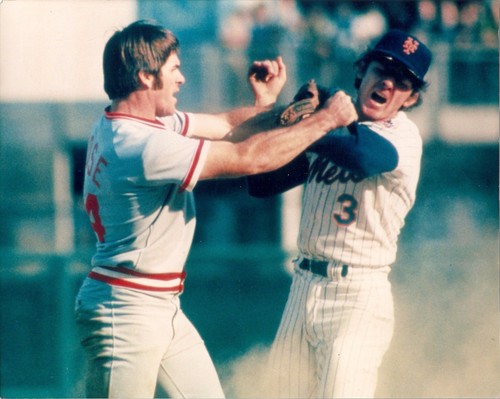
October 8, 1973: Pete Rose vs. Bud Harrelson

October 8, 1973: A year to the day after the Lerrin LaGrow-Bert Campaneris incident, there's another Playoff brawl, this time in the National League Championship Series.

The New York Mets beat the Cincinnati Reds, 9-2 in Game 3 at Shea Stadium, in a game that should have been remembered for Rusty Staub hitting home runs in the 1st and 2nd innings.

Instead, it is remembered for 5-foot-11, 200-pound Pete Rose breaking up a double play by crashing into 5-foot-11, 140-pound Bud Harrelson, and then starting a fight with the much thinner man.

With the fight broken up, Rose returns to his position in left field, where Met fans (understandably angry, but they were hardly justified in their actions) start throwing things at him. Reds manager Sparky Anderson takes his team off the field, fearing for their safety.

The umpires get a message to Loren Matthews, the Shea public address announcer, who announces that if the throwing doesn't stop, the game will be forfeited. Remember, the series is tied 1-1 and the Mets, barring a total (or even, dare I say it, Metlike) collapse, have this game won, and need only 1 more win for the Pennant. Lose it, even by forfeit, and it will be the Reds who are just 1 game from the Pennant.

Desperate, Met manager Yogi Berra takes Tom Seaver and Willie Mays out there, and the 3 of them plead for peace. Listening to the 3 New York baseball legends, the fans stop, and the Mets finish off the win.

The next day, with a banner hanging from Shea's upper deck reading, "A ROSE BY ANY OTHER NAME STILL STINKS" -- I guess they weren't willing to say "Sucks" in public in 1973 -- Rose will make his point by winning the game and tying up the series with an extra-inning home run. But the Mets will win Game 5 and the Pennant.

*

October 8, 1973 was a Monday. The American League Championship Series was on a travel day, with the Oakland Athletics and the Baltimore Orioles tied at 1 game apiece. The A's would beat the O's in 5 games, and then beat the Mets in the World Series.

The NBA season started the next day; the NHL and American Basketball Association seasons, the day after that. The World Hockey Association season had already begun, but it scheduled no games for this date.

And on ABC Monday Night Football, the Washington Redskins beat the Dallas Cowboys, 14-7 at Robert F. Kennedy Memorial Stadium.

If you've watched the superhero film X-Men: Days of Future Passed, you saw the villain Magneto (played as a younger man by Michael Fassbinder) rip RFK Stadium off its foundation in 1973, and move its circular form around the White House to block it off. As he begins this, the field is being lined for a baseball game. This means that, in the Marvel Cinematic Universe, the Washington Senators did not move to become the Texas Rangers after the 1971 season; or D.C. got yet another new team to replace the "New Senators" after the "Old Senators" became the Minnesota Twins after the 1960 season.

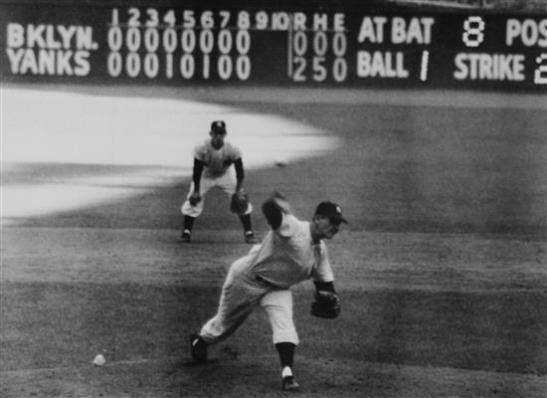
October 8, 1956: Don Larsen's Perfect Game

October 8, 1956: Game 5 of the World Series is played at the original Yankee Stadium in The Bronx. The previous year, the Brooklyn Dodgers had beaten the New York Yankees in the Series. They had previously been 0-7 in World Series, including 0-5 against the Yankees.

This time, the Dodgers had won Games 1 and 2 at Ebbets Field in Brooklyn. This included the Game 2 start of the Yankees' Don Larsen, who didn't get out of the 2nd inning, but also didn't end up as the losing pitcher, since the Yankees came back to retake the lead, and then lost it again. The Yankees took Games 3 and 4 at Yankee Stadium.

For Game 5, Yankee manager Casey Stengel took a chance on Larsen, who'd had only 3 days rest (in those days, when it was an All-New York "Subway Series," there were no travel days), but had pitched less than 2 full innings. He also had a "no-windup delivery," which was easier on his arm.

A 27-year-old righthanded pitcher born in Michigan City, Indiana, who grew up in San Diego, Donald James Larsen was unremarkable for most of his career. Indeed, like the only man ever to pitch back-to-back no-hitters, Johnny Vander Meer of the 1938 Cincinnati Reds, he had a losing won-lost record for his career: 81-91. Much of that was due to his 3-21 performance for the 1954 Baltimore Orioles, although he did go 11-5 for the Yankees in the 1956 regular season.

Starting for the Dodgers was Sal Maglie, the former ace of the New York Giants and one of the most hated opponents in Brooklyn history, but who had come to the Dodgers in midseason and pitched a no-hitter of his own -- something he hadn't done for the Giants. It is still the last no-hitter pitched by a player for a National League team in New York -- unless you believe that Carlos Beltran’s line drive really was foul, thus giving Johan Santana a no-hitter for the Mets in 2012.

Maglie was a proven veteran, Larsen a journeyman. And Game 6 would be at Ebbets Field. If necessary, so would Game 7.

It wasn't looking good for the Bronx Bombers.

Here was the Dodgers' starting lineup:

2B 19 Jim "Junior" Gilliam
SS 1 Harold "Pee Wee" Reese
CF 4 Edwin "Duke" Snider
3B 42 Jackie Robinson
1B 14 Gil Hodges
LF 15 Edmundo "Sandy" Amoros
RF 6 Carl "The Reading Rifle" Furillo
C 39 Roy Campanella
P 35 Sal "The Barber" Maglie

Granted, Walter Alston was the manager of the defending World Champions, but what was he thinking? Robinson, an ideal leadoff man but not with much home run power, batting 4th? Furillo, a former batting champion, 7th? Campy, a terrific power hitter, 8th?!?

And for the Yankees:

RF 9 Hank Bauer
1B 15 Joe Collins
CF 7 Mickey Mantle
C 8 Lawrence "Yogi" Berra
LF 17 Enos Slaughter
2B 1 Billy Martin
SS 12 Gil McDougald
3B 6 Andy Carey
P 18 Don Larsen

The umpires were:

* At home plate, Ralph "Babe" Pinelli, a former 3rd baseman for the Cincinnati Reds, who was calling his last games before retiring after 22 seasons as a National League umpire.

* At 1st base, an American League ump who had been a two-way back for the football New York Giants, appearing in 5 NFL Championship Games, winning in 1938.

* At 2nd base, Lynton "Dusty" Boggess, an NL ump and a former St. Louis Cardinal farmhand.

* At 3rd base, an AL ump, a Brooklyn native, and a former minor league catcher, who would be the 1st base umpire for Catfish Hunter's perfect game in 1968.

* In left field, Tom Gorman, a Manhattan native who pitched 4 games for the Giants in 1939 before becoming an NL ump.

* And, in right field, Ed Runge, an AL ump whose son Paul and grandson Brian also became major league umps. 

At 1:02 PM, Eastern Time, Pinelli yelled, "Play ball!" and a crowd of 64,519 was ready to go. Larsen began the game by striking Gilliam out. He got to 3 balls on Reese, but struck him out. He would not get to 3 balls on another batter that day. He got Snider to line out to right. In the Yankee half of the 1st, Bauer popped to short, Collins was unable to beat out a bunt to 3rd, and Mantle flew to left.

The closest call came leading off the top of the 2nd inning, when Robinson hit a sharp grounder off Carey's glove. McDougald, who moved from 3rd to short in the Yankee lineup after Phil Rizzuto was released a few weeks earlier, took it, and just barely threw Robinson out. Larsen then struck Hodges out, and got Amoros to pop to 2nd. For the Yankees, Berra popped to short, Slaughter flew to left, and Martin struck out.

In the 3rd, Larsen got Furillo to fly to right, struck Campanella out, and got Maglie to line out to Mantle. McDougald grounded to 3rd, Carey popped up behind the plate where the ball was caught by Campanella, and Larsen did the same.

In the top of the 4th, Larsen got Gilliam to ground to 2nd, got Reese to do the same, and struck Snider out. Maglie, whom Dodger fans despised when he was the headhunting ace of their arch-rivals, actually had a perfect game going himself going into the bottom of the 4th. He got Bauer to ground to 2nd, and struck Collins out. But Mickey Mantle broke it up with a home run into the right field seats. It wasn't one of Mantle's famed towering drives, but it wasn't a "short porch" home run, either: It would have been a home run in just about any ballpark. Maglie then got Berra to line to center, but it was 1-0 Yankees.

In the 5th, Robinson hit a long fly to right, but Bauer caught it. Hodges came up, and drove the ball to Yankee Stadium's famed left-center "Death Valley." Mantle made a running, onehanded, backhanded catch. It was about 420 feet from home plate, and was nearly as remarkable as the 440-foot catch Willie Mays had made 2 World Series earlier. Perhaps even more so, since, unlike Willie, Mickey wasn't known as a spectacular fielder (though that may have been because so much fuss was made about his hitting). Larsen got Amoros to ground to 2nd.

Slaughter led off the bottom of the 5th with a walk. Martin tried to bunt him over, but the Dodgers got the lead run. And then McDougald hit a line shot at Reese, who caught it, and threw over to Hodges to double Martin off. End of 5, Yankees 1, Dodgers 0.

Larsen got Furillo to pop up to 2nd, then got Campanella to do the same, and struck Maglie out. With 6 innings gone, people began to talk about the fact that a no-hitter was in progress. But old superstitions die hard. No one wanted to say the word "no-hitter" for fear of jinxing it.

After all, none had ever been itched in the World Series before. The Yankees' Herb Pennock came within 4 outs of a perfect game in 1927. In 1947, the Yankees' Bill Bevens needed 1 more out against the Dodgers, but he had walked 10 batters, and Cookie Lavagetto cost him the game with a 2-RBI double. That was only 9 years earlier, and 1 Yankee from that game was in this one: Berra.

When Larsen sat down in the dugout, everybody near him got up and moved to the other end of the dugout. After the 7th, he purposely sat down next to Mantle, and said, "Hey, Mickey, can you believe I got a no-hitter going?" Mickey jumped up, and said, "Get away from me!"

Equally nervous was Berra, who said, many years later, "I think I woulda thought more about it if we had a 9-0 lead: 'Ooh, he's got a no-hitter goin'.' But, at 2-0, I was just worried about winning the game."

Yogi was right to worry. Snider was that season's NL home run leader and the previous season's RBI leader, and would end up with 407 career home runs. At the time, comparing him to Mantle and Willie Mays among New York's center fielders was no joke. Hodges would end his career with 370 home runs. Campanella had won 3 NL Most Valuable Player awards, and had been the NL RBI leader in 1953. That same year, Furillo had been batting champion. Robinson was batting champion and MVP in 1949. These were dangerous hitters, as Larsen had found out firsthand in Game 2.

Carey led off the bottom of the 6th with a single. Larsen sacrificed him to 2nd. Bauer singled him home. Collins singled, but Mantle grounded into a double play. End of 6: Yankees 2, Dodgers 0.

Top of the 7th: Larsen got Gilliam to ground to short, Reese to fly to center, and Snider to fly to left. Bottom of the 7th: Berra popped to 3rd, Slaughter flew to left, Martin singled to left, McDougald walked, and Carey grounded to short for a force play.

Top of the 8th: Robinson grounded back to Larsen. Hodges lined out to Carey. Amoros flew to center. Bottom of the 8th: Maglie was still pitching strong, and struck out the side: Larsen, Bauer and Collins.

Top of the 9th. A huge audience was watching Mel Allen call the game on NBC-TV, and listening to Bob Wolff on CBS radio. There had never been a no-hitter pitched in 53 years of World Series play. And the term "perfect game" wasn't widely known, either: It had been done by such luminaries as John Montgomery Ward, Cy Young and Addie Joss, but hadn't been done by anyone since another journeyman, Charlie Robertson, did it for the Chicago White Sox in 1922.

Furillo led off, and hit a long drive to right, barely going foul. He flew to right again, but, this time, it was a comparatively easy catch for Bauer. Campanella grounded to 2nd. Just 1 out to go.

Alston sent Dale Mitchell up to pinch-hit for Maglie. As a Cleveland Indian, Mitchell had been in the opposing dugout for Mays' catch, but had always hit well against the Yankees. He was a .312 lifetime hitter, a 2-time All-Star, and a member of the Indians' 1948 World Champions. This would, however, turn out to be the last career at-bat for the 35-year-old lefty-hitting left fielder from Colony, Oklahoma.

Larsen threw a pitch that Pinelli called a ball. Then he threw a pitch that Pinelli called a strike.

Wolff: "I guarantee you that nobody, but nobody, has left this ballpark. And if somebody did, by chance, manage to leave early, man, he is missing the greatest! Here comes the pitch: A swing and a miss, strike 2!"

It was 3:08 PM. The count was 1-and-2. Larsen threw his 97th pitch of the afternoon. It snuck over the outside corner. Mitchell took the pitch. He died in 1987, still insisting that the pitch was a ball. Well, even if Pinelli had called it as such, the count would have been 2-and-2, and not to Mitchell's advantage.

But Pinelli called, "Strike three!" Ballgame over. Shutout over. No-hitter over. Perfect game over. Yankees win.

Wolff's call: "Two strikes, ball one, here's the pitch: Strike three! A no-hitter, a perfect game for Don Larsen! Yogi Berra leaps on Larsen!"
Two years later, Wolff would be behind the mike at Yankee Stadium again, calling the 1958 NFL Championship Game, in which the Baltimore Colts beat the football version of the New York Giants in overtime, the so-called "Greatest Game Ever Played."

It remains the greatest pitching performance in baseball history, and it was by an ordinary pitcher who was usually so unserious, his teammates called him Gooney Bird. But he had done what no other pitcher -- not Christy Mathewson, not Walter or Randy Johnson, not Lefty Grove, not Bob Feller, not Whitey Ford, not Sandy Koufax, not Bob Gibson, not Tom Seaver, not Steve Carlton, not Roger Clemens, not Greg Maddux -- has ever done: Pitch a no-hitter in the World Series. And he made it a perfect game. And he did it against the defending World Champions, with only a 2-0 lead, in what was really a must-win game.
The series shifted back to Ebbets Field. Bob Turley of the Yankees and Clem Labine of the Dodgers both went all 10 innings of Game 6, before a walkoff single by Jackie Robinson ensured a Game 7 for the Dodgers.

That Game 7 would prove calamitous for the Brooks, as Don Newcombe got shelled. Yogi hit 2 homers, Elston Howard added one, and Moose added another, a grand slam. Johnny Kucks pitched a 3-hit shutout, and the Yankees won, 9-0, avenging the previous year's defeat.

The last out was Jackie Robinson. Kucks struck him out, but Berra couldn't handle it. Perhaps remembering Game 4 of the 1941 World Series, where a similar play cost the Dodgers against the Yankees, Robinson ran to 1st. Unlike the ill-fated Mickey Owen in 1941, however, Yogi was able to throw Jackie out.

No one knew it at the time, but that was Jackie's last at-bat. He retired in the off-season. Also not known at the time: That Game 7 was the last World Series game the Brooklyn Dodgers ever played. After 1 more season, they moved to Los Angeles. At the same time, the Giants moved to San Francisco. There would not be another "Subway Series" until 2000, Yankees vs. Mets.

On May 17, 1998, David Wells pitched a perfect game for the Yankees. He went to the same high school as Larsen, Point Loma in San Diego. On July 18, 1999, the Yankees honored Yogi, and had him catch a ceremonial first ball from Larsen. Wells had been traded, so he wasn't there. David Cone pitched a perfect game as Larsen and Berra watched.
Yogi and Don, on an Old-Timers' Day

On September 21, 2008, the last game was played at the old Yankee Stadium. As part of pregame ceremonies, the 3 men who pitched perfect games there, and their catchers, assembled on the mound: Larsen and Berra, Wells and Jorge Posada, and Cone and Joe Girardi.
Left ot right: Girardi, Cone, Larsen, Berra, Wells, Posada

Larsen's gem is no longer the only no-hitter in postseason history -- Roy Halladay turned the trick for the Philadelphia Phillies in 2010 -- but it's still the only perfect game in postseason history, and still the only no-hitter in a game later than the Division Series. (UPDATE: Five Houston Astros pitchers combined to pitch a no-hitter against the Phillies in Game 4 of the 2022 World Series.)

In 1981, baseball historian John Thorn published Baseball's 10 Greatest Games. He included this game as one of them.

UPDATE: Among the Yankees' many traditions is Monument Park at Yankee Stadium. From the 1955-58 team that won 4 straight American League Pennants, including 2 World Series, they have honored center fielder Mickey Mantle with a Monument; and given Plaques to catcher Lawrence "Yogi" Berra, shortstop Phil Rizzuto (who became a broadcaster in 1957), pitcher Edward "Whitey" Ford, left fielder Elston Howard (who switched positions with Yogi in 1960), manager Charles "Casey" Stengel (who managed 1 more Pennant in 1960), public address announcer Bob Sheppard, and broadcaster Mel Allen.

Billy Martin played 2nd base until mid-1957, but that's not why he's in Monument Park, or why his uniform Number 1 is retired. The Yankees have retired the numbers 7 for Mantle, 8 for Berra, 10 for Rizzuto, 16 for Ford, 32 for Howard and 37 for Stengel. Although left fielder Enos Slaughter and general manager George Weiss are in the Baseball Hall of Fame, they are not honored in Monument Park. Neither are team owners Dan Topping and Del Webb, who are also not in the Hall of Fame.

*

October 8, 1956 was a Monday. It was the only baseball game on the day. Basketball and hockey seasons were about to start. And while it was football season, there was, as yet, no Monday Night Football. So the score that made this a historic day was the only score on this historic day.

Actress Stephanie Zimbalist was born, co-star with Pierce Brosnan on the 1980s NBC drama Remington Steele. She was the granddaughter of classical music conductor Efrem Zimbalist Sr. and the daughter of actor Efrem Zimbalist Jr.

Wednesday, October 5, 2022

October 5, 1953: Five Straight World Series Wins

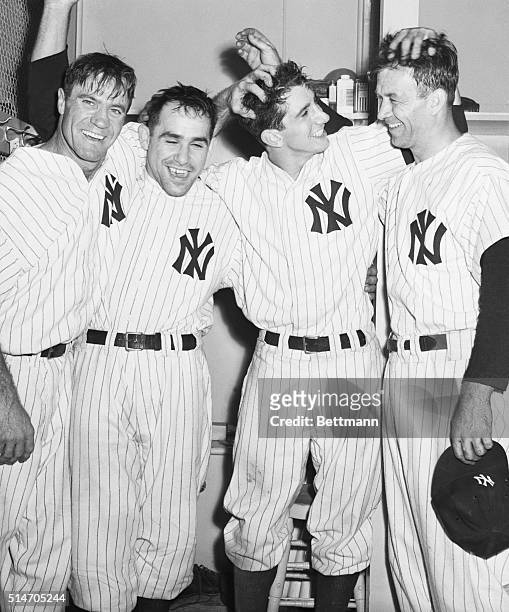
Left to right: Hank Bauer, Yogi Berra,
Billy Martin and Joe Collins

October 5, 1953: The New York Yankees beat the Brooklyn Dodgers, 4-3 at Yankee Stadium, to win Game 6 of the World Series, clinching it, 4 games to 2. This was the 5th straight World Championship for the Yankees. No other baseball team has ever done that.

The Yankees hired Charles Dillon "Casey" Stengel as their manager for the 1949 season, and he led them to the American League Pennant in each of the next 5 years. In 1949, they beat the Dodgers in the World Series in 5 games. In 1950, they swept the Philadelphia Phillies in 4 straight. In 1951, they beat the New York Giants in 6 games. That was Joe DiMaggio's last season, and Mickey Mantle's 1st season.

In 1952, it took them 7 games to finish the Dodgers off. That gave them 4 straight World Series wins, matching the Joe McCarthy-managed Yankees of 1936 to 1939.

In 1953, they faced the Dodgers again. It's important to note that, due to his U.S. Army commitments -- the Korean War was over by this point, but not everybody serving in it had been discharged yet -- the Dodgers did not have their best pitcher, Don Newcombe, for either the 1952 or the '53 Series. However, the Yankees had lost Whitey Ford to the war for the Series in '51 and '52. And the Giants had lost their best player, Willie Mays, for the '52 and '53 seasons, so if he was available, maybe they would have won those Pennants instead of the Dodgers.

The Dodgers were loaded. They won 105 games, which would remain a franchise record for 64 years. They finished 13 games ahead of the newly-moved Milwaukee Braves in the National League. They had 6 .300+ hitters, led by NL batting champion Carl Furillo at .344, and center fielder Edwin "Duke" Snider right behind at .336.

All 8 starting position players had at least 18 doubles, with Snider and Furillo each hitting 38. 2nd baseman Jim Gilliam led the NL with 17 triples. Snider hit 42 home runs, catcher Roy Campanella hit 41, and 1st baseman Gil Hodges hit 31. They had 5 players with at least 95 RBIs, with Campy leading the NL with 142, the Duke having 126, and Hodges 121. Campy was named NL Most Valuable Player.

They were superb defensively as well: Furillo also had the best right field arm in the game at the time, Snider was at least the equal with the glove in center as the Yankees' Mickey Mantle (if not of Mays), Hodges was the best-fielding 1st baseman in baseball, Billy Cox was the best-fielding 3rd baseman, Harold "Pee Wee" Reese was still the best shortstop in the NL; and Jackie Robinson, rotated between 2nd base, 3rd base and left field, played all of those positions well.

Their pitching was also strong, even without Newcombe available. Carl Erskine had the best curveball in the NL, going 20-6, leading the League with a .769 winning percentage. Russ Meyer, "The Mad Monk," was 15-5. Billy Loes was 14-8. Elwin "Preacher" Roe was 11-3. Rookie Johnny Podres was 9-4. Clem Labine, Joe Black and Jim Hughes made for a good bullpen.

But the Yankees were still the Yankees. They still had the best catcher in all of baseball, Lawrence "Yogi" Berra. Mantle, not yet 22 years old, had come into his own, launching some of the longest home runs anyone had ever seen: That season alone, he may have hit the longest ones ever seen at Griffith Stadium in Washington, Shibe Park/Connie Mack Stadium in Philadelphia, and Sportsman's Park/Busch Stadium in St. Louis. Left fielder Gene Woodling and right fielder Hank Bauer both batted over .300. Phil Rizzuto was still Reese's equal as a shortstop. Gil McDougald had become an excellent 3rd baseman.

And Ford returned to a starting rotation that still had "The Big Three": Allie Reynolds, Eddie Lopat and Vic Raschi. Stengel's alternation from the speedy Reynolds to the junkballing Lopat, then to the speedy Raschi, then to the mix-it-up master Ford kept American League batters on their toes, and made it hard for them to get into a day-to-day rhythm. The Yankees won 99 games, finishing 8 1/2 ahead of the Cleveland Indians, whose 3rd baseman, Al Rosen, narrowly lost the batting title to cost himself the Triple Crown. He was named the AL's MVP.

Despite the Dodgers' firepower, the Yankees' experience, especially against the Dodgers, made them slight betting favorites. Dwight D. Eisenhower, a former West Point baseball and football player in his 1st year as President, admitted before Game 1 that, "It would be nice if someone besides the Yankees won for a change."

With 85-year-old Cy Young throwing out the ceremonial first ball to Berra to open the World Series -- Yogi said, "It was like watching a statue come to life" -- the Yankees won Game 1, 9-5 at Yankee Stadium in The Bronx. Yogi hit a home run, and Eisenhower, having watched the television broadcast of the game on NBC, said, "I received a terrific kick out of Yogi Berra's home run. That fellow really slammed it out of the park."

The Yankees won Game 2 at home, 4-2. The Series moved to Ebbets Field in Brooklyn, and the Dodgers won Game 3, 3-2, and Game 4, 7-3. In Game 4, Erskine struck out 14 batters, setting a new Series record that would last for 10 years. But in Game 5, Mantle hit a grand slam to give the Yankees an 11-7 win, and a 3-2 lead in the Series.

Game 6 was played at Yankee Stadium, in front of 62,730 fans, about the twice the seating capacity of Ebbets Field. Ford started for the Yankees, Erskine for the Dodgers. With one of the best curveballs in the game at the time, "Oisk," as the Dodger fans called him in their Brooklyn accent, gave the Flatbush Faithful -- also known as the Flastbush Flock -- hope that "Dem Bums" could push the Series to a Game 7.

But the Yankees struck quickly. Woodling led off with a walk. 1st baseman Joe Collins struck out, but Bauer singled, and Berra hit a ground-rule double to get Woodling home. Mantle was walked intentionally. 2nd baseman Billy Martin grounded to 2nd, and Gilliam bobbled the ball, allowing Bauer to score. For whatever reason, Dodger manager Charlie Dressen had put his usual 2nd baseman, Jackie Robinson, in left field.

The Yankees scored again in the 2nd, on a sacrifice fly by Woodling. The game remained 3-0 until the top of the 6th. With 1 out, Robinson doubled to left, and stole 3rd base. Campanella got him home on a groundout, to make it 3-1.

Stengel brought Reynolds in for the 8th inning, thinking he had the right mentality to close the game out. Perhaps the best starting pitcher on his 5 Pennant winners, Reynolds had a blazing fastball, and was willing to throw inside. He hit 57 batters during his career, but claimed he only hit 6 on purpose. The Dodgers accused him of targeting black players, but he seemed to brush white players back with the same frequency. He once plunked a batter on a 3-0 count, telling a reporter after the game, "If I'm going to put you on, I might as well hurt you." Partly because of his Cherokee heritage, and partly because his fastball seemed to bring up memories of a speeding train of that name, he was known as the Superchief.

Reynolds got through the 8th, giving up only a single to Robinson. But with 1 out in the 9th, he walked Snider, and then gave up a home run to Furillo. The game tied, Reynolds then struck out Cox and the opposing pitcher, Labine.

This was the last game played by Hall-of-Famer Johnny Mize: "The Big Cat," a 1st baseman, pinch-hit for Collins in the 8th, and grounded out to 1st. He was 40 years old and fat, so, despite also being a 1st baseman, he did not take the position in the 9th, Stengel instead sending Don Bollweg in to do so.

Cliché Alert: Walks can kill you, especially the leadoff variety. Labine walked Bauer to start the bottom of the 9th. He got Berra to fly to right. But Mantle beat out a single to 3rd. The batter was Martin. An ordinary player from April through September, he always seemed to turn it on for the World Series, turning a regular-season batting average of .257 to a World Series average of .333. In 28 World Series games, he hit 5 home runs and had 19 RBIs. Stretch that to a full 154-game season, as was standard at the time, and it would have been 28 homers and 105 RBIs. And a catch he made in Game 7 in 1952 may have saved the Series for the Yankees. Whatever else can be said about Billy -- as a player, as a manager, and as a person -- he was a clutch performer as a player.

At this point, 4 players had collected 12 hits in a single World Series: Charles "Buck" Herzog of the 1912 New York Giants, Shoeless Joe Jackson of the 1919 Chicago White Sox (in spite of the accusation that he helped "throw" the Series), Sam Rice of the 1925 Washington Senators, and Johnny "Pepper" Martin of the 1931 St. Louis Cardinals. Oddly, all but Pepper Martin -- no relation to Billy -- were on the losing side.

Billy Martin singled up the middle, for his 12th hit of the Series, and Bauer came around 3rd to score the winning run: Yankees 4, Dodgers 3. The Yankees had won their 5th straight World Series.

There were 11 players who played on all 5 of those Yankee World Champions: Phil Rizzuto, Yogi Berra, Johnny Mize, Gene Woodling, Hank Bauer, Jerry Coleman, Joe Collins, Allie Reynolds, Vic Raschi, Eddie Lopat, and, though he played just 156 games in those 5 seasons, and just 1 ever in the World Series, backup catcher Charlie Silvera. Coleman, however, was serving in the Korean War for most of the '52 and '53 seasons, and, though he returned for the end of the '53 season, was not placed on the Series roster. Collins was a rookie in '49, and was not on the Series roster.

Since then, 3 in a row has been done, but not 4, and certainly not 5. The Montréal Canadiens would soon start a streak of 5 straight Stanley Cups, but they were unable to make it 6. The Boston Celtics would later win 8 straight NBA Titles, but basketball didn't exactly get the best athletes then.

This was the last World Series, and the last Pennant in either League, won by an all-white team. The next season, the Yanks lost the American League Pennant to the well-integrated Cleveland Indians, and the argument of, "Why integrate? We're winning with what we've got" was no longer valid. Elston Howard became the 1st black man to play for the Yankees the following April, and the team went on to win 9 Pennants and 4 World Series in the next 10 years.

Art Schallock is the last surviving member of the 1953 World Champion New York Yankees. He is also the last surviving former teammate of Joe DiMaggio, although he was not on the World Series roster in either 1951 or 1952. As of October 5, 2022, he is the oldest living former player, age 98. (UPDATE: He lived to be 100, but died in 2025, shortly before he would have turned 101.)

There have now been 3 players with 13 hits in a single World Series: Bobby Richardson of the 1964 Yankees, Lou Brock of the 1968 Cardinals, and Marty Barrett of the 1986 Boston Red Sox -- and all 3 ended up on the losing side.

In 1972-74, the Oakland Athletics won 3 straight World Series. They remain the only team other than the Yankees ever to win more than 2 straight. The Yankees won 3 straight in 1996-98.

*

October 5, 1953 was a Monday. This was before Monday Night Football, so there were no football games. It was too early to start the new NBA and NHL seasons. So there were no other scores on this historic day.

Friday, September 30, 2022

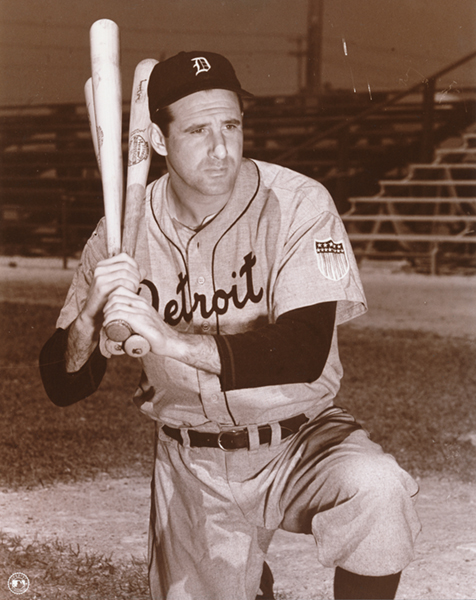
September 30, 1945: Lieutenant Hank Greenberg Clinches the Pennant

Swinging two bats in the on-deck circle
was a common sight before the Yankees' Elston Howard
invented the "bat donut" in the 1960s.
Hank Greenberg was one of the few players
who was strong enough to swing three bats.

September 30, 1945: Hank Greenberg, recently discharged from the U.S. Army, hits a grand slam off Nelson Potter in the top of the 9th inning, and gives the Detroit Tigers a 6-3 win over the St. Louis Browns at Sportsman's Park, clinching the American League Pennant, which the Browns had won the previous season, for the only time in their history. The Tigers go on to win the World Series over the Chicago Cubs in 7 games.
The 1st player to go into the service was Philadelphia Phillies pitcher Hugh Mulcahy, drafted on March 8, 1941, and he served for the duration of The War. As my grandmother taught me, she and everyone else who lived through it, even if they never left "the home front," always called it "The War," Capital T, Capital W. 
Greenberg had been the 1st major baseball star to volunteer for the U.S. armed forces in preparation for World War II, inducted into the Army on May 7, 1941. So it was only natural that he was the 1st player to return, discharged on June 14, 1945, with Nazi Germany having surrendered, but not, as yet, Imperial Japan. He had scouted bombing targets for B-29 bombers in the China/India/Burma Theater of Operations, and was discharged with the rank of 1st Lieutenant.
Already known as Hammerin' Hank before Henry Aaron was even born, he had lost his seasons of age 31, 32 and 33, and the 1st half of his age 34 season. He finished his career with a lifetime batting average of .313 and 331 home runs. He should have had at least 150 more home runs. He never regretted it, saying, "My country comes first."
Nor did Chief Petty Officer Bob Feller, U.S. Navy, who lost his seasons of ages 23, 24, 25 and most of 26. He won 266 games and struck out 2,581 batters, all for the Cleveland Indians. Based on his 1941 and 1946 performances, he should have had at least another 90 wins and 1,000 strikeouts, which could have made him the all-time strikeout leader, and, with another 98 wins, the pitcher with the most in the post-1920 Lively Ball Era.
He knew The War was more important. He also knew that people like Ty Cobb and Ohio State football coach Woody Hayes, who compared sports to war, were blowhards, saying, "Anybody who says sports is war has never been in a war."
Warren Spahn had appeared in 4 games before going into the service, and was the winning pitcher in exactly none of them. By the time he rejoined the Boston Braves, 1st Lieutenant Warren Spahn, U.S. Army, had missed his age 22, 23 and 24 seasons, and had gotten frostbite in the Battle of the Bulge and been wounded at the Remagen Bridge.
But his wartime experience may have matured him. From age 25 to 44, he did become the Lively Ball Era's winningest pitcher, and the winningest lefthanded pitcher regardless of era, with 363. So maybe his stats didn't suffer.
The stats of Sergeant Joe DiMaggio, U.S. Army Air Force, did suffer, as he lost his age 28, 29 and 30 seasons. He finished with a .325 batting average, and 2,214 hits including 361 home runs. He should have had at least another 550 hits and another 75 home runs.
And then there was Ted Williams, who served as a flight instructor in World War II and a fighter pilot in the Korean War. By the time he left the service for the last time in 1953, Captain Theodore S. Williams, U.S. Marine Corps, had damaged hearing, and had lost his seasons of age 24, 25 and 26, and most of those of age 33 and 34.
He batted .344 for his career, with 2,654 hits and 521 home runs. It shouldn't surprise people who know a little about baseball history that Ted reached 500 homers, only the 4th to do so after Babe Ruth, Jimmie Foxx and Mel Ott. But it is surprising that the man often called "The Greatest Hitter Who Ever Lived" didn't even get close to 3,000 hits. (He also never got 200 hits in a season.) By missing 4 1/2 prime seasons, he may have missed out on as many as 600 hits and 200 home runs, which would have put him past the 714 of Ruth, the record before Aaron reached 755.
In contrast, Ruth only missed 1 month due to World War I, September 1918, and that was because everybody missed at least that much, since the season was cut short. And Aaron was never drafted. Mickey Mantle was classified 4-F, medically unfit for service.
Willie Mays did serve in the Korean War, missing most of his age 21 season and all of his 22, probably costing him around 350 hits on top of his 3,293, and at least 50 homers on top of his 660, meaning he might have gotten to 715 before Aaron did. Yankee pitcher Whitey Ford (1951 and '52) and Brooklyn Dodger pitcher Don Newcome (1952 and '53) also missed 2 seasons serving in Korea.)
Seaman 1st Class Stan Musial, U.S. Navy, the best hitter in the National League while Ted was the best in the American League, only missed 1945, his age 24 season, due to World War II. He had 3,630 hits and 475 home runs, so he may have missed 200 hits and maybe the 25 homers that would have put him over 500.
One man was a veteran of both D-Day and Major League Baseball. In his case, he was just 19 when he was in a U.S. Navy ship off the coast of Normandy, and his service probably didn't delay his entry into the major leagues by much. He may have been the calmest man in the battle, later saying that the exploding shells looked like fireworks. He was Seaman 2nd Class Lawrence Peter Berra. Yogi.
Yankee shortstop and Seaman 1st Class Phil Rizzuto missed his age 25, 26 and 27 seasons due to those huckleberries Hitler and Tojo. His Dodger counterpart, Chief Petty Officer Harold "Pee Wee" Reese, missed his age 24, 25 and 26 seasons. And Army 1st Lieutenant Jack Roosevelt Robinson missed his age 24, 25 and 26 seasons in the Army. Of course, at that point, he had no idea that he would ever play professional baseball in any capacity, much less the one that would make him the most important player of all time.
UPDATE: Bobby Shantz, who turned 100 on September 26, 2025, became the last remaining veteran of both World War II and Major League Baseball. 
*
September 30, 1945 was a Sunday. These other baseball games were played that day:
* The New York Yankees beat the Boston Red Sox, 12-2 at Yankee Stadium. Tuck Stainback and Charlie Keller hit home runs. Keller had also recently returned, from the U.S. Merchant Marine. Joe Page, who would go on to be much better known as a reliever, started and went the distance for the win.
* The New York Giants beat the Boston Braves, 1-0 at Braves Field in Boston, in the 1st game of a doubleheader. Napoleon "Nap" Reyes, a 3rd baseman, light-skinned enough to be allowed to play even though he was Hispanic, and from Cuba so he wouldn't be drafted to fight in The War, hit a home run in the top of the 13th inning. Don Fisher pitched all 13 innings for the shutout. The nightcap was tied 2-2 after 7 innings, when Massachusetts' 7:00 PM curfew for Sunday sports kicked in and stopped the game.
* The Brooklyn Dodgers beat the Philadelphia Phillies, 4-1 at Shibe Park in Philadelphia.
* The Chicago Cubs beat the Pittsburgh Pirates, 5-3 at Forbes Field in Pittsburgh.
* The St. Louis Cardinals beat the Cincinnati Reds, 3-2 at Crosley Field. Del Rice won the game with a home run in the top of the 12th inning.
* The Washington Senators completed their 154-game schedule, but played their 154th game on September 23, a week before the regular season was supposed to end. Wartime travel restrictions, and the desire to get Griffith Stadium ready for the NFL's Washington Redskins, led to the Senators' condensed schedule. As a result, when their season ended, the Senators were 1 game behind the Tigers for the AL Pennant; but when the season finally ended, the Tigers were a game and a half ahead.
* The Chicago White Sox played their 149th game on September 25, and never played their last 5 games. The Philadelphia Athletics played their 150th game on September 27, and never played their last 4. The Cleveland Indians played their 145th game on September 28, and never played their last 9. Most likely, these were also due to wartime travel restrictions, even though The War had ended with the Japanese' official surrender on September 2 (following their unofficial surrender on August 14, which is recognized as V-J Day).
There were 2 NFL games played that day. The Green Bay Packers beat their arch-rivals, the Chicago Bears, 31-21 at Green Bay City Stadium. And the Cleveland Rams beat the Chicago Cardinals, 21-0 at League Park in Cleveland.
And Ehud Olmert, who served as Prime Minister of Israel from 2006 to 2009, was born on this day.

Wednesday, September 28, 2022

September 28, 1955: Jackie Robinson Steals Home Plate In the World Series

September 28, 1955: Game 1 of the World Series, at the original Yankee Stadium. Yes, a World Series game was played on a September 28. This was also the 1st World Series game broadcast in color, on NBC, although hardly anyone has a color TV set at this point. No TV recording of it, in color or otherwise, is known to survive. (All World Series from the 1st telecast of one in 1947 were on NBC, until 1975.)
There is film footage, though. That footage shows Jackie Robinson of the Brooklyn Dodgers stealing home plate against the New York Yankees. Home plate umpire Bill Summers rules him safe. Yankee catcher Yogi Berra says Jackie was out, and has a fit.
To the end of his life, Yogi insisted that he wouldn't have argued that strenuously if he wasn't sure, or if Jackie was definitely safe. Monte Irvin of the New York Giants stole home on Yogi in the 1951 World Series, and Yogi did not argue that time.
Whitey Ford was pitching, and he insisted to the end of his life that Jackie was out. But Phil Rizzuto claimed that Jackie was safe, and he said he knew, because he was playing shortstop, and had the best view of the play.
Whitey didn't like that, so he looked it up. The steal was in the top of the 8th inning -- and in the bottom of the 6th, manager Casey Stengel had pinch-hit Eddie Robinson (white, and thus not related to Jackie) for Rizzuto! In the top of the 7th, a new shortstop took the field: Jerry Coleman (normally a 2nd baseman). Coleman was playing short when Jackie stole home. Oops on the Scooter.
So who was right? Judge for yourself. Here's the film. It's hard to tell from there. But the photo shown above makes it obvious: He was out! See: Yogi's mitt was between Jackie's foot and the plate.
And if the Yankees had lost the game, and the World Series, because of this, there would have been an uproar -- or, as the Dodgers' legendary broadcaster, ironically now with the Yankees, Red Barber, would have put it, a rhubarb.
But the Yankees did not lose the Series, or even the game, because of the steal. Indeed, the Yankees won the game, 6-5. Left fielder (and backup catcher) Elston Howard, the 1st black player for the Yankees and a "rookie" at age 30, hit a home run off Don Newcombe in the 2nd inning, while 1st baseman Joe Collins hit 2 homers off Big Newk. Carl Furillo and Duke Snider hit home runs off Ford.
Like Carlton Fisk's home run in Game 6, 20 years later, Robinson's steal of home was a spectacular moment, but, ultimately, it had no effect on the result of the Series.
Still, stealing home plate became Jackie Robinson's signature, along with his grace under more pressure than any American athlete has ever faced. He stole home plate 19 times in the regular season, plus this 1 time in the World Series -- still the last steal of home in a World Series game. (One of the many records that Ty Cobb set, and one that he still holds, is the most steals of home in a career: 54.) It even became a point of reference in Buddy Johnson's 1949 song about Jackie, with the Count Basie Orchestra having made the best-known recording:
Did you see Jackie Robinson hit that ball?
Did he hit it?
Yeah!
And that ain't all:
He stole home!
Yes, yes, Jackie's real gone.
"Gone" meaning "cool." Not as in "has left the vicinity" or "gone in the head." No player ever kept his head -- or had to -- as much as Jack Roosevelt Robinson of Pasadena, California (and Stamford, Connecticut).
Eddie Robinson was the last surviving player from this game, living until 2021.
This Series was a classic, and it went to 7 games. In the end, as would be said in the Brooklynese accent, the Dodgers finally dooed it. After World Series losses in 1916, 1920, 1941, 1947, 1949, 1952 and 1953 (the last 5 of those 7 against the Yankees), losses in Playoffs for the National League Pennant in 1946 and 1951 (the latter against the hated New York Giants), losing the Pennant on the final day of the regular season in 1942 and 1950, and finishing 2nd to the Giants in 1954 -- 10 close calls in a span of 14 years -- 1955 turned out to be the "Next Year" that Dodger fans from Williamsburg to Coney Island, from Morristown to Montauk, from Poughkeepsie to Point Pleasant, had waited for.
*
September 28, 1955 was a Wednesday. Football was in midweek, and it was too early for the 1955-56 NBA and NHL seasons to start. So this was the only score on this historic day. 

September 28, 1951: A No-Hitter and a Clincher for the Yankees

September 28, 1951: A sweep of a doubleheader with the Boston Red Sox at Yankee Stadium means that the New York Yankees will clinch the American League Pennant. They win the 1st game 8-0, as Allie Reynolds pitches his 2nd no-hitter of his career -- and his 2nd of the season, having blanked the Cleveland Indians on July 12. He is backed by home runs by Joe Collins and Gene Woodling.

The part-Cherokee fireballer known as the Superchief was the 1st AL pitcher to throw 2 no-hitters in a season. The only other major league pitchers to do it, through 2021: Johnny Vander Meer of the 1938 Cincinnati Reds (the only back-to-back no-hitters in MLB history), Virgil Trucks of the 1952 Detroit Tigers (one of them against the Yankees), Roy Halladay of the 2010 Philadelphia Phillies (one a perfect game, the other in the Playoffs), and Max Scherzer of the 2015 Washington Nationals.

The last out Allie needed for the 2nd no-hitter was Ted Williams, often called "the greatest hitter who ever lived." Allie got the Splendid Splinter to pop up in foul territory, but catcher Yogi Berra dropped it. Yogi goes to the mound to apologize, but Allie says, "Don't worry, Yogi, we'll get him again." He was right: He induced another pop-up, but Yogi caught this one.

The nightcap was not as spectacular, but no less effective: A Pennant-clinching 11-3 win. Vic Raschi was the winning pitcher, backed by a home run by Joe DiMaggio, the 361st of his career -- and, as it turned out, his last in regular-season play. He would hit 1 more in the upcoming World Series, and then retire.

Other Major League Baseball games played on this Friday:

* The Philadelphia Phillies beat the Brooklyn Dodgers, 4-3 at Shibe Park in Philadelphia. With the New York Giants not scheduled, this drops the Dodgers, who had been 13 1/2 games ahead of the Giants on August 11, into a tie for 1st place in the National League. The season will end with them tied, forcing a Playoff. And if you don't know how that turned out, you're too young to know baseball history, and/or you're too ignorant to be reading this blog.

* The Cincinnati Reds beat the Pittsburgh Pirates, 4-3 at Forbes Field in Pittsburgh.

* And the Chicago White Sox swept a doubleheader from the St. Louis Browns at Sportsman's Park in St. Louis. The Pale Hose won the opener, 6-2; and the nightcap, 4-3 in 10 innings.

There was also an NFL game played on this day. The Los Angeles Rams beat the football team named the New York Yanks, 54-14 at the Los Angeles Memorial Coliseum. Rams quarterback Norm Van Brocklin passed for 554 yards. To this day, it is an NFL record. And the achievement is worthy of its own entry, which I have written. 

Saturday, August 20, 2022

August 20, 1964: The Harmonica Incident

Phil Linz (left) and Yogi Berra. Winning solves everything.
At least for a while.

August 20, 1964: An incident on the New York Yankees' team bus wakes the team up, and leads to a Pennant.

In 1959, catcher Yogi Berra and left fielder Elston Howard had their positions switched by manager Casey Stengel. Talking about how the Sun combined with the old Stadium's roof, making it difficult to see a fly ball from left field, Yogi said, "It gets late early out there."

He was still a key figure on Pennant-winning teams. But after the 1963 season, Yogi was 38 and clearly slowing down. And, with Ralph Houk, his former backup catcher, being moved up from field manager to general manager, Yogi was offered the job of managing the Yankees for the 1964 season.

There were those who thought that Yogi was too much of a softie to manage, especially players he'd played with. On August 20, the Yankees lost to the Chicago White Sox, 5-0 at Comiskey Park in Chicago. John Buzhardt went the distance for the ChiSox, while Whitey Ford got knocked out of the box in the 4th inning.

Former Yankee Bill "Moose" Skowron went 3-for-4 with an RBI for the ChiSox. The Yankees only got 7 hits, all singles: 3 by shortstop Tony Kubek, 2 by right fielder Roger Maris, 1 by Howard, and 1 by backup catcher Johnny Blanchard, who started in left field on this day. Usual center fielder Mickey Mantle was once again battling an injury, and did not play.

The loss completed a 4-game sweep by the Pale Hose over the Bronx Bombers, and left them 4 1/2 games behind Chicago with 23 to go. The Baltimore Orioles were just half a game behind the White Sox.

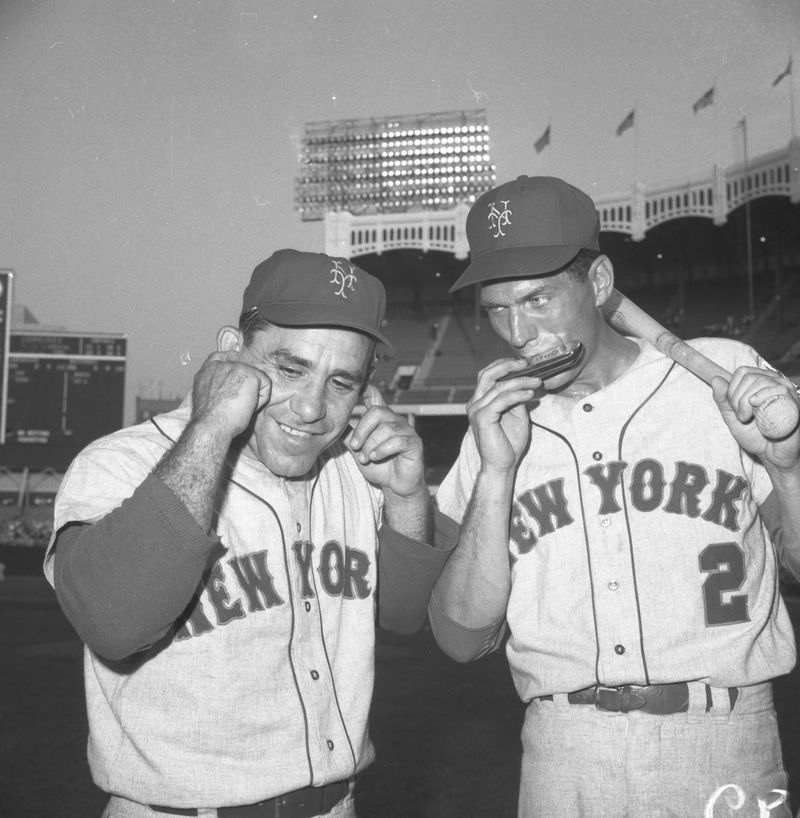
The tension on the team bus to O'Hare International Airport was so thick, it could have been cut with a knife. Reserve infielder Phil Linz pulled out a harmonica he'd begun learning how to play, and began to play "Mary Had a Little Lamb," the traditional song for anyone learning how to play an instrument to start with.

Yogi, sitting at the head of the bus, heard it, and yelled back, "Whoever's playing that thing, shove it up your ass!" (Yogi was old-school even by the standards of the Sixties, but he was no prude when it came to language.) Linz didn't hear what he said, and asked Mantle what it was. Being a wisenheimer, Mickey said, "He said, 'Play it louder.'" So Linz did.

Yogi wasn't having it. He got up, walked down the aisle of the bus, saw Linz, and said, "I thought I told you to shove that thing up your ass." Linz said, "If you want it shoved up my ass, why don't you shove it there?" He flipped the instrument to Yogi... who slapped it down.

There are 2 versions of what happened next. One is that everyone saw that Yogi could mean business, and that the respect for him as a manager suddenly grew by leaps and bounds. That's the version that Yankee management, in the years since, would have fans believe.

The other version, which is more believable, is included in Peter Golenbock's book Dynasty, and has been backed up by the surviving '64 Yanks, all of whom said that respect for Yogi was never an issue. This version says that the slapped-down harmonica bounced off 1st baseman Joe Pepitone's leg. Pepi then fell into the aisle in mock agony, rolling around on the floor of the bus like a Spanish soccer player (with the bad hair to match). Everyone cracked up -- and loosened up.

With respect for Yogi restored, or the tension shattered, whichever is true, the Yankees went on a tear. They flew to Boston and lost 2 more, then won 28 of their last 39, including an 11-game winning streak from September 16 to 26, and won the Pennant, winning 99 games, beating the White Sox by 1 game and the O's by 2. Yogi had won his 1st Pennant as a manager, and he wasn't even 40.

But they lost the World Series -- ironically, to Yogi's boyhood team, the St. Louis Cardinals. This was in spite of Linz, substituting for an injured Kubek, playing in all 7 games, and hitting home runs in Games 2 and 7, both off Bob Gibson. Yankee management fired Yogi, anyway, which they were determined to do even if he won the Series. If he was upset, he never let on: When people would ask him about it, he'd just say, "That's baseball."

At least they told him to his face. That would not be the case the 2nd time he was fired as Yankee manager.

With Stengel now managing the Mets, he hired Yogi was one of his coaches, and Yogi even played a few more games. In 1966, with Stengel having retired and Wes Westrum having been hired as Mets manager, the Yankees traded Linz to the Philadelphia Phillies. In 1967, the Phils traded Linz to the Mets, reuniting him with Berra.
Linz's playing career ended after the 1968 season, and he ran a restaurant in Manhattan, before retiring to Leesburg, Virginia. He died in 2020. (Not from COVID.)

Berra was on the coaching staff of Gil Hodges as the Mets won the 1969 World Series. In 1972, Hodges died at the end of Spring Training, and Yogi was named manager, winning the National League Pennant in 1973. He was fired in 1975, and brought back to the Yankees as a coach.

He was named manager for the 1984 season, but was fired early in 1985. Team owner George Steinbrenner, instead of telling Yogi face-to-face, sent a team official to do it. Furious over this lack of courtesy, not over the firing itself, Yogi said he would never set foot in Yankee Stadium again as long as Steinbrenner owned the team. He kept that promise for 14 years, until peace between them was negotiated, including a face-to-face apology from George to Yogi. Yogi was brought back into the Yankee fold, and remained there until his death in 2015.
 
*

August 20, 1964 was a Thursday. These other baseball games were played that day:

* The Boston Red Sox beat the Baltimore Orioles, 4-3 at Fenway Park in Boston. Carl Yastrzemski went 2-for-4. Brooks Robinson went 0-for-4.

* The Philadelphia Phillies swept a doubleheader from the Pittsburgh Pirates, 2-0 and 3-2 at Connie Mack Stadium in Philadelphia. Art Mahaffey pitched a 2-hit shutout in the opener, allowing a single each to both of the Bucs' eventual Hall-of-Famers, Roberto Clemente and Bill Mazeroski. Frank Thomas -- not the later White Sox slugger -- won it with a home run off Bob Friend in the bottom of the 9th. Clemente and Willie Stargell each got 2 hits in the nightcap, but a home run by Johnny Callison helped give the Phils the win.

* The Kansas City Athletics beat the Cleveland Indians, 7-4 at Cleveland Municipal Stadium.

* The Los Angeles Angels beat the Detroit Tigers, 4-3 at Tiger Stadium in Detroit. Al Kaline went 1-for-4 with a walk.

* The Milwaukee Braves beat the Los Angeles Dodgers, 8-2 at Dodger Stadium in Los Angeles. Hank Aaron went 4-for-5, although none of his hits was a home run.

* The Cincinnati Reds beat the San Francisco Giants, 10-7 at Candlestick Park in San Francisco.

* And the New York Mets, the Chicago Cubs, the Houston Colt .45s, the St. Louis Cardinals, the Washington Senators and the Minnesota Twins were not scheduled.

December 31, 1999 & January 1, 2000: The Millennium

December 31, 1999:  The Millennium arrives. The people of planet Earth survived. At a terrible cost. But we hadn't destroyed ourselves. ...