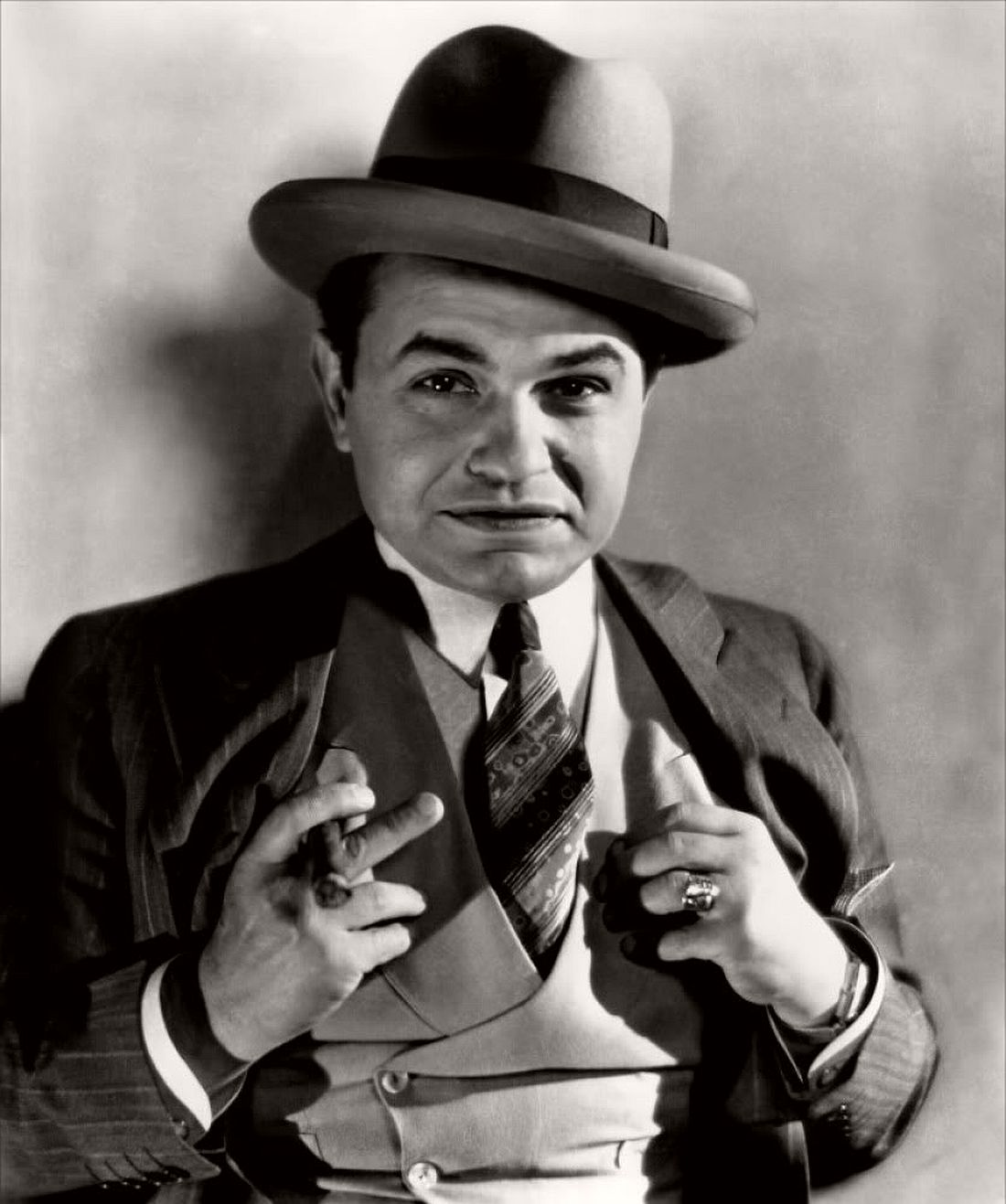
January 9, 1931: Little Caesar premieres, based on the 1929 novel of the same title by William R. Burnett. Directed by Mervyn LeRoy, it is considered the 1st great gangster film.
Edward G. Robinson -- born Emanuel Goldenberg, and therefore Jewish instead of Italian -- plays Caesar Enrico Bandello, better known as Rico. Douglas Fairbanks Jr., son of one of the earliest Hollywood icons, plays Joe Massara -- possibly a play on Joe Masseria, then the biggest crime boss in America. They both go to Chicago to seek their fortunes, Rico in crime, Joe as a dancer.
Glenda Farrell plays Olga Stassoff, who becomes Joe's dance partner and Rico's girlfriend. Rico rises high in the underworld (if you don't mind my mixing of metaphors), while Joe and Olga become stars. But Rico feels threatened by what they know about him. Even then, keeping your mouth shut -- what the original Sicilian Mafia called Omertà, a code of silence meaning you don't talk about your activities to outsiders, especially the law -- was considered an important part of organized crime.
Finally, Olga goes to the police, and tells what she knows. Rico believes Joe put her up to it, and comes for him, but is gunned down behind a billboard, advertising the Joe & Olga dance team. His last words are, "Mother of mercy, is this the end of Rico?"
Before 1931 was over, "the Castellamamrese War" was ended, with the assassination of Masseria and the establishment of "The Commission" by Lucky Luciano to govern organized crime in America; the conviction of the real-life big boss in Chicago, Al Capone; and the making of 2 more classic gangster films: The Public Enemy starring James Cagney, and Scarface, a reference to one of Capone's nicknames, starring Paul Muni. (It wouldn't be released until the next year, but was a runaway hit, and was remade in 1983 with Al Pacino.)
The Great Depression was a time of fear and anger, and this allowed gangster movies to be popular. This would also be true of horror movies.
Robinson would become typecast as a tough guy, especially a gangster. In real life, he was a soft-spoken, sensitive renaissance man, who built an extensive art collection -- twice, since getting onto the Hollywood blacklist in the late 1940s hurt his career, and he had to sell his first one, and he built another. He spoke 7 languages, and the federal government (before considering his leftist leanings to be unpatriotic) hired him to make radio broadcasts in Europe, to people in their own languages.
In 1956, he got back into Hollywood's good graces, and embraced his heritage, sort-of, by playing the villainous Dathon in The Ten Commandments. The character's skepticism of Charlton Heston's Moses became part of a comedy routine by Billy Crystal, about how the movie was supposed to be an epic semi-historical drama, but turned out campy. Robinson's last role, in 1973, as he was dying of cancer, was again alongside Heston, but far in the other direction of time: The futuristic thriller Soylent Green. Heston delivered the eulogy at Robinson's funeral.
His son, Edward G. Robinson Jr., a.k.a. Manny Robinson, also became an actor, and he made his mark in a parody of gangster movies, shooting George Raft in Some Like It Hot. He died of a heart attack just over a year after his father, not quite 41 years old.
*
January 9, 1931 was a Friday. Baseball and football were out of season. The NBA hadn't been founded yet. And while the NHL was in season, no games were scheduled. So there were no scores on this historic day.


