Showing posts with label green hornet. Show all posts

Friday, September 9, 2022

September 9, 1966: "The Green Hornet" Premieres On TV

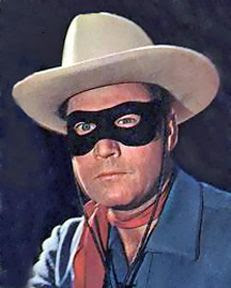
Lee, and Williams aiming the Hornet Sting,
behind the Black Beauty

September 9, 1966, 60 years ago: Riding the success of his version of Batman, ABC premieres producer William Dozier's update of the Green Hornet. While Dozier narrated every episode of Batman, he only narrates the opening montage of The Green Hornet, with Al Hirt on trumpet leading Billy May's orchestra in playing the character's established theme song, Nikolai Rimsky-Korsakov's 1900 composition "Flight of the Bumblebee."

Van Williams, one of the stars of the earlier private detective series Surfside 6, plays Britt Reid, publisher of the Daily Sentinel newspaper in an unidentified city -- updated for this version as also owning a TV station -- who embarks as a masked hero pretending to be a masked criminal, in order to sabotage rackets from within.

Bruce Lee, not yet widely known, plays Reid's valet Kato, thus making the character Chinese, where he had previously been Japanese and, later, due to rising tensions with Japan, Filipino on radio, and Korean in the 1940s film serials.

While Kato's mechanical genius and driving expertise had been established on the radio in 1936, and emphasized in the 1940 and '41 film serials, he had rarely been shown fighting before, and was either unknown or mainly an accessory as far as the Hornet's opponents were concerned. Lee's skills made him, and all versions of Kato who have followed, a martial arts wizard, and a familiar and indispensable partner for the hero-playing-villain.

In the radio show and the film serials, Kato had souped-up Britt's car, the Black Beauty. For the TV series, it was a 1966 Chrysler Imperial, and Kato loaded it to the point where it was a more powerful car, in terms of speed and weaponry, than Adam West's Batmobile.

As with the radio and the movies, Kato invented the Hornet's signature weapon, a gun that produced knockout gas. For the TV series, he also invented the Hornet Sting, a retractable weapon the fired sonic waves that could start fires, pick locks, and, at full power, blow down steel doors. I saw a YouTube comment that called it "The Cadillac of Weapons."

Only 2 others know the Hornet's dual identity. Britt's secretary, Lenore Case, an unknowing sympathizer in the film serials, who had found out and later married him on the radio show, here knows the secret from the beginning. Britt maintains a playboy image, and she is rather jealous, but he does give indications that he loves her, too. She is played on TV by Wende Wagner.

Also knowing is District Attorney Frank Scanlon, played by Walter Brooke (the "plastics" advisor in The Graduate), who tips Britt off to suspected rackets and helps where he can. On the radio, it had been the police commissioner who took this role, but since Batman already had Commissioner Jim Gordon, Dozier decided to change this.

The other constant character is Mike Axford, the Daily Sentinel's crime reporter and an old friend of Britt's father, the Sentinel's previous publisher. Lloyd Gough played down Axford’s previously-established stereotypical Irish accent and well-meaning bumbling, but kept the pride of an aging crimebuster and the clueless hatred of the Hornet.

The first episode is titled "The Silent Gun," and shows the Hornet and Kato already established, as the series never shows an origin story, only once alluding to Britt having taken to fighting crime due to his father having been framed for murder. (The large painting of the elder Reid in Britt's office suggests that his name was cleared, but whether this happened before he died is left hanging.)

Despite taking a serious approach – Williams said he wouldn't have done the series if it was campy like Batman -- poor ratings led ABC to try a crossover episode with Batman, suggesting that Britt Reid and Bruce Wayne were rivals since childhood (but definitely establishing that Britt lives somewhere other than Gotham City). That couldn't save the show. Nor could the sloppy "Alias the Scarf," in which the Hornet took on a villain coming out of retirement. Nor could the desperately campy 2-part season finale, "Invasion from Outer Space," which became the series finale, airing on March 17, 1967.

Lee stunningly died at age 33 in 1973. Gough died in 1984, Brooke in 1986, Dozier in 1991, Wagner in 1997, Hirt in 1999, May in 2004, Williams in 2016.

*

September 9, 1966 was a Friday. These Major League Baseball games were played:

* The New York Yankees beat the Boston Red Sox, 2-1 at Fenway Park in Boston. Fred Talbot outpitched Darrell "Bucky" Brandon. Steve Whitaker went 0-for-4 for the Yankees. Pitcher Jim Bouton did not get into the game. All 3 would end up on the expansion Seattle Pilots in 1969.

Whitaker was playing center field, giving Mickey Mantle a day off. Roger Maris, in what turned out to be his last month as a Yankee, went 0-for-2 with a walk, and an RBI on a sacrifice fly. Carl Yatrzemski went 0-for-2 with 2 walks.

* The New York Mets lost to the Atlanta Braves, 8-3 at Shea Stadium. The Braves scored 4 runs in the 8th and 1 in the 9th to win it. Hank Aaron went 0-for-3 with a walk. Joe Torre went 2-for-4 with a home run, a walk, and 2 RBIs. Rico Carty went 4-for-5 with 4 RBIs.

* The Philadelphia Phillies beat the Cincinnati Reds, 7-6 at Connie Mack Stadium in Philadelphia. Tony Taylor went 3-for-4 with 2 RBIs. Pete Rose went 2-for-4.

* The Pittsburgh Pirates beat the St. Louis Cardinals, 3-2 at Forbes Field in Pittsburgh. In the bottom of the 12th inning, Bill Mazeroski hit a sacrifice fly that scored Matty Alou with the winning run. Roberto Clemente went 4-for-5 with a walk. Willie Stargell went 1-for-3 with a walk and 2 RBIs. Lou Brock went 0-for-4, but drew a walk and stole a base.

* The Cleveland Indians beat the California Angels, 8-7 at Cleveland Municipal Stadium. The Angels scored a run in the top of the 10th inning, but Bill Davis hit a 2-run home run in the bottom of the 10th. Luis Tiant ended up as the winning pitcher.

* The Chicago White Sox beat the Washington Senators, 1-0 at Comiskey Park in Chicago. In the bottom of the 10th inning, John Romano grounded to 3rd baseman Ken McMullen, who bobbled it, allowing Tommie Agee to score the only run of the game. This makes Hoyt Wilhelm a winning pitcher in relief of Gary Peters.

* The Minnesota Twins beat the Baltimore Orioles, 6-1 at Metropolitan Stadium in the Minneapolis suburb of Bloomington, Minnesota. Jim Kaat advanced to 23-9 on the season, and would finish 25-13. Harmon Killebrew went 1-for-3 with 2 RBIs. Don Mincher went 2-for-3 with a walk and 3 RBIs. Frank Robinson went 1-for-4. Brooks Robinson went 0-for-3 with a walk.

* The Kansas City Athletics beat the Detroit Tigers, 2-1 at Kansas City Municipal Stadium. Mickey Lolich walked rookie pinch-hitter Rick Monday with the bases loaded in the bottom of the 10th inning, forcing Bert Campaneris home with the winning run. Al Kaline went 1-for-1... with 4 walks.

* The Los Angeles Dodgers beat the Houston Astros, 7-0 at Dodger Stadium in Los Angeles. Claude Osteen pitched a 3-hit shutout.

* And the Chicago Cubs beat the San Francisco Giants, 6-0 at Candlestick Park in San Francisco. Ken Holtzman allowed 3 hits over 7 2/3rds innings, and Bill Hands finished the 4-hit shutout, outpitching Juan Marichal. Ernie Banks went 1-for-4 with an RBI. Willie Mays went 0-for-1 with 3 walks. Willie McCovey went 2-for-4.

The NFL season started the next day. There was 1 game played in the AFL on this night: The New York Jets beat the Miami Dolphins, 19-14 at the Orange Bowl in Miami. It was only the 2nd regular-season game played by the expansion Dolphins: On September 2, also at home, they lost to the Oakland Raiders, 23-14. The day when the Orange Bowl stadium would become a fortress for the Dolphins was a few years off; for the University of Miami Hurricanes, even further.

Wednesday, July 20, 2022

July 20, 1973: The Death of Bruce Lee

July 20, 1973: Bruce Lee dies, shocking the world, which was just getting to really know him. He was only 32 years old.

He was born on November 27, 1940, as Lee Jun-fan, in San Francisco, where his Hong Kong-based parents were living at the time. A nurse at the hospital nicknamed him "Bruce," although his parents never used it. His father, Lee Hoi-chen, was an opera singer in the Cantonese dialect of Chinese. The family returned to Hong Kong the following year, surviving the Japanese occupation of the British colony during World War II. In 1950, father and son both appeared in the film The Kid. By the time Bruce was 18, he had appeared in 20 films.

He got into street fights, and his parents decided he needed martial arts training. By 1958, he was not only the Hong Kong schools boxing champion, but also the winner of the Crown Colony Cha-Cha Championship. Apparently, the movements of martial arts helped him with his dancing.

He returned to America, to Seattle, and attended the University of Washington, but dropped out in 1964, and moved to Oakland. There, he continued his martial arts education, and developed two of his signature moves, the one-inch punch and the two-finger push-up.

He caught the attention of William Dozier, the producer who created the 1966 TV version of Batman. He had an idea for a similar crimefighter series, based on the Green Hornet, who'd been on radio in the 1930s and '40s, and in 2 early 1940s film serials.

The Green Hornet was Britt Reid, a newspaper publisher who saw a crime wave in his city, and decided what was needed was a modern-day Robin Hood, so he took on the masked persona and pretended to be a competing gangster, muscling in on bad guys' territory, and setting them up to be captured by the cops.

He was assisted by Kato, an Asian mechanical genius, who designed and built the character's knockout-gas gun, and turned Britt's car into the souped-up "Black Beauty." Originally, Kato was said to be Japanese. But by the time of the 1st film serial in 1940, the Japanese were committing war crimes against China, so the character was rewritten as Korean. Although a capable fighter, his only use of martial arts, in either The Green Hornet (1940) or The Green Hornet Strikes Again! (1941), was the occasional judo chop.

Dozier cast former Surfside Six star Van Williams as Reid, and Lee as Kato -- allegedly, because he was the only Asian-American actor he could find who could properly pronounce the name "Britt Reid." The character was every bit the genius as before, adding to the hero's arsenal a "Hornet Sting" that used sound waves as a weapon. To match Lee, his ethnicity was changed to Chinese, and one episode included Kato taking on the unnamed city's Chinese gangs, or "tongs." The show only lasted 1 season, but, in spite of his earlier experience, Lee wrote Dozier a letter thanking him for "my start in show business."
Van Williams (left) and Bruce Lee.
Kato never got a "superhero name."

In 1967, after leaving the show, he founded Jeet Kune Do, a martial arts philosophy in which he spoke of "the style of no style," or its variation "Using no way as way." Basketball star Allen Iverson wouldn't have liked him, as he emphasized practice: "Do not beware the man who has practiced a thousand kicks. Beware the man who has practiced a single kick a thousand times."

By 1969, Bruce was married to the former Linda Emery, and they had a son, Brandon, and a daughter, Shannon. And Bruce's brother, who goes by Robert Lee Jun-fai, had a rock band, The Thunderbirds, which was big in Hong Kong. If that doesn't sound like a big deal to you, keep in mind that Hong Kong is home to about 7 million people, a little less than New York and London. And they're packed onto islands, making it the most densely-populated city in the world.

Also big in Hong Kong -- a British colony until 1997, when by treaty it went back to China -- is their movie production industry. Martial arts films had been popular there in the 1930s, and by 1970 had returned to prominence after a long period of suppression.

In 1971, Bruce starred in The Big Boss, followed in 1972 by Fist of Fury and The Way of the Dragon, with Bruce having written and directed the last of these. In The Way of the Dragon, released in America as Return of the Dragon, a fight scene was filmed inside the Roman Colosseum, with Chuck Norris, already a renowned martial arts practitioner and instructor.

Chuck has always insisted that, if it was a real fight, he would have won. But it was Bruce's film, and Chuck knew that this meant that Bruce had to win. In the Internet Age, someone who was tired of the silly "Chuck Norris Facts" routine, posted this meme.
With these films being shown in America, it inspired the TV series Kung Fu, starring David Carradine as Kwai Chang Caine, a half-American-half-Chinese martial arts master in the Wild West. In flashbacks, Caine's mentor, Master Po, is played by Keye Luke, who had played Kato in the 1940s Green Hornet serials. (A sequel series in the 1990s, Kung Fu: The Legend Continues, featured Carradine as the original Caine's grandson and namesake, and Chris Potter as the great-grandson, a Los Angeles detective.)

Between them, Lee and Carradine made martial arts enormously popular in America. What's more, along with the Civil Rights Movement making "blaxploitation" films popular, Bruce Lee elevated the profile of Americans of Asian descent, giving them a point of pride not connected to organized crime (gangs known as "tongs"), and making them cool for the first time.

It inspired martial arts scenes in a kung fu sequence in the 1974 James Bond film The Man with the Golden Gun. It also inspired "Kung Fu Fighting," a song by soul singer Carl Douglas that hit Number 1 in 1974. In turn, that song inspired a curious trend of black men becoming martial arts fans and practitioners, culminating in the 1985 film The Last Dragon, starring Taimak Guarriello as "Bruce Leroy."

In late 1972, Bruce began work on Game of Death, including a fight scene with a former student of his, basketball star Kareem Abdul-Jabbar. At 5-foot-8 and 165 pounds, Bruce was not a small man, and was as solidly built as a man can be. But Kareem was 7-foot-2 and 225, so Bruce was, literally, punching above his weight.

But in mid-filming, Warner Brothers offered Bruce the lead in Enter the Dragon. He filmed it in Hong Kong from February to April 1973. It was set to be released on July 26.

But on May 10, while doing automated dialogue replacement for Enter the Dragon -- it had become a trope that Hong Kong martial arts films had the English dialogue way out of step with the Cantonese original -- Bruce collapsed, and went into seizures. He was taken to a hospital, where doctors diagnosed cerebral edema: Swelling of the brain. He was told to get rest.

On July 20, Bruce and film producer Raymond Chow went to the home of co-star Betty Ting Pei, to go over a script. Bruce developed a headache, and Ting Pei gave him Equagesic, a painkiller containing aspirin and a tranquilizer called meprobamate. At 7:30, he took a nap. When he didn't show up for his dinner meeting, Chow went back to the house, and they were unable to wake Bruce up. He was dead on arrival at the hospital.

There is doubt as to the cause of his death. An autopsy revealed a new edema, which explained the headache. But Chow believed the real cause was an allergic reaction to the painkiller. Heatstroke has been suggested as a factor, as both May 10 and July 20 were hot days in Hong Kong, which is only at 22 degrees north latitude. (For comparison's sake: Los Angeles is at 34, and New York is at 41.) Rumors abounded that Bruce had offended someone in organized crime, who ordered his murder, but there was no evidence of foul play.

He was buried in Seattle, Linda's hometown, and pallbearers included his brother, and actors Steve McQueen and James Coburn, both former students of his. That's how cool Bruce Lee was: He taught two of The Magnificent Seven. (Coburn maintained an interest in Asian culture for the rest of his life, including playing a Japanese musical number with Animal to close his appearance on The Muppet Show.)

Enter the Dragon was released on time, and, on a budget of $850,000, made over $400 million worldwide over nearly half a century -- about $2 billion in today's money.

Game of Death took until 1978 to be released, with stand-ins. Lee's yellow jumpsuit with black piping became legendary, and was copied for Uma Thurman's character Beatrix "The Bride" Kiddo in Quentin Tarantino's 2003 film Kill Bill, Vol. 1.

Linda married twice more, and now goes by the family name of her 3rd and current husband, Linda Lee Caldwell. Brandon Lee and Shannon Lee followed their father into acting and the study of martial arts. Brandon was also on the verge of superstardom in 1993, when an accident killed him on the set of the film The Crow. He was just 28, and this has led to the belief of a curse on the Lee family. At the time of his death, he was engaged to Eliza Hutton. Shannon became a film producer, married a man named Ian Keasler, and has a daughter named Wren, Bruce Lee's only grandchild.

Although the San Francisco Giants have held Bruce Lee Tribute Night, calling him a "Bay Area icon," I can't find any reference to him being a baseball fan. Given that he was already 17 years old when the Giants moved from New York to San Francisco, it isn't obvious that he would have rooted for them. And he moved to and left Oakland before the Athletics moved there from Kansas City, and died between the failure of the Seattle Pilots and the arrival of the Seattle Mariners, so it's not clear he would have rooted for a team in his adopted hometowns, either.

In a 2012 episode of the YouTube series Epic Rap Battles of History, YouTuber and visual artist Mike Diva played Bruce Lee, against "Epic" Lloyd Ahlquist as Clint Eastwood.

*

July 20, 1973 was a Friday. These games were played in Major League Baseball that day:

* The New York Yankees swept a doubleheader from the Chicago White Sox at Yankee Stadium. They won the opener, 12-2. Celerino Sanchez  went 4-for-5 with 2 RBIs, Matty Alou went 3-for-3 with 2 walks and an RBI, and Roy White went 2-for-5 with 3 RBIs. All this was in support of George "Doc" Medich, who outpitched knuckleballer Wilbur Wood.

The Yankees were leading the nightcap, 7-0 in the bottom of the 6th inning, when the game was called due to rain. Wood started that game, too, and remains the last MLB pitcher to start both games of a doubleheader. White homered, and had 4 RBIs, for a total of 7 on the day. Sam McDowell, the former strikeout ace of the Cleveland Indians, had allowed only 2 hits and struck out 8. It was the 138th win of his career, but injuries and alcoholism limited him to 141. He later began recovery, and has been a substance abuse counselor ever since.

* The New York Mets lost to the Houston Astros, 6-2 at the Astrodome in Houston. Doug Rader hit 2 home runs. Wayne Garrett homered for the Mets. Willie Mays went 1-for-5 with a walk.

* The Boston Red Sox beat the Minnesota Twins, 5-0 at Fenway Park in Boston. John Curtis pitched a 5-hit shutout, outpitching Bert Blyleven. Tommy Harper and Carlton Fisk hit home runs. Carl Yastrzemski and Rod Carew both went 1-for-4.

* The Philadelphia Phillies beat the Atlanta Braves, 6-4 at Atlanta Stadium (now Atlanta-Fulton County Stadium). Hank Aaron hit the 699th home run of his career.

* The Pittsburgh Pirates swept a doubleheader from the San Diego Padres at Three Rivers Stadium in Pittsburgh. They won the 1st game, 5-4. Willie Stargell and Rennie Stennett hit home runs. They won the 2nd game, 7-0. Jim Rooker pitched a 6-hit shutout, and Stennett homered again.

* The Cincinnati Reds beat the Montreal Expos, 4-0 at Riverfront Stadium in Cincinnati. Fred Norman pitched 8 innings of 5-hit shutout ball. Pete Rose and Johnny Bench both went 1-for-4, and Joe Morgan went 0-for-3.

* The San Francisco Giants beat the Chicago Cubs, 5-4 at Wrigley Field in Chicago.

* The Los Angeles Dodgers beat the St. Louis Cardinals, 4-3 at Busch Memorial Stadium. Steve Garvey drove in the winning run with a double in the top of the 15th inning.

* The Kansas City Royals beat the Milwaukee Brewers, 6-1 at Royals Stadium (now Kauffman Stadium) in Kansas City.

* The Texas Rangers beat the Detroit Tigers, 8-6 at Arlington Stadium in the Dallas suburb of Arlington, Texas. Al Kaline went 1-for-3.

* The California Angels beat the Baltimore Orioles, 8-3 at Anaheim Stadium (now Angel Stadium of Anaheim). Frank Robinson went 1-for-3 with a walk for the Angels against his former team. Brooks Robinson went 0-for-3.

* And the Oakland Athletics beat the Cleveland Indians, 6-5 at the Oakland Coliseum. Reggie Jackson supported Jim "Catfish" Hunter with a home run off Gaylord Perry.

Monday, January 31, 2022

January 31, 1936: "The Green Hornet" Debuts

Gordon Jones in the 1940 serial

January 31, 1936: The Green Hornet debuts on Detroit radio station WXYZ, 1270 on the AM dial, created by station owner George W. Trendle and writer Fran Striker.

The Green Hornet was Britt Reid, the wealthy publisher of a newspaper, The Daily Sentinel, who saw a crime wave in his city, and decided that what was needed was "a modern-day Robin Hood," so he took on the masked persona and pretended to be a competing gangster, muscling in on bad guys' territory, and setting them up to be captured by the cops.

He was assisted by Kato, an Asian mechanical genius, who designed and built the character's knockout-gas gun, and turned Britt's car into the souped-up "Black Beauty." Originally, Kato was said to be Japanese. But by the time of the 1st film serial in 1940, the Japanese were committing war crimes against China, so the character was rewritten as Korean. Although a capable fighter, his only use of martial arts, in either of the film serials, was the occasional judo chop.

On radio, the Hornet was played by Al Hodge from 1936 to 1945. He would later star as the early science fiction TV hero Captain Video. Bob Hall took over the role in 1945, and Jack McCarthy was the last in the role, from 1947 to 1952. Kato was played by Raymond Toyo, and later by Rollon Parker. For the entire run, it was directed by James Jewell, and his sister, Leonore Jewell Allman, played Lenore Case, Britt's secretary, who occasionally had to be rescued by the Green Hornet, and finally discovered his secret identity in 1948.

In 1947, Britt revealed his identity to the Daily Sentinel's actual owner, his father, Dan Reid Jr. The father had his own revelation, that Britt was not the first fighter for justice in the family: Dan is the son of Dan Reid, a Texas Ranger who was martyred, and whose brother fought criminals in the Wild West as the Lone Ranger. The Reid family fortune came from the silver mine that also supplied the Ranger's bullets.

The radio show could legally do this, because Trendle and Striker had created the Lone Ranger 3 years earlier, and his show was still running, with WXYZ as its flagship station. Every subsequent version of the Hornet has added a generation, but he's still descended from the Lone Ranger's martyred brother.

Two film serials were produced: The Green Hornet in 1940, with Gordon Jones in the title role; and The Green Hornet Strikes Again! in 1941, with Warren Hull starring. Both were directed by Ford Beebe. In both versions, Kato was played by Keye Luke, who had already become famous playing Lee Chan, the "number one son" in the Charlie Chan films.

Anne Nagel played Lenore Case, who supported the Hornet; and Wade Boteler played Mike Axford, the paper's leading reporter, who opposed the Hornet, seeing only the criminal side of him, not the "Robin Hood" side. Neither discovered his true identity over the length of the serials.

In 1966, William Dozier, creator and producer of the Batman TV series, wanted to try another superhero show. For his version of The Green Hornet, he cast former Surfside Six star Van Williams as Reid, who was made a rich man of his time: A swinging playboy who, in addition to his newspaper, also ran a TV station, known as Daily Sentinel TV. It used the initials DSTV, so that it couldn't be pinned down to a single city, and thus not have to start with a W (indicating that it was in the Eastern U.S.) or a K (the West). Nor was a channel number ever mentioned.

Hong Kong-based actor and martial arts expert Bruce Lee was cast as Kato -- allegedly, because he was the only Asian-American actor that Dozier could find who could properly pronounce the name "Britt Reid." The character was every bit the genius as before, adding to the hero's arsenal a "Hornet Sting": A device that looked like a walking stick, and used sound waves as a weapon.
Van Williams (left) and Bruce Lee.
Kato never got a "superhero name."

To match Lee, his ethnicity was changed to Chinese, and one episode, "The Praying Mantis," included the Hornet and Kato taking on the unnamed city's Chinese gangs, or "tongs," as a friend of Kato's was the son of a tong leader who was trying to take his group legitimate, and their rivals didn't want them to "go straight."

Aside from Kato, 2 characters knew Britt's secret identity from the beginning. Wende Wagner played Lenore Case, or "Casey." And while Batman had the city's police commissioner as his establishment ally (but not knowing his secret identity), Dozier didn't want the Hornet's ally to have the exact same job, so Walter Brooke was cast as the District Attorney, Frank Scanlon, who did know.

Lloyd Gough played Mike Axford, the Daily Sentinel’s crime reporter, said to be an old friend of Britt's father, the Sentinel's previous publisher. Gough played down Axford's previously-established stereotypical Irish accent and well-meaning bumbling, but kept the character's clueless hatred of the Hornet, and the pride of an aging crimebuster who occasionally got in over his head while pursuing a story, and had to be reluctantly (on his part) rescued by the Hornet.

A key difference this time is that Britt's father, seen only in a portrait in his office, is dead. The episode "The Frog Is a Deadly Weapon" mentions that he had been framed for murder, though it is left ambiguous as to whether he was convicted and died in prison, or acquitted and then the stress of the experience killed him. What is clear is that he was set up by a gangster that the elder Reid was pursuing, Glenn Connors, played by Victor Jory. Finally given the chance to do so, the Hornet defeated him in the episode.

Unlike with Batman, Dozier did not narrate the show, but he did narrate its opening, which sounds like a holdover from the days of radio:

Another challenge for the Green Hornet, his aide Kato, and their rolling arsenal, the Black Beauty. On police records a wanted criminal, the Green Hornet is really Britt Reid, owner-publisher of the Daily Sentinel. His dual identity is known only to his secretary, and to the District Attorney. And now, to protect the rights and lives of decent citizens, rides The Green Hornet!

Just as The Lone Ranger kept Giacomo Rossini's William Tell Overture as its theme song when making the transition from radio to TV, The Green Hornet had a familiar classical piece as a theme: Flight of the Bumblebee, composed in 1900 by Nikolai Rimsky-Korsakov, played by the great jazz trumpeter Al Hirt, while Lionel Newman conducted the orchestra in an arrangement by Billy May, who was responsible for the arrangements in some of Frank Sinatra's best work.

Van Williams said he wouldn't have done the series if it was going to be as campy as Batman. At first, it wasn't. But the ratings were never good. A crossover with Batman, "A Piece of the Action" and "Batman's Satisfaction," aired, establishing that Bruce Wayne and Britt Reid were rivals.

A fight between Batman and the Green Hornet, and between Robin and Kato, ended in a draw as the police came in. Lee insisted: He was willing to lose a fight to Batman, since it was his show; but his pride was such that he refused to lose a fight to Robin, a character then seen widely as a joke. (This was long before, in the comics, Dick Grayson, the original Robin, became Nightwing and the leader of the Teen Titans, and became regarded as a character who, while keeping his sense of humor and sunny attitude, could be taken much more seriously.)

The crossover didn't help the ratings, and the show was canceled after 1 season. Lee wrote Dozier a letter thanking him for "my start in show business."

The Green Hornet appeared in a few comic books, including one showing the nephew of the '66 Britt Reid and the niece of the '66 Kato fighting crime together, with Diana Reid, daughter of Britt and Casey (and thus the 1st cousin of this younger Britt), filling in for the deceased Scanlon as D.A.

In 2010, Seth Rogen made a Green Hornet film, playing the starring role as a ridiculous playboy who, unlike previous editions of the character, was a wasted disappointment to his father, but nevertheless enlists the help of Kato, played by Jay Chou, to avenge him after his murder by a Russian gangster, played by Christoph Waltz with his usual bad-guy scenery-chewing. Cameron Diaz played Lenore Case. Michel Gondry directed. The film flopped: It infuriated the character's existing fans (myself included), and didn't add many new ones. 

Also in 2010, filmmaker Kevin Smith, long with an interest in superheroes and comic books, began writing a series for the Green Hornet, which still runs, set in the present day, with a female Kato. In July 2020, he announced plans to develop a Green Hornet animated TV series, based on his series. As of January 31, 2022, a new film project, separate from Smith's idea, is also planned.

In 1978, WXYZ, the station where the Green Hornet and the Lone Ranger debuted, switched from music to talk. In 1984, the call letters were changed from the alphabetical closure WXYZ to WXYT, the "T" standing for "Talk." In 2000, it switched to sports/talk, and was rebranded as "The Bet Detroit" in 2021.

Wade Boteler died in 1943, Fran Striker in 1962, Gordon Jones in 1963, Anne Nagel in 1966, Rollon Parker in 1968, George Trendle in 1972, Bruce Lee in 1973, Warren Hull in 1974, James Jewell in 1975, Ford Beebe in 1978, Al Hodge in 1979, Lloyd Gough in 1984, Walter Brooke in 1986, Bob Hall and Leonore Allman in 1989, Keye Luke and William Dozier in 1991, Jack McCarthy in 1996, Wende Wagner in 1997, Al Hirt in 1999, Raymond Toyo in 2000, and Van Williams in 2016.

(UPDATE: On June 23, 2022, it was announced that Leigh Whannell, the Australian filmmaker who co-created the Saw franchise, would direct the reboot. On April 7, 2023, it was reported that Chris Pine would play the Hornet, but this was not confirmed. As of January 31, 2026, the 90th anniversary of the premiere of the radio series, both the film reboot and the animated TV series remain in limbo.)

*

January 31, 1936 was a Friday. Baseball and football were out of season. The NBA hadn't been founded yet. And there were no games scheduled in the NHL. So there were no scores on this historic day.

January 31, 1933: "The Lone Ranger" Debuts

Clayton Moore, in the 1949-57 TV series

January 31, 1933: Detroit radio station WXYZ, 1270 on the AM dial, debuts a new program, The Lone Ranger, created by station owner George W. Trendle and writer Fran Striker. A legend is born.

While details differ across the various versions, the basic story of the Lone Ranger's origin is consistent in most versions of the franchise. He is the sole survivor of a group of 6 ambushed Texas Rangers, sometime after the American Civil War. The Rangers, led by Captain Dan Reid, pursue a band of outlaws led by Bartholomew "Butch" Cavendish, but are betrayed by a civilian guide who was secretly working with Cavendish, and who led the unsuspecting Rangers into an ambush at a canyon known as Bryant's Gap.

Later, a Native American named Tonto discovers one of the Rangers, Captain Reid's younger brother, John Reid, barely alive, and he nurses the man to health. In some versions, Tonto recognizes the lone survivor as the man who had saved his life when they both were children. According to the television series, Tonto gave Reid a ring and the name "Kemo Sabe," which he said means "trusty scout." (In some versions, it means "trusted friend.")

John tells Tonto that he intends to hunt down Cavendish and his men, and to bring them to justice. To conceal his identity, and honor his fallen brother, Reid fashions a black domino mask using cloth from his late brother's vest. To aid in the deception, Tonto digs a sixth grave and places at its head a cross bearing John Reid's name, so that Cavendish and his gang will believe that all the Rangers had been killed. In many versions, Reid continues fighting for justice as the Lone Ranger even after the Cavendish gang is captured.

Trendle and Striker drew up guidelines for the Lone Ranger, including a strict moral code:

  • He was never seen without his mask or some sort of disguise.
  • He was never captured or held for any length of time by lawmen, avoiding his being unmasked.
  • He always used perfect grammar and precise speech, devoid of slang and colloquialisms -- not only making him different from many other Western characters, before and after, but also making him understandable in all regions of the country, once the show got nationally syndicated.
  • Whenever he was forced to use guns, he never shot to kill, but instead tried to disarm his opponent as painlessly as possible.
  • He was never put in a hopeless situation; for example, he was never seen escaping from a barrage of gunfire merely by fleeing toward the horizon.
  • He rarely referred to himself as "the Lone Ranger." If someone's suspicions were aroused, either he would present one of his silver bullets to confirm his identity, or someone else would attest on his behalf; the latter happened at the end of most episodes when someone would ask, "Who was that masked man?" as the Lone Ranger departed. His decision to adopt the moniker of Lone Ranger was inspired by Tonto: Following the ambush at Bryant's Gap, Tonto observed him to be the only Ranger left. In other words, he was the "lone" Ranger.
  • Though the Lone Ranger offered his aid to individuals or small groups facing powerful adversaries, the ultimate objective of his story always implied that their benefit was only a byproduct of the development of the West or the country.
  • Adversaries were rarely other than American, to avoid criticism from minority groups, with some exceptions. He sometimes battled foreign agents, though their nation of origin was generally not named. An exception was his having helped the Mexican statesman Benito Juárez against French troops of Emperor Maximilian, as occurred in the radio episodes "Supplies for Juarez" (September 18, 1939), "Hunted by Legionnaires" (September 20, 1939), and "Lafitte's Reinforcements" (September 22, 1939).
  • The names of unsympathetic characters were carefully chosen, so that they never consisted of two names if it could be avoided. More often than not, a single nickname or surname was selected.
  • The Lone Ranger never drank or smoked, and saloon scenes were usually shown as cafes, with waiters and food instead of bartenders and liquor.
  • Criminals were never shown in enviable positions of wealth or power, and they were never successful or glamorous.

The original radio series was directed by John Jewell, who came up with the names "Tonto" and "Kemosabe." Although clearly highly intelligent, Tonto spoke in broken English, to emphasize that he had learned it as a second language. Unfortunately, this perpetuated the stereotype of "Indians" speaking in such form: If he had the infamous Star Wars line, it would have been "Me have bad feeling about this, Kemosabe." In the local Native American language, "Tonto" meant "wild one." But because it means "stupid" in Spanish, the character was renamed "Toro," for "Bull," in the media of Spanish-speaking countries.

The Lone Ranger's horse was white, and named Silver, and when he rode away at the end of each episode, he would yell, "Hi-yo, Silver, away!" Tonto rode a paint horse named Scout, and would yell, "Get 'em up, Scout!"

George Seaton was the first voice of the Lone Ranger, until Earle Graser took over on May 16, 1933. On April 8, 1941, he was killed in a car accident. Brace Beemer took over until the end of the radio show in 1954. Tonto was played by John Todd.

From the beginning of the radio series, the Lone Ranger's theme has been "March of the Swiss Soldiers," the 4th and final part of the Overture to Giacomo Rossini's 1829 opera William Tell.

Republic Pictures released 2 film serials: The Lone Ranger in 1938, starring Lee Powell; and The Lone Ranger Rides Again, starring Robert Livingston. Both times, Tonto was played by Victor Daniels, under the name Chief Thunder-Cloud.

The best-known version of the character was on a TV series that ran from 1949 to 1957, and was the 1st hit show for the new ABC television network. The opening sequence featured the William Tell Overture, and announcer Fred Foy saying:

The Lone Ranger! A fiery horse with the speed of light, a cloud of dust, a hearty "Hi-yo, Silver!" The Lone Ranger! With his faithful Indian companion, Tonto, the daring and resourceful masked rider of the Plains led the fight for law and order in the early West. Return with us, now, to those thrilling days of yesteryear! The Lone Ranger rides again!

Clayton Moore starred in the 1949-50 and 1950-51 seasons, before being fired in a salary dispute with George Trendle, who still had the rights to the character. John Hart replaced Moore in the 1952-53 season. Trendle sold the rights in 1954, and Moore was immediately rehired for the 1954-55 season. The series did not run in 1955-56, but was brought back for one more season in 1956-57. Throughout the series, Tonto was played by Jay Silverheels, a Mohawk actor from Canada.

For the rest of their lives, both Moore and Hart made public appearances as the Lone Ranger. On a 1982 episode of Happy Days, Hart played himself, in costume, because the Lone Ranger was the hero of the character of Arthur "The Fonz" Fonzarelli. The Ranger gave the Fonz a silver bullet.

The TV show had such an effect that reviving the character has proven problematic. In 1961, CBS produced a pilot, Return of the Lone Ranger, starring Tex Hill, but it wasn't picked up. In 1981, The Legend of the Lone Ranger starred Klinton Spilsbury. Tonto was played by Native actor Michael Horse, and Butch Cavendish by Christopher Lloyd. "Wild West" figures Wild Bill Hickok, Buffalo Bill Cody and George Armstrong Custer were depicted, and Jason Robards played President Ulysses S. Grant. The film was a massive flop, Spilsbury was particularly roasted by the critics, and he never appeared in another film.

In 2013, The Walt Disney Company tried again, with Armie Hammer as the Lone Ranger (wearing a white hat as always, but otherwise wearing black instead of his traditional powder blue), Johnny Depp as a supposedly more accurate-looking (but ultimately ridiculous-looking) Tonto, and William Fichtner as Cavendish. It was another flop. In a sick irony, Fichtner's version of Cavendish is said to be a cannibal; while, in 2021, Hammer was accused of abusing women, including the claim that he wanted to eat them.

George Seaton, as said, died in 1941, Victor Daniels in 1955, John Todd in 1957, Fran Striker in 1962, Brace Beemer in 1965, George Trendle in 1972, George Seaton in 1979, Jay Silverheels in 1980, Clayton Moore in 1999, John Hart in 2009, Fred Foy in 2010, and Tex Hill in 2014. As of January 31, 2022, Klinton Spilsbury, Michael Horse, Armie Hammer and Johnny Depp are still alive.

As a fan of hockey's New Jersey Devils, I have noted that their arch-rivals, the New York Rangers, whom Devils (and New York Islanders) fans like to say "suck," wear blue shirts, although a deeper blue than that worn by the Lone Ranger. Noting also that baseball's Texas Rangers and Scottish soccer's Rangers Football Club also wear blue shirts -- and that they also have an unfortunate string of bigotry in their fan bases -- I like to say, "The only Ranger in a blue shirt who doesn't suck is the Lone Ranger."

In 1936, WXYZ introduced another hero, set in the present day: The Green Hornet. The identity was adopted by newspaper publisher Britt Reid, son of Dan Reid Jr., grandson of Dan Reid, and thus the grandnephew of the Lone Ranger. This fact was not revealed until a 1947 episode of the radio series, when Britt reveals his dual identity to his father, who explains that he's not the first costumed crimefighter in the family. Every subsequent version of the Hornet has added a generation, but he's still descended from the Lone Ranger's martyred brother.

In 1935, WXYZ moved from Mutual Broadcasting to the NBC Blue Network. In 1946, NBC Blue separated from NBC, and became the American Broadcasting Company, or ABC. In the 1950s, "Wixy" became Detroit's Top 40 radio station. In 1967, losing its audience to WKNR, and to CKLW across the river in Windsor, Ontario, Canada, it switched to an adult contemporary format. WXYZ switched to talk radio in 1978. Since 1984, the station has used the call letters WXYT. In 2000, it switched to sports talk.

Writing in the Denver Post in 1962, Jack Guin wrote, "An intellectual is a man who can listen to the William Tell Overture without thinking of the Lone Ranger." Less intellectual even than that is a joke:

Q: Where does the Lone Ranger take his garbage?
A: To the dump, to the dump, to the dump, dump, dump!

*

January 31, 1933 was a Tuesday. Hockey Hall-of-Famer Camille Henry of the New York Rangers was born on this day.

Baseball and football were out of season. The NBA hadn't been founded yet. But there were 4 games played in the NHL:

* The New York Rangers lost to the Detroit Red Wings, 2-1 at the old Madison Square Garden.

* The New York Americans lost to the Toronto Maple Leafs, 7-1 at Maple Leaf Gardens in Toronto.

* The Montreal Canadiens beat the Ottawa Senators, 3-1 at the Montreal Forum.

* The Chicago Black Hawks beat the Boston Bruins, 5-1 at the Boston Garden.

* The Montreal Maroons were the only team not scheduled.

Wednesday, January 12, 2022

January 12, 1966: "Batman" Premieres On TV

Burt Ward (left) as Robin, and Adam West as Batman
January 12, 1966: Batman premieres on ABC. The villain in the 1st 2-part episode is the Riddler, played by noted impressionist Frank Gorshin, and the episodes are titled "Hi Diddle Riddle" and, the next night, "Smack in the Middle." Most of the halves of the 2-part episodes had rhyming titles.

Batman had appeared in live-action before, in a 1943 film serial, titled simply Batman, starring Lewis Wilson, and Douglas Croft as Robin; and a 1949 serial, Batman and Robin, starring Robert Lowery and Johnny Duncan. But this was Batman's, and Robin's, 1st TV appearance.
The show ran for 120 episodes, 3 seasons, over the next 2 years, and became the only successful live-action TV series featuring a superhero between The Adventures of Superman's last airing in 1958 and The New Original Wonder Woman's premiere in 1975.
The standard format:
* The 1st part of a 2-part episode would air on a Wednesday night. William Dozier, the series' creator and executive producer, would narrate.
* The opening shot would usually be of Manhattan in New York City, standing in for Gotham City, the fictional home of the Batman character since his debut in Detective Comics #27 in 1939. Location shots later in the show make it look like there are beaches and mountains nearby, suggesting that Gotham looks more like Los Angeles, where the show really was filmed.
But while most versions of Gotham -- in comic books, on TV and in films -- have it looking like a crime-ridden mess, practically a lost cause, Batman '66 (what some fans of the character like to call the show, to differentiate it from other versions of the Bat-Story) makes Gotham look like a nice place, because Batman and his sidekick, Robin the Boy Wonder, have done such a great job in cleaning it up.
Likewise, unlike most versions, where Police Commissioner James Gordon willingly works with Batman, but the rest of the city doesn't quite trust him, and fears him, and some people believe he's an urban legend created to scare criminals, on this show, Batman and Robin are well-known celebrities, and beloved. Not just by Gothamites: Their fame and admiration extends around the world.
But that idyllic urban opening shot is always interrupted by Dozier saying something like, "But, wait! What's this?" And we see the villain and his (or her) henchmen (and/or henchwomen) striking, usually a robbery. This is, after all, the 1960s: Network censors wouldn't take kindly to murders right off the bat, especially for a show based on a comic book aimed at children. The villain and his crew get away with this crime -- for the moment.
* The scene then shifts to Police Headquarters, where Commissioner Gordon and the Chief of Police, Miles O'Hara, realize who is behind the crime, often because the villain is arrogant enough to leave behind a clue admitting it, and realize that this is someone who has them in over their heads.
Gordon was played by Neil Hamilton, and this is one of the few times that he is depicted without a mustache. O'Hara was created specifically for the series, and was played by Stafford Repp, usually with an exaggerated Irish accent, as so many policemen who started when he would have were of Irish descent.
So Gordon says there's only one man who can help them now. He walks over to a red telephone, and uses it to call Batman.
* Dozier says, "Meanwhile, at stately Wayne Manor... " The Manor is owned by a man nearly always referred to as "millionaire Bruce Wayne." In most versions since, Bruce is referred to as a billionaire and one of the richest men in the world. 
The TV version never explains how his family got its money, only that they were one of Gotham's founding families. This is also true in the comics, which suggested armaments, during the American Civil War, and then even more so during the World Wars. This has suggested that Bruce's father, Thomas Wayne, became a doctor and a charity runner out of liberal guilt.
In the very first episode, and only once thereafter, does Bruce (Adam West) mention that his parents, Thomas and Martha Wayne, were murdered by criminals. On no episode is the killer identified, as he was in the comics: Joe Chill, as a result of a robbery gone wrong -- or, depending on which writer is telling the story, it was a hit, hired by a gangster named Lew Moxon, who had a grudge against Dr. Wayne. Only in the 1989 Batman film is the murder committed by Jack Napier, the man who went on to become the Joker.
West was 37 years old when the pilot episode first aired, and, clearly, he's already a veteran crimefighter. Bruce has never been married, so, under the laws of the time, he couldn't adopt a child, but he could be the legal guardian for one. So it is with Dick Grayson -- played by Burt Ward, 20 at the time -- who gets his driver's license in the 2nd season, suggesting that he then turned 16.
In the comics, Dick was a gymnast, who with his parents performed as The Flying Graysons in a circus. The circus was sabotaged by a gangster, and Dick's parents were killed. Batman taught him to deal with his anger by fighting crime with his brain as well as with his fists, and the gangster was brought to justice.
Robin's origin was never touched upon on the show, but Bruce, both in costume and out, is constantly pushing Dick's education, both at his private school and in the Batcave beneath Wayne Manor. He wants Dick to be as smart as he is, and, at times, he seems so, but still has a lot to learn.
When Gordon calls, Bruce will be doing something in line with the Wayne Foundation, or teaching Dick something, usually in the company of Dick's aunt, Harriet Cooper (Madge Blake), who does not know their secret. The longtime Wayne family butler, Alfred Pennyworth (Alan Napier -- and his last name is never mentioned on the show), does know, and he walks into the room, and whispers in Bruce's ear, telling him that Gordon is calling.
* Bruce and Dick walk into Bruce's private study. Bruce picks up his extension of the red phone, a.k.a. the Batphone, and says, "Yes, Commissioner?" Gordon explains the problem. Bruce tells him they'll be right over. Bruce pulls on the head of a bust of William Shakespeare, and a bookcase moves back, to reveal two poles, similar to those of a firehouse. Bruce tells Dick, "To the Batpoles!" They slide down, still in their civilian clothes, and then the opening credits start.
* We come back from the 1st set of commercials, and Bruce and Dick reach the bottom of the poles, in their costumes. They run to the Batmobile, and the episode's title is shown. As they pull out of the cave, they reach a road, where a sign says, "Gotham City 14 miles." The credits show: "Special Guest Villain" (or "Special Guest Villainess"), the actor's name, and his (or her) character. If there's a 2nd villain, it's "Extra Special Guest Villain.") As they go down the highway, and then pull up in front of Police Headquarters, the episode's writer(s), producer(s) and director are named.
* Gordon and O'Hara brief Batman and Robin, a.k.a. the Caped Crusaders, a.k.a. the Dynamic Duo, on what they already know. Batman, often with help from Robin, makes a guess as to the villain's next move. They turn out to be right, but the villain gets away.
* Back at the Batcave, the Duo, often with Alfred's help, use their resources, including a Batcomputer, to make another deduction about the villain's moves. They figure it out.
* They get to the villain's hideout, and there's a fight! And with every impact of a fist or other object on the villain or a henchman, graphics appear on the screen: "POW!" "ZAP!" "BAM!" "SOCK!" "KAPOW!" "ZING!" and the ever-popular "OOOOFF!" Naturally, this is the Batman, the world's greatest hand-to-hand com-BAT-ant, and he's going to win the fight.
* But no! The Bat and the Boy Wonder lose the fight! And they end up trapped in some gizmo tied in with the theme of the villain's crimes! Much like in a James Bond film, the villain explains his plan, because it doesn't matter if Batman and Robin hear it, because they're not going to be alive to do anything about it! And then, the villain and his henchmen leave the Dynamic Duo to their fate!
* Dozier narrates again! Points out how they're trapped! Words on the screen! Always ending with an exclamation point! Can they get out of it? Dozier closes with, "Tune in tomorrow! Same Bat-Time, Same Bat-Channel!"
* And then the closing credits roll, showing a cartoon Bat-Signal over a cartoon city. Except, on the show, the Bat-Signal was rarely used: Nearly every time that Gordon wanted to contact Batman, it was in daylight, and so he used the Batphone.
* Then the viewer had to wait until Thursday night. The episode begins with a recap of the one before. Then the opening credits. Then, upon coming back from the commercials, Batman figures out an impossible way of getting out of the impossible situation. (While Bruce wanted Dick to learn all about science, the science of the show often didn't make sense.)
* They get back to the Batcave to talk to Alfred, or to GCPD HQ to talk to Gordon and O'Hara, to strategize.
* Finally, there is another knock-down-drag-out fight, and, this time, Batman and Robin win. Then, Gordon and/or O'Hara burst in, leading uniformed cops, and Batman tells them to take the bad boys away. Usually, Batman drops a line about how crime does not pay -- sometimes even acknowledging the villain's worthiness as an opponent, and saying something like, "If only he used his mind for good."
* The episode usually concludes either in Wayne Manor, with Aunt Harriet talking about how wonderful Batman and Robin are, not knowing that they're right there with her in the room; or in Gordon's office, with Batman summing things up and leaving, and Gordon wondering what the city would ever do without them, and sometimes wondering who they really are. And then, the closing credits.
In spite of all the fighting, it's basically just ordinary stuff. There's no lethal force, or even nearly-lethal stuff. If your experience with Batman is in any version from 1989 onward, and you've never seen this version, you may feel let down. Indeed, in the entire series, only 3 criminals ever die, all lackeys.
The most common villains were the more familiar ones from the comics: The Joker (Cesar Romero, who refused to shave his famous mustache, and so, instead of making it green like the Joker's hair, they put the same white makeup used for his face on it, but it can still clearly be seen), the Penguin (Burgess Meredith), the Riddler (Frank Gorshin, with John Astin substituting on an occasion when Gorshin wanted more money), and Catwoman. 
In the comics, Catwoman tends to play both sides of the law, and even becomes Batman's main love interest. But on this show, while she'd love to get into Batman's tights, she's all evil. In the 1st season, she was played by Julie Newmar.
The 1st season was so successful, a movie was made, with those 4 main villains teaming up in an attempt to extort the whole world for big bucks. But Newmar was filming another movie, and was unavailable. So Lee Meriwether played Catwoman this one time. For the 2nd season, Newmar returned. 
For the 3rd season, the character was played by Eartha Kitt, a black actress, whose stage name even suggested a cat, and she not only played up the feline puns used by Newmar and Meriwether, but added her own distinctive purring sound. Of course, since this made Batman and Catwoman an interracial relationship, and this was 1968, the hints of them getting together were dropped.
Also scaled back due to the censors: The Joker's tendency to be a homicidal maniac. Romero's version was little more than a master criminal with clown makeup and, usually, joke themes to his gadgets and crimes. The comics' Joker would have considered him little more than an amateur, and maybe even an insult.
A character created for the comics a few years earlier, Mr. Zero, was renamed Mr. Freeze for the show, and the name change was applied to the comics. Like the Joker, Mr. Freeze's persona had been accidentally created by Batman in the comics. Unlike in the comics, this was never mentioned for the Joker, but it was for Mr. Freeze, and his 3 storylines -- 1st season, played by George Sanders; 2nd, by noted Swedish director Otto Preminger; 3rd, by Eli Wallach -- tended to be a bit darker.
Indeed, one of the darkest episodes, and one of the least "campy" (an adjective all too often correctly applied to this show), was Sanders' appearance, where he appeared to have frozen Batman and Robin to death. They couldn't get out of it themselves, and were very carefully thawed out by doctors.
The Mad Hatter was also adapted from the comics, played here by David Wayne. But the Scarecrow, one of the earlier Batman villains who has been adapted a few times recently, starting with Christopher Nolan's Dark Knight Trilogy, does not appear.
There was a plan to feature Two-Face. Famed science-fiction writer Harlan Ellison even contributed a script for an episode. And Clint Eastwood, just becoming a big star with his "Man With No Name" Western movies, was approached to play him. But the makeup department couldn't make a mask that made former District Attorney Harvey Dent's acid-scarred left profile not look too scary for kids. (Ellison's story was later adapted for a comic book, and an animated film based on it.) Nor did Clayface appear, and the special effects for his appearance would have stretched the show's already stretched budget.
So, with Two-Face and Clayface not viable options, a new character was created: False Face, a master of disguise who could appear to be anybody, including a Bat-ally, and was listed in the opening credits of both parts, and the closing credits of the 1st part, as simply "?" The closing credits of the 2nd part revealed the actor's name: Malachi Throne.
In fact, many villains were created just for the series, including Victor Buono as King Tut (a history professor who had come to think of himself as the ancient Egyptian Pharoah, now destined to rule the modern world), Vincent Price as Egghead (with his egg-shaped bald head and his egg-asperating puns), Roddy McDowall as the Bookworm (his episode was dark, as it began by having him appear to have masterminded Gordon's assassination), Milton Berle as flower-themed gangster Louie the Lilac, Van Johnson as the singing criminal the Minstrel (one of the less campy episodes), Art Carney as the Archer (this variation on Robin Hood didn't steal from the rich and give to the poor, he just stole and kept it); and, in the series' most-watched episode, Liberace as twins: Chandell, a renowned concert pianist, and his brother Harry, who used his brother's image (figuratively and literally) to commit crimes.
The show was successful enough that Dozier was approached about a 2nd superhero show. So he created a new version of the Green Hornet, starring Van Williams as newspaper publisher Britt Reid and a not-yet-famous Bruce Lee as his Chinese valet Kato. (Kato was Japanese in the 1930s radio show; and, because Japan was seen an enemy nation by then, Korean in the early 1940s film serials.)
The kick to The Green Hornet was that he was a good guy pretending to be a bad guy, so he could muscle in on the gangsters' territory, and then defeat them, and lead the police to them. The downside is that the public had to believe that the Hornet and his sidekick (the public never seemed to know his name, and no superhero "codename" was ever created for Kato) were master criminals, and so Reid had to keep up the illusion, by having his Daily Sentinel play this image up.
Aside from Kato, the only people who knew Reid's dual identity were his secretary, Lenore Case (Wende Wagner), and the District Attorney, Frank Scanlon (Walter Brooke). On the radio show, Reid's contact in law enforcement was the Police Commissioner, possibly inspiring Batman's Jim Gordon. To avoid confusion, Scanlon became a D.A. for the TV show.
The Green Hornet was considerably more serious than Batman: Williams said he wouldn't have done the show if it was silly. But the ratings never reached the heights. A crossover episode was done, explaining that Bruce Wayne and Britt Reid had been rivals since they were kids. The Hornet's city was never mentioned in his show's script, but in the Batman 2-parter, "A Piece of the Action" and "Batman's Satisfaction," airing on March 1 & 2, 1967, it's clear that Reid and Kato are "in town," meaning they don't live in Gotham. (The 2011 film The Green Hornet definitively places them in Los Angeles.) 
They compete with each other as Bruce & Dick and Britt & Kato, but also as Batman & Robin and the Green Hornet & Kato, fighting each other as well as a villain, Colonel Gumm (Roger C. Carmel, better known as Star Trek's Harry Mudd). 
They even get into a Bam! Smack! Pow! fight, in which Kato says to the Hornet, "It's a good thing those guys are on our side, even if they don't know it!" And Robin says to Batman, "It's a good thing those guys aren't in town every week!"
Lee, already a true martial arts master, told the writers and producers that he didn't mind losing a fight to Batman, since it was his show; but he refused to lose a fight to a sidekick like Robin. So the fight was rewritten as a draw, and the Hornet and Kato were the only "criminals" who ever truly got away from the Caped Crusaders.
The crossover didn't work, ratings-wise, and the show didn't get a 2nd season. Although there would be comic books featuring him thereafter, the Green Hornet didn't appear in live-action again until the horrible Seth Rogen film of 2011, and hasn't since.
After Batman's 2nd season, Madge Blake fell ill, and did not appear in most 3rd season episodes. So a new character was introduced: Yvonne Craig as Gordon's daughter, Barbara, a librarian, who, inspired by Batman, becomes Batgirl. In her 1st appearance, Alfred accidentally learns her identity, but she convinces him to tell no one -- and he doesn't even tell Batman. (In the comics, Batman and Robin know -- and she and Dick even date for a while).
Familiar Batman stories that began after 1968 are, of course, not touched upon in this show. Ra's al-Ghul and his daughter Talia, Professor Hugo Strange, Killer Croc, the Ventriloquist and his doll Scarface, Hush, Bane, and the Court of Owls do not appear.
Dick doesn't leave Batman and become the grownup hero Nightwing. There are no new Robins: No Jason Todd, no Tim Drake, no Stephanie Brown, no Damian Wayne, no Carrie Kelley. Batgirl is the only female counterpart: There's no Batwoman, no Huntress, no Lady Shiva, no Gotham Girl. And Batgirl is never shot and paralyzed by the Joker, forcing her to become the behind-the-scenes figure Oracle.
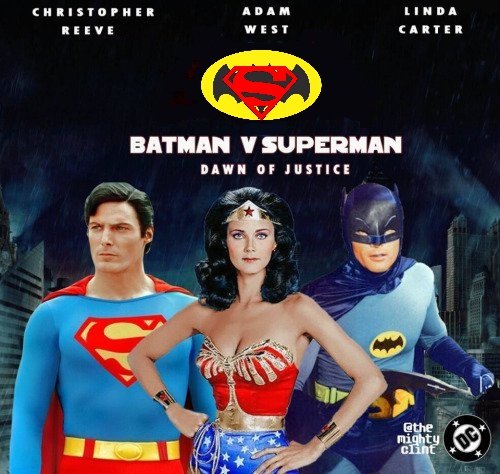
And George Reeves, who starred in The Adventures of Superman, had been dead since 1959, so there was no chance of a "World's Finest" crossover. Stanley Ralph Ross, a writer for Batman '66, created the Wonder Woman series that began with a pilot in 1975 and became a series the next year, starring Lynda Carter. And Christopher Reeve starred in the 1st of 4 Superman movies in 1978. But there was never a crossover between any two of Reeve, Carter and West.
No, we never got this. Nor did we ever get
Reeve, Carter, and Michael Keaton from the 1989 Batman film,
which could have added John Wesley Shipp from the 1990-91 Flash series.
Indeed, there was never an indication on either The Adventures of Superman, Batman ('66), or The New Original Wonder Woman that any other superheroes existed. On the Superman and Wonder Woman shows, there was no indication that there were even any non-powered costumed crimefighters. On Batman '66 (as it's sometimes known), the only other such characters were the Green Hornet and Kato. So, there were no superhero crossovers. No team-ups. No Justice League. No Earth-One or Earth-Two.
And we are all the poorer for it, old chum.As of January 12, 2026, Burt Ward is the last survivor of the main cast. Adam West died in 2017. Of the supporting players: Madge Blake died in 1969, Stafford Repp in 1974, Neil Hamilton in 1984, Alan Napier in 1988, William Dozier in 1991, and Yvonne Craig in 2015.
Of the regular rotation of villains: George Sanders (Mr. Freeze in Season 1) died in 1972, Victor Buono (King Tut) in 1982, Otto Preminger (Mr. Freeze early in Season 2) in 1986, Vincent Price (Egghead) in 1993, Cesar Romero (the Joker) in 1994, David Wayne (the Mad Hatter) in 1995, Burgess Meredith (the Penguin) in 1997, Frank Gorshin (the Riddler in Seasons 1 & 3) in 2005, Eartha Kitt (Catwoman in Season 3) in 2008, Eli Wallach (Mr. Freeze later in Season 2) in 2014, and Julie Newmar (Catwoman in Seasons 1 and 2) and John Astin (the Riddler in Season 2) are still alive.
*
January 12, 1966, as I said, was a Wednesday. It was the off-season for baseball. The NFL and AFL seasons had concluded a few days earlier. And none of the NHL's 6 teams were scheduled for that night. But there were 3 NBA games played:
* The New York Knicks lost to the San Francisco Warriors, 122-114 at the Civic Auditorium in San Francisco, now named for local music promoter Bill Graham. The Knicks' leading scorer was Dick Barnett with 20. Tom Meschery scored 22 for the Warriors. They would move across the Bay to Oakland in 1971, and become the Golden State Warriors, keeping that name when the went back to San Francisco in 2019.
* The Detroit Pistons beat the Philadelphia 76ers, 129-111 at Cobo Hall in Detroit. Wilt Chamberlain scored 41 for the Sixers, but this was matched by the Pistons' Dave DeBusschere, later to star for the Knicks.
* And the Boston Celtics beat the Los Angeles Lakers, 114-102 at the Boston Garden. Bill Russell scored 20 for the Celtics, while Elgin Baylor and Walt Hazzard each scored 21 for the Lakers. This was a rematch of the previous season's NBA Finals, and turned out to be a previous of this season's. The Celtics won those, too.

December 31, 1999 & January 1, 2000: The Millennium

December 31, 1999:  The Millennium arrives. The people of planet Earth survived. At a terrible cost. But we hadn't destroyed ourselves. ...