Showing posts with label 1926. Show all posts

Monday, December 19, 2022

December 20, 1926: The Hornsby-Frisch Trade

Rogers Hornsby

December 20, 1926: The New York Giants trade their 2nd baseman and Captain, Frankie Frisch, and Jimmy Ring to the St. Louis Cardinals for Rogers Hornsby.
Frisch had led the Giants to 4 straight National League Pennants from 1921 to 1924, including winning the 1921 and 1922 World Series. But on August 20, Giant manager John McGraw berated him in front of his teammates for missing a sign that cost the team a run in a game -- with retroactive irony, against the Cardinals. So he quit the team.
Frankie Frisch, the Fordham Flash
Giants management refused to step in and straighten things out between the manager and his best player. And since McGraw was also a part-owner of the Giants, and had the backing of main owner Charles Stoneham, he was not going to be the one to go. And Ring was a mediocre pitcher nearing the end of the line.
John McGraw
In exchange, the Giants got Hornsby, also a 2nd baseman, and the best hitter in the National League. From 1920 to 1925, Hornsby had won 6 straight NL batting titles, batting .370, .397, .401, .384, .424 (which remains the highest batting average since 1901, and the highest in the NL since 1887) and .403. In 1922 and 1925, he also led the NHL in home runs (with 42 and 39, respectively) and RBIs (152 and 143), becoming the 1st player to win the Triple Crown twice (an achievement since matched only by Ted Williams).
How good a hitter was he? Legend tells of the greatest umpire of that era, Bill Klem, calling a pitch that Hornsby took a ball; and, when the catcher objected, Klem told him, "Young man, when the pitcher throws a strike, Mr. Hornsby will show you." In other words, by hitting it.
Hornsby had also managed the Cardinals in 1925 and '26, and even owned some stock in them. Since he had to divest himself of that stock in order for the trade to go through, and majority owner Sam Breadon was offering less than Hornsby wanted, the trade was held up for a while. But it did go through.
At first, this blockbuster deal looked great for the Giants. The trade was great -- for the Cardinals. Hornsby's attitude was considerably worse than Frisch's, and McGraw had enough of him that 1st season, trading him afterward. The Giants didn't win another Pennant until 1933, after McGraw retired.
McGraw could be one ornery cuss, but Hornsby was nearly impossible to deal with. As would a later slugger, Dick Allen, he put up All-Star-worthy numbers 4 years in a row, for 4 different teams: He batted .317 with 11 home runs and 93 RBIs for the 1926 Cardinals; .361, 26 and 125 for the 1927 Giants; a League-leading .387, 21 and 94 for the 1928 Boston Braves; and .380, 39 and 149 for the 1929 Chicago Cubs.
He did help the Cubs win Pennants in 1929 and 1932, but was in decline by the latter year. The Cardinals took him back in 1933, but quickly traded him to their Sportsman's Park landlords, the woeful St. Louis Browns, and he served as a player-manager until 1937, when he retired as a player. He was elected to the Baseball Hall of Fame in 1942.
His .358 lifetime batting average ranks 2nd all-time behind Ty Cobb, and tops all National League hitters and all righthanded hitters. His 301 home runs included 298 in NL play, which topped all NL players at the time of his retirement in 1937. His 2,085 hits were the most in the 1920s. He fell short of 3,000 career hits, though, finishing at 2,930. 
Like later basketball star Bill Russell, he found it considerably harder to be a manager/head coach without himself as a contributing player. He was also a racist, and a compulsive gambler. Had the extent of his betting on horse racing been known at the time, he might have gotten banned from baseball.
But because he had lost so much money gambling, he had to stay employed in baseball, which wasn't easy. He was a player-manager for the Chattanooga Lookouts of the Southern Association in 1938, and the Baltimore Orioles of the International League in 1939. He went back to Texas, and got into the Texas League Playoffs managing the Oklahoma City Indians in 1940 and the Fort Worth Cats in 1942. Then the TL decided to suspend play for the duration of World War II.
He served as a Spring Training instructor for the Chicago White Sox and the Cleveland Indians. In 1949, he broadcast Cubs games on TV. In 1950, he went back to the Texas League, and led the Beaumont Roughnecks to the Pennant. In 1951, he won the Pacific Coast League Pennant with the Seattle Rainiers.
That got the majors' attention again. In 1952, Bill Veeck hired him to manage the Browns. It lasted 2 months, and when Veeck fired him, the Browns players gave him an engraved trophy to thank him. A few weeks later, the Cincinnati Reds hired him, but, frustrated, he resigned with 8 games left in the season. He coached for the Cubs.
In 1962, when no one else would hire him, his former Giant teammate Casey Stengel hired him as 3rd base coach for the expansion New York Mets. Rogers Hornsby coached that season, and was expecting to be brought back for the next season, when he died on January 5, 1963, in Chicago, of a heart attack. He was 66 years old.
Helped tremendously by a change of scenery, teammates and bosses, Frisch helped the Cardinals win Pennants in 1928, '30, '31 and, as player-manager of a team that became known as the Gashouse Gang, '34. So he was a member 8 Pennant winners, and 4 World Series winners.
He was elected to the Hall of Fame in 1947, and became a broadcaster, first for the Giants, then for CBS and its Game of the Week. He became known for moaning about walks: "Oh, those bases on balls!"
As a member of the Hall of Fame's Committee on Veterans, he was known for lobbying for the election of his former Giant and Cardinal teammates, which many later fans have suggested were undeserving. The term "The Frisch Five" was coined, although there is not consensus on who the 5 players are. From the Giants, they have included George "High Pockets" Kelly, Ross Youngs, Dave Bancroft, Travis Jackson and Freddie Lindstrom. From the Cardinals, they have included Jim Bottomley, Chick Hafey, Jesse Haines and Burleigh Grimes.
Frankie Frisch died on March 12, 1973, at the age of 75, at a hospital in Wilmington, Delaware, from injuries sustained in a car crash in nearby Elkton, Maryland.

In 1949, Ogden Nash, my grandmother's favorite poet, even though he was a Giant fan and she was a Brooklyn Dodger fan, wrote "Line-Up for Yesterday" for Sport magazine, an alphabetical list of star players. For the letter F, he wrote: 

F is for Fordham
And Frankie and Frisch;
I wish he were back
With the Giants, I wish.

And for H:

H is for Hornsby;
When pitching to Rog,
The pitcher would pitch,
Then the pitcher would dodge.

*
December 20, 1926 was a Monday. Baseball and football were out of season. The NBA hadn't yet been founded. One game was played in the NHL, and what would eventually be called "the old Madison Square Garden," but was then new: The New York Americans beat the Toronto Maple Leafs, 2-0.

Sunday, December 18, 2022

December 18, 1926: Philadelphia's 1st NFL Championship

Henry "Two-Bits" Homan

December 18, 1926: The Frankford Yellow Jackets can only manage a 0-0 tie against the Pottsville Maroons, despite being at home at Frankford Stadium in Northeast Philadelphia. But it's enough to win them the NFL Championship.

The Yellow Jackets were founded in 1899, as the Frankford Athletic Association. This was a community-based non-profit organization of local residents and businesses. In keeping with its charter, which stated that "all profits shall be donated to charity," all of the team's excess income was donated to local charitable institutions. The beneficiaries of this generosity included Frankford Hospital, the Frankford Day Nursery, the local Boy Scouts, and the local American Legion Post 211. The officers of the Association never received a salary or compensation for their work on behalf of the team.

In 1922, Frankford absorbed the Philadelphia City Champion team, the Union Quakers, and won the unofficial City Championship. Over the course of the 1922 and '23 seasons, they compiled a 6-2-1 record against teams from the National Football League. The NFL thus offered them a franchise for 1924, making them the 1st Pennsylvania-based team in the League.

They played at Frankford Stadium, a small stadium located at 6101 Frankford Avenue, also bordered by Devereaux Avenue, Hawthorne Street and Benner Street. It was 8 miles northeast of City Hall.
They were coached by Guy Chamberlin. The Nebraska native, just 32 years old, also played end on both offense and defense. He is the only man to play on 4 consecutive NFL Champions: The 1921 Chicago Staleys (who became the Bears the next season), the 1922 and '23 Canton Bulldogs, and the 1924 Cleveland Bulldogs. So the Jackets made it 5 in 6 years. And he was player-coach for all but the 1st of these.

His best player was his smallest: At 5-foot-5 and 150 pounds, quarterback and safety Henry Homan was known as "Two-Bits." He only played 6 seasons in the NFL, all for Frankford, but there are those who believe there is an unfair bias against the pioneer players of the NFL when it comes to voting for the Pro Football Hall of Fame, and that Homan should be among the players elected. If he ever is, he will be the smallest player in it.

They were immediately one of the NFL's better teams, going 11-2-1 in 1924, to finish 3rd; and 13-7 in 1925, to finish 6th. They began the 1926 season on September 25, with a 6-6 home tie against the Akron Indians. To get around Pennsylvania's "blue laws," they often scheduled back-to-back games: A home game on a Saturday, and an away game against the same team the next day, Sunday. They hosted the Hartford Blues, beating them 13-0; then went to Hartford, and beat them again, 10-0.

They beat the Buffalo Rangers, 30-0 at home, then swept a home-and-home with the New York Giants, winning each game by a 6-0 score. They beat the Canton Bulldogs, 17-0 at home. Then came a home loss to the Providence Steam Roller (no S on the end), 7-6, followed the next day, Halloween, by a 6-3 win in Providence.

The loss to Providence would prove to be the only one of the season. They beat the defending NFL Champions, the Chicago Cardinals, 33-7 at Frankford. They beat the Duluth Eskimos, 10-0 at home; then the Dayton Triangles, 35-0 at home. On November 25, Thanksgiving, they hosted the Green Bay Packers, and won, 20-14. Two days later, they beat the Detroit Panthers, 7-6 at home.

The demand for tickets was too much for Frankford Stadium, and so their December 4 game with the Chicago Bears was moved to Shibe Park, home of baseball's Philadelphia Athletics. (It was later home to the Phillies and the Eagles as well, and renamed Connie Mack Stadium.) The Jackets won, 7-6, and that game effectively decided the title.. They avenged their loss again by beating the Steam Roller, 24-0 at home, before closing the season with the tie with Pottsville.

The day after that game, the Bears and the Packers played to a 3-3 tie at Wrigley Field in Chicago, but it wouldn't have mattered: The Yellow Jackets were 14-1-2, while the Bears were 12-1-3, and a win would only have brought them to 13-1-2. Under the format that was put in place in 1933, the Jackets and the Bears would have met somewhere in Philadelphia in the NFL Championship Game. (This being an even-numbered year, the Eastern Division Champions would have hosted.) But the Championship Game hadn't been developed yet, and the NFL was still a single-division League, so the Jackets were the Champions. Philadelphia had its 1st NFL title.

Guy Chamberlin was offered more money by the Cardinals, and so he left for them for 1927. The Jackets fell to 6-9-3 in 1927. They bounced back, going 11-3-2 in 1928, to finish 2nd; and 10-4-5 (that's right, 5 ties) in 1929, to finish 3rd.

Then came the Great Depression. The Jackets were just 4-13-1 in 1930. On July 27, 1931, Frankford Stadium burned down. Retail shops are now on the site. For the 1931 season, the team played their 1st 2 home games at Municipal Stadium (later renamed John F. Kennedy Stadium), and their last 2 at the Phillies' Baker Bowl, and finished only 2-6-1. Their last home game was, appropriately, on Halloween, a 14-0 loss to the Portsmouth Spartans. Their farewell was on November 8, a 13-0 loss to the Giants at the Polo Grounds. The Frankford Athletic Association turned ownership of the team back over to the League.

Under the belief, confirmed in November 1933, that Pennsylvania would legalize professional sports on Sundays, former University of Pennsylvania teammates and assistant coaches Bert Bell and James Ludlow "Lud" Wray bought the rights to the NFL franchise in Philadelphia; while Art Rooney did so for Pittsburgh, which had not previously had one. Rooney named his team the Pirates, and renamed them the Steelers in 1940. Bell and Wray named their team the Eagles, for the "Blue Eagle" logo of the National Recovery Administration, and the original colors were blue and yellow, before switching to green and white in 1935.

Contrary to popular belief, although playing in the same city, and their 1st home being Baker Bowl, the Yellow Jackets' last home, the Eagles are not the same franchise as the Yellow Jackets: Bell and Wray had bought only the right to operate an NFL team in Philadelphia, not the team itself. They never approached the Frankford Athletic Association with an offer to buy the Yellow Jackets' name or any of the team's assets, and no player on the '33 Eagles had ever played for the Yellow Jackets. 

The Eagles won the NFL Championships for the seasons of 1948, 1949, 1960 and 2017, but they properly do not claim the Frankford title of 1926, any more than the Philadelphia Phillies claim the Pennants and World Series won by the Athletics, or the Philadelphia 76ers claim the 1947 and 1956 NBA titles won by the Philadelphia Warriors, or MLS' Philadelphia Union claim the 1973 NASL title won by the Philadelphia Atoms.

*

December 18, 1926 was a Saturday. There was 1 other football game, a college game: The University of Utah beat the University of Hawaii, 17-7 at Honolulu Stadium. That ballpark was brand-new, and UH would play there until the opening of Aloha Stadium in 1975, while the Pacific Coast League's Hawaii Islanders played there from 1961 to 1975, before also moving to the new stadium. It was demolished in 1976.

Baseball was out of season, and the NBA hadn't been founded yet. There were 4 games in the NHL:

* The New York Americans lost to the Chicago Black Hawks, 4-2 at the Chicago Coliseum.

* The Ottawa Senators and the Montreal Maroons played to a tie, 0-0 at the Montreal Forum.

* The Boston Bruins beat the Pittsburgh Pirates 3-0 at the Boston Arena (now the Matthews Arena, used by Northeastern University, the oldest remaining arena in the country).

* The Montreal Canadiens beat the Toronto Maple Leafs, 2-0 at the Mutual Street Arena in Toronto.

* And the New York Rangers and the Detroit Cougars -- forerunners of the Red Wings -- were not scheduled.

Wednesday, December 14, 2022

December 14, 1926: Agatha Christie Is Found

December 14, 1926: Agatha Christie, the world's best-selling mystery novelist, is found, safe and sound, 11 days after disappearing. It was a story worthy of one of her own fictional detectives.

Born in Torquay, Devon, in England's West Country in 1890, she struggled as a writer until 1920, when The Mysterious Affair at Styles was published, introducing the world to Hercule Poirot, her Belgian private detective. More Poriot stories followed.

She had married Army officer Archie Christie in 1914, and both served in World War I: Archie in the Royal Flying Corps, Agatha as a nurse back in Torquay. He survived the war, and Agatha's only child, Rosalind, was born in 1919.

In April 1926, Agatha's mother, Clara Miller, died, leaving her in a deep depression. In August, Archie asked her for a divorce, because he'd fallen in love with another woman. She wouldn't grant it. On December 3, Archie announced he was going to spend the next weekend with friends, without Agatha. That night, she drove off from their house at Sunningdale, Berkshire, about 25 miles west of London.

The next day, her car, a Morris Cowley, was found at Newlands Corner, about 14 miles to the southeast. Inside were women's clothes and an expired driver's license. The search was on, with the police, civilians, and early airplanes searching the rural area. Sherlock Holmes' creator, Dr. Sir Arthur Conan Doyle, gave one of her gloves to a spirit medium, with no luck. The British press, always on the look for a sensational story, the more salacious the better for them, went wild. The rest of the world covered it as well, with The New York Times featuring an account of her disappearance on a front page.

On December 14, she was found, at the Swan Hydropathic Hotel in Harrogate, North Yorkshire, 184 miles north of her house. She was registered as Mrs. Tressa Neele, from Cape Town, South Africa. This was a dig at her husband: His mistress was named Nancy Neele, spelled exactly the same way.

The next day, her sister Margaret, a.k.a. Madge, took Agatha to her home in Cheadle, outside Manchester, and kept her "in guarded hall, gates locked, telephone cut off, and callers turned away." "Callers" meaning "visitors." She acted as though she had no memory of leaving Sunningdale, and 2 doctors diagnosed her memory loss as genuine. Perhaps she had a nervous breakdown, but the fact that she had signed her name as that of her husband's mistress led many to consider it a publicity stunt, perhaps to frame her husband for murder (despite the lack of a dead body), and turn on her.

A year later, the December 1927 issue of The Royal Magazine published The Tuesday Night Club, a Christie story that introduced a new consulting detective, an old lady whose vast experience enable her to solve current cases. The following year, Archie got the divorce he wanted, and married Nancy Neele. He died in 1962.

Also in 1928, Agatha first rode the Orient Express, the already-famous Paris-to-Istanbul train, and traveled to the Middle East, to indulge her love of archaeology. On a subsequent trip in 1930, she met archaeologist Max Mallowan, 13 years younger, and they married, and went on expeditions together. They were together until death did they part.

In 1934, she published Murder On the Orient Express, in which Poirot is on the eponymous train, and is called on to solve a murder on board. It became her most famous work, although it wasn't filmed until 1974, with Albert Finney playing Poirot. It was filmed again in in 2001, with Alfred Molina; 2010, with David Suchet, who is usually considered to be the role's definitive portrayer; and 2015, with Kenneth Branagh.

Agatha Christie was knighted in 1971, and died in 1976. Her daughter, Rosalind Hicks, married an Army officer just as her mother had, but he was killed in action in World War II. She remarried, and guarded her mother's estate and legacy until her own death in 2004. Her only child, Matthew Prichard, inherited the estate, which is now run by his son, James Prichard.

*

December 14, 1926 was a Tuesday. Baseball was out of season. Football was in midweek. The NBA hadn't yet been founded. There were 3 NHL games that night:

* The New York Americans lost to the Ottawa Senators, 2-0 at the new Madison Square Garden -- which, since 1968, has been known as the old Madison Square Garden. Cy Denneny scored both goals.

* The Montreal Maroons beat the Toronto St. Patricks, 3-0 at the Montreal Forum. The following season, under new ownership, the St. Patricks were renamed the Maple Leafs, and their dominant color from green to blue.

* And the Boston Bruins beat the Detroit Cougars, 7-2 at the Boston Arena (now the Matthews Arena). The Cougars became the Detroit Falcons in 1930, and the Detroit Red Wings in 1932.

Sunday, December 4, 2022

December 4, 1926: Poland's Ekstraklasa Is Formed

December 4, 1926, 100 years ago: The Ekstraklasa is formed, as the top level of Polish soccer. Or football. Or, as it's known in Poland, piłka nożna. However, the announcement of the founding wasn't made until March 1, 1927, so 1927-28 was its 1st season of play.

From its founding until 1948, it was known simply as the Liga, or the League. From 1949 to 2004, it was "I Liga," or "pierswsza liga," or "first league." In 2004, it was renamed the Ekstraklasa, or "top league," and was sponsored by Poland's top communications company, then known as Idea, so it was "Idea Ekstraklasa." After just 1 year, the company rebranded, and the league became "Orange Ekstraklasa."

In 2011, another communications company bought the sponsorship, and it was the T-Mobile Ekstraklasa. In 2016, the national lottery bought the rights, and so it became the Lotto Ekstraklasa. Since 2019, the rights have been held by Powszechna Kasa Oszczędności Bank Polski, or "General Savings Bank, Bank of Poland," and is known as the PKO Bank Polski Ekstraklasa.

Somehow, the league survived the Great Depression of the 1930s, the Nazi occupation of 1939-45, and the Communist rule of 1945-89. It is more popular than ever. However, the best Polish players tend not to stay: Kazimierz Deyna, Jerzy Dudek and Wojciech zczęsny went to England's Football League, Jan Domarski went to what is now Ligue 1 in France, Władysław Żmuda and now Piotr Zieliński went to Italy's Serie A, and Robert Lewandowski and Jakub Błaszczykowski went to Germany's Bundesliga.

Legia Warsaw, the leading team in the national capital, and founded by the Polish Army, have won the most titles, 15. Górnik Zabrze and Wisła Kraków have each won 14. Ruch Chorzów have won 13. Lech Poznań have won 8. Cracovia, in Kraków, have won 5, but none since 1948. Pogoń Lwów won 4, but were dissolved when World War II ended in 1945, because the city of Lwów was transferred to the Soviet Union, and later to Ukraine, under the name Lviv.

There have been 2 titles each won by ŁKS Łódź, Polonia Bytom, Polonia Warsaw, Stal Mielec, Śląsk Wrocław, Warta Poznań and Zagłębie Lubin. There have been 1 title each for Garbarnia Kraków, Szombierki Bytom and Piast Gliwice
The championship trophy

The Polish Cup, or Puchar Polski, has been won by Legia Warsaw 19 times (including 7 League and Cup "Doubles," in 1955, 1956, 1994, 1995, 2013, 2016 and 2018); Górnik Zabrze 6 times (including 3 Doubles, in 1965, 1971, 1972); 5 times by Lech Poznań (including a Double in 1984); 4 times by Wisła Kraków (including a Double in 2003); 4 times by Zagłębie Sosnowiec, the most of any Cup winner that has never won the League; 3 times each by Ruch Chorzów (including a Double in 1974), GKS Katowice and Amica Wronki; twice each by Raków Częstochowa, Śląsk Wrocław, Polonia Warsaw, Arka Gdynia and Lechia Gdańsk; and once each by Jagiellonia Białystok, ŁKS Łódź, Widzew Łódź, Cracovia, Gwardia Warsaw, Wisła Plock, Stal Rzeszów, Miedź Legnica, Dyskobolia Grodzisk and Zawisza Bydgoszcz.
The Polish Cup

(UPDATE: Raków Częstochowa won their 1st Ekstraklasa in 2023. Jagiellonia Białystok won their 1st in 2024. Lech Poznań won it in 2025 and 2026, making for 10 titles. Legia won the Cup in 2023 and 2025, for 19 wins. Wisła Kraków won a 5th Cup in 2024. Górnik Zabrze won a 7th Cup in 2026.)

My ancestors came from Borki Wielkie, in Masuria, in northeastern Poland, a section that had belonged to East Prussia and thus the German Empire. The closest major city to it isn't even in Poland: It's Kaliningrad, Russia, 78 miles north. Gdańsk is 140 miles northwest, and Warsaw is 160 miles south. So if there are any family members left there, who would they support? Most likely, Legia, as they are the default team for the country, the most successful, and thus also the most popular -- but also, as with the Yankees, the most hated.

To my regret as an American soccer fan of Polish descent, Polish teams have not done well in European tournaments. ŁKS Łódź won the Intertoto Cup in 1965 and 1967. Wisła Kraków won it in 1969, 1970 and 1973. The best performance of any Polish team in the European Cup/UEFA Champions League was Legia, reaching the Semifinal in 1970; and Widzew Łódź, reaching the Semifinal in 1983.

To my further regret, Poland's record in international competition is poor. Out of 21 World Cups staged from 1930 to 2018, they have played in only 8, having withdrawn in 1934 and 1954, and refusing to enter in 1930 and 1950. They reached the Semifinals in 1974 and 1982; the Quarterfinals in 1978; the Round of 16 in 1938 and 1986; and the Group Stage in 2002, 2006 and 2018. (UPDATE: They reached the Round of 16 in 2022, but did not qualify in 2026.)

The European Championships were established in 1960, and they didn't qualify until 2008. They qualified as co-hosts with Ukraine in 2012, and reached the knockout stage for the 1st time in 2016, getting to the Quarterfinals.

*

December 4, 1926 was a Saturday. In English soccer, Arsenal defeated Manchester-area team Bury, 1-0 at the Arsenal Stadium, nicknamed Highbury for its North London neighborhood.

There was 1 score in college football: Notre Dame beat USC, 13-12. It was the 1st meeting between the schools, and the birth of a great rivalry. I have a separate entry for this event.

There was 1 score in the NFL: The Frankford Yellow Jackets beat the Chicago Bears, 7-6 at Shibe Park in Philadelphia. This game was considered big enough to move from the Jackets' usual home, Frankford Stadium in North Philadelphia. The Jackets went on to win the NFL Championship.

Baseball was out of season. Professional basketball was hardly major league at this point. There were 5 games in the NHL:

* The New York Rangers lost to the Detroit Cougars, 1-0 at the Border Cities Arena (now the Windsor Arena) in Windsor, Ontario, Canada, across the Detroit River from Detroit. The Cougars moved to the Olympia Stadium in Detroit in 1927, became the Detroit Falcons in 1930, and became the Detroit Red Wings in 1932.

* The New York Americans beat the Toronto St. Patrick's, 1-0 at the Mutual Street Arena in Toronto. The St. Patricks became the Maple Leafs in 1927.

* The Chicago Black Hawks beat the Montreal Maroons, 5-3 at the Montreal Forum.

* The Ottawa Senators beat the Montreal Canadiens, 4-1 at the Ottawa Auditorium.

* And the Boston Bruins beat the Pittsburgh Pirates, 4-3 at the Duquesne Gardens in Pittsburgh. Harry Oliver scored the winning goal, 7:25 into overtime.

December 4, 1926: The 1st Notre Dame vs. USC Game

December 4, 1926: The University of Notre Dame and the University of Southern California play each other in football, at the Los Angeles Memorial Coliseum. It was the 1st meeting between the schools, and the birth of a great rivalry.

So why do a school based in South Bend, Indiana and one based in Los Angeles, California play each other, just about every year? Blame Bonnie Rockne and Marion Wilson, the wives of, respectively, Notre Dame head coach Knute Rockne and USC athletic director Gwynn Wilson.

In 1926, USC, already a traditional power in West Coast college football, had an open date on their schedule, and were looking for a major opponent to fill it. The Wilsons went to Lincoln, Nebraska to watch Notre Dame, themselves already a traditional power nationwide, play the University of Nebraska on Thanksgiving Day. Nebraska won, 17-0.

Mr. Wilson approached Mr. Rockne about the idea of the Fighting Irish coming to L.A. to play USC. He didn't want to do that much traveling. After all, this was still the early days of airplanes, and the year the federal highway system was founded, so most long-distance travel was still done by train. But Mrs. Wilson told Mrs. Rockne that a trip every 2 years to sunny Southern California was better than one to snowy, hostile Nebraska. Mrs. Rockne talked Mr. Rockne into it, and the game was played on December 4, 1926, at the Coliseum. Notre Dame won, 13-12, and Rockne called it the greatest game he'd ever seen.

For the 1927 and 1929 games, Notre Dame had the home field, and since their on-campus Cartier Field topped out at 30,000 seats, they chose to play at Soldier Field in Chicago. Their 7-6 win in 1927 and their 13-12 win in 1929 were both seen by about 120,000 people, among the largest crowds in college football history.

Notre Dame Stadium opened on the South Bend campus in 1930. It long had a capacity of 59,075, until a 1997 renovation expanded it to 77,622. And so, every year, from 1930 onward, they've traded home fields -- except for the World War II seasons of 1943, '44 and '45, when wartime travel restrictions made intersectional college football games inappropriate, with even the major bowl games restricting themselves to matchups of teams from their own regions.

But every year since 1946, USC has hosted the game at the Coliseum in even-numbered years, usually on the Saturday of Thanksgiving weekend; while Notre Dame had hosted it in South Bend in odd-numbered years, usually in the middle of October, because the weather is usually better in the Midwest then than it would be in late November.

And, since 1951, it has always been broadcast on national television. When it's at USC, ABC broadcasts it in prime time. When it's at NBC, since 1991, they've broadcast it, leading to jokes about NBC standing for "Notredame Broadcasting Company."

In 1931, USC won in South Bend for the 1st time, coming from 14-0 down to win 16-14 on Johnny Baker's 33-yard field goal with 1 minute left, ending Notre Dame's 26-game unbeaten streak, a streak that had been intact despite Rockne's death in a plane crash early in the year. In 1938, Notre Dame went into the game ranked Number 1, but USC beat them, 13-0. In 1948, Notre Dame went into the game ranked Number 1 and with a 21-game winning streak, but USC held them to a 14-14 tie.

In 1964, Notre Dame went into the game ranked Number 1, but USC beat them, 20-17. In 1968, USC went into the game ranked Number 1, but Notre Dame tied them, 21-21. In 1972, Anthony Davis scored 6 touchdowns in a win. In 1974, Notre Dame led 24-0, but USC won 55-24. It was "The Anthony Davis Game," as A.D. scored 4 times.

From 1983 to 1993, Notre Dame beat USC 11 straight times, with a tie in 1994 and another Irish win in 1995. It became a running gag on the TV show Live! with Regis and Kathie Lee: The Monday morning after the game, Kathie Lee Gifford would take a dollar bill and slip it to Regis Philbin, because he, a Notre Dame graduate, had a bet with Kathie Lee's husband, Frank Gifford, an ABC sportscaster and one of USC football's biggest legends. From 2002 to 2009, USC won 8 straight years, including the 2005 game won with the supposedly illegal push of Reggie Bush into the end zone in South Bend.

Including the game of November 26, 2022, a 38-27 USC win, Notre Dame leads the rivalry, 48-37, with 5 ties. The teams play for the Jeweled Shillelagh, a trophy that goes to the winning team each year. Although it's not the kind of thing you normally show in public.
Take a guess as to why.
 
Alabama, Michigan or Ohio State fans might object, but it could be argued that Notre Dame and USC are the two greatest college football programs. Notre Dame have won 11 National Championships, 22 bowl games, and 7 Heisman trophies -- but no Conference Championships, since they've never been in a conference. USC have won 11 National Championships, 39 Conference Championships, 36 bowl games, and 8 Heisman Trophies.

UPDATE: As of the 2025 season, Notre Dame leads, 51-37-5. But USC's move to the Big Ten Conference -- a move that the Midwest-based Notre Dame should have made decades ago, but never has -- led to scheduling issues that prevented games between the schools for the 2026, '27, '28 and '29 seasons. They've agreed to play in 2030, '31, '32 and '33, but early in the season, instead of in the middle when it's Notre Dame's turn to host and late when it's USC's.


*

December 4, 1926 was a Saturday. In English soccer, Arsenal defeated Manchester-area team Bury, 1-0 at the Arsenal Stadium, nicknamed Highbury for its North London neighborhood.

I have a separate entry for this event.

There was 1 score in the NFL: The Frankford Yellow Jackets beat the Chicago Bears, 7-6 at Shibe Park in Philadelphia. This game was considered big enough to move from the Jackets' usual home, Frankford Stadium in North Philadelphia. The Jackets went on to win the NFL Championship.

Baseball was out of season. Professional basketball was hardly major league at this point. There were 5 games in the NHL:

* The New York Rangers lost to the Detroit Cougars, 1-0 at the Border Cities Arena (now the Windsor Arena) in Windsor, Ontario, Canada, across the Detroit River from Detroit. The Cougars moved to the Olympia Stadium in Detroit in 1927, became the Detroit Falcons in 1930, and became the Detroit Red Wings in 1932.

* The New York Americans beat the Toronto St. Patrick's, 1-0 at the Mutual Street Arena in Toronto. The St. Patricks became the Maple Leafs in 1927.

* The Chicago Black Hawks beat the Montreal Maroons, 5-3 at the Montreal Forum.

* The Ottawa Senators beat the Montreal Canadiens, 4-1 at the Ottawa Auditorium.

* And the Boston Bruins beat the Pittsburgh Pirates, 4-3 at the Duquesne Gardens in Pittsburgh. Harry Oliver scored the winning goal, 7:25 into overtime. 

Wednesday, November 16, 2022

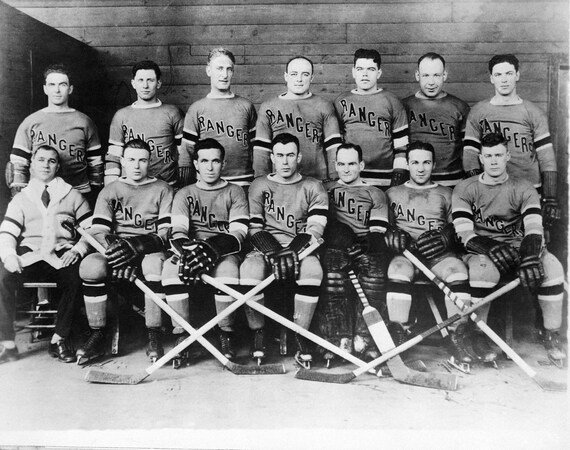
November 16, 1926: The New York Rangers Debut

November 16, 1926: The New York Rangers make their National Hockey League debut. They beat the Montreal Maroons, 1-0 at Madison Square Garden.

The first hockey team in New York was the New York Americans, who debuted in 1925, to fill the gap in the NHL left by the folding of the Ontario-based Hamilton Tigers. They were awful on the ice, but drew a lot of fans to the newly-built third Madison Square Garden, on 8th Avenue between 49th and 50th Streets. (The 1st 2 Gardens were built off the northeastern corner of Madison Square, on Madison Avenue between 26th and 27th Streets -- the 1st in 1879, the 2nd in 1890. The New York Life Building stands on the site now.)

The 3rd Garden, and the corporation that ran its business and events, was owned by George "Tex" Rickard, the nation's foremost boxing promoter. (One of his limited partners was wrestling promoter Jess McMahon, grandfather of WWE boss Vince McMahon.) Tex was so pleased by the profits from "the Amerks" that he applied to the NHL to have a second team at The Garden. Why not? New York had enough baseball fans for 3 teams, and enough football fans for 2 teams; so, surely it had enough hockey fans for 2 teams. He turned out to be wrong about that -- but in a way that benefited him.

The new team was quickly nicknamed "Tex's Rangers" by the media, and Tex went with it, outfitting them in the same colors as the Amerks: Red, white and blue. He hired Lester Patrick, one of the greatest defensemen of the previous era, as head coach and general manager.

Patrick had played for, among other teams, the now-defunct Montreal Wanderers. The Maroons had become the team of Montreal's English-speaking community, and the Canadiens that of its French speakers. There would be a similar divide in New York: The Amerks were the team for blue-collar fans, while the Rangers were billed as "the classiest team in hockey," with some fans coming to The Garden in tuxedos and gowns, as if they were attending the opera or a Broadway opening night. Tex even had the puck dropped at the same time Broadway curtains then went up: 8:45 PM.

The Maroons were defending Stanley Cup Champions, but that didn't faze the Rangers. They were 1 of 4 new teams in the NHL, made possible by the collapse of the Pacific Coast Hockey Association, which made such an expansion possible. The others were the Chicago Blackhawks, the Detroit Cougars (who became the Falcons in 1930 and the Red Wings in 1932), and the Pittsburgh Pirates (who became the Philadelphia Quakers in 1930 and folded due to the Great Depression in 1931).

Patrick had coached and managed in the PCHA. In fact, he and his brother Frank had not only built the Vancouver Millionaires and their British Columbia rivals the Victoria Cougars, they had financed the building of both teams' arenas, and the Cougars' rink was named the Patrick Arena. The Red Wings-to-be were named the Cougars because they were made up of most of the Victoria team, the last team from outside the NHL to win the Stanley Cup, in 1925.

So Lester knew to stock the Rangers with as many players with PCHA experience as he could. His 1st signing, and the Rangers' 1st Captain, was right wing Bill Cook from the Saskatoon Sheiks. He also signed Cook's brother and Saskatoon teammate, left wing Frederick "Bun" Cook. He signed center Frank Boucher from the Vancouver Maroons (formerly the Millionaires). And he signed goaltender Hal Winkler from the Calgary Tigers.

Defenseman Ivan Johnson, known as "Ching" because, in that politically-incorrect time, someone thought he looked Chinese, had starred for teams in Minneapolis. Patrick also signed goaltender Lorne Chabot.

So while the Ranger franchise was brand-new, it had plenty of on-ice experience. And with 1 minute and 23 seconds left in the 2nd period, it was, appropriately enough, Bill Cook who scored the 1st goal in team history. Winkler kept the Maroons at bay, and the Rangers were 1-0 victors. Winkler thus became the 1st goalie to have a shutout in his NHL debut.

But Winkler only played 8 games for the Rangers, before Patrick traded him to the Boston Bruins. It was Chabot who would go on to become the 1st great Ranger goalie, and also the 1st hockey player on the cover of Time magazine, which was founded in 1923.

But Chabot is best known for a game he had to leave early due to an injury. In 1928, at the close of the Rangers' 2nd season, they faced the Maroons in the Stanley Cup Finals. In Game 2, Chabot was struck in the eye by the puck -- no masks in those days -- and had to leave the game. The Rangers had no other goalie. So Patrick 44 years old, 12 years past his last game, and having played in goal only once, took on the post, stopped 18 of 19 shots, and the Rangers won in overtime. With the League allowing the emergency signing of Americans goalie Joe Miller, the Rangers won the Cup.

The Rangers also won the Cup in 1933 and 1940, and also reached the Finals in 1929, 1932 and 1937. Rickard lived to see the first Cup, but fell victim to appendicitis, and, in the days before antibiotics, died in 1929, just 58 years old. He had lived just long enough to see the first of what he planned on being 6 copies of The Garden built around the country. He called it the Boston Madison Square Garden -- which, of course, was soon shortened to just "the Boston Garden." (Maple Leaf Gardens in Toronto, aside from being one of the Original Six teams' arenas, had no connection to Rickard.)

The Rangers' success meant doom for the Americans: In spite of a stirring Playoff win over the Rangers in 1938, the manpower drain of World War II killed them in 1942. The Rangers didn't fare much better, going into a tailspin: A Finals berth in 1950 was an aberration until they got good again in the late 1960s, moving into the 4th and current Madison Square Garden, between 31st and 33rd Streets, and between 7th and 8th Avenue in 1968.

The Rangers reached the Finals in 1972, but that team got old fast, and by 1975, a bitterness had set in that rendered any idea of the Ranger team, or its fans being "classy" a relic. They became one of the dirtiest teams in hockey, reaching the Finals in 1979, but falling short again and again before winning the Cup again in 1994. Since then, they have reached the Finals only once more, in 2014.

UPDATE: Through the 2025-26 season, the Rangers do not have a team Hall of Fame, but they have a lot of players who were elected to the Hockey Hall of Fame. Many of those weren't Rangers for very long. These contributed to at least a Stanley Cup Finals appearance:

* From the 1928 Stanley Cup win: Head coach and general manager Lester Patrick, defenseman Ivan "Ching" Johnson, and the "A Line" of center Frank Boucher, right wing Bill Cook, and his brother, left wing Frederick "Bun" Cook. Although goaltender Lorne Chabot was named to The Hockey News' 1998 list of the 100 Greatest Hockey Players, he has never been elected to the Hall of Fame.

* From the 1933 Stanley Cup win: Patrick, Johnson, Boucher, both Cook brothers, defenseman Earl Seibert, and left wing Albert "Babe" Siebert. Earl and Babe were not related: Note the difference in the spelling of their surnames. Goaltender Andy Aitkenhead has not been elected to the Hockey Hall of Fame.

* From the 1940 Stanley Cup win: Lester Patrick, now only the general manager: Boucher, now the head coach; left wing Lynn Patrick, Lester's son; defensemen Art Coulter and Walter "Babe" Pratt, centers Neil Colville and Clint Smith, and right wing Bryan Hextall.

* From the 1950 Stanley Cup Finals: Boucher, now the GM; goaltender Chuck Rayner, defenseman Allan Stanley, and centers Edgar Laprade and Buddy O'Connor.

Defenseman Murray "Muzz" Patrick, another son of Lester, and Colville's brother, Matthew "Mac" Colville, also played on this Ranger team, but neither has been elected to the Hall of Fame. Nor has goaltender Davey Kerr. Bryan Hextall's sons Bryan Jr. and Denis, grandson Ron all played in the NHL. His granddaughter Leah became a hockey broadcaster. His great-grandson Brett played in the minor leagues, and now works in the Pittsburgh Penguins' front office, under his father, general manager Ron.

* From the 1950s and 1960s, the era in which television allowed Ranger fandom to grow by leaps and bounds, despite the team's struggles: Goaltender Lorne "Gump" Worsley, defensemen Harry Howell and Bill Gadsby, and right wing Andy Bathgate.

* From the 1972 Stanley Cup Finals: Executive William M. Jennings, head coach and general manager Emile Francis, goaltender Eddie Giacomin, defenseman Brad Park, center Jean Ratelle and right wing Rod Gilbert. Left wing Vic Hadfield, from this team, has not been elected to the Hall of Fame, but his Number 11 has been retired, as have the 1 of Giacomin, the 7 of Gilbert, and the 19 of Ratelle.

* From the 1979 Stanley Cup Finals: Jennings, head coach and GM Fred Shero, and center Phil Esposito; and broadcaster Sal Messina.

* From the 1994 Stanley Cup win: General manager Colin Campbell, center Mark Messier; right wing Glenn Anderson (who played only 35 games for the Rangers); defensemen Brian Leetch, Kevin Lowe and Sergei Zubov; and broadcasters Messina, Sam Rosen and John Davidson.

Head coach Mike Keenan has not been elected to the Hall of Fame. Nor have right wing Adam Graves or goaltender Mike Richter, yet the Rangers have retired Graves' Number 9 and Richter's Number 35. In 1996, the Rangers acquired center Wayne Gretzky, who played 3 seasons for them, and his Number 99 has been retired.

* From the 2014 Stanley Cup Finals: Rosen and goaltender Henrik Lundqvist, whose Number 30 has been retired.

Messina, Rosen and Davidson each received the Hall of Fame's award for broadcasters, the Foster Hewitt Memorial Award. Although both were longtime Ranger broadcasters before any of them, neither Win Elliott nor Marv Albert ever received the award. Albert did receive the Curt Gowdy Media Award from the Basketball Hall of Fame for his Knicks broadcasts, also from Madison Square Garden.

The Rangers have an unusual pattern of uniform number retirements. They are willing to honor two players to a number, but not always. Lester Patrick played just 2 games for the Rangers, but 1 was one of the most important games in team history, yet the Number 16 he wore has not been retired, not for him or for anyone else.

Ching Johnson won 2 Cups and wore 3, but it has been retired only for Harry Howell, who never played on a Cup Finalist in New York. Frank Boucher wore 7, and given that he was the best player on 2 Cup-winning teams and the head coach of another, he is arguably the greatest figure in team history behind Lester Patrick. But 7 has been retired only for Rod Gilbert, who is, to be fair, still the team's all-time leading scorer.

Lynn Patrick won a Cup, and is in the Hall of Fame. Andy Bathgate is in the Hall of Fame, but his only Cup came with the Toronto Maple Leafs. Adam Graves won a Cup, but is not yet in the Hall. All 3 men wore 9, but the number is retired for Bathgate and Graves, but not Patrick.

Vic Hadfield appeared in only 1 Cup Finals, and has not been elected to the Hall of Fame, yet got the honor of getting 11 retired along with Mark Messier, the most important Ranger since 1940.

*

November 16, 1926 was a Tuesday. There were 2 other NHL games that night. The Boston Bruins beat the Montreal Canadiens, 4-1 at the Boston Arena -- now the Matthews Arena, home to Boston University. And the Americans beat the Pittsburgh Pirates, 1-0 at the Duquesne Gardens.

Those were the only scores: Baseball was in the off-season, the NFL played on Sundays, and the NBA hadn't been founded yet.

The Rangers first won the Stanley Cup on April 14, 1928, beating the Montreal Maroons, 3 games to 1. Game 2, when Rangers head coach and general manager Lester Patrick, at age 44, became a victorious emergency goaltender, was played on April 7. There were no other games on that day: The NBA hadn't been founded yet, and the baseball season was about to start.

Monday, October 31, 2022

October 31, 1926: The Death of Harry Houdini

October 31, 1926: Harry Houdini could escape from anything. Except death, the one thing from which no person escapes.

Erik Weisz was born on March 24, 1874 in Budapest, Hungary, then part of the Austrian Empire. When he was 4 years old, his family took him to America, to Appleton, Wisconsin. To fit in with the largely German population, his name was re-spelled Erich Weiss, although pronounced the same way.

The family moved to New York, where little Erich became a trapeze artist and a competitive cross-country runner. In 1890, he read The Memoirs of Robert-Houdin, by the Frenchman regarded as the master of modern magic, Jean-Eugène Robert-Houdin.

Incorrectly thinking that adding a letter I to the end of a French name meant "like," he wanted people to think he was "like Robert-Houdin." He also admired an American magician named Harry Kellar, and so he took the stage name "Harry Houdini."

By 1908, his own reputation solid, Harry had lost his respect for his forebear, believing him to have taken credit for others' innovations. Much like later magician James "The Amazing" Randi, he took to debunking famous people he considered frauds, especially in magic, and published The Unmasking of Robert-Houdin.

Although he mastered many magic tricks, he became best known as an escape artist. All over the world, over the 1st 2 decades of the 20th Century, he challenged police forces to keep him locked up. Soon, he extended his repertoire to include chains, ropes slung from skyscrapers, straitjackets, being locked in trunks, and having to escape from and hold his breath inside a sealed milk can with water in it.

In 1894, he married Wilhelmina Beatrice Rahner, a Brooklyn-born daughter of German immigrants. She became known as Bess Houdini, and assisted him in his act. They never had children, and Bess' niece, Marie Blood, believed that Bess had a medical condition that prevented it.

On October 22, 1926, before a show at the Princess Theatre in Montreal, Houdini was in his dressing room, with some students at nearby McGill University. One, Jocelyn Gordon Whitehead, asked Houdini if it was true that punches in the stomach did not hurt him. He said they didn't. However, this was only true if he was properly braced for them. He had recently broken an ankle, and was sitting down, and getting up would have been painful. Whitehead began punching Houdini, and did so several times before Houdini told him to stop.

The show went on as scheduled, but Houdini was in pain throughout. For the next 2 days, the pain was bad enough that he couldn't sleep. Finally, in Detroit for a show at the Garrick Theater, he saw a doctor, who diagnosed him with appendicitis and a fever, and told him to have immediate surgery. (With a fever, this would have been a bad idea.) He went onstage that night, anyway, and his fever reached 104, and he passed out. He was taken to Grace Hospital, and died there from peritonitis on October 31, at the age of 52.

Did he already have appendicitis before the punches? It's been suggested that he didn't take the pain as seriously as he should have, since he thought it was from the punches. But after taking statements from the other McGill students, his insurance company concluded that the death was due to the dressing-room incident, and paid Bess a double indemnity.

And so, the Master of Magic was dead -- perhaps appropriately, on Halloween. Bess operated a tea house until her own death, in 1943. Whitehead was not charged with any crime in connection with Houdini's death, and lived in obscurity and poverty until 1954.

To this day, when asked to perform a seemingly impossible task, some people ask, "What do you think I am, a magician?" Some take it a step further, and ask, "What am I, Houdini?" And any seemingly miraculous escape is called "pulling a Houdini" or "a Houdini act."

In a 2015 episode of the YouTube series Epic Rap Battles of History, "Epic" Lloyd Ahlquist played Houdini, while his wife Josie Ahlquist played Bess Houdini. His opponent, as played by "Nice" Peter Shukoff, was more recent magician David Copperfield.

*

October 31, 1926 was a Sunday. British entertainer Jimmy Savile was born. Meaning this day stunk in two ways: We lost the greatest magician of all time, and gained a cruel sex fiend.

Baseball season had ended 3 weeks earlier, with the St. Louis Cardinals beating the New York Yankees in the World Series. Professional basketball was still very minor-league. And the NHL season was 16 days away. But there were 7 games in the NFL that day:

* The Frankford Yellow Jackets beat the Providence Steam Roller, 6-3 at the Providence Cycledrome in Providence, Rhode Island.

* The Kansas City Cowboys beat the Hartford Blues, 7-2 at the East Hartford Velodrome in East Hartford, Connecticut.

* The Pottsville Maroons beat the Buffalo Rangers, 14-0 at Minersville Park in Pottsville, Pennsylvania.

* The Detroit Panthers beat the Canton Bulldogs, 6-0 at Navin Field in Detroit. (That ballpark was renamed Briggs Stadium in 1938, and Tiger Stadium in 1961.)

* The Green Bay Packers beat the Chicago Cardinals, 3-0 at Normal Park in Chicago.

* The Chicago Bears beat the Akron Indians, 17-0 at Wrigley Field in Chicago.

* The Duluth Eskimos beat the Milwaukee Badgers, 7-6 at Athletic Park in Milwaukee. (That ballpark was renamed Borchert Field the next year.)

Sunday, October 23, 2022

October 23, 1926: Tulane Stadium Opens

October 23, 1926: Tulane Stadium opens in New Orleans. Hosts Tulane University lose to Auburn, 2-0. Auburn scored a safety, one of the rare instances of the expression "Defense wins games" actually being true.
The Tulane Green Wave would continue to play in the 80,000-seat rounded horseshoe until the 1974 season. They had already won the Southern Conference title in 1925, and would win it again in 1929, 1930 and 1931. They would win the Southeastern Conference title in 1934, 1939 and 1949, before downgrading their program after the 1965 season.
From 1935 to 1975, usually on New Year's Day, the stadium would also host the Sugar Bowl, which became the stadium's nickname as well, usually with the Southeastern Conference Champions, often going for the National Championship. They were won in the Sugar Bowls of 1939, by Texas Christian University (TCU); 1940, by Texas A&M; 1952, by Maryland; 1953, by Georgia Tech; 1958, by Louisiana State (LSU), Tulane's arch-rivals; 1960, 1961 and 1963, by Mississippi (Ole Miss); 1961, by Alabama; and 1973, by Notre Dame.
The NFL's New Orleans Saints played there from their 1967 inception through 1974. Tom Dempsey set an NFL record there by kicking a last-play 63-yard field goal to give the Saints a win over the Detroit Lions in 1970.
It also hosted Super Bowl IV in 1970: Kansas City Chiefs 32, Minnesota Vikings 14; Super Bowl VI in 1972: Dallas Cowboys 24, Miami Dolphins 3; and Super Bowl IX in 1975: Pittsburgh Steelers 16, Vikings 6. In each case, it was the 1st World Championship won by each team.
Tulane Stadium was replaced by the Louisiana Superdome in 1975, and demolished in 1979. Yulman Stadium, Tulane's 30,000-seat stadium starting in 2014, was built on the site.
*
October 23, 1926 was a Saturday. These other notable college football games were played:
* Alabama beat Sewanee, 2-0 at Rickwood Field in Birmingham.
* Stanford beat Oregon, 29-12 at Hayward Field in Eugene, Oregon. Alabama and Stanford would play each other to a 7-7 tie in the Rose Bowl on January 1, 1927, and share the National Championship.
* Army beat Boston University, 41-0 at Michie Stadium in West Point, New York; and Navy beat Colgate, 13-7 at Thompson Stadium in Annapolis, Maryland.
* Among New York City teams, Columbia beat Duke, 24-0 at Baker Field; and Fordham lost to Washington & Jefferson, 28-13 at the Polo Grounds. Both stadiums were in Upper Manhattan. And New York University (NYU) beat Rutgers, 30-0 at Yankee Stadium in The Bronx. The other major New Jersey team, Princeton, beat Lehigh, 7-6 at Palmer Stadium in Princeton.
* Notre Dame beat Northwestern 6-0 at Dyche Stadium outside Chicago in Evanston, Illinois. Dyche Stadium had just opened 3 weeks earlier. In 1997, it was renamed Ryan Field.
* In rivalry games, Carnegie Tech (now Carnegie-Mellon) beat their neighbors, the University of Pittsburgh, 14-0 at Pitt Stadium; Virginia Tech beat Virginia, 6-0 at Miles Stadium in Blacksburg, Virginia; and Washington State beat Washington, 9-6 at Husky Stadium in Seattle.

Saturday, October 22, 2022

October 22, 1926: The Tragedy of Harry Greb

October 22, 1926: Harry Greb, a former Middleweight Champion of the World, dies in Atlantic City, New Jersey. He was only 32 years old.

Edward Henry Greb was born on June 6, 1894 in Pittsburgh, leading to his nicknames: "The Pittsburgh Windmill," "The Smoke City Wildcat" and "The Pittsburgh Bearcat." I thought his surname might have been shortened (either by him or his father) from a longer one, either Slavic or Italian, but, apparently, that was it, and he was of German descent.

By 1915, he was fighting world-class opposition, including 2 fights, though not sanctioned for the title, against Middleweight Champion George Chip. He lost both fights by what was then called a "newspaper decision." In 1917, he set a record that will almost certainly never be broken with 37 officially sanctioned fights in a single year -- an average of 1 every 9.8 days. He won 34 of them. He beat Barney "Battling" Levinsky, the Light Heavyweight Champion, although, again, the title was not officially on the line. Starting in 1918, he won 52 straight fights, including fights against Levinsky, and Billy Miske and Mike Gibbons, both of whom would later fight Jack Dempsey for the Heavyweight Championship.

In 1921, during a fight with light heavyweight Kid Norfolk, he was thumbed in the right eye, which is believed to have resulted in a retinal tear. He would eventually lose all sight in the eye, and lose some vision in his left eye as well. He kept this a secret from everybody except his wife and his closest friends. If even one State boxing commission found out, it would have notified the commissions in the other 47 States then in the Union, and Greb wouldn't have been able to box anywhere in America.

Despite the injury, Greb won the fight via a newspaper decision, and got a fight for the American light heavyweight title. On May 23, 1922, he faced champion Gene Tunney at the 2nd Madison Square Garden. In the 1st round, Greb broken Tunney's nose. Somehow, Tunney, a wealthy and cultured man who had learned to box while serving in the Marine Corps during World War I, managed to avoid getting knocked down, let alone out. Greb was announced as the winner, and The Ring magazine named it Fight of the Year.

It was the only professional fight Tunney ever lost. They fought at the 2nd Garden again on February 23, 1923, and Tunney won by a split decision. They fought there a 3rd time on December 10, 1923, and Tunney won by a unanimous decision. They fought a 4th time, on September 17, 1924 at the Olympic Arena in Cleveland, and it was ruled a draw. They fought a 5th time on March 27, 1925 at the St. Paul Auditorium in Minnesota, and Tunney won another unanimous decision.

A boxer facing a man 5 times? Greb fought Levinsky 6 times, and won them all. He also faced former Light Heavyweight Champion Tommy Loughran 6 times, losing the 4th, drawing the 6th, and winning the rest.

On August 31, 1923, Greb finally got his shot at a World Championship, winning a unanimous decision over Middleweight Champion Johnny Wilson at the Polo Grounds. He successfully defended the title 5 times, including a rematch against Wilson at The Garden in 1924; and one over then-Welterweight, later Middleweight, Champion Mickey Walker, "The Toy Bulldog," at the Polo Grounds in 1925.

On February 26, 1926, 2 months after the 3rd Madison Square Garden, the building that would become known as "The Old Garden," opened, he lost the title in a split decision to Theodore "Tiger" Flowers, who thus became the 1st black fighter to win the Middleweight title. After winning 2 tuneup fights, Greb fought a rematch, but Flowers won on an even more controversial split decision. This time, the fans stormed the ring to protest the outcome. Greb later stated, "Well, that was one fight I won, if I ever won any."

Officially, he won 108, lost 8, and drew 3. Of those 8 losses, 3 were to Tunney and 2 were to Flowers. Of those 108 wins, 33 of them were over 16 different members of the International Boxing Hall of Fame, and Greb is still the all-time leader in that category.

But he had to retire. His health, as had his face, had taken a beating. Not only did he have to have his right eye removed and replaced with a glass prosthesis, but damage to his nose had led to breathing issues. It forced him to turn down a job as a sparring partner for Dempsey, who was about to defend the Heavyweight Championship against Tunney in Philadelphia. Knowing both men's styles well, Greb was sure that Tunney would win that fight. He was right, and Tunney won the rematch as well, which became known as the "Long Count Fight."

Greb saw the 1st Dempsey-Tunney fight, but not the 2nd. He checked into a hospital in Atlantic City for surgery, but complications set in, causing a heart attack that killed him on October 22, 1926. He has been called the greatest middleweight fighter of all time, and one of the very greatest boxers, pound-for-pound, who has ever lived. But the thing that stands out the most about him isn't his fight totals, or his holding of a championship for 3 years, but the fact that he was the only man ever to beat Tunney, who remains the only man ever to retire while still Heavyweight Champion and stay retired.

*

October 22, 1926 was a Friday. This was also the day that The Sun Also Rises by Ernest Hemingway was published. I have a separate entry for that event.

The baseball season had just ended, with the St. Louis Cardinals beating the Yankees in the World Series. Football was in midweek. The NBA hadn't yet been founded. And the NHL season wouldn't begin until November 16. So there were no scores on this historic day.

December 31, 1999 & January 1, 2000: The Millennium

December 31, 1999:  The Millennium arrives. The people of planet Earth survived. At a terrible cost. But we hadn't destroyed ourselves. ...